Which channels you ran, and whether you made the posts or only scheduled them, is the first thing a hiring manager looks for on a social media manager resume. Each example below names its platforms, weekly output and tools, and they differ by setting, seniority and whether the week goes mostly to writing, video, community or paid budget.
An in-house manager who owns the calendar and the monthly report
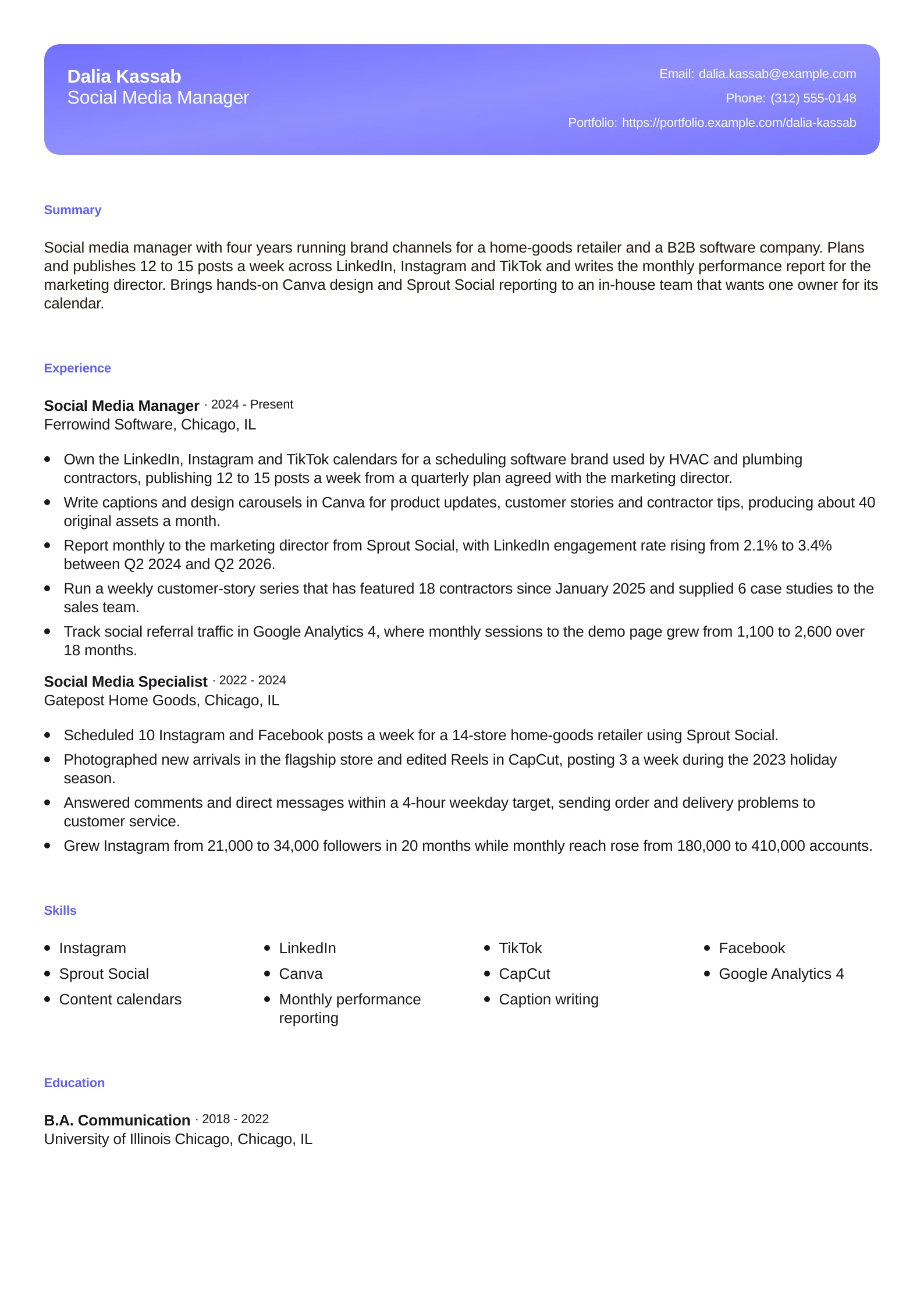
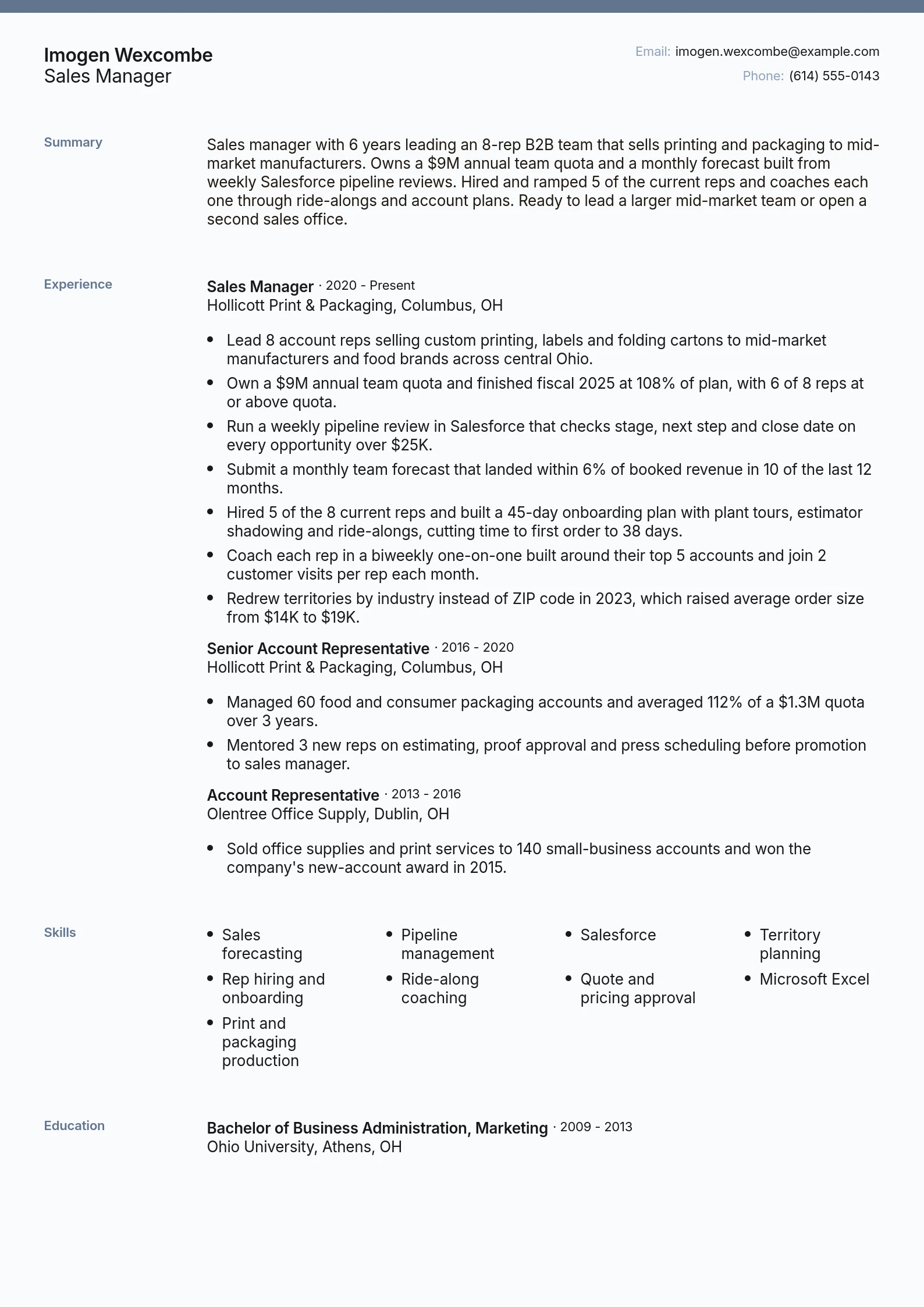
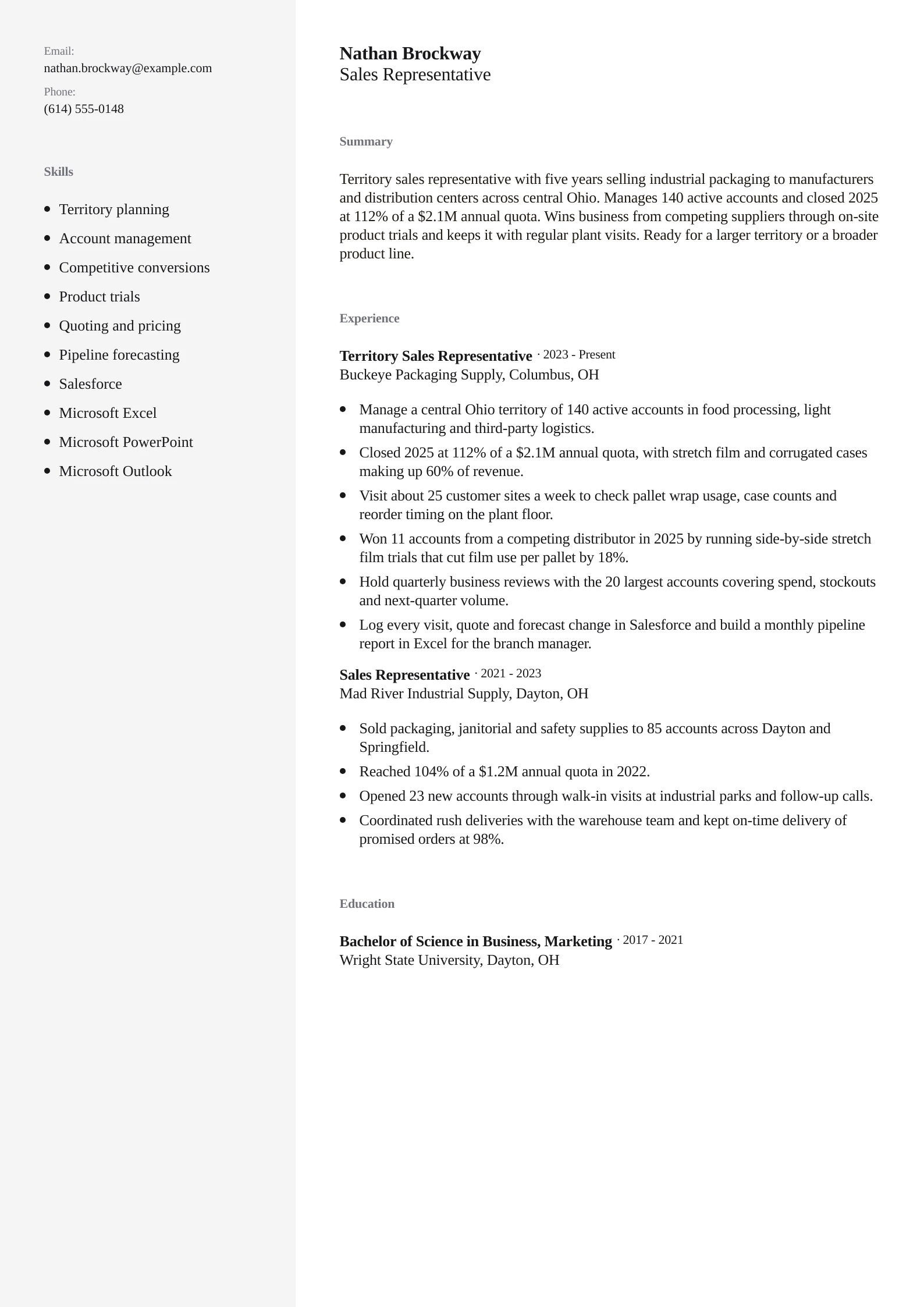
Dalia Kassab's resume fits the most common version of this job: one person running a brand's channels day to day. Her current role names three platforms, a weekly post count, the Canva work she makes herself and a monthly report to the marketing director.
Each growth figure gives a starting number, an end number and the period, so a reader can judge the change instead of guessing at it.
Find the example closest to your channels and employer
The other 11 resumes each change one thing: seniority, type of employer, or the part of the job that takes most of the week. Pick the one closest to the role you're applying for, then swap in your own platforms, numbers and tools.
Entry level: a first full-time role after campus and part-time accounts
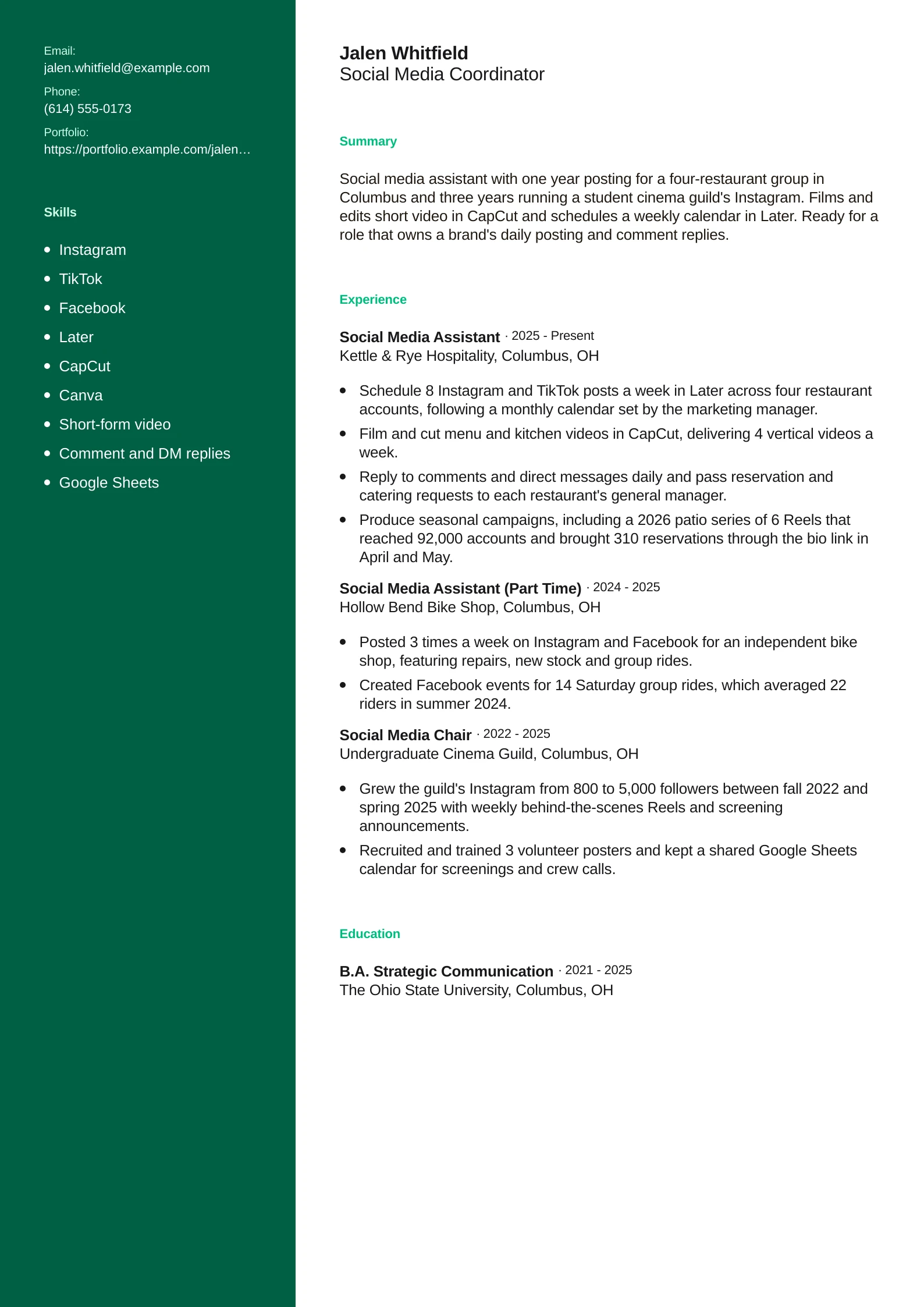
Jalen Whitfield has one year as a restaurant group's social media assistant, so the resume leads with that job's weekly output and a patio campaign tied to bio-link reservations. A part-time bike shop role and a student cinema guild account grown from 800 to 5,000 followers fill the rest of the page. Use it if your experience comes from campus groups, part-time work and a first assistant job.
Reservations traced to a 6-Reel campaign
Student account growth with start and end dates
CapCut and Later named in the bullets
Senior: leading a small team and reporting to executives
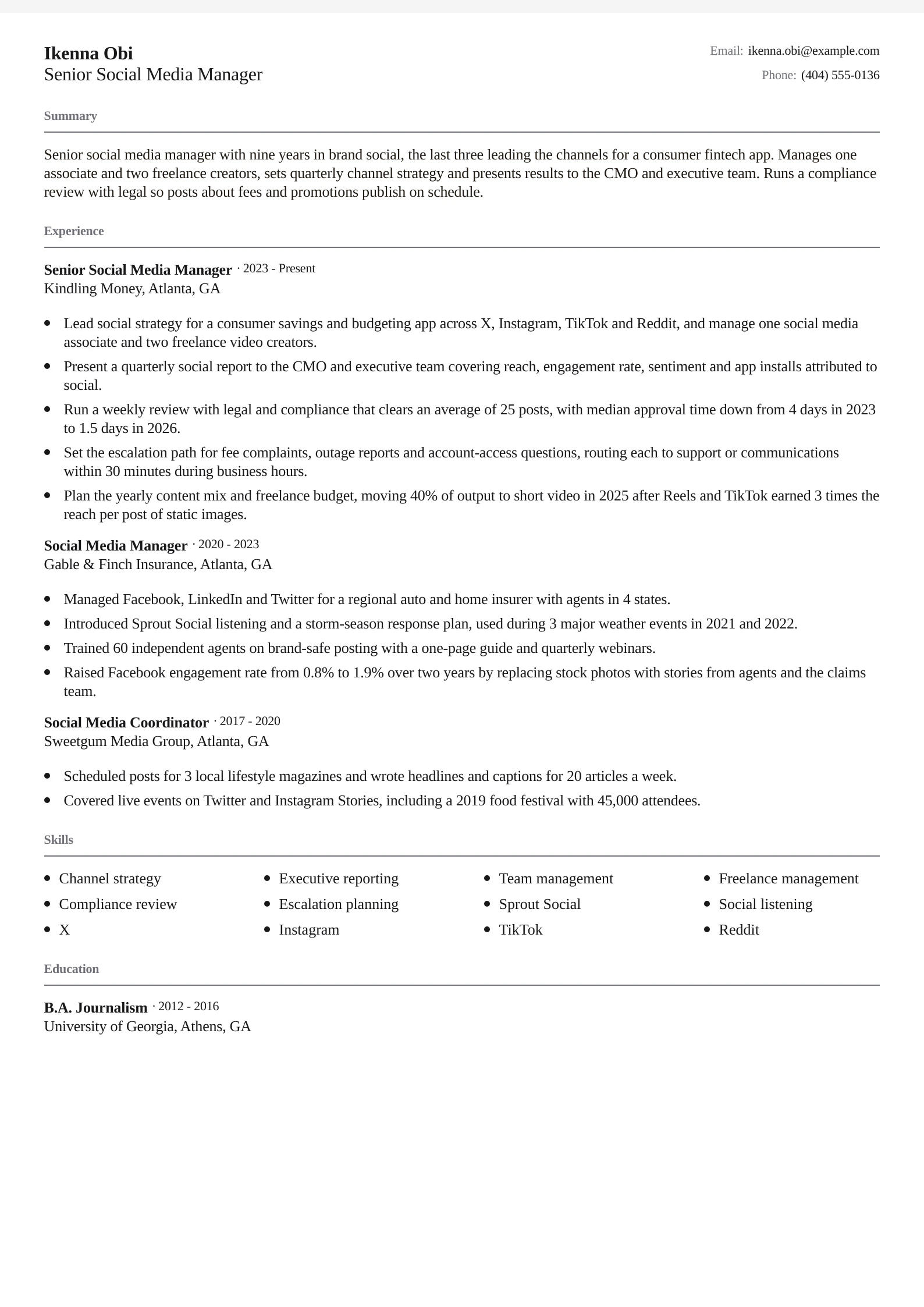
Ikenna Obi's resume opens with the team he manages, one associate and two freelance creators, and the quarterly report he gives the CMO. Bullets show a compliance review that cut approval time from 4 days to 1.5, an escalation path for fee complaints, and a budget shift toward short video backed by reach data. Use it if you set strategy and manage people in a regulated industry.
Team size and reporting line in the first two bullets
Approval time measured before and after
Escalation path for complaints and outages
Social media marketing manager: paid and organic judged on leads
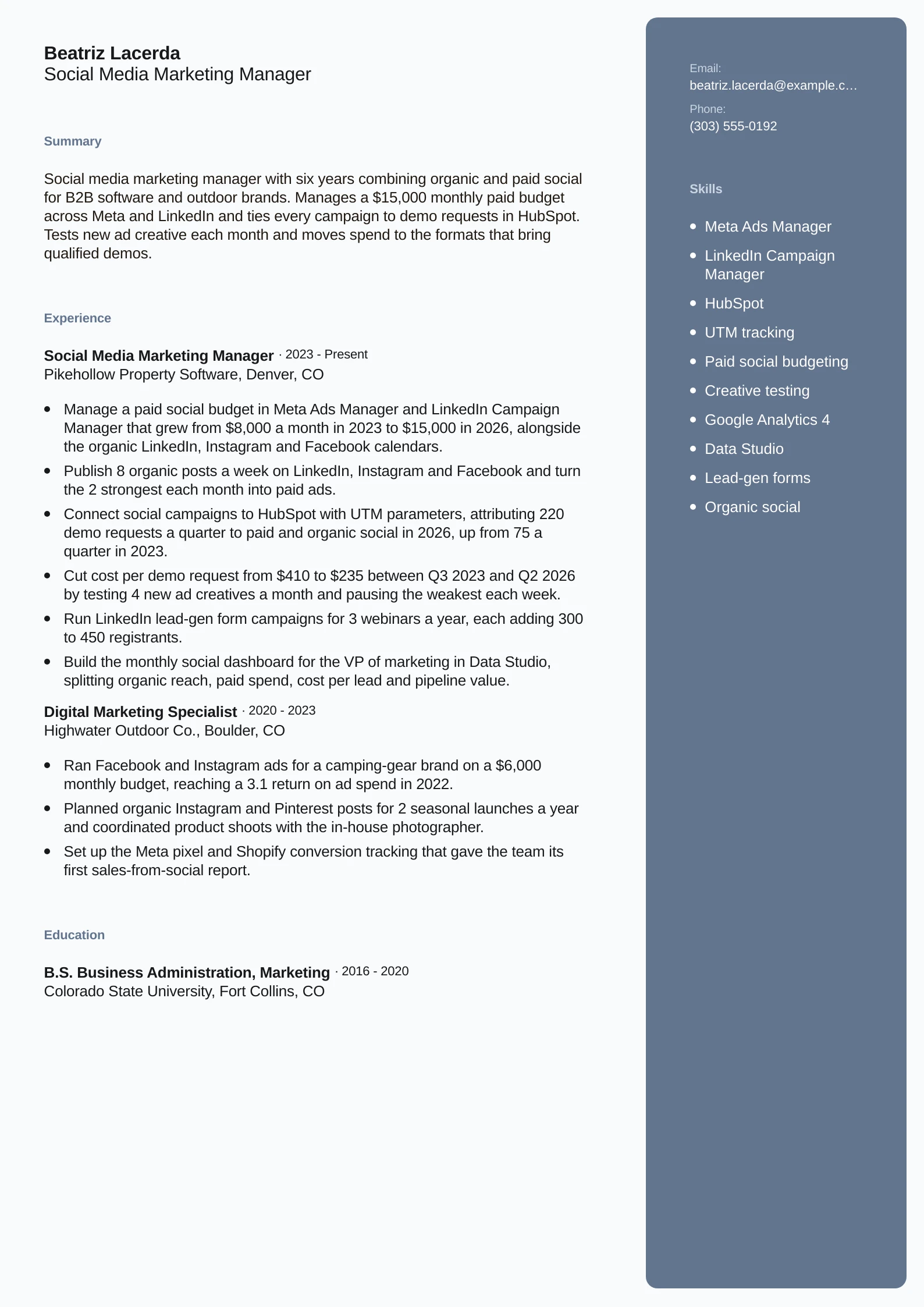
Beatriz Lacerda's resume suits a role judged on leads rather than reach. It shows a paid budget that grew to $15,000 a month across Meta Ads Manager and LinkedIn Campaign Manager, organic posts turned into ads, demo requests tracked in HubSpot, and cost per demo falling from $410 to $235 since 2023. Use it if you run paid and organic social together and your manager asks what social added to the sales pipeline.
Paid budget growth and the platforms it runs on
Organic posts reused as paid ads
Cost per demo request with dates
Agency: five client brands and monthly client reviews
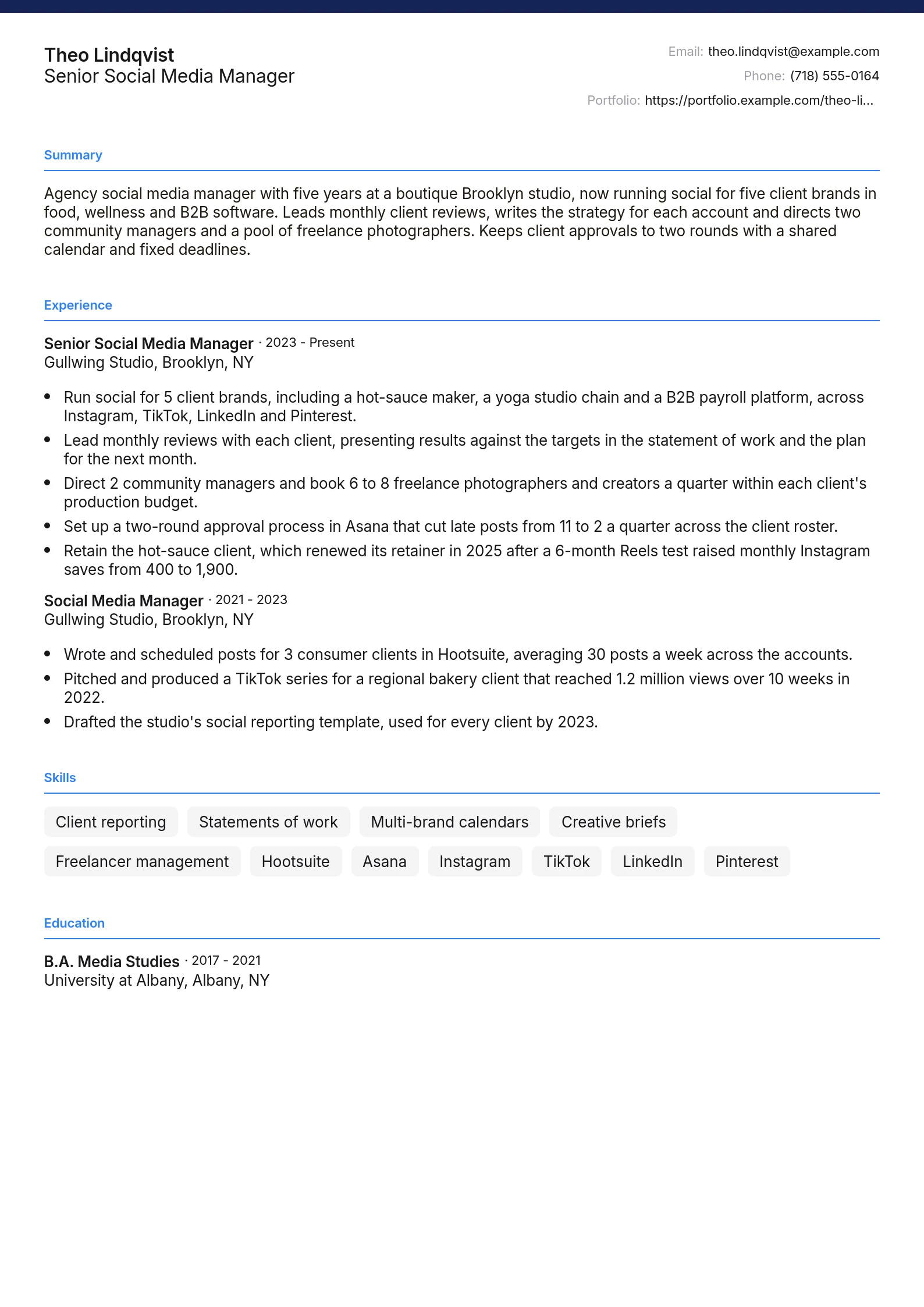
Theo Lindqvist works at a boutique agency, so the resume counts clients instead of channels: five brands across food, wellness and B2B software. It shows monthly client reviews, two community managers he directs, a two-round approval process that cut late posts, and a Reels test that kept a client through its retainer renewal. Use it if you juggle several brands, approval cycles and freelance shoots at once.
Client roster in one bullet
Late posts cut from 11 to 2 a quarter
Retainer renewal tied to a test result
B2B tech: LinkedIn, X and YouTube around launches and conferences
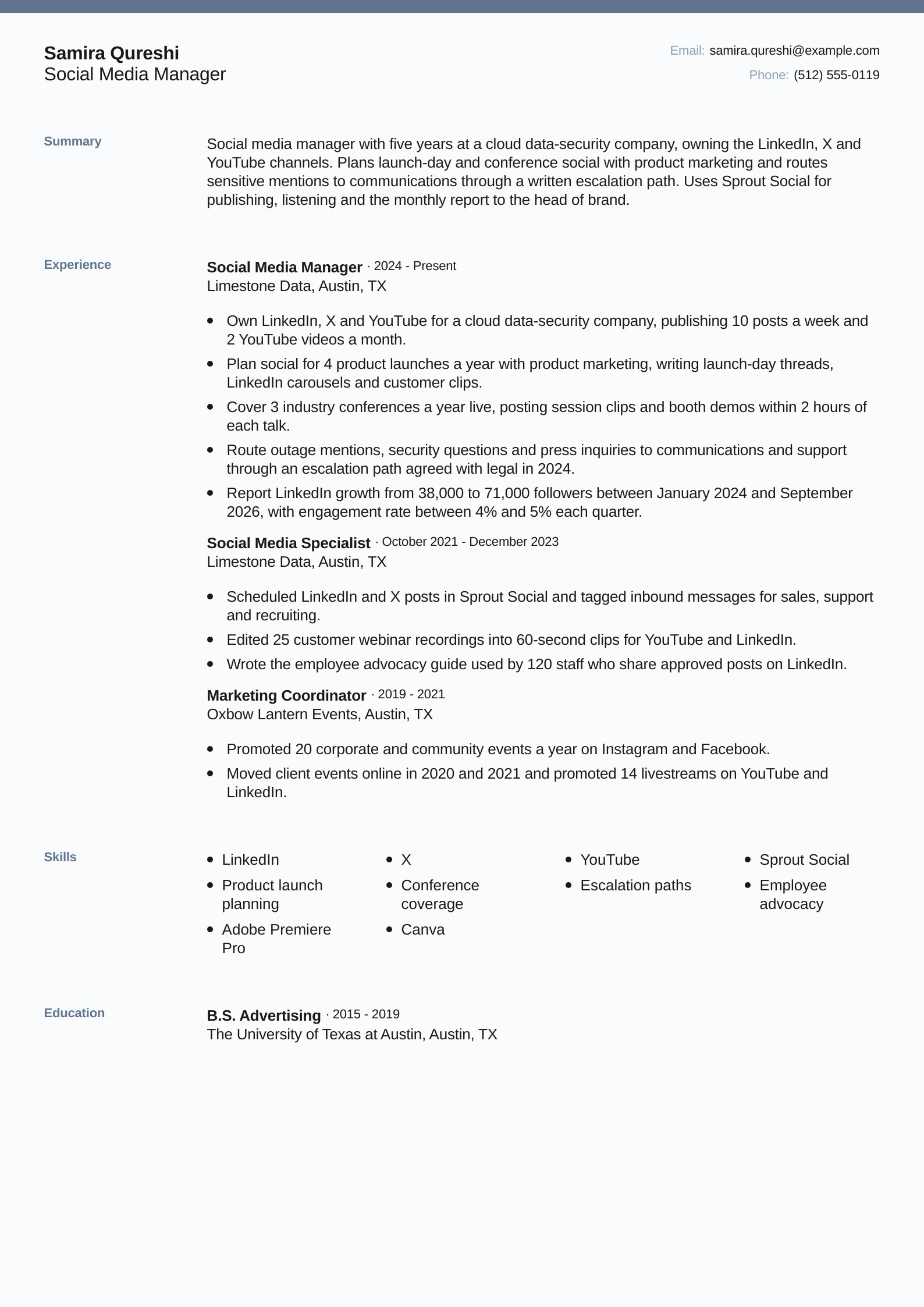
Samira Qureshi's resume fits a software brand where LinkedIn and X do most of the work. It covers four product launches a year, conference coverage posted within two hours of each talk, an employee advocacy guide for 120 staff, and an escalation path for outage and security mentions agreed with legal. Use it if your content follows launches, events and a review process.
Launch and conference social in separate bullets
Sensitive mentions routed to communications
LinkedIn growth with a steady engagement rate
E-commerce: product drops, creators and sales from social
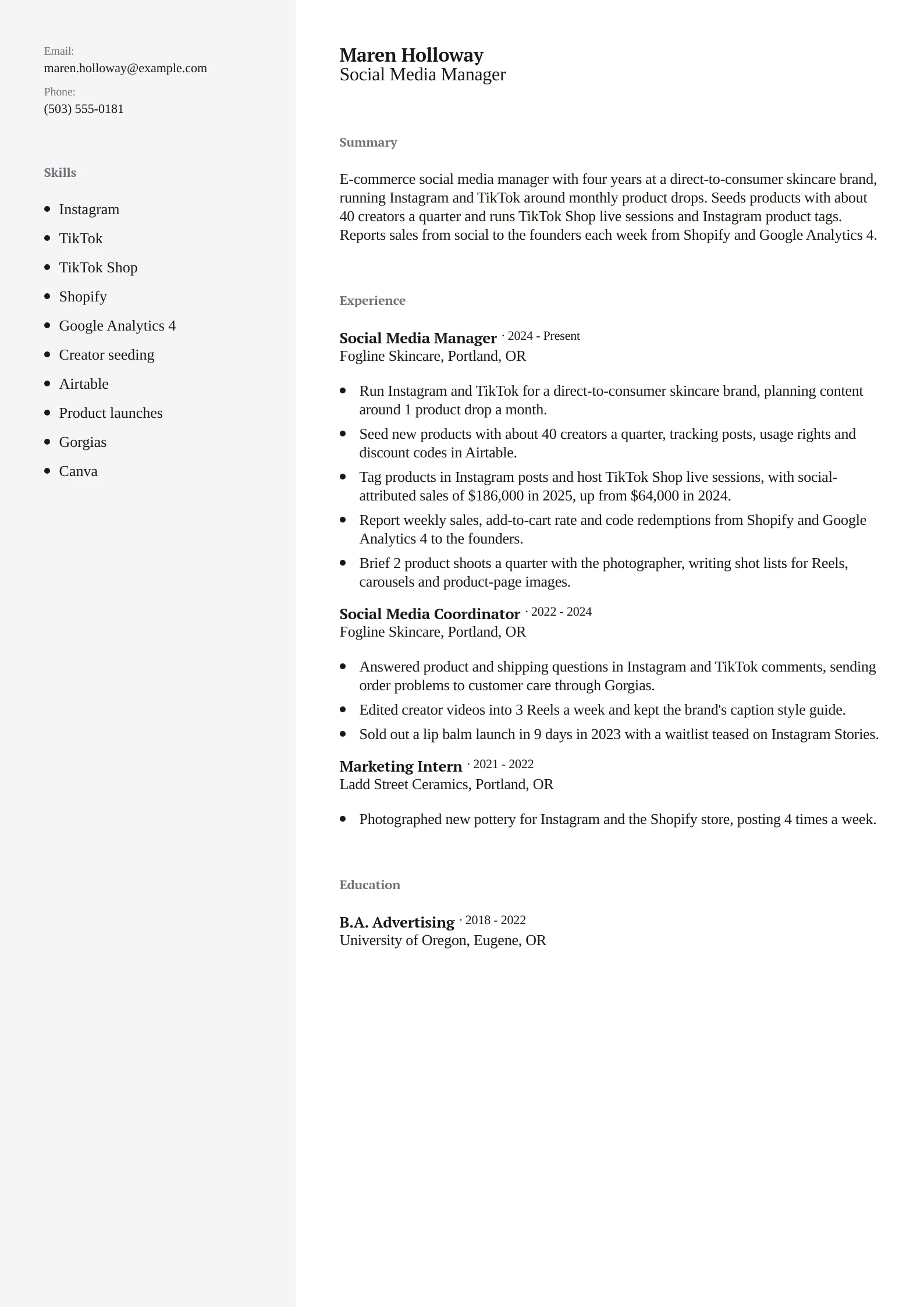
Maren Holloway runs Instagram and TikTok for a skincare brand that releases a product each month, and the resume measures social in sales. It shows creator seeding for about 40 creators a quarter, TikTok Shop live sessions, social-attributed sales rising from $64,000 to $186,000, and weekly Shopify reports to the founders. Use it if you sell directly through social and work with creators.
Sales from social, year over year
Creator seeding tracked in Airtable
Weekly Shopify and Google Analytics 4 reporting
Video-first: shooting and editing short-form video every week
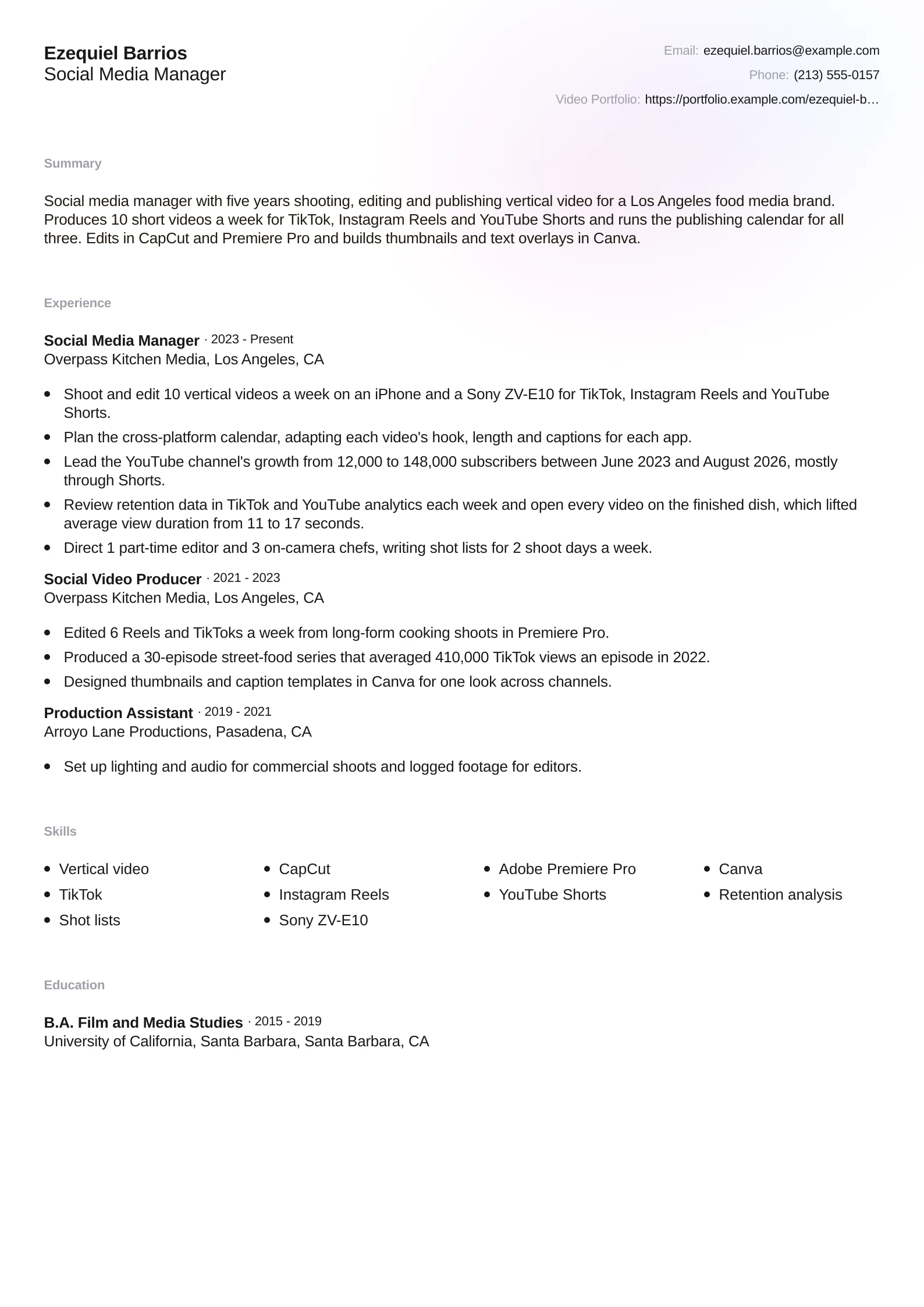
Ezequiel Barrios's resume puts production first: 10 vertical videos a week shot and edited for TikTok, Instagram Reels and YouTube Shorts. The bullets name his camera, CapCut and Premiere Pro, a 30-episode street-food series, and a YouTube channel grown through Shorts from 12,000 to 148,000 subscribers. Use it if you film and edit your own content and want a hiring manager to see that before the calendar work.
Weekly video output in the first bullet
Editing software and camera named
Video portfolio link in the header
Community: replies, moderation and response-time targets
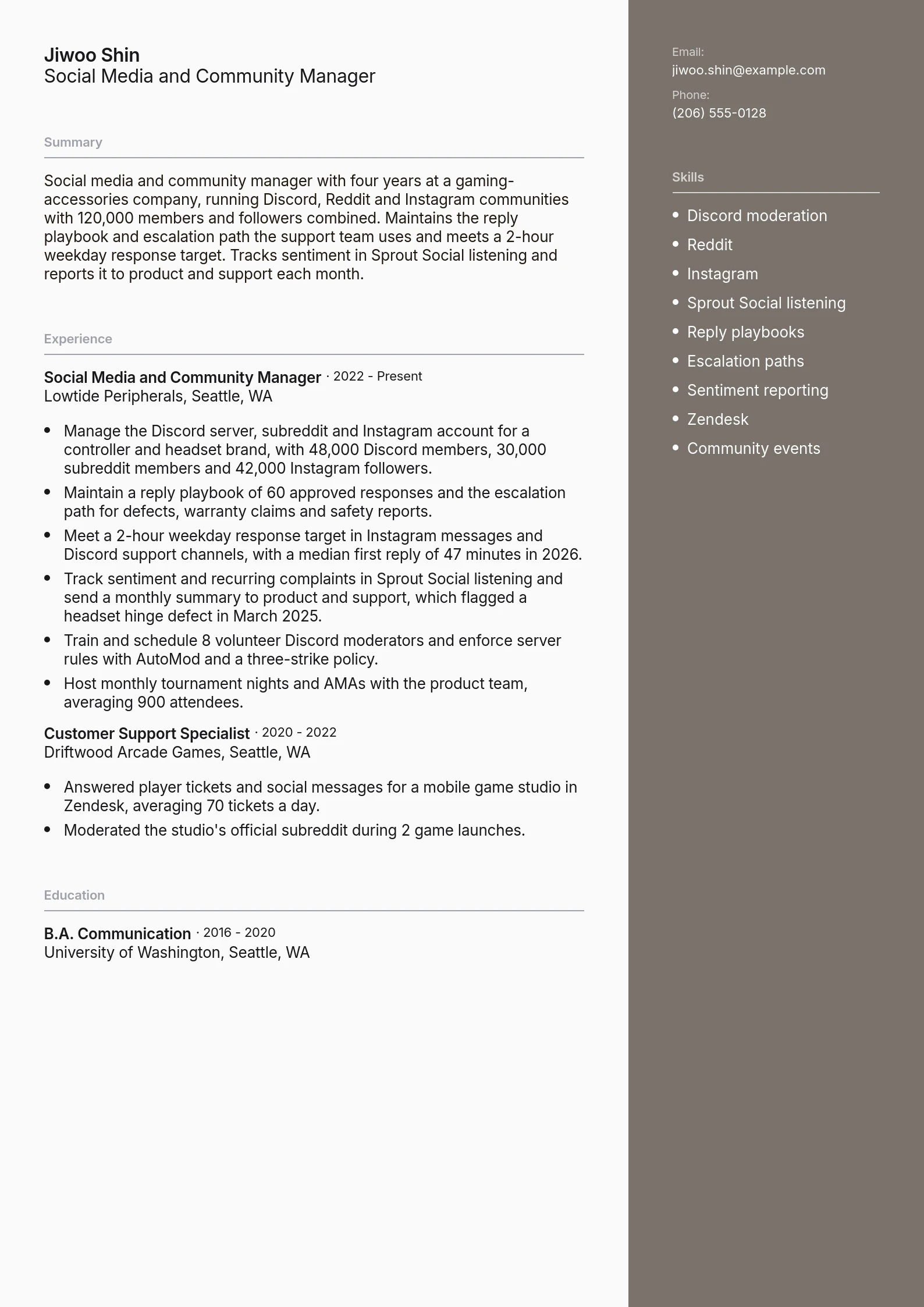
Jiwoo Shin spends most of the day replying, so the resume leads with the communities managed and their size: Discord, Reddit and Instagram with 120,000 members and followers combined. It shows a 2-hour response target against a 47-minute median, a 60-reply playbook, eight volunteer moderators, and listening that flagged a product defect. Use it if your role is judged on response time and sentiment more than posting.
Response target next to the actual median
Escalation path for defects and safety reports
Volunteer moderator team
Nonprofit: a one-person team measured in gifts and volunteers
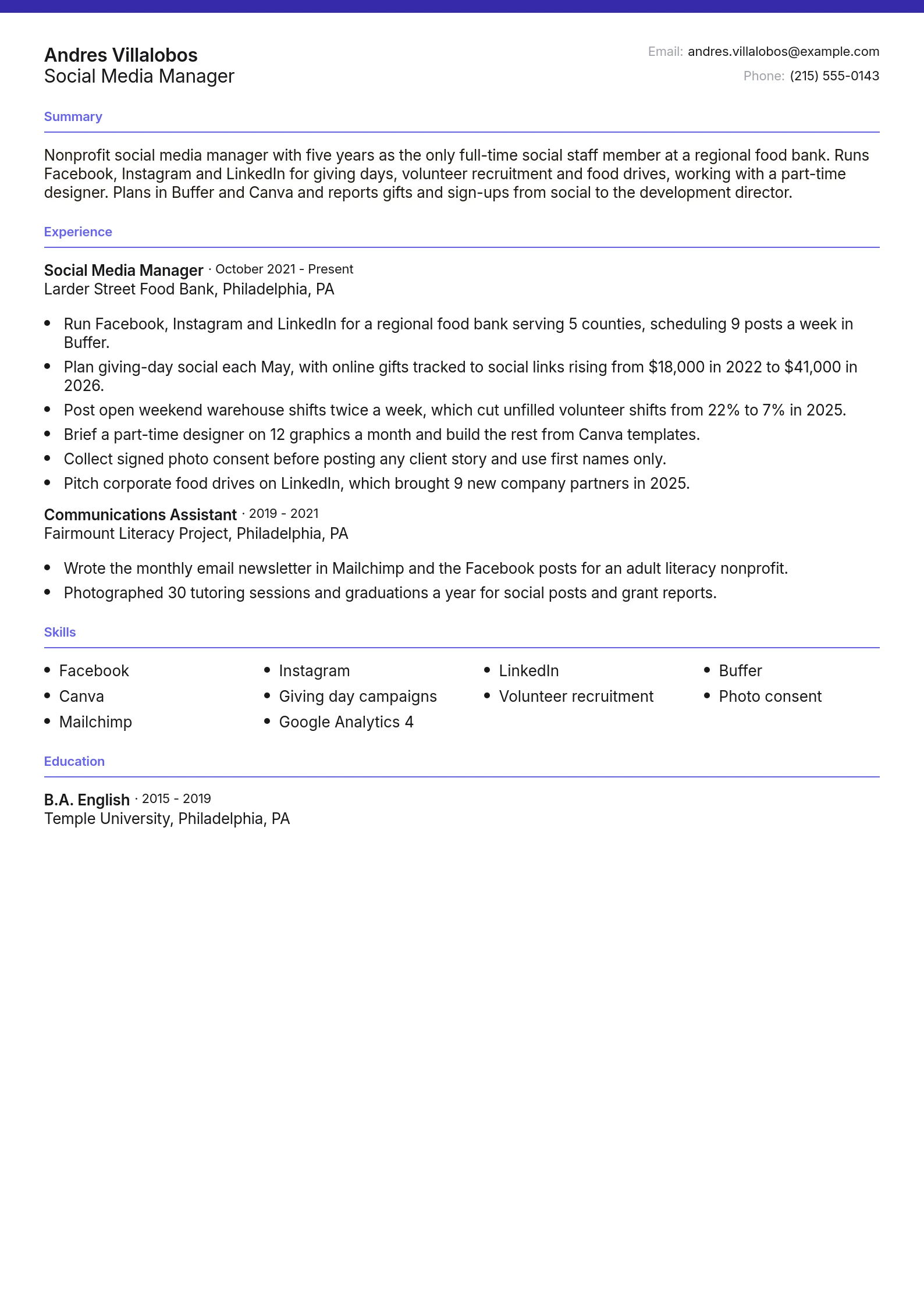
Andres Villalobos is the only full-time social staff member at a regional food bank, and the resume measures social in gifts and volunteer shifts. It shows giving-day gifts rising from $18,000 to $41,000, unfilled shifts cut from 22% to 7%, photo consent rules for client stories, and a part-time designer briefed each month. Use it if you handle every channel alone with tools such as Buffer and Canva.
Giving-day gifts by year
Volunteer shift fill rate
Consent rules for client stories
Freelance: retainers with local small businesses
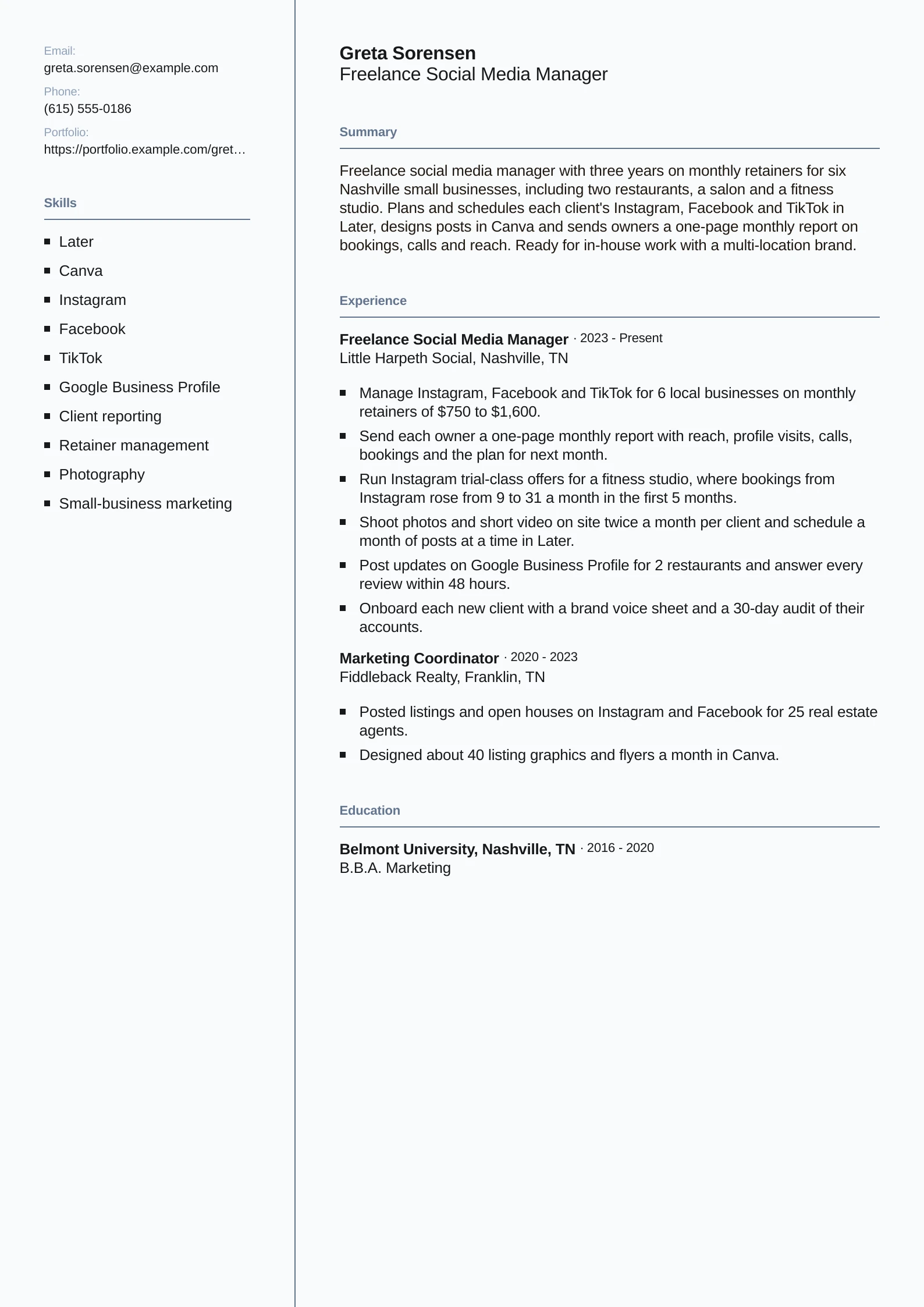
Greta Sorensen has three years of freelance retainers with six Nashville businesses, and the resume lists the freelance business as one job with client results inside it. It shows retainer fees, the one-page monthly report owners receive, fitness studio bookings from Instagram rising from 9 to 31 a month, and review replies on Google Business Profile. Use it if your clients are owners who care about bookings and calls.
Freelance work listed as one job
Client results named by business type
What the monthly owner report covers
Career change: from store manager to social media manager
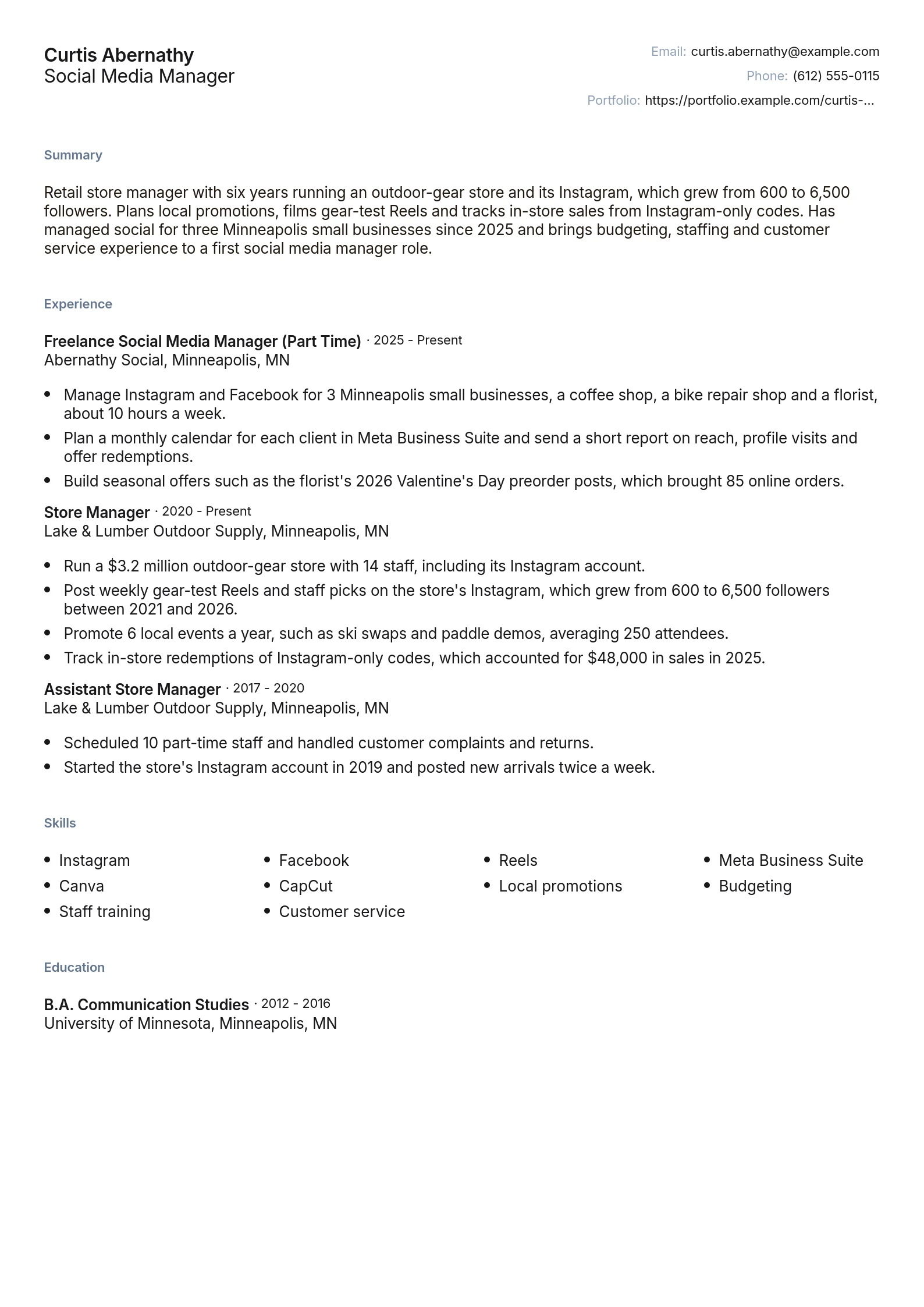
Curtis Abernathy is moving from retail store management into social, so the summary leads with proof instead of an objective: a store Instagram grown from 600 to 6,500 followers and $48,000 in sales from Instagram-only codes. A part-time freelance role with three local clients sits above the store job. Use it if you've run a brand's social inside another job and need to show it first.
Proof-based summary in place of an objective
Social results inside a retail job
Freelance clients listed above the store job
Name the channels you ran and what you made for them
Hiring managers look first for which platforms you owned and whether you created the content or scheduled what others made. Job ads for this title split into writers, video creators, community leads and strategists, so the first bullet in your current role should make clear which one you are.
Name each platform and the weekly output: 'Own the LinkedIn, Instagram and TikTok calendars, publishing 12 to 15 posts a week.' Write X for current work, as job ads do, and Twitter only for a role that ended before the July 2023 rename. Name formats such as Reels, Stories, carousels or YouTube Shorts when the job ad uses them.
Then say what you made yourself. 'Design carousels in Canva' and 'shoot and edit 10 vertical videos a week' describe a different job from 'schedule posts in Hootsuite', and all three are worth listing when they're true. If a designer or video team made the assets, say how many briefs you wrote for them each month.
Add who you reported to and how often. A monthly report to a marketing director and a quarterly presentation to the CMO describe two different levels of job, and the reader uses that line to place you.
Give each result a baseline, a period and the decision it led to
Show results as a change in a business number over a stated period. Follower counts alone tell a hiring manager little, and a percentage with no starting point tells them even less.
For brand roles, report engagement rate, reach or sentiment with the before and after figures and the months covered. For paid or B2B roles, use demo requests, cost per lead or pipeline from HubSpot or another CRM. For e-commerce, use sales from Shopify or tracked discount codes, and for nonprofits, use gifts and volunteer sign-ups.
Add the recommendation the data led to when you made one, such as moving budget to short video or dropping a weak format. Senior roles are hired for that judgment as much as for the numbers.
A baseline, a period and what changed
Raised LinkedIn engagement rate from 2.1% to 3.4% between Q2 2024 and Q2 2026 after moving to a weekly customer-story series, which also supplied 6 case studies to the sales team.
A percentage with no baseline
Increased engagement by 300% and grew followers across all platforms.
Social media tools and keywords to name, by part of the job
Use the platform, tool and format names the job ad uses, and put each one in a bullet that shows what you did with it. A skills list of 25 apps with no matching bullets doesn't show any work.
Most ads list the platforms and formats the team works in, and some name a publishing and analytics tool such as Sprout Social or Hootsuite. Copy their spelling exactly: Meta Business Suite, LinkedIn Campaign Manager, Instagram Reels, YouTube Shorts.
Part of the job
Names and keywords to use
Show it in a bullet like this
Publishing and listening
Sprout Social, Hootsuite, Later, Buffer, Meta Business Suite, content calendar, social listening
Schedule 12 to 15 posts a week in Sprout Social and report monthly to the marketing director
Run a weekly compliance review with legal that clears an average of 25 posts
Link a portfolio that shows the posts behind your numbers
Put a portfolio link in your header, because a hiring manager will want to see your posts before calling, and some ads list a portfolio as a requirement. A page on your own site, a shared Google Drive folder or a Notion page all work if the link opens without a sign-in.
Choose 6 to 10 pieces that match the job: carousels and captions for a writing-heavy role, a reel of your best short videos for a video-first role, or a launch plan and a monthly report for a strategist role. Add one line under each piece naming the platform, your part in it and the result.
If you grew an account, give the start and end follower counts with dates, as Jalen Whitfield does for a student cinema guild account, and link the account from your portfolio. For client work you can't share publicly, show screenshots with the brand name removed.
Link a personal profile only when it shows professional work, such as a LinkedIn profile you post on every week or a TikTok you built to practice editing.
Show how you handled reviews, complaints and sensitive mentions
In finance, health care, software or any brand with a legal team, show the review process you worked inside and how you routed problems. Fintech and B2B ads ask for someone who escalates sensitive topics to communications and keeps posts within compliance rules.
Name the reviewers and the cadence: 'Run a weekly compliance review with legal that clears an average of 25 posts.' If you shortened the cycle, give the before and after, such as approval time cut from 4 days to 1.5.
Describe the escalation path as mention types and where each one goes: outage reports to support, press questions to communications, account-access problems to customer service. Add the response time if you had a target.
Write about a crisis in terms of what you did, such as pausing scheduled posts and publishing a status update within 30 minutes. Leave out confidential details about customers or incidents.