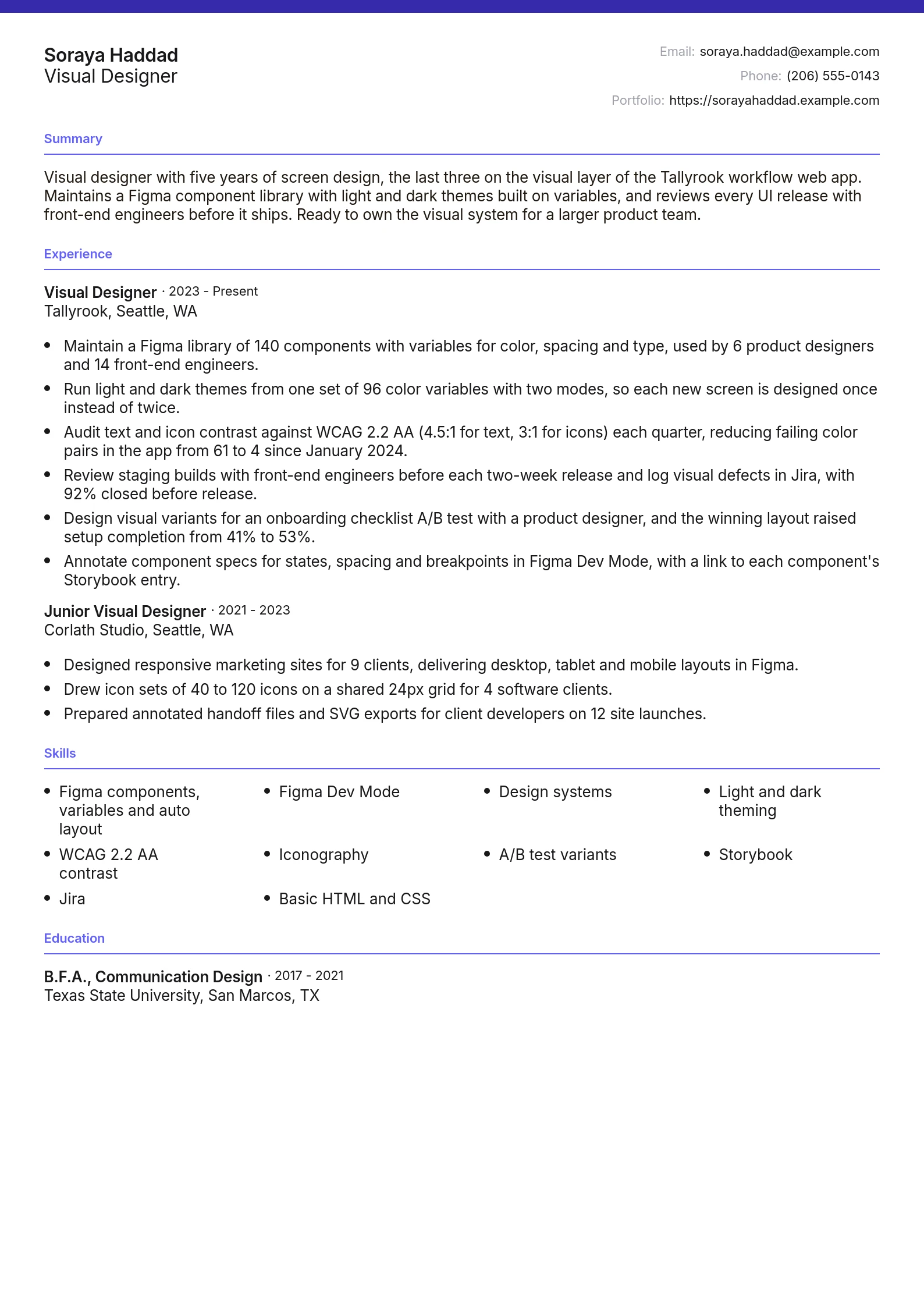
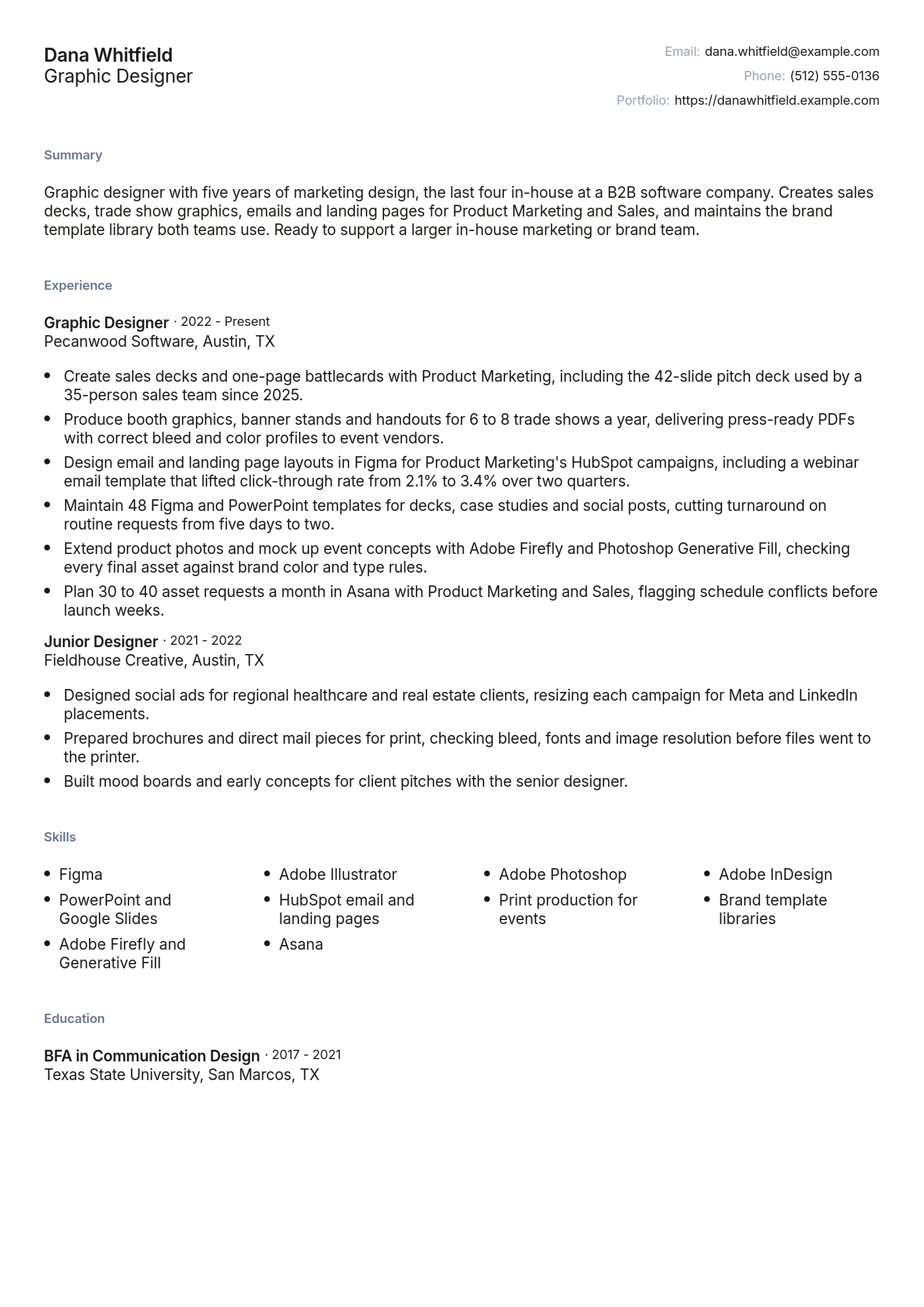
Creative hiring managers read your resume as the index to your portfolio, so it has to say what each piece was, where it ran and which part you did.
The examples cover an agency copywriter, a brand-side creative strategist, a freelance art director and a new graduate, and each one takes the design only as far as its reader expects.
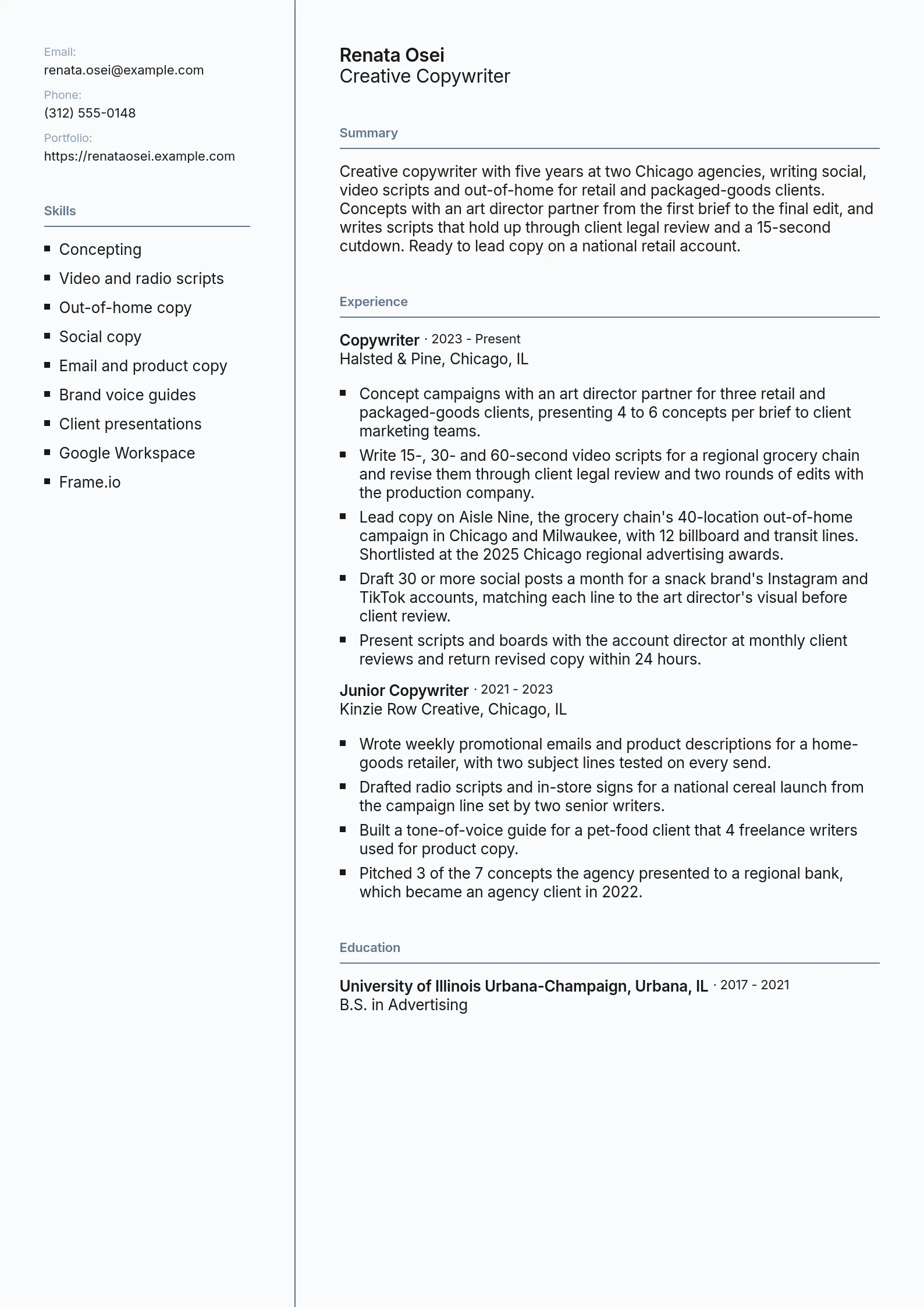
Creative copywriter resume with the portfolio link in the header
Renata's resume suits a mid-level agency copywriter who concepts with an art director partner. Each bullet names the format, the client category and where the work ran, so a creative director can match the line to a piece in her portfolio.
Her summary opens with the formats she writes and the clients she writes for, and ends with the job she wants next. Her award shortlist sits inside the bullet for Aisle Nine, the campaign it was for, instead of in a separate awards list.
The creative layout puts her skills and education in a right sidebar and her portfolio link next to her email. Every line a reader needs is still real text in a plain top-to-bottom order.
Strategist, freelance art director and new graduate examples
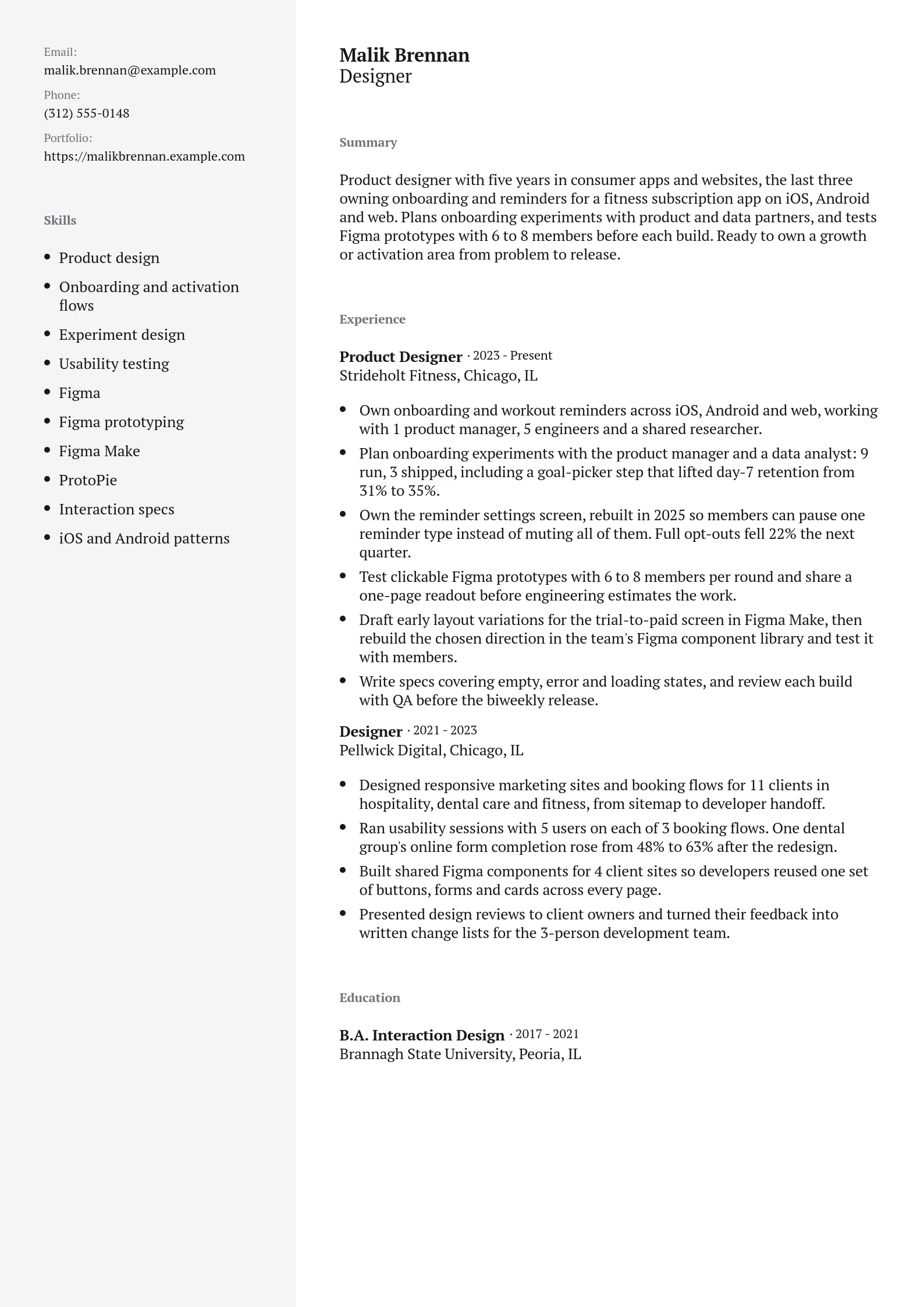
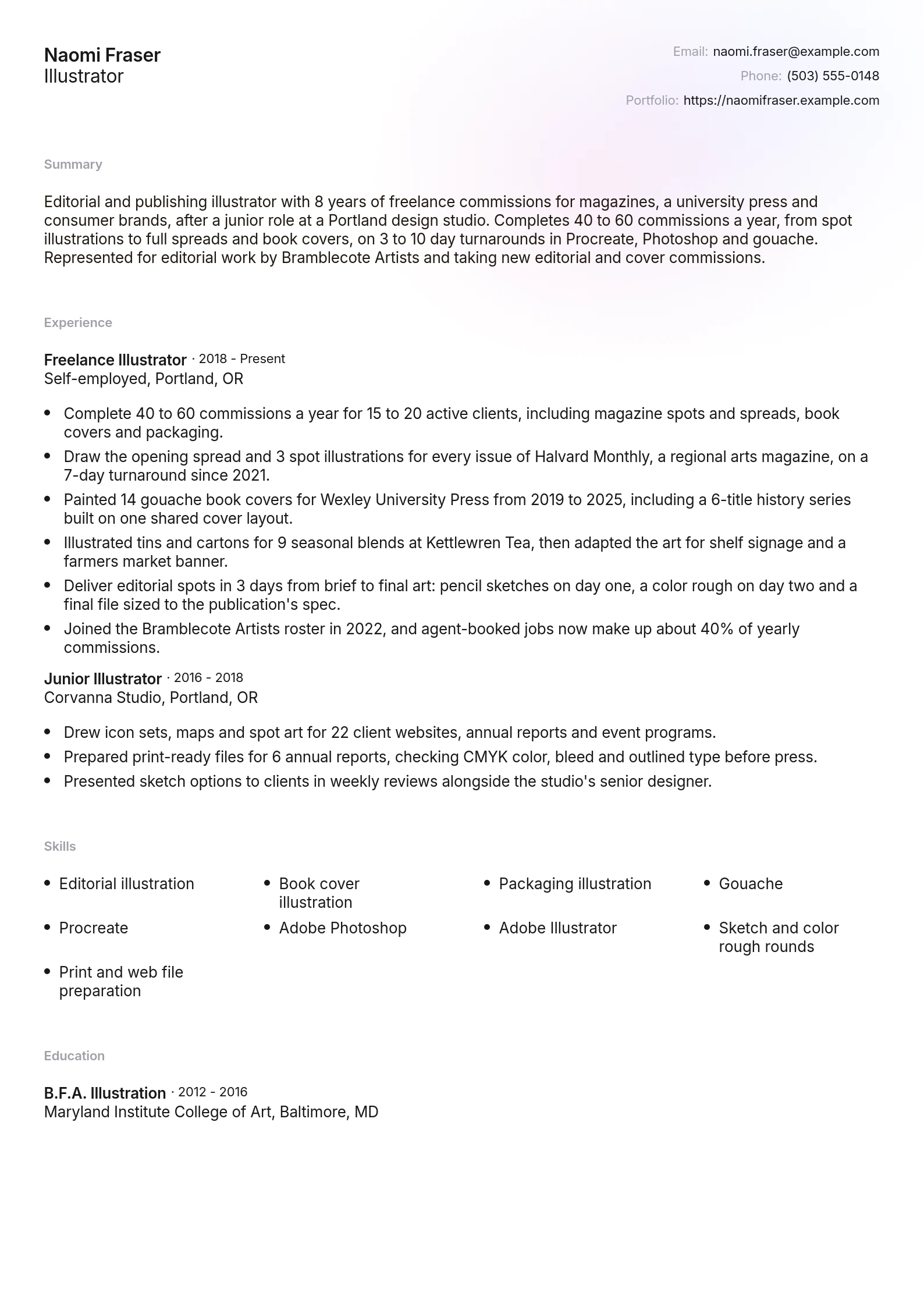
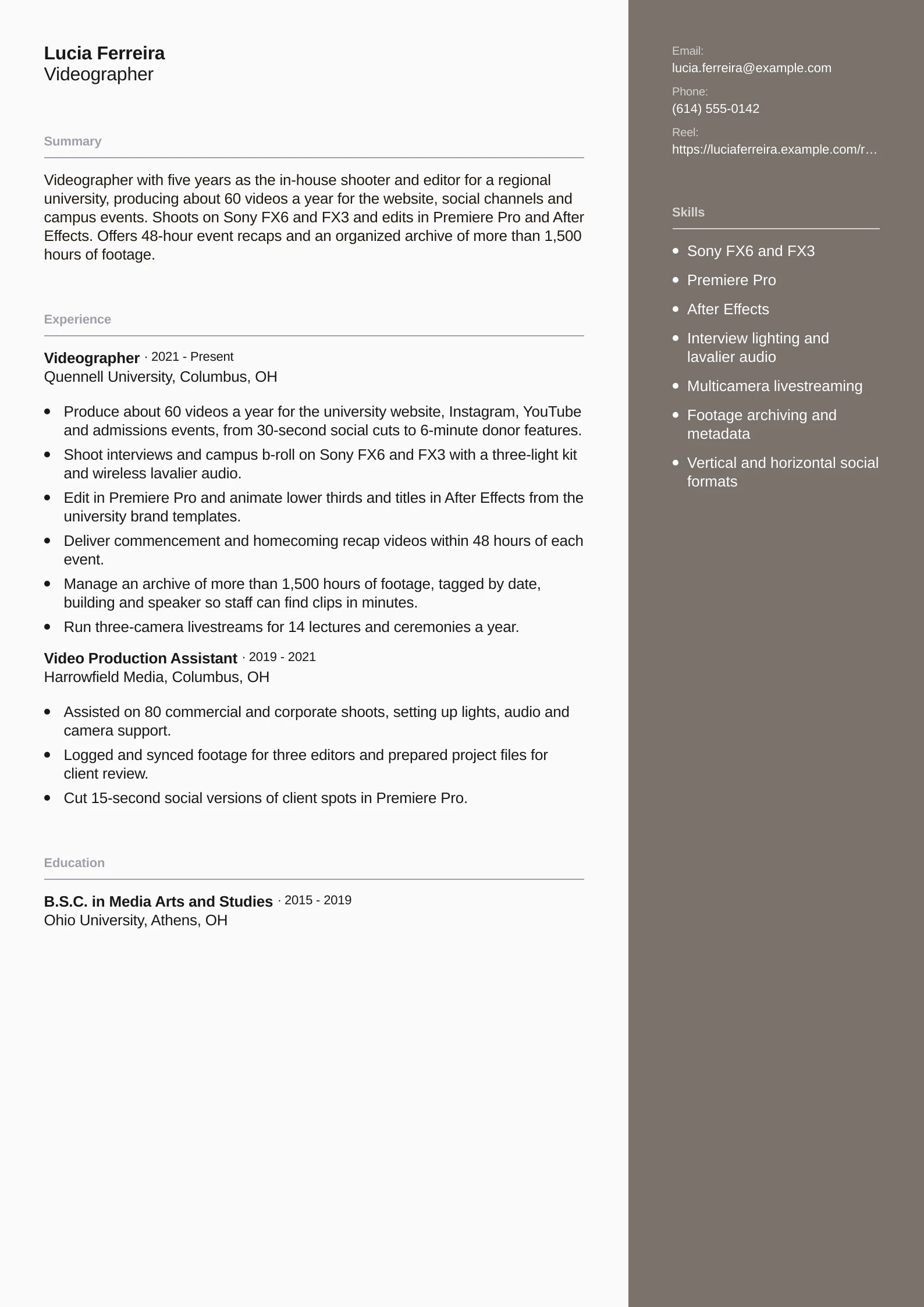
Each of the other three resumes takes the design as far as its reader expects. Darnell, a creative strategist, uses the professional layout because the people hiring him look for numbers first. Giulia, a freelance art director, uses the creative layout with her portfolio up top. Mateo, a new graduate, uses the classic layout so his spec work and internships carry the page.
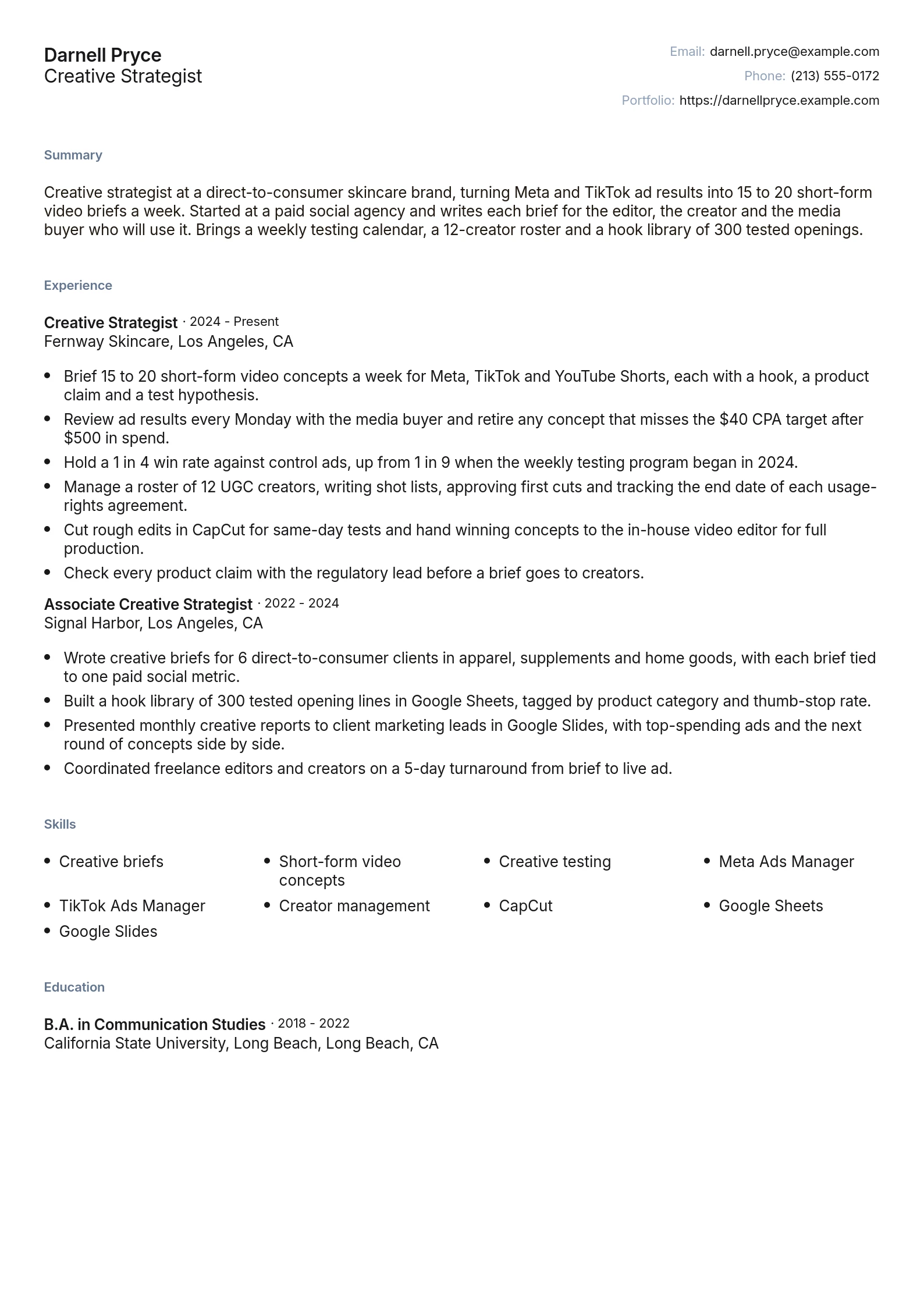
Creative strategist resume built on test results
Darnell's resume suits anyone in a brand-side or performance creative job where the work is judged by ad results. His bullets give his weekly brief volume, the CPA cutoff he tests against and his win rate against control ads, so a hiring manager sees how he decides what to make next. The professional layout keeps those numbers easy to scan, and his agency role shows where his hook library came from.
15 to 20 video briefs a week with a $40 CPA cutoff
1 in 4 win rate against control ads
12-creator roster with usage-rights tracking
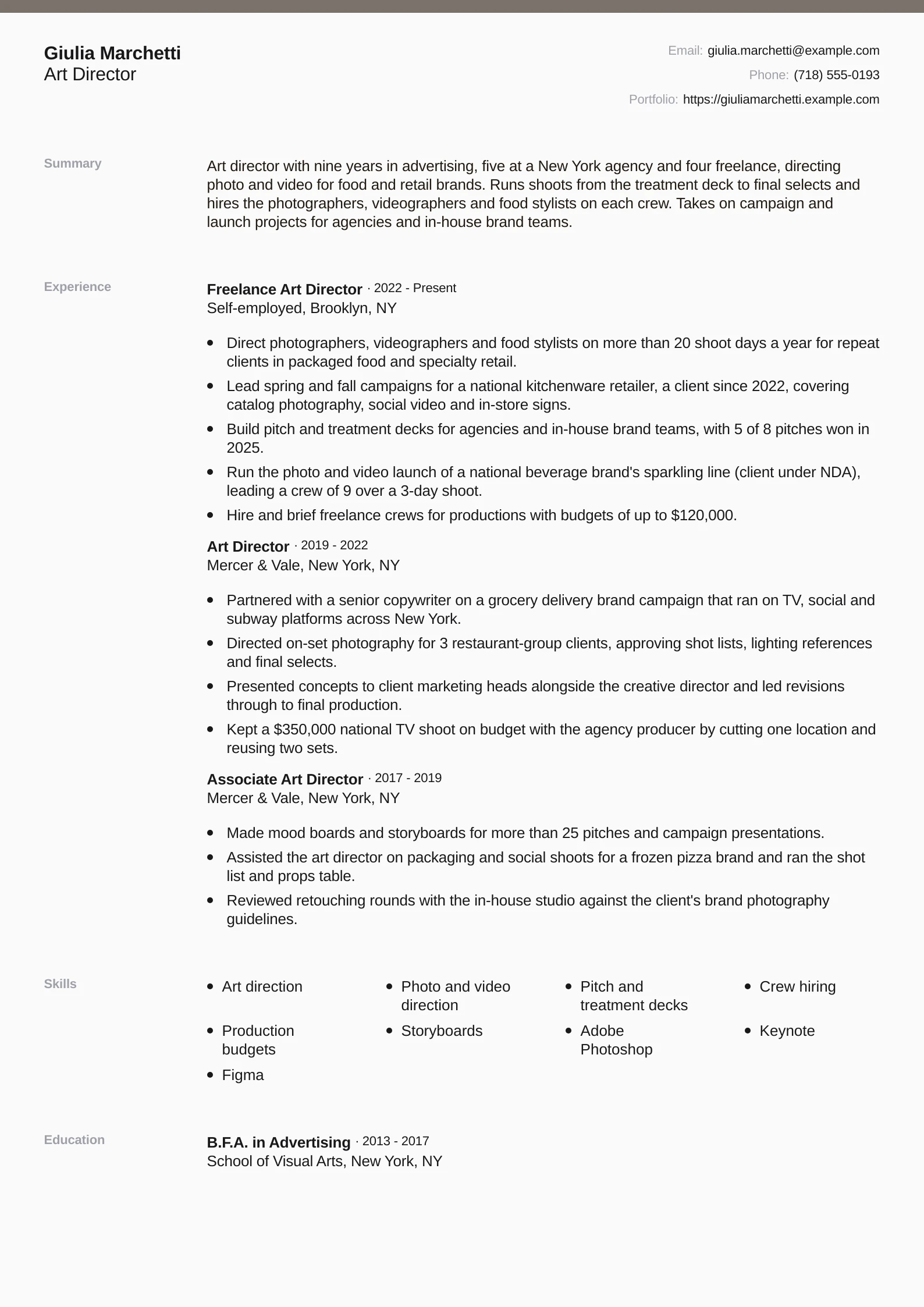
Freelance art director resume with an NDA client
Giulia's resume is for senior creatives who work project to project. Her freelance years sit under one self-employed entry, with repeat clients described by sector and one launch marked as under NDA. Her bullets name the crews she directed, the shoot days and the budgets she held, which tells an agency how large a production she can run. Her portfolio link sits next to her email in the header.
Four freelance years under one self-employed entry
NDA client described by sector only
Shoot days, a crew of 9 and budgets up to $350,000
Entry-level creative resume led by spec work
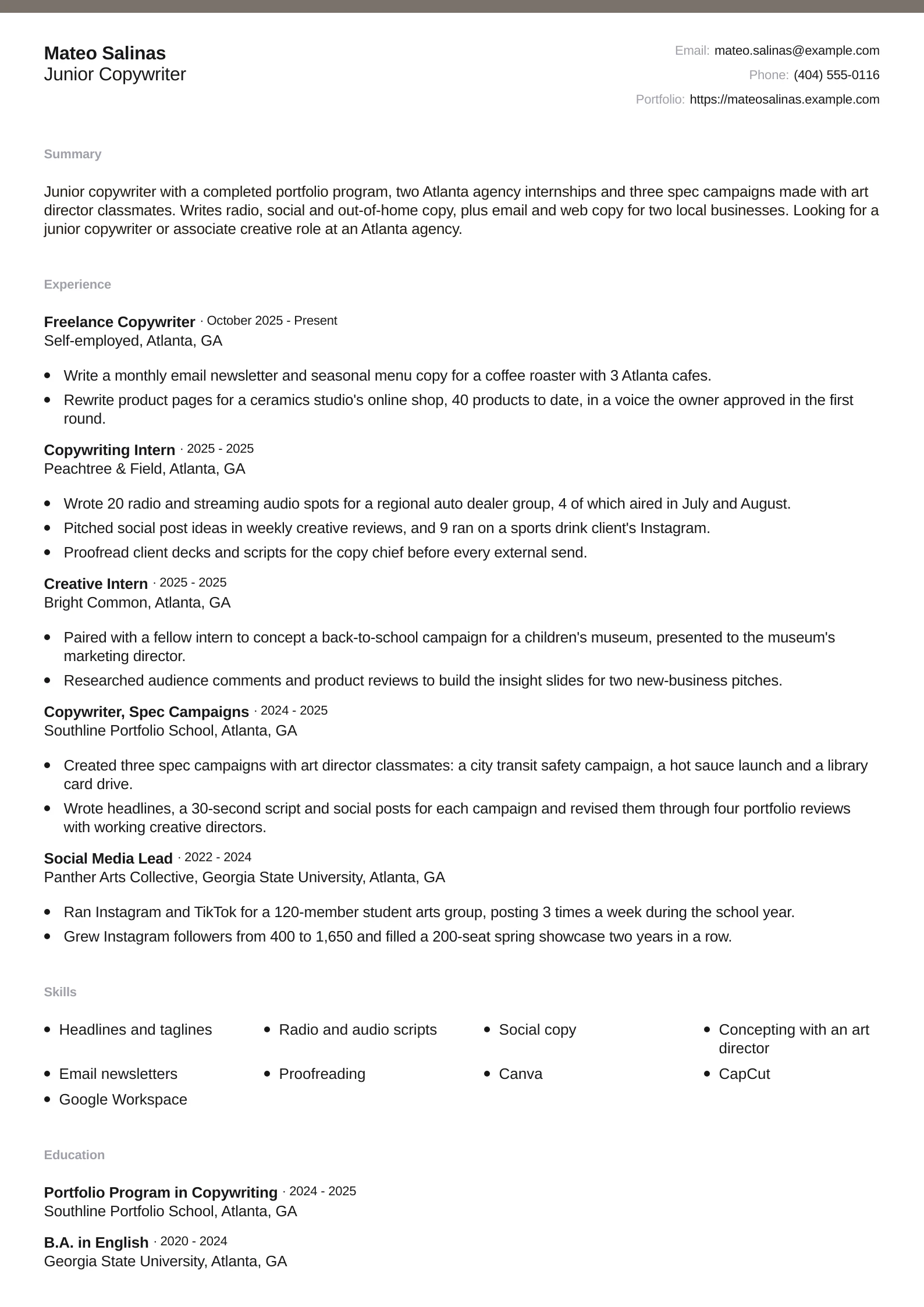
Mateo's resume suits a new graduate or portfolio-school student applying for junior copywriter and associate creative roles. His spec campaigns get their own entry, with the three subjects, the formats he wrote and the reviews they went through. Internship bullets count spots that aired and posts that ran, and current freelance work fills the months since his last internship. The classic layout, with no colored accent, keeps attention on the writing.
Spec campaigns listed as their own entry
Internship work counted in spots aired and posts run
Freelance copy for two local businesses
Spend the design on the header and one color
A creative resume can carry an accent color, a distinctive header and a sidebar, as long as job titles, dates and bullets read as plain text in a normal order. Use the table to decide what goes on a copywriter, strategist or art director resume. If you're a graphic, brand or UI designer, the graphic designer resume examples cover how much visual craft to show.
Design choice
Use it?
How to handle it
One accent color
Yes
Use it for your name and section headings. Keep body text black or dark gray so bullets print and scan cleanly.
A sidebar
Yes
Keep job history in the main column, where readers look first. Put skills, tools and education in the sidebar.
Portfolio link in the header
Yes, always
Write it as a short URL next to your email and phone so it works on screen and on paper.
Custom section names, such as 'Things I've made'
No
Use Experience, Skills and Education. Hiring managers skim for those words to find your history.
Skill bars or star ratings
No
A bar that says 80% copywriting tells the reader nothing. List the formats you write instead, such as radio scripts, out-of-home or short-form video briefs.
Headshot
No
US employers rarely expect one, and it takes space from your work.
Text inside an image or exported design file
No
Keep every word as real text so it can be selected, searched and copied into an application system.
A concept resume, such as one written as a print ad
Only as a portfolio piece
Put the idea in your portfolio and send a standard resume with it.
Make each bullet point to a piece in your portfolio
Your portfolio shows how the work looks. Your resume tells the reader what each piece was, who it was for, where it ran and what you did on it, so they know which case study to open first. A creative director with a stack of applications uses the resume to decide whose portfolio gets the next ten minutes.
Write each campaign bullet with four parts: your role, the format, the client category and where it ran. 'Wrote 12 billboard and transit lines for a regional grocery chain's campaign across Chicago and Milwaukee' tells the reader exactly what to look for. If the piece has a name in your portfolio, use the same name on the resume, as Renata does with Aisle Nine.
Put the portfolio link in the header next to your email and phone, written as a short URL such as yourname.com rather than a long link from a hosting site. If the portfolio needs a password, give it in the application form or cover letter, and check that the link opens on a phone. One link in the header is enough, so don't repeat it under every job.
Copywriters and strategists sometimes skip the portfolio because their work isn't visual. Strategist job ads ask for one too, often for work that shows measurable results. A strategist's portfolio can be four or five short case studies, each with the insight, the brief, the ads it produced and the result, and the resume bullets should name the same numbers.
Art directors can name the shoot or film in the bullet and link the case study from the portfolio's front page. List the medium too, such as photo, video or out-of-home, because a creative director hiring for a TV-heavy account looks for video first.
Name your part of a campaign the whole team made
Say what you made and who you made it with. Creative directors know campaigns come from teams, and they hire for the part you played, so a bullet that claims the whole campaign leaves them guessing.
Give your role a plain verb: wrote the scripts, art directed the shoot, wrote the brief, edited the cutdowns. Then name your partners by role, such as art director partner, photographer, media buyer or production company. Strategists can name the creators and editors who made ads from their briefs, and art directors can give the crew size they directed.
Put an award shortlist or win inside the bullet for that work, with the year and the show, and list it only once.
Shows your part and your partner
Led copy on Aisle Nine, a regional grocery chain's 40-location out-of-home campaign, writing 12 billboard and transit lines with an art director partner. Shortlisted at the 2025 Chicago regional advertising awards.
Claims the whole campaign
Created the award-shortlisted Aisle Nine campaign for a regional grocery chain.
Use the numbers your role controls
Most creative work never gets tied to a sales figure, but almost every creative job produces something you can count. Pick the numbers your role decides, and leave out revenue you can't trace to your own work. Brand-side strategists need numbers most, because the ads for those jobs ask for a record of turning ad results into new creative.
When a client won't share results, count your own output and its reach: concepts presented, pieces that ran, locations or markets. Don't estimate impressions or sales lift you never saw in a report.
Wrote 12 billboard and transit lines that ran at 40 locations in Chicago and Milwaukee.
Art director
Shoot days, crew size, production budget, pitches won
Directed a crew of 9 over a 3-day launch shoot for a national beverage brand.
Creative strategist
Concepts briefed per week, win rate against control ads, CPA target
Brief 15 to 20 short-form concepts a week and hold a 1 in 4 win rate against control ads.
Social or content creative
Posting schedule, follower growth, posts that ran
Grew a student arts group's Instagram from 400 to 1,650 followers, posting 3 times a week.
Freelancer
Repeat clients, years with a client, projects per year
Lead spring and fall campaigns for a national kitchenware retailer, a client since 2022.
Group freelance clients under one self-employed entry
List freelance work as one job, titled with your role and dated from your first client to today, with 'Self-employed' or your studio name where the employer would go. Under it, write bullets for your biggest or longest clients instead of a separate entry for each two-week project. Giulia's resume covers four years of client work in five bullets this way.
Describe each client by sector and size when you can't use the name: a national kitchenware retailer, a regional grocery chain, a direct-to-consumer skincare brand. Repeat business is your strongest freelance number, so say how long a client has kept booking you, as in 'a client since 2022'.
For work under a nondisclosure agreement, write the bullet with the sector, the scope and your role, and add '(client under NDA)' so the reader knows why the name is missing. In an interview, share only as much detail as the agreement allows.
Whether you can show client work in your portfolio depends on your contract. Work you made as part of your job as an employee belongs to the employer, and the rights to freelance work depend on what your agreement says, so check it or ask the client before you post the piece.
About 65% of writers and authors are self-employed, so freelance years on a copywriter's resume are normal and need no explanation. If you're moving from freelance to a staff job, say so in the last line of your summary.