Art directors and editors read an illustrator resume as a commission record: who hired you, what you drew, in what format and how fast you delivered it. The six examples differ by where the work comes from: freelance editorial clients, an in-house game studio, picture book publishers, a medical center, a first internship and a career that started in a public library.
Freelance editorial illustrator with 8 years of commissions
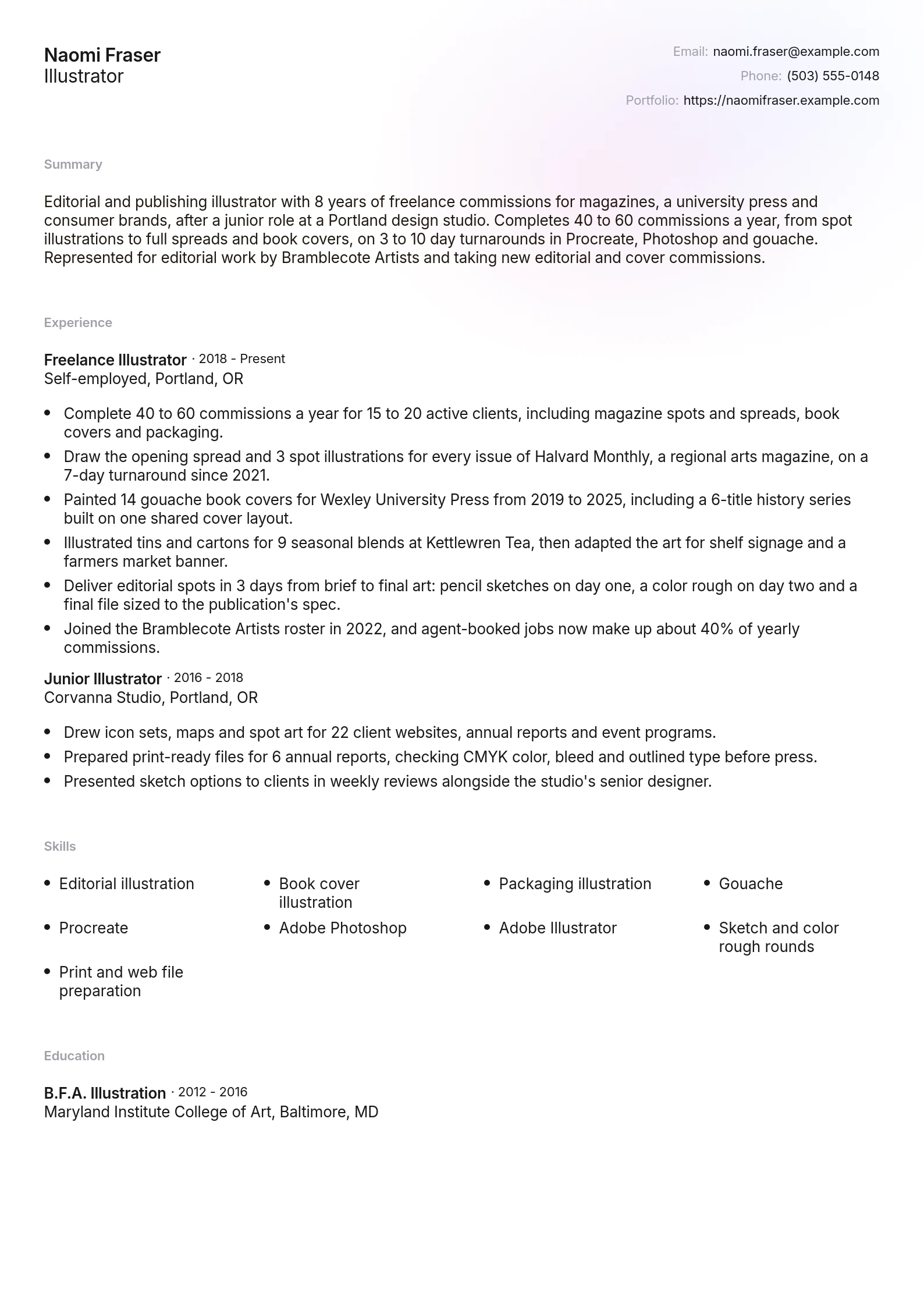
Naomi Fraser's resume works for an illustrator who sells commissions rather than holding a staff job. One freelance entry covers 8 years, and its bullets name clients, formats and turnaround times: an opening spread and spots for a monthly magazine on 7 days, 14 covers for a university press, tea packaging that later ran on shelf signage.
Her agent appears as a dated fact with the share of work it brings in, which tells an art director she already works through representation. The studio job sits underneath as a short entry, because a junior role drawing icons and preparing print files matters less than the current client list. Copy this layout if most of your income comes from repeat clients and you want their names to do the work a job title would.
Pick the illustrator resume closest to how you get work
Each example below starts from a different source of work, so the bullets change shape too. In-house bullets count pieces per week and follow a style guide, book bullets count titles and spreads, and medical bullets name the people who check the work for accuracy.
In-house illustrator on a game studio team
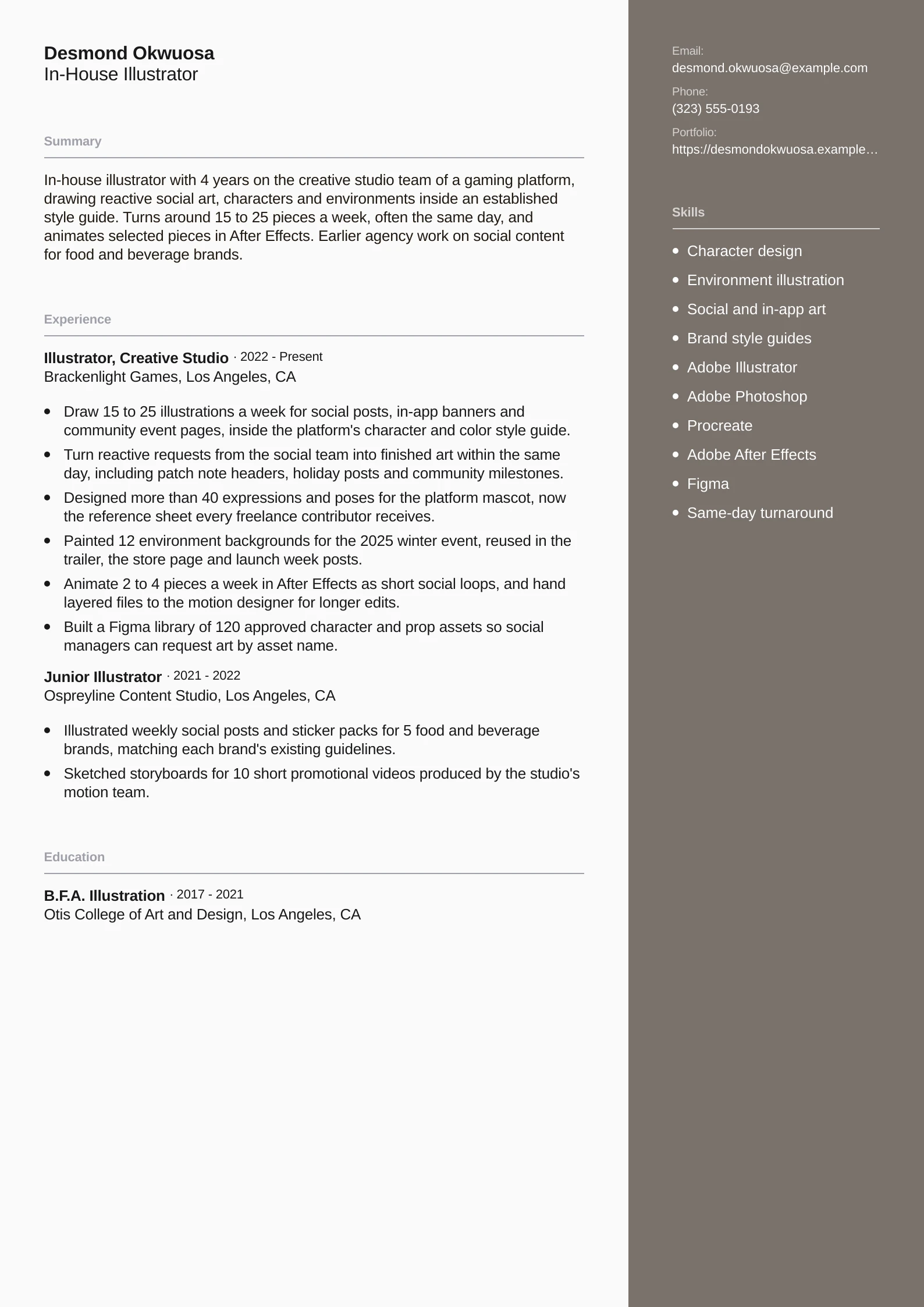
Desmond Okwuosa's resume suits an illustrator applying to in-house social, content or brand teams in tech and gaming. His bullets count weekly output of 15 to 25 pieces, name the same-day requests he turns around for the social team, and point to a mascot reference sheet other contributors now follow. Motion loops in After Effects and a Figma asset library show up as part of the daily work.
15 to 25 pieces a week inside one style guide
Same-day reactive art for the social team
After Effects loops handed to a motion designer
Children's book illustrator with published titles
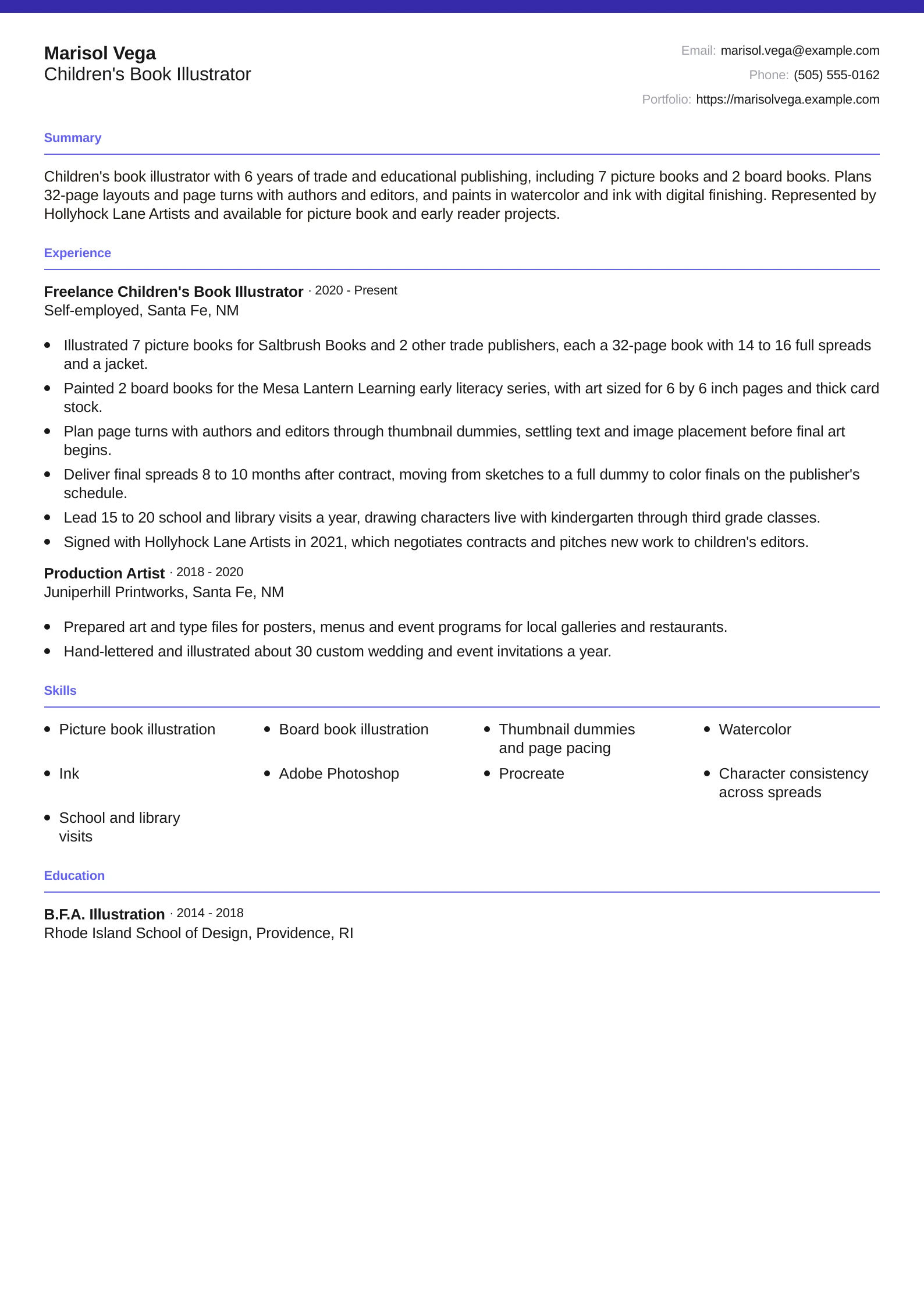
Marisol Vega's resume fits a picture book illustrator with published titles and an agent. Instead of listing duties, it counts books (7 picture books and 2 board books), the spreads in each and the 8 to 10 months from contract to final art. Thumbnail dummies and page-turn planning with authors show the storytelling editors hire for. Use it if your record is titles and publishers.
Book count with spreads per title
Dummy and page-turn planning with authors
15 to 20 school and library visits a year
Medical illustrator with a biomedical visualization degree
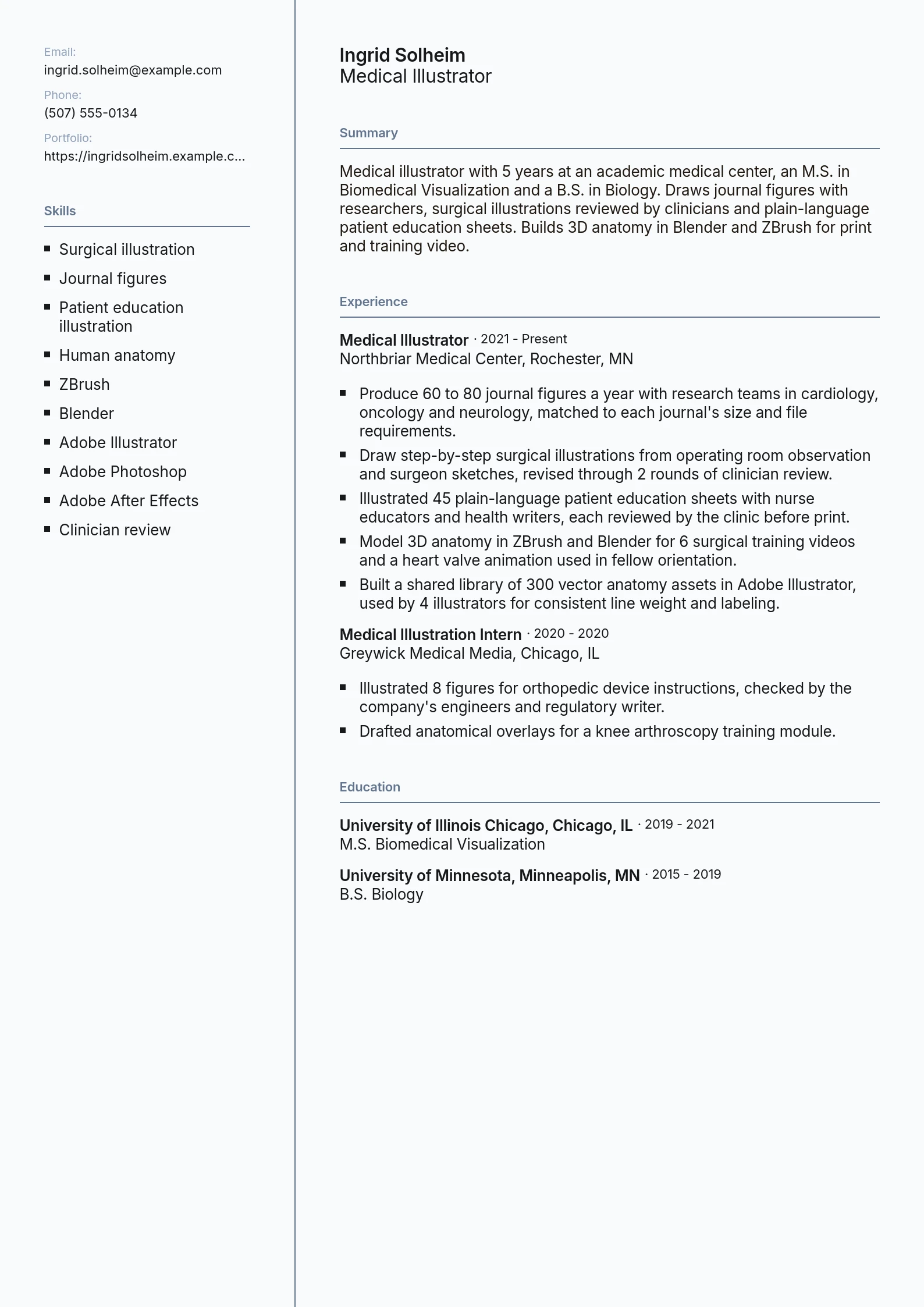
Ingrid Solheim's resume suits a medical illustrator applying to hospitals, journals or medical media companies. Her master's in biomedical visualization and her biology degree appear in the first line of the summary, because employers in this specialism weigh training in both art and science. Bullets name who reviews the work (surgeons, researchers, nurse educators) and what she delivers: journal figures, surgical sequences, patient sheets and 3D models.
Art and science degrees named in the summary
Clinician and researcher review in the bullets
3D anatomy in ZBrush and Blender
Entry-level illustrator with an internship and first commissions
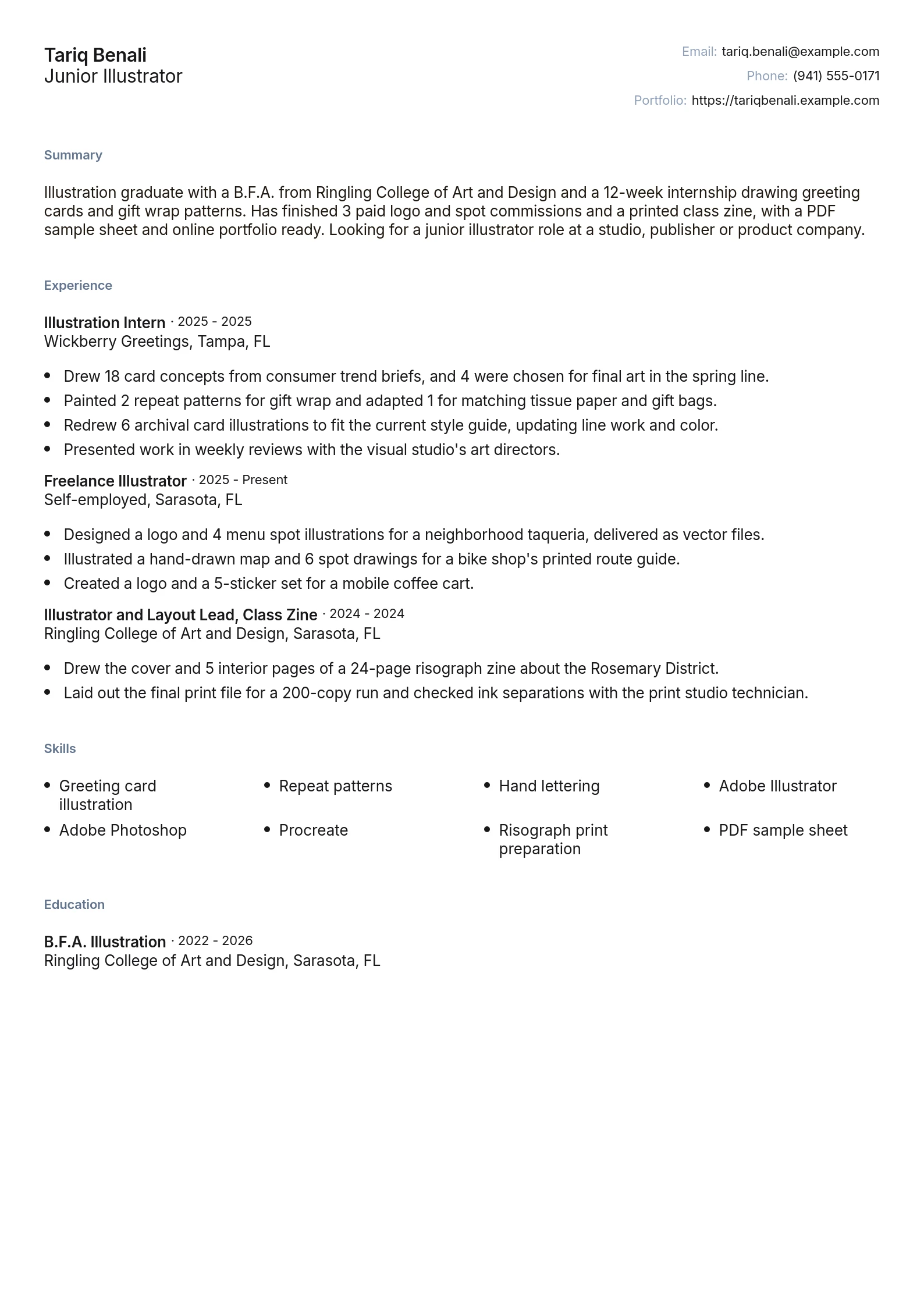
Tariq Benali's resume is built for a new illustration graduate with one internship and a few paid jobs. Each bullet states his part of a project: 18 card concepts drawn and 4 picked for final art, or the cover and 5 pages of a 24-page class zine. His 3 small paid commissions get their own entry with real deliverables, and the summary says a PDF sample sheet is ready.
Internship output counted card by card
His share of a group zine stated plainly
3 paid commissions with named deliverables
Career change from children's librarian to illustrator
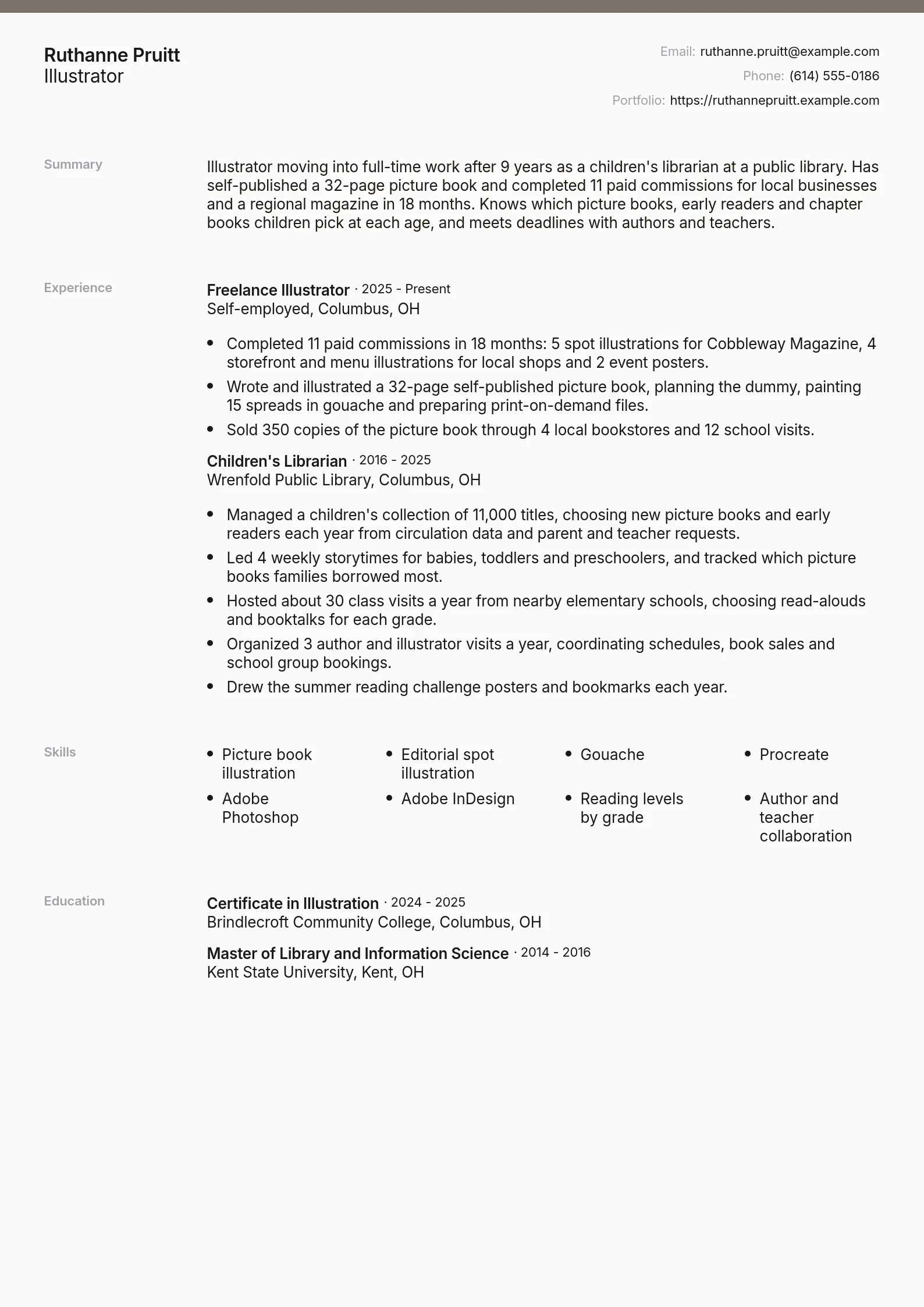
Ruthanne Pruitt's resume suits someone moving into illustration from another career. The new work goes first: 11 paid commissions in 18 months and a self-published picture book that has sold 350 copies. Her 9 years as a children's librarian follow, with bullets an art director or children's editor can use, such as weekly storytimes, choosing the children's collection and running author visits.
Recent commissions placed above the old job
Self-published book with copies sold
Librarian bullets that point toward children's publishing
Build in Adobe Illustrator only for the PDF a person will read
You can design your resume in Adobe Illustrator, but send that file only where a person opens it, such as an email to an art director or a download on your portfolio site. Online job forms often pass your file through an applicant tracking system first, and some of those systems can misread text set in columns, text inside shapes and icons used in place of words.
If you build it in Adobe Illustrator, keep every word as live type and never convert fonts to outlines, because outlined text exports as a drawing with no words in it. Export a PDF, open it, and copy the whole page into a plain text editor. If your name, email or a job title comes out missing or scrambled, software reading the file will have the same problem.
Keep a second, one-column version for online applications. Put your name and contact details as plain text at the top, use standard headings such as Experience, Skills and Education, and leave no words inside images. Write the software as Adobe Illustrator in your skills, since that's the name job ads use.
A decorated resume competes with your portfolio for attention. Use one accent color or a small mark of your own if you want the page to feel like yours, and let the portfolio carry the drawing.
Treat your client list as your work history
If most of your work is freelance, write one entry titled Freelance Illustrator with your start date and Present, then use its bullets as your commission record. Many illustrators are self-employed, so editors and art directors are used to reading client names the way they would read employers.
Open the entry with a bullet that gives the scale of the whole practice, such as 40 to 60 commissions a year for 15 to 20 clients. Then give each important client or title its own bullet with the format, the count and the timing: "Draw the opening spread and 3 spot illustrations for every issue of a monthly arts magazine on a 7-day turnaround."
For books, name the publisher, the number of titles and the book type, such as picture book, board book, middle grade cover or nonfiction series. Add the years if the books came out over a long stretch, so the reader can see the work is current.
Give a client its own entry only when the work ran like a job: a retainer, a year or more of steady work, or a contract with set hours. List an agent as a dated fact, for example "Joined an artists' agency roster in 2022", and add what it changed if you can count it. Any staff role you held before freelancing goes below, in two or three bullets, unless it's closer to the job you want.
Name your specialism in the title and link the matching portfolio page
Put your specialism in the job title under your name, because illustrator alone covers book, editorial, medical, in-house and product work, and each is hired on different proof. Write Children's Book Illustrator or Medical Illustrator rather than Illustrator and Designer or a list of styles.
Art directors and clients look at portfolios when they decide whom to hire, so the link matters as much as any line on the page. Put one short link in your contact details, written as a plain address such as yourname.com/books, and point it at the section that matches the job. A children's editor who lands on your packaging work has to hunt for what they came to see.
Check what each application asks for. Some employers want a PDF portfolio or sample sheet even when you have a website, so keep a short PDF of your strongest matching pieces ready alongside the site. Name the file with your name and specialism so it's easy to find in an inbox.
Repeat the specialism in your summary with two facts a reader can check in the portfolio: the formats you deliver, such as spots, spreads, covers, packaging or social posts, and the media you work in, such as gouache, watercolor, Procreate or Blender. "Versatile style" gives them nothing to check.
Put the format, the turnaround and the brief in every bullet
A strong illustration bullet says what you drew, where it ran and how fast you delivered it. Art directors are checking range, speed and whether your style fits their list, and one bullet can show all three.
Name the format, because a spot, a full spread, a 32-page book and a sticker pack call for different skills. Give the timing in days or pieces per week when speed matters, as it can for in-house social teams. One in-house social team's posting asked for polished work within hours or a single day when needed. Show fit by naming the brief you worked within: a brand style guide, a shared series cover layout or a publisher's trim size.
Cover range in one bullet by listing subject types, such as characters, environments, objects, maps or anatomy. Keep numbers you can explain in an interview, such as books published or pieces per week, and leave out percentages you would have to guess.
Specific
Draw 20 social and in-app illustrations a week in the studio's character style guide, with reactive requests from the social team finished the same day.
Vague
Created high-quality illustrations for a variety of clients using Adobe tools while meeting tight deadlines.
Lead with training for medical work and with titles for book work
Specialist illustrators should open with whatever the hiring reader checks first. For medical illustration that's education: medical illustrators usually need a bachelor's degree that combines art with premedical courses, and some go on to a master's degree in medical illustration. Put the degree in the first line of your summary and list it in full under Education.
If you hold a master's in medical illustration or biomedical visualization, name it before the bachelor's degree. For other specialisms, the table shows what to put first and what to name in your bullets.
Specialism
Put first
Name in your bullets
Medical
Your degree in medical illustration, biomedical visualization or biology with art coursework
Who reviewed the work (surgeons, researchers, nurse educators) and the output: journal figures, surgical sequences, patient sheets, 3D models
Children's books
Published titles, the publishers and your agent, if you have one
Book type, page count, spreads per book, dummies and months from contract to final art
In-house content
The team, the product and your weekly output
Pieces per week, same-day requests, the style guide you work inside, motion or Figma work
Editorial
Your client list, starting with recent magazines and publishers
Spot or spread size, turnaround in days, rounds of art director feedback
Greeting cards and products
The product formats you have drawn for
Cards, gift wrap, packaging, repeat patterns and collections built from a trend brief