Your portfolio shows how your work looks, and your resume shows what you delivered: the formats you owned, who each piece served and whether the files were ready for print or launch.
The five examples cover an in-house marketing designer, a senior designer running a brand system, a junior designer in a first full-time job, a freelancer with small-business clients and a packaging specialist.
In-house marketing designer at a B2B software company
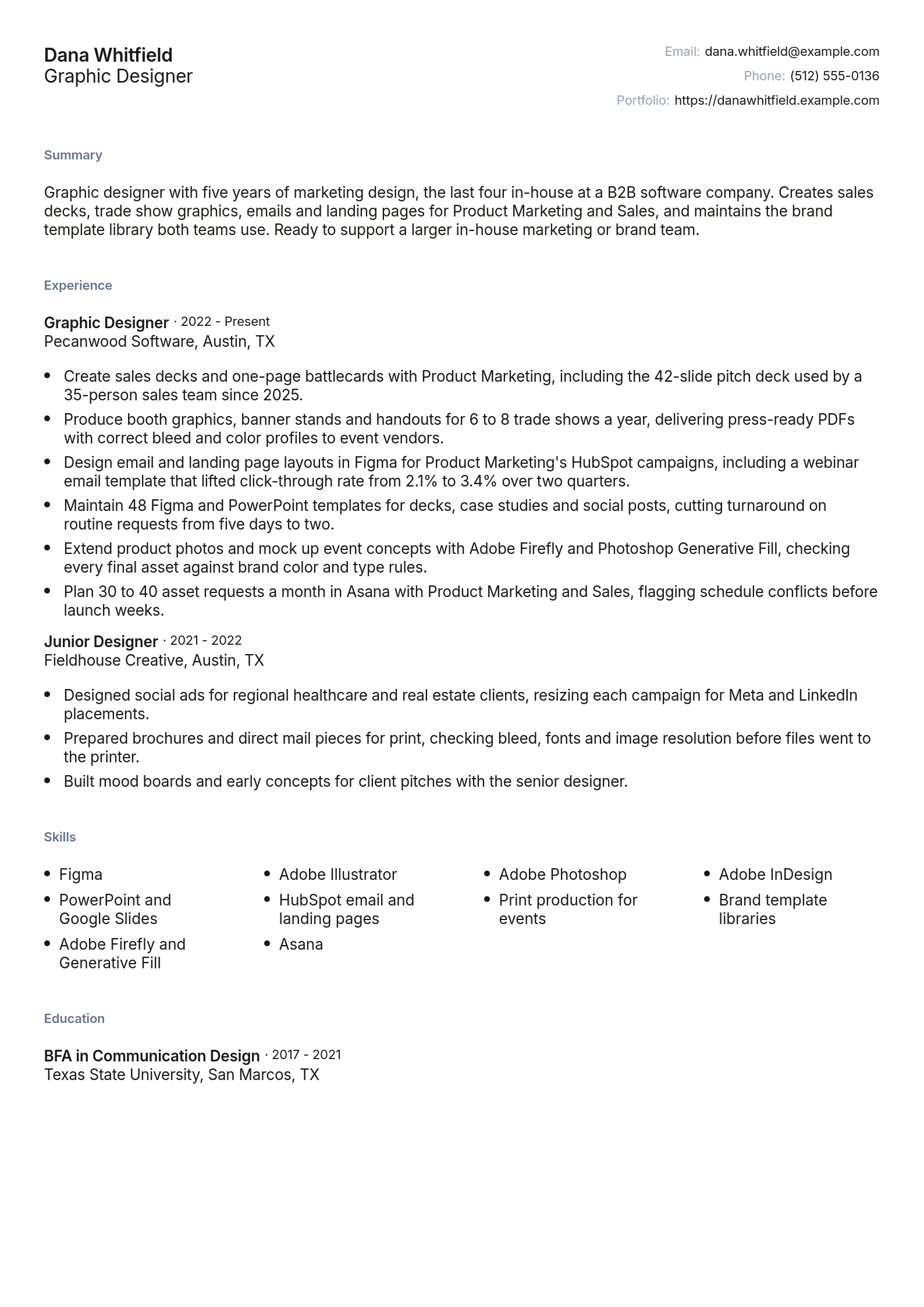
Dana's resume fits a designer with three to six years of experience applying to an in-house marketing or brand team. The Pecanwood bullets name the format, the team that asked for it and where it ran: sales decks for a 35-person sales team, booth graphics for trade shows, HubSpot emails with a click-through result.
Copy this structure if most of your work supports Sales and Product Marketing. The bullets cover what a portfolio can't show, such as the template library other teams use, the monthly request volume in Asana and the files sent straight to event vendors.
Senior, junior, freelance and packaging designer resumes
Each resume below is built around the work a different kind of designer does every week. Pick the one closest to your current job, then borrow lines from the others where your work overlaps.
Senior graphic designer who leads a brand system
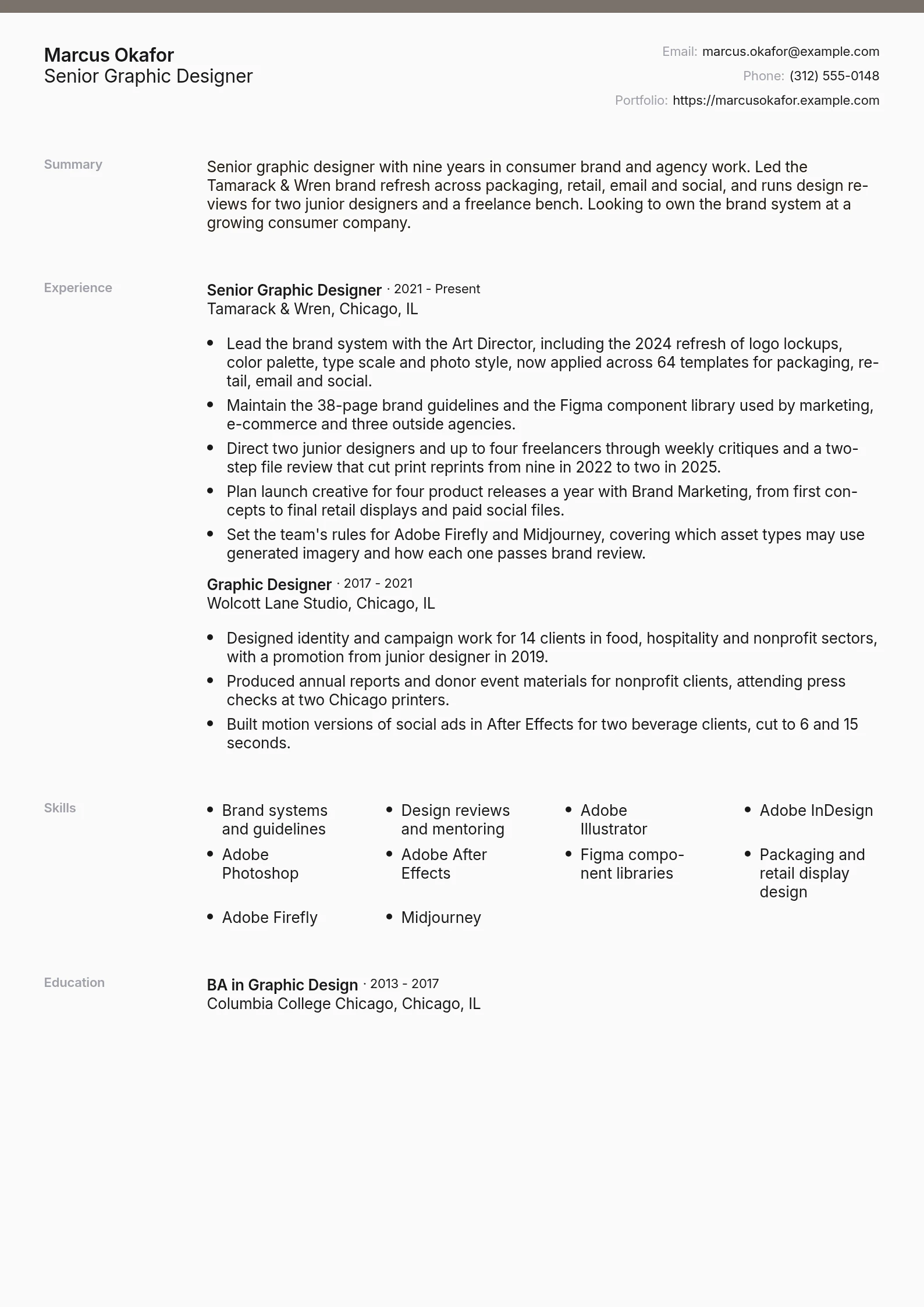
Marcus's resume suits a designer with eight or more years who now sets standards for other people's work. The Tamarack & Wren bullets give the size of the brand refresh in templates, name the guidelines and Figma library other teams use, and measure his file review by the drop in print reprints. The agency role is short because the current job carries the senior case.
Brand refresh applied across 64 templates
Reprints cut from nine to two with a two-step file review
Team rules for Firefly and Midjourney use
Junior graphic designer in a first full-time job
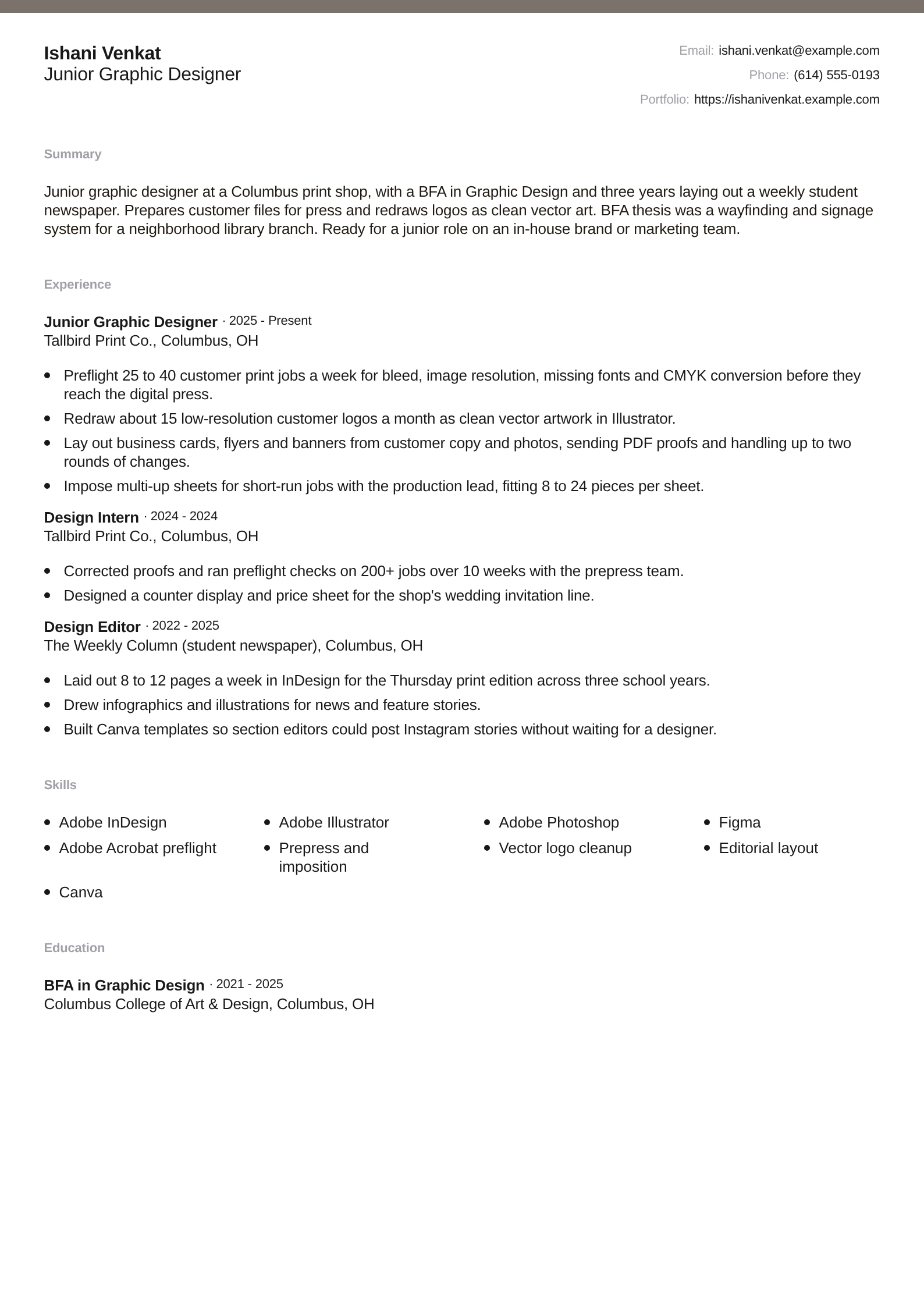
Ishani's resume fits a designer one or two years out of a BFA who learned production before brand work. Her print shop bullets count weekly preflight jobs and vector logo redraws, the internship at the same shop shows how she was hired, and the student newspaper role shows a weekly InDesign deadline met for three years. The summary names her thesis project so the portfolio link has context.
Preflight checks on 25 to 40 print jobs a week
Internship that led to a full-time job
Canva templates built for student editors
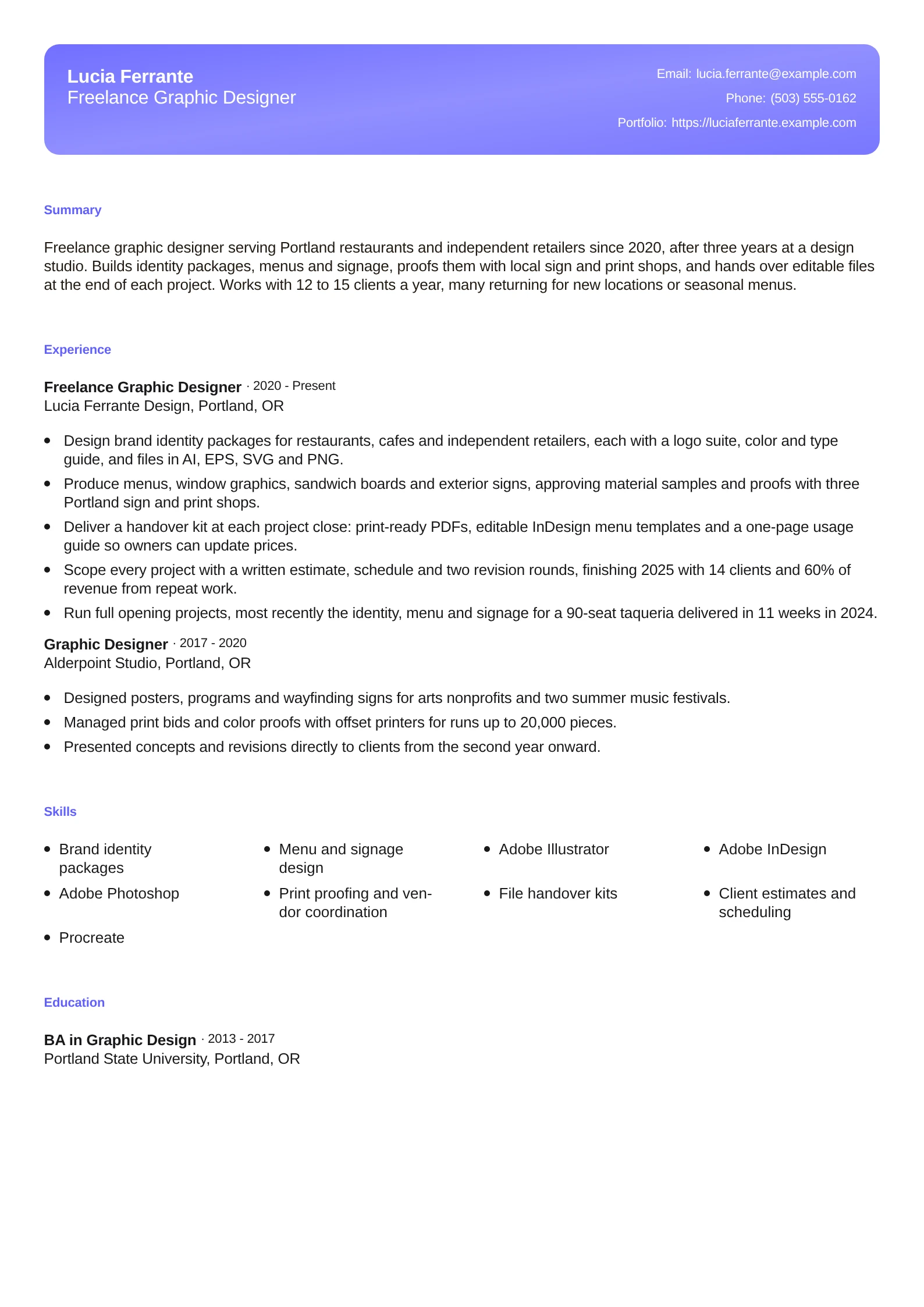
Freelance graphic designer with restaurant and retail clients
Lucia's resume suits a self-employed designer who needs one business entry to read like a steady job. It gives her client count and repeat-revenue share, spells out what goes in each identity package and handover kit, and counts the local sign and print shops she proofs with. The earlier studio role covers print bids and color proofs for runs up to 20,000 pieces.
14 clients in 2025, with 60% of revenue from repeat work
Handover kit with editable menu templates
Identity, menu and signage for a restaurant opening
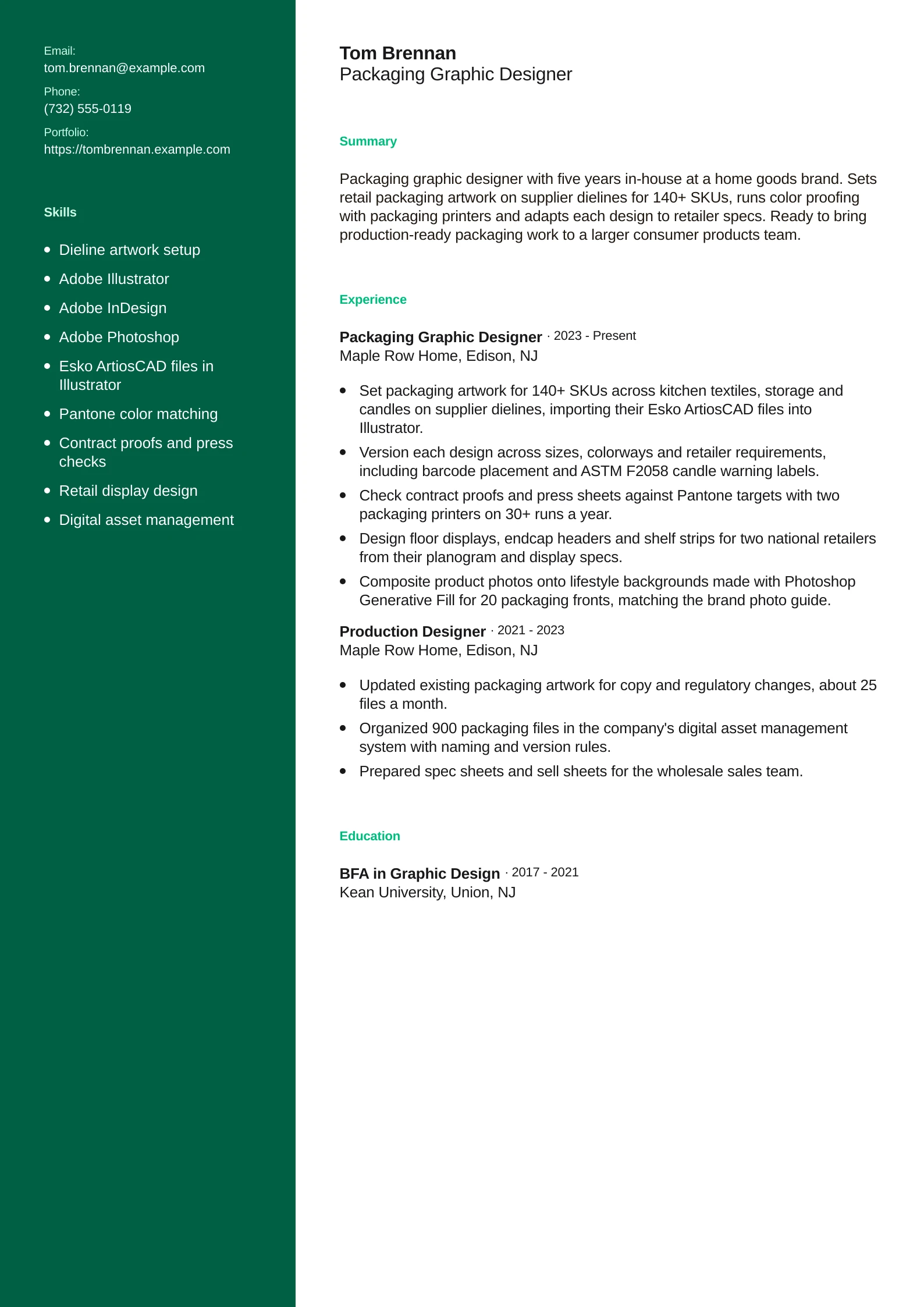
Packaging graphic designer for a home goods brand
Tom's resume fits a designer whose portfolio is full of packaging and who needs the resume to prove the production side. It counts SKUs, names dielines, Pantone targets and contract proofs, and cites the retailer planograms and display specs he works from. Splitting one employer into two titles shows the move from updating existing artwork to building new packaging for the full product line.
Artwork on supplier dielines for 140+ SKUs
Contract proofs checked against Pantone targets
Promotion shown as two titles at one employer
Name the formats you shipped and how each file left your hands
The resume should list the formats you produced from brief to final file, because the hiring manager already has your portfolio open for the visual judgment. In-house ads for this job ask for decks, event signage, email, landing pages, packaging and retail displays, and one posting often names several of them. The resume is where you confirm you've delivered each one.
Group your bullets by format and say what you handed over. A marketing designer can write "booth graphics and handouts for 6 to 8 trade shows a year, delivered as press-ready PDFs to event vendors." A packaging designer can name dielines, contract proofs and Pantone targets. A junior designer at a print shop can count preflight checks per week, which tells a manager your files will print correctly.
Add volume and turnaround where you have them: assets per month, templates maintained, SKUs versioned, days from request to delivery. Dana's resume says her template library cut turnaround on routine requests from five days to two, and that number tells a hiring manager more than a list of tools.
Put the portfolio link in your contact details and use a short URL you control. If a case study in the portfolio covers the same project as a bullet, use the same project name in both so the reader can match them.
Tie each deliverable to the team, channel and launch it served
A strong design bullet says who asked for the work, where it ran and what it was for, then gives the deliverable. In-house designers work beside Product Marketing, Sales, events and e-commerce teams, and ads for these jobs ask for designers who can turn a brief from those teams into finished assets.
Name the partner team and the occasion, such as "with Product Marketing for the spring release" or "for the sales kickoff." Name the channel and format: "HubSpot email template," "LinkedIn carousel," "endcap header." Add a result only when you have a real one, such as click-through rate, reprints avoided or how many people use a template.
Freelancers can swap the team for the client and the occasion, such as "identity, menu and signage for a 90-seat taqueria opening." Junior designers can name the customer or editor they served, such as walk-in print customers or a student newspaper's section editors.
Names the team, channel and result
Design email and landing page layouts in Figma for Product Marketing's HubSpot campaigns, including a webinar email template that lifted click-through rate from 2.1% to 3.4% over two quarters.
Lists the deliverable only
Designed emails, landing pages and social graphics for marketing campaigns.
Sort software, production skills and AI tools into separate groups
List tools in groups the reader can check against the job ad, and name each product instead of writing "Adobe Creative Cloud." US ads for this job usually name Photoshop, Illustrator, InDesign and Figma, and some add After Effects, HubSpot or Asana.
Some ads now list AI tools as requirements, naming Adobe Firefly, Generative Fill, Figma AI and Midjourney. List the ones you use, and add one experience bullet that says what the tool produced and how you checked the result against the brand's color, type and photo rules.
Skip ratings such as "Photoshop 90%" or five-dot skill bars. A hiring manager can't compare them across candidates, and your bullets already show what you've made with each tool.
Skill group
What to list
Example from these resumes
Design software
The apps you use every week, by product name. Add After Effects or Figma component work only if you've shipped real projects with it.
Marcus: Illustrator, InDesign, Photoshop, After Effects, Figma component libraries
Print and file production
Print production steps you handle yourself, such as preflight, bleed and color profiles, imposition, press checks and contract proofs.
Tom: dielines, Pantone color matching, contract proofs and press checks
Digital and email
The platforms your files go into and any code you write, such as HubSpot, Pardot or HTML for email.
Dana: HubSpot email and landing pages
AI tools
Each tool by name, paired with a bullet that says what it produced.
Dana: Adobe Firefly and Generative Fill for extending product photos
Workflow and handover
Request tools, asset libraries and file standards other people rely on.
Tom: digital asset management. Lucia: file handover kits
Lead with one specialty and file the rest under it
Pick the discipline the target job asks for most and make it the focus of your summary and the first two bullets in each role. Many graphic designers do brand, print, digital, motion and packaging work in the same year, and a resume that gives each one equal weight leaves the reader guessing what you want next.
Read the ad and count which formats it names. For a partner marketing role that asks for emails, landing pages and event materials, lead with those and move packaging or illustration lower. For a packaging role, lead with dielines and SKU counts the way Tom's resume does, and keep social graphics to one closing bullet.
Use the summary to connect your disciplines through one audience. "Marketing design for B2B sales and events" covers decks, booths and email without sounding scattered. Marcus's summary does the same for packaging, retail, email and social by tying them to one brand refresh.
Motion, web and UX work can stay on the resume as supporting skills if you've shipped it. If you're applying for UX or motion design jobs, build a separate resume around that work.