Two jobs share the visual designer title, product UI and design systems or brand and marketing sites, and hiring managers check which one you do and whether your work shipped to screens.
The five examples cover a product designer at a software company, a startup's first brand designer, a design system lead, a new graduate and a print designer moving to web.
A product visual designer who runs the component library
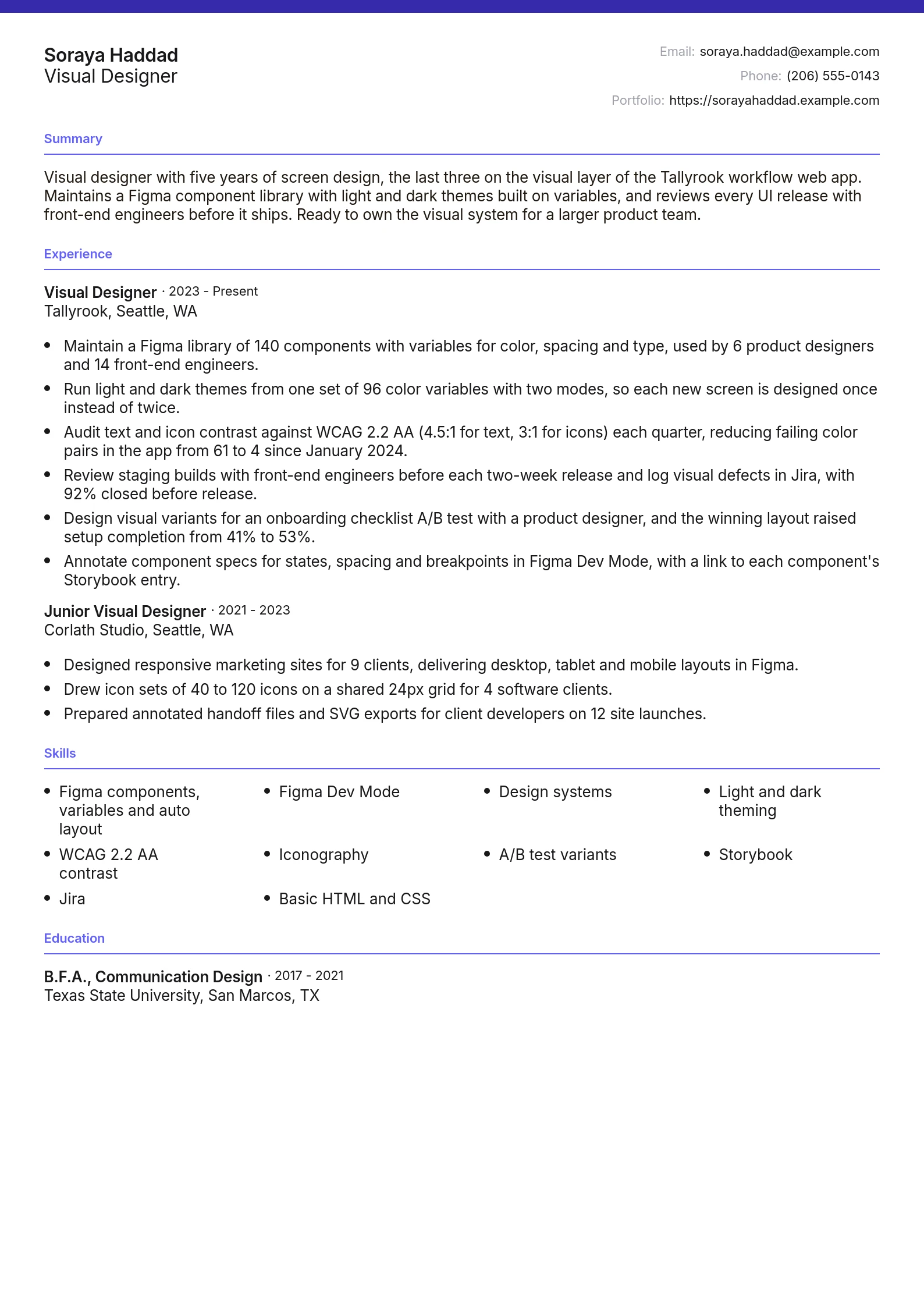
Soraya's resume fits a visual designer on a software product team. The summary names the product, the library she maintains and the engineers she reviews releases with, so a hiring manager can place her on the product side before reaching the first bullet.
Each bullet counts something a design system lead would ask about: components, color variables, contrast failures fixed and defects closed before release. The agency role underneath shows where her responsive layout and icon skills came from in three short bullets.
Brand, systems lead, graduate and career-change resumes
Match on the work you ship before you match on years. A brand designer with eight years will copy more from Jordan's resume than from Kenji's, even though Kenji is closer in seniority.
Brand visual designer at a startup
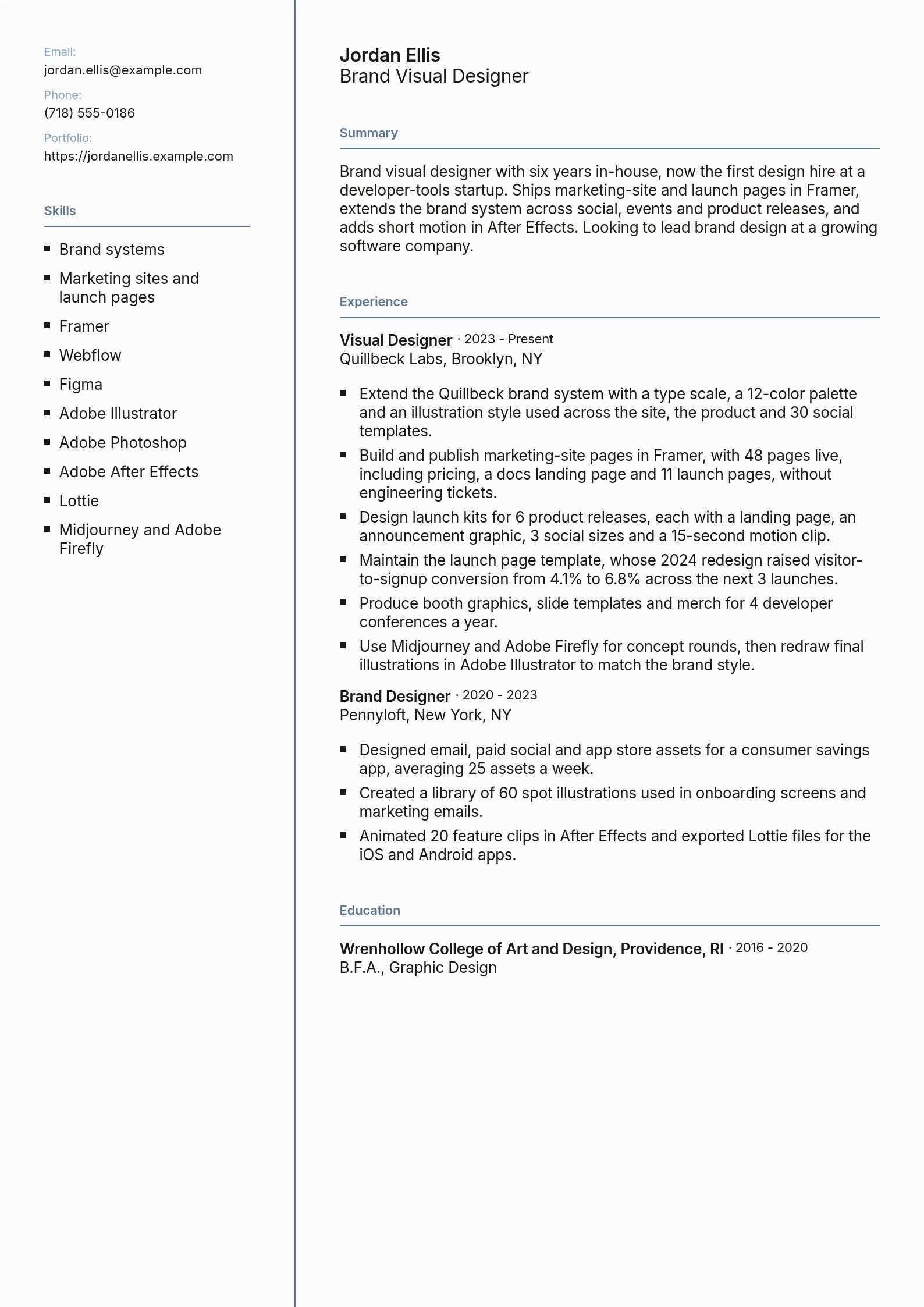
Jordan is the first designer at a developer-tools startup, so the resume leads with Framer pages shipped and the brand system behind them. Launch kits are listed piece by piece, a conversion change on the launch template gives the brand work a number, and AI tools appear as one step of the concept process. Use it if you own a marketing site, launches and social assets more than product screens.
48 Framer pages published without engineering tickets
Launch template raised signup conversion from 4.1% to 6.8%
Feature clips animated in After Effects and exported as Lottie files
Senior visual designer who leads a design system
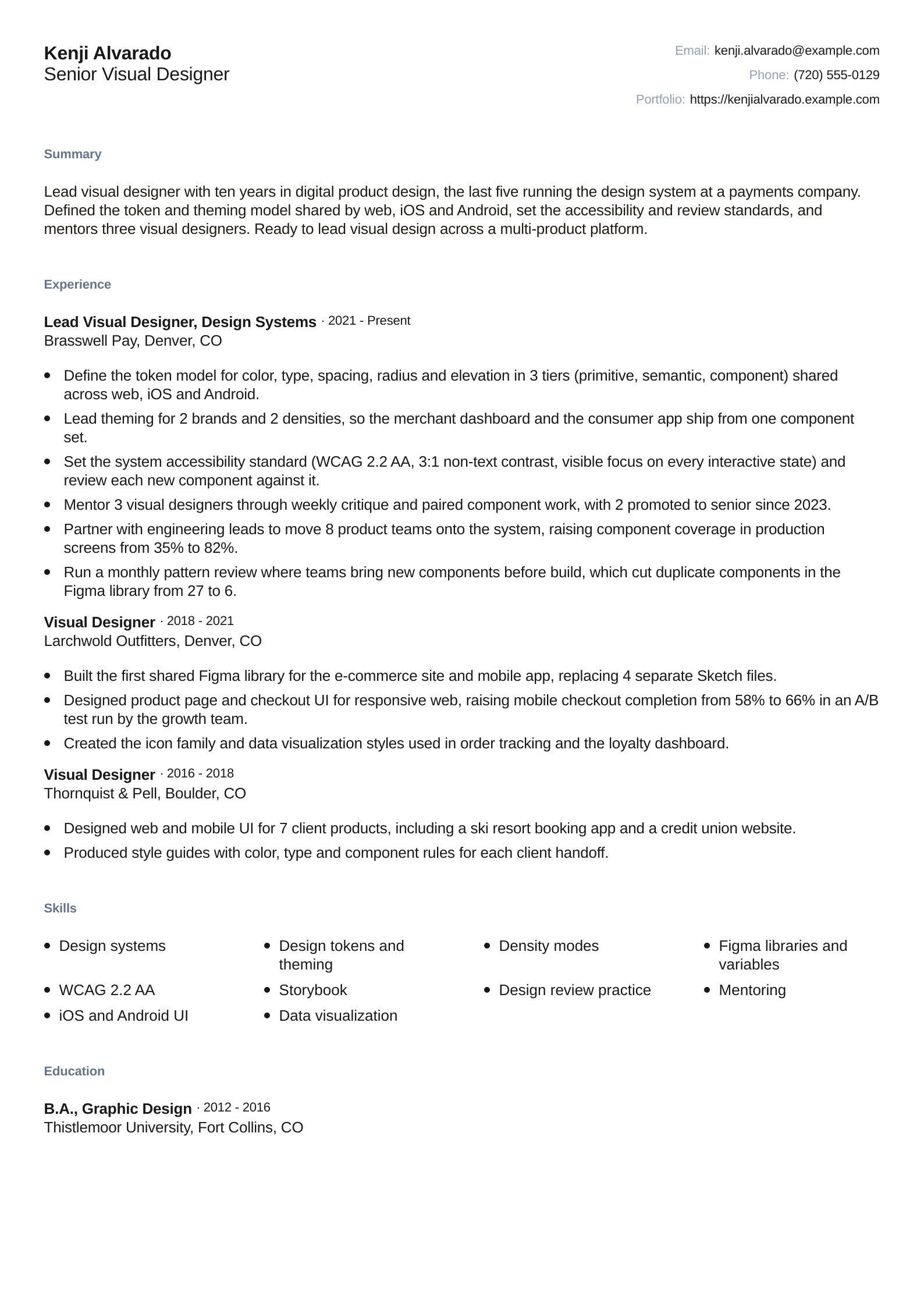
Kenji leads the design system at a payments company. His bullets name the three token tiers, the brands and densities the themes cover, and the accessibility standard every new component is reviewed against. Adoption is measured in product teams and production coverage, and mentoring shows up as promotions. Use it if you set standards for other designers and work with engineering leads to move several teams onto one system.
Tokens shared by web, iOS and Android
Component coverage raised from 35% to 82% across 8 teams
Mentors 3 visual designers, 2 promoted to senior
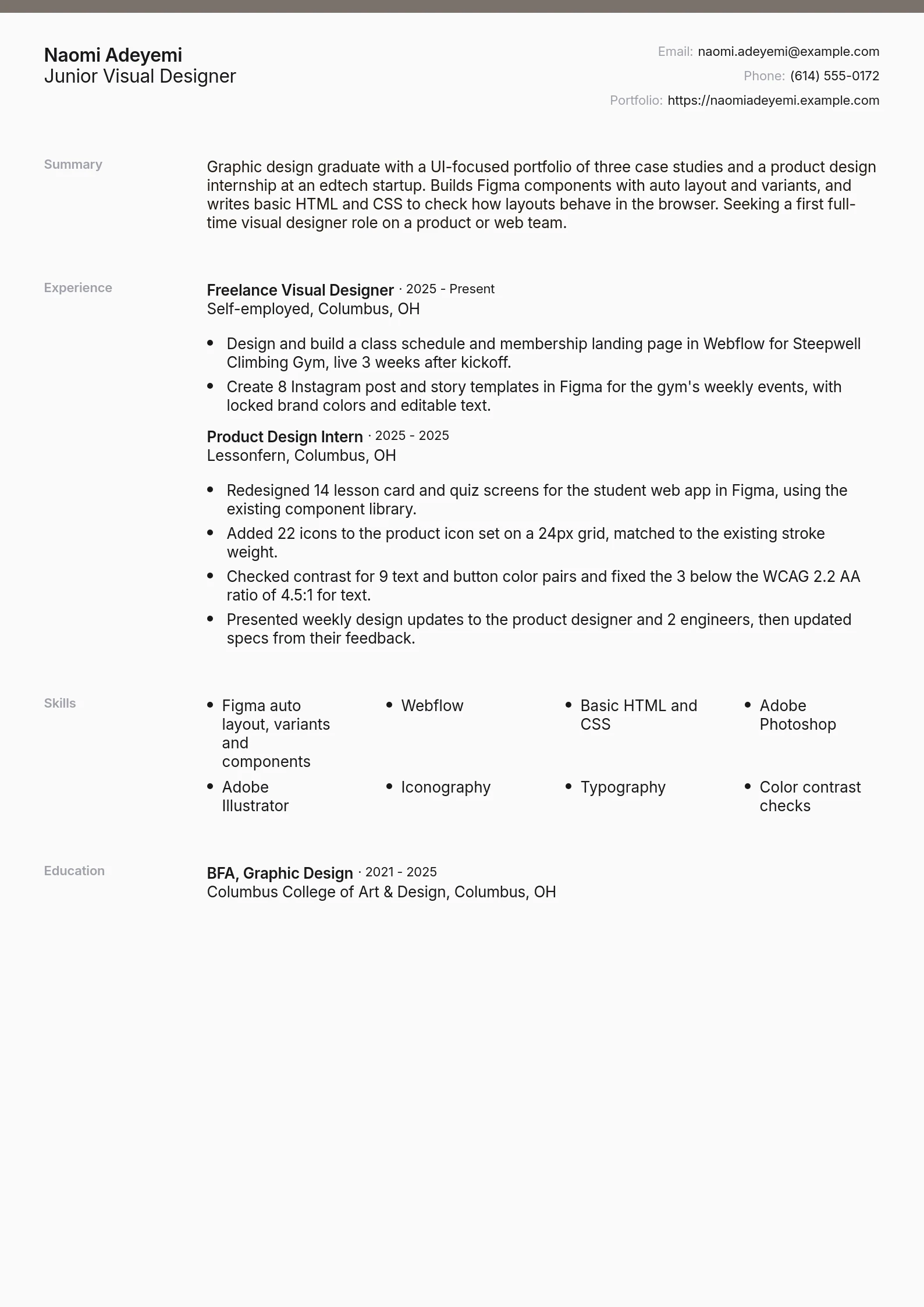
Junior visual designer with an internship and a freelance site
Naomi finished a graphic design BFA in 2025 with a portfolio aimed at UI work. The resume puts the portfolio link in the header, describes the internship by screens redesigned, icons drawn and contrast pairs fixed, and lists a freelance Webflow page as current work. Use it if you have one internship, a few case studies and basic HTML and CSS, and want a first full-time visual designer job.
Portfolio link in the header
Internship counted in screens, icons and contrast fixes
Freelance Webflow page listed as current work
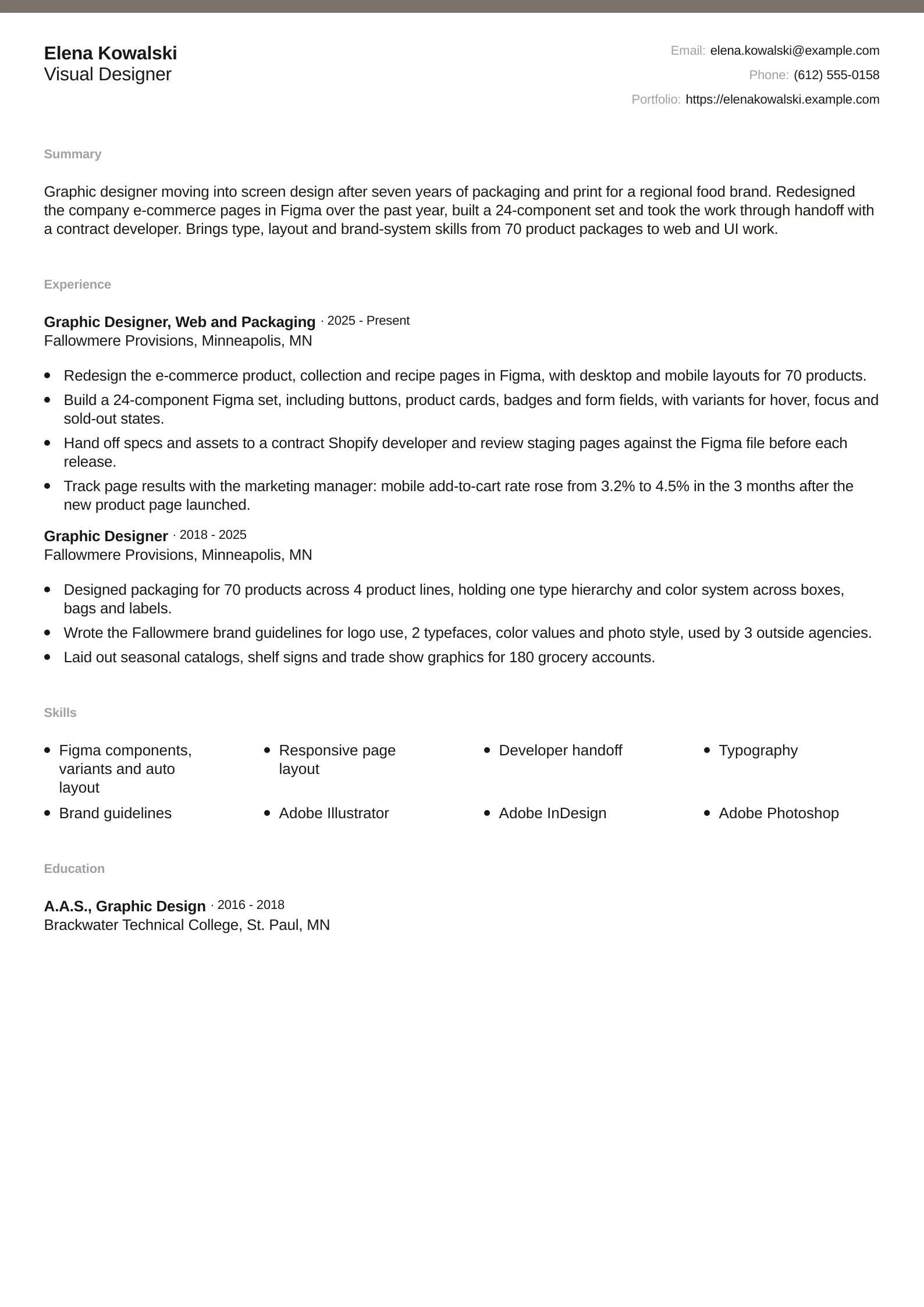
Graphic designer moving from print to screens
Elena spent seven years on packaging and print for a food brand, then redesigned its e-commerce pages in Figma. Her resume splits one employer into two roles so the web work sits on top, lists the component states she designed and names the handoff to a contract developer. The print role keeps skills a screen team can use: type hierarchy, color and brand guidelines. Use it if your web work started inside a print job.
One employer split into a web role and a print role
24-component Figma set with hover, focus and sold-out states
Mobile add-to-cart rate up from 3.2% to 4.5%
Say which kind of visual designer you are in the title line
The visual designer title covers two jobs, and your title line and summary should say which one you do. Product visual designers work on the interface, components and design system of a software product. Brand visual designers own the identity, marketing site and launch assets. A graphic designer resume covers print and production, which is a third job.
Write the side into your title, as in "Visual Designer, Product" or "Brand Visual Designer," then repeat it in the first line of your summary with the product or brand you design for. If you do both, lead with the side the job ad asks for and keep the other to one bullet per role.
Compare
Product visual designer
Brand visual designer
Graphic designer
Main work
UI for a web or mobile app, components, themes and icons
Brand system, marketing site, launch pages, social and event assets
Print, packaging, signage and production files
What bullets count
Components, variants, teams using the library, contrast fixes, defects caught before release
Pages published, launches supported, signups or conversion, assets per week
Pieces produced, print runs, deadlines met
Tools to name first
Figma variables and libraries, Figma Dev Mode, Storybook
Figma, Framer or Webflow, After Effects or Rive
Illustrator, InDesign, Photoshop
Summary opens with
"Visual designer on the web app at..."
"Brand visual designer and first design hire at..."
"Graphic designer producing packaging for..."
Examples on this page
Soraya, Kenji, Naomi
Jordan
Elena's earlier role
Count the components, themes and teams your library serves
Design system work reads as scale when the bullet names what you built, who builds from it and what changed. A hiring manager for a systems role wants the number of components, the token types, the themes, and how many designers and engineers use the library.
Name the token tiers if you defined them, such as primitive, semantic and component. List the states you designed (hover, focus, disabled, error) and any themes or densities. For adoption, give the number of product teams or the share of production screens built from the system, the way Kenji's resume does.
Put accessibility in the same bullets. Give the standard, such as WCAG 2.2 AA (4.5:1 contrast for normal text, 3:1 for large text and for UI components), and a count: contrast failures fixed, components reviewed or focus states added. Junior designers can count the screens they built from an existing library and the contrast pairs they checked.
Shows its size and who uses it
Maintain a Figma library of 140 components with variables for color, spacing and type, used by 6 product designers and 14 front-end engineers.
Says the system exists
Created and maintained the design system in Figma for the product team.
Show how closely engineers built what you designed
Describe collaboration by what you handed off, how you checked the build and what got through. "Worked closely with engineering" tells the reader nothing, while a bullet that names the review step and its result shows that your designs ship as drawn.
Product visual designers should name the handoff artifact (Figma Dev Mode specs, Storybook entries, annotated redlines), the review point, such as staging builds before each two-week release, and a count of visual defects logged and closed. Some employers call this implementation fidelity, and the phrase is worth using if the job ad does.
When you work in a pair with a product designer, say what you owned. Soraya's resume gives her the visual variants for an onboarding A/B test and the result: setup completion rose from 41% to 53%.
Brand visual designers often publish pages themselves. Say so with the tool and the volume, as in "Build and publish 48 pages in Framer," and tie a launch to a number the marketing or growth team tracked, such as signups or conversion rate. Use only numbers your team measured, because interviewers ask where they came from.
Juniors and career changers need one handoff to show they know the process. Elena's resume names a contract Shopify developer and the staging review before each release, and Naomi's internship bullet says she updated specs after weekly feedback from two engineers.
Name the Figma features and web builders you use, then the Adobe apps
List tools in your skills section, and name the ones the job depends on inside the bullets where you used them. Figma is expected on every visual designer resume, so name the features you work in, such as variables, libraries, auto layout and Dev Mode.
Some brand roles expect AI design tools and list Framer or Webflow and motion in After Effects or Rive as a bonus. Include them when you have shipped work with them, and put Adobe apps after your screen tools unless the role includes print.
Tool
Who should list it
How to show it in a bullet
Figma variables, libraries, auto layout, Dev Mode
Every visual designer
"Maintain a library of 140 components with variables for color, spacing and type"
Framer or Webflow
Brand and marketing-site designers, and juniors with a live page
"Build and publish 48 pages in Framer" or "Design and build a landing page in Webflow"
After Effects or Rive
Designers who make product or launch motion
"Animated 20 feature clips in After Effects and exported Lottie files"
Storybook, basic HTML and CSS
Product designers who review builds and juniors who code their own layouts
"Annotate component specs in Dev Mode with a link to each Storybook entry"
Midjourney or Adobe Firefly
Brand designers who use AI for concept rounds
"Use Midjourney and Adobe Firefly for concept rounds, then redraw final illustrations in Illustrator"
Illustrator, Photoshop, InDesign
Illustrator and Photoshop for most designers, InDesign when print is part of the role
Skills section, plus a bullet for icon, illustration or print work