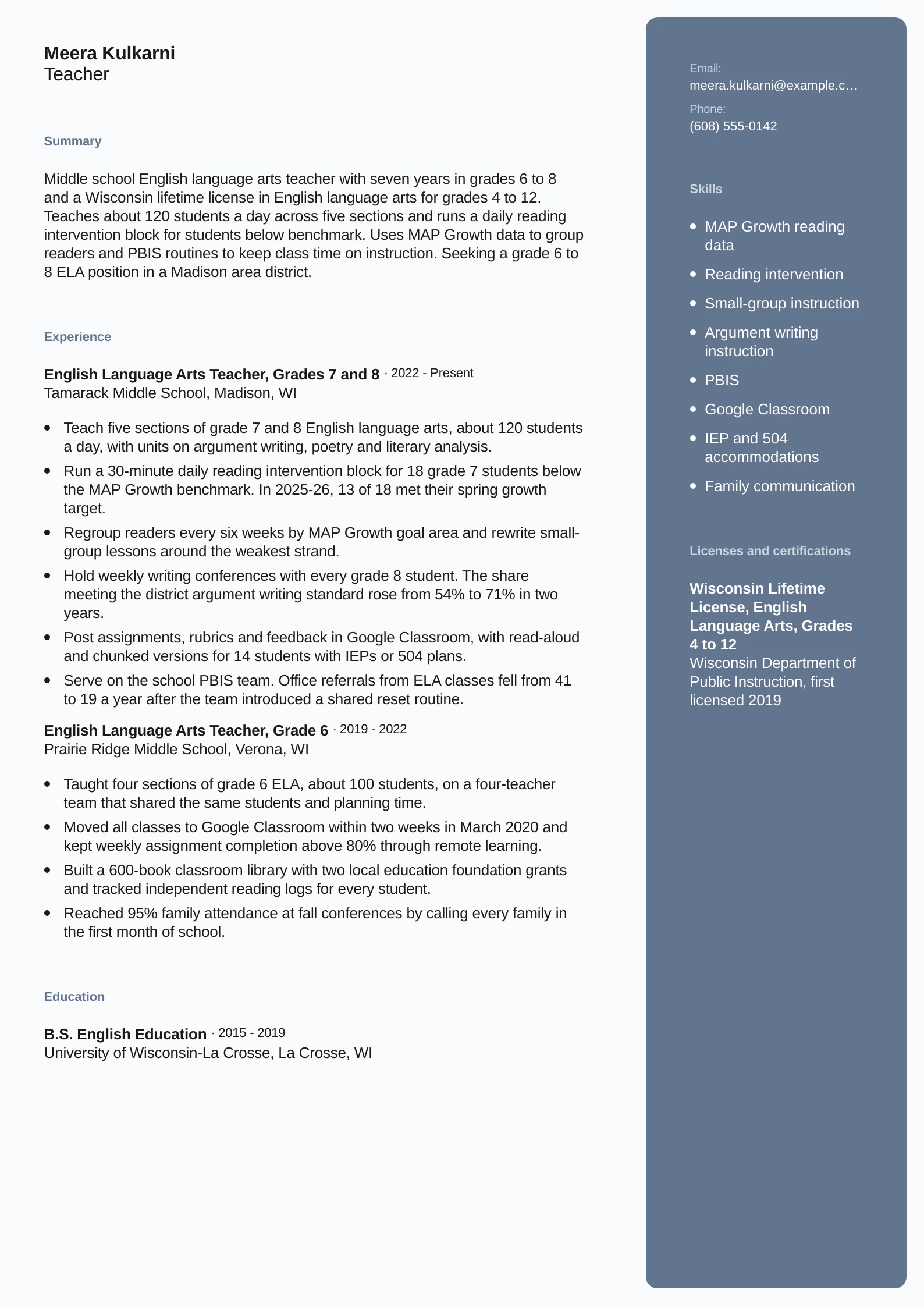
A coaching resume is read for safety paperwork before wins, so your CPR, NFHS courses, fingerprint clearance or U.S. Soccer license belong where an athletic director or club director sees them first. The six examples cover a varsity teacher-coach, a first paid assistant job, club soccer, college recruiting, a move from warehouse work into wrestling and a credentialed leadership coach.
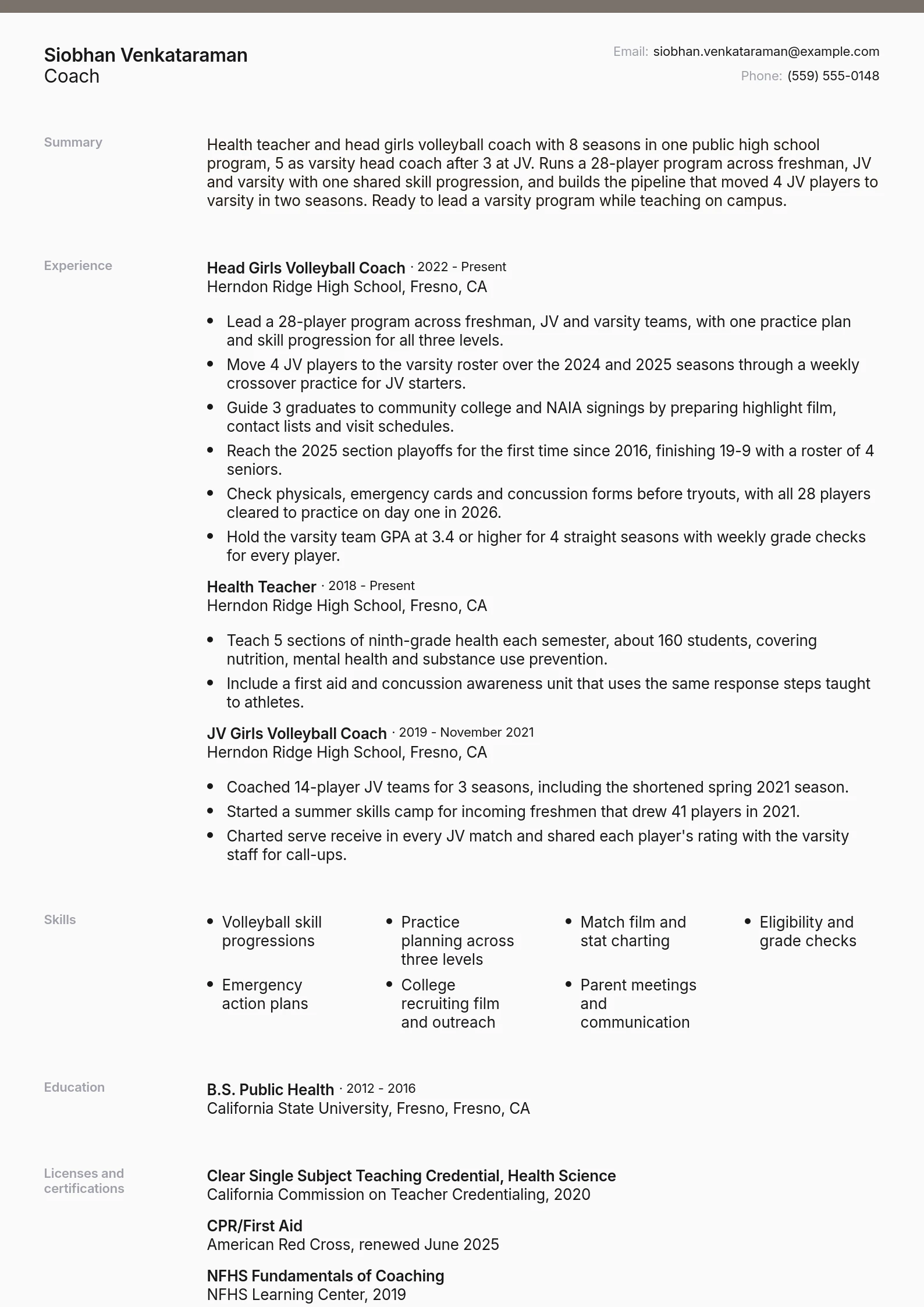
Siobhan coaches girls volleyball at the public high school where she teaches health, the most common route into a high school coaching job. Her resume counts development across three levels: 28 players, 4 moved up from JV to varsity in two seasons, and 3 graduates signed with community college or NAIA programs.
Her CPR/First Aid renewal and four NFHS Learning Center certificates sit in the sidebar, each with its own line and year. Copy this layout if you coach a school sport while working in the building, then swap in your sport, levels and roster numbers.
Club, college, entry-level and career-change coach resumes
Each example is written for a different hiring reader. A club director scans for the license and SafeSport training, a college head coach looks for recruiting volume and NCAA rules knowledge, and a corporate sponsor of leadership coaching wants client hours and a credential. Pick the one whose setting matches the job you're applying for, even if the sport is different.
First paid assistant job after playing in college
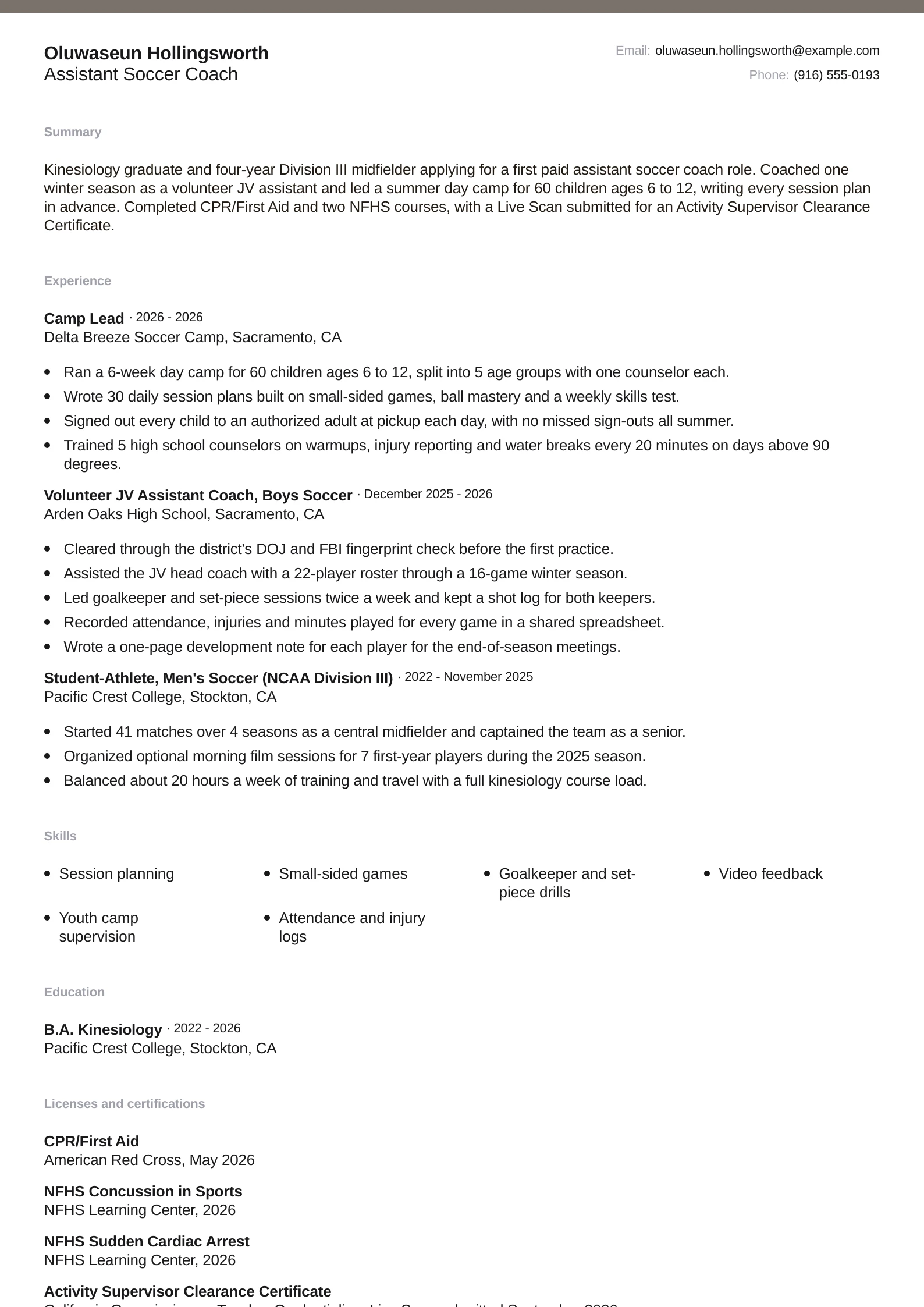
Oluwaseun has one volunteer JV season and one summer camp, so his resume leans on what he ran himself: 30 written session plans, water breaks for 60 children on hot days, and a shot log for two goalkeepers. His four years as a Division III midfielder appear as experience with starts and a captaincy, and his state clearance certificate shows its Live Scan date. Use it if you played in college and want a first paid assistant role.
Camp lead role with 60 children and 30 session plans
College playing record listed with starts and captaincy
Pending clearance certificate with its Live Scan date
Club soccer coach working around a day job
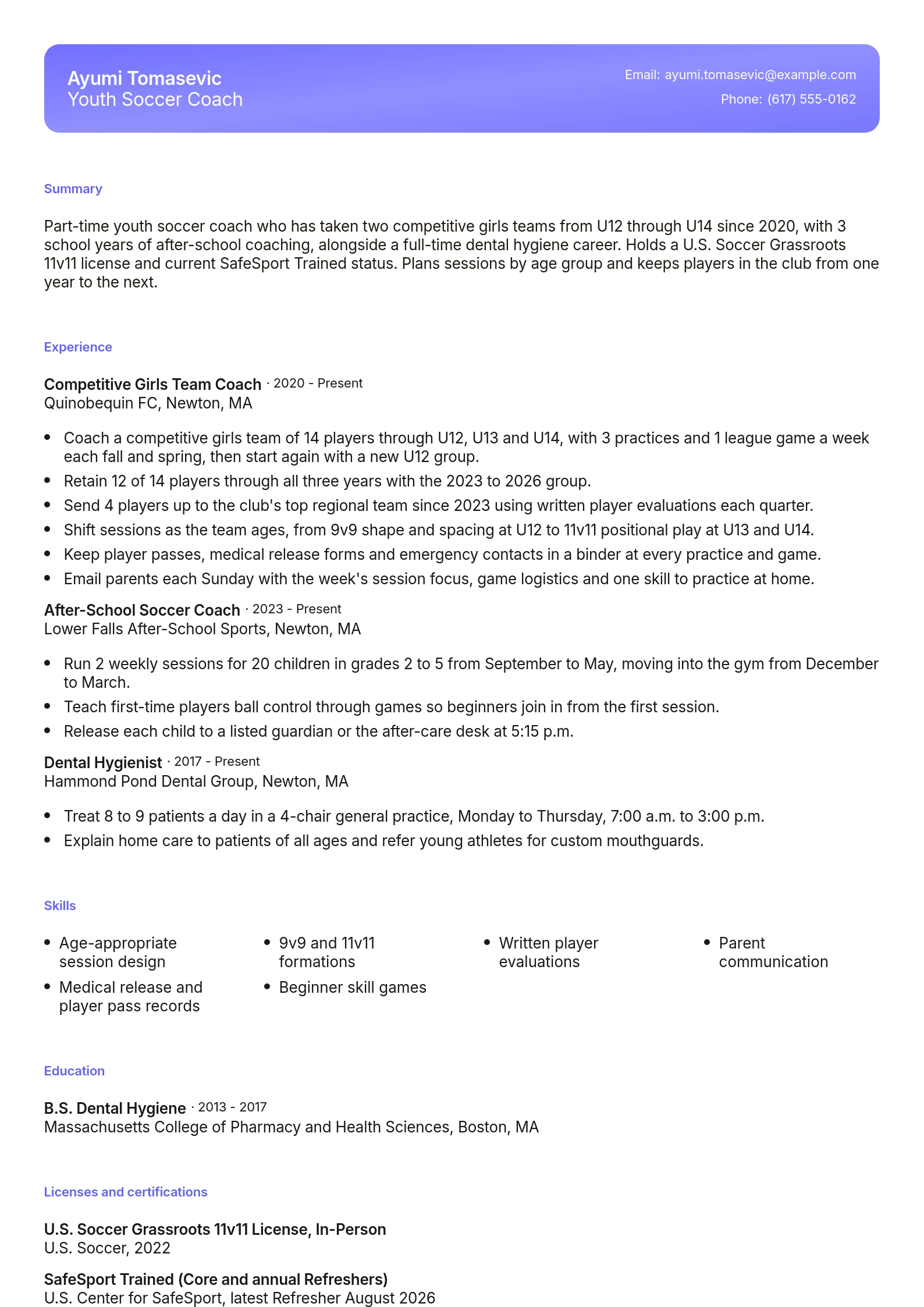
Ayumi coaches a competitive girls team part-time while working as a dental hygienist. Her U.S. Soccer Grassroots license, SafeSport training and safe playing environments course lead the credentials list. Her club bullets count players retained, players moved up to the top regional team, and the switch from 9v9 to 11v11. The dental job shows a Monday to Thursday schedule. Use it if you coach club evenings and weekends around another career.
U.S. Soccer and SafeSport credentials with dates
Retention and move-up numbers in place of a win record
Day job hours that leave afternoons free for practice
College assistant coach and recruiting coordinator
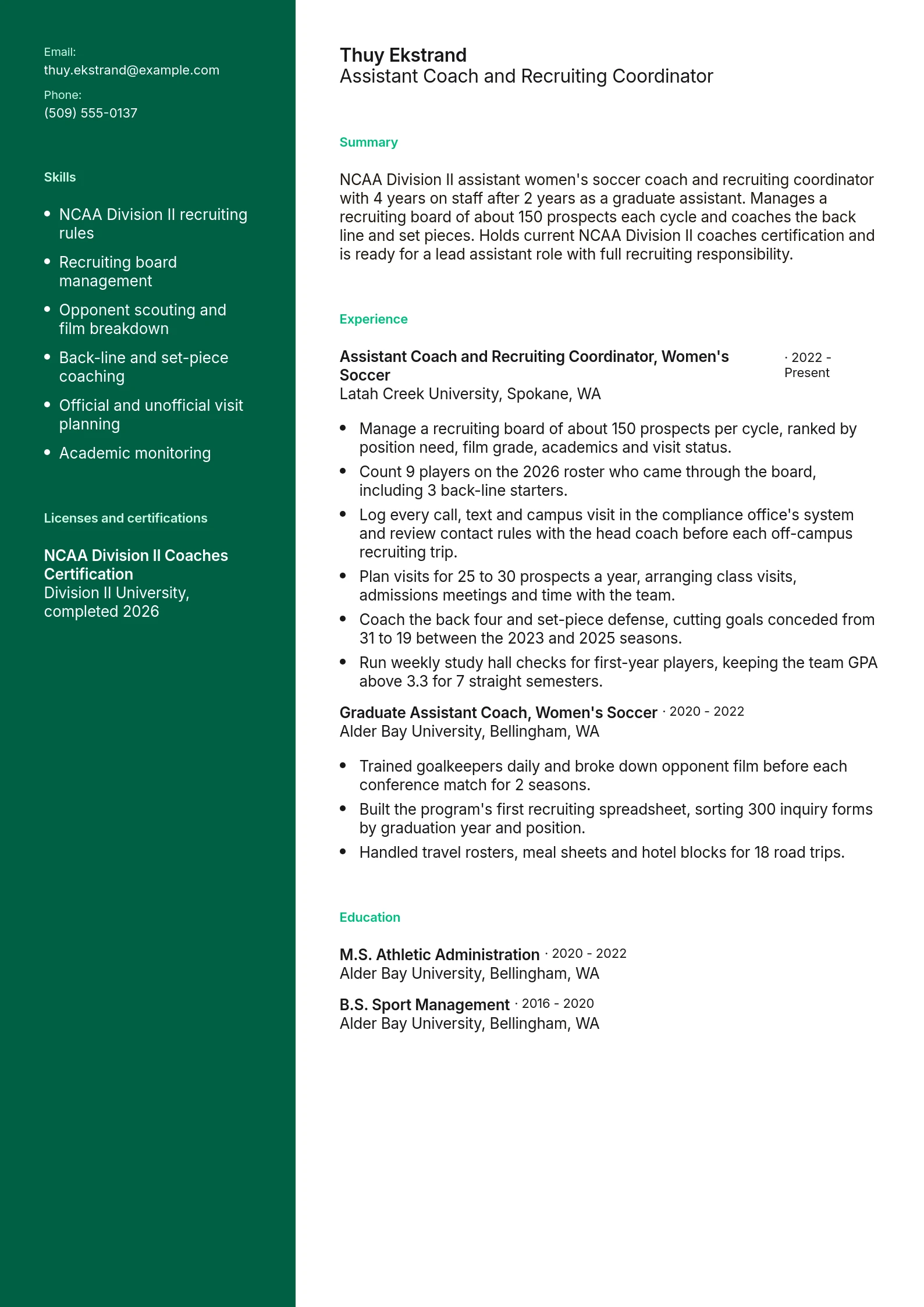
Thuy's resume is written for an NCAA head coach who reads for recruiting volume and rules knowledge. It names a board of about 150 prospects per cycle, 9 players on the current roster who came through that board, every contact logged with rules reviewed before each recruiting trip, and a team GPA above 3.3 for seven semesters. A graduate assistant role alongside her master's degree shows how she started. Use it if you're moving up within college athletics.
Recruiting board size and recruited players on the roster
Annual NCAA Division II coaches certification listed
Graduate assistant role paired with the master's degree
Leadership and career coach with an ICF credential
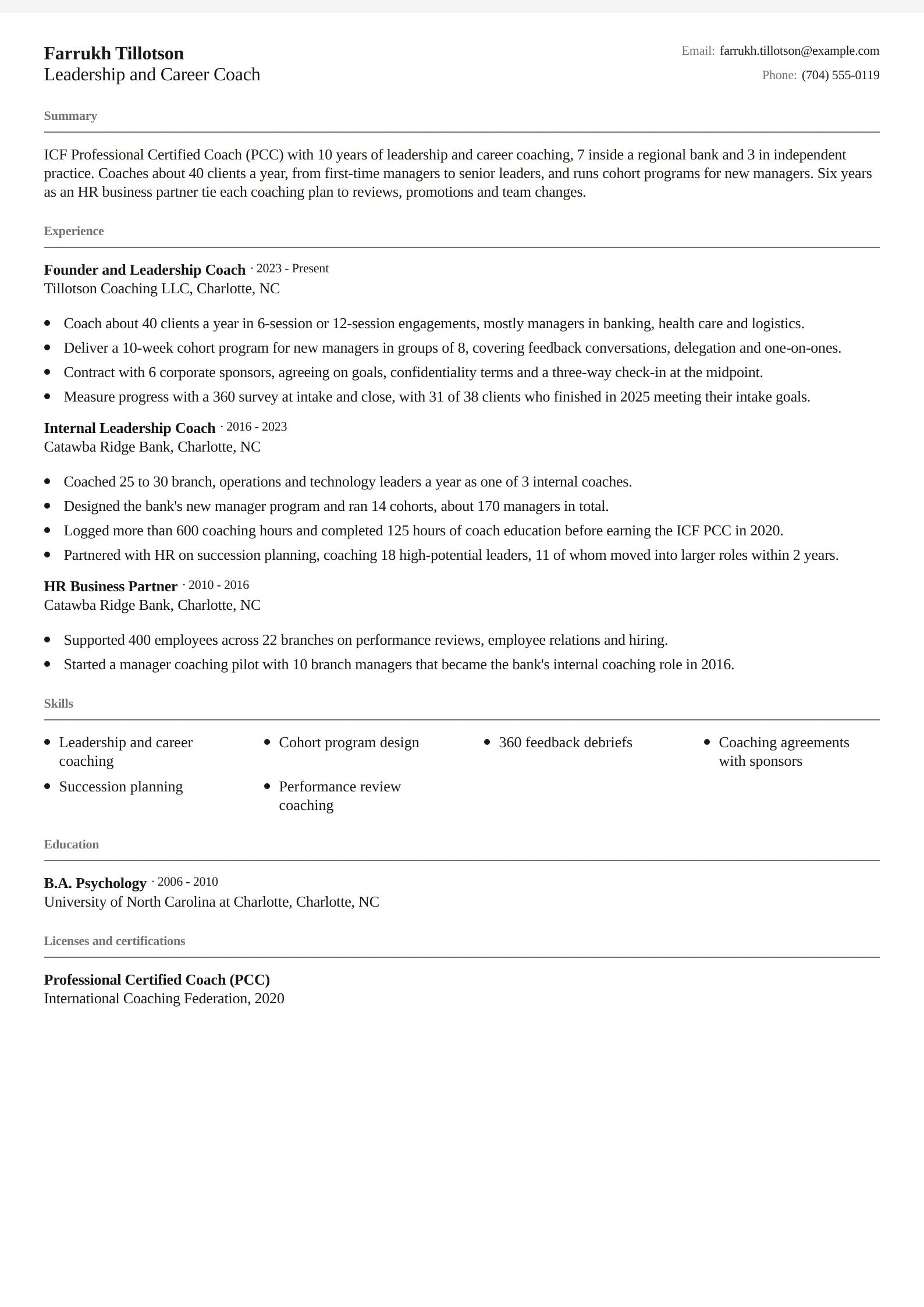
Farrukh coaches managers, not athletes, so his resume reads like a professional services record: ICF Professional Certified Coach status, about 40 clients a year, a 10-week program for new managers, and how many clients met the goals set at intake. Six years as an HR business partner explain how his coaching ties to reviews and promotions. Use it for life, career or executive coaching, where the credential and client hours carry the page.
ICF PCC with the year earned and the hours behind it
Client volume, engagement length and goal results
Corporate sponsor contracts and new manager cohorts
Warehouse supervisor moving into high school wrestling
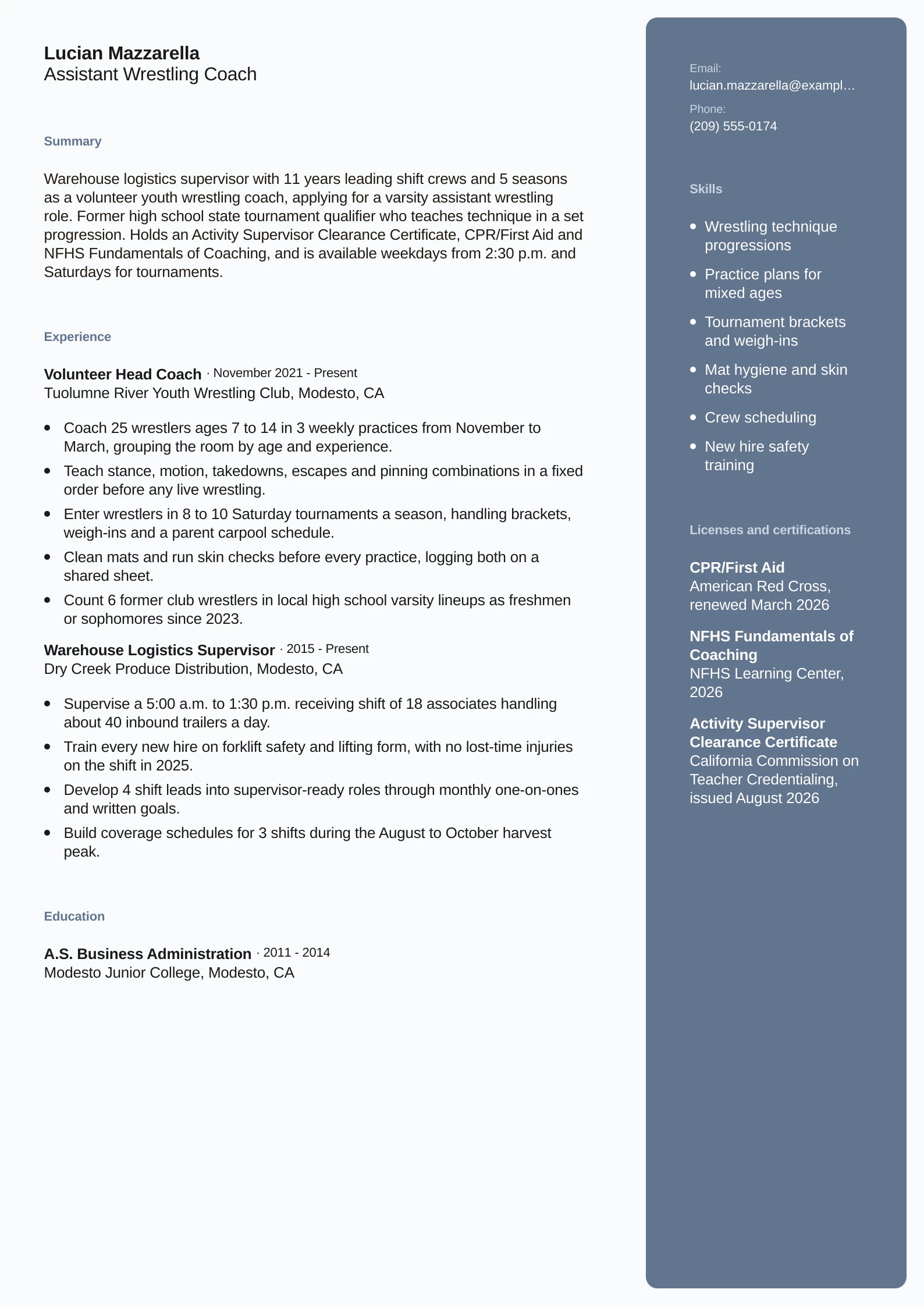
Lucian has 11 years supervising a warehouse shift and five volunteer seasons coaching youth wrestling. His resume puts the club first, with 25 wrestlers, a technique progression and 6 former club wrestlers now in high school varsity lineups, then shows the 5:00 a.m. shift that frees his afternoons. A state clearance certificate, CPR/First Aid and NFHS Fundamentals of Coaching answer a district's walk-on questions. Use it if you're coming to school coaching from outside teaching.
Volunteer club coaching listed above the full-time job
Early shift hours that show afternoon availability
Clearance, CPR and NFHS course for a walk-on coach
Count the players who moved up a level
Show what your coaching changed in the players, because a win-loss record mostly reflects the roster you inherited. Athletic directors and club directors read for development, retention and how well you ran the program.
Count athletes who moved up: freshman to JV, JV to varsity, a club team to the top regional team, or high school to a college roster. Name the level and the time frame, as in "Move 4 JV players to the varsity roster over the 2024 and 2025 seasons."
For college signings, give the number and the level, such as NCAA Division II, NAIA or community college. Club coaches often have a stronger number in retention: how many players returned for a second or third season with you. College assistants can count recruited players on the current roster and the size of the recruiting board.
Give a record only with context, such as the first playoff berth in nine years or a league finish after a losing season. Team GPA, eligibility and the share of players cleared to practice on day one also count, because they show you ran the whole program.
Development with context
Move 4 JV players to the varsity roster over two seasons, guide 3 graduates to community college and NAIA signings, and reach the 2025 section playoffs for the first time since 2016 at 19-9.
Record only
Head varsity volleyball coach. Went 19-9 in 2025.
Put CPR, NFHS courses and clearances near the top
List every certificate and clearance the job ad names in its own credentials section, with the exact course name, the issuer and a completion or renewal date, and name the ones the ad stresses in your summary too. Districts and clubs check these before they read your coaching record, and the list differs by state, district and club, so match each ad.
Use the course name the issuer uses. Write "NFHS Concussion in Sports, NFHS Learning Center, 2026," not "concussion certified." If an ad asks for hands-on CPR, name the hands-on skills session in the course title.
Give a status for anything pending. "Activity Supervisor Clearance Certificate, Live Scan submitted September 2026" tells a district the clearance is under way and when it started.
Setting
What recent ads ask for
How to write it
Public high school
CPR/First Aid renewed every 2 years. NFHS Fundamentals of Coaching, Concussion in Sports and Sudden Cardiac Arrest, plus Heat Illness Prevention in some districts. DOJ and FBI fingerprint clearance through the district or a California Activity Supervisor Clearance Certificate.
One line per NFHS course with the NFHS Learning Center as issuer and the year. Give the CPR renewal month and year, because a 2-year card can lapse mid-season.
Youth club soccer
U.S. Soccer Grassroots license, in-person or blended. Current SafeSport training. U.S. Soccer Introduction to Safe and Healthy Playing Environments. Background check.
License first, with its game format, such as 11v11, and whether you took it in person. Give SafeSport the date of your latest course, because SafeSport Trained status lasts 12 months.
College program
Bachelor's degree, NCAA rules knowledge, recruiting experience and a background check. Some programs require an NCAA recruiting test.
List the NCAA recruiting test or coaches certification with the year completed, because Division II renews it every year. Show rules knowledge in bullets, such as logging contacts and checking contact rules with compliance staff.
Life, career or executive coaching
An ICF credential: ACC (60+ hours of coach education, 100+ coaching hours), PCC (125+ and 500+) or MCC (200+ and 2,500+).
Write the full credential name with its abbreviation and the year earned. Put coaching hours in a bullet when they are well above the level's minimum.
Give each coaching job its own entry, with seasons, level and roster
List seasonal, stipend and volunteer coaching as full experience entries with a title, school or club, city and dates. Most coaching jobs are part-time, and a hiring director expects to see them beside another job.
Use the title the program uses, such as "Head Girls Volleyball Coach," "JV Assistant Coach" or "Volunteer Head Coach." Then put the level and roster size in the first bullet. "Coach a competitive girls team of 14 players through U12, U13 and U14, with 3 practices and 1 league game a week" tells a club director exactly what you handled.
Use month and year dates that cover the seasons, such as 08/2019 to 11/2021. Keep every season with the same title and program under one entry, and start a new entry when the title changes, as Siobhan does when she moves from JV coach to head coach. If you coach two sports at one school, give each sport its own entry so each record is clear.
Order entries by what the target job cares about. A career changer can put a volunteer club above a full-time job, as Lucian does with youth wrestling. Keep the day job on the page with its hours: a 5:00 a.m. shift or a Monday to Thursday clinic schedule answers the question of whether you can make a 3:30 p.m. practice.
Leave stipend amounts off. They describe what the school paid for the job, and a $2,110 stipend can make a full season of work look small next to a salary.
Turn your playing years into a first coaching resume
If you've played but never coached, lead with any work you've done with younger players and put your playing record second. A director hiring a first assistant wants to know you can run a drill, supervise children and show up for every practice.
List playing as an experience entry with the level, position, years and starts, as Oluwaseun does with his Division III career. Add anything you ran for teammates, such as film sessions or warmups, and any camp, clinic or volunteer season with younger players. Count it: children supervised, session plans written, ages coached.
Finish the free certificates an ad names before you apply. Clovis Unified in California lists three NFHS courses, Concussion in Sports, Sudden Cardiac Arrest and Heat Illness Prevention, that take 15 to 30 minutes each. Then use the summary below and fill each bracket from your own record.
Summary for a former player applying to assist
Former [level] [position] with [number] years of competitive play, applying for a first assistant [sport] coach role. Ran [camp, clinic or volunteer role] for [number] players ages [range], writing session plans and tracking attendance and injuries. Completed CPR/First Aid and [NFHS courses], with fingerprint clearance submitted [month year].
Choose a sidebar layout that keeps certificates in view
Choose a one-page template with a sidebar, and check where it puts your credentials before you commit. Some layouts show licenses and certifications in the sidebar beside your experience, and others list them below your experience and education.
School coaches with four or more short certificates should pick a layout that puts them in the sidebar, as Siobhan's does. Each NFHS course and the CPR renewal date fit on one line there, and an athletic director can confirm them without scrolling.
If your credentials land below your experience, name the two the ad asks for most in your summary. Ayumi's summary names her U.S. Soccer license and SafeSport training, and Lucian's names his clearance certificate, because a club or district checks those first.
College coaches and leadership coaches need room for numbers in their bullets: prospects per cycle, clients per year, coaching hours. Keep skills in the sidebar so the main column holds those bullets at one or two lines each, as Thuy's and Farrukh's examples do.
Leave team logos, mascots and photos of you on the sideline off the page. They take space from the record and print poorly when a hiring committee copies your resume.