Elementary schools hire generalists, so your resume has to show the license and grade band you hold, every subject you teach and how much your class grew in reading and math.
Each example comes from a different classroom: third grade, a charter network, rural combined grades, departmentalized fifth grade, kindergarten, dual immersion, Montessori, a cross-state move and a paraeducator's first year as a teacher.
A self-contained third grade resume with DIBELS and PSSA results
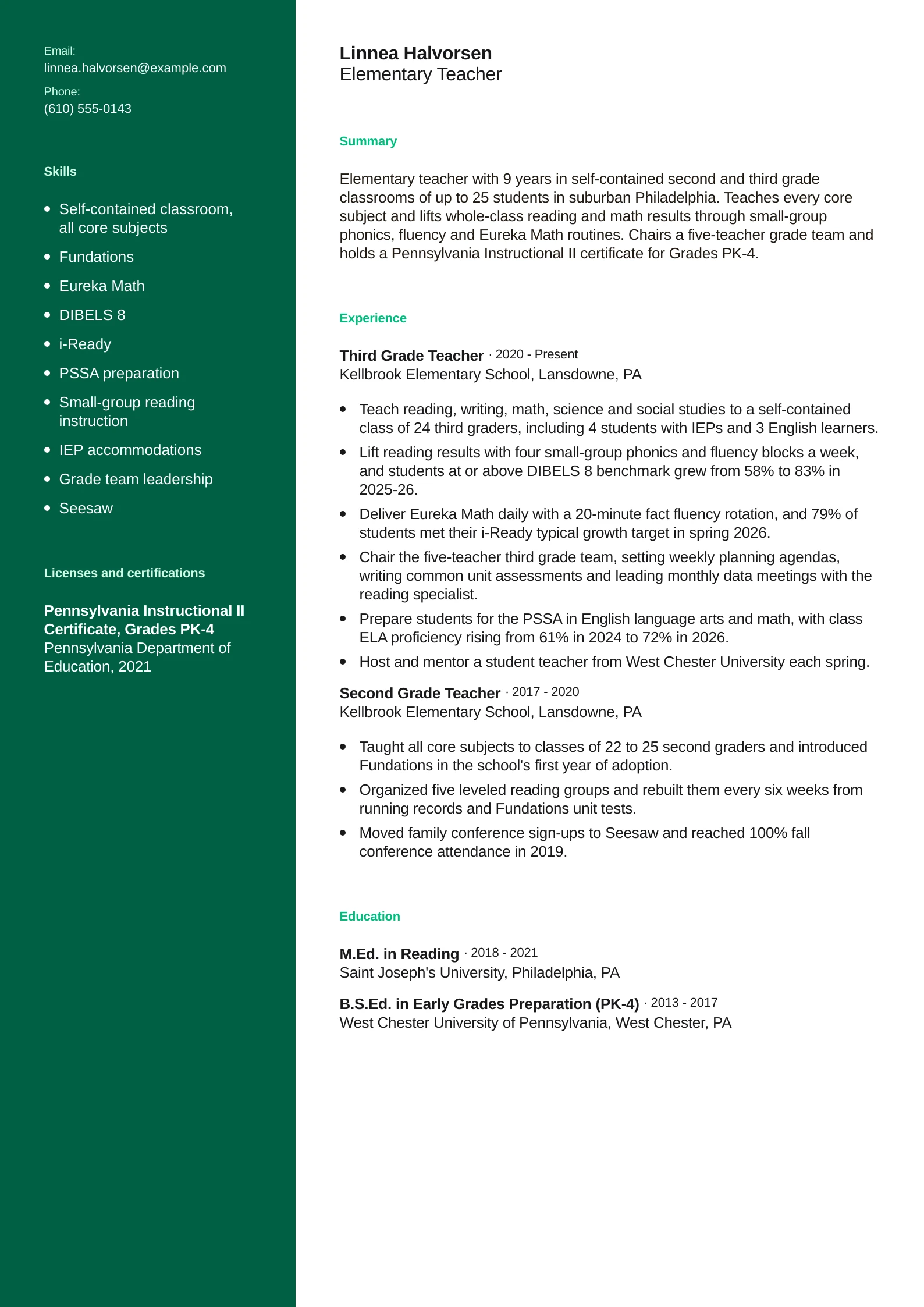
Linnea teaches every core subject to 24 third graders, and her first bullet says so before anything else. Her certificate line gives the level and the PK-4 grade band, so a principal can see at a glance that it covers the opening.
Each result names the assessment and the school year: DIBELS 8 for reading, i-Ready for math and the PSSA for state tests. Use this one if you teach a single grade in a public district and want your next application to read as a step up.
Eight more classrooms, each with a different first impression
Each resume below leads with what its school reads for first: a data cycle, a combined class, a fifth grade certificate band, a phonics adoption, a bilingual authorization, a Montessori credential, a license in process or the route in from a support role.
Charter school teacher with weekly data cycles
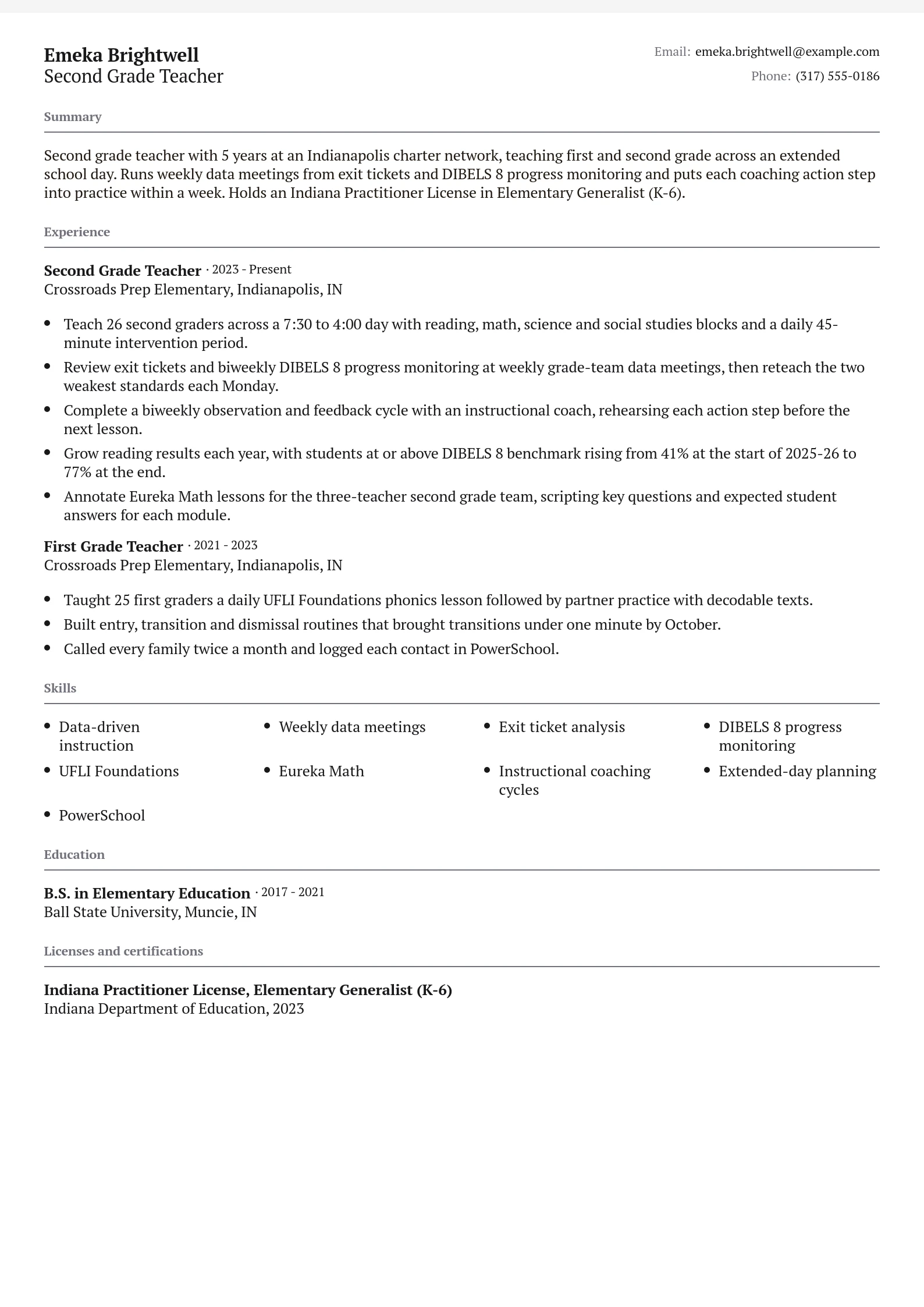
Emeka's bullets follow the week of a charter network teacher: exit tickets and DIBELS checks reviewed at a weekly data meeting, the two weakest standards retaught each Monday, and a coaching cycle every other week. His reading result runs from the beginning to the end of one school year, and his Indiana license line names its level. Use it if your school has a long day, set curricula and an instructional coach.
Data meeting and Monday reteach plan in one bullet
DIBELS 8 benchmark rate from 41% to 77% in a year
Extended day with a 45-minute intervention period
Rural combined-grade teacher on a four-day week
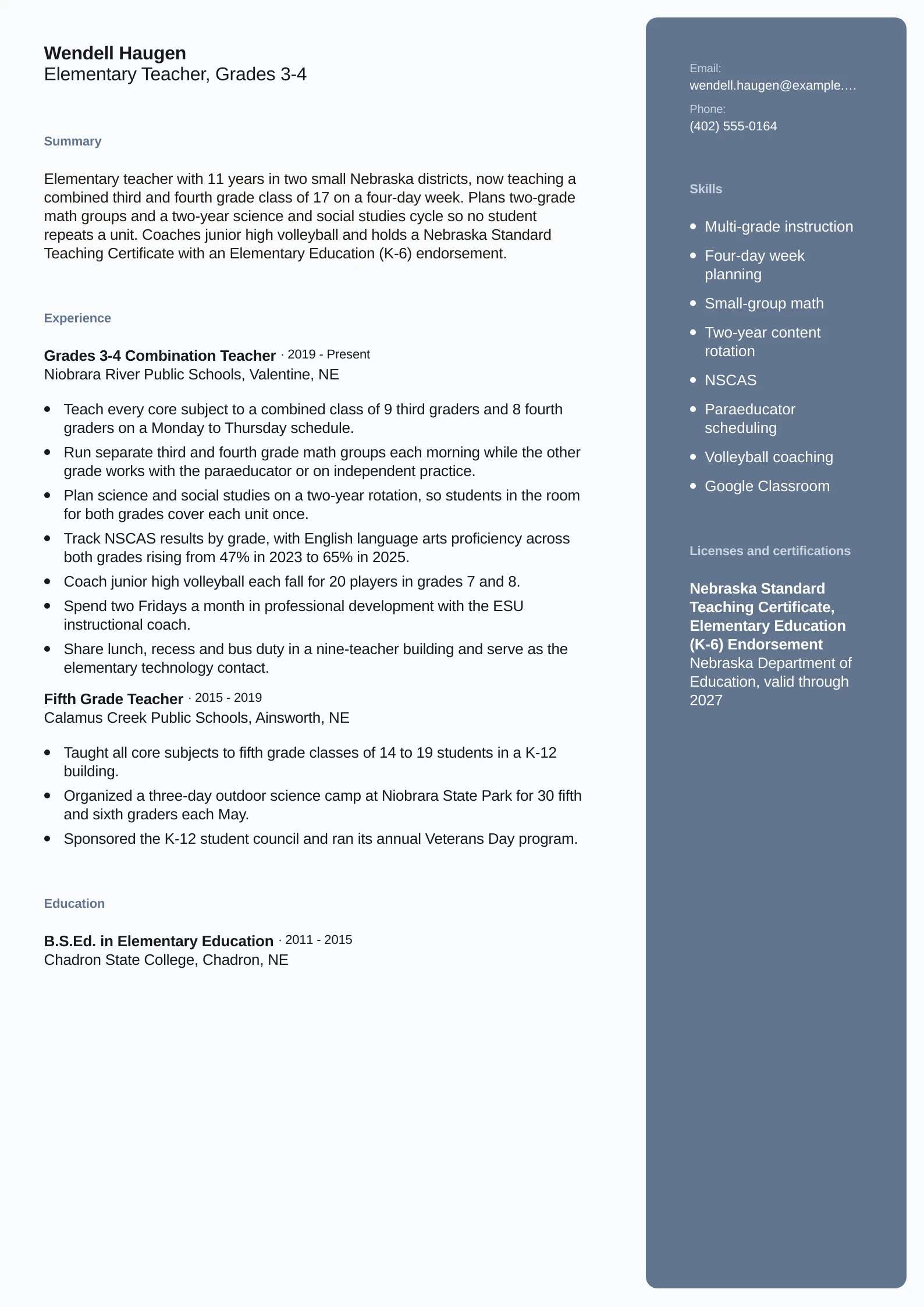
Wendell teaches 9 third graders and 8 fourth graders in one room, and his bullets explain how: split math groups, a paraeducator, and a two-year science and social studies rotation. Volleyball coaching and building duties sit under the same job because small districts hire for them. Use it if you teach a combined class, work a Monday to Thursday week or take on extra duties.
Combined class with a count for each grade
Two-year rotation so no unit repeats
Coaching and duties listed with the teaching job
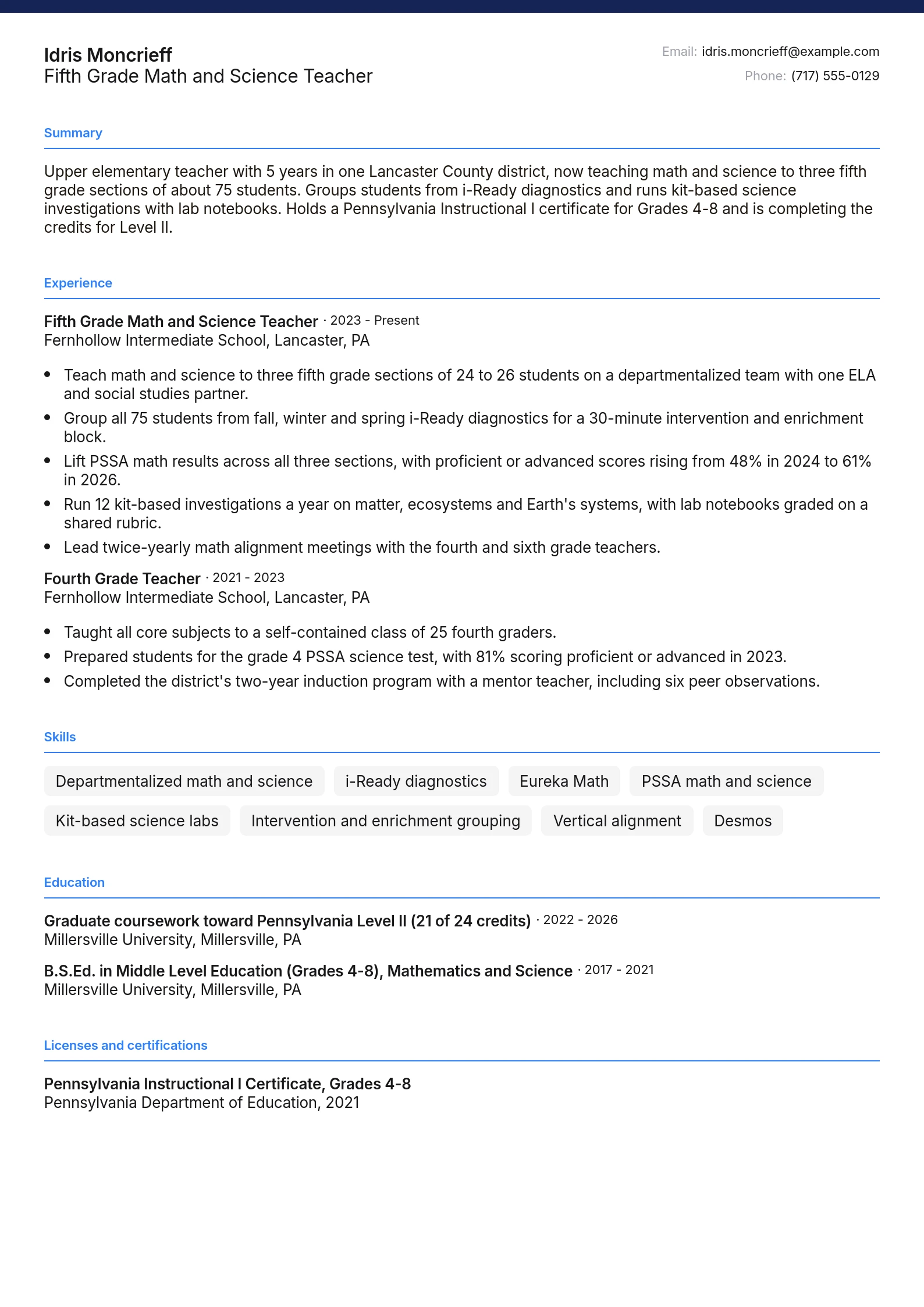
Departmentalized fifth grade math and science teacher
Idris teaches math and science to three sections, so his numbers cover all 75 students instead of one homeroom. His credentials show a Pennsylvania Grades 4-8 certificate, and his education section counts the credits left for Level II. Use it if you teach one or two subjects across several upper elementary classes, or if your certificate band starts at fourth grade.
PSSA math results across three sections
Grades 4-8 certificate with Level II credits in progress
PSSA science result from his fourth grade year
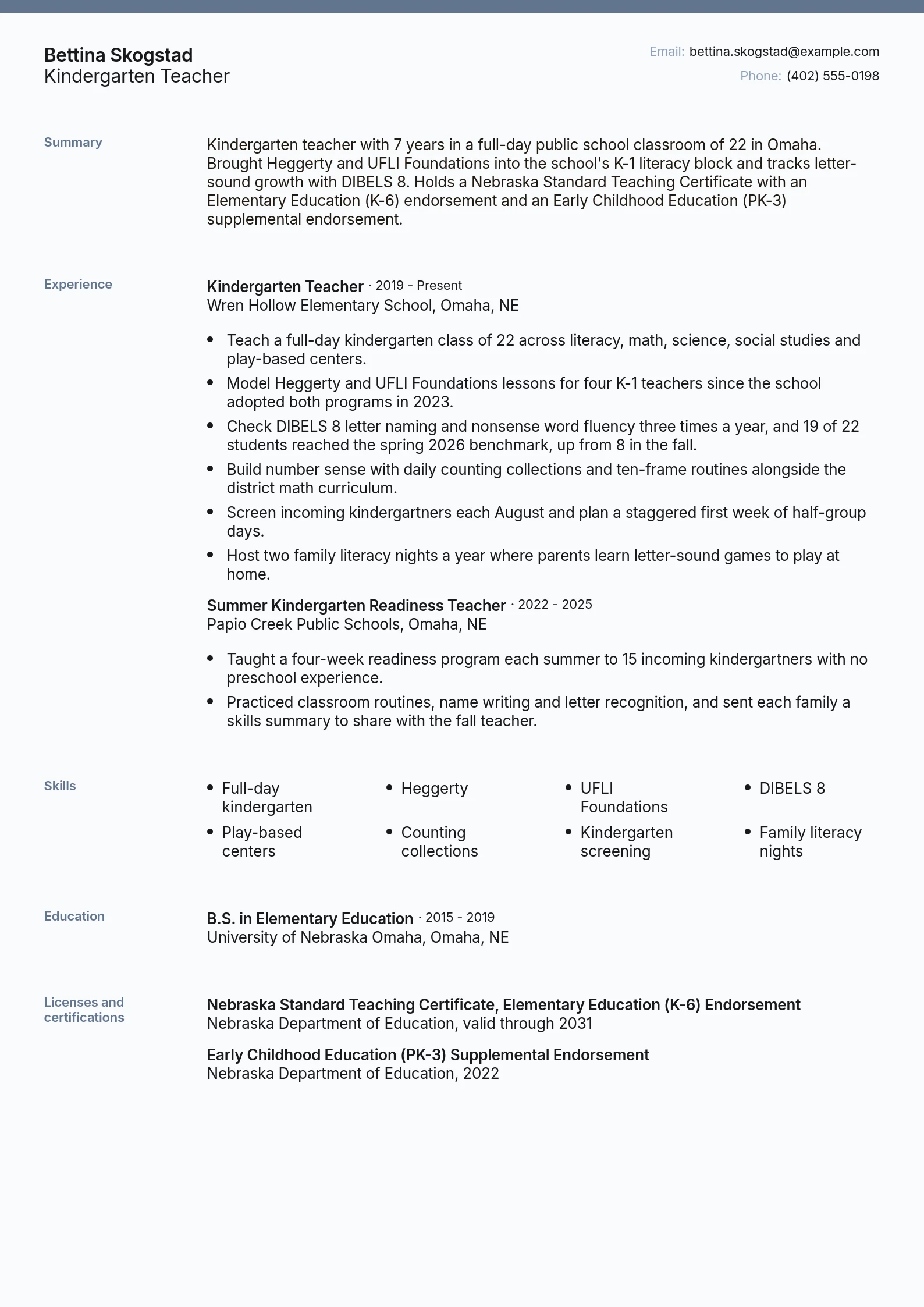
Kindergarten teacher who led a phonics adoption
Bettina's resume is built around early literacy: Heggerty and UFLI Foundations by name, DIBELS 8 letter naming and nonsense word fluency checks, and a count of children who reached the spring benchmark. Her two Nebraska endorsements sit together, so the early childhood supplement reads as an addition to K-6. Use it for a kindergarten or first grade opening in a public school.
Spring benchmark shown as 19 of 22 children
Modeling lessons for four K-1 teachers after a phonics adoption
Early Childhood supplement listed with the K-6 endorsement
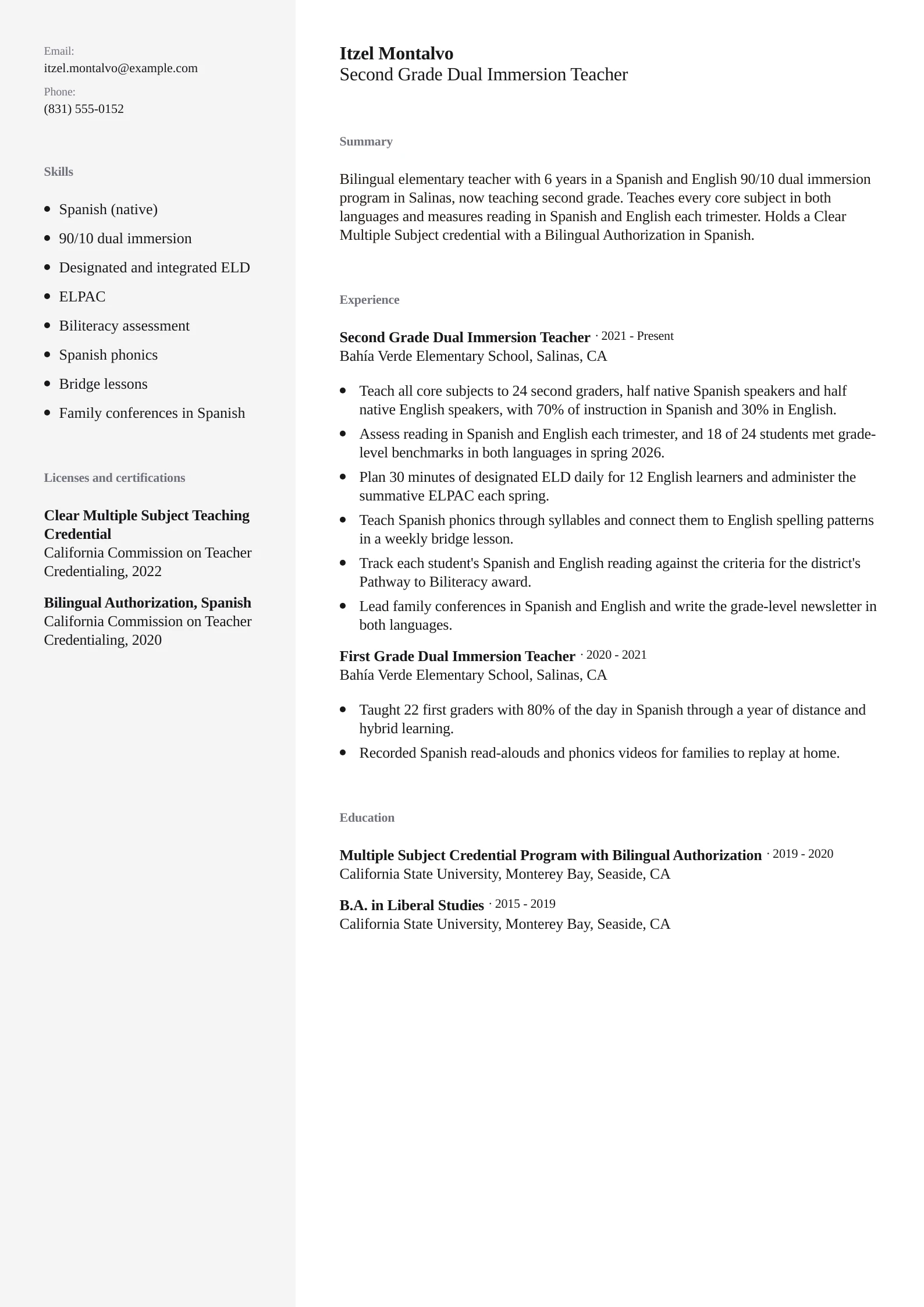
Dual immersion teacher with a Bilingual Authorization
Itzel's resume names the 90/10 model, the language split for her grade and how many native Spanish and English speakers are in the class. Reading results cover both languages, and ELD and the ELPAC get their own bullet. Her Bilingual Authorization is a separate line from the Multiple Subject credential, as California issues it. Use it for a dual-language or bilingual opening.
70/30 Spanish and English split for second grade
Benchmarks met in both languages
Bilingual Authorization on its own line
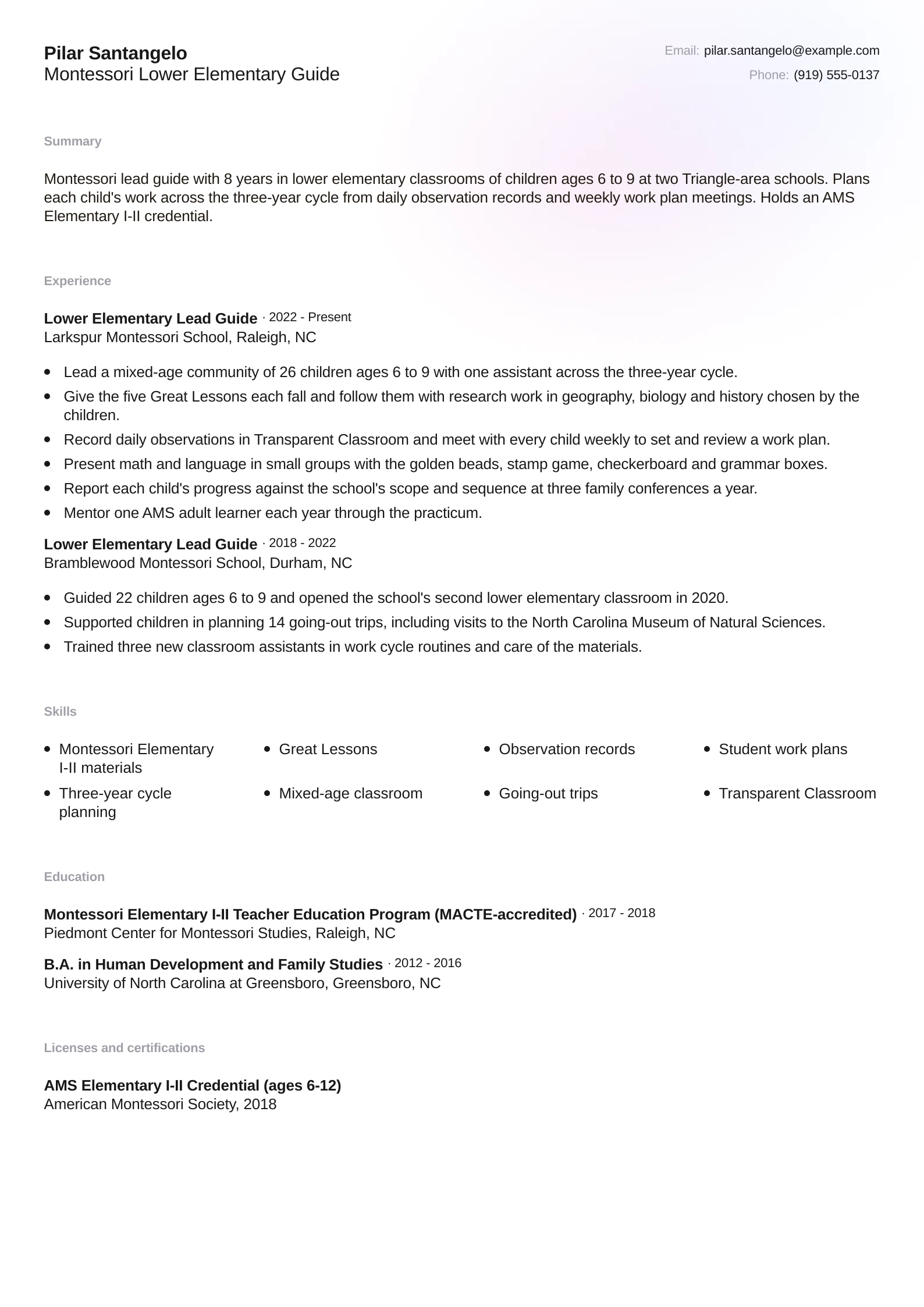
Montessori lower elementary guide with an AMS credential
Pilar's summary names her AMS Elementary I-II credential and her credentials section gives its age range, because Montessori schools screen for the credential first. Her bullets use the terms a head of school expects: Great Lessons, work plans, observation records, golden beads and going-out trips. Use it if you lead a classroom of 6 to 9 year olds or are moving between Montessori schools.
AMS credential with its 6 to 12 age range
Weekly work plan meetings and daily observation records
Great Lessons and Montessori materials by name
Fourth grade teacher moving to a new state
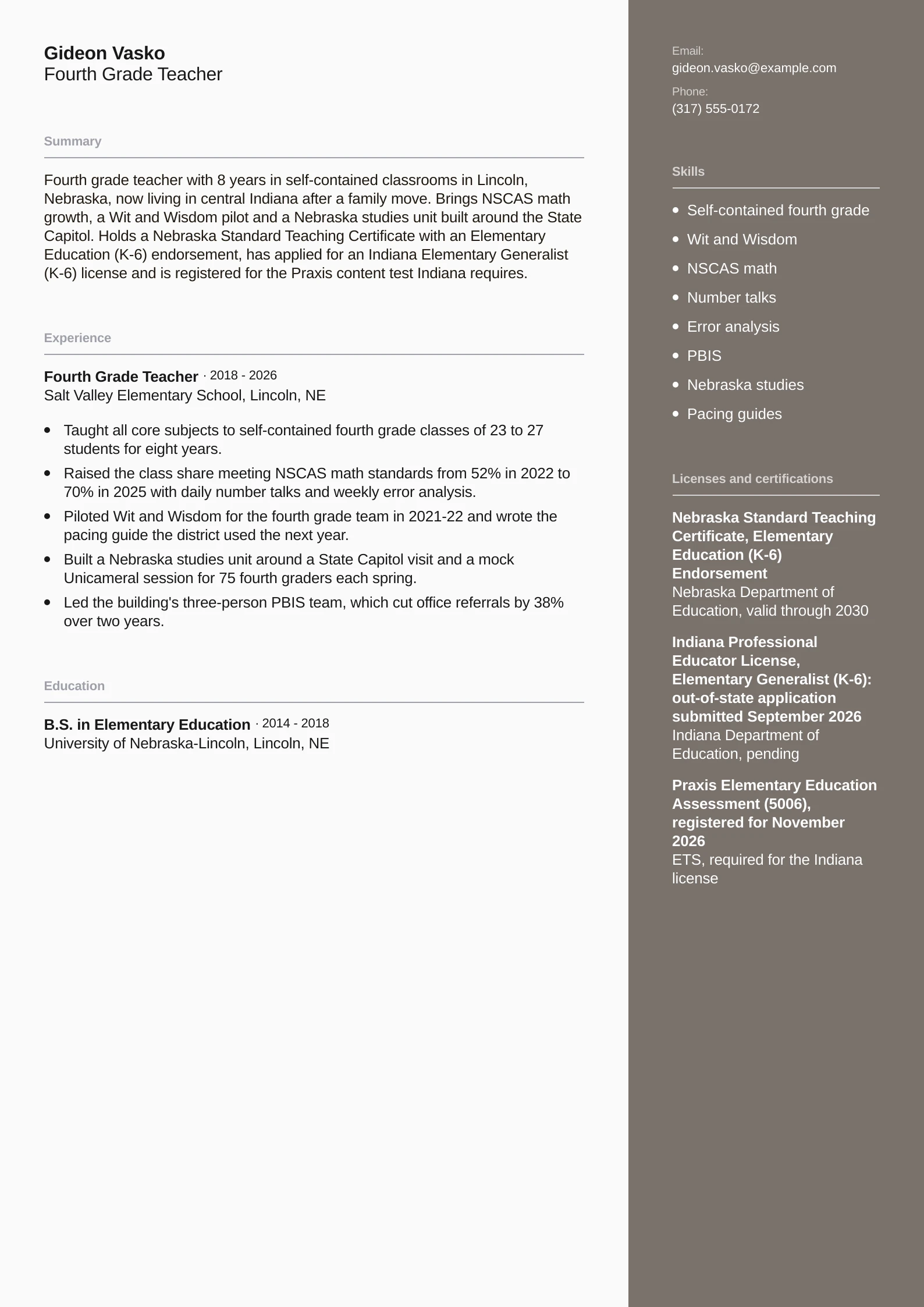
Gideon taught fourth grade in Nebraska for eight years and now lives in Indiana, so his credentials list the Nebraska certificate he holds, the Indiana license he applied for and the test he is registered to take. His summary explains the move in one sentence and spends the rest on his classroom. Use it if you are relocating and your new state's license is still in process.
Indiana application and test date on separate lines
Nebraska certificate kept as the current license
Move explained once, in the summary
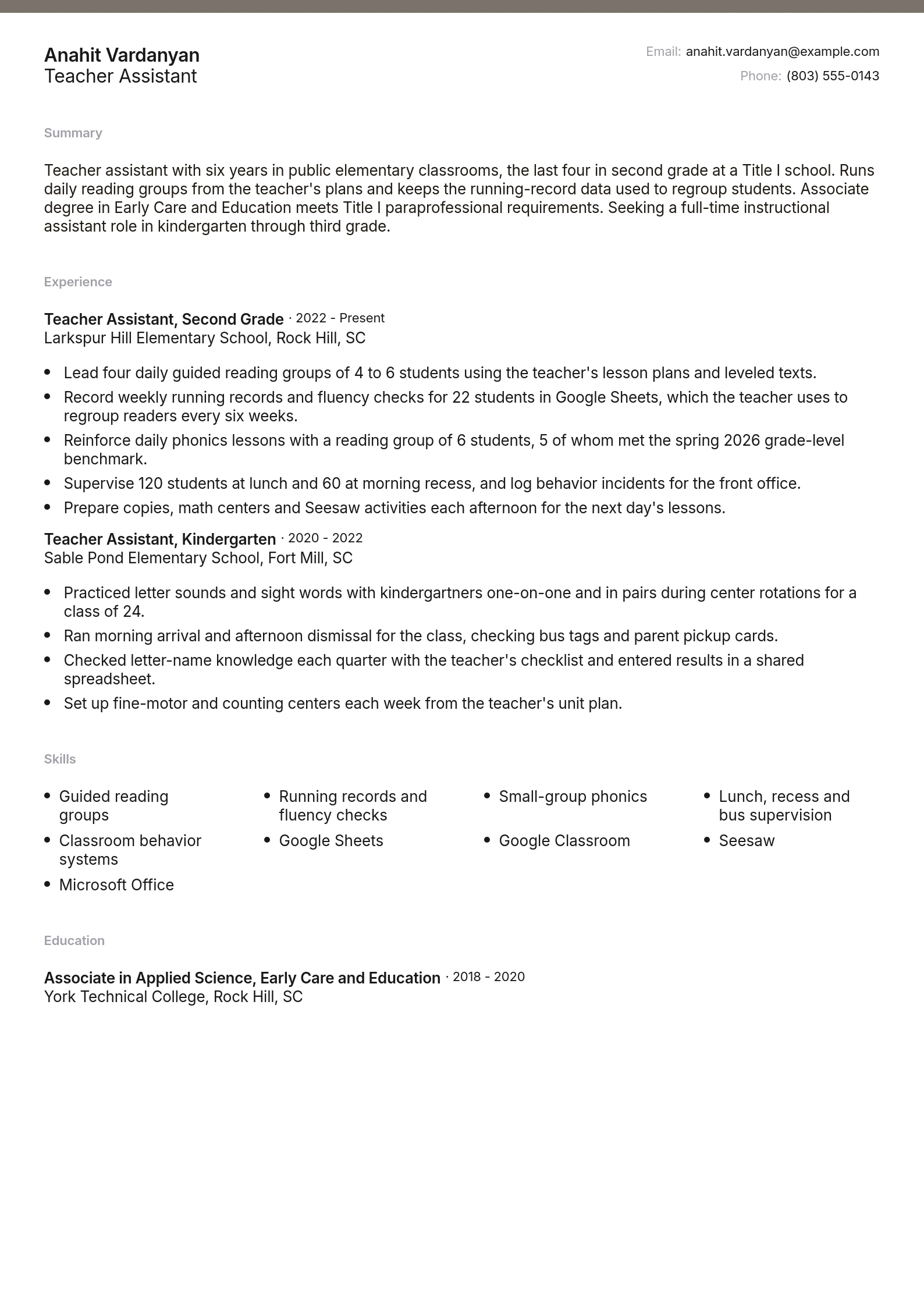
Paraeducator who became a first grade teacher
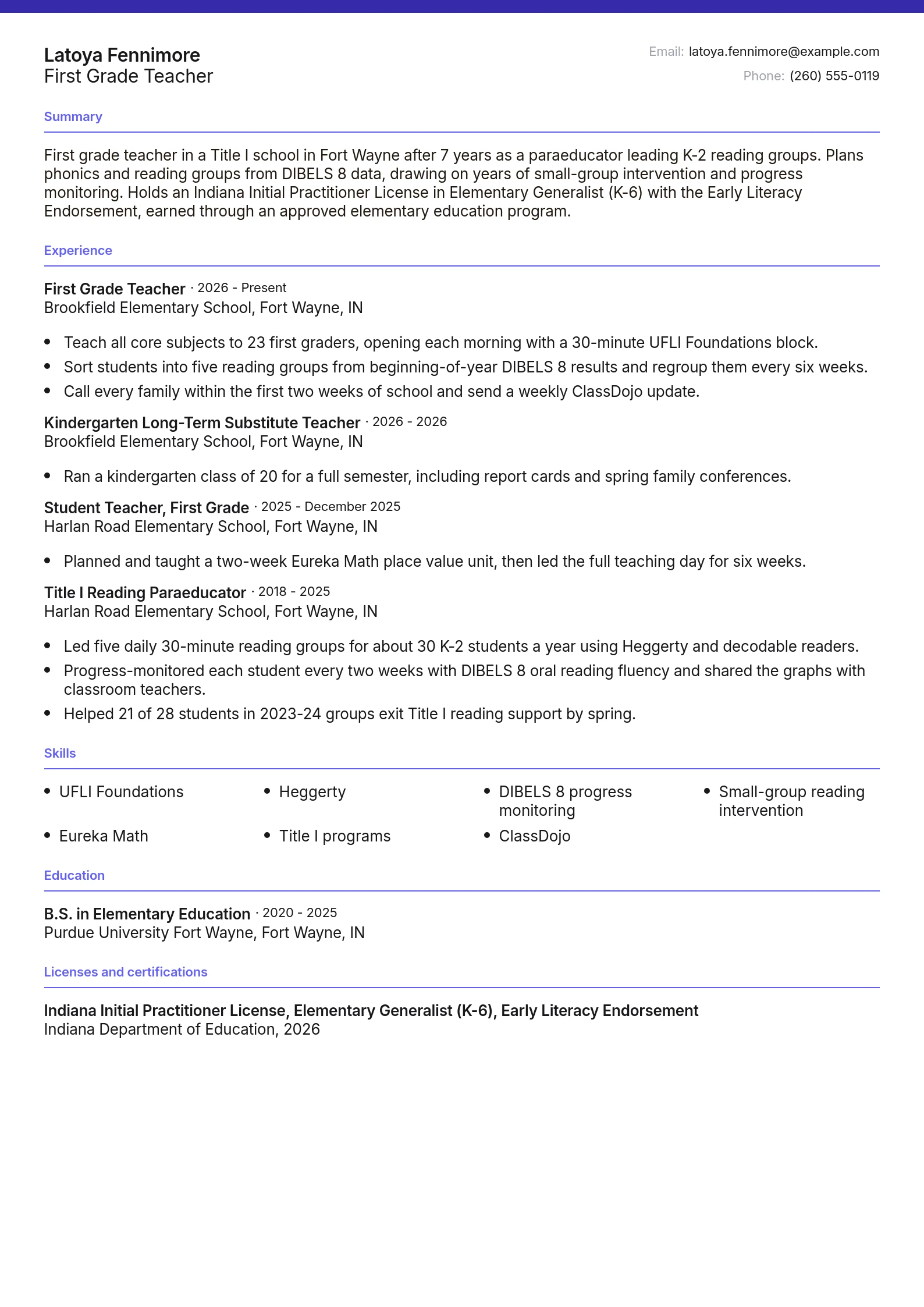
Latoya's resume lists her current first grade classroom, then a long-term substitute semester, student teaching and seven years as a Title I paraeducator. The paraeducator bullets carry the strongest evidence: daily reading groups, biweekly DIBELS 8 progress monitoring and 21 of 28 students exiting support. Use it if you are moving from a support role into your own classroom.
Paraeducator work with group sizes and results
Student teaching and substitute roles listed as experience
New Indiana license with the year issued
Write the certificate, its level and its grade band on one line
List the exact license name, its level and the grade band it covers, then name the grade band again in your summary. Principals check that your certificate covers the opening before they read your bullets, and each state draws its bands differently.
Pennsylvania splits elementary certificates into Grades PK-4 and Grades 4-8, and the 4-8 certificate covers all core subjects only through sixth grade. Nebraska's Elementary Education K-6 endorsement covers every elementary subject from kindergarten through sixth grade. A PK-4 teacher applying for fifth grade should expect that question, so say which grades you have taught.
Give the level when your state uses one. Pennsylvania teachers write Instructional I or Instructional II, and a teacher on Instructional I should list the credits completed toward Level II, since Instructional I is valid for six service years. California teachers write Preliminary or Clear before Multiple Subject and list a Bilingual Authorization on its own line with the language.
License rules differ by state and change over time, so check the posting and the state education department's site before you describe what yours covers.
Names the state, level and grades
Pennsylvania Instructional II Certificate, Grades PK-4, Pennsylvania Department of Education, 2021
Leaves the principal to guess
Certified elementary teacher, K-5
Name the phonics, math and assessment programs you teach with
Your skills section should name the curricula and assessments you use, because every elementary teacher claims differentiated instruction and only a real classroom has a program list. Postings rarely name tools, so the specifics have to come from you.
Group the list the way a principal reads it: phonics, reading, math, then assessment. K-2 teachers should lead with phonics and phonemic awareness programs such as UFLI Foundations, Fundations or Heggerty. Teachers in grades 3 to 5 should put the reading curriculum, math program and state test first.
Add the classroom skills that come up in interviews: IEP accommodations, English learner support, small-group rotations and the family app you use, such as Seesaw or ClassDojo. Then put each program in a bullet too, with the grade and the result, so the skills list matches the experience.
If your school wrote its own curriculum, name its parts instead, such as a district phonics scope and sequence and decodable readers.
Area
Programs to name if you use them
How it reads in a bullet
Phonics and phonemic awareness
UFLI Foundations, Fundations, Heggerty
Teach a daily 30-minute UFLI Foundations block to 23 first graders
Reading and writing curriculum
Wit and Wisdom or your district's adopted program
Piloted Wit and Wisdom for the fourth grade team and wrote its pacing guide
Math
Eureka Math
Deliver Eureka Math daily with a 20-minute fact fluency rotation
Screening and benchmarks
DIBELS 8, i-Ready
Group 75 students from fall, winter and spring i-Ready diagnostics
State and language tests
PSSA in Pennsylvania, NSCAS in Nebraska, ELPAC for English learners in California
Prepared students for the grade 4 PSSA science test, with 81% proficient or advanced
Show one reading result and one math result for the whole class
Pick one reading measure and one math measure, and give the start and end numbers with the assessment and school year. "Students at or above DIBELS 8 benchmark grew from 58% to 83% in 2025-26" tells a principal more than a list of every subject you improved.
Match the measure to the grade. Kindergarten and first grade teachers should report letter naming, nonsense word fluency or oral reading fluency on DIBELS 8. Teachers in third grade and up can add state test proficiency, such as PSSA or NSCAS, across two or three years. If your school uses i-Ready, give the share of students who met their typical growth target.
Use counts when the class is small. "19 of 22 students reached the spring benchmark" reads as a real class, while 86% of 22 children reads like a district report. A combined class can report each grade or the whole room, as long as you say which.
Departmentalized teachers should report across every section they teach and give the total number of students. Montessori guides rarely have grade-level benchmarks, so describe the records instead: daily observations, weekly work plans and progress against the school's scope and sequence.
New teachers can take results from paraeducator or student teaching work. "Helped 21 of 28 students exit Title I reading support" is growth a principal will ask about, even though the group met outside your own classroom.
Reorder the same jobs for charter, rural, dual-language and Montessori schools
Keep your jobs and dates the same and change which facts come first in the summary and the top bullets. Each setting reads for something different, and the posting usually tells you what.
Rewrite the second sentence of your summary for each application and move the matching bullet to the top of your current job. Then adjust the skills section: a dual-language school wants the language and model listed, and a charter network wants the assessments and the coaching cycle.
Rural postings sometimes say the grade assignment will follow your strengths, so list every grade you have taught and any combined classes, with student counts.
Setting
What the posting asks for
Put this first
Example to open
Charter network
Data-driven instruction, coaching, a longer day
Weekly data meetings, coaching cycles and growth from the beginning to the end of the year
Emeka, second grade
Rural district
Flexible grade assignment, a four-day week, extra duties
Combined grades with counts, the schedule and any coaching or duties
Wendell, grades 3 and 4
Dual-language school
Bilingual authorization, a named immersion model
Authorization and language, the model and its split for your grade, results in both languages
Itzel, second grade
Montessori school
AMS, AMI or MACTE-accredited credential, years at the level
Credential and age range, the three-year cycle, observation records
Pilar, ages 6 to 9
Public district
State certificate for the grade band, state tests
Certificate level and grade band, benchmark and state test results