A tutoring manager matches you to students by subject, grade band and session format, so the top of your resume should answer those three questions before anything else. The examples below cover a full-time math tutor inside a school, a college peer tutor on work-study and a private writing tutor with evening and weekend clients.
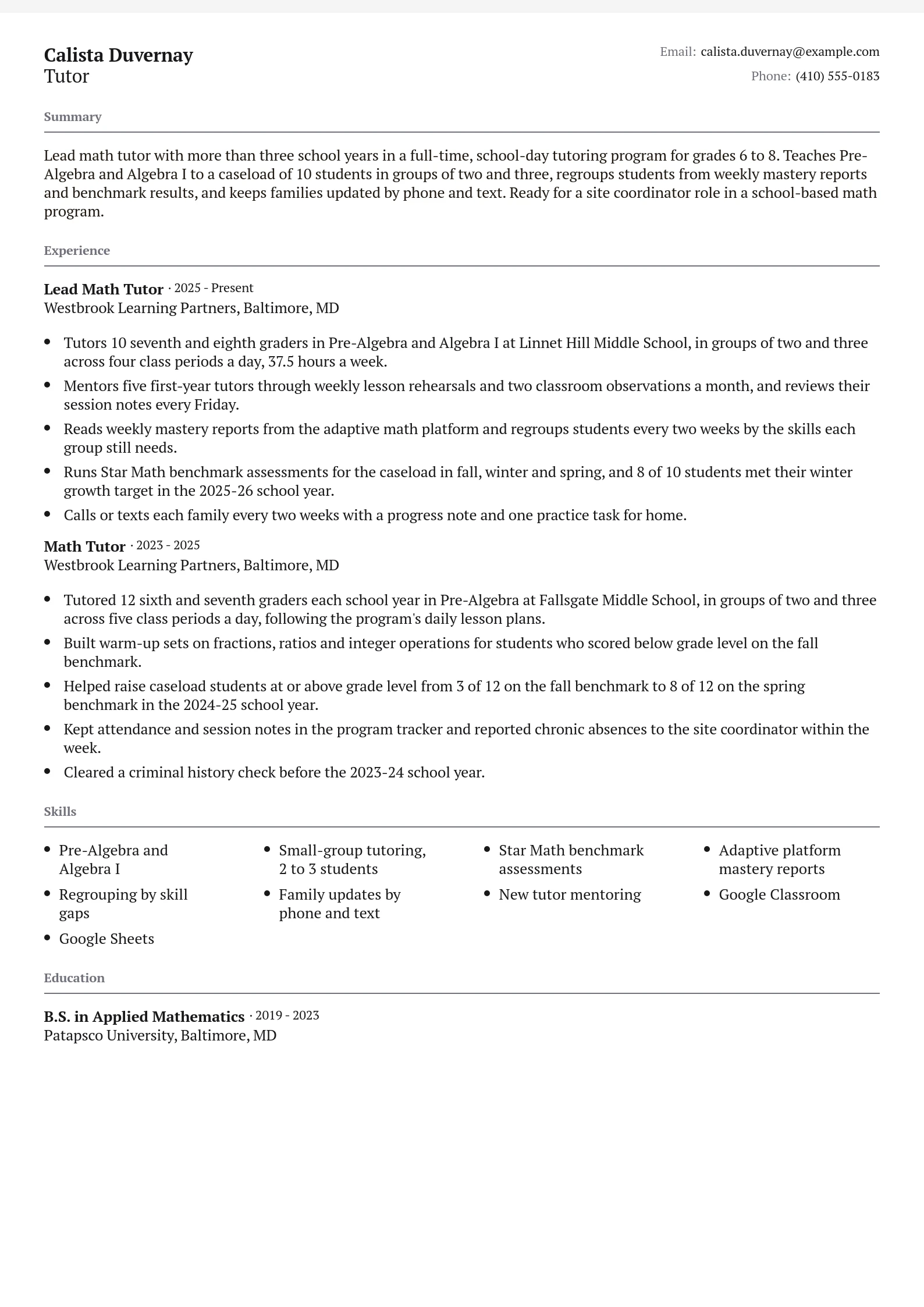
Calista's resume opens with the facts a program director checks first: Pre-Algebra and Algebra I, grades 6 to 8, groups of two and three, 37.5 hours a week in school hours. Her bullets then show how she read benchmark and mastery data and regrouped students because of it.
The promotion to lead tutor sits as a separate role above her first two years, so the mentoring of five new tutors reads as added responsibility. Use this layout if you work full time inside a school, or want to.
Campus and private tutor examples
Pick the one closer to your situation: a student tutoring around a class schedule, or an independent tutor whose clients are families.
Student tutor on work-study
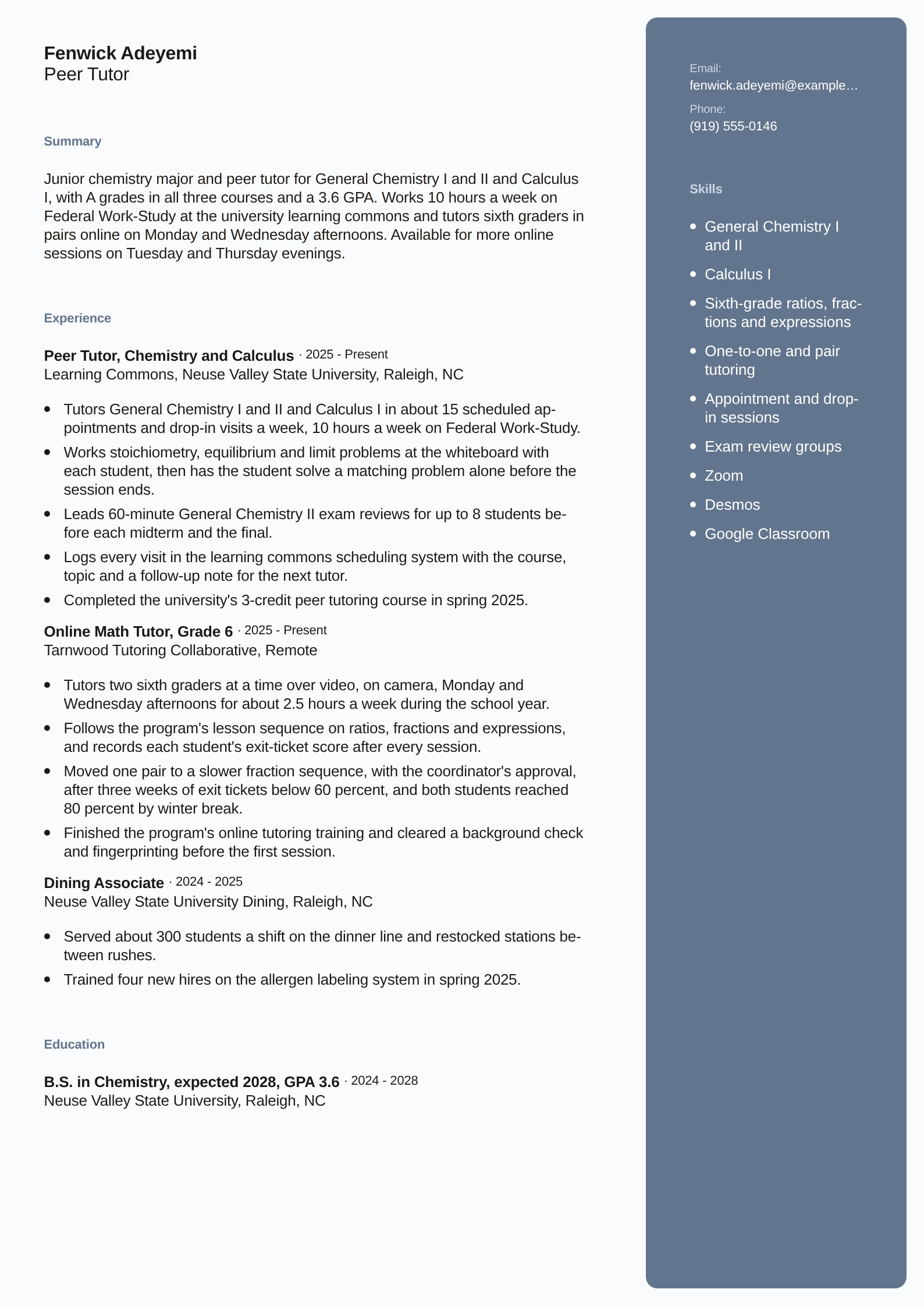
Fenwick's resume suits a college student whose tutoring is a campus job. His summary names the three courses he tutors, his A grades in them and his 3.6 GPA, which a campus learning center may check before it hires a tutor. His work-study hours, the Monday and Wednesday online sessions and his open evenings are all stated, and a dining job stays short at the bottom to show steady work without crowding out the tutoring.
Course grades and GPA in the summary, where eligibility is checked
Two tutoring jobs with separate hours and formats
Exit-ticket scores used to slow a lesson sequence
Freelance tutor with private clients
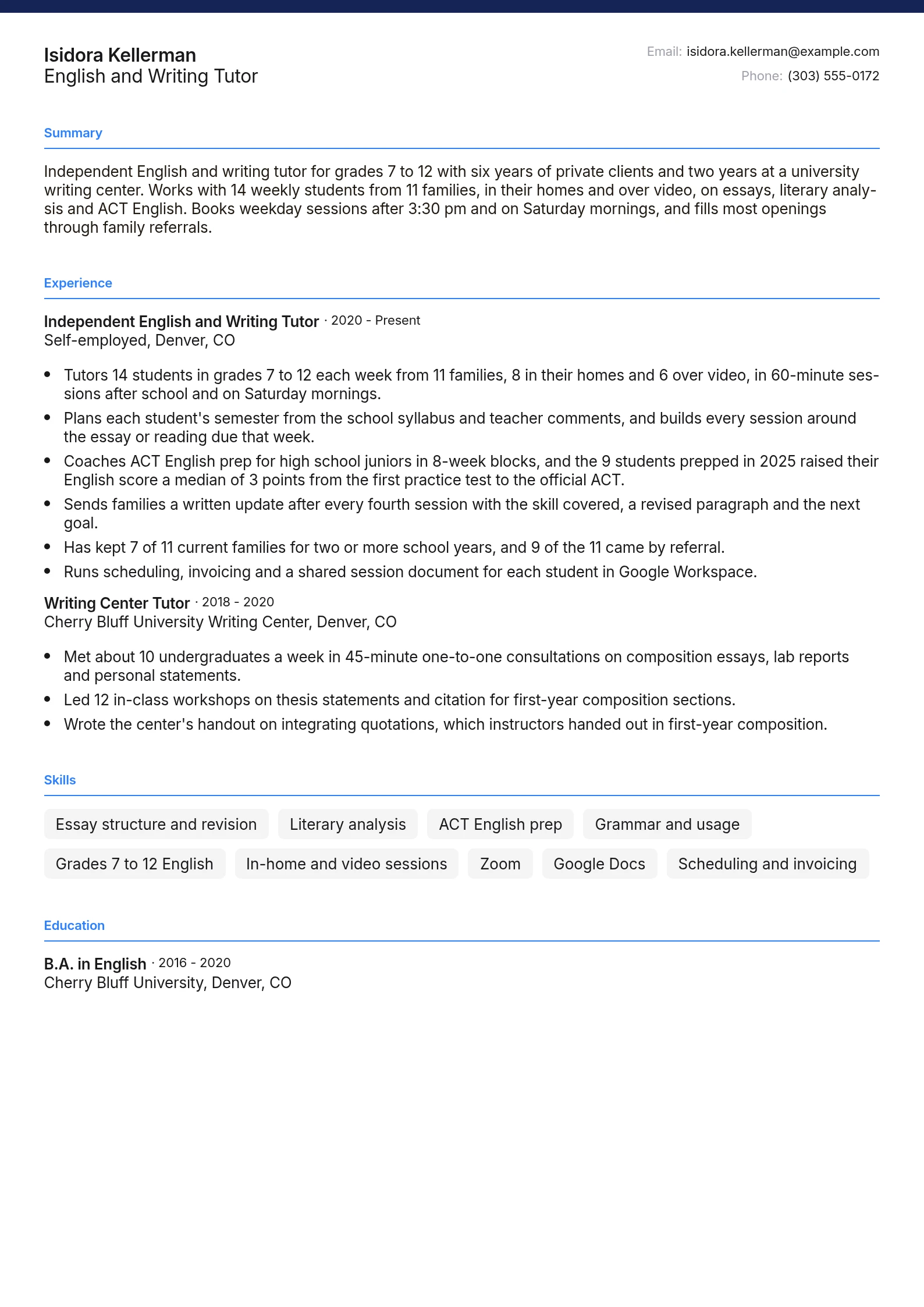
Isidora's resume suits an independent tutor whose clients are families rather than an employer. She lists her practice as self-employed, describes clients by grade band and how long they have stayed, and gives the split between in-home and video sessions. Her ACT English bullet reports a median score gain with the number of students behind it, and her two years at a university writing center sit below as earlier one-to-one work.
Student count, retention and referrals in place of an employer name
In-home and video split with after-school and Saturday hours
ACT English results with the number of students stated
List each course and grade band you can tutor
Write the exact courses and grade levels you tutor, because tutoring programs match tutors to students by subject and grade band. "Math, all grades" gives a manager nothing to match. "Pre-Algebra and Algebra I, grades 6 to 8" points to a specific caseload.
Put the list in two places. Name the courses in your summary, then repeat them in the bullets for the job where you taught them, with the grade band and group size: "Tutored Algebra I to ninth graders in groups of three." Your skills section can hold the short forms, such as "Algebra I", "General Chemistry II" or "ACT English", so a quick scan picks them up.
Order the courses by how often you could take a student in them. A chemistry major who also covers Calculus I should list chemistry first. If you can teach calculus, physics, statistics or essay writing, name it even if you tutored it less often, because one large online platform lists those among its high-demand subjects.
Name the age group on every tutoring role. Middle and high school programs ask about it directly, and one school-based program's lead tutor posting asks for a full year of tutoring middle or high school students. A role that says "high school juniors" counts toward that. A role that says "students" doesn't.
State your tutoring hours and session format
Put your weekly hours and session format in your summary, because a tutoring manager has to fill specific time slots before anything else. Tutoring jobs come in very different shapes, and the line you write depends on which one you're applying for.
Write days and times rather than "flexible": "Available Tuesday and Thursday 4 to 8 pm and Saturday mornings." If you have classes or another job, list only the hours left over, so nobody books you into a clash. Say whether you tutor one to one, in pairs or in small groups, and whether you work in person, online or both.
Setting
Typical schedule
What to write
School-day program
Full time inside a school during school hours, such as 37.5 hours a week
Full-time availability for the school year, the grades you served and your group size, such as "groups of two and three"
After-school or work-study program
A few hours on set afternoons, such as two afternoons a week for about 2.5 hours
The days and times you can cover for the whole school year, and whether you hold a Federal Work-Study award
Campus learning center
Set weekly hours around your class schedule
Hours a week, appointment or drop-in format, and the courses you tutor
Online platform
A weekly minimum, such as at least five hours, scheduled week by week
Weekly hours, your time zone and the video tools you use, such as Zoom or Google Meet
Private clients and test prep
Weekday evenings and weekends, when students are out of school
How many students you see each week, the split between in-home and video sessions, and the evenings and weekend days you book
Show progress with benchmarks, exit tickets and family updates
You can show that students improved without standardized test scores by naming what you measured, how often, and what you changed after reading it. One school-based tutoring program lists analyzing student data to differentiate instruction among a tutor's core duties, so a bullet that shows that loop matches the job itself.
Use the measures your setting already has. School-based tutors can cite benchmark assessments such as Star Math or mastery reports from an adaptive math platform. Campus tutors can cite exit problems solved without help, or repeat visits from the same students. Private tutors can describe an essay grade before and after revision, or a practice test score at the start and end of a prep block.
Give the count behind any result. "8 of 10 students met their winter growth target" is believable. "Improved student scores by 40%" makes a reader ask how many students and on which test. Then say what you changed because of the data: regrouped students, slowed a lesson sequence, added a warm-up set on fractions.
Family contact counts as evidence too. "Calls or texts each family every two weeks with a progress note" shows the parent communication that school programs list as a duty, and private tutors can describe the written updates they send after sessions.
Names the measure, the change and the count
Regrouped 12 sixth graders every two weeks using mastery reports from the adaptive math platform, and 9 of 12 reached grade level on the spring benchmark.
Claims growth with nothing to check
Helped students improve their math skills and confidence through patient one-on-one support.
Answer the background check and eligibility questions early
Tutoring programs that place you with minors check your age, work eligibility and background before you start. One school-based tutoring nonprofit asks that you're 18 or older with a high school diploma or GED, hold US work authorization and clear a criminal history check before training starts. Some work-study tutoring roles add fingerprinting.
If a past tutoring or youth job already cleared you, add a short line under that role, such as "Cleared a criminal history check before the 2023-24 school year." Leave case numbers, your date of birth and your Social Security number off the resume. Employers collect those through the application.
Online platforms set their own gates. One large platform asks for college sophomore standing or a four-year degree, a valid SSN, US work eligibility and at least five hours a week. If you're a student, put your expected graduation year in the education line, such as "B.S. in Chemistry, expected 2028", so a screener can see your standing without asking.
Campus learning centers often check your grades in the course you'll tutor. UNC-Chapel Hill's Learning Center, for example, asks for a 3.0 GPA after one semester, an A or B in the course, and a 3-credit peer tutoring course before paid work. If you meet a rule like that, put your GPA and course grades in your summary, and list the training course with the semester you finished it.
Count peer, volunteer and family tutoring as experience
Any regular, scheduled teaching counts as tutoring experience if you can name the subject, the students and how often you met. Peer tutoring at a campus learning center, a volunteer homework club, a library reading program and paid sessions with a neighbor's child all qualify. List each one as a role with dates, not as a line in your skills.
Give each one a title that says what you did and where: "Volunteer Reading Tutor, Eastside Library Homework Club" or "Private Math Tutor, Self-employed." For family or neighbor clients, describe the student by grade and subject, such as "a ninth grader in Algebra I, weekly for one school year", and leave names out.
Write the same details a paid role would have: hours a week, session length, group size and what you used to plan sessions. A volunteer who ran 90-minute Saturday sessions for eight fourth graders for two years has far more to show than "helped kids with homework" suggests.
Related jobs such as teaching assistant, after-school aide or camp counselor belong in the same section when you describe the teaching part of the work. If a posting asks for a set amount of experience, such as one year with middle or high school students, put the grade band on every role that counts toward it so the screener can add it up.