Principals and HR screeners check one thing on a teacher assistant resume before anything else: whether you meet the paraprofessional rule by degree, college credits or a passed test. The four examples below cover a Title I reading assistant, a first-time applicant with a test pass, a 1:1 special education para and a bilingual assistant teacher.
Second-grade assistant qualified by an associate degree
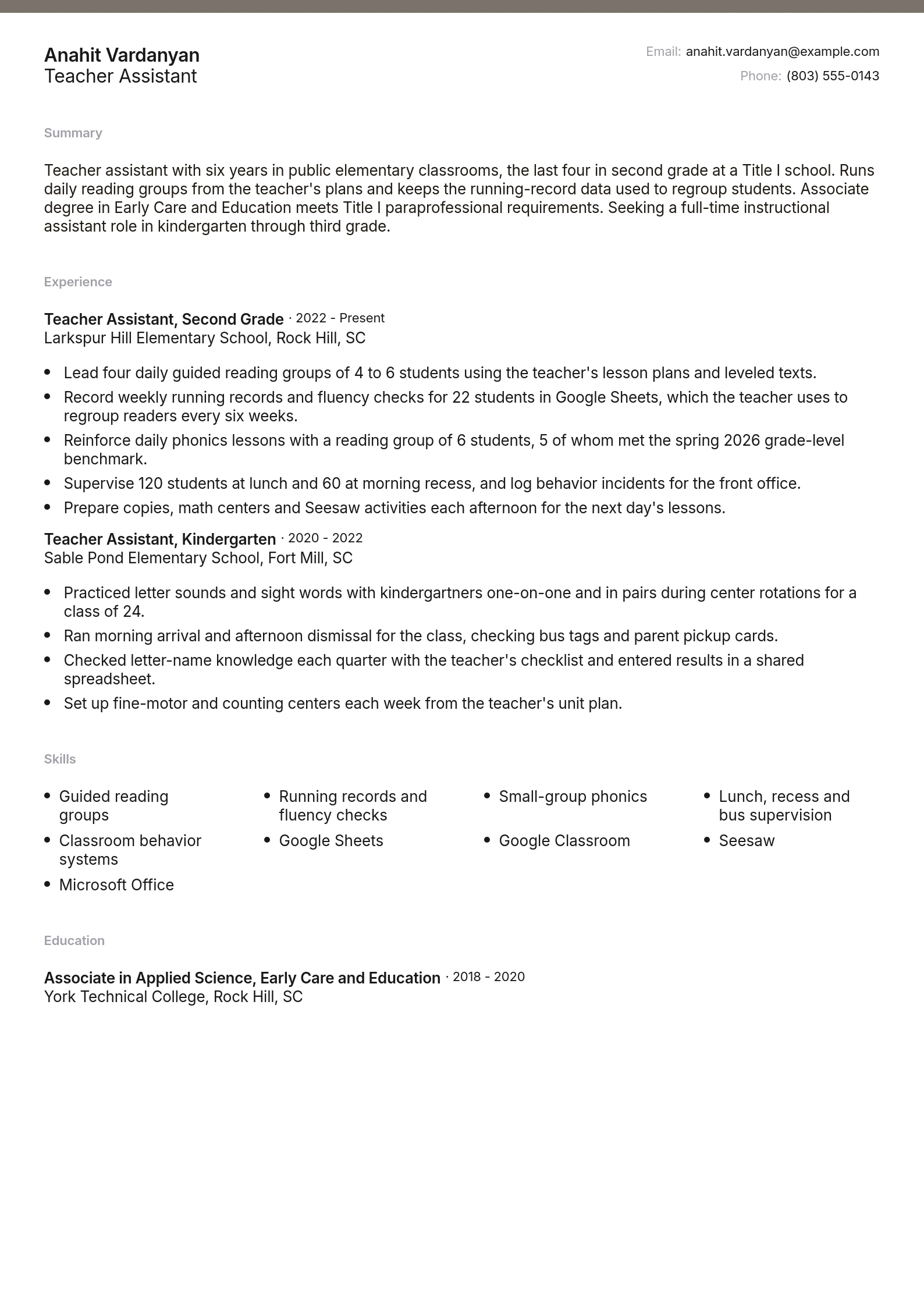
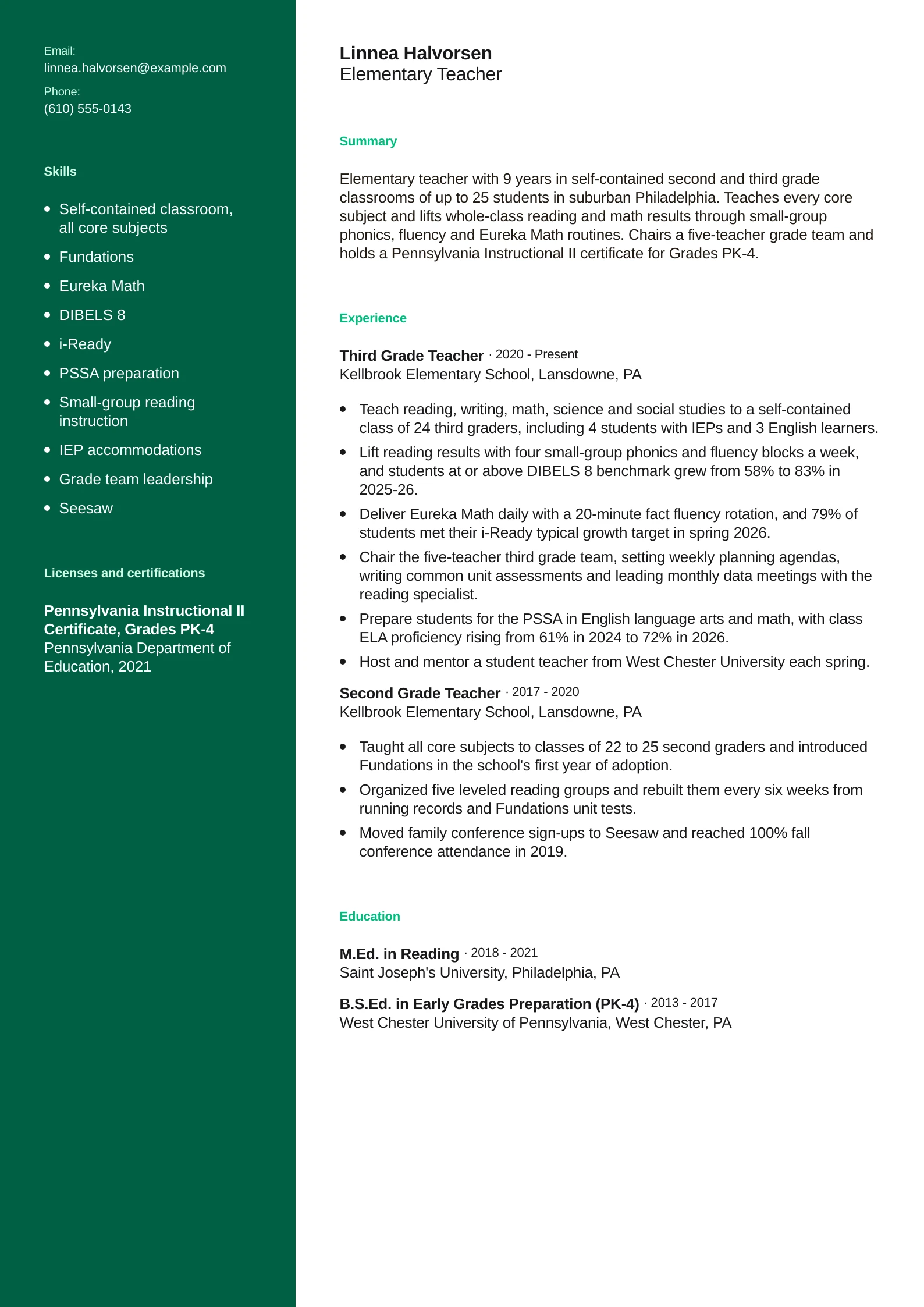
Anahit's resume is written for a Title I elementary posting, so her qualification route is in the summary: an associate degree, named in full, with the college and years in the education section. A screener checking the paraprofessional rule finds it in the first lines.
Her current job leads with reading groups because that is most of her day. Her reading bullets give the group size and what she recorded for the teacher, such as running records in Google Sheets that drive regrouping every six weeks. Lunch and recess supervision gets its own line with student counts, because principals need assistants who can cover those duties.
Her earlier kindergarten job uses past tense and different work (centers, sight words, arrival and dismissal), so six years read as growth, not repetition.
Examples for first-time, special education and bilingual roles
Pick the one closest to your posting. A first paraeducator job is screened for a test pass, a 1:1 role for IEP data and personal care, and a bilingual role for interpreting and language groups.
Teacher assistant resume with no paid school experience
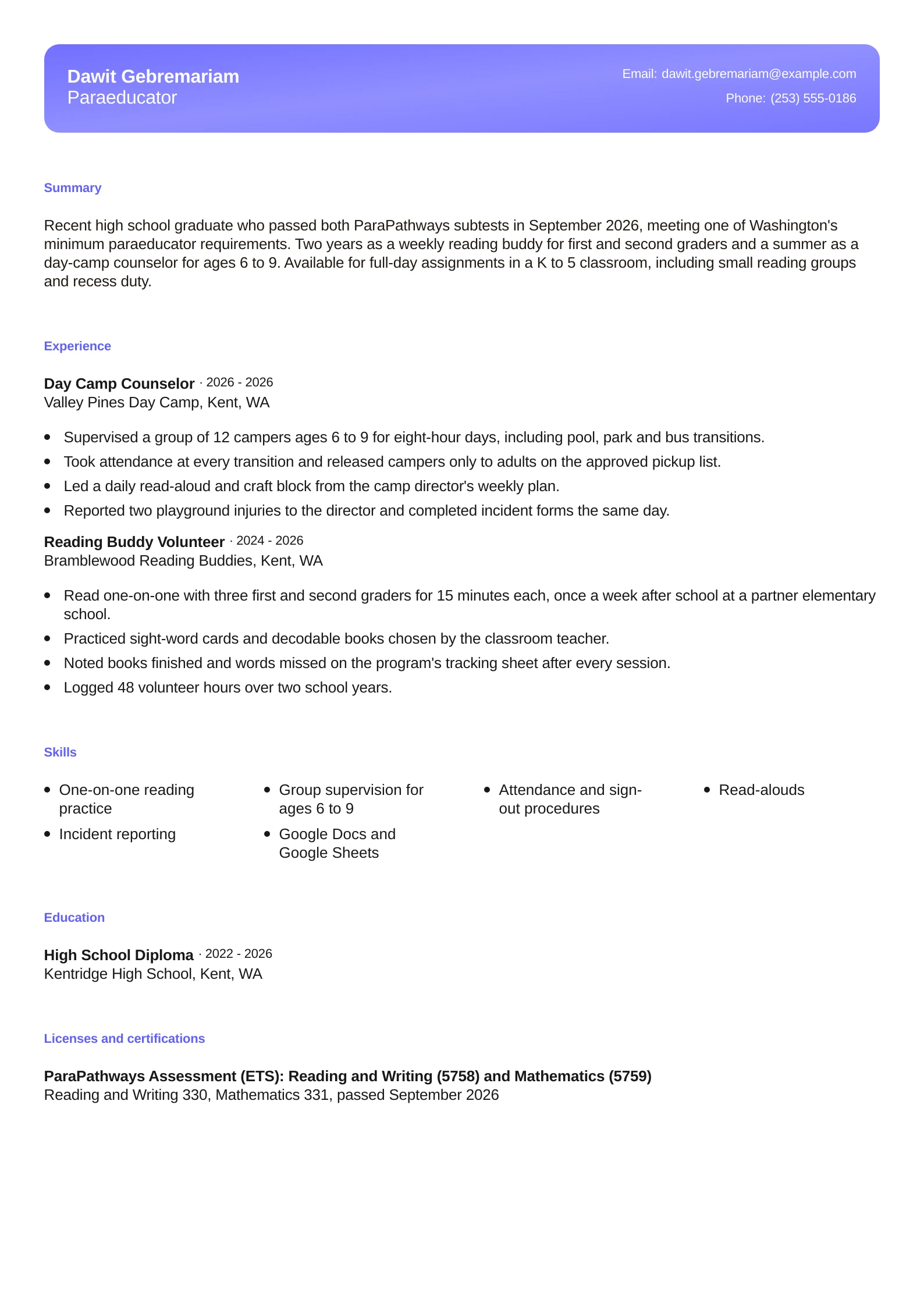
Dawit has never been paid to work in a school, so his credentials section carries the application: both ParaPathways subtests named with their test numbers, his scores and the month he passed, which meets one of Washington's minimum paraeducator requirements. His day-camp and reading-buddy roles sit under experience with group sizes, ages, weekly minutes and logged hours. Copy this layout if you're a recent graduate, parent volunteer or camp counselor applying for a first paraeducator job.
Both ParaPathways subtests named, scored and dated
Volunteer reading hours counted across two school years
Camp sign-out and incident duties that carry over to recess
Special education paraprofessional resume (1:1)
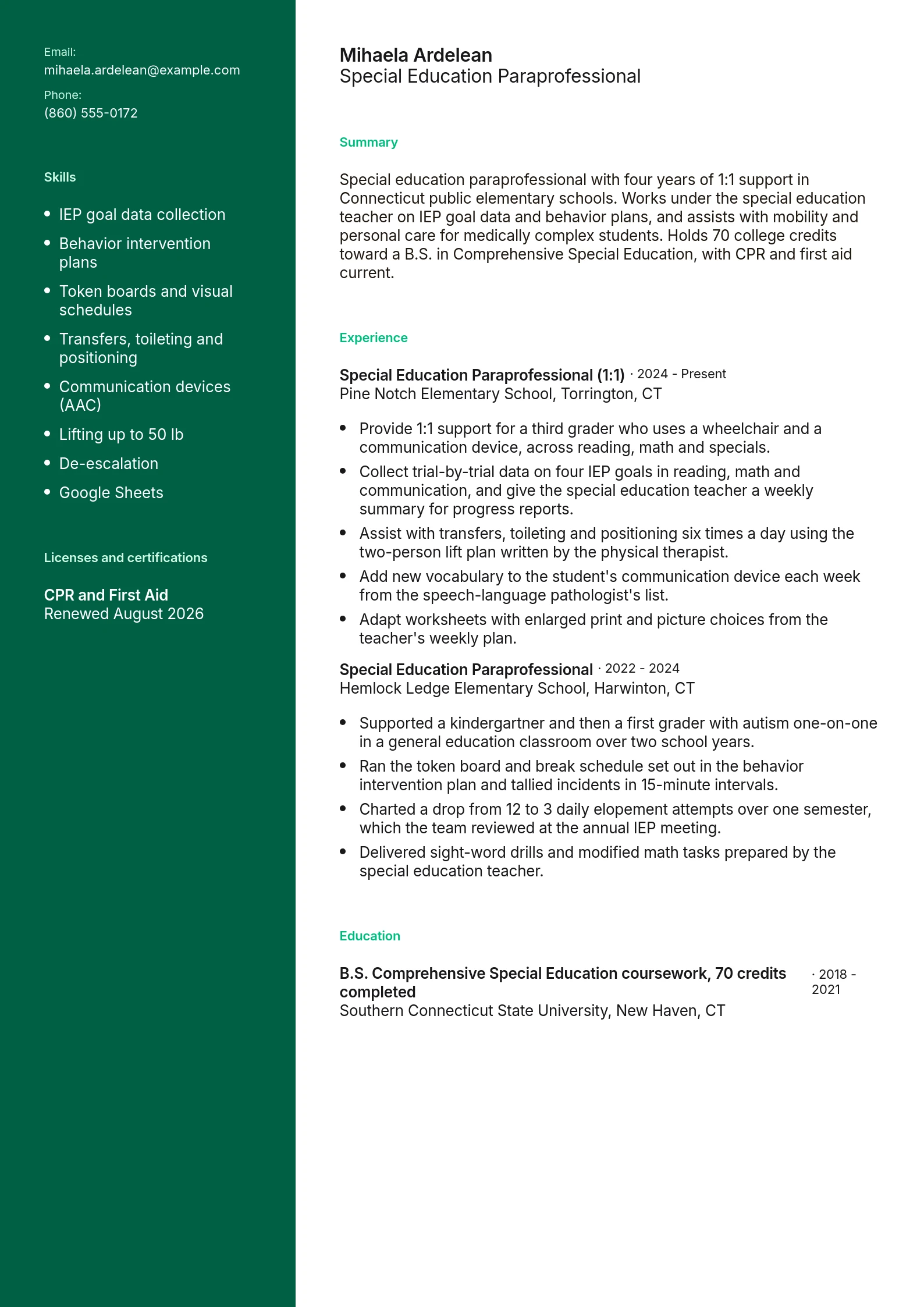
Mihaela's bullets name the IEP goal areas she takes data on, the behavior plan tools she ran and the personal care she gives, including transfers and toileting, because 1:1 postings screen for exactly that. Her 70 college credits appear with the degree they count toward, which shows the two-years-of-college route. CPR and first aid sit in credentials with a renewal date. Use it for 1:1, resource room or self-contained classroom applications.
Weekly IEP data summaries for progress reports
Transfers, toileting and lift plan duties stated plainly
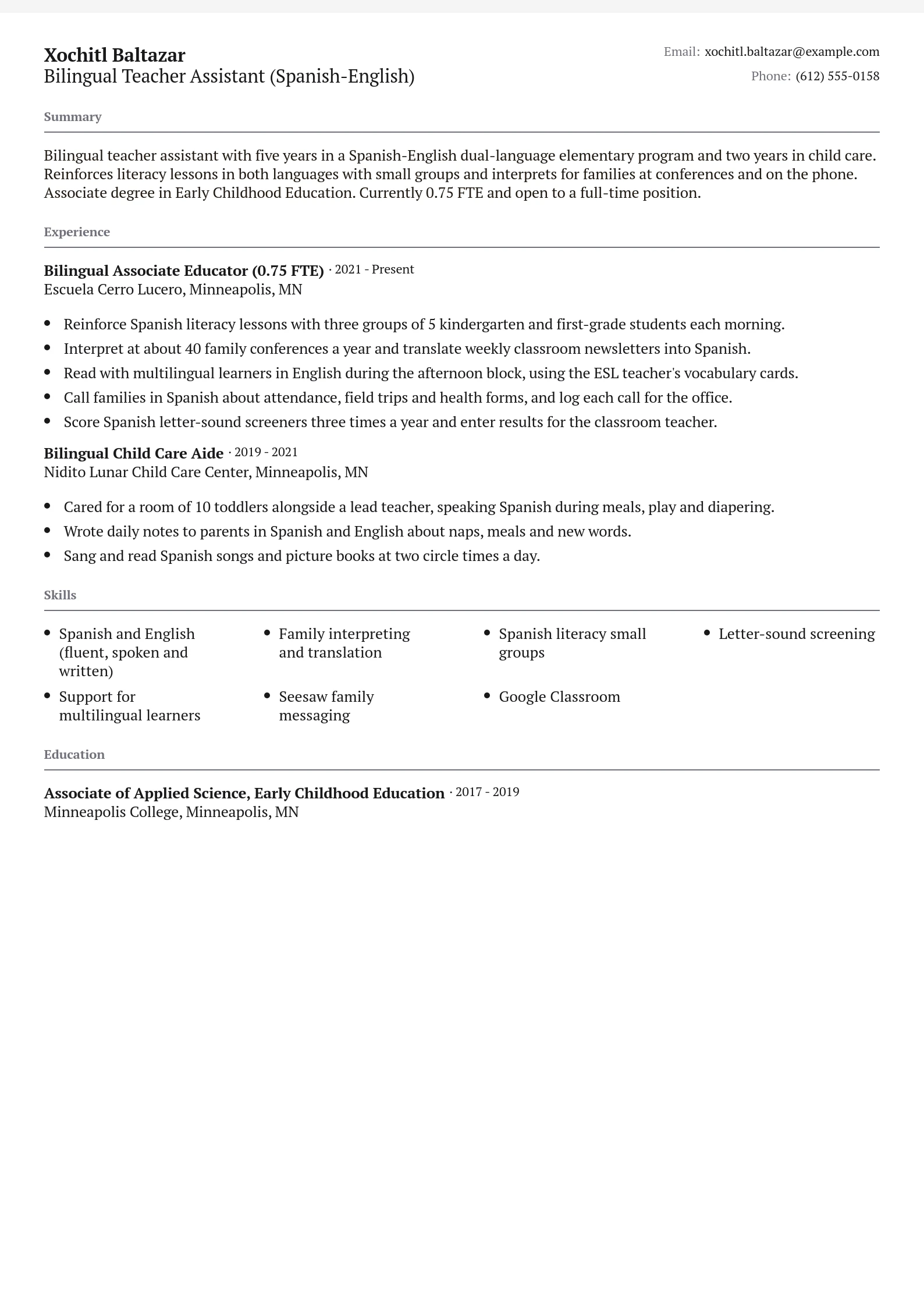
Xochitl puts Spanish in her headline and skills, then proves it in bullets: Spanish literacy groups by grade and size, a yearly count of family conferences she interprets and the newsletters she translates. Her 0.75 FTE schedule appears in her job title, and her summary says she is open to full-time hours. Use it for dual-language, ESL support or newcomer program roles where a second language is required.
Spanish literacy groups by grade and size
About 40 family conferences interpreted each year
Part-time FTE shown in the job title
Name the qualification route you meet, with proof
Most public school postings for instructional assistants ask for one of three things: an associate degree or higher, at least two years of college, or a passing score on a state or local paraprofessional assessment. The rule comes from federal Title I requirements, and districts check it before they read your experience. Say which route you meet in your summary, then back it up in education or credentials. A line such as "Associate degree in Early Care and Education meets Title I paraprofessional requirements" does the job.
The details change by state and district. South Carolina counts two years of college as 60 semester hours, while Massachusetts and Washington accept 48. Passing scores differ too: ParaPro 456 in South Carolina, 464 in Massachusetts and 460 for Minneapolis Public Schools; ParaPathways 332 in Reading and Writing and 334 in Mathematics in South Carolina, but 324 and 325 in Washington.
The test itself has changed. ETS stopped offering the ParaPro Assessment after August 31, 2026, although Washington extended it to December 31, 2026. Its replacement, ParaPathways, has two subtests, Reading and Writing (5758) and Mathematics (5759), and you must pass both. Each state or employer decides which test it accepts, so check the posting or your state education department before you list either one.
If you qualify two ways, such as 64 college credits and a ParaPathways pass, list both. A district that accepts only one of them still finds the route it needs.
Your route
What to write
Where it goes
Watch for
Associate degree
The degree type and field in full: Associate in Applied Science, Early Care and Education
Education, plus a short mention in your summary
Some districts name a field, such as education or child development
Two years of college, no degree
Credits completed and the program: 70 credits toward a B.S. in Special Education
Education, with the years you attended
Say if your college used quarters: 90 quarter credits equal 60 semester credits
ParaPathways
Both subtests with their numbers, your scores and the month passed: Reading and Writing (5758) and Mathematics (5759), passed September 2026
Credentials
The subtests can be passed on different days, so give the month of the later pass
Earlier ParaPro pass
Test name, score and year: ParaPro Assessment, score 468, 2024
Credentials
Give the score itself, not just "passed," so the screener can compare it with the district's minimum
Write bullets around group size, grade and the data you kept
Describe the instruction you delivered and name whose plan it came from. A principal hiring an assistant expects you to reinforce lessons, run small groups, supervise students and keep records. A bullet that says you planned or taught whole-class lessons reads as inflated, and one that says you "assisted the teacher" tells them nothing.
For each instructional bullet, give the grade and group size ("reading groups of 4 to 6 second graders"), what you delivered ("phonics review from the teacher's lesson plan") and what you recorded or handed back ("weekly running records in Google Sheets"). If your group hit a benchmark, give the count: "5 of 6 students met the spring benchmark."
Count supervision duties too. Lunch, recess, bus and arrival coverage is work principals must staff, so write it with numbers: "Supervise 120 students at lunch and 60 at morning recess." Name the tools you use for it, such as Seesaw for family messages or Google Classroom for posting assignments.
If you support IEP goals, name the goal area and the data you take, never the student. "Collect trial-by-trial data on four IEP goals and give the teacher a weekly summary" is specific enough for any special education team.
Group, plan and record named
Run four daily reading groups of 4 to 6 second graders from the teacher's lesson plans and record weekly running records she uses to regroup students.
A duty list that could be anyone
Assisted the teacher with reading instruction and helped students as needed.
Match the resume to special education, bilingual or Head Start postings
The assignment changes what a screener reads for. A general classroom posting looks for reading groups and supervision, while special education, bilingual and Head Start postings each add requirements a generic resume leaves out.
Read the physical and language lines in the posting. If it says "lift up to 50 pounds" or "Spanish required," put matching evidence in a bullet, not only in your skills list. A skill with no bullet behind it is easy to skim past.
For special education, list CPR and first aid with the month you renewed them, because some positions require both and an undated card leaves the screener guessing. For bilingual roles, rate speaking and writing separately if they differ, since interpreting at a conference and translating a newsletter test different skills.
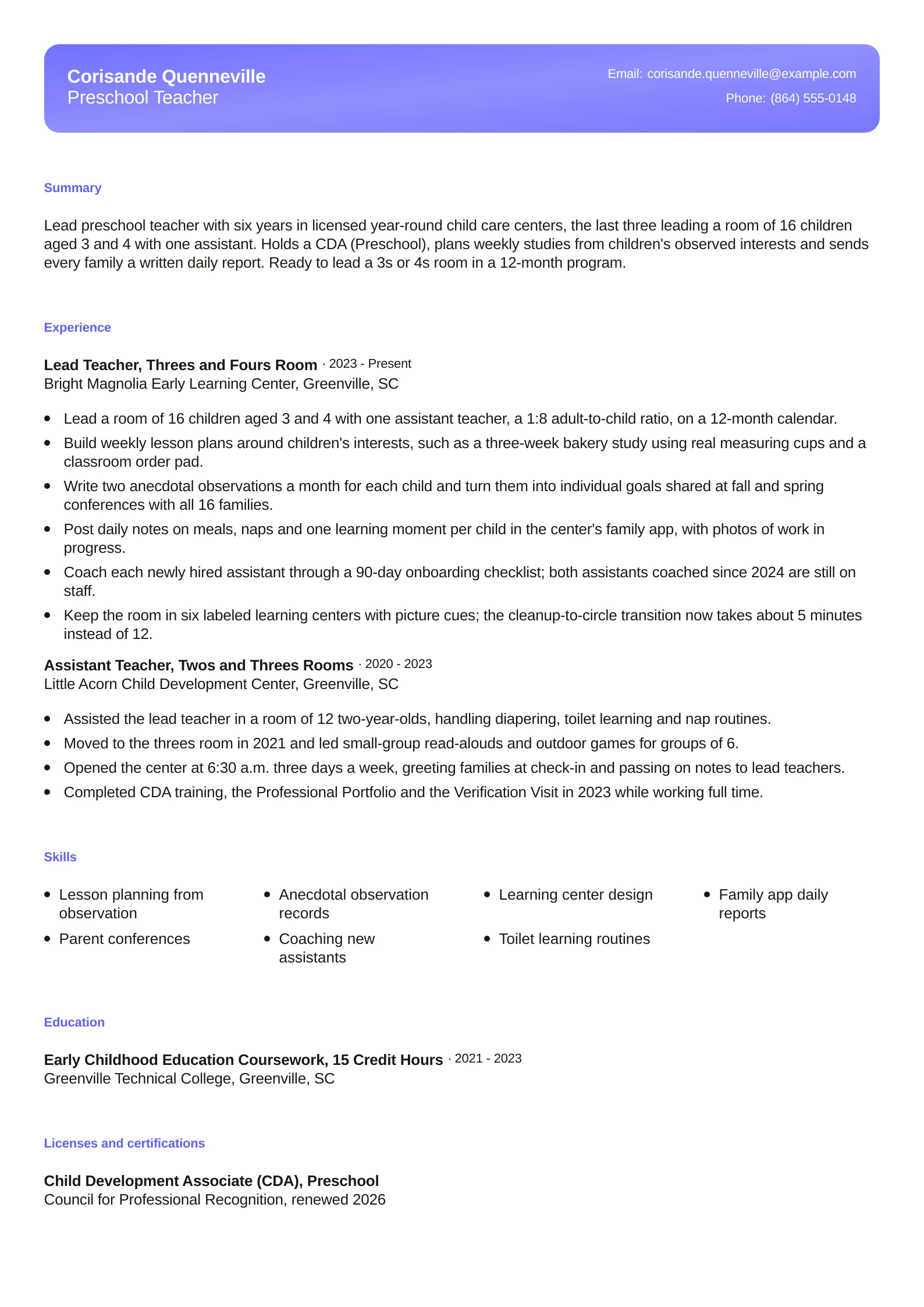
Head Start and child-care assistant teacher jobs may ask for a Child Development Associate (CDA) credential, issued by the Council for Professional Recognition, and some accept a CDA earned within 18 months of hire. Our preschool teacher resume examples cover that route in more detail.
Assignment
What postings add
What to show
Example line
Special education
1:1 or small-group support, IEP and behavior plans, mobility, toileting and lifting up to 50 pounds. Most states require skills testing for assistants who work with special-needs students
IEP goal areas and the data you collect, behavior plan tools, personal care tasks, and CPR and first aid if you hold them
Assist with transfers, toileting and positioning six times a day using the physical therapist's lift plan.
Bilingual
A required language, interpreting for families and sometimes a part-time schedule such as 0.75 FTE
The language in your headline and skills with your level, then bullets showing groups taught in that language and family interpreting with a count
Interpret at about 40 family conferences a year and translate weekly newsletters into Spanish.
Head Start or child care
A high school diploma or GED, a CDA within 18 months, toddler and preschool experience, Head Start performance standards, family engagement and lifting 50 pounds or more
Ages and group sizes, daily routines, family contact and your CDA status with a target date
Child Development Associate (CDA), in progress, expected May 2027
Questions about titles, volunteering and school-year gaps