Principals look for the right state license, subject and grade band first, then for proof that your students learned. The examples cover a middle school ELA teacher, a student teacher, a team lead, two special education teachers, a private school history teacher, a high school math teacher and an engineer earning certification.
Middle school ELA teacher moving to a new district
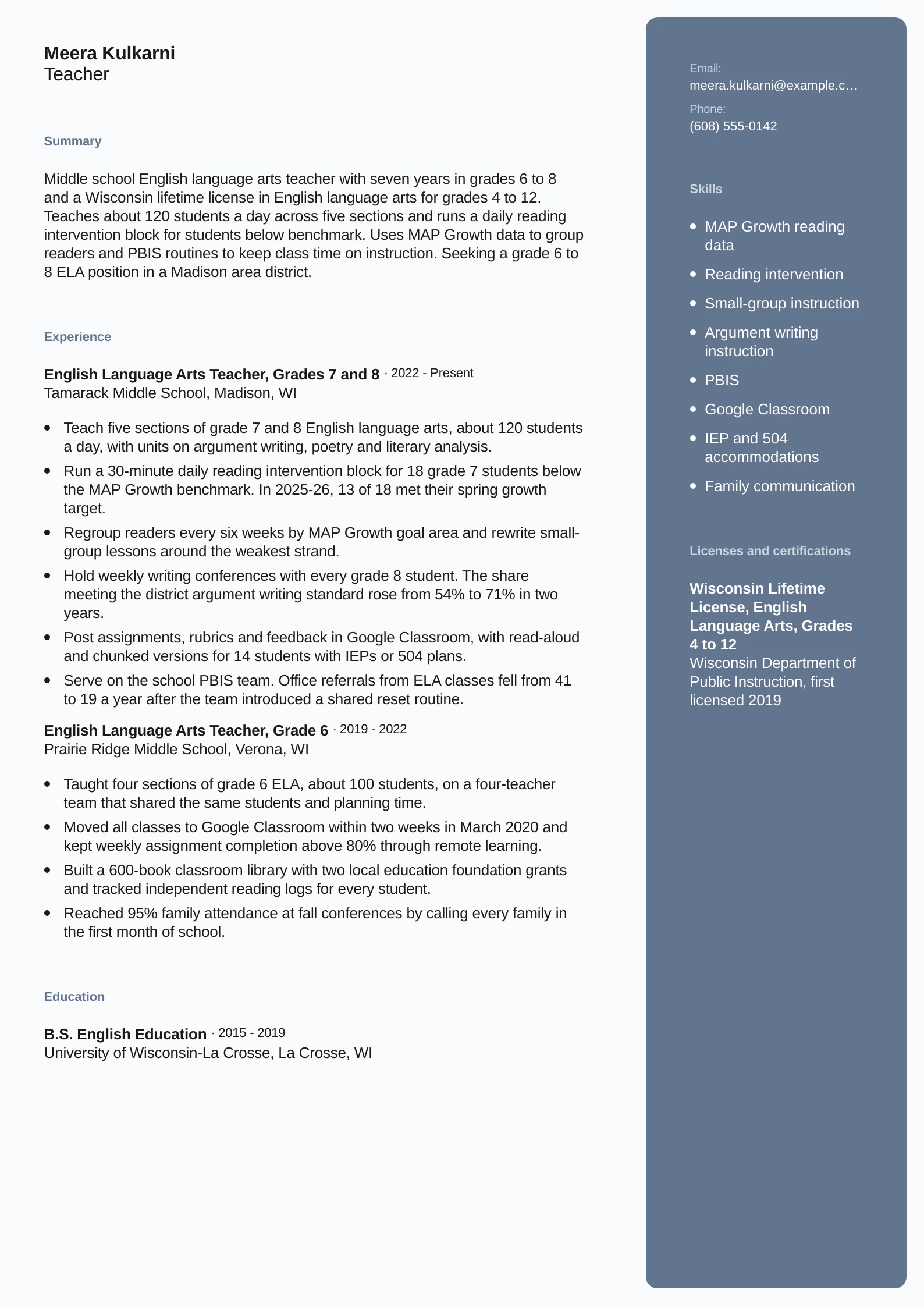
Meera's summary opens with her Wisconsin license, subject and grade band, and the credentials section repeats it with the year she was first licensed, so a principal hiring for grade 7 or 8 ELA sees the match first. Each bullet then names a grade, a number of students or the assessment behind the result.
Her intervention bullet is the one to copy if you run a pull-out or intervention block. It gives the group size, the screener and how many students met their growth target. Swap in your own screener, such as i-Ready, FastBridge or STAR.
Examples for new, lead, special education and career-change teachers
Pick the example closest to the job you're applying for, not the one you hold now. A classroom teacher applying to lead a grade-level team should start from the lead teacher example, and a public school teacher moving to an independent school from the private school one.
Student teacher with a credential in progress
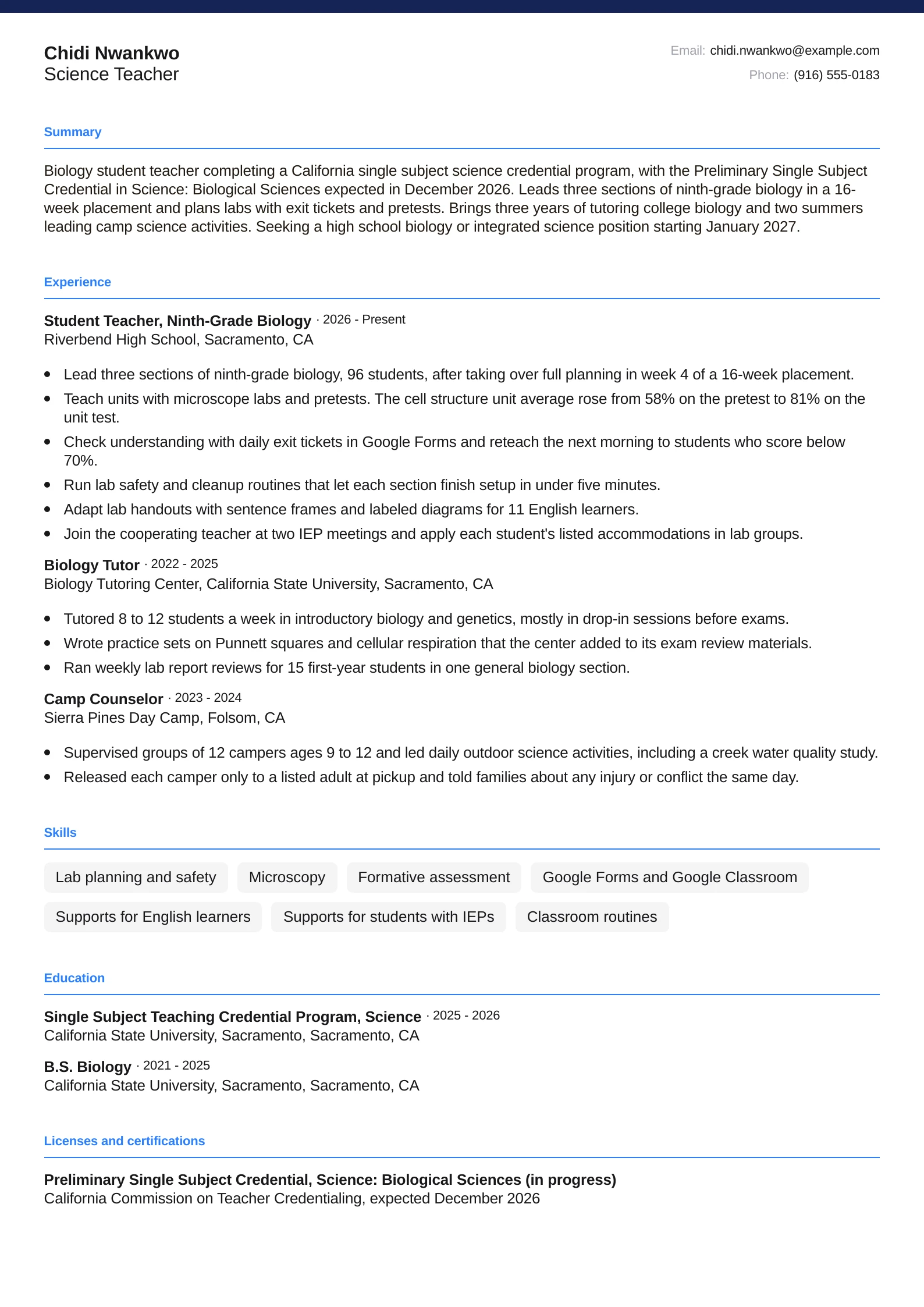
Chidi lists his 16-week placement as his first teaching job, with the grade, subject, number of sections and the week he took over planning. His credential line names the subject area, marks it in progress and gives an expected month. Tutoring and camp work sit below, each with the number and level of students. Use it if you're finishing student teaching or a credential program and have no paid classroom job yet.
Student teaching listed as a job with sections and dates
Credential marked in progress with an expected month
Tutoring and camp roles with group sizes
Lead teacher who mentors and runs a PLC
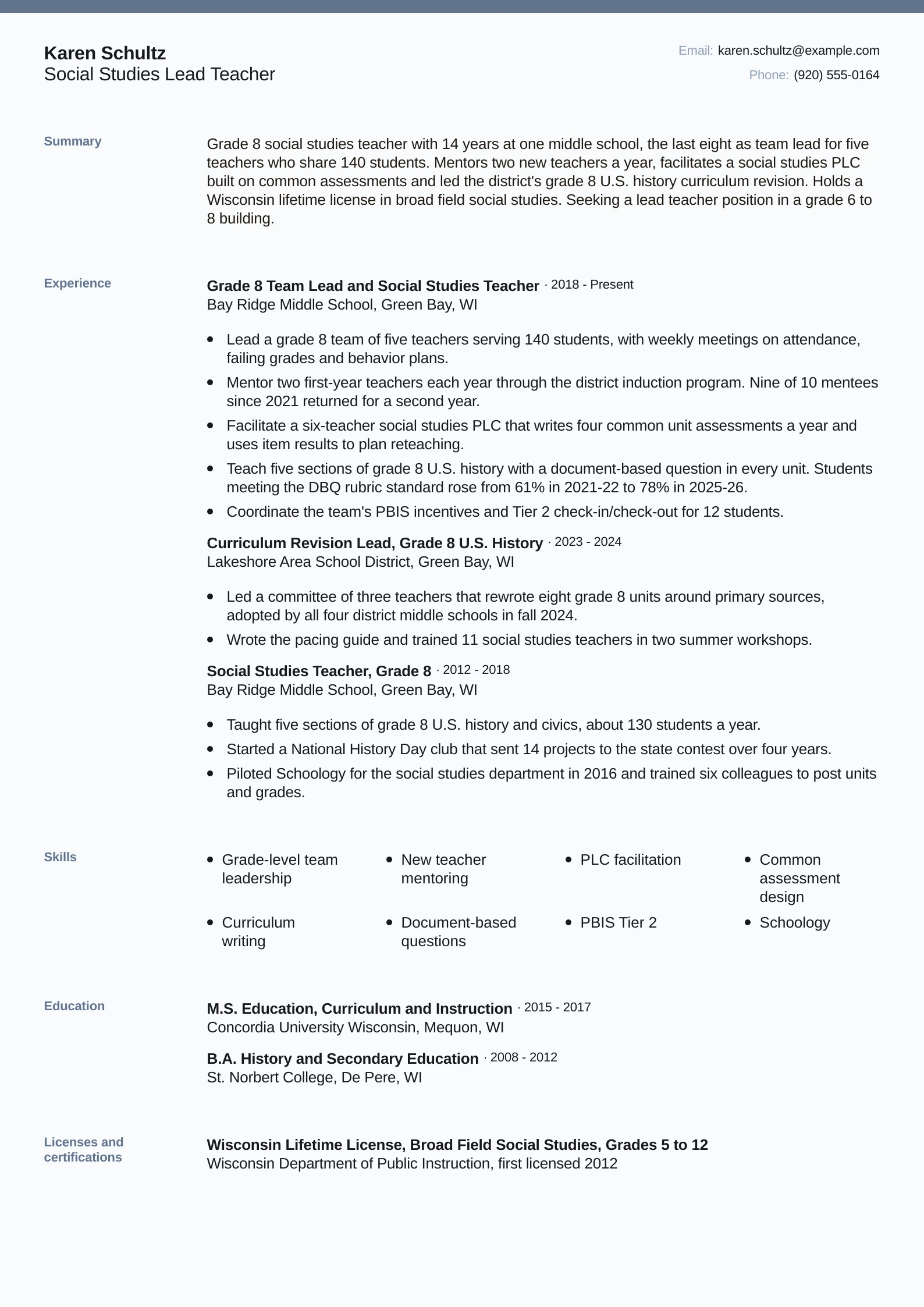
Karen splits her school into two entries so her team lead years and her earlier classroom years each carry their own dates. Her leadership bullets count people: five teachers, two mentees a year and how many stayed. A separate curriculum entry names the committee, the units rewritten and the schools that adopted them. Use it if you lead a grade-level team, department or PLC and still teach a full schedule.
Team size and mentee retention in numbers
Curriculum revision as its own dated entry
Classroom results kept alongside leadership
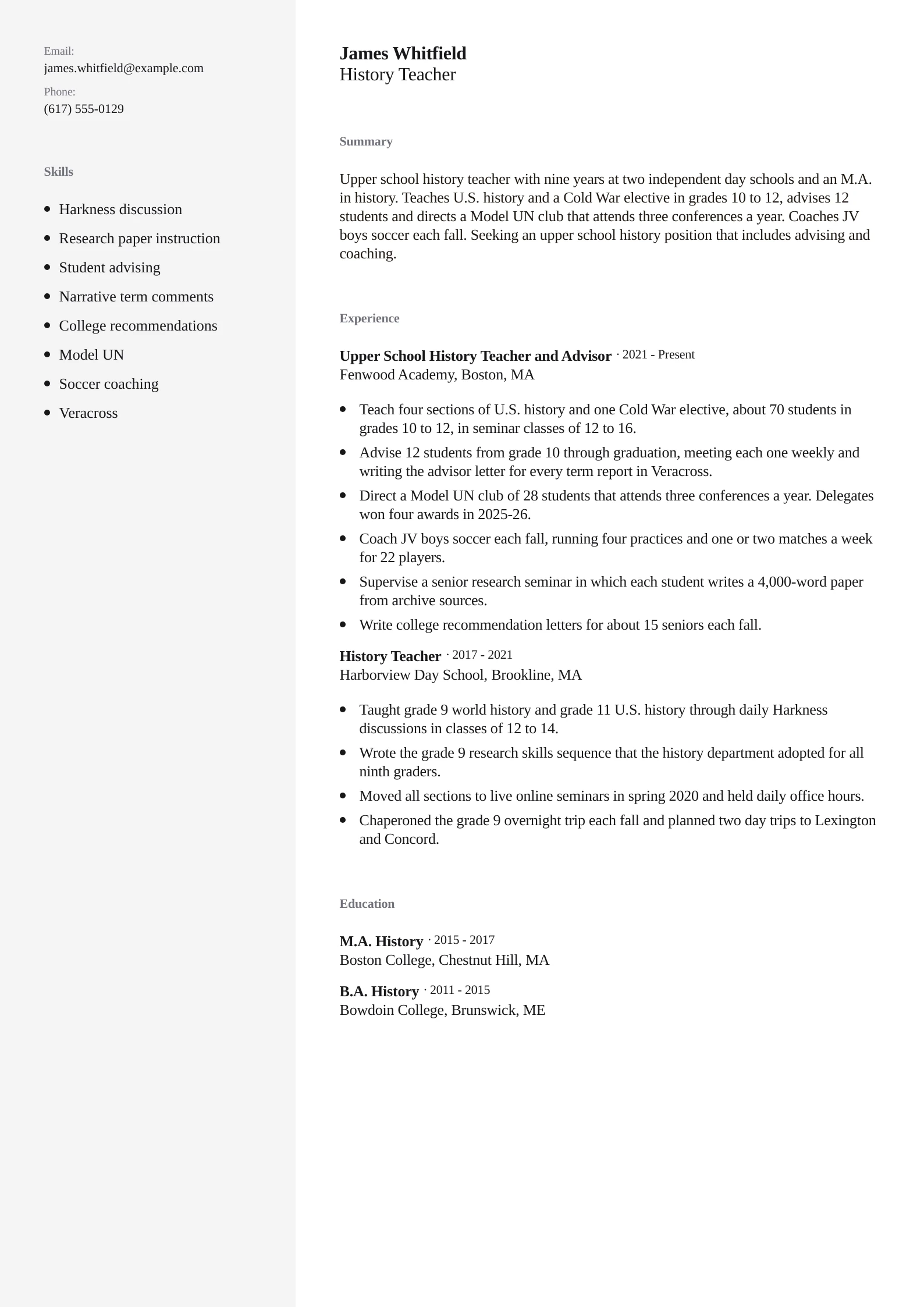
Private school history teacher with advising and coaching
James lists no state license, because private school teachers typically don't need one. His M.A. in history carries the academic weight instead, and his bullets give equal space to advising, Model UN and JV soccer, which independent school hiring committees weigh alongside teaching. Class sizes of 12 to 16 and Harkness discussion show he knows the seminar format. Use it for independent, parochial or boarding school applications.
No license line, with an M.A. in the subject instead
Advising, Model UN and coaching with student numbers
Harkness seminar format named
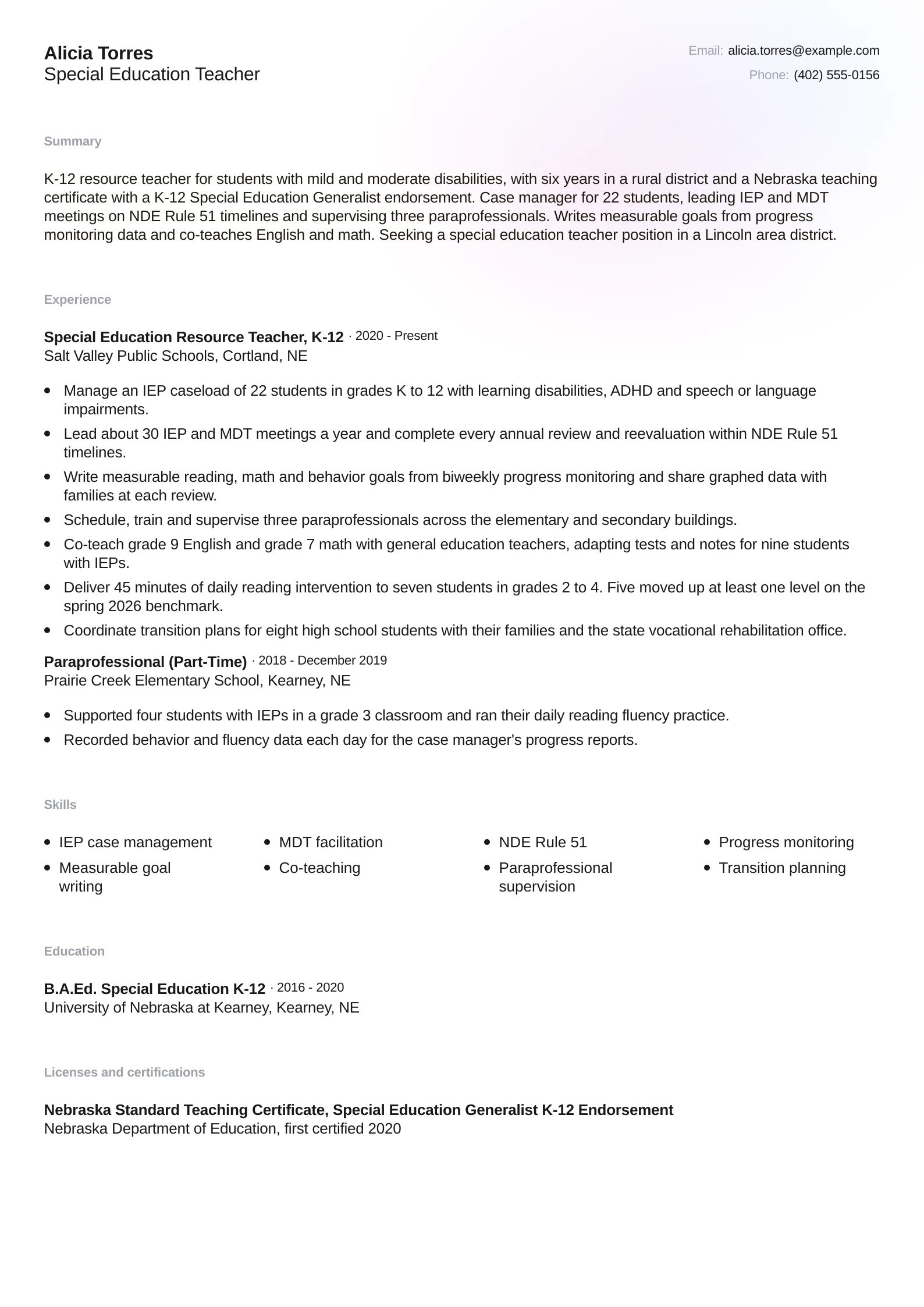
Special education teacher with an IEP caseload
Alicia opens with her Nebraska certificate and special education endorsement, then counts her caseload, meetings and staff: 22 students, about 30 IEP and MDT meetings a year and three paraprofessionals. Her goal-writing bullet names the progress monitoring behind it, and her paraprofessional job shows she knows the role she now supervises. Use it for public school resource, inclusion or co-teaching jobs where you case-manage IEPs.
Caseload, meetings and staff supervised in numbers
NDE Rule 51 timelines named
Earlier paraprofessional role
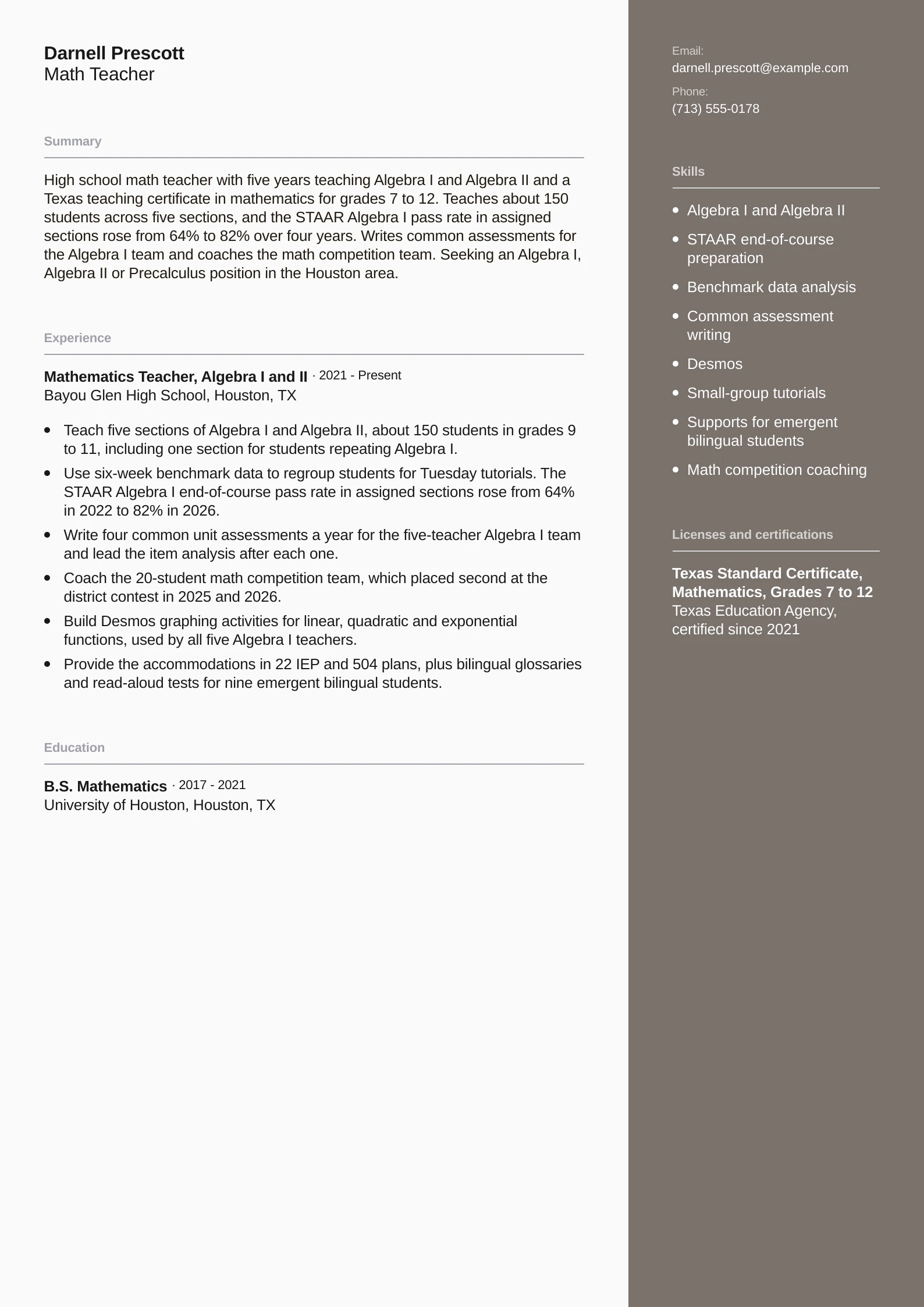
High school math teacher with STAAR results
Darnell leads with his Texas mathematics certificate for grades 7 to 12 and a pass rate that moved from 64% to 82% over four years. His bullets show the course load (five sections, about 150 students), the benchmark data he regroups by, and the common assessments he writes for his team. Use it for any secondary subject where test results and course load are the story.
Texas certificate with subject and grade band
STAAR pass rate before and after
Sections and student count stated
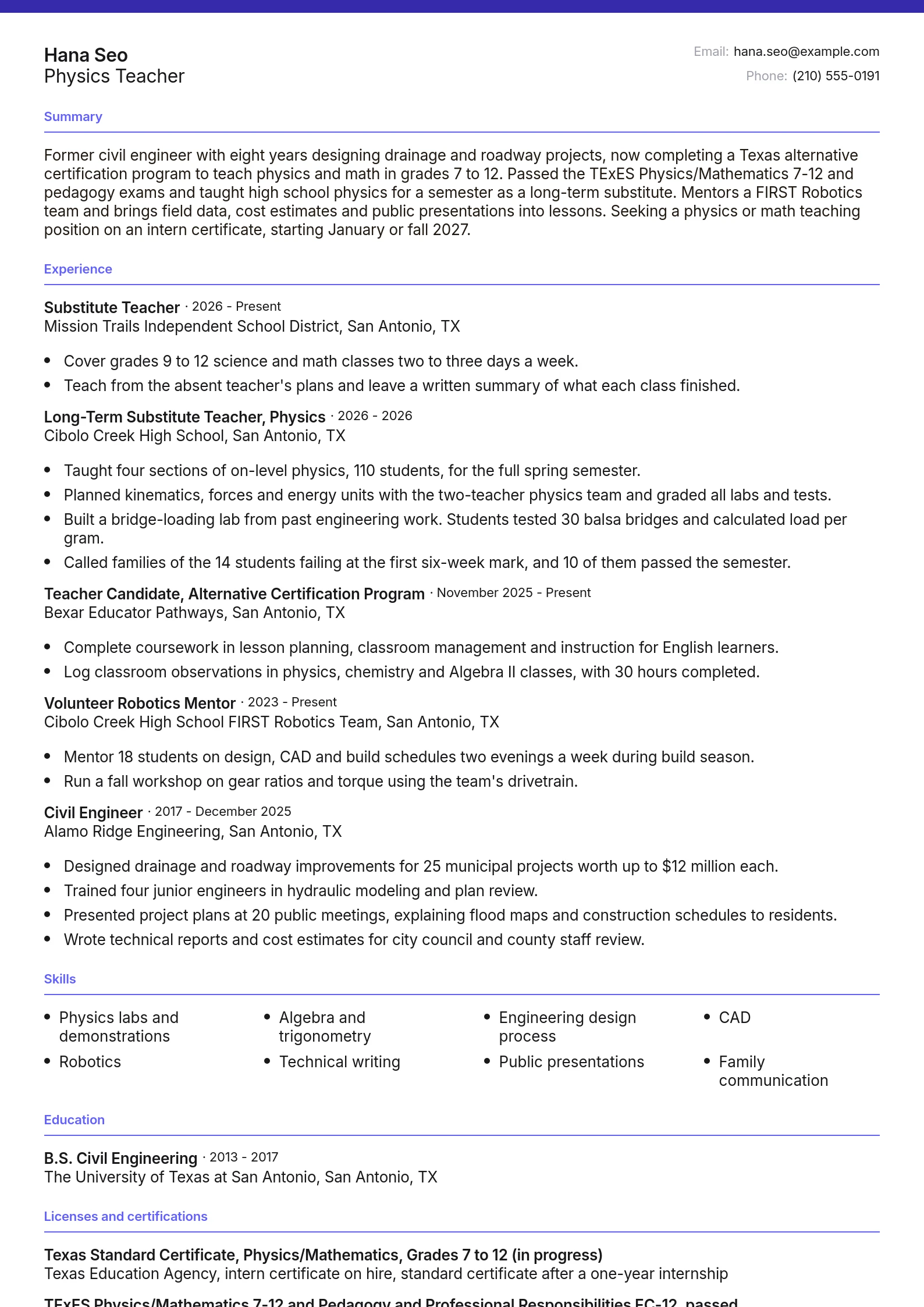
Career changer earning Texas certification
Hana puts teaching first: her substitute and long-term physics roles sit above eight years of engineering, and her alternative certification program has its own entry. The credentials list shows the passed TExES exams and the certificate marked in progress. Her engineering bullets keep what transfers to a classroom, such as explaining plans at public meetings and training junior engineers. Use it if you're moving into teaching from another field.
Teaching roles above eight years of engineering
Alternative certification entry and passed TExES exams
Robotics mentoring with student numbers
Special education teacher in an autism program
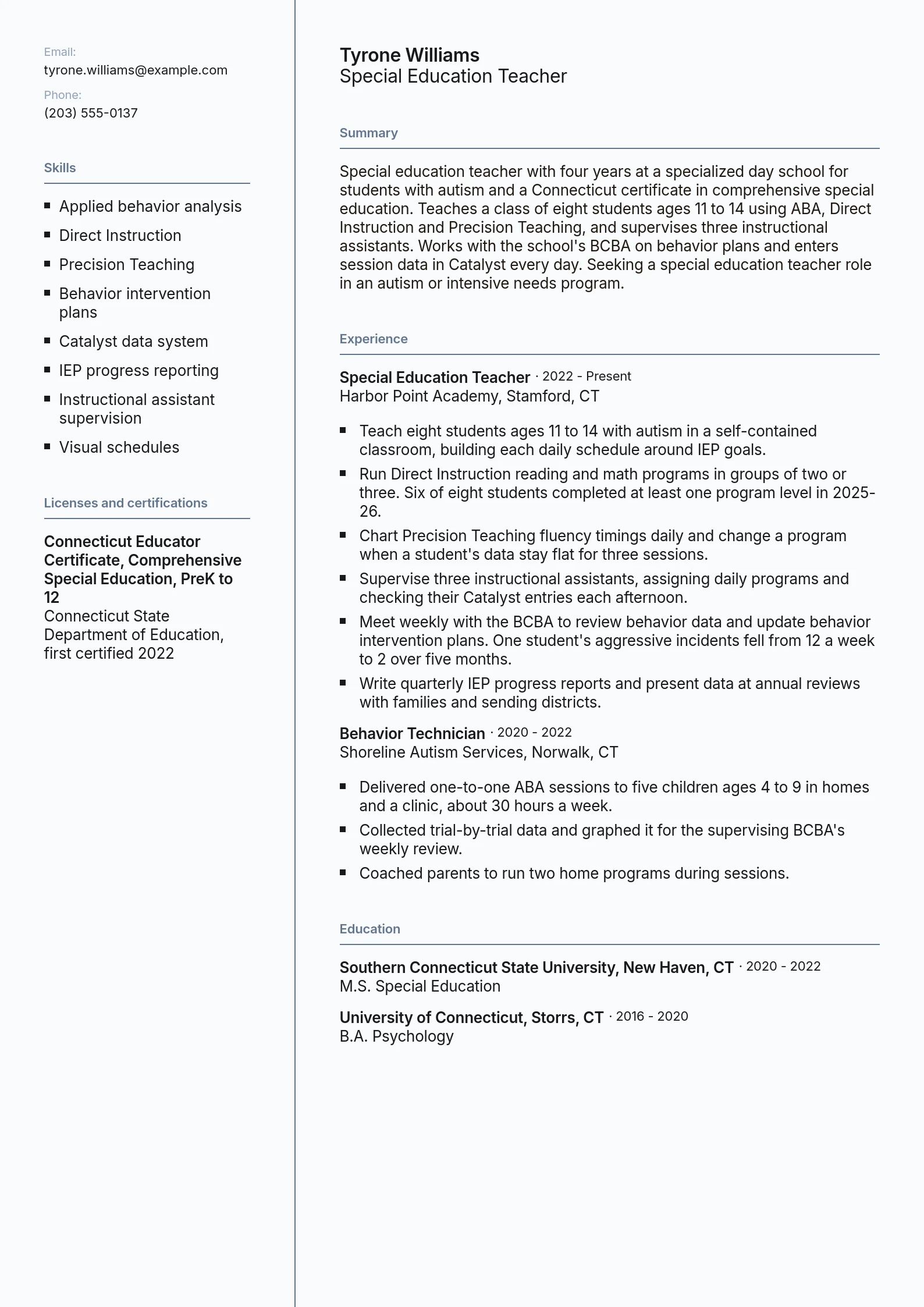
Tyrone writes for specialized schools, where the methods matter as much as the caseload. He names ABA, Direct Instruction and Precision Teaching, gives his class size of eight, and shows how he works with the BCBA through a behavior plan with a before and after count. His behavior technician job explains where his ABA training came from. Use it for private special education schools, autism programs or self-contained classrooms.
ABA, Direct Instruction and Precision Teaching named
Instructional assistants and BCBA work in numbers
Behavior technician role before teaching
Put your state, subject and grade band in the license line
Write your license the way the state names it, then add the subject or endorsement and the grade band, because principals screen for that match before they read your experience. Put it in the first line of your summary and again in a credentials section with the issuing agency and year.
States license by grade level and the details differ, so match the posting's wording. A Texas math posting asks for a certificate for the subject and level assigned, and a Nebraska special education posting asks for the special education endorsement. Leave off license numbers and test scores.
Mark anything the state hasn't issued yet as in progress, with the month you expect it.
Your situation
What to write
Example line
License current
State, license name, subject or endorsement, grade band, agency and the year you were first licensed
Wisconsin Lifetime License, English Language Arts, Grades 4 to 12. Wisconsin Department of Public Instruction, first licensed 2019
Finishing a credential program
The credential's name in that state, the words in progress and the month you expect it
Preliminary Single Subject Credential, Science: Biological Sciences (in progress). California Commission on Teacher Credentialing, expected December 2026
Alternative certification
The certificate you're working toward, the exams you've passed and the step still left, such as an internship year
Texas Standard Certificate, Physics/Mathematics, Grades 7 to 12 (in progress). TExES content and pedagogy exams passed 2026, intern certificate on hire
Special education
The teaching certificate plus the special education endorsement
Nebraska Standard Teaching Certificate, Special Education Generalist K-12 Endorsement. Nebraska Department of Education, first certified 2020
Moving to another state
Your current license as issued, plus the step you've taken in the new state and when
Texas Standard Certificate, Mathematics, Grades 7 to 12. Wisconsin DPI license application submitted September 2026
Private school only
List a state license if you hold one. If you don't, lead with your degree in the subject
M.A. History, Boston College, 2017
Give each bullet a grade, a class size and a measured result
A district already assumes you plan lessons, grade work and call families, so a bullet that lists those duties tells the reader nothing. Write what you taught, to whom, and what changed, using data your school already collects.
Open each bullet with the grade, subject and number of students or sections, such as five sections of Algebra I, about 150 students. Then name the assessment: MAP Growth, i-Ready, STAAR end-of-course, common unit tests, a DBQ rubric or IEP progress monitoring. Give the result as a before and after figure or a count, such as 13 of 18 students meeting their growth target.
For behavior, name the system and what changed: PBIS, check-in/check-out or a behavior plan written with a BCBA, and the drop in referrals or incidents. Without class-level numbers, use what you can count: students who moved up a reading level, mentees who returned or units your team adopted.
Grade, group size, screener and result
Run a 30-minute daily reading intervention block for 18 grade 7 students below the MAP Growth benchmark. In 2025-26, 13 of 18 met their spring growth target.
A duty every teacher has
Responsible for planning lessons, assessing students and differentiating instruction to meet the needs of diverse learners.
Match the posting's terms for your subject, students and setting
Use the posting's own words in the places a principal reads first: the license line, the summary and the bullets that prove each term. If an ad asks for PBIS, differentiated standards-aligned instruction or data-driven instruction, put that phrase in a bullet next to the class it happened in and the result.
Read two or three postings for your subject and grade band, and use the terms that appear in more than one. List a tool or program in skills only when a bullet shows it in use, such as Google Classroom for chunked assignments or Catalyst for session data.
Job type
Terms postings use
Where to show them
Middle and high school subjects
Certificate for the subject and level assigned, standards-aligned instruction, data-driven instruction, common assessments, PBIS, classroom behavior management
License line, then bullets with grade, course and results
Public school special education
Special education endorsement, case management, IEP and MDT facilitation, progress monitoring, state rules such as NDE Rule 51, paraprofessional supervision
Summary for caseload size, bullets for meetings and timelines
Specialized special education schools
ABA, Direct Instruction, Precision Teaching, BCBA collaboration, caseload size, electronic data system
Summary for methods, bullets for data and staff you supervise
Independent schools
Advising, coaching, clubs, Harkness or seminar teaching, narrative comments, a degree in the subject
Bullets with student counts and seasons
Lead teacher roles
Team lead, PLC, mentoring, new teacher induction, curriculum revision
A title and dates for the lead role, with team size
Career changers
Alternative certification program, content and pedagogy exams, observation hours, long-term substitute
Credentials list and the first experience entries
List student teaching under experience, with weeks and sections
Student teaching is classroom experience, so make it your first experience entry rather than a line under education. Use the title Student Teacher, then the school, the grade and subject, and the dates of the placement.
Say how much of the teaching you led. Give the number of sections and students and the week you took over full planning, as in three sections of ninth-grade biology, 96 students, full planning from week 4 of 16. That tells a principal how close you are to running your own schedule.
Write your other bullets about work you planned yourself: a unit with its pretest and unit test averages, a lab or project you designed, or supports you added for English learners or students with IEPs. When you sat in on something, such as an IEP meeting, say you joined or observed it.
Put tutoring, coaching, camp and paraprofessional jobs below student teaching, each with the age of the students and the size of the group. In the credentials section, list your credential as in progress with the month you expect it, plus any subject or pedagogy exams you've passed, such as CSET in California or TExES in Texas.
Count the teachers you lead as well as the students you teach
A lead teacher shows seniority through responsibility beyond one classroom, so give the lead role its own title and dates and count the adults involved. Most teaching postings state no minimum years, and many district pay scales credit years of experience anyway, so team size and mentoring results say more than a number of years.
Write the role as it was assigned, such as Grade 8 Team Lead and Social Studies Teacher, starting the year you took it on. Under it, name the team size and the students it serves, the PLC you run and what it produces, such as four common unit assessments a year, and how many new teachers you mentored and how many returned.
Give curriculum work its own short entry when it reached beyond your school: the committee, the number of units and where they were adopted. Keep one or two classroom bullets with results, since you'll still teach your own sections.
If you lead without a title, such as running a PLC as the most experienced teacher on a team, add it as a bullet under your teaching role. Don't create a title your school never used.
Questions about summaries, licenses, length and references