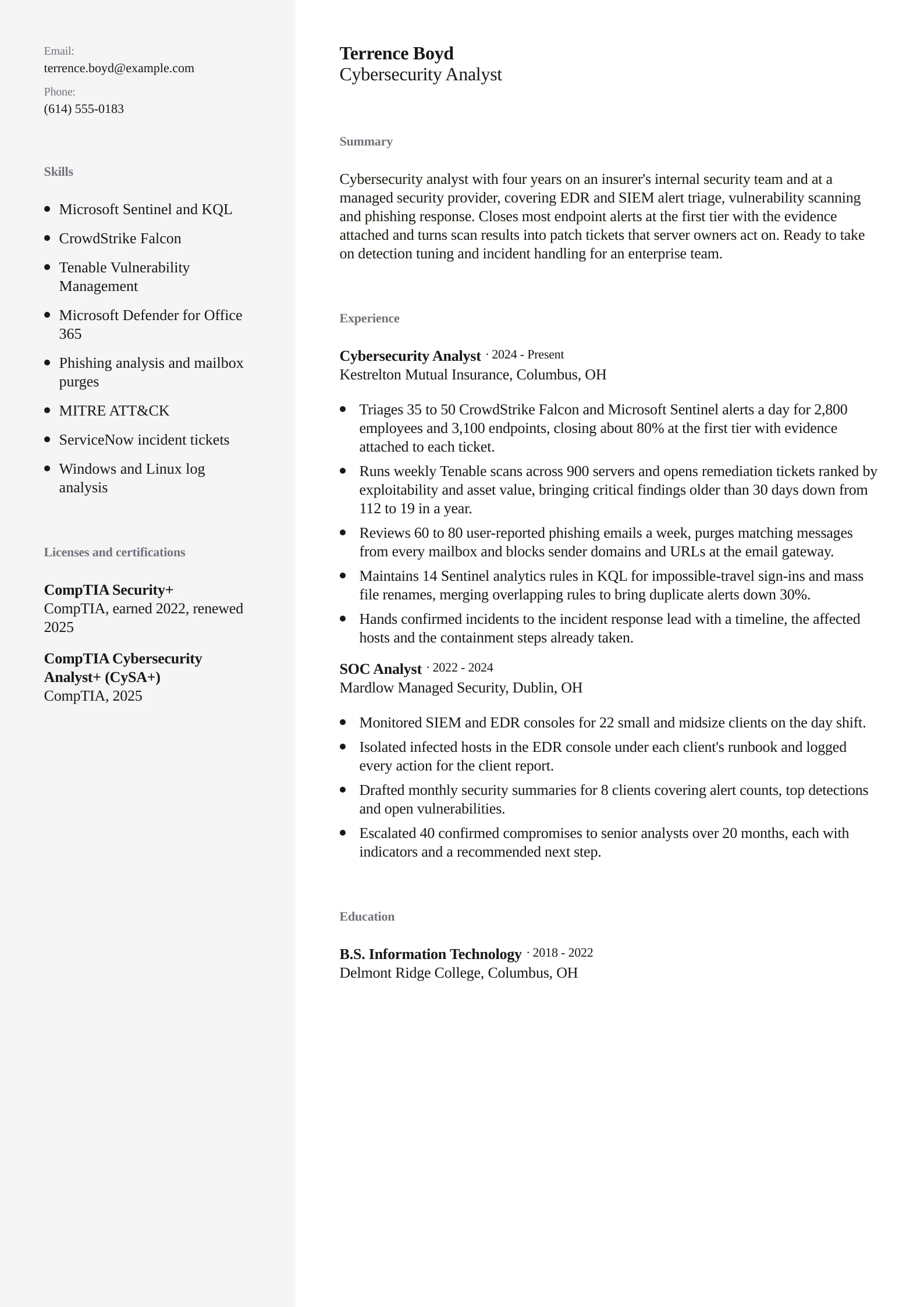
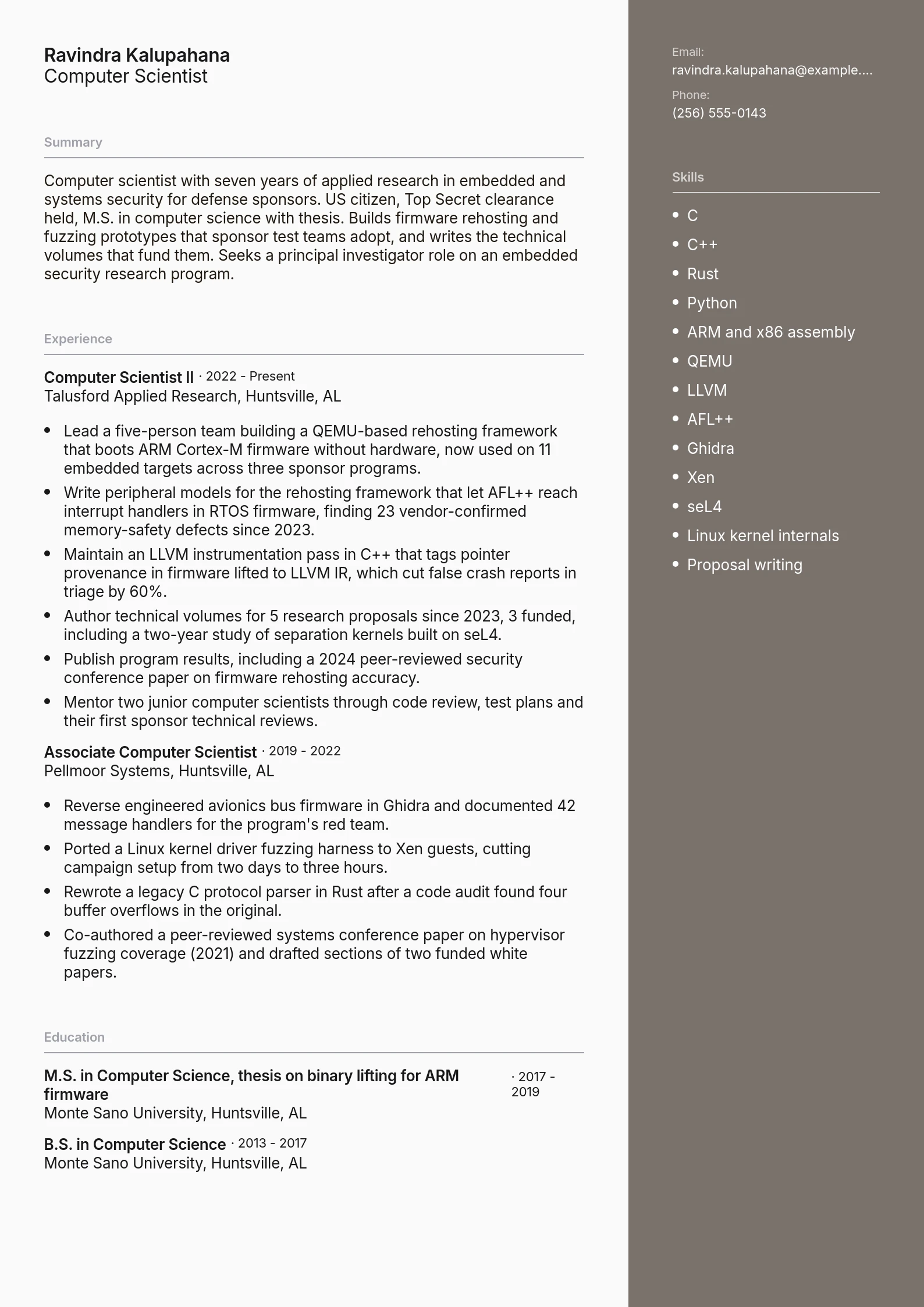
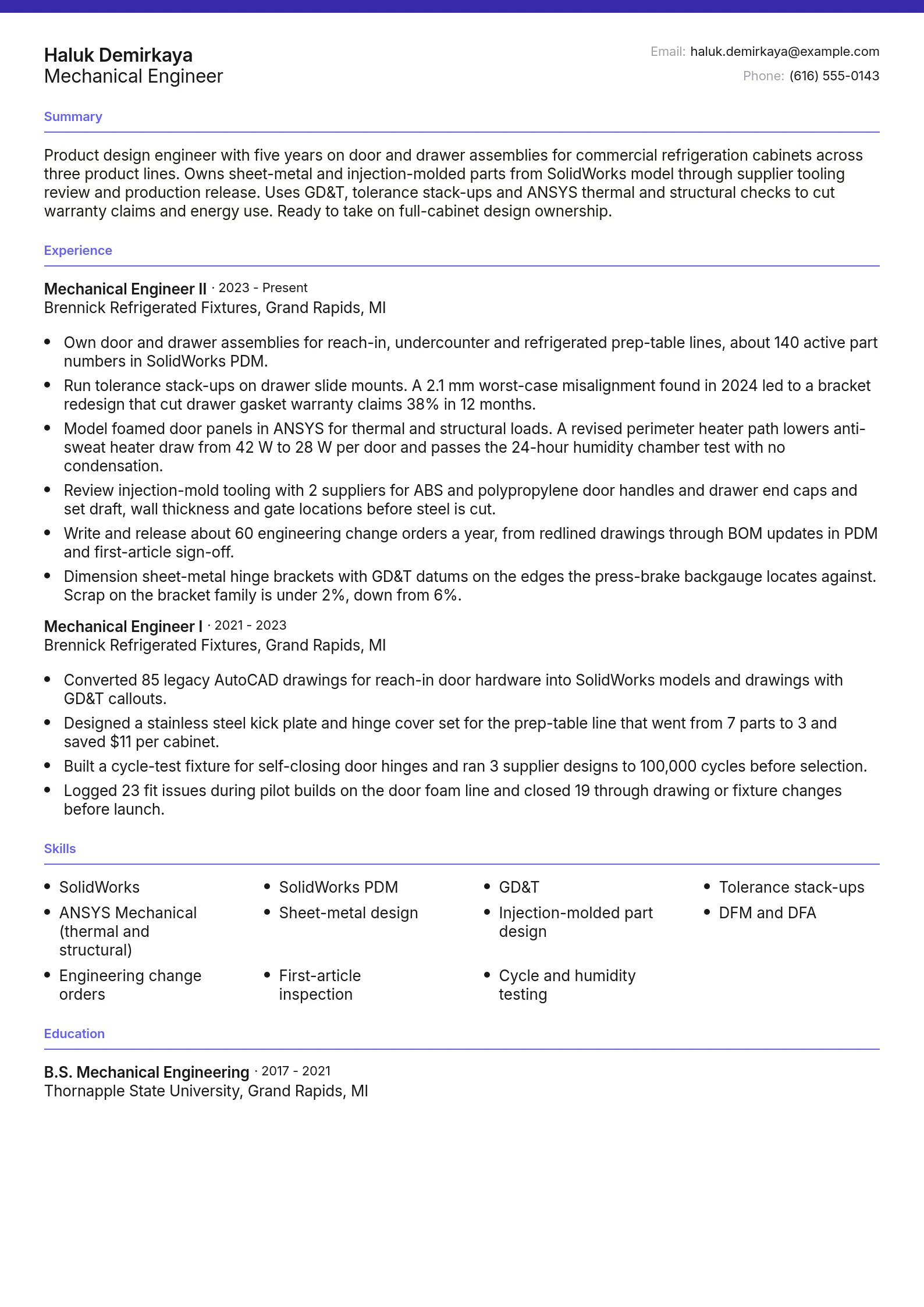
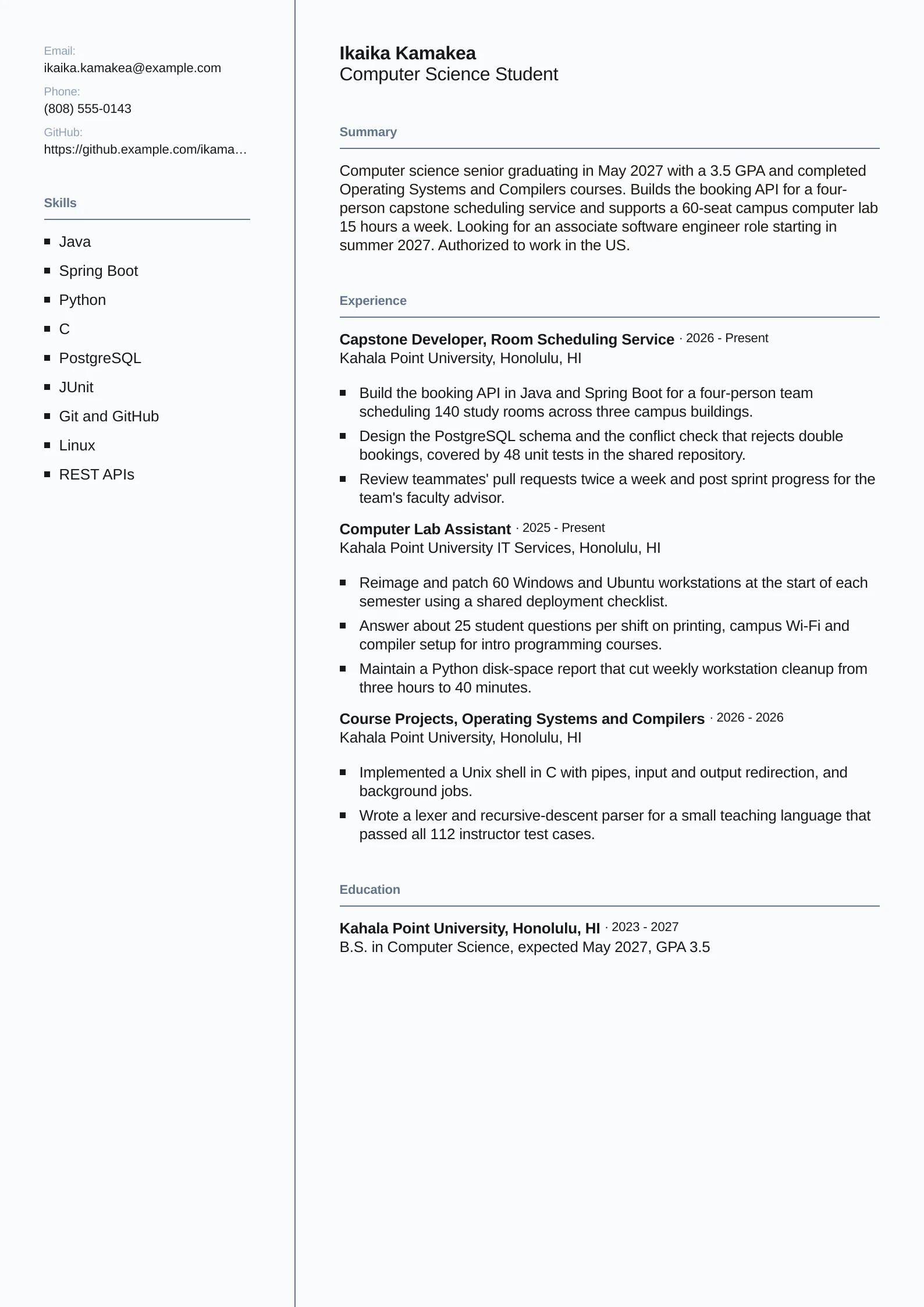
Architecture firms check your license status first, then look at how big your projects were and how far you carried them.
The four examples cover a licensed project architect, an architectural designer partway through AXP and the ARE, a healthcare specialist and a sole practitioner.
Licensed project architect with numbers on every project
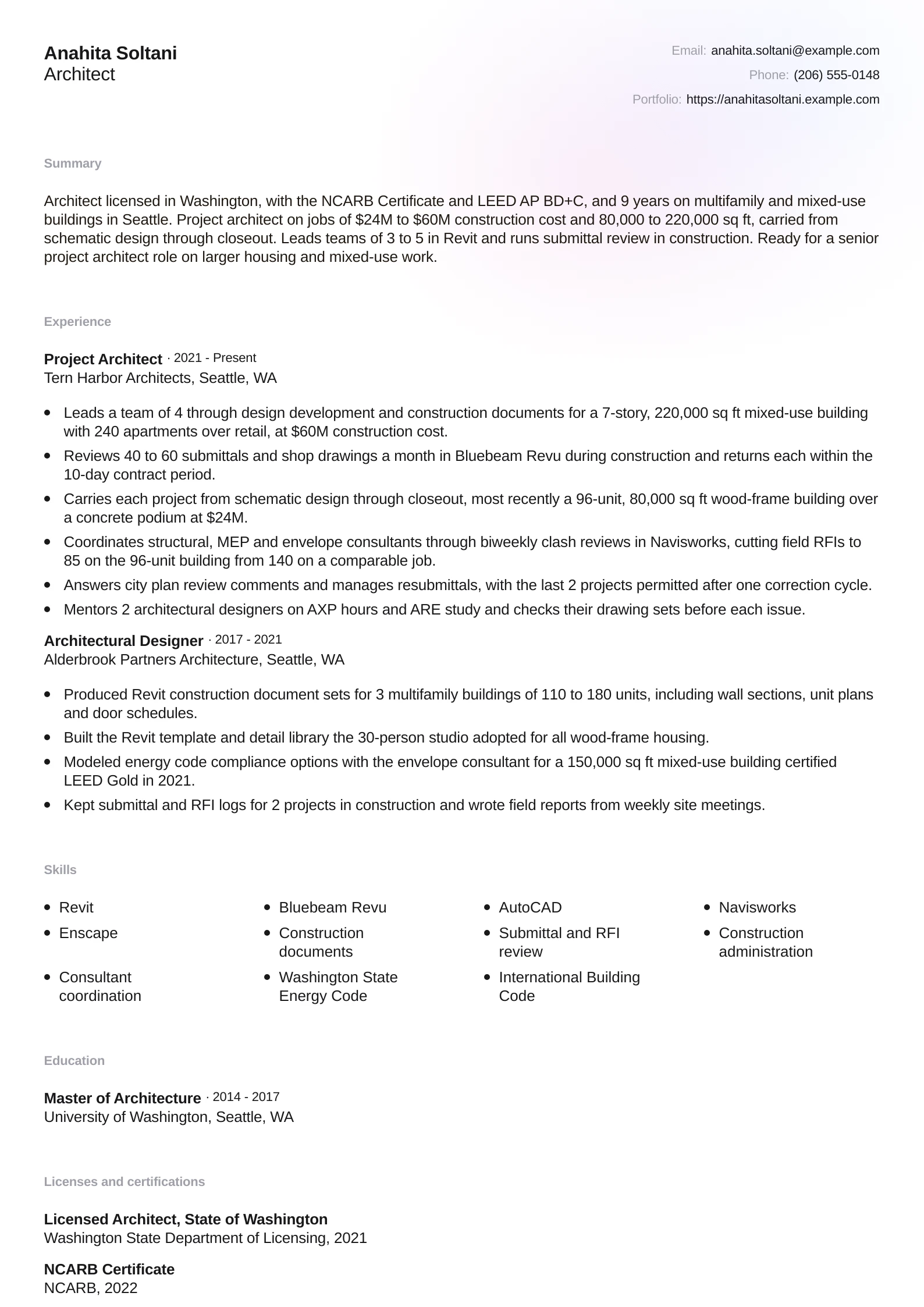
Anahita Soltani's summary opens with her Washington license, NCARB Certificate and LEED AP BD+C, so a reviewer looking for a stamp finds it in the first line. Her project bullets then give the building type, floor area, construction cost and the phases she led.
Copy this one if you're licensed and have taken projects through construction administration. Swap in your state, the year you were licensed and your own project numbers.
Examples for designers on the AXP path, specialists and sole practitioners
Pick the example closest to your license status and the work you do now. The building types matter less than the structure they share: license status in the summary, then projects described by size, cost and phase.
Architectural designer with AXP and ARE in progress
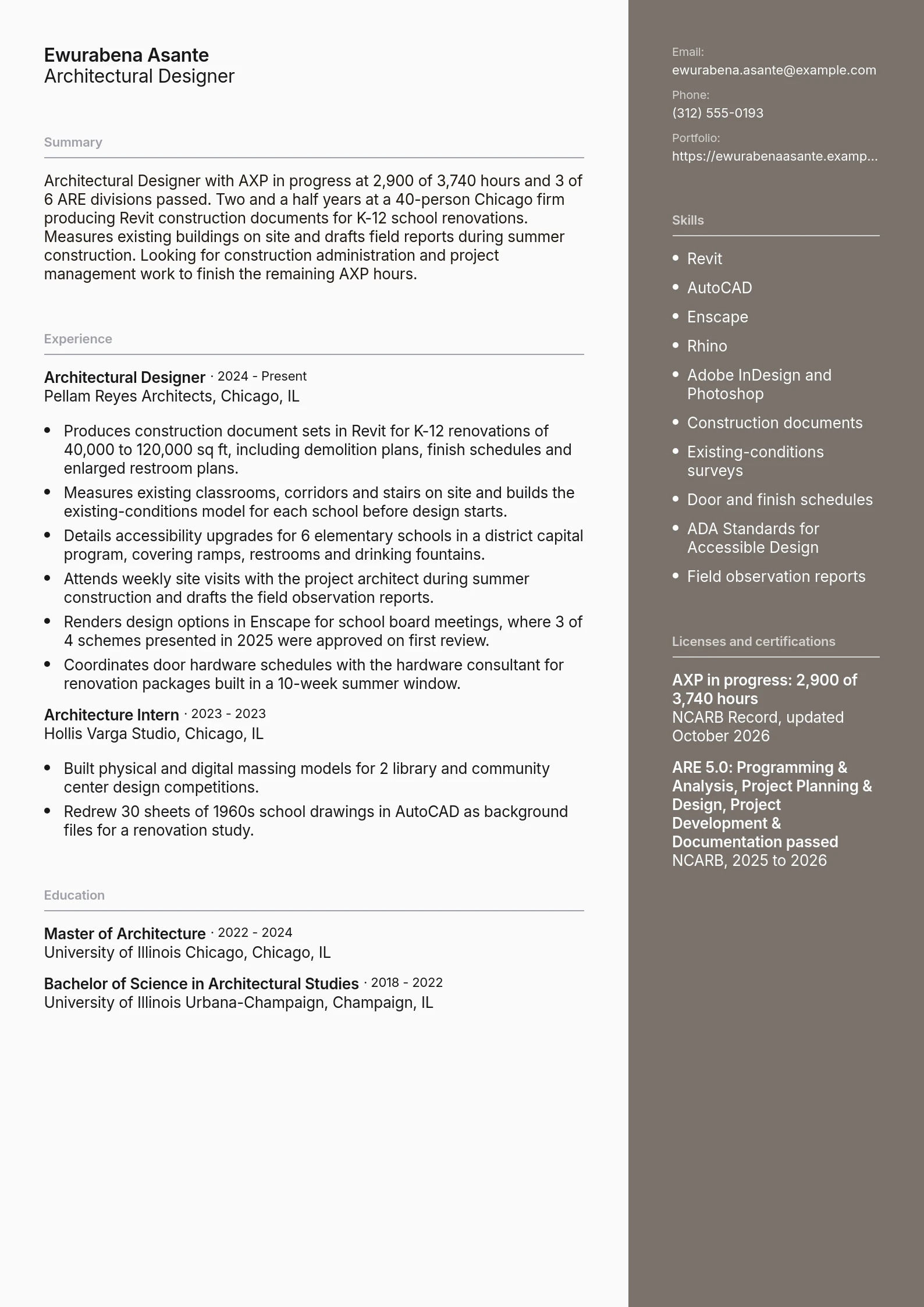
Ewurabena Asante uses the title Architectural Designer and puts her exact standing in the summary: 2,900 of 3,740 AXP hours and 3 of 6 ARE divisions passed. Her credentials name each division she has passed. The bullets cover construction documents for K-12 renovations, measuring existing buildings and weekly site visits. Use it if you finished your degree in the last few years and are working toward a license at a firm.
AXP hours and ARE divisions given as numbers
Passed ARE divisions named in credentials
K-12 renovation drawings and field measurement
Healthcare architect working in occupied hospitals
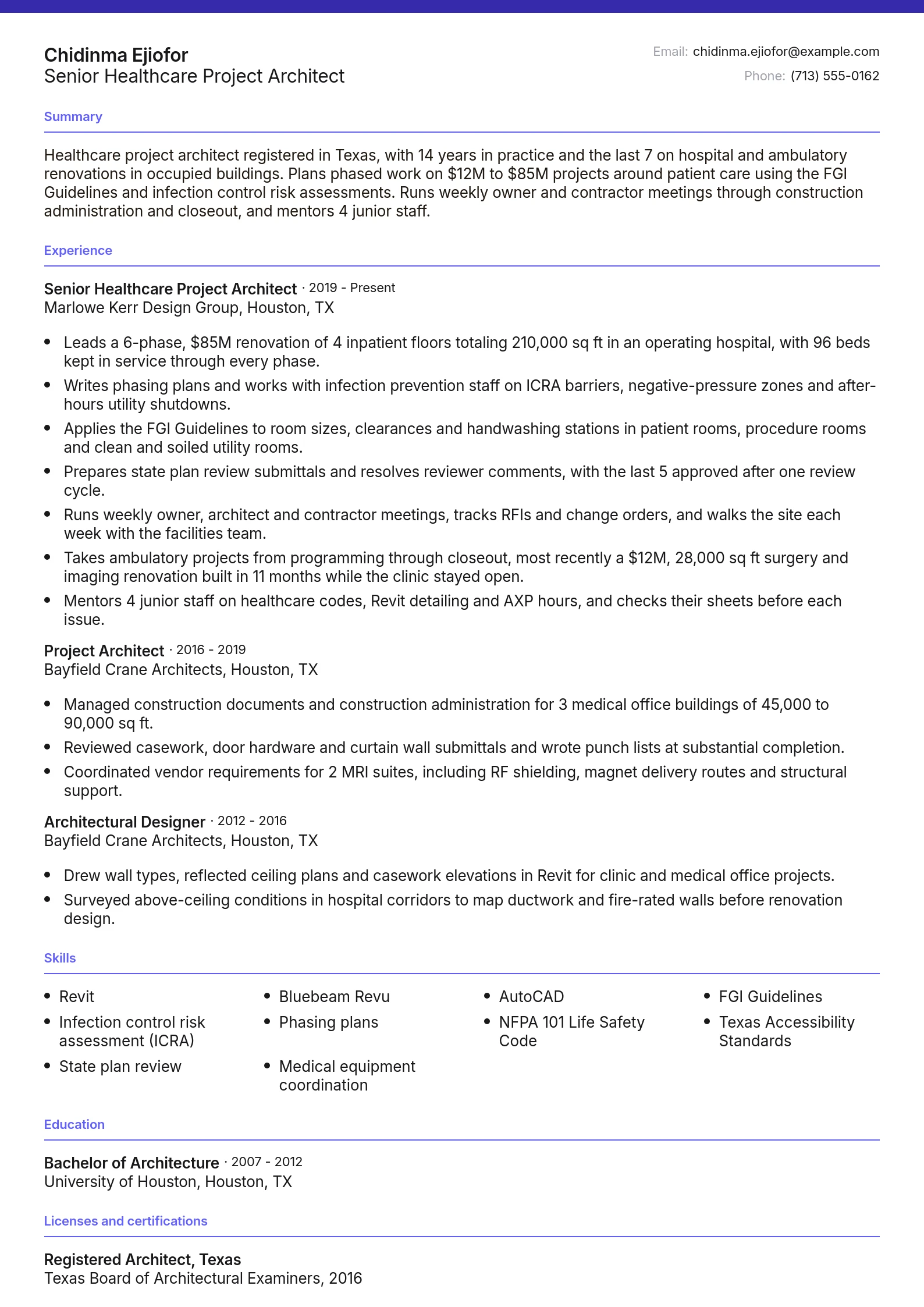
Chidinma Ejiofor's bullets center on what makes healthcare work different: phasing renovations in buildings that stay open, infection control risk assessments, FGI Guidelines and state plan review. Her two largest projects give construction cost and floor area, and the hospital job adds the 96 beds kept open. Her first firm is split into two titles at the year she became registered in Texas. Use it for hospital, clinic or medical office roles where the setting shapes the job.
Phasing plans that keep patient beds open
FGI Guidelines and ICRA named in bullets
Titles split at the year of registration
Freelance architect running a sole practice
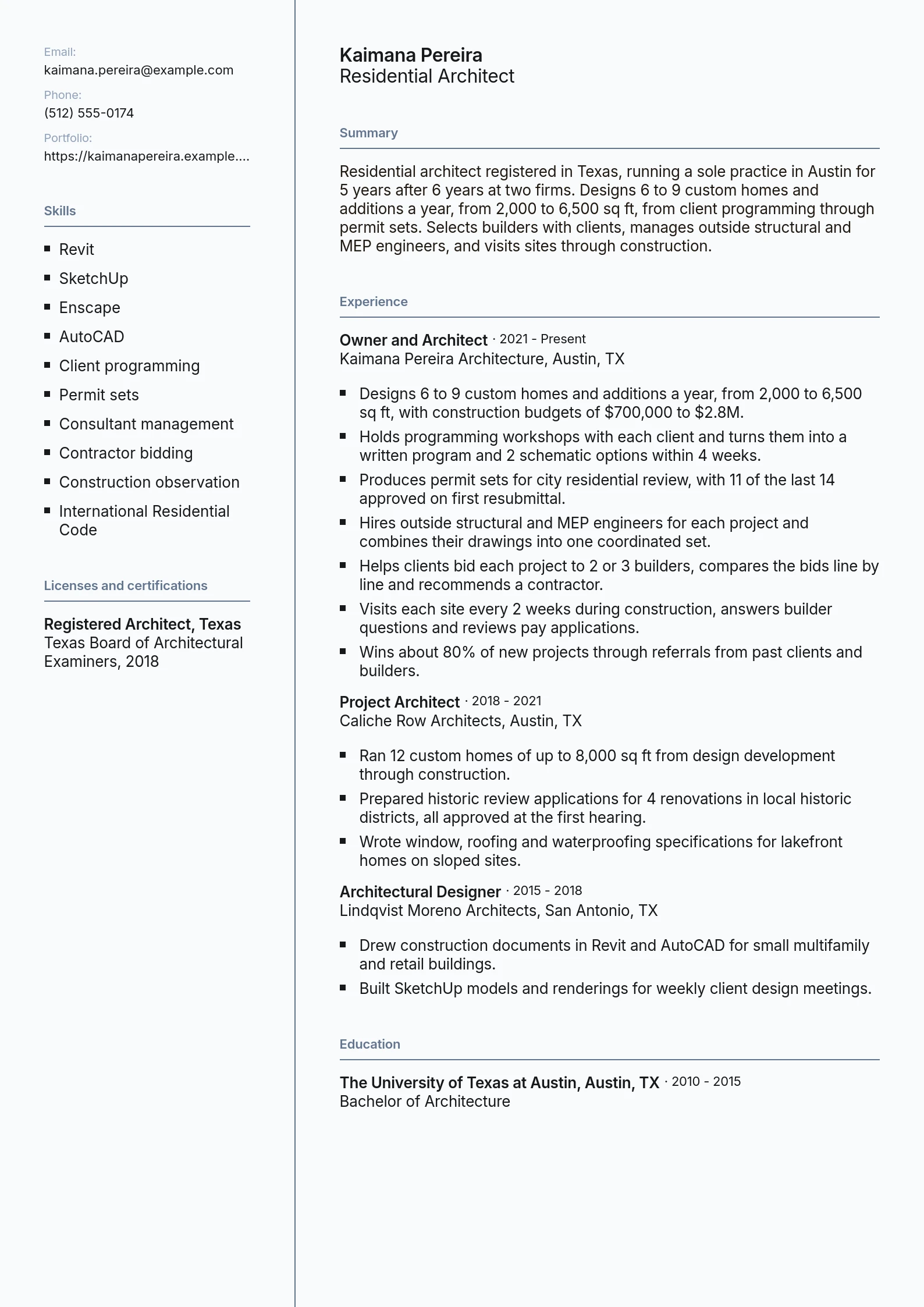
Kaimana Pereira lists his own practice as the current job and gives it numbers: projects a year, house sizes, construction budgets and permit results. His bullets show the parts of practice a staff role rarely covers, such as hiring outside engineers, helping clients choose a builder and finding new work through referrals. A portfolio link sits in the header. Use it if you run your own practice.
Projects a year, house sizes and budgets
Engineers hired and builders selected
Portfolio link in the header
Write your license status as a state, a certificate or a count of hours and divisions
Put your license status in the first line of your summary and repeat it in your credentials section. Firms screen on it before they read your projects, and a job ad that asks for a licensed architect or someone on the licensure path needs to see which one you are.
Name the state that licensed you and the year, because each state licenses architects separately. Add the NCARB Certificate if you hold it, since it makes getting licensed in another state easier and firms working across state lines look for it.
List LEED AP with its specialty and the year, such as 'LEED AP BD+C, GBCI, 2019'. You don't need a separate LEED Green Associate line once you hold LEED AP, because Green Associate is earned first or at the same time.
If you aren't licensed yet, give numbers. Write your AXP hours out of 3,740 and the number of ARE divisions you've passed out of six, then name the divisions in your credentials. 'Pursuing licensure' doesn't tell a reviewer whether you're six months or four years from a license.
Your status
Title
First line of the summary
Credentials entry
Licensed in one state
Architect or Project Architect
Architect licensed in Washington with 9 years on multifamily and mixed-use buildings
Licensed Architect, State of Washington, 2021
Licensed with the NCARB Certificate
Architect or Project Architect
Licensed in Washington and holds the NCARB Certificate
NCARB Certificate, NCARB, 2022
Licensed in one state, moving to another
Architect
Registered in Texas and applying for a Washington license by reciprocity
Registered Architect, Texas Board of Architectural Examiners, 2016
AXP and ARE in progress
Architectural Designer
AXP 2,900 of 3,740 hours and 3 of 6 ARE divisions passed
ARE 5.0: Programming & Analysis, Project Planning & Design, Project Development & Documentation
Recent graduate starting AXP
Architectural Designer
Master of Architecture graduate with an open NCARB Record and 600 AXP hours
NCARB Record, AXP 600 of 3,740 hours
Give every project a cost, a floor area and the phases you led
Write each project as building type, floor area, construction cost and the phases you worked on, then say what you produced or ran. Hiring managers use those facts to judge whether your experience matches their work, and a list of duties without them reads as drafting.
Use the phase names firms use: schematic design, design development, construction documents, bidding and construction administration. Junior candidates name the drawings they produced, such as enlarged restroom plans, wall sections or finish schedules. Project architects add team size, submittals or RFIs handled each month, and how the permit went, such as 'approved after one correction cycle'.
For construction administration, count what you handled: submittals a month, RFIs answered, site visits a week or punch lists written. Specialists add the condition that made the job harder, such as phasing in an occupied hospital or a historic district review.
If a client's budget is confidential, give a range such as $18M to $25M, or use floor area and unit count alone. Group small jobs into one line with a count, such as '14 additions and remodels of 400 to 1,200 sq ft', so they don't crowd out your larger projects.
Type, area, cost and phase
Led a team of 4 through design development and construction documents for a 7-story, 220,000 sq ft mixed-use building with 240 apartments over retail ($60M construction cost), then reviewed 40 to 60 submittals a month during construction.
Duties without scale
Responsible for design and documentation of multifamily projects using Revit.
List Revit first, then the codes and phases you can run
List the software you'd use on your first day at the firm, then the skills that show which phases of a project you can handle. Revit is the program architecture job ads ask for most often. AutoCAD, Bluebeam Revu, SketchUp and Adobe InDesign follow close behind.
Choose skills that match your level. A project architect lists construction administration, submittal and RFI review, and consultant coordination. A junior designer lists construction documents, existing-conditions surveys, and door and finish schedules. A healthcare architect adds the FGI Guidelines, infection control risk assessment and life safety plans.
Name codes and standards by title when you've designed to them: the International Building Code, the ADA Standards for Accessible Design, NFPA 101 or your state's energy code. 'Code knowledge' can't be checked. 'Washington State Energy Code compliance' gives an interviewer something specific to ask about.
List rendering tools you'd use at work, such as Enscape, Lumion or Twinmotion, and drop programs you only opened in a studio course. If you list Rhino or Grasshopper, back it with a bullet that shows the project where you used it.
Leave out traits like 'creative' or 'detail-oriented' and show them in a bullet instead. A Revit detail library your studio adopted or a permit set approved on its first resubmittal makes the same point with proof.
Link a portfolio from the header and keep the resume layout calm
Yes, link your portfolio. Put the link in the resume header next to your email, because architecture job ads often ask for a resume and portfolio together and the reviewer will open it next. Use a web address or a PDF link that doesn't need a login.
Keep the portfolio to 10 to 20 pages of your strongest work. Label each project with the same type, area, cost and phase you used on your resume, and mark which drawings you produced yourself on team projects, because interviewers ask.
If you're early in your career, include one or two school studio projects labeled as academic work next to the construction drawings you produced at a firm. Firms hiring junior staff want to see that you can produce a clean drawing set, so include at least one wall section or detail sheet.
Let the portfolio carry your design work and keep the resume plain. A one- or two-column layout with clear headings shows design sense better than renderings or heavy graphics, and the text stays readable when a firm's applicant system pulls it out.
Use one page if you have under five years of experience and two pages after that. A senior architect with a long project history can add a selected project list as the second page, one line per project: building type, area, cost, phases and role.