Name the databases you ran, how big they were and what happened when one failed, because that's what a hiring manager reads for before your list of SQL dialects. The five examples cover a PostgreSQL engineer at a SaaS company, a senior platform owner, a SQL Server engineer in a health system, a MySQL engineer at a consumer app and a backend developer making the move.
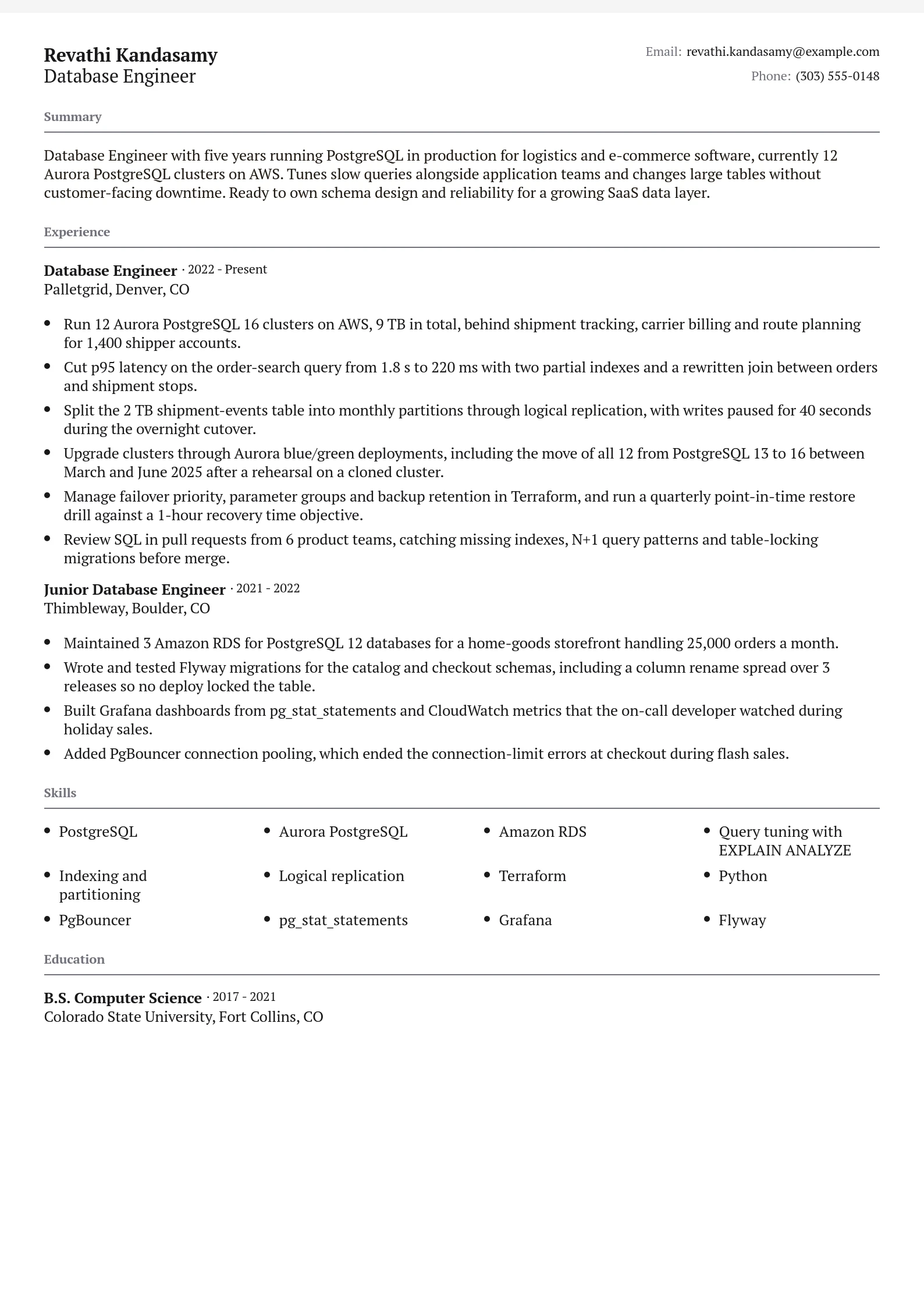
Revathi Kandasamy's resume opens with the estate she runs: 12 Aurora PostgreSQL clusters, 9 TB in total, and the product areas they support. Most bullets after that name a query, a table or a recovery target, so an interviewer can pick any line and ask how she did it.
Copy this layout if you have three to six years with PostgreSQL at a product company and split your week between query tuning, schema changes and the Terraform around them. If your cloud is Google Cloud or Azure, put Cloud SQL or Azure Database for PostgreSQL in the same places.
Match the example to your engine and how much you own
The four examples below differ by database engine, workplace and how much of the platform the candidate is accountable for. Pick the one whose estate looks most like yours, then replace the counts, versions and dates with your own.
Senior engineer who runs the database platform for other teams
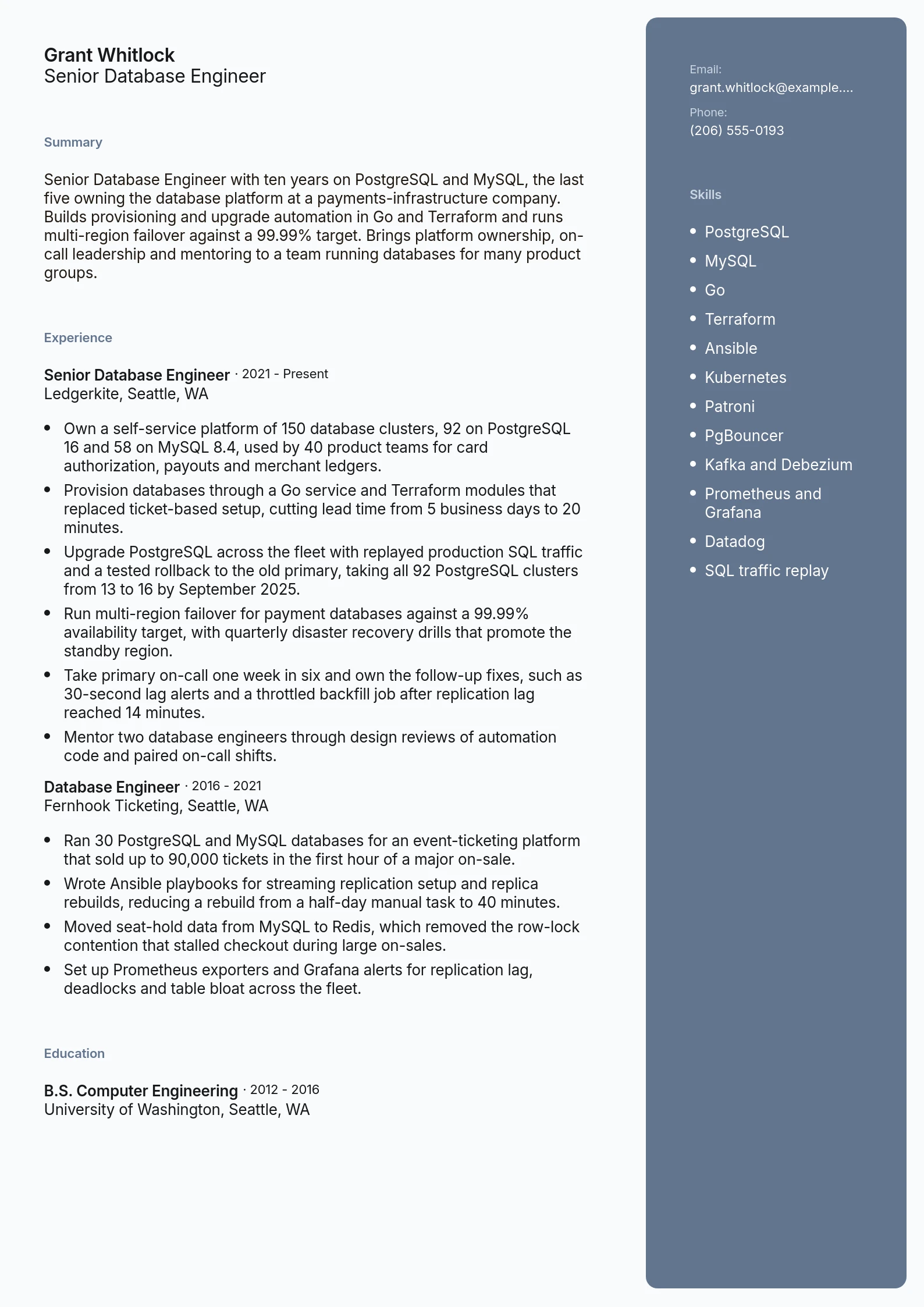
Grant Whitlock's resume is built around a platform other engineers use: 150 PostgreSQL and MySQL clusters for 40 product teams, provisioned by a Go service instead of tickets. His upgrade bullet names both versions, the cluster count, the finish date and the replay testing behind it. Use this layout if you are senior or staff level and your best work is automation, multi-region failover and mentoring, more than single-query fixes.
150 database clusters for 40 teams, provisioned in 20 minutes
PostgreSQL 13 to 16 upgrade with traffic replay and rollback
Primary on-call one week in six
SQL Server engineer in a regional health system
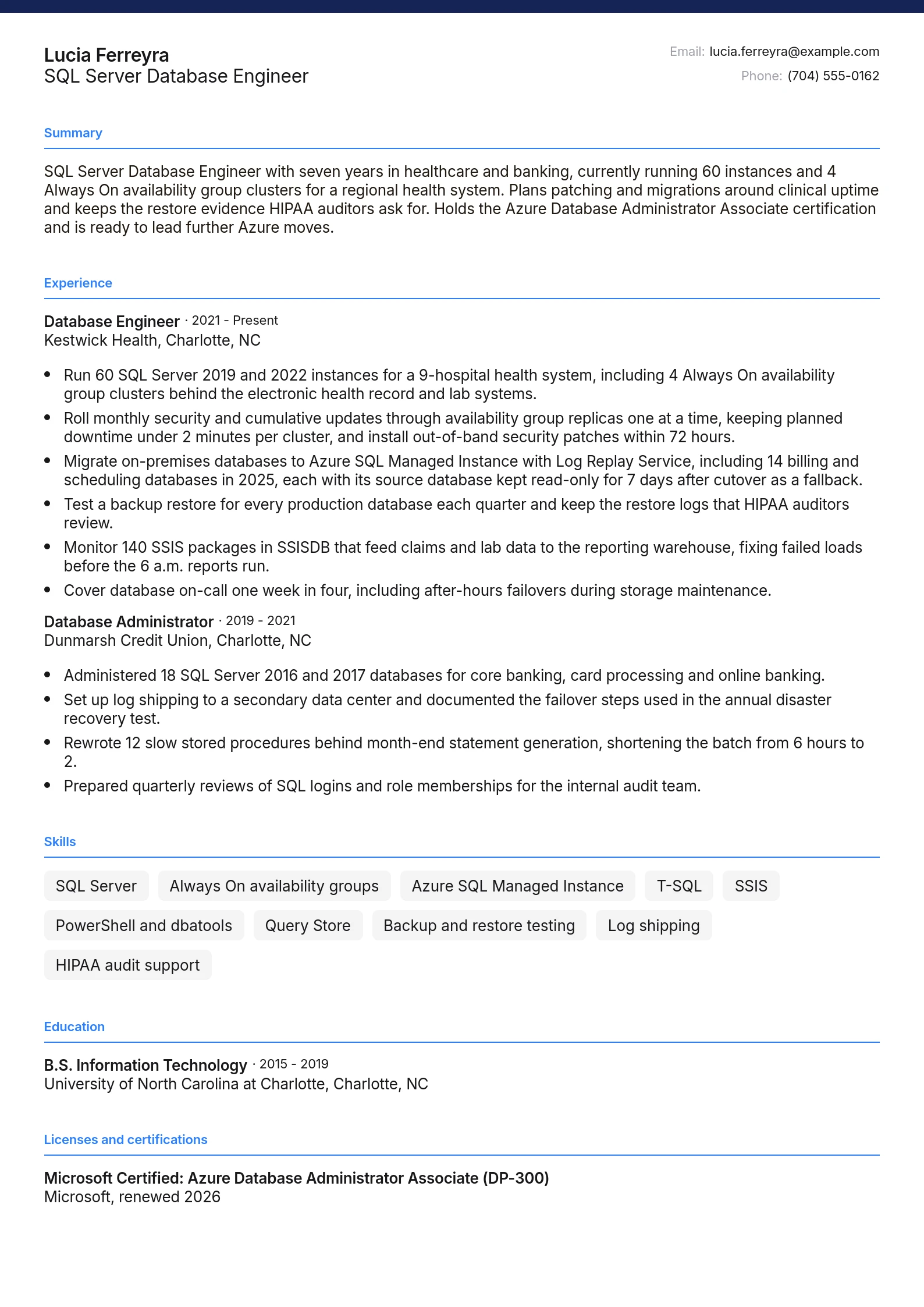
Lucia Ferreyra works in a regulated hospital network, so her resume leads with Always On availability group clusters, monthly patching windows and quarterly restore tests that HIPAA auditors review. Her Azure SQL Managed Instance migration lists the database count, the method and how long each source database stayed available as a fallback. Choose it if you run SQL Server for a hospital, bank or insurer, where change windows and audit evidence matter as much as query speed.
4 Always On clusters across 60 instances
14 databases moved to Azure SQL Managed Instance
DP-300 listed with its 2026 renewal
MySQL engineer at a high-traffic consumer app
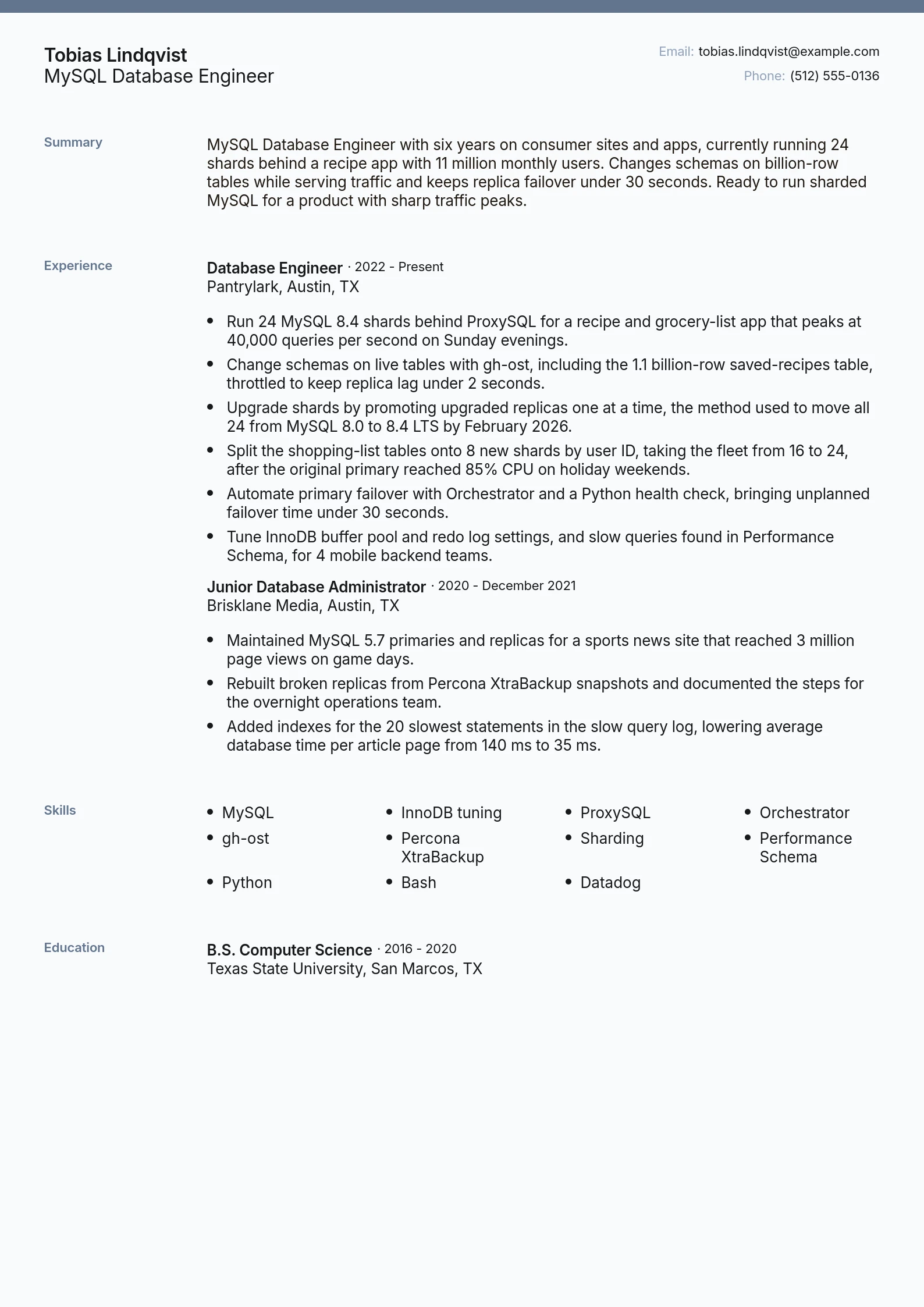
Tobias Lindqvist runs sharded MySQL behind a recipe app with 11 million monthly users, so his bullets quote queries per second, shard counts and replica lag limits. He shows a live schema change on a billion-row table, a reshard driven by CPU headroom and a dated move to MySQL 8.4 LTS. Use it if your traffic comes from consumers in sharp peaks and your tools are ProxySQL, gh-ost and Orchestrator.
40,000 queries per second at peak across 24 shards
gh-ost change on a 1.1 billion-row table
MySQL 8.0 to 8.4 LTS before end of life
Backend developer moving into database engineering
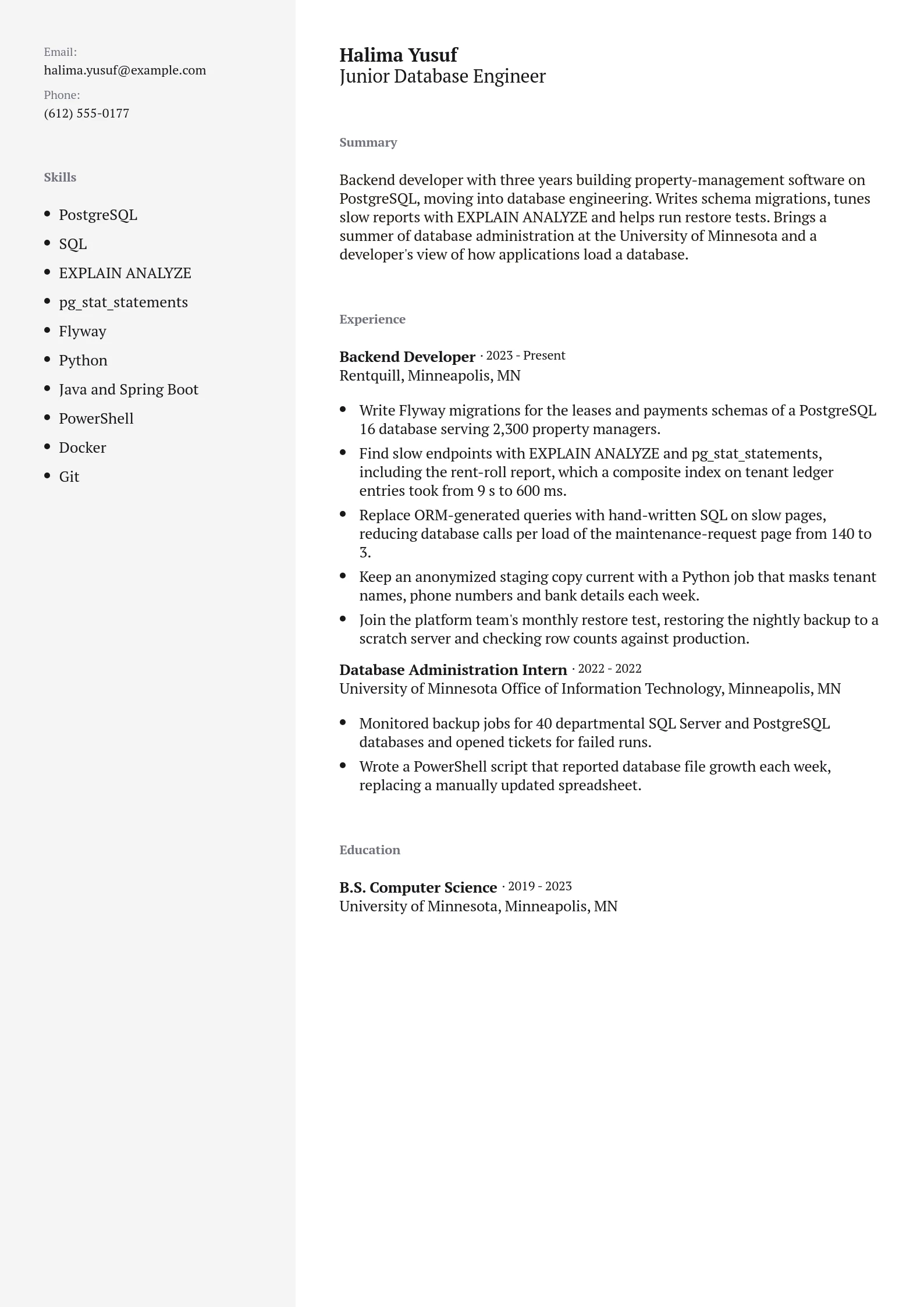
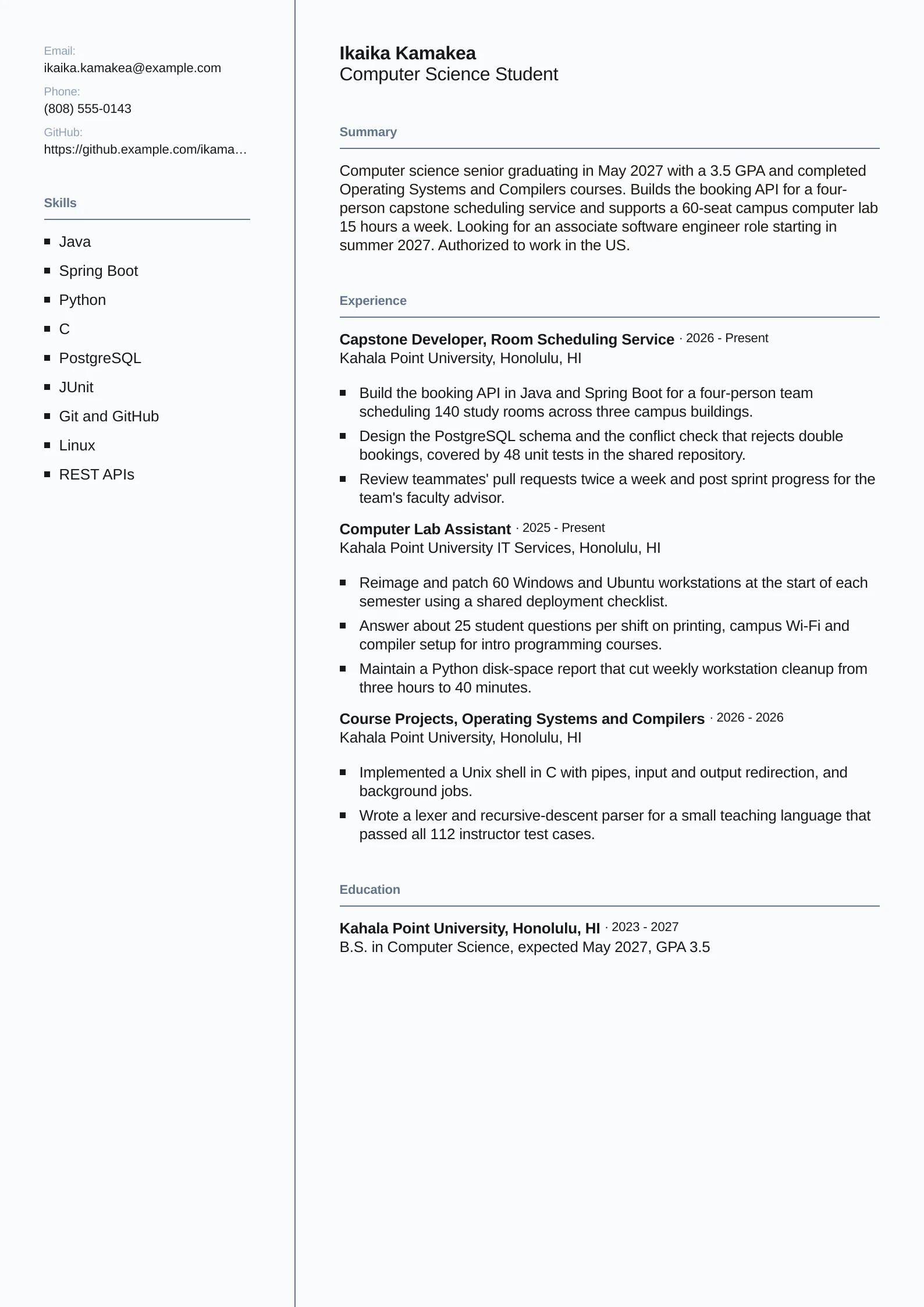
Halima Yusuf has three years as a backend developer and a summer internship in university database administration, with no database title yet. Her bullets pull out the database work inside a developer job: Flyway migrations, an index that took a report from 9 seconds to 600 ms, a fix for an ORM query flood and restore tests. Use it if you are an early-career developer or junior DBA applying for your first database engineering role.
Rent-roll report from 9 s to 600 ms with one composite index
Masked staging database refreshed by a Python job
Database administration internship at the University of Minnesota
Open each role with the estate you ran and its recovery targets
Show scale with the engine, count and size of the databases you were accountable for, then what happened under load or failure. A skills line reading "PostgreSQL, MySQL, T-SQL" looks the same whether you ran 3 databases or 300.
Make the first bullet in each role the estate: engine and version, number of clusters or instances, total data size and what the business runs on them. "12 Aurora PostgreSQL 16 clusters, 9 TB, behind shipment tracking and billing" gives a reader your scope in one line.
Give every performance number a baseline and a named query or job. "Cut order-search p95 from 1.8 s to 220 ms" can be discussed in an interview. "Improved query performance by 30%" can't, because nobody knows which query or how it was measured.
State reliability as a target and a test, such as a 99.99% availability goal, a 1-hour recovery time objective or a quarterly point-in-time restore drill. If you never measured uptime, write about your restore drills and failovers instead of quoting a percentage.
The estate, a named query and a tested recovery target
Run 12 Aurora PostgreSQL 16 clusters (9 TB) behind shipment tracking and carrier billing. Cut order-search p95 from 1.8 s to 220 ms with two partial indexes and a rewritten join. Run a quarterly point-in-time restore drill against a 1-hour recovery time objective.
Tools and round numbers, no scope
Managed PostgreSQL and MySQL databases, improved query performance by 30% and maintained 99.9% uptime.
Write migrations and upgrades as source, target, size, downtime and rollback
A migration bullet is the line interviewers probe hardest, so name the source, the target, how much data moved, how long writes stopped and how you could have gone back. Those five details show you planned for failure.
For a major version upgrade, give both versions, the number of clusters, the finish date and how you tested. Grant writes that he took all 92 PostgreSQL clusters from 13 to 16 by September 2025, validated with replayed production SQL traffic. If you used Aurora blue/green deployments, pg_upgrade or logical replication, name the method.
For a move to the cloud, name the target service and the method. "Moved 14 databases to Azure SQL Managed Instance with Log Replay Service, sources kept read-only for 7 days as a fallback" says far more than "migrated to Azure." Add the reconciliation step if you ran one, such as row counts or checksums compared before cutover.
For a change on a live table, give the row count or size, the tool and the pause. A gh-ost change on a 1.1 billion-row table, or a 2 TB table split into monthly partitions with a 40-second write pause, shows you can change production without booking a maintenance weekend.
If you moved between engines, such as Oracle to PostgreSQL, add the conversion work: stored procedures rewritten, data types mapped and how you compared results between the old and new systems. Interviewers will ask about the parts that didn't convert cleanly, so have one example ready.
Show what you automated and designed, beyond keeping databases up
A database engineer resume shows the systems you built around the database: provisioning code, migration tooling, failover automation and schema decisions made with application teams. DBA, backend and data engineering resumes often hold the same raw experience, written as tasks or as features. The table shows how to move each kind of line toward engineering.
Put at least one automation bullet in every recent role and say what it replaced. "Provision databases through a Go service and Terraform modules that replaced ticket-based setup" reads as engineering, and "cutting lead time from 5 business days to 20 minutes" gives it a result.
Coming from
Your resume usually says
Rewrite it to show
DBA
Applied patches, ran backups, created logins on request
The automation you wrote for those jobs, such as Ansible playbooks for replica rebuilds or a PowerShell patch rollout across availability group replicas, and the hours it saved
Backend developer
Built API endpoints for leases and payments
The database work inside those features: Flyway or Liquibase migrations, indexes added after reading EXPLAIN ANALYZE output, ORM queries replaced with hand-written SQL
Data engineer
Built pipelines into the warehouse
The source-database side: replication slots or change data capture with Debezium, the load your extracts put on the primary, and schema changes agreed with the teams that own the tables
Site reliability engineer
Handled incidents across services
Database incidents and fixes by name: replication lag, deadlocks, table bloat, connection exhaustion fixed with PgBouncer, and the alerts you added afterward
Give on-call its rotation, its incidents and what changed after
Put on-call inside the role it belongs to as one bullet: the rotation, what you covered and an incident or fix that came out of it. "Primary on-call one week in six" tells a reader the load, and one real incident tells them how you work under pressure.
Describe an incident by symptom, cause and the change you made. Grant names the incident, replication lag that reached 14 minutes during a bulk backfill, and the two fixes he owned afterward: 30-second lag alerts and a throttled backfill job. That is specific enough to discuss and still fits on two lines.
For SQL Server and regulated settings, include patching windows and after-hours work. Monthly security and cumulative updates rolled through availability group replicas, out-of-band security patches within 72 hours and failovers during storage maintenance all show you can be trusted with a production change window.
Skip incident counts with no context. "Resolved 200+ incidents" could mean paging noise or real outages. Name the class of alert you reduced instead, such as deadlock pages or failed SSIS loads, and the before and after numbers if you tracked them.
DP-300 renews every year, and the AWS database specialty is retired
Microsoft Certified: Azure Database Administrator Associate, earned through exam DP-300, is current and is Microsoft's credential for running SQL Server and Azure SQL databases. It renews every 12 months through a free online assessment, so list it with the issuer and the year you last renewed, as Lucia does with "Microsoft, renewed 2026."
AWS Certified Database Specialty was retired in April 2024. Holders keep it active for three years from the date they earned it, so list it only while it is still within that window, with the year earned. The last of these lapse in April 2027. Once it lapses, remove it and let your Aurora or RDS bullets carry the AWS experience.
Certification is optional for most database engineer roles. BLS notes that vendors offer it and some employers require it for the products they run, while a bachelor's degree in computer and information technology or a related field is the usual entry route. Four of the five examples here list no certification.