Hiring managers read a software engineer resume for what you own in production: the system, who or what depends on it, and what you did when it broke. The 12 examples differ by level and by kind of work, covering a student with only projects, a new graduate, mid-level, senior and principal engineers, and specialists in iOS, firmware, machine learning, platform, security and bank software.
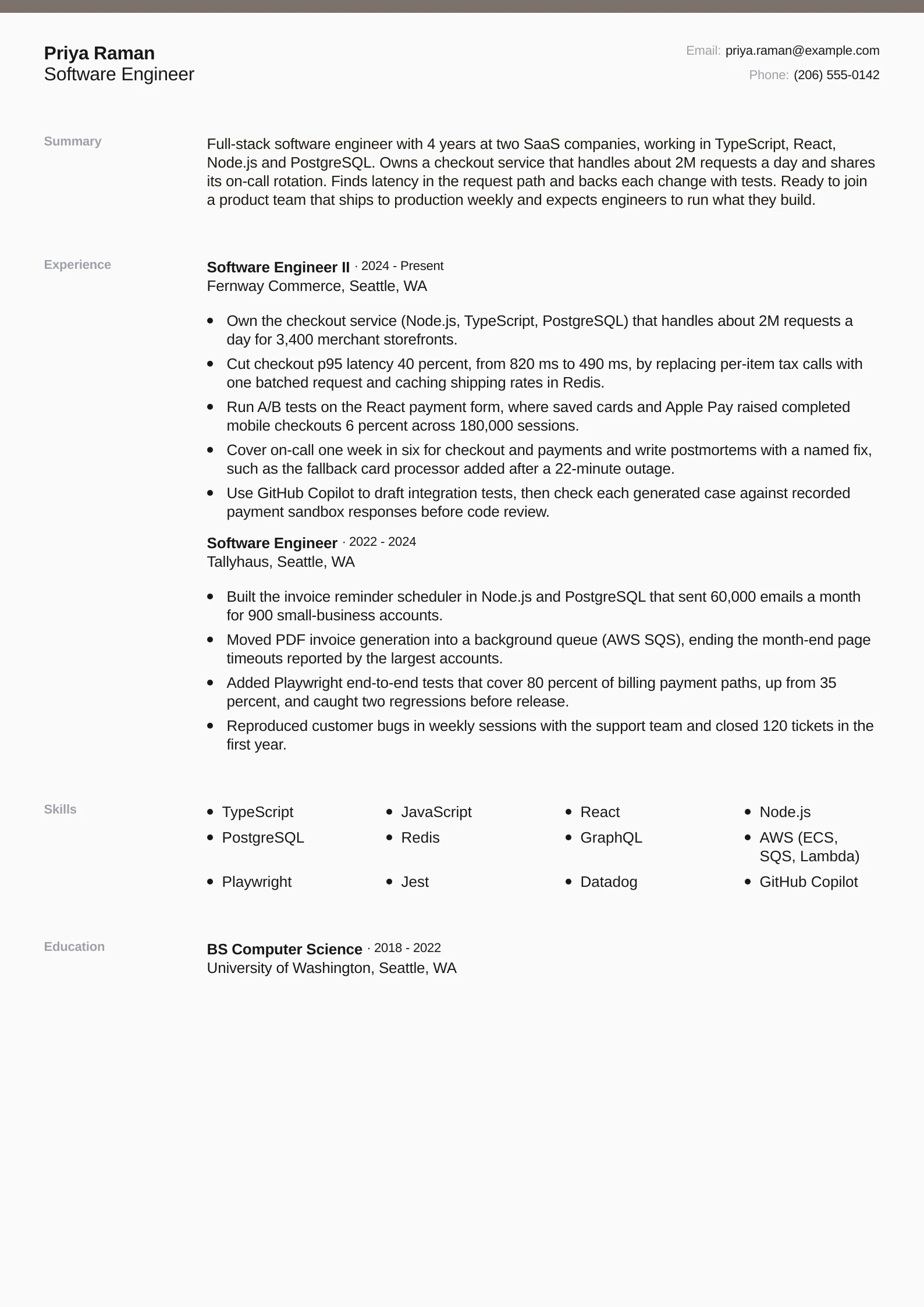
A mid-level resume built around one service she owns
Priya's resume makes her level clear in the first third of the page: 4 years, one stack (TypeScript, React, Node.js, PostgreSQL) and a checkout service she owns at about 2M requests a day. Most bullets pair a change with its result, such as the batched tax call and Redis cache that cut p95 latency 40 percent.
It also gives on-call its own bullet and spends one line on how she checks AI-drafted tests. Start from it if you have 2 to 5 years on a product team and want a structure for ownership, incidents and results.
Resumes for other levels and kinds of engineering
Each resume below is written for a different level or kind of engineering work. Pick the candidate who looks most like you, then replace their systems and numbers with yours.
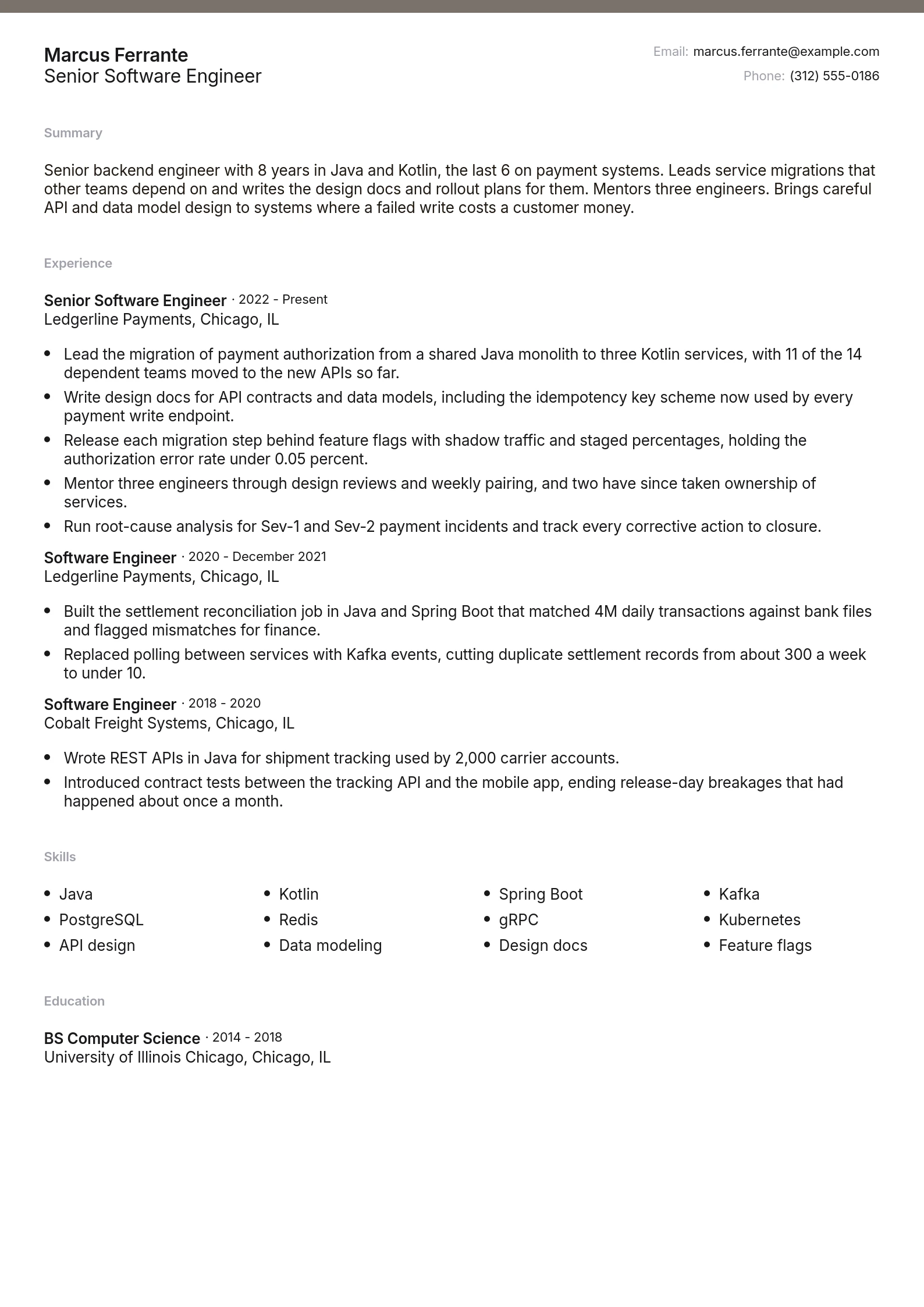
Senior backend engineer leading a migration
Marcus shows senior scope through work other teams depend on: a move of payment authorization to Kotlin services with 14 dependent teams, design docs that set the idempotency key scheme, and staged rollouts held under an error-rate limit. A promotion at one employer appears as two separate roles. Use it if you have 6 or more years on backend services and lead changes beyond your own team.
Migration with 14 dependent teams in the first bullet
Promotion shown as two roles at one employer
Mentoring with a stated outcome
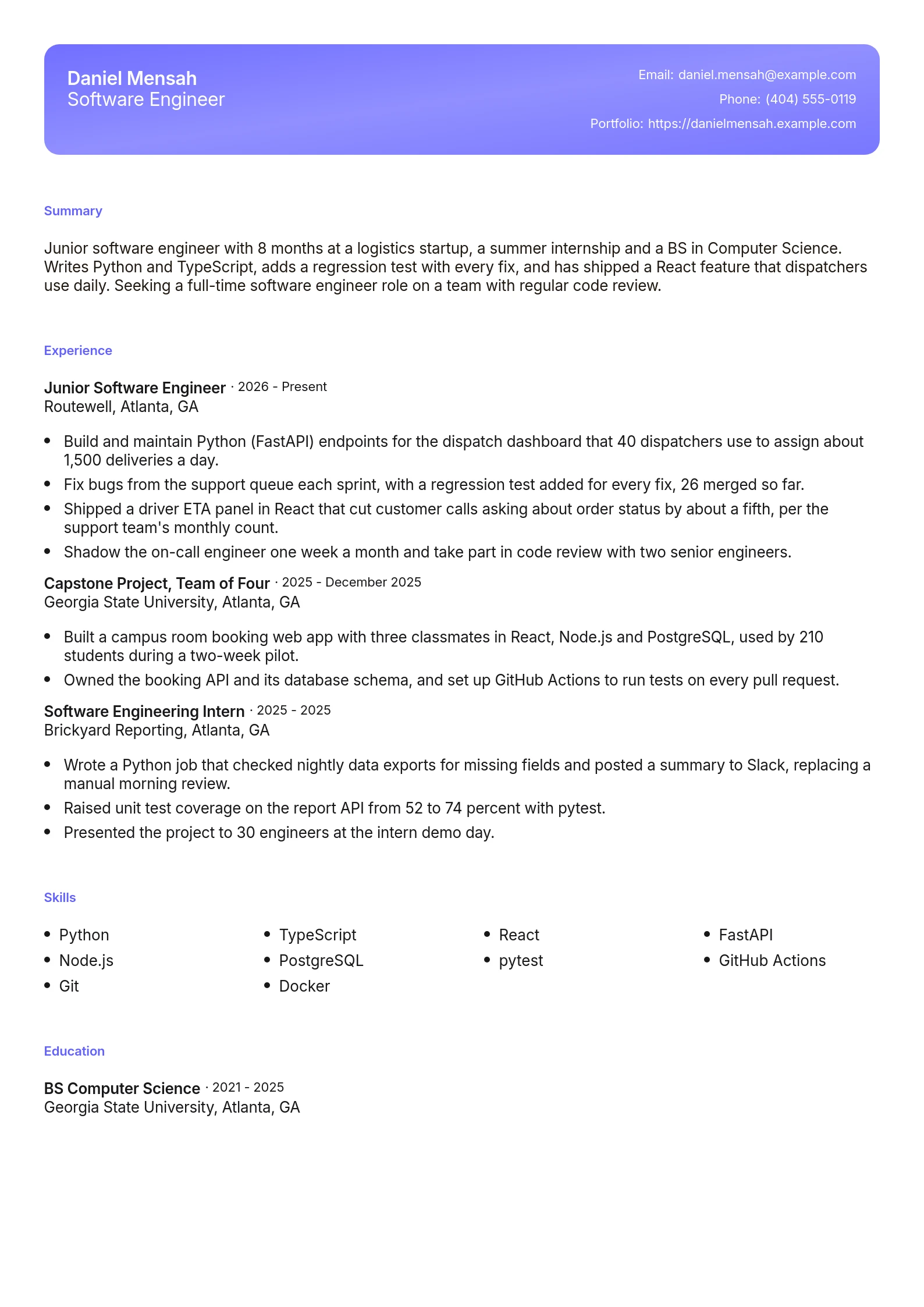
New graduate with an internship and a capstone
Daniel has 8 months in a junior role, so the paid job comes first, followed by a capstone listed as experience and a summer internship. The capstone names the team size, the API he owned and how many students used the app. Junior role bullets tie his code to the dispatchers who use it every day. Use it if you graduated in the last year or two with one internship.
Capstone listed as experience with team size and his part
Regression test added with every bug fix
Portfolio link in the header
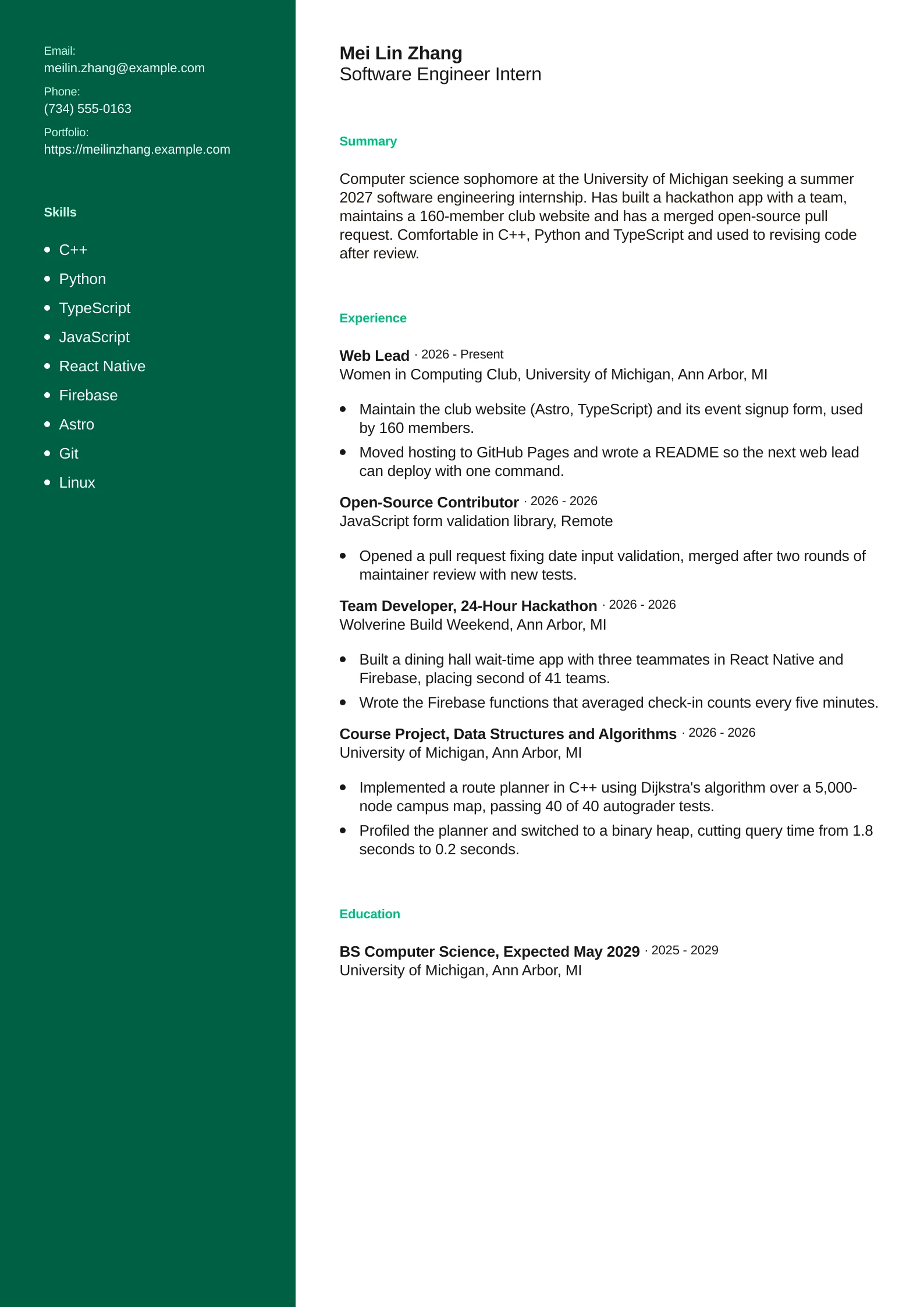
Student with projects and no paid experience
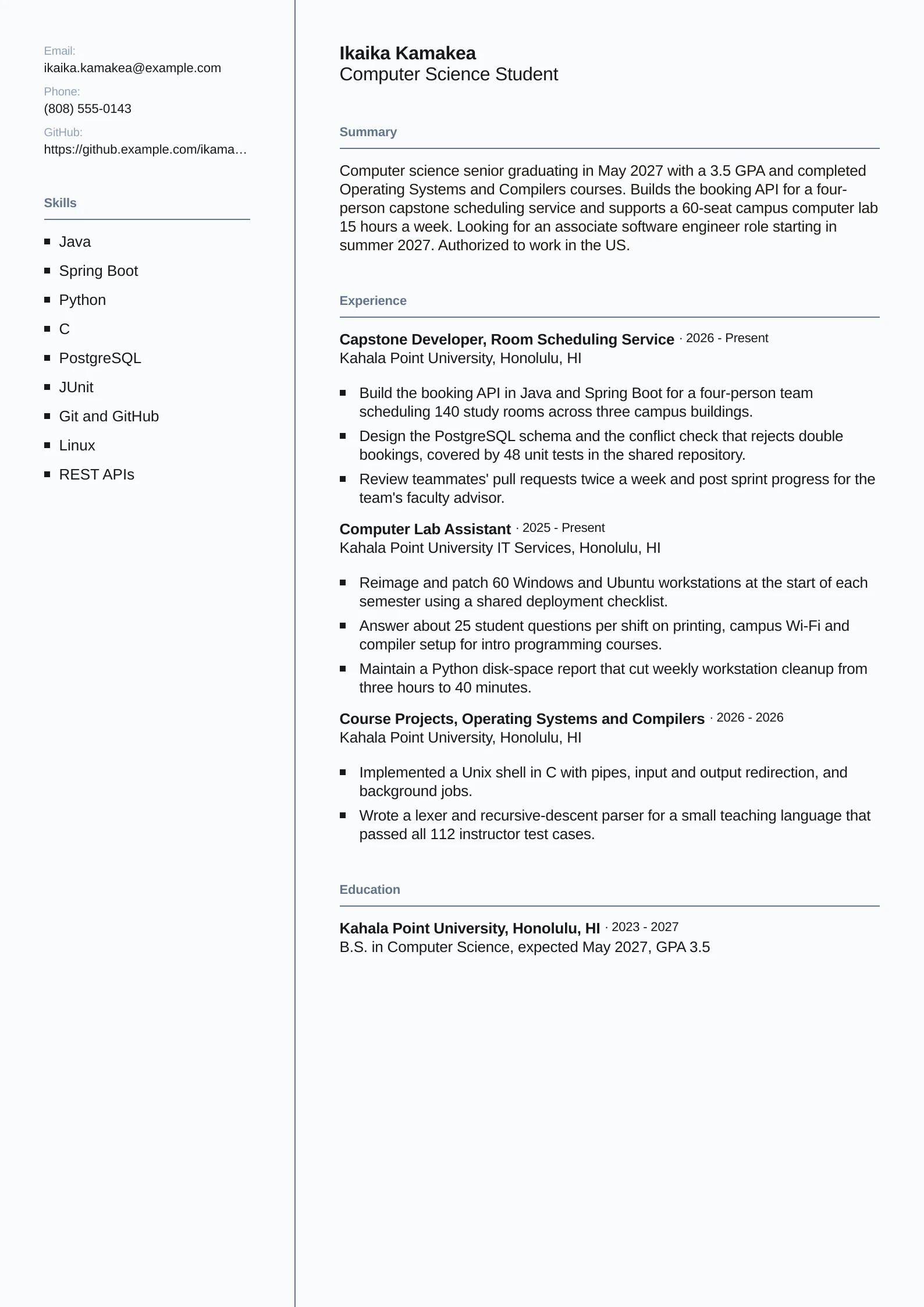
Mei Lin has no paid experience, so a hackathon app, a club website she maintains, a merged open-source pull request and a C++ course project fill the experience section. Each entry carries a detail a reader can check: second of 41 teams, 160 members, 40 of 40 autograder tests. The summary names the internship season she wants. Use it if you are early in a degree and applying for your first internship.
Club, hackathon, open-source and course work as experience
Expected graduation date in the education title
Summary names summer 2027
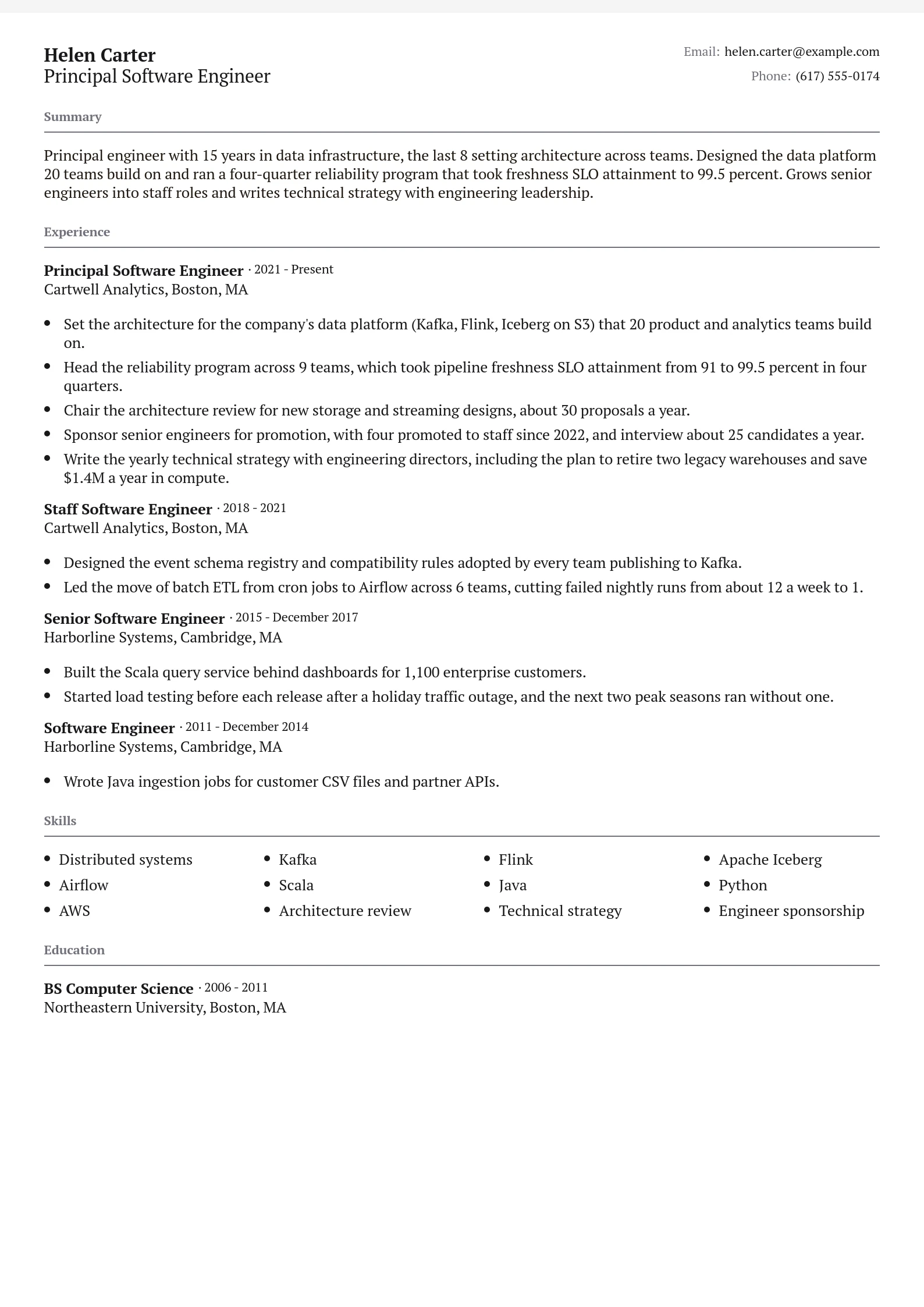
Principal engineer setting architecture for 20 teams
Helen's bullets cover the company rather than one team: a data platform 20 teams build on, a four-quarter reliability program across 9 teams, an architecture review she chairs and four engineers sponsored to staff. Her earliest role gets one bullet, so 15 years still read quickly. Use it if you are a staff or principal engineer whose work is mostly design, technical strategy and growing other engineers.
Reliability program with SLO attainment before and after
Strategy bullet with a yearly cost saving
Older roles cut to one or two bullets
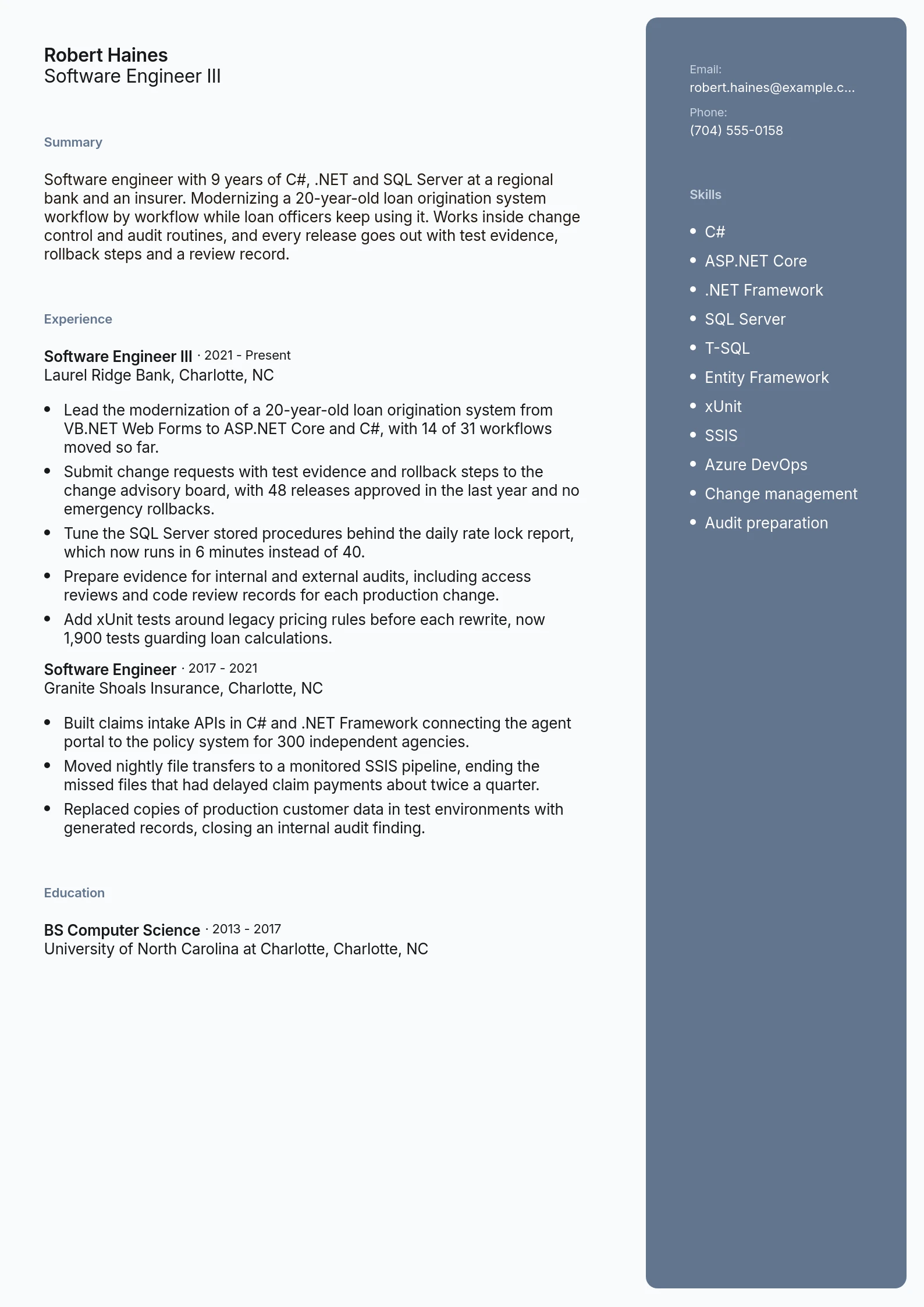
Enterprise .NET engineer at a regional bank
Robert's resume suits banks, insurers and other employers with change control and audits. His bullets name the change advisory board, test evidence with rollback steps, audit preparation and a 20-year-old loan system moving to ASP.NET Core one workflow at a time. SQL Server tuning gets a before and after run time. Use it if you write C# and .NET in a regulated company and want process to read as a strength.
Modernization progress shown as 14 of 31 workflows
Change control and audit work as bullets
Classic layout with skills as a list
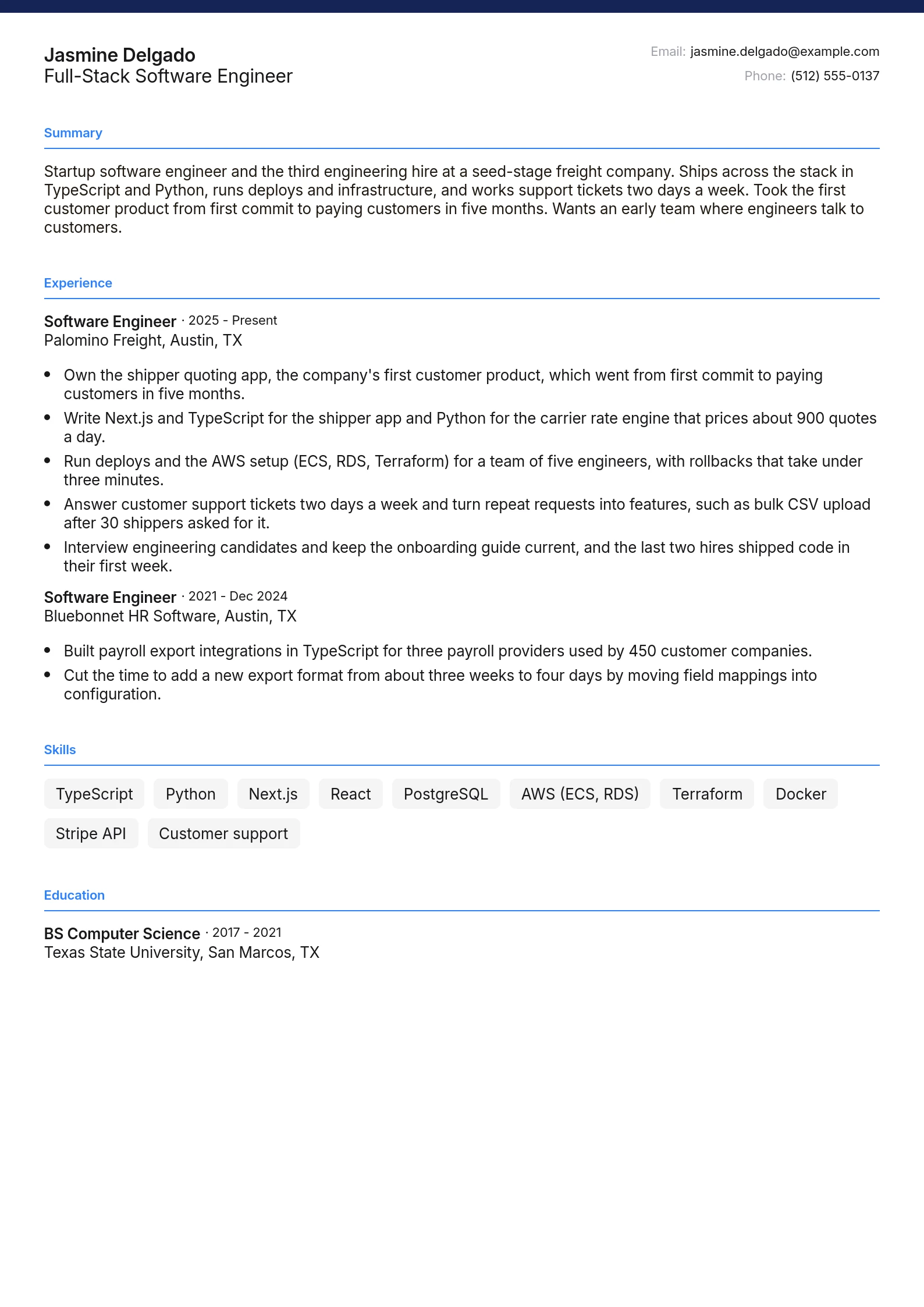
Third engineer at a seed-stage startup
Jasmine was the third engineer at a freight startup, so her resume shows range: a quoting app taken from first commit to paying customers in five months, a Python rate engine, deploys and Terraform, and two days a week on support tickets. A prior payroll software job shows she has also worked in a larger codebase. Use it if you are a generalist applying to small, early teams.
Five-month build from first commit to paying customers
Support work turned into a shipped feature
Deploys and infrastructure listed beside product code
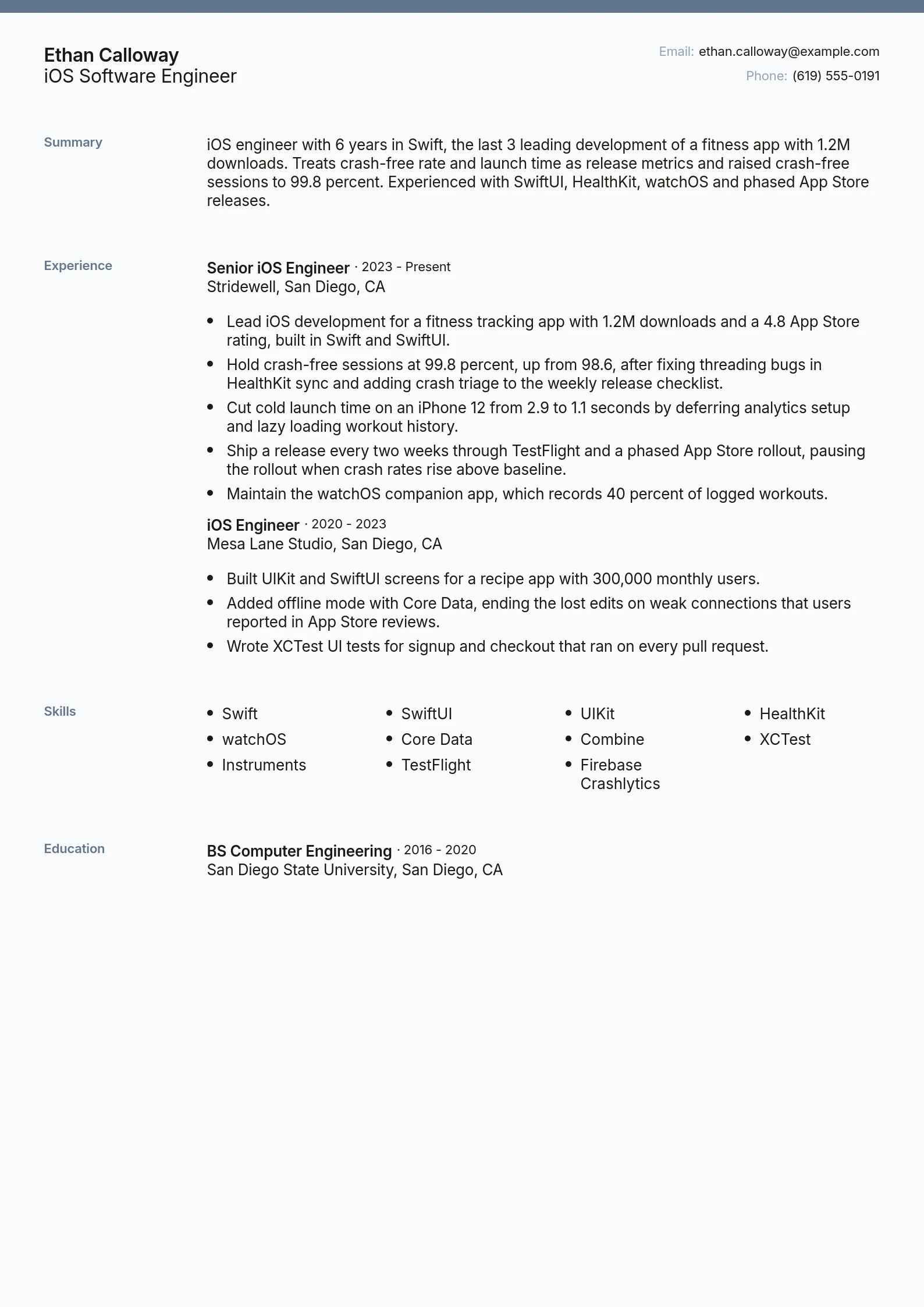
iOS engineer who owns crash rate and launch time
Ethan's resume rests on two app metrics he owns: crash-free sessions, raised from 98.6 to 99.8 percent, and cold launch time, cut from 2.9 to 1.1 seconds on a named device. It also gives the release cadence, the phased App Store rollout and a watchOS companion app. Use it if you ship consumer iOS apps in Swift and SwiftUI and can quote crash and performance numbers.
Download count and App Store rating in the first bullet
Launch time measured on a named iPhone
Release process with a rollout pause rule
Firmware engineer on medical and industrial devices
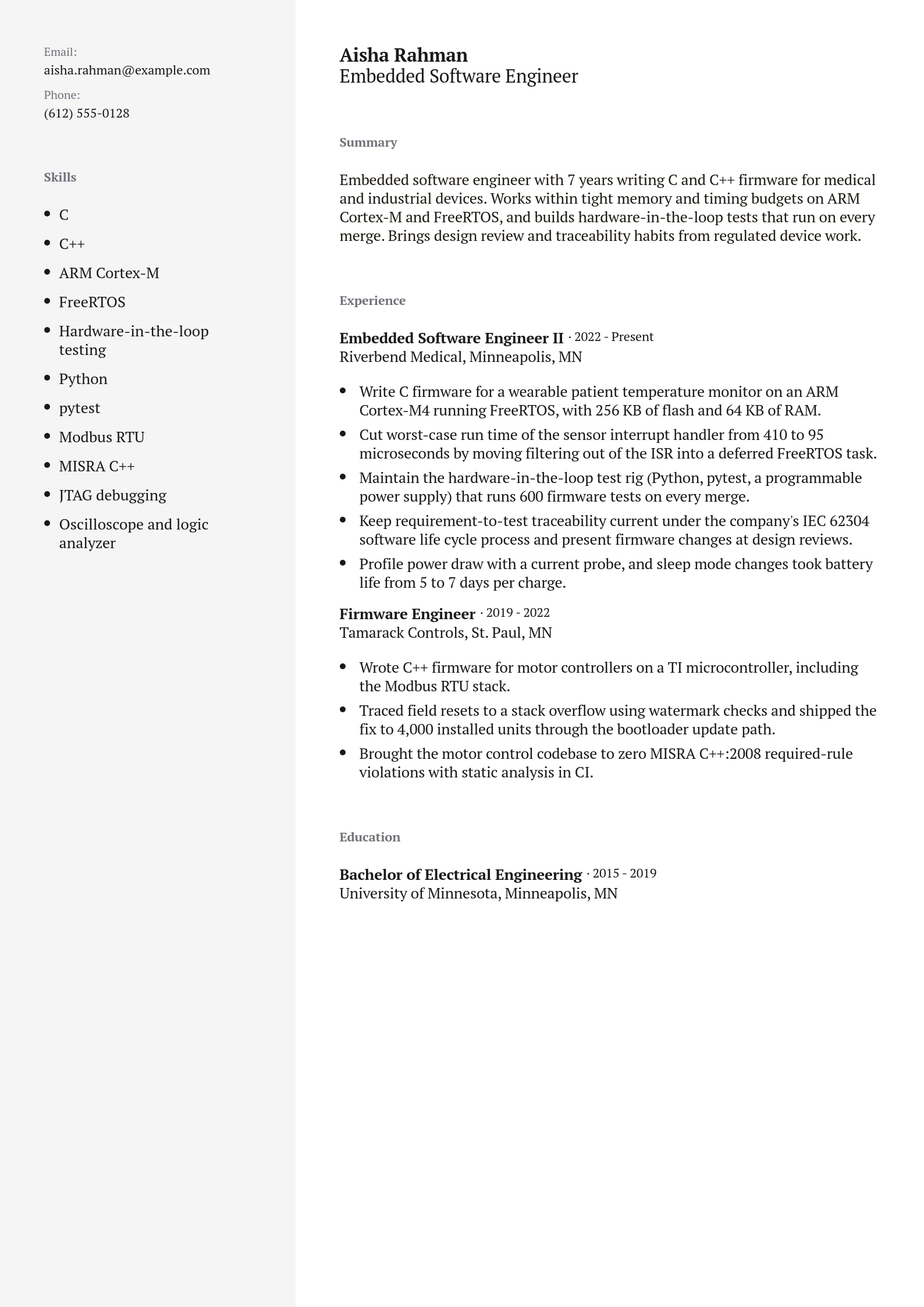
Aisha states the hardware limits up front: an ARM Cortex-M4 with 256 KB of flash and 64 KB of RAM running FreeRTOS, and sensor interrupt handler time cut from 410 to 95 microseconds. A hardware-in-the-loop rig running 600 tests per merge and IEC 62304 traceability show how she tests. Use it if you write C or C++ firmware and need to show timing, memory and test work instead of web metrics.
Memory and timing budgets named in bullets
Field fix shipped to 4,000 installed units
Battery life measured in days per charge
ML engineer running model serving and evaluation
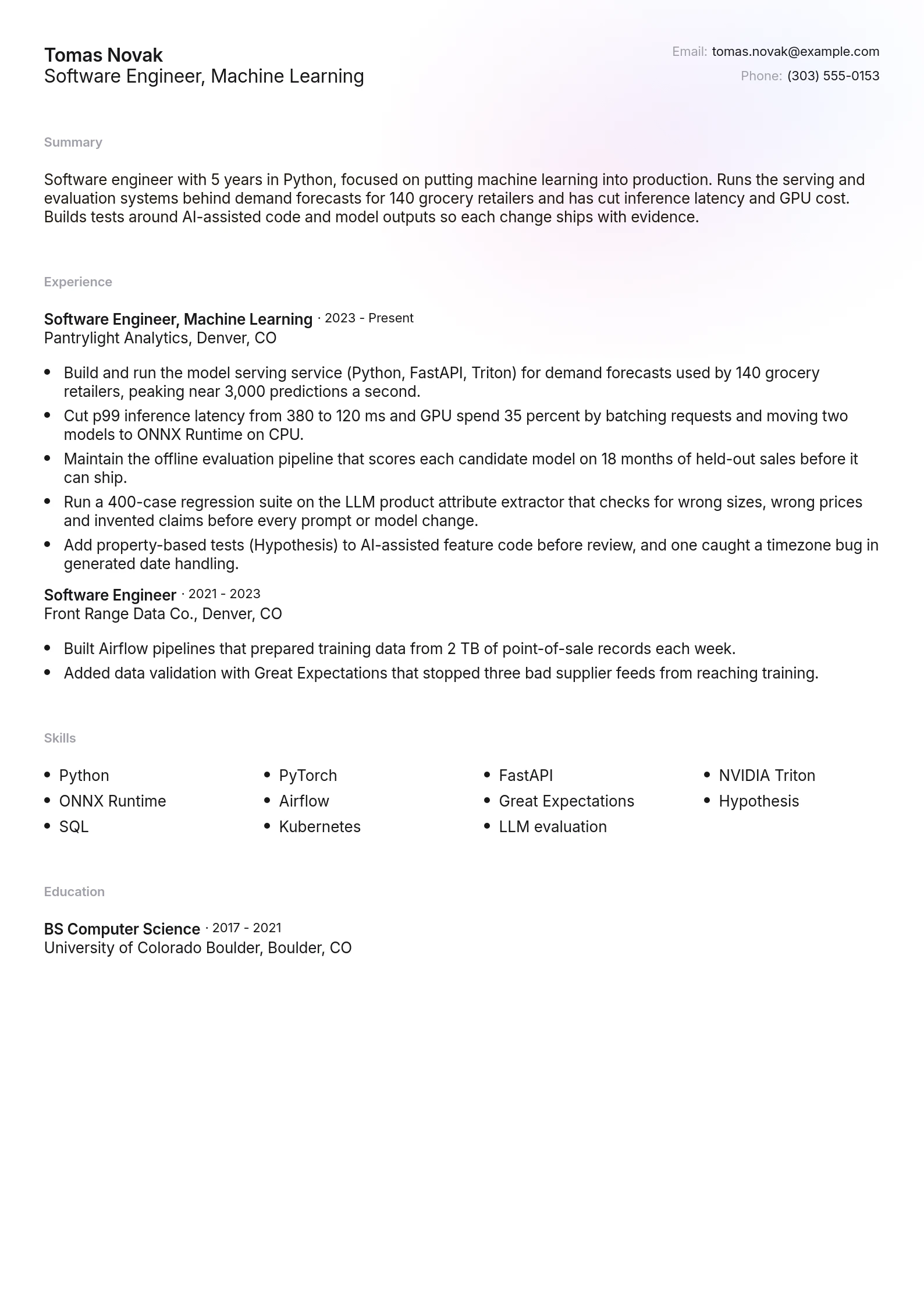
Tomas treats machine learning as production software: a serving service at 3,000 predictions a second, p99 latency and GPU cost cuts, and an evaluation gate every model must pass. Two bullets show how he checks AI output, a 400-case regression suite for an LLM feature and property-based tests on AI-assisted code. Use it if you deploy and maintain models more than you research them.
Latency and GPU cost cut in one bullet
LLM regression suite with named failure types
Data validation before training
Platform engineer running CI/CD for 180 engineers
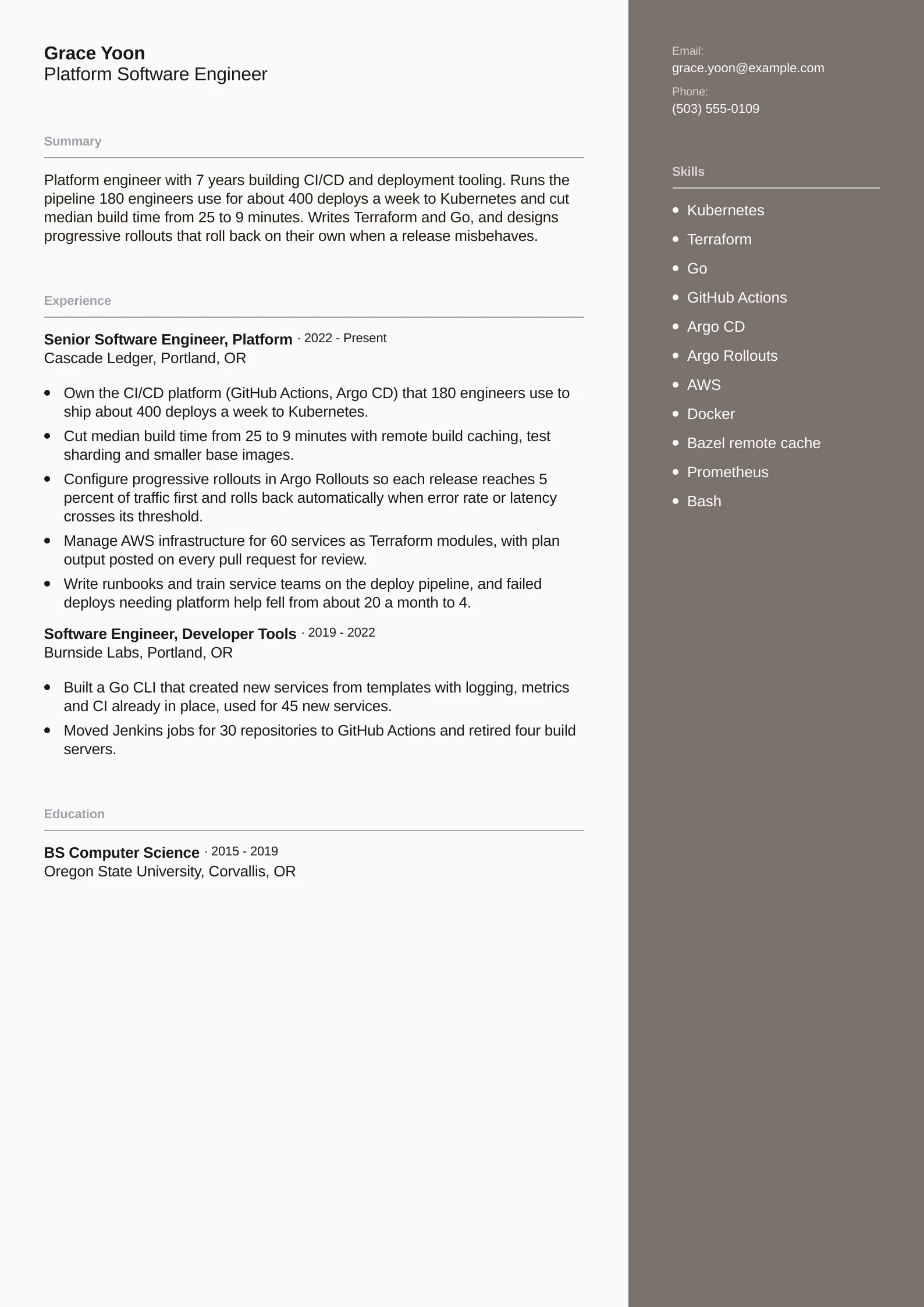
Grace's users are other engineers, so her resume counts them: 180 engineers, about 400 deploys a week and 60 services in Terraform. Build time cut from 25 to 9 minutes comes with the three changes that did it. Progressive rollouts that roll back on their own show her reliability work. Use it if you build internal tooling, CI/CD pipelines or Kubernetes platforms.
Build time result with its three causes
Internal users counted like customers
Go CLI used to create 45 services
Security engineer building detection and login systems
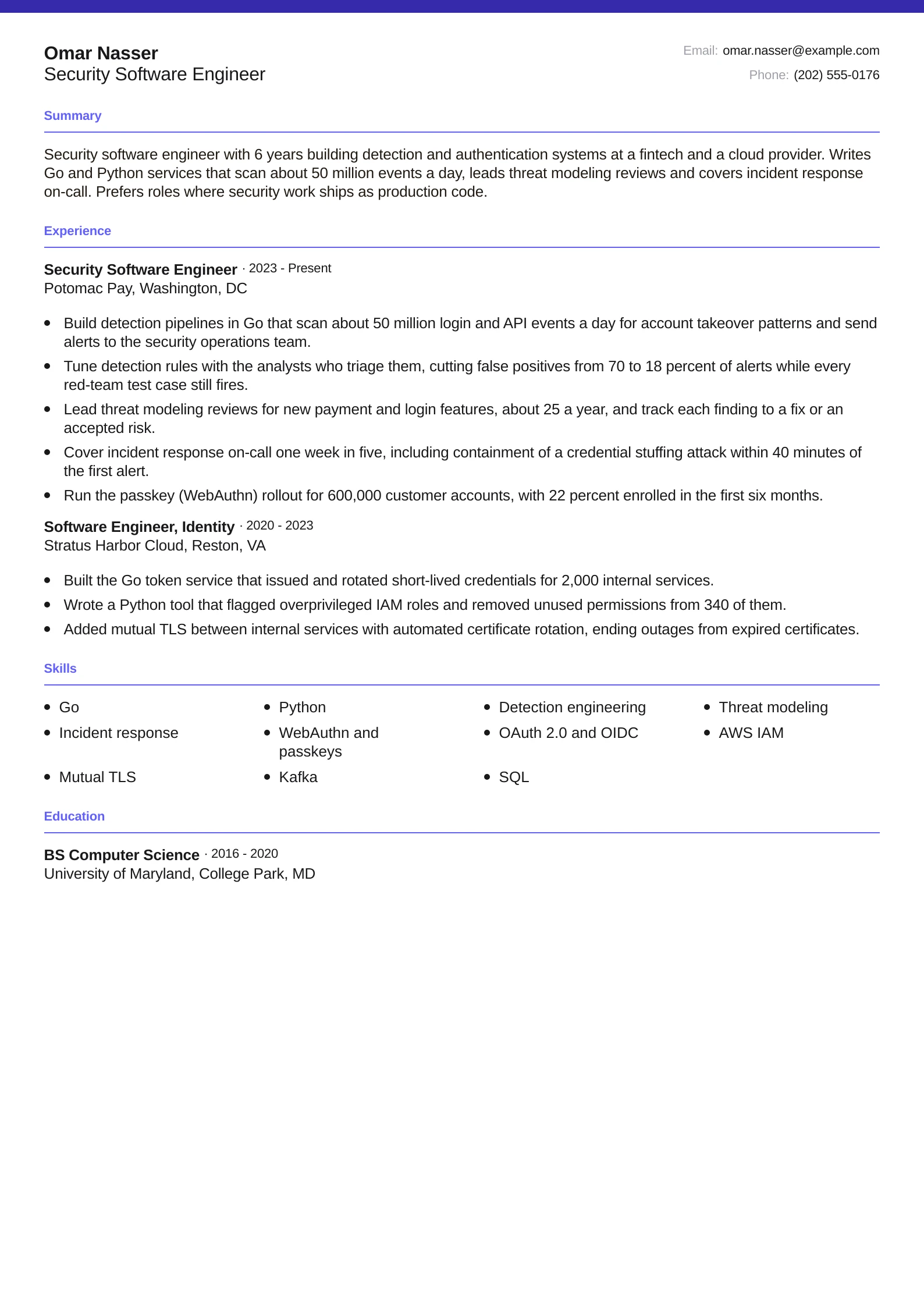
Omar presents security as shipped code: Go pipelines scanning about 50 million events a day, false positives cut from 70 to 18 percent of alerts, a passkey rollout to 600,000 accounts and threat modeling reviews tracked to fixes. Incident response on-call comes with a containment time. Use it if you are a software engineer in application, identity or detection security.
False positive rate before and after
Threat modeling reviews counted per year
Containment time for a credential stuffing attack
Show what you run in production and what depends on it
Hiring managers look for production ownership: a system you built or run, the load or teams that rely on it, and what you did when it failed. A list of languages shows none of that. Datadog's senior ad asks engineers to fix production issues in a service their team owns, and Airbnb's asks for migrations other teams depend on.
Open your current role with the system and its scale, as in "Own the checkout service (Node.js, TypeScript, PostgreSQL) that handles about 2M requests a day." Put the stack in the same line so the reader sees where you used it, not only that you know it.
Give on-call and incidents their own bullet. Say how often you're on call and name one fix that came out of a postmortem, such as a fallback card processor added after an outage. Platform and security engineers can use automatic rollbacks or containment time instead.
Put your years and main stack in the first line of the summary. Ads screen by range, such as 2 to 4 years for a Software Engineer II and 6 or more for senior, and the reader shouldn't have to add up dates to find yours.
Replace missing numbers with load, dependents and before and after
When you can't share revenue or user numbers, show scale through the load on the system, the people who depend on it, or the state before and after your change. Recruiters read for business impact and hiring managers also want the technical problem, so one bullet should carry both.
Use rough load ("about 900 quotes a day") or counts of teams, services and engineers ("180 engineers, about 400 deploys a week"). If a number is confidential, give a percentage or a before and after ratio, such as false positives cut from 70 to 18 percent of alerts. If there's no number at all, name the problem that ended, such as month-end timeouts or release-day breakages.
Names the change and the problem it ended
Moved PDF invoice generation into a background queue (AWS SQS), ending the month-end page timeouts reported by the largest accounts.
Vague: no system, no fix, no result
Worked on backend performance improvements and fixed bugs for the billing team.
Match the ad's stack and prove each tool in a bullet
List the languages, frameworks and tools you could use on day one in the skills section, then make sure each one also appears in a bullet that shows where you used it. A skill with no matching bullet reads like a course you once took.
Order the list by the ad you're applying to and use its spelling. A Software Engineer II ad asking for C# and React should find "C#" and "React" near the top, not "C-Sharp" or "ReactJS." Robert's list leads with C#, ASP.NET Core and SQL Server, the stack his bullets use most.
Name each tool in the bullet where it did the work: "caching shipping rates in Redis" tells the reader what Redis was for. Infrastructure tools such as Kubernetes, Terraform and specific AWS services, and test tools such as Playwright, pytest and XCTest, belong in the list too.
O*NET's in-demand list for software developers includes Python, Java, C++, TypeScript, Scala, React and Spring Boot, so name the ones you use rather than writing "various languages." Leave off any language you couldn't use in a technical interview.
List internships, capstones and team projects as experience
With little or no paid work, put internships, capstones and serious projects in the experience section with dates and a role, because early-career hiring counts them. Stripe's early-career posting accepts internships or multi-person coding projects and is open to people with up to 18 months of professional experience.
For a team project, give the team size and the part you owned. Daniel's capstone says he built the app with three classmates and owned the booking API and its database schema. Add a user count or test result if you have one, such as 210 students in a pilot or 40 of 40 autograder tests.
For an internship, write what shipped and who used it, even if it was an internal tool. A nightly check on data exports that replaced a manual morning review is a stronger bullet than "learned Python." Still in school? Put the expected graduation month and year in the education entry.
Internship applicants should name the term they want, such as a summer 2027 internship, in the summary. Link a portfolio or repository only when it has a README that says what the project does and how to run it.
What a mid-level, senior or principal resume has to prove
Each level up, the bullets cover a wider circle: a feature, a service, the teams that depend on it, then the company's architecture. Ads read years and scope together, with Software Engineer II roles asking for 2 to 4 years and senior roles at Datadog and Airbnb asking for 6 or more plus architecture and cross-team work.
Lead titles mean different things at different companies, so write the scope directly: how many engineers you lead, what you set direction on and what shipped.
Level
What the bullets prove
Line from this page
Entry level
You ship code into a real codebase through review and tests
"Fix bugs from the support queue each sprint, with a regression test added for every fix"
Mid-level
You own a service or feature end to end, including on-call
"Own the checkout service (Node.js, TypeScript, PostgreSQL) that handles about 2M requests a day"
Senior
You design changes other teams depend on and help engineers grow
"Lead the migration of payment authorization from a shared Java monolith to three Kotlin services"
Principal
You set architecture and strategy across teams and sponsor senior engineers
"Set the architecture for the company's data platform (Kafka, Flink, Iceberg on S3) that 20 product and analytics teams build on"
Pick a layout by how much your resume has to hold
Choose a layout that keeps your stack visible without pushing recent experience onto a second page. Every example here puts skills in a sidebar so the main column holds experience and the reader finds your stack at a glance.
Skip skill bars and star ratings, because a bar can't say how well you know Go or what you built with it.
Layout
Good fit for
Examples on this page
Technical
Long stacks and many bullets, with smaller type, tight spacing and skills as tags
Priya, Ethan, Aisha, Grace
Professional
Senior and specialist engineers with several roles, with an accent header and line dividers between sections
Marcus, Helen, Tomas, Omar
Classic
Banks, insurers and new graduates, with no accent color and skills as a bulleted list
Robert, Daniel
Creative
Students and startup generalists whose projects carry the page, with skills and education in a right-hand sidebar
Mei Lin, Jasmine
Questions about degrees, GitHub links, AI tools and length