Shipped models, how you validated them and the metric each one moved are what a hiring manager looks for on a data scientist resume. Each example below starts from a different place: four years with models in production, a senior lead, a new master's graduate, an experimentation specialist, an insurance modeler with a Ph.D. and a reporting analyst moving into modeling.
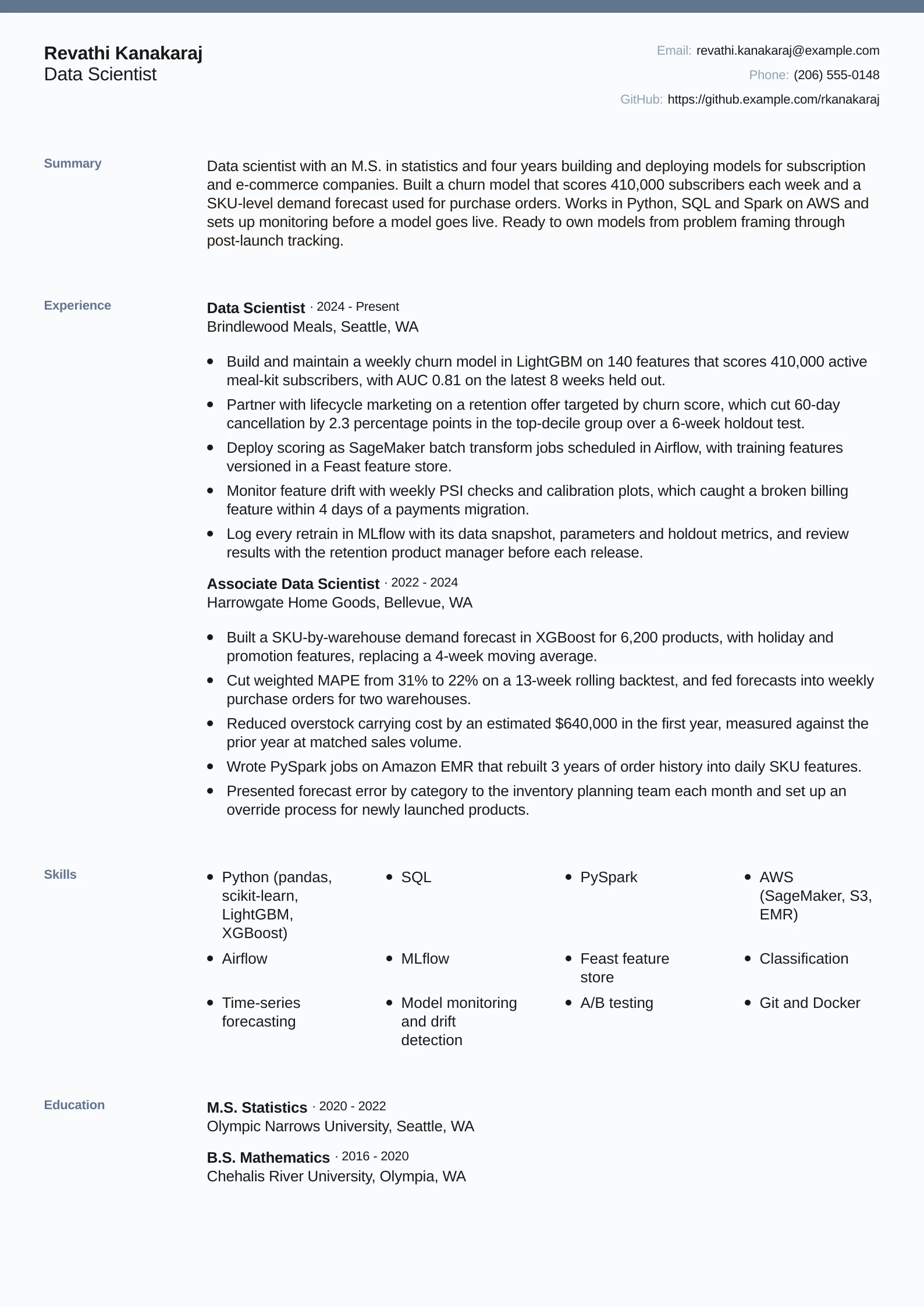
Data scientist resume with two models in production
Revathi has an M.S. in statistics and four years of modeling, which meets the master's-plus-three-years line in some postings. Each job leads with a model, then gives its validation result and the business number it moved: AUC 0.81 on a recent holdout for churn, and weighted MAPE cut from 31% to 22% for demand.
Copy the order of her bullets: what was modeled, how it was tested, how it runs and what it changed. Her deployment line names SageMaker, Airflow and Feast, so a reader can see the churn model scores subscribers every week instead of living in a notebook.
Data scientist resumes by experience, degree and setting
Pick the example closest to your degree and years first, then the one closest to the work you do. The product and insurance examples show method and governance details that a general resume leaves out.
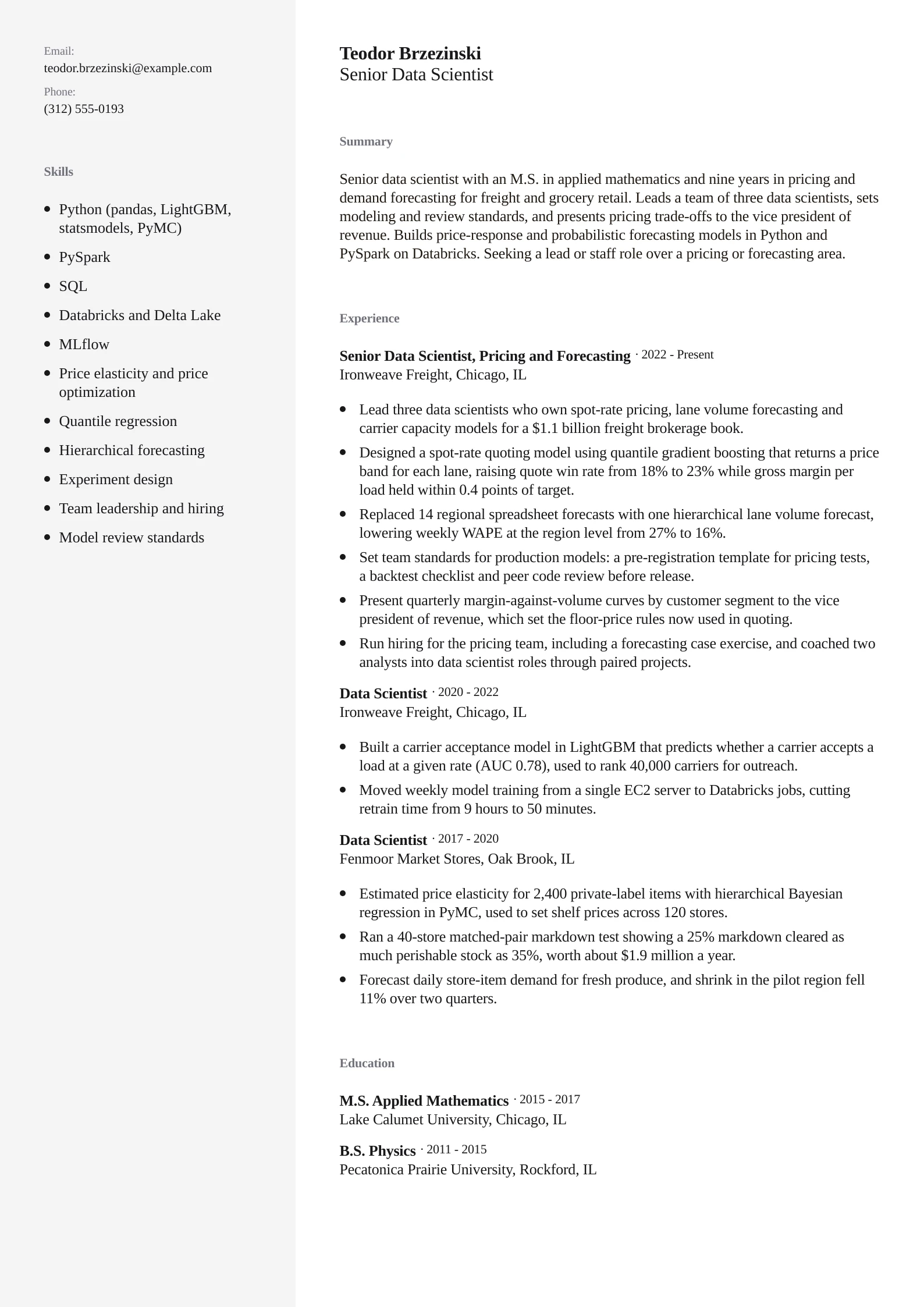
Senior data scientist resume
Teodor leads three data scientists in freight pricing, so his current role opens with the area he runs and the size of the brokerage book. Bullets pair each model with a business trade-off, such as quote win rate against margin, and one line lists the review standards he set for the team. Use it if you have seven or more years and lead people or a modeling area.
Win rate from 18% to 23% with margin held within 0.4 points
Team standards: pre-registered pricing tests, a backtest checklist and peer review
Earlier grocery pricing work with PyMC elasticity models
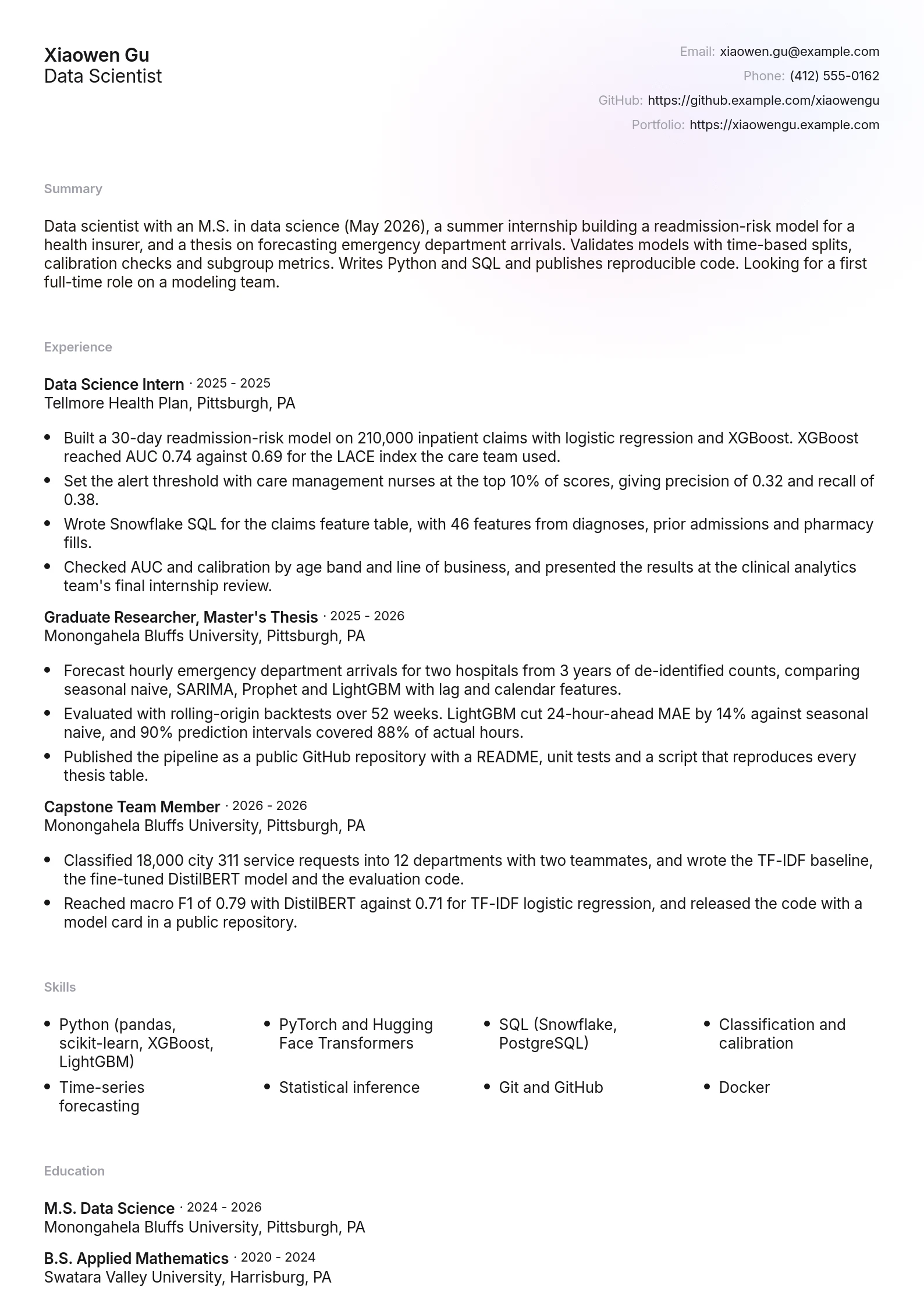
Entry-level data scientist resume
Xiaowen has a new M.S. in data science, one internship, a thesis and a team capstone, and lists all three as experience with results. The internship bullets compare her model with the LACE index the care team already used and give precision and recall at the alert threshold. Use it if you are finishing a degree and your strongest evidence is an internship, thesis or course project.
Readmission model: AUC 0.74 against 0.69 for the LACE index
Capstone bullet names the models and evaluation code she wrote
GitHub and portfolio links in the header
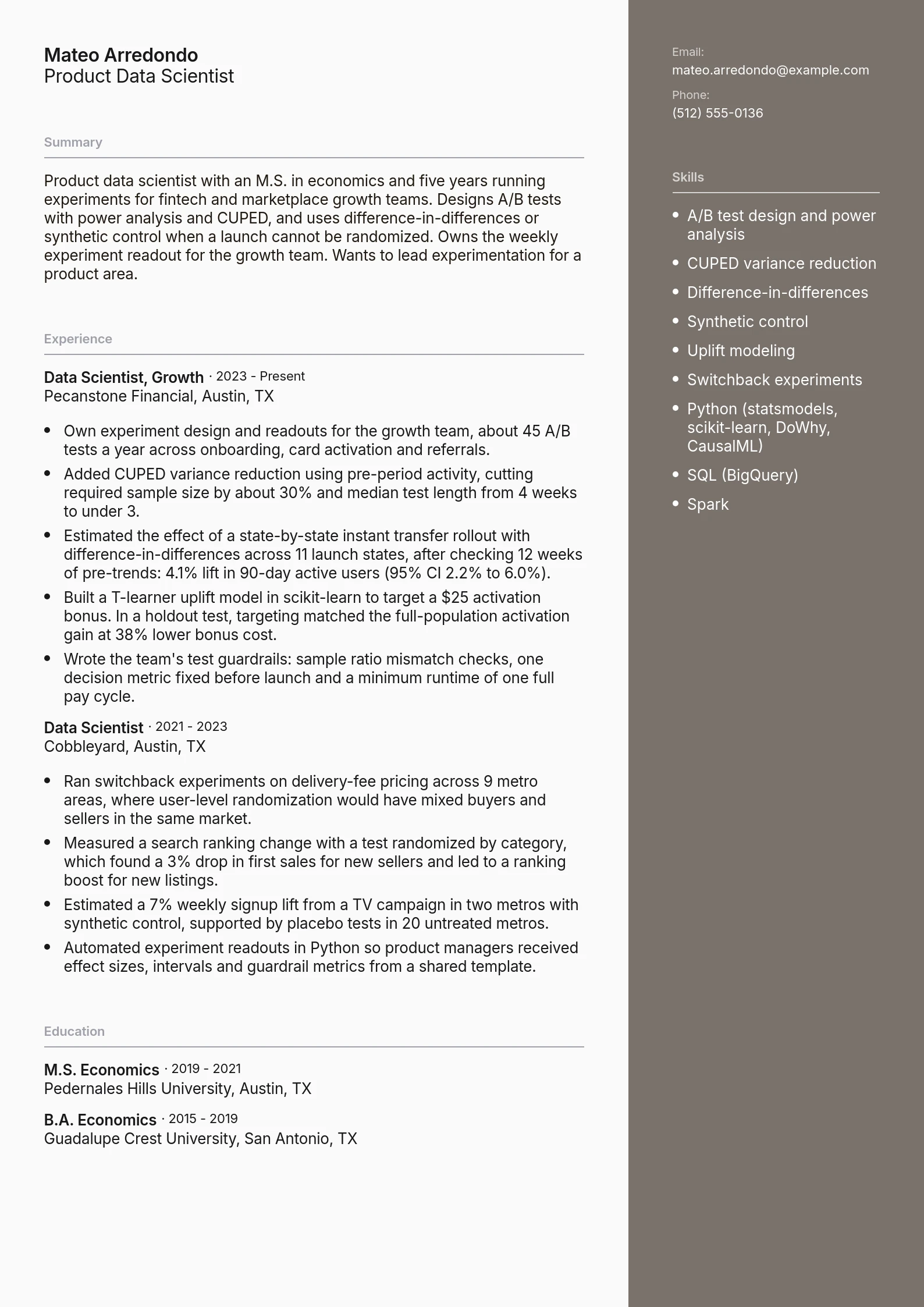
Product data scientist resume for experimentation
Mateo designs and reads out tests for a fintech growth team, so his bullets name the method before the result: CUPED, difference-in-differences, switchback tests and synthetic control. Effects come with a confidence interval or a placebo check and the decision that followed. Use it if most of your work is experiment design and causal inference, or the posting says product, growth or marketing data scientist.
4.1% lift with a 95% confidence interval from a staged rollout
Uplift model that cut activation bonus cost by 38%
Switchback tests for marketplace delivery fees
Data scientist resume for banking and insurance
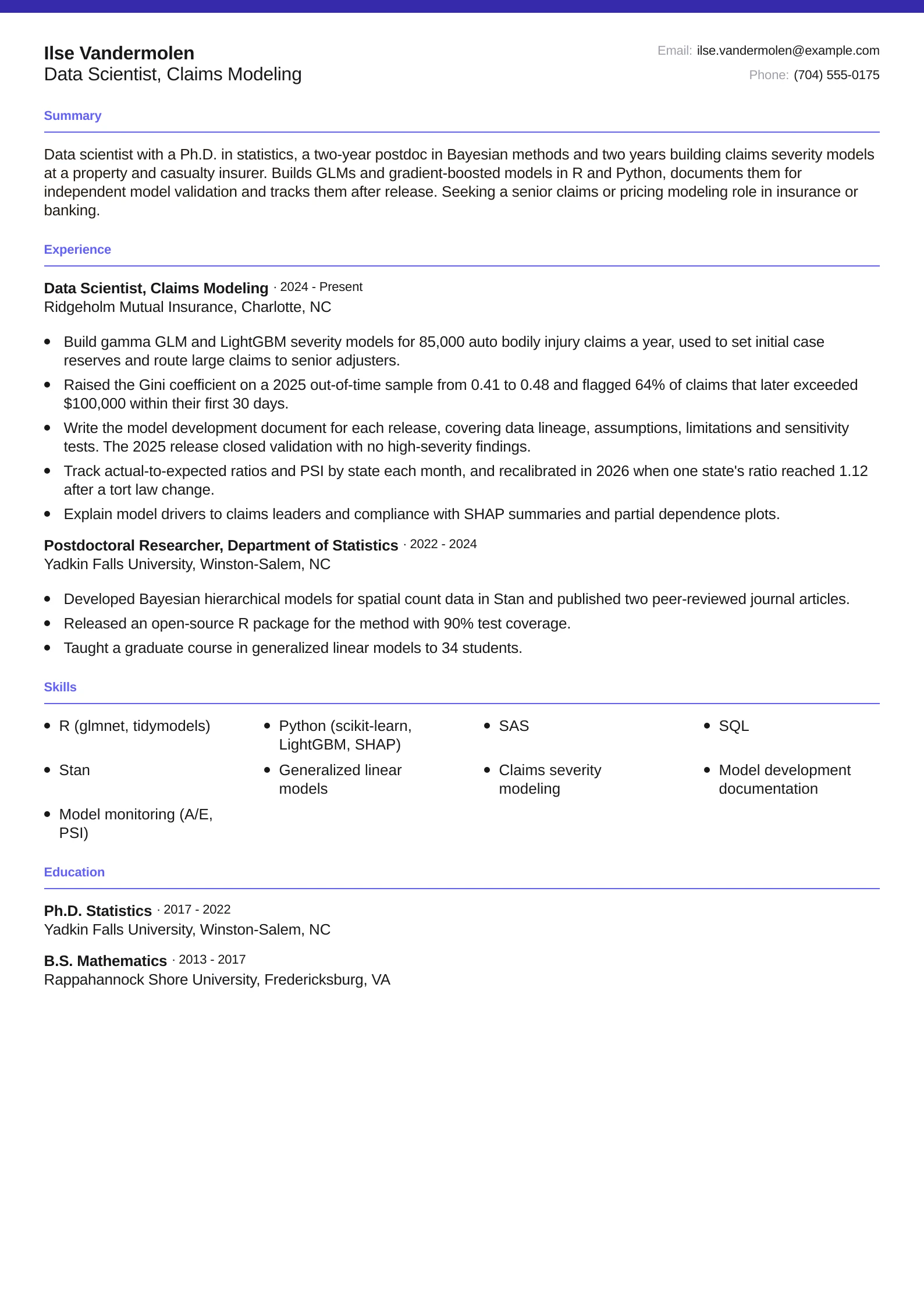
Ilse has a Ph.D. in statistics, a two-year postdoc and two years building claims models at an insurer. Her bullets cover what regulated employers check: model development documents, findings answered for independent validation, and monthly actual-to-expected monitoring by state. Use it if you work in insurance, banking or credit risk, where models pass validation before release, or if you are moving into industry after a Ph.D.
Gini from 0.41 to 0.48 on an out-of-time sample
Validation closed with no high-severity findings
Postdoc listed as a job with an R package and a taught course
Career change to data scientist resume
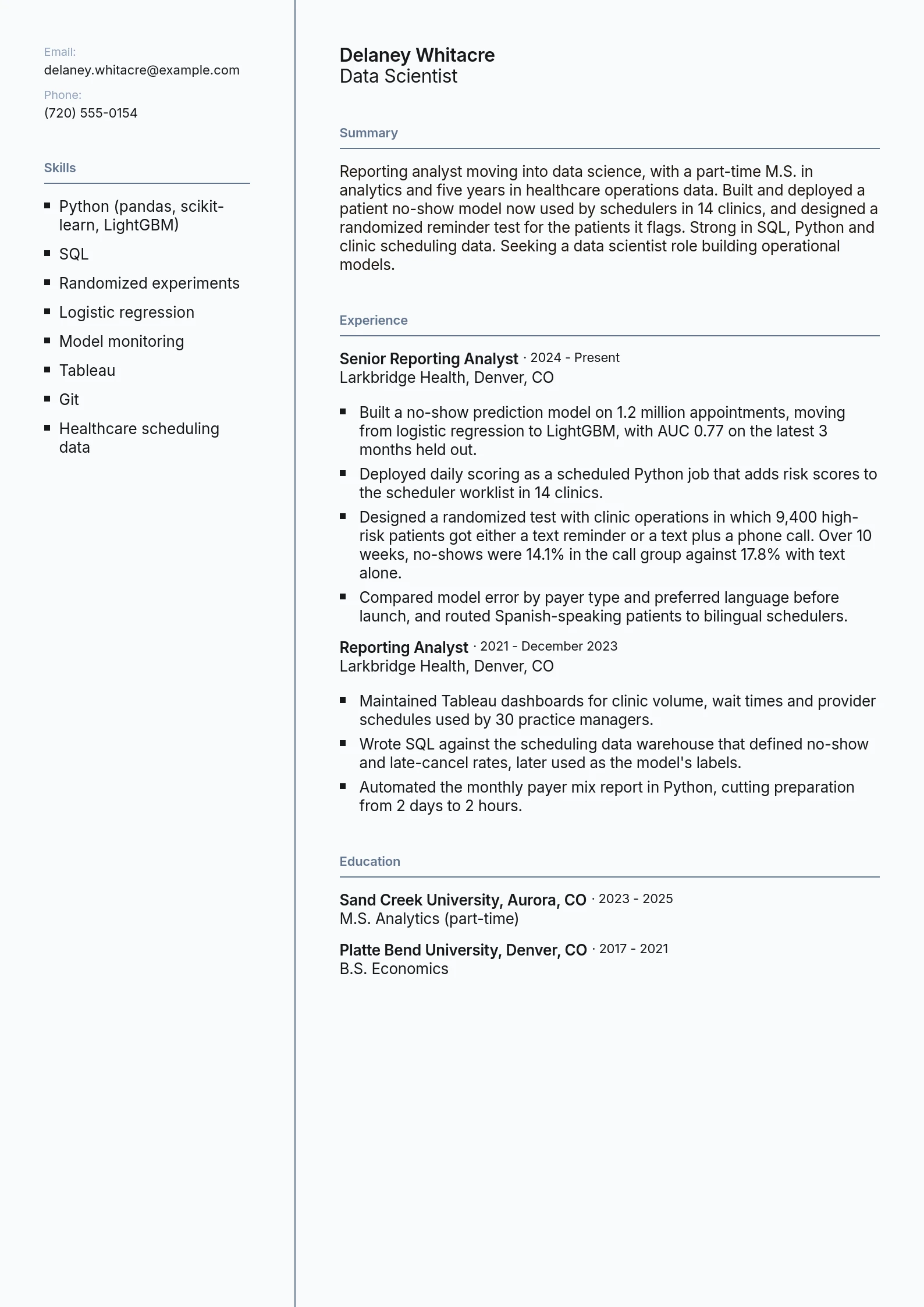
Delaney spent five years as a reporting analyst at a healthcare company and finished a part-time M.S. in analytics. Her current job leads with a no-show model and a randomized reminder test, while dashboard work moves to the earlier role. Use it if you are an analyst, engineer or researcher who has built at least one model at work and needs the resume to show that move.
No-show model scored daily for 14 clinics
Randomized call test: 14.1% no-shows against 17.8%
Earlier SQL reporting work that defined the model's labels
Put methods in bullets and tool names in the skills list
Name each tool where the reader can see what it did: the skills list is for scanning, and a bullet proves the keyword. Copy the exact names from the posting, such as Databricks, H2O or SAS, into your skills list, then check that each one appears in at least one bullet.
Group libraries under their language, such as Python (pandas, scikit-learn, PyTorch), so the list stays short. List Tableau or Power BI only when you used them to explain a model or a test, because on a data scientist resume they pull the reader toward reporting work.
Keyword type
Examples
Where it goes
How it reads in a bullet
Languages
Python, SQL, R, SAS, Scala
Skills list, then the bullets where the language did the work
"Built the 46-feature claims table in SQL on Snowflake"
Skills list and the bullet about scale or deployment
"Rebuilt 3 years of order history with PySpark on Amazon EMR"
Methods
Classification, forecasting, causal inference, A/B test design, uplift modeling
Bullets first, then the summary
"Estimated a staged rollout with difference-in-differences"
Production tools
MLflow, Airflow, feature stores, Docker, model monitoring
The bullet about how the model runs
"Scored weekly in SageMaker, scheduled in Airflow, features in Feast"
Metrics
AUC, precision and recall, MAPE, Gini, lift
Inside the bullet, next to the model
"AUC 0.81 on the latest 8 weeks held out"
Follow each model past launch
A shipped model is shown by three things a notebook model lacks: where it runs, who acts on its output and the metric that moved after launch. Name the job that scores it, such as a SageMaker batch transform, an Airflow DAG or a Databricks job. Name the team or process that uses the scores, such as a retention offer or weekly purchase orders. Then put the business result next to the offline metric.
Skip accuracy for rare outcomes such as churn, fraud or readmission, where a model that predicts "no" for everyone scores well. Give AUC, or precision and recall at the threshold the business used, or the share of positives caught in the top decile.
If a model never launched, say what the work decided, such as keeping a vendor score because yours added 0.01 AUC. That is still a result a hiring manager can weigh.
Shipped and measured
Built a LightGBM churn model that scores 410,000 subscribers each week (AUC 0.81 on the latest 8 weeks held out). A retention offer targeted by score cut 60-day cancellations by 2.3 percentage points in a 6-week holdout test.
Built, with no outcome
Developed a machine learning model using Python and XGBoost to predict customer churn with high accuracy.
Write each experiment as design, effect and decision
An experiment bullet has three parts: the design, the measured effect with its uncertainty and what the team did next. "Ran A/B tests" tells a hiring manager nothing about whether you can design one.
Name the design when it was not a plain user-level A/B test. Switchback tests, cluster randomization by city or category, staged rollouts and long-term holdouts each solve a specific problem, and naming one shows you saw the problem. Mateo's marketplace bullet says why user-level randomization would have mixed buyers and sellers.
Give the effect with an interval, plus the sample or duration: "4.1% lift in 90-day active users (95% CI 2.2% to 6.0%) across 11 launch states." If you improved the testing process itself, give that number too, such as CUPED cutting required sample size by about 30%.
For quasi-experiments, name the method and the check you ran. Difference-in-differences needs a pre-trend check and synthetic control needs placebo tests, so a clause such as "checked 12 weeks of pre-trends" tells a reviewer you know where the method breaks.
If you analyzed tests that someone else designed, write "analyzed" and name what you added, such as a guardrail metric or a sample ratio mismatch check. Product teams hire for that work too.
Match your degree to the years a posting asks for
Data scientist postings often trade degree level against years, so put your degree and years of modeling work in the first line of the summary, where a screener can check both at once. Every example on this page does this.
Count the years you built and validated models, including a postdoc or research job when modeling was the work. If your degree is in economics, physics or another field the posting does not list, name the quantitative method from your thesis or courses in the summary. A part-time master's finished while working, as in the career change example, adds the degree without resetting your years.
Highest degree
Years asked for in recent postings
What to show first
Bachelor's
About 2 for associate roles, 4 to 6 for mid-level and principal roles
Years of modeling and the models that reached production
Master's
0 for some associate roles, 3 for senior and principal roles
Degree and field, then years and shipped models
Ph.D.
0 to 1, even for senior and principal roles
Dissertation method when it matches the job, then any industry work
Choose a template with room for grouped skills
A data scientist resume needs a long, grouped skills list next to dense bullets full of numbers, so a template with a skills sidebar beside the experience column suits most candidates. Every example here uses one.
Choose a tighter split layout, as in the senior and product examples, when you have three or more jobs or a dozen tool groups. The smaller type and spacing leave room for bullets that each carry a method, a metric and a decision.
Choose a plainer layout, as in the entry-level and career change examples, when you have fewer jobs and want a thesis or project entry to read like work. Keep your GitHub or portfolio link in the header.
Leave out skill bars and percentage ratings for Python or SQL. A reader cannot check "Python 90%", and a bullet that names the library and the result says more.