Many Computer Scientist openings sit with defense contractors, federal agencies and research labs, which often check citizenship, clearance and degree before they read about your research.
Each example puts the facts its route checks near the top, then shows prototypes, papers and proposals for a different route: cleared contractor, new Ph.D., federal GS-1550, national-lab HPC and bachelor's entry level.
Cleared applied researcher with an M.S. and seven years in systems security
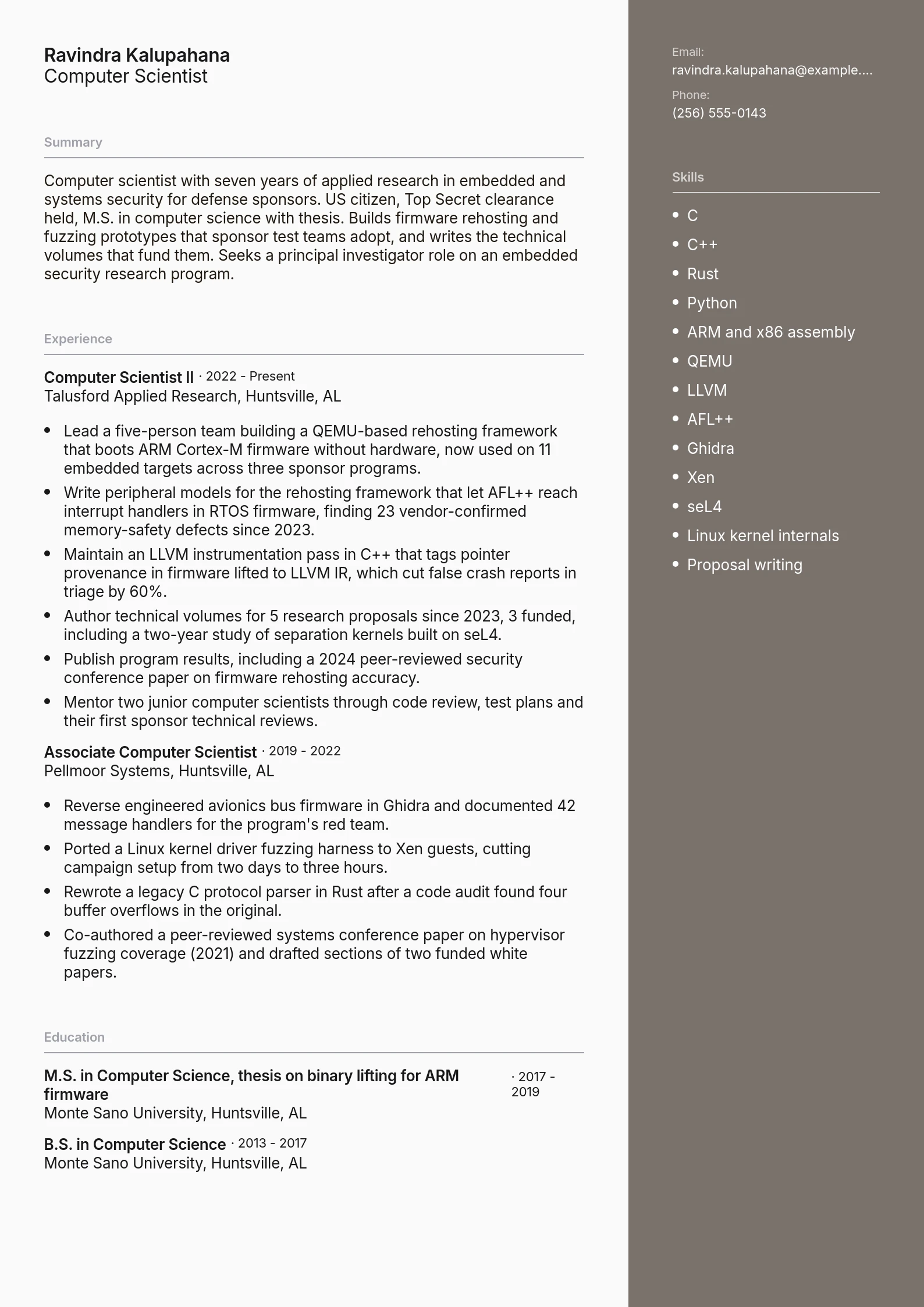
Ravindra's resume is the closest fit if you hold a clearance and have several years of applied research at a contractor. The summary's second sentence gives citizenship, clearance and the thesis degree, the facts a contractor screener checks before reading further.
His bullets pair a tool with a target and a result: QEMU rehosting across 11 firmware targets, peripheral models that let AFL++ find 23 vendor-confirmed defects, and an LLVM pass that cut false crash reports by 60%. Papers and proposals sit inside the job that produced them, with funded proposals counted against those written. Mentoring two junior computer scientists shows he's ready to lead a research thrust.
Four more routes into the same job title
The other four examples follow different hiring routes. Pick the one whose screening matches the posting you're answering, then swap in your own tools, sponsors and results.
New Ph.D. moving from dissertation research to a research scientist role
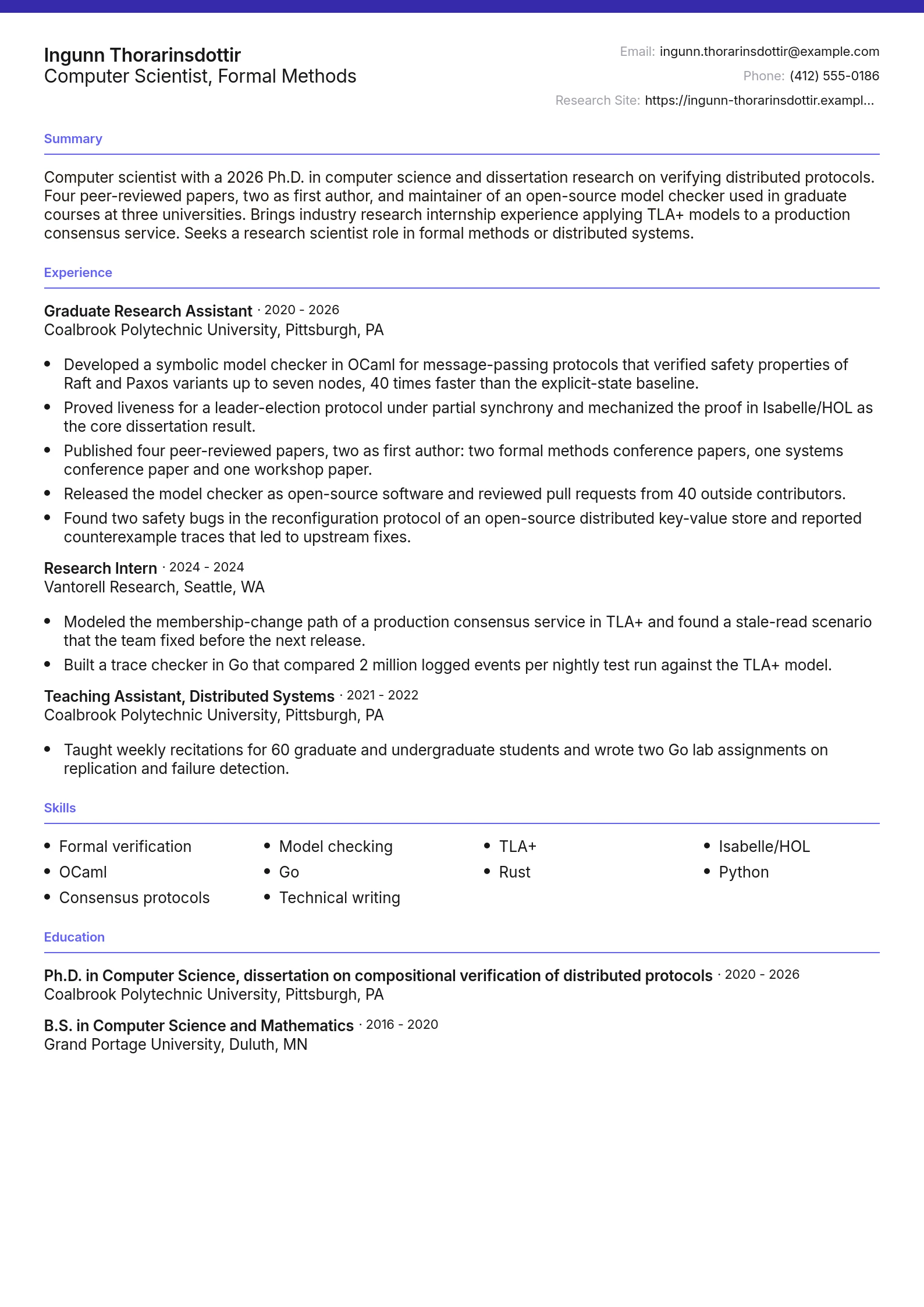
Ingunn's resume suits a new Ph.D. whose evidence is papers and tools rather than years on the job. The dissertation topic sits in the education line, the four papers are counted inside the research assistant entry with two marked first author, and the open-source model checker shows outside use. A summer internship shows her methods catching a real bug in a production service. Use it if you defended in the last year.
Four peer-reviewed papers counted by author position
Open-source model checker used in courses at three universities
Internship that found a stale-read scenario with a TLA+ model
GS-12 federal computer scientist applying for GS-13
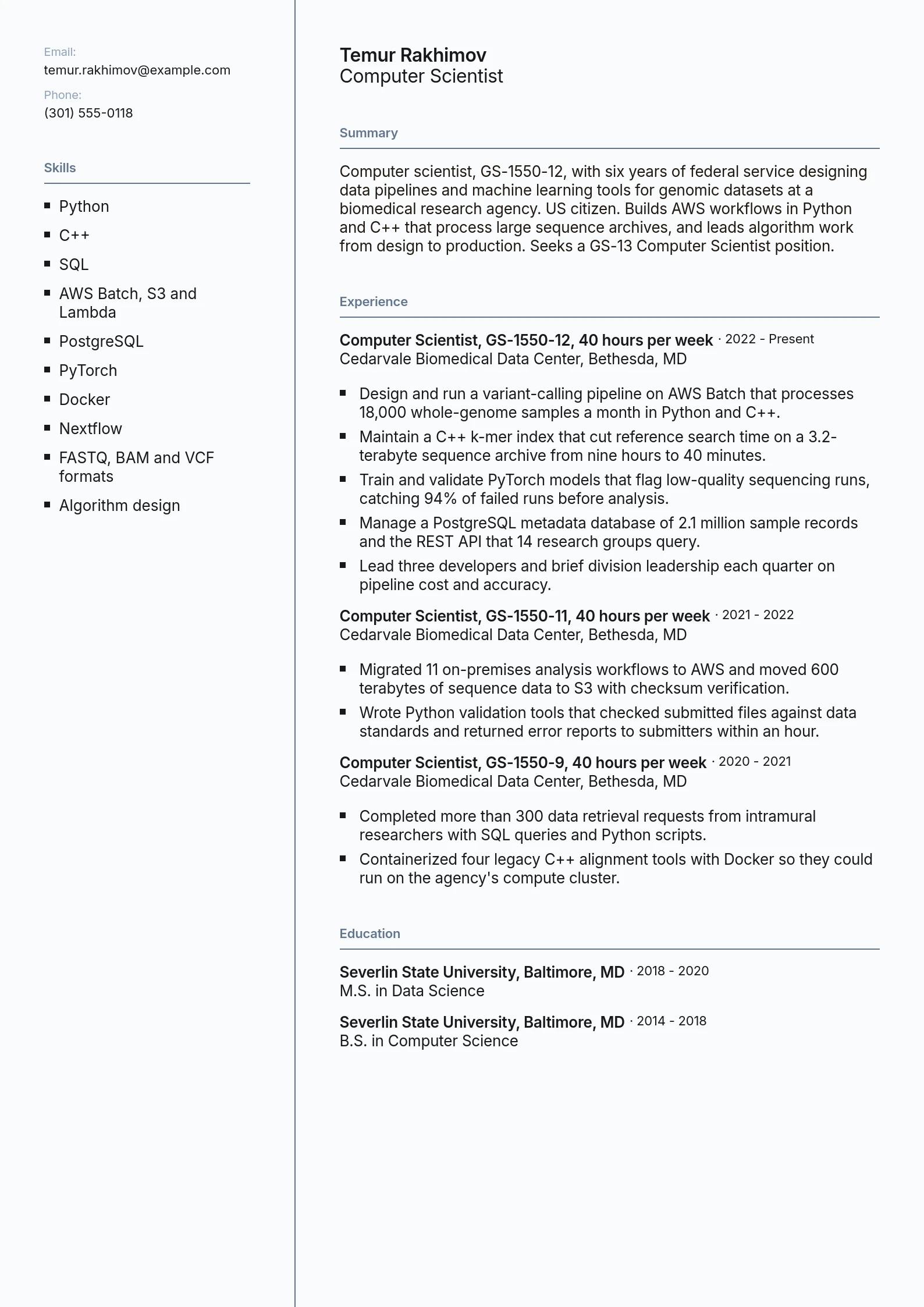
Temur's resume is built for USAJOBS screening. Every job title line carries the series, grade and 40 hours per week, dates are month and year, and the whole resume fits the two-page limit. His GS-12 bullets name the algorithm, dataset size, AWS service and database so a reviewer can match them to the announcement. Use it if you're a federal employee moving up a grade in the GS-1550 series.
Series, grade and hours in every job title line
GS-12 bullets matched to large-dataset, cloud and database work
Three federal grades on two pages
Senior HPC researcher at a national computing laboratory
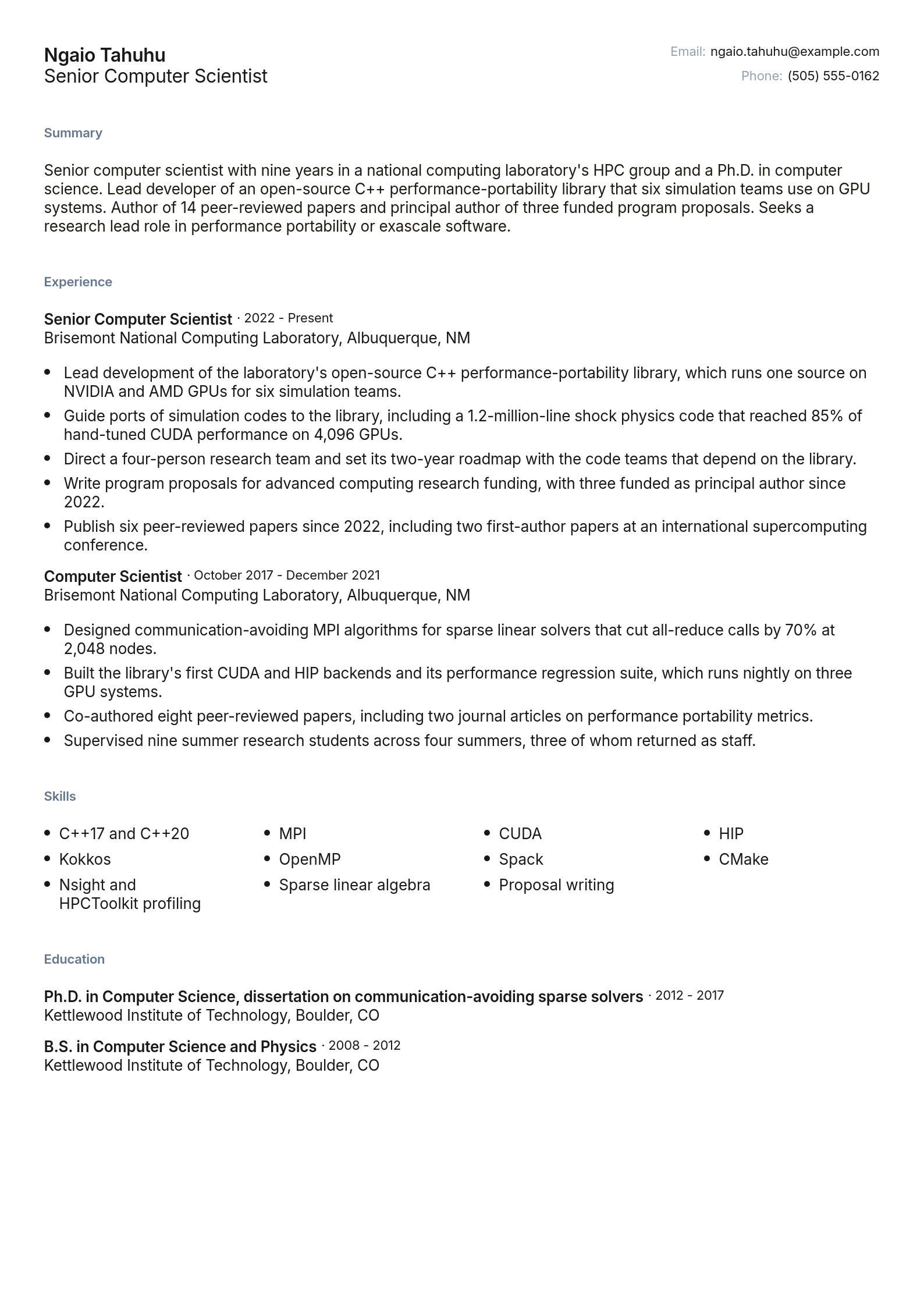
Ngaio's resume fits a senior lab researcher whose evidence is software other teams depend on. The summary names the performance-portability library and the six simulation teams using it, and bullets give scale in GPUs, nodes and lines of code. Papers are split across her two roles with first-author work called out, and funded proposals are counted. Use it if you have a Ph.D. and a long publication record and want a research lead role.
Library adoption by six simulation teams in the summary
Scaling results on 4,096 GPUs and 2,048 nodes
14 peer-reviewed papers split across two roles
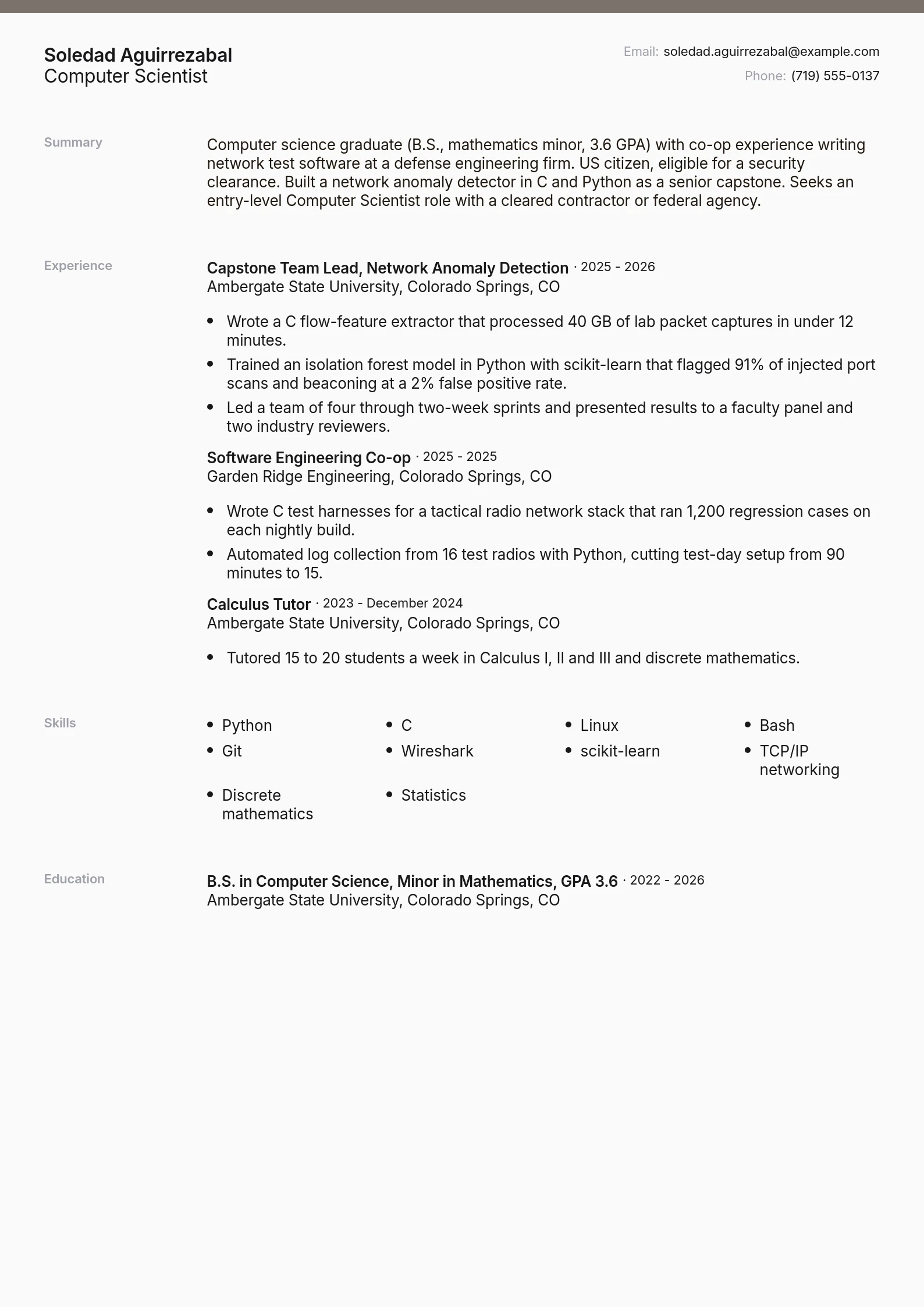
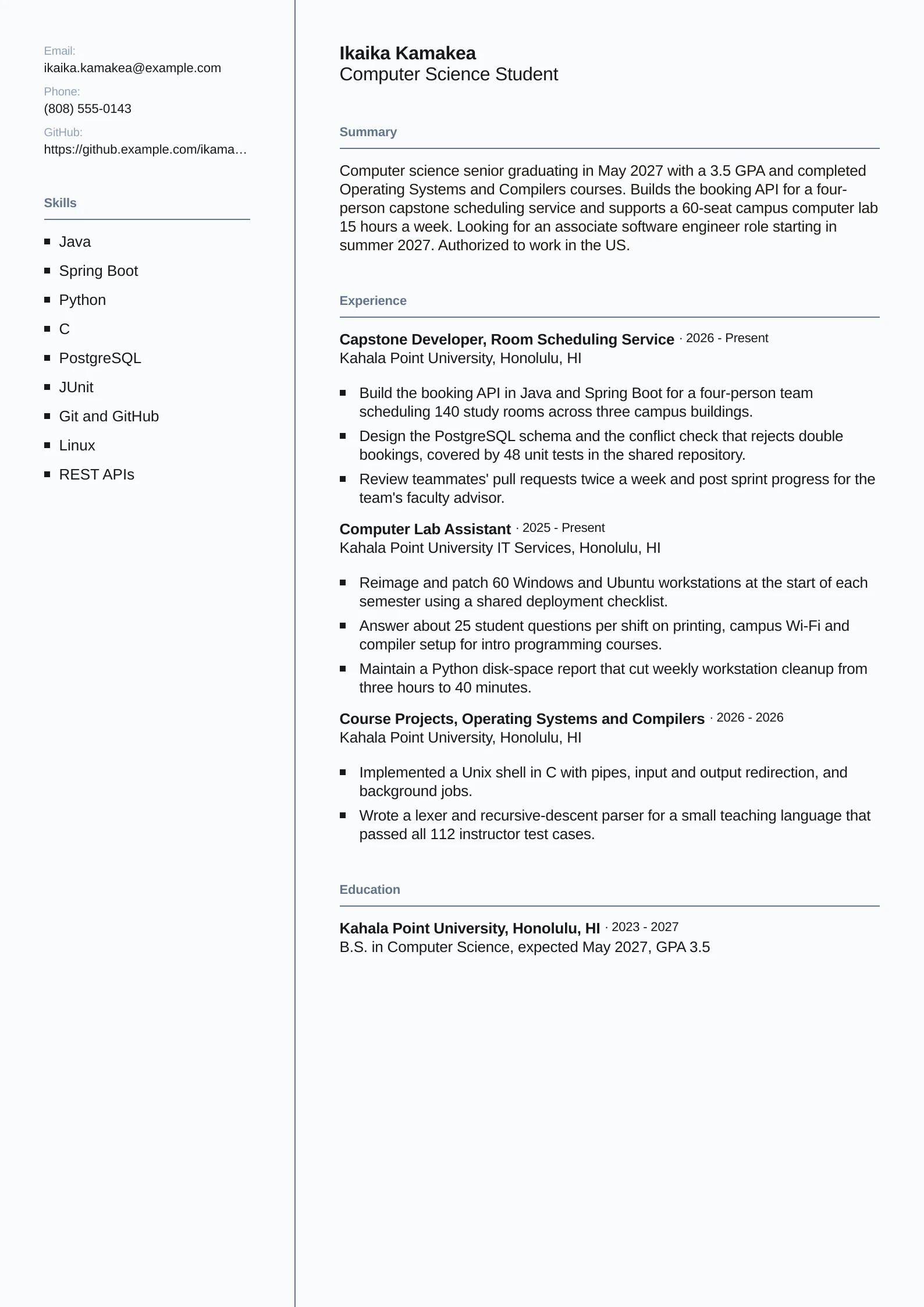
Bachelor's graduate eligible for a clearance
Soledad's resume suits a new bachelor's graduate applying to cleared contractors and federal entry roles. The summary opens with degree, minor and GPA, then states US citizenship and clearance eligibility. Her senior capstone is written as a job entry with a C feature extractor, a Python model and detection rates, and the co-op shows C test harnesses for tactical radios. Calculus tutoring backs up the math minor.
Citizenship and clearance eligibility in the summary
Capstone written as a job entry with detection results
Co-op test harness running 1,200 nightly cases
Match the resume to who is hiring: contractor, agency, lab or university
Work out which route a posting belongs to before you change a line, because each one screens on different facts. A contractor posting that opens with 'US citizen' and a clearance level wants both answered in your summary. A federal announcement wants your job entries to match its specialized-experience statement. Lab and university postings read the research record first, so lead with what you built and where it was published.
Hiring route
Checked first
Lead your resume with
Closest example
Defense or government contractor
US citizenship, a clearance held or eligibility for one, and degree level
Citizenship and clearance in the summary, then prototypes delivered to sponsors and proposals funded
Ravindra (primary) or Soledad
Federal agency, GS-1550 series
US citizenship or nationality, the series education requirement, and specialized experience at the next lower grade
Series, grade, hours per week and month/year dates on every job, within two pages
Temur
National or research laboratory
Often a Ph.D., a publication record and depth in an area such as HPC
Software other teams use, scaling results, paper count and funded proposals
Ngaio
University or industry research group
Dissertation topic, first-author papers and fit with the group's research
Dissertation in one line, papers counted by author position, tools you released
Ingunn
Put each paper and proposal inside the job that produced it
Keep research output in the experience bullet where the work happened, and save the full publication list for a CV. A screener for an applied role wants your own contribution and whether it left the paper.
Name what you built or proved, the tool, and what happened next: a sponsor adopted it, a team ran it, a vendor patched the bug. Describe each publication by venue type and year, such as 'peer-reviewed systems conference paper (2021)', and mark first-author papers when you apply to a lab or research scientist role. Count proposals as written and funded, as in 'technical volumes for 5 research proposals, 3 funded'.
When a posting asks for a publication record, add the total to your summary, as Ngaio's '14 peer-reviewed papers' does. Systems security postings name tools such as LLVM, QEMU and AFL++, so put each tool in the bullet where you used it as well as in your skills list.
Specific: tool, result and venue type in one line
Built a QEMU rehosting framework that boots ARM Cortex-M firmware without hardware, adopted on 11 targets across three sponsor programs, and published its accuracy results as a peer-reviewed security conference paper (2024).
Vague: no tool, result or venue
Conducted research on embedded firmware security and published papers at conferences.
Write citizenship and clearance as held or eligible, in the summary
Put citizenship and clearance status in the first two lines of your summary, because contractor postings check them before anything else. If you hold a clearance, write 'US citizen, Top Secret clearance held', as Ravindra does.
If you don't hold one, write 'US citizen, eligible for a security clearance', as Soledad does. Never write 'applying for a clearance', because an individual can't start one.
Federal Computer Scientist announcements can require US citizenship or nationality even when the job needs no clearance. Add 'US citizen' to a GS-1550 summary, as Temur does, so the reviewer doesn't have to look for it.
For lab and university research roles, follow the posting. If it lists citizenship or a clearance, state yours in the same words. If it lists neither, use that summary line for your research focus, as Ingunn and Ngaio do.
On a GS-1550 resume, give every job its series, grade and hours
A federal resume needs the employer, job title, start and end month and year, and hours per week for each relevant job, plus series and grade for federal jobs. Under the current Merit Hiring Plan rule, USAJOBS accepts no more than two pages.
Put the series and grade in the job title line, as Temur does with 'Computer Scientist, GS-1550-12, 40 hours per week'. For a contractor or university job, give the same month/year dates and hours per week without a grade.
GS-13 requires one year of specialized experience at GS-12, so a GS-13 applicant's GS-12 entry carries the bullets that match the announcement. If it asks for algorithms for large datasets, AI or machine learning, cloud and database work, write one bullet for each with the dataset size, model, cloud service and database named.
To fit two pages, keep one or two papers that match the announcement inside the job entry and drop the rest of the list. Give older, lower-grade jobs two bullets each.
Federal job entry header
Computer Scientist, GS-1550-12 | Agency Name, City, ST | 09/2022 to Present | 40 hours per week
Spell out the degree, thesis and coursework each employer counts
Put the degree that meets the posting's minimum in your summary, then spell it out in the education entry. A master's is the typical entry-level degree for this occupation, but federal agencies and some contractors hire at the bachelor's level. Add the thesis or dissertation title, because some contractor postings ask specifically for an M.S. with thesis and research groups read the topic for fit.
Degree
Where it meets the minimum
What to write
B.S. in computer science
The GS-1550 basic requirement, with superior academic achievement qualifying for GS-7, and contractor roles that pair a bachelor's with 3 to 5 years of experience
Degree, minor, GPA and graduation year, as in Soledad's education entry
Bachelor's in another field
GS-1550 when it includes 30 semester hours of mathematics, statistics and computer science, at least 15 of them in mathematics and statistics including calculus
A line under the degree listing semester hours by subject, such as '15 semester hours of computer science, 15 of mathematics and statistics including calculus'
M.S. with thesis
Federal entry at GS-9 when related to the job (GS-11 for research positions), and contractor research roles that ask for an M.S. with thesis plus experience
'M.S. in Computer Science' with the thesis topic, as Ravindra does
Ph.D.
Federal entry at GS-11 when related to the job (GS-12 for research positions), and lab and research scientist roles that prefer a doctorate
Dissertation topic and defense year, with papers counted in experience bullets, as Ingunn and Ngaio do
Questions about cleared, federal and research resumes