Security employers look for a named credential that fits the job's level before they read your tools, and cleared or regulated employers also look for the framework you worked under. The 11 examples cover a new graduate, a cleared contractor, SOC shift work, healthcare, compliance, incident response, threat analysis, penetration testing, management and a move from systems administration, each with credentials dated the way a recruiter checks them.
Lead with alert triage, scan results and two dated CompTIA credentials
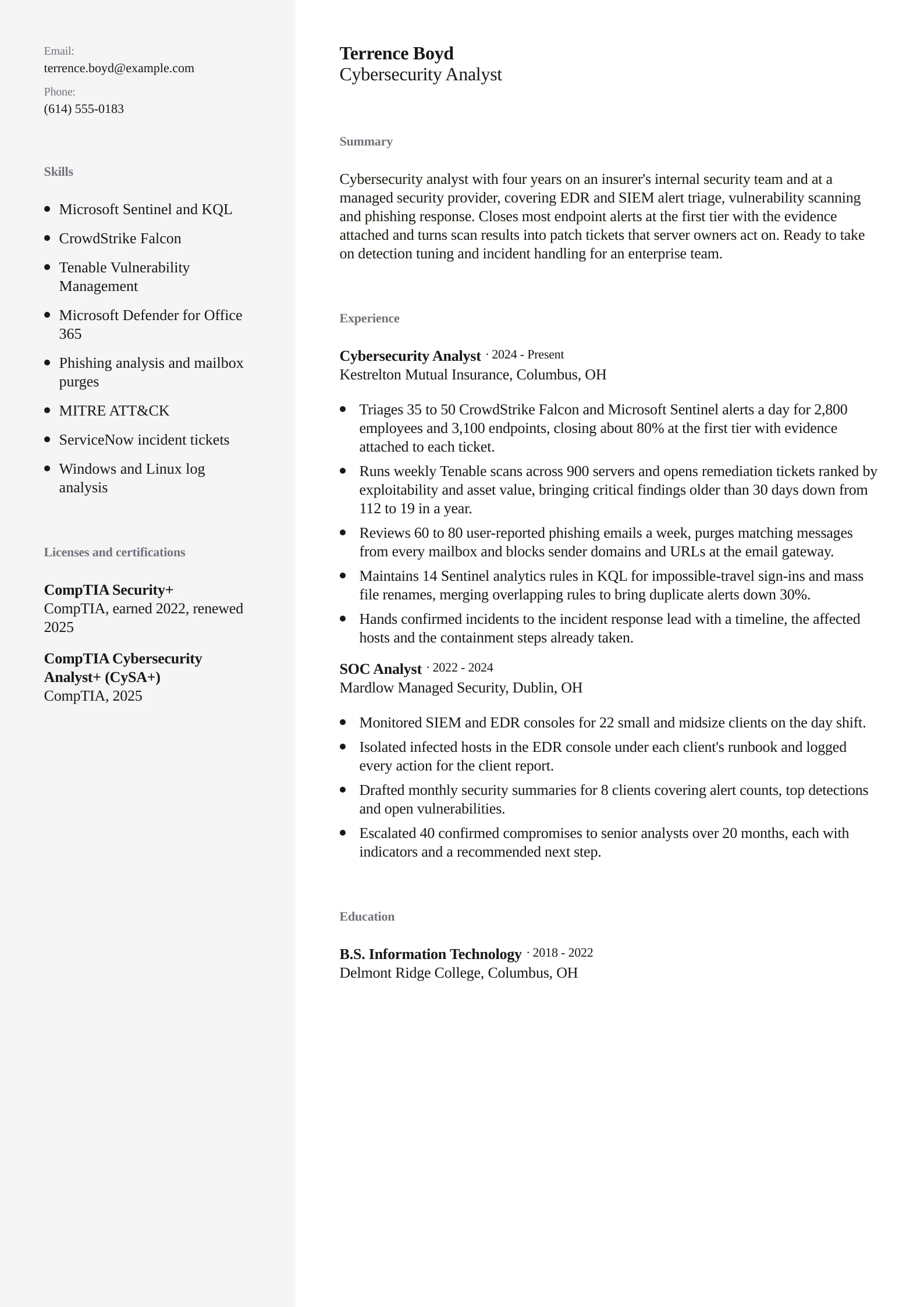
Terrence Boyd has four years across an insurer's internal security team and a managed security provider. His resume gives the daily alert volume he triages, the tools behind it (CrowdStrike Falcon, Microsoft Sentinel and Tenable) and the drop in aging critical findings his scan tickets produced.
Both credentials sit under one heading with issuer and year: Security+ earned in 2022 and renewed in 2025, and CySA+ earned in 2025. A recruiter can see he's current without looking anything up. Copy this layout if you're a mid-level analyst whose week mixes alerts, vulnerability scans and phishing reports.
Find the example closest to your clearance, schedule or specialty
Each example shows a different kind of security work, so pick by what you do every day rather than by job title. The cleared, healthcare and state agency examples name the framework they worked under, and the SOC example puts the shift rotation in its summary.
Entry-level cybersecurity resume with a help desk internship and home lab
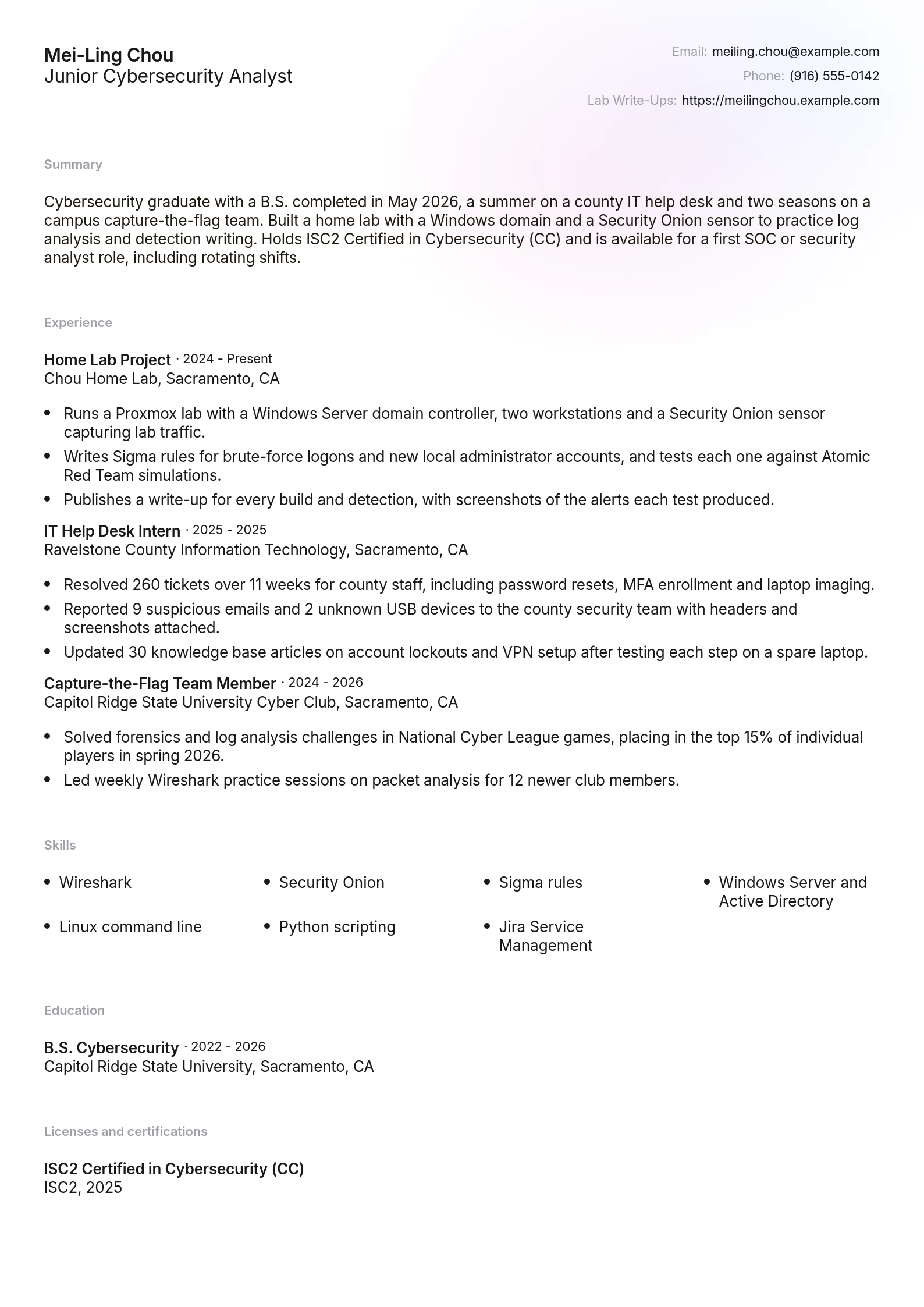
Mei-Ling Chou graduated in 2026 with one summer on a county help desk, so her resume gives the internship, a capture-the-flag team and a home lab their own entries with numbers. The lab bullets name Security Onion, Sigma rules and Atomic Red Team tests. ISC2 CC appears with its year, and the summary says she can work rotating shifts. Use it if you're a new graduate with little paid security work.
Home lab listed as an entry with its tools and tests
Suspicious emails reported during a help desk internship
ISC2 CC with the year earned
Cleared cybersecurity analyst resume with ACAS, STIGs and RMF
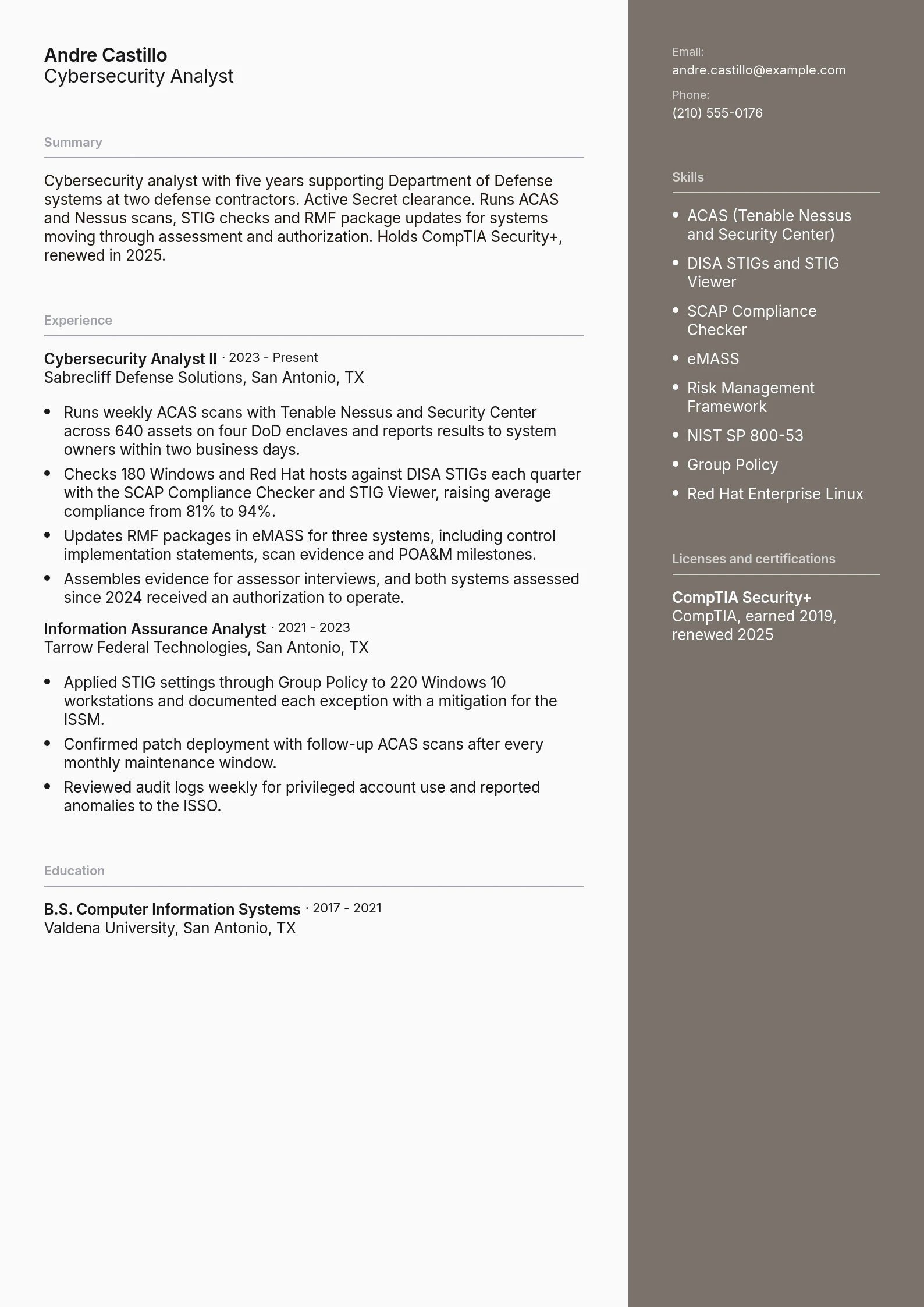
Andre Castillo's summary states 'Active Secret clearance' in its second sentence, then gives his ACAS, STIG and RMF work on DoD systems. Bullets count the assets scanned, the hosts checked against STIGs and the compliance rate that followed. Security+ shows both years, earned 2019 and renewed 2025, which answers the IAT Level II line in contractor ads. Use it if you hold an active clearance and support assessment and authorization work.
Active Secret clearance stated in the summary
STIG compliance raised from 81% to 94%
Security+ with earned and renewed years
SOC analyst resume for a 24/7 rotation with nights and holidays
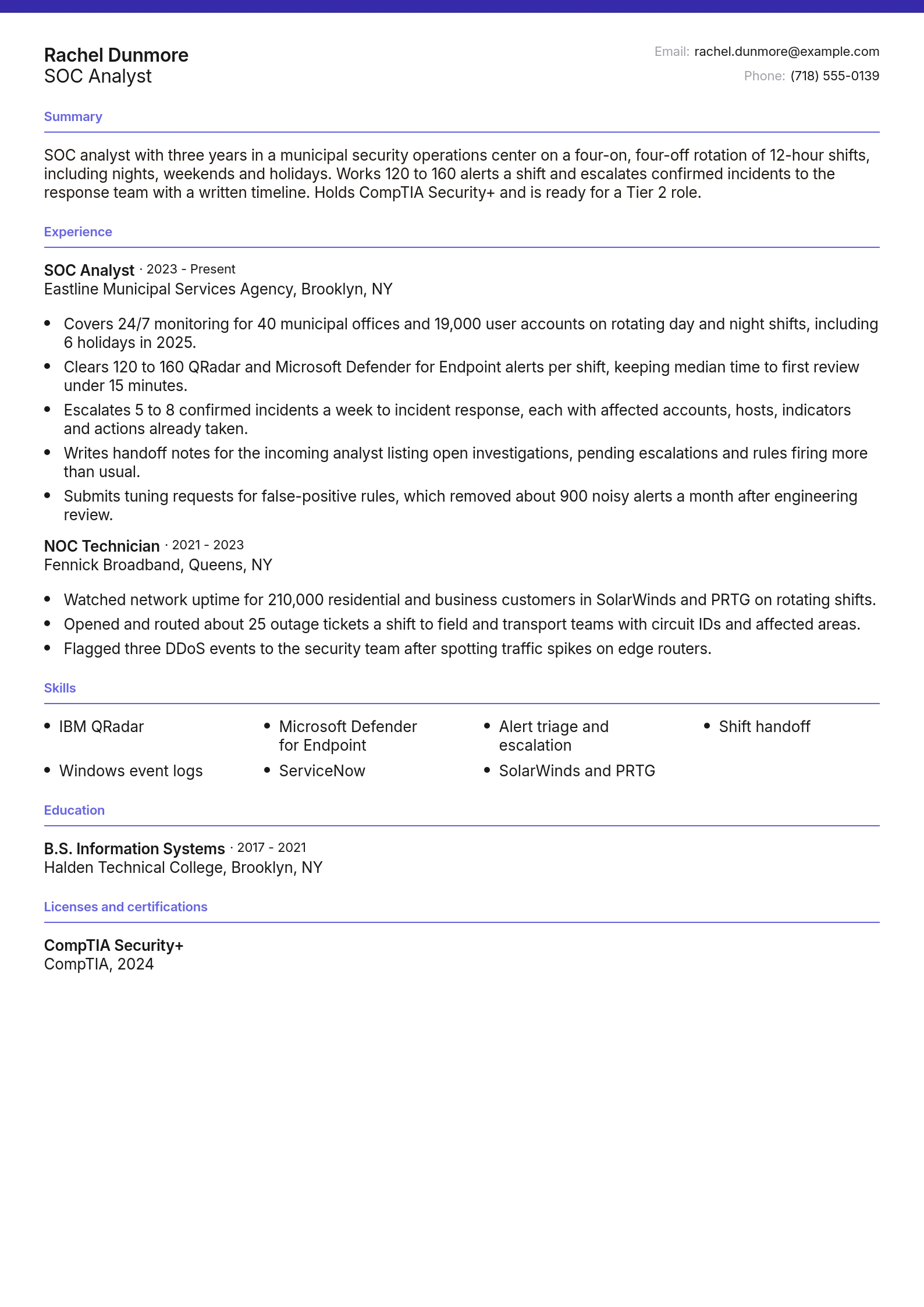
Rachel Dunmore's summary opens with her four-on, four-off rotation of 12-hour shifts, including nights and holidays, before it names a tool. Her bullets give alerts cleared per shift, median time to first review and confirmed incidents escalated each week. A NOC job before the SOC shows she has worked rotating shifts for five years. Use it if you work a monitoring queue on a 24/7 schedule and want a Tier 2 role.
Shift pattern stated before any tool
120 to 160 alerts per shift with a review-time target
Handoff notes and tuning requests as separate bullets
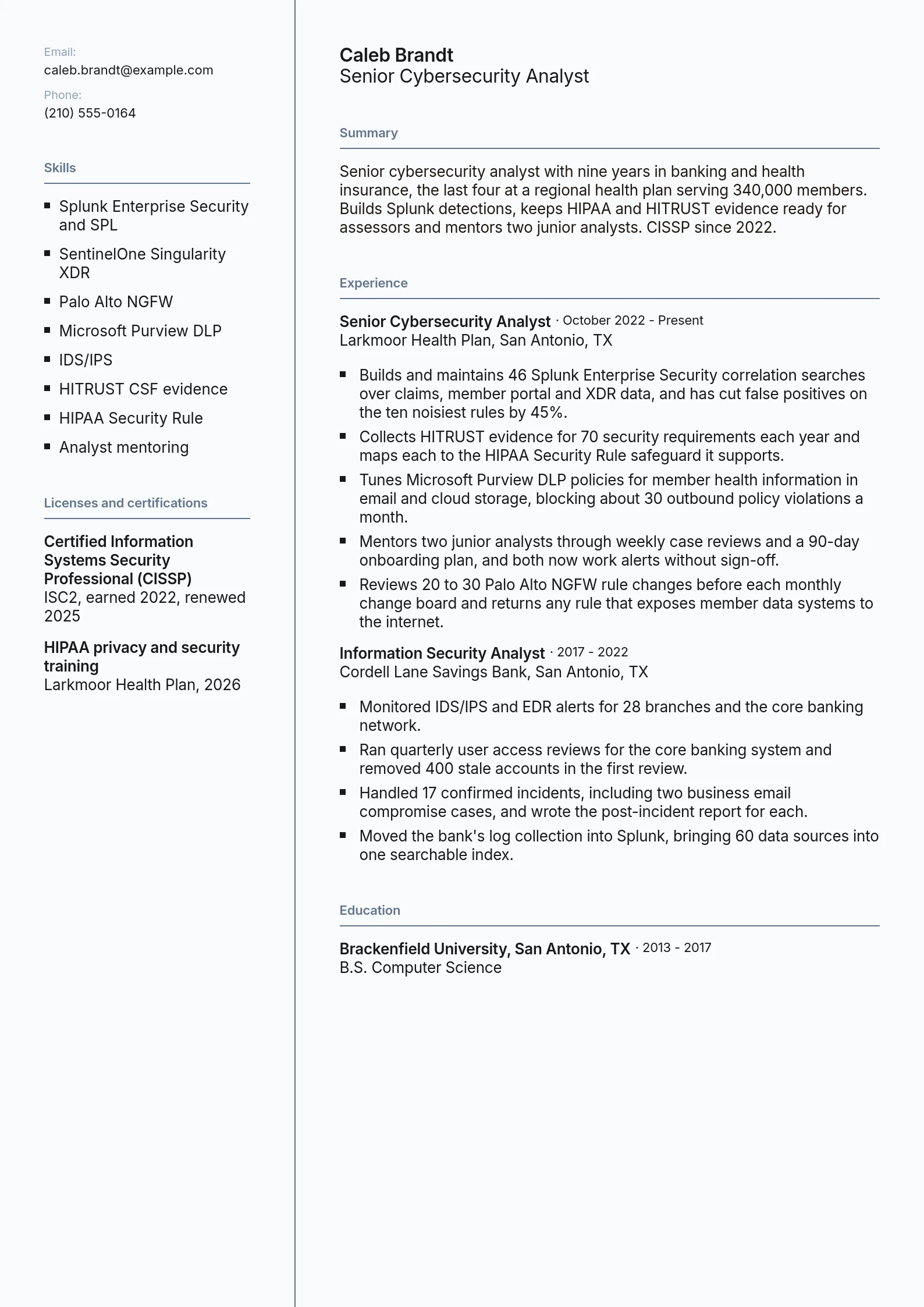
Senior cybersecurity analyst resume for a health plan
Caleb Brandt has nine years in banking and health insurance, so his resume moves from monitoring to detection building, HITRUST evidence and mentoring. Splunk correlation searches, DLP tuning and firewall change reviews each carry a number. CISSP shows the year earned and the year renewed, and HIPAA privacy and security training sits on its own line as employer training. Use it if you're a senior analyst in a regulated industry.
CISSP earned in 2022, renewed in 2025
HITRUST requirements mapped to HIPAA safeguards
Two junior analysts mentored to independent alert work
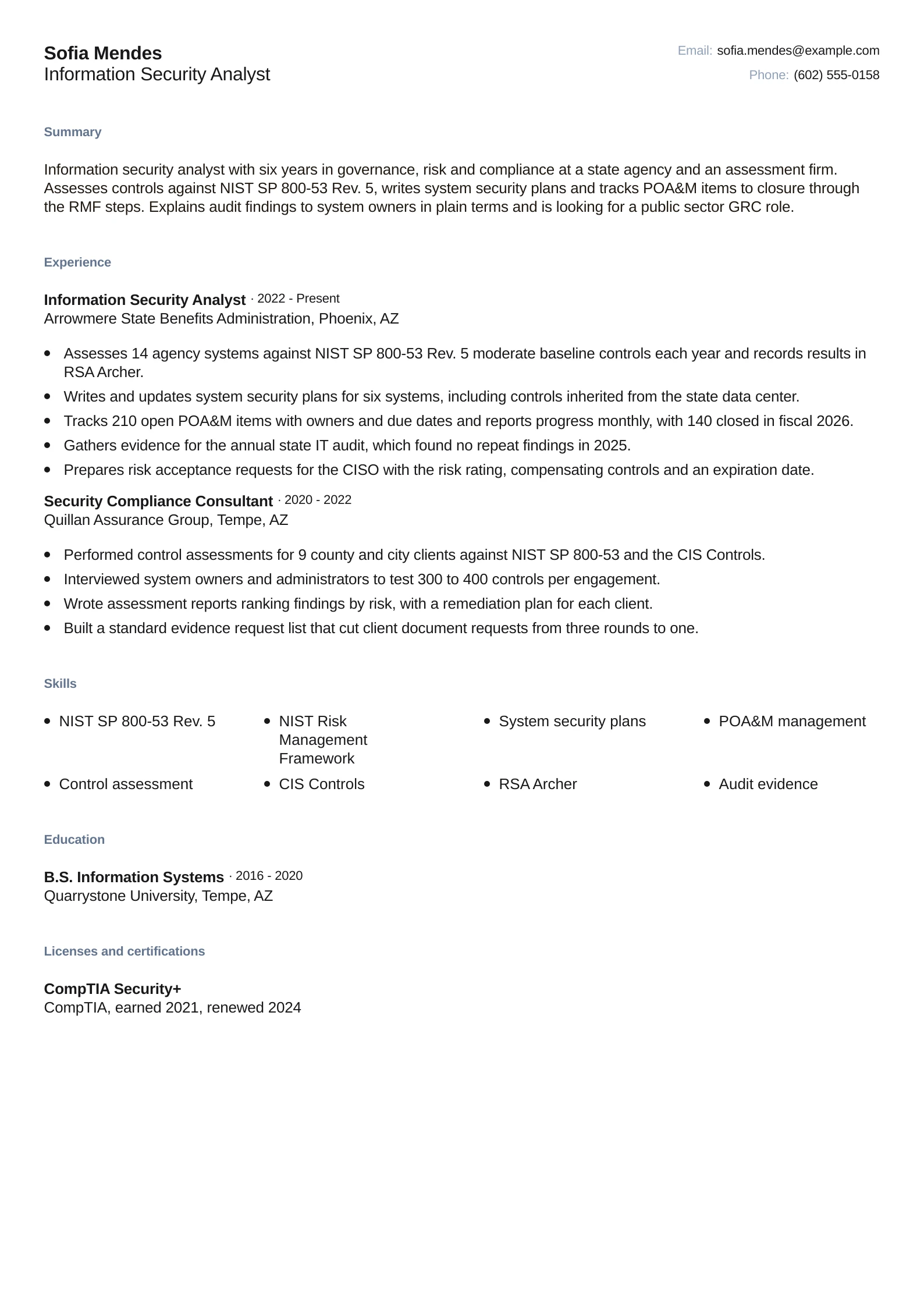
Information security analyst resume for compliance and RMF work
Sofia Mendes assesses controls instead of watching alerts, so her bullets name NIST SP 800-53 Rev. 5, system security plans, POA&M counts and audit results. Her consulting job shows how many controls she tested per engagement and how she cut evidence requests to one round. Security+ appears with its renewal year. Use it if you work in governance, risk and compliance at a state agency or an assessment firm.
14 systems assessed against the 800-53 moderate baseline
210 POA&M items tracked, 140 closed in a year
Consulting assessments for county and city clients
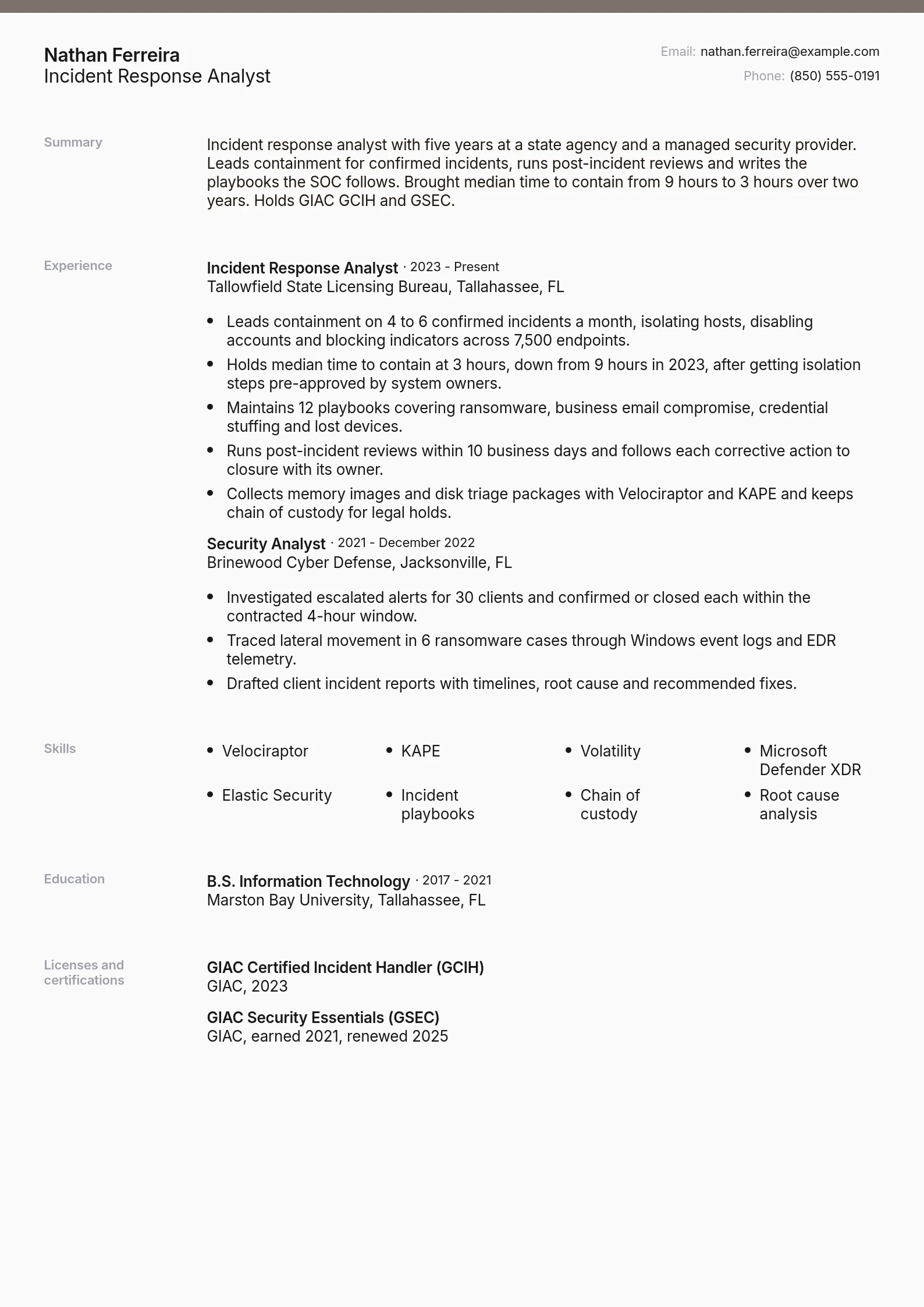
Incident response analyst resume with GCIH and playbooks
Nathan Ferreira leads containment rather than first-tier triage, and his resume shows it with incidents handled each month, median time to contain and the playbooks he wrote. Forensic tools such as Velociraptor and KAPE appear in the bullet that uses them. GIAC GCIH and GSEC carry their years, with GSEC renewed on GIAC's four-year cycle. Use it if you handle confirmed incidents and run post-incident reviews.
Median time to contain down from 9 hours to 3
12 playbooks named by incident type
GCIH and GSEC with earned and renewed years
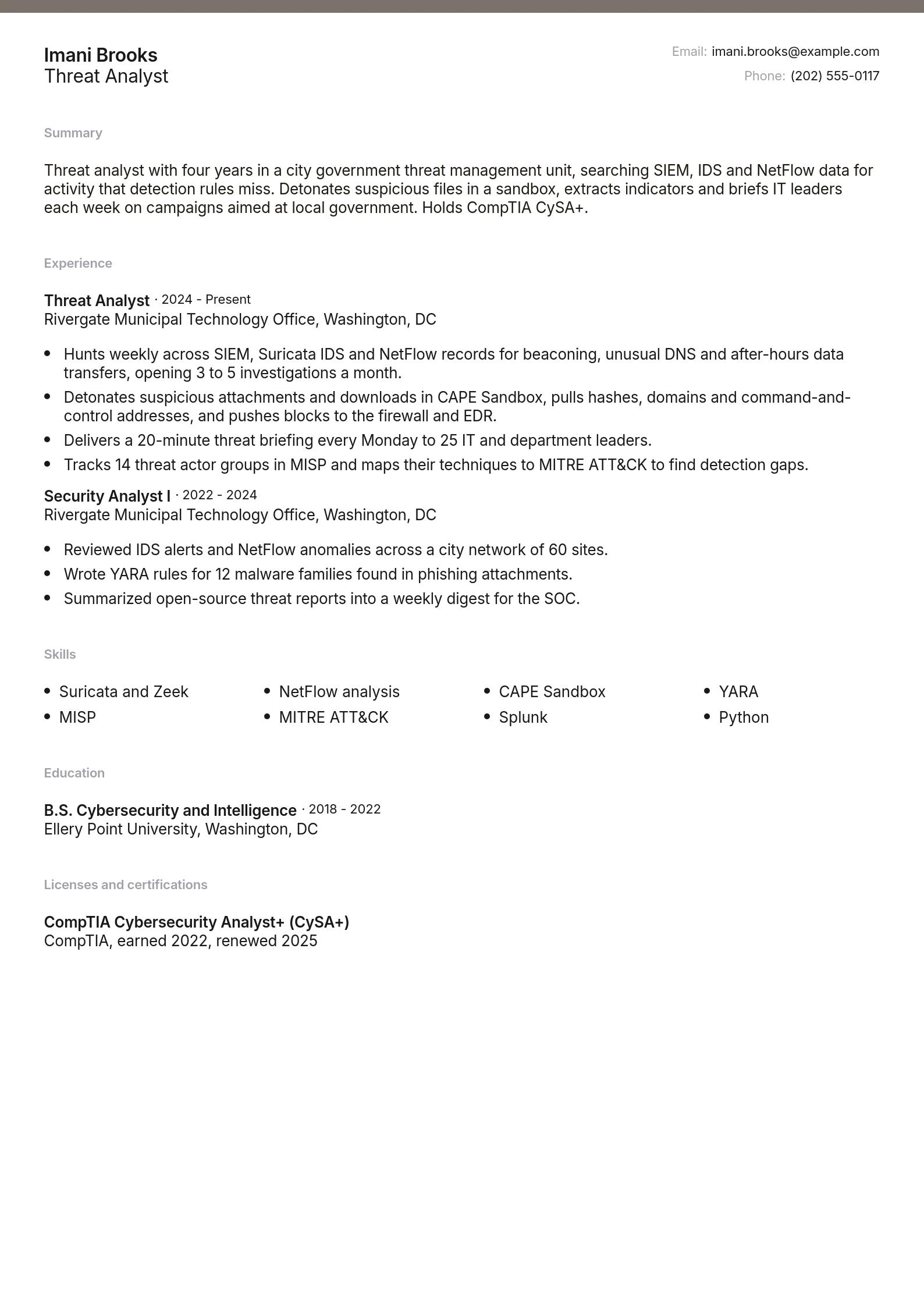
Threat analyst resume with malware triage and weekly briefings
Imani Brooks hunts across SIEM, IDS and NetFlow data and detonates suspicious files in a sandbox, so her bullets describe the patterns she looks for and the indicators she sends to blocking. A Monday briefing for 25 IT leaders shows she can explain threats to people outside security. CySA+ shows its earned and renewed years. Use it if you do threat hunting or intelligence work in government without a clearance.
Hunting across NetFlow, DNS and IDS data
Weekly threat briefing with its audience size
YARA rules and MISP tracking named
Penetration tester resume for consultancy engagements
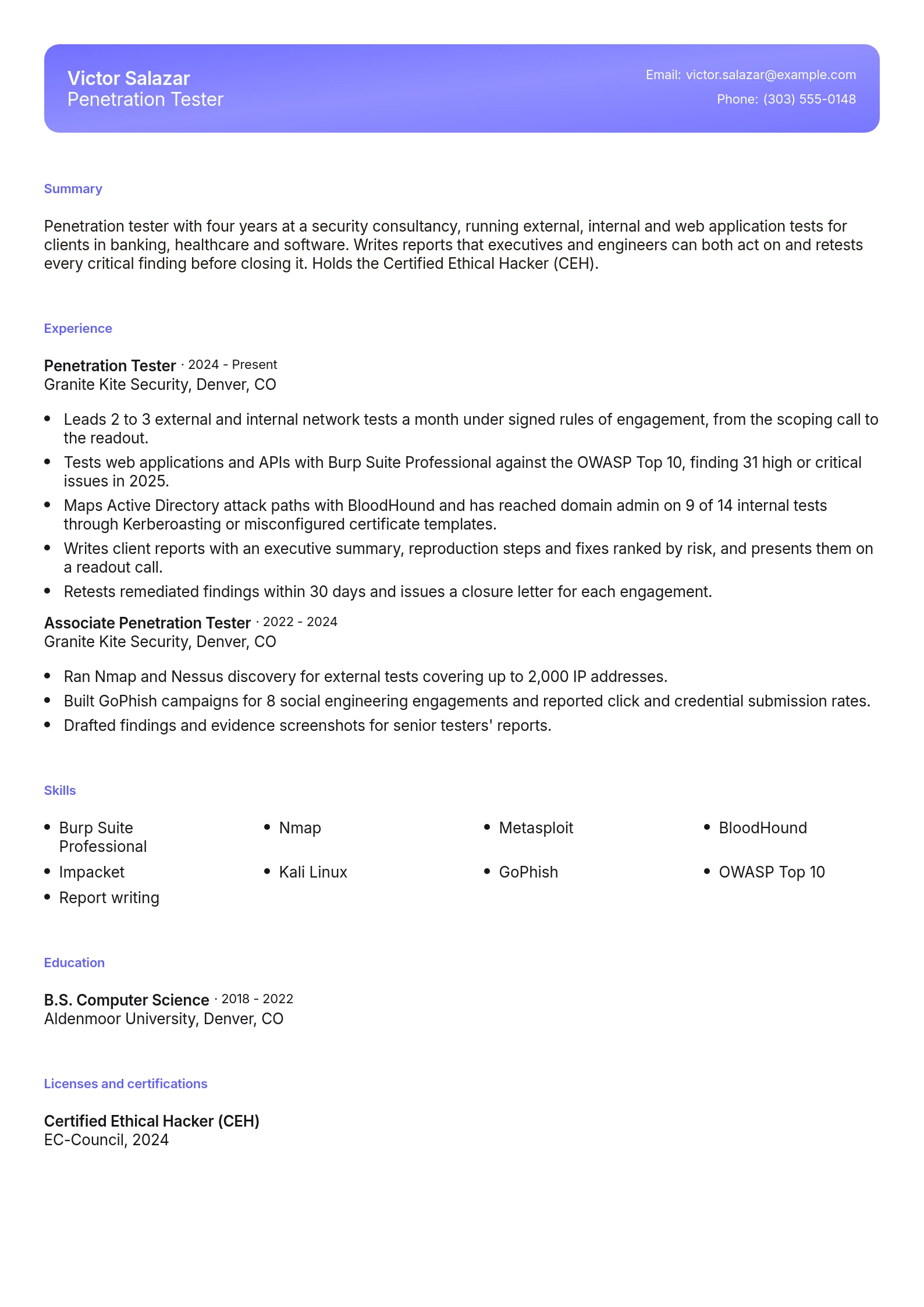
Victor Salazar's resume follows a test from scoping to retest: rules of engagement, network and web application testing, Active Directory attack paths, the report and the readout call. High and critical findings and his domain admin rate are counted. His associate years add discovery scans and phishing campaigns. CEH appears with EC-Council and the year earned. Use it if you test for clients and write the reports.
Domain admin reached on 9 of 14 internal tests
Report structure and 30-day retest window described
CEH with issuer and year
Cybersecurity manager resume with budget and audit results
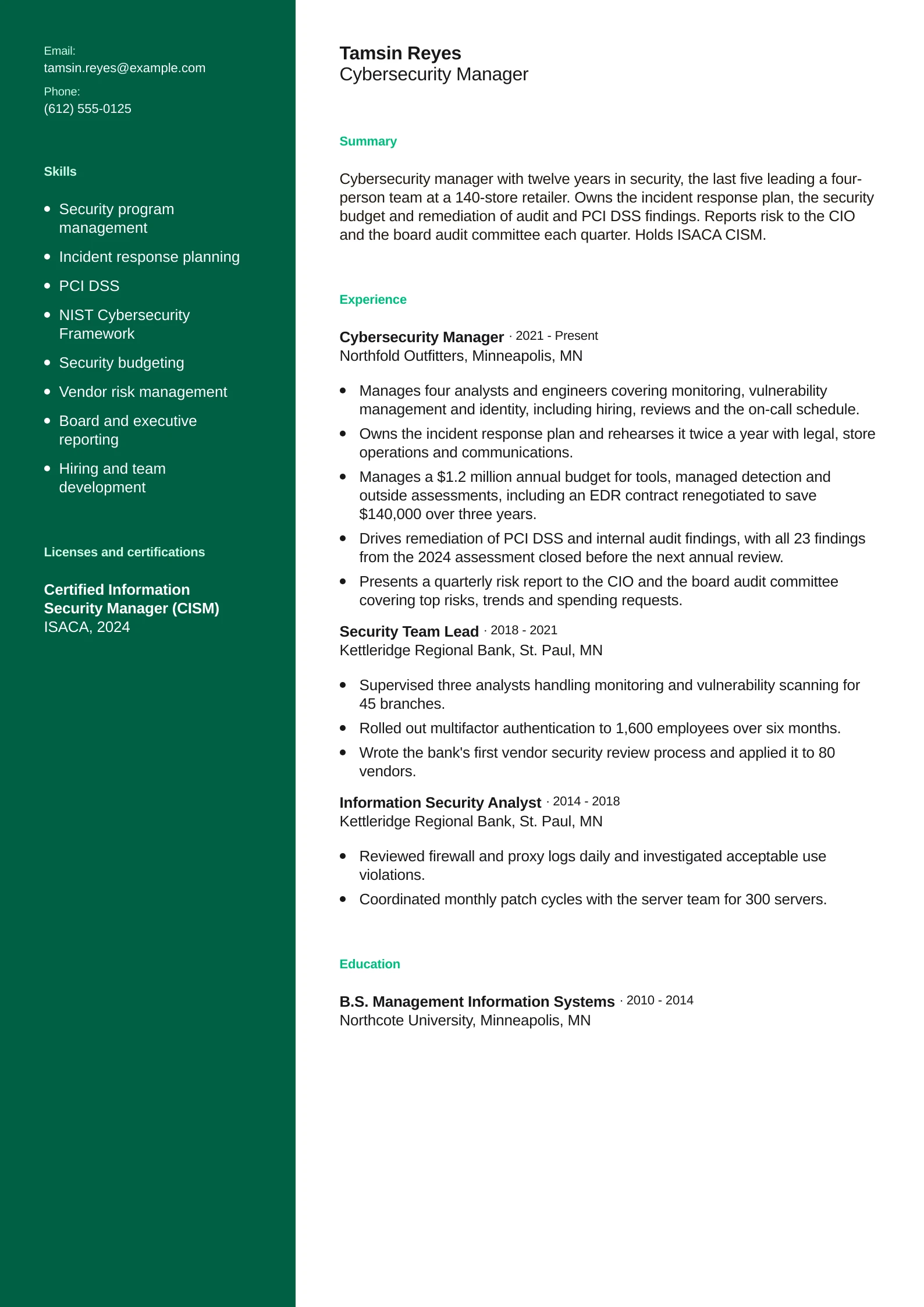
Tamsin Reyes leads a four-person team at a retailer, so her bullets cover staffing, the incident response plan, a $1.2 million budget and PCI DSS findings closed. Her bank team lead role and current job add up to more than five years of leading people before she earned CISM in 2024. A quarterly board report shows she explains risk to executives. Use it if you manage a security team or want your first manager role.
$1.2 million budget and a $140,000 contract saving
All 23 PCI DSS findings closed
CISM after more than five years leading teams
Career change resume from systems administrator to security analyst
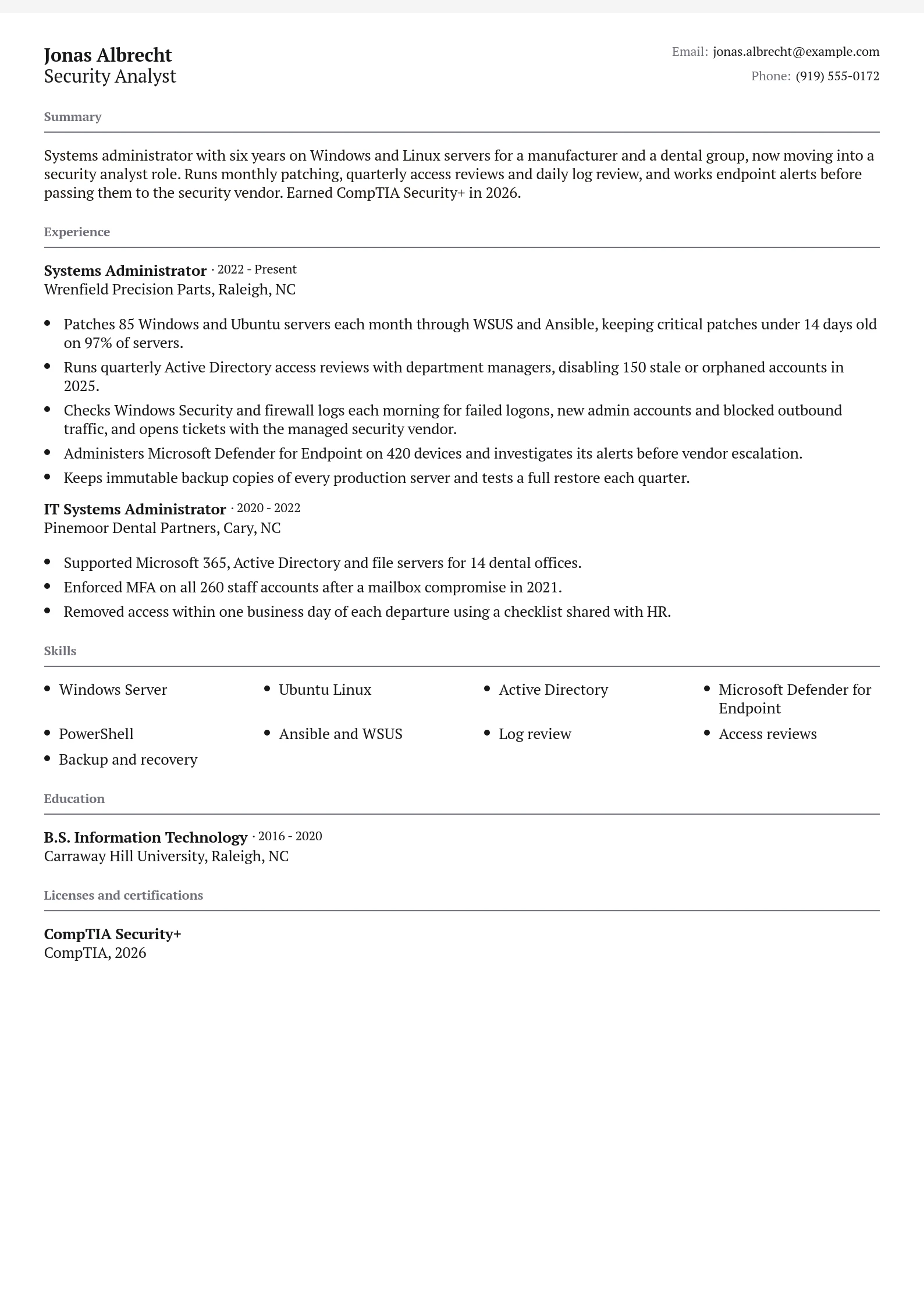
Jonas Albrecht keeps his systems administrator titles and rewrites the bullets around the security work he already does: patching against a 14-day target, quarterly access reviews, daily log review and Defender for Endpoint alerts. The summary names the move and his 2026 Security+ in three sentences. Use it if you work in IT operations and want your admin years to count toward an analyst role.
Security tasks pulled out of an admin job
Patch and access review numbers
Security+ earned in 2026
Date every certification and check its experience requirement
List each certification by its full name, then the issuer and the year you earned or last renewed it, such as 'CompTIA Security+, CompTIA, earned 2022, renewed 2025'. Recruiters check the level first: an entry credential for analyst jobs, CISSP or a similar credential for senior jobs, and a DoD 8140-approved credential for cleared work.
Don't list a credential whose experience requirement you haven't met. If you passed the CISSP exam without five years of qualifying work, write 'Associate of ISC2', which is what ISC2 calls you until you finish. Leave off exam versions such as SY0-701, because CompTIA is replacing the Security+ and CySA+ exams between late 2026 and mid-2027.
Credential
Issuer
Before you list it
Renewal
Fits
CompTIA Security+
CompTIA
Pass the exam. CompTIA recommends Network+ and two years in a security or systems administrator role.
Every three years, by continuing education or a current exam
First analyst jobs, career changers and IAT Level II ads
CompTIA Cybersecurity Analyst+ (CySA+)
CompTIA
Pass the exam
Every three years, by continuing education or a current exam
SOC, threat and analyst jobs past entry level
ISC2 Certified in Cybersecurity (CC)
ISC2
Pass the exam. No work experience required.
45 CPE credits per three-year cycle
New graduates
Certified Information Systems Security Professional (CISSP)
ISC2
Five years of paid full-time work in two or more of the eight domains. A degree or approved credential waives one year.
120 CPE credits every three years
Senior analyst and lead jobs
Certified Information Security Manager (CISM)
ISACA
Five years of information security management across three of the four domains, within the ten years before you apply
120 CPE hours every three years
Managers and team leads
GIAC Security Essentials (GSEC)
GIAC
Pass the exam. It's aimed at people new to security.
36 CPE credits over four years
Analyst jobs, including IAT Level II ads that name it
GIAC Certified Incident Handler (GCIH)
GIAC
Pass the exam. GIAC states no prerequisite.
36 CPE credits over four years
Incident response jobs
Certified Ethical Hacker (CEH)
EC-Council
Pass the exam. EC-Council recommends two years of IT security experience.
Check EC-Council's current renewal terms
Penetration testing jobs
Put an active clearance in your summary and name the approved credential
If you hold a clearance, state its level and status in your summary, written as 'Active Secret clearance' or 'Active TS/SCI'. Cleared contractor ads list the clearance before any skill, so a recruiter looks for it in your first lines.
A government agency or a cleared contractor sponsors each clearance, and you can't apply for one yourself. If you don't hold an active clearance, leave the line out.
Many ads still ask for 'DoD 8570 IAT Level II', but DoDM 8140.03 replaced DoD 8570.01-M in February 2023 and was phased in over the following two to three years. Name your credential in full, such as CompTIA Security+ or GIAC Security Essentials (GSEC), and you can describe it as DoD 8140-approved. Don't write that it qualifies you for a specific work role.
Then put the cleared tools from the ad in your bullets with a count: ACAS and Tenable Nessus scans, STIG checks with the SCAP Compliance Checker, and the RMF packages or POA&M items you updated. Andre Castillo's example attaches assets, hosts or systems to each one.
Write your rotation and alerts per shift into the SOC bullets
SOC ads state the schedule before the tools, so put your rotation in the summary or first bullet: '4-on, 4-off 12-hour shifts' or 'rotating days, nights, weekends and holidays'. Then count the queue: alerts per shift, the tools they came from and how fast you reached them.
Give escalations their own number. Say how many confirmed incidents you passed to incident response each week and what each handoff included, such as affected hosts, accounts and indicators. If you write shift handoff notes or rule tuning requests, give each a bullet with a count, as Rachel Dunmore's example does.
Gives the rotation, the volume and the escalations
Works a four-on, four-off rotation of 12-hour day and night shifts, clearing 120 to 160 QRadar and Defender alerts per shift and escalating 5 to 8 confirmed incidents a week to incident response.
Says nothing about the schedule or the queue
Monitored SIEM alerts and escalated security incidents in a 24/7 SOC.
Name the framework, then the control work you did under it
Write the framework into the bullet where you used it, with the control work and a count. 'Assesses 14 agency systems against NIST SP 800-53 Rev. 5 moderate baseline controls' tells a state agency far more than 'NIST' in a skills column.
For government work, name the RMF document or step you handled: system security plans, control assessments, POA&M items or authorization packages. Give the number of systems or controls and the result, such as items closed or a system that received an authorization to operate.
For healthcare, write 'HIPAA privacy and security training' under credentials with your employer and year, because HIPAA training comes from your employer and isn't a certification. HITRUST is your employer's framework, not a personal credential, so describe the evidence you collected for it, such as the number of requirements you supported.
Retail and payment employers ask about PCI DSS. Name the assessment year and how many findings you closed, as the manager example does.
Copy tool and framework names from the ad into the bullet that used them
Use the exact terms the ad uses for tools, frameworks and credentials, and put each one in a bullet that shows the work, as well as in your skills list. If the ad says 'Splunk' and you used Splunk Enterprise Security, write the full product name. If it says 'EDR', name the product you ran, such as CrowdStrike Falcon or Microsoft Defender for Endpoint.
Match only terms you've used. An interviewer can ask how you wrote an SPL search or which STIG checks failed most often.
Bullets with the number of systems or controls assessed
Penetration testing
External and internal network tests, web application testing, OWASP Top 10, retesting, reporting
Bullets that follow one engagement from scope to retest
Choose a template that keeps credentials and clearance on page one
A good cybersecurity resume template keeps the summary, dated credentials and grouped skills on the first page, because those are what a recruiter checks against the ad's requirements. Put the credentials section near the top when the ad names a required certification, as most cleared and senior ads do.
Group skills by type instead of running 20 tools together: SIEM and detection, endpoint and network, vulnerability management, frameworks. Keep to one page with under five years of experience, and use a second page only for relevant roles.
The technical design used by the cleared, SOC, incident response and penetration testing examples gives tool-heavy skills lists more room. The classic and professional designs suit compliance, management and career change resumes, where the bullets carry most of the detail.