A business analyst gets hired for a change they got agreed and delivered, so each line on your resume should name the system, the stakeholders, the document you wrote and what worked better after release.
Each of the 12 examples covers a different level or setting, including an intern, a team lead, a health plan, a state pension board, Salesforce, Workday and process automation.
A mid-level analyst on an Agile logistics software team
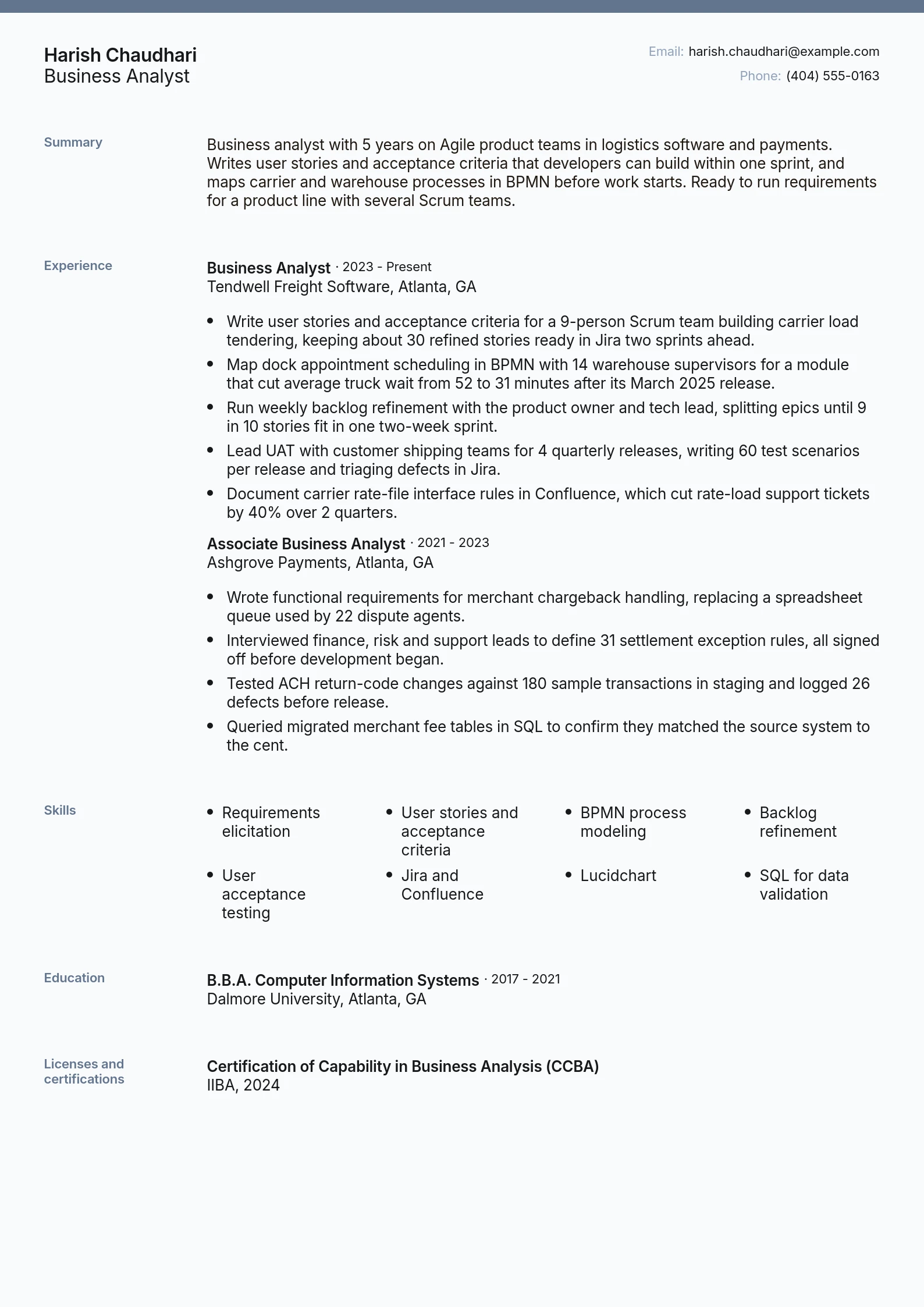
Harish has 5 years of BA work, so his first bullet names the product, the team and the document he wrote: user stories and acceptance criteria for a 9-person Scrum team building carrier load tendering. A hiring manager sees the kind of software and the size of the backlog before reading anything else.
His strongest bullet pairs a BPMN process map with the number it moved, as truck wait fell from 52 to 31 minutes after the release. His earlier payments role uses SQL to confirm that migrated fee tables matched the source system, which is validation work, not reporting. The CCBA sits at the bottom with the issuer and year, and his hours clear its 3,750-hour rule.
Eleven more analysts, sorted by level and then by platform
Find the example closest to your level first, then the one closest to your platform or industry. The industry and platform examples name a system or business area in the headline. The entry-level and career change examples show analysis done under other job titles.
Entry level business analyst moving from claims operations
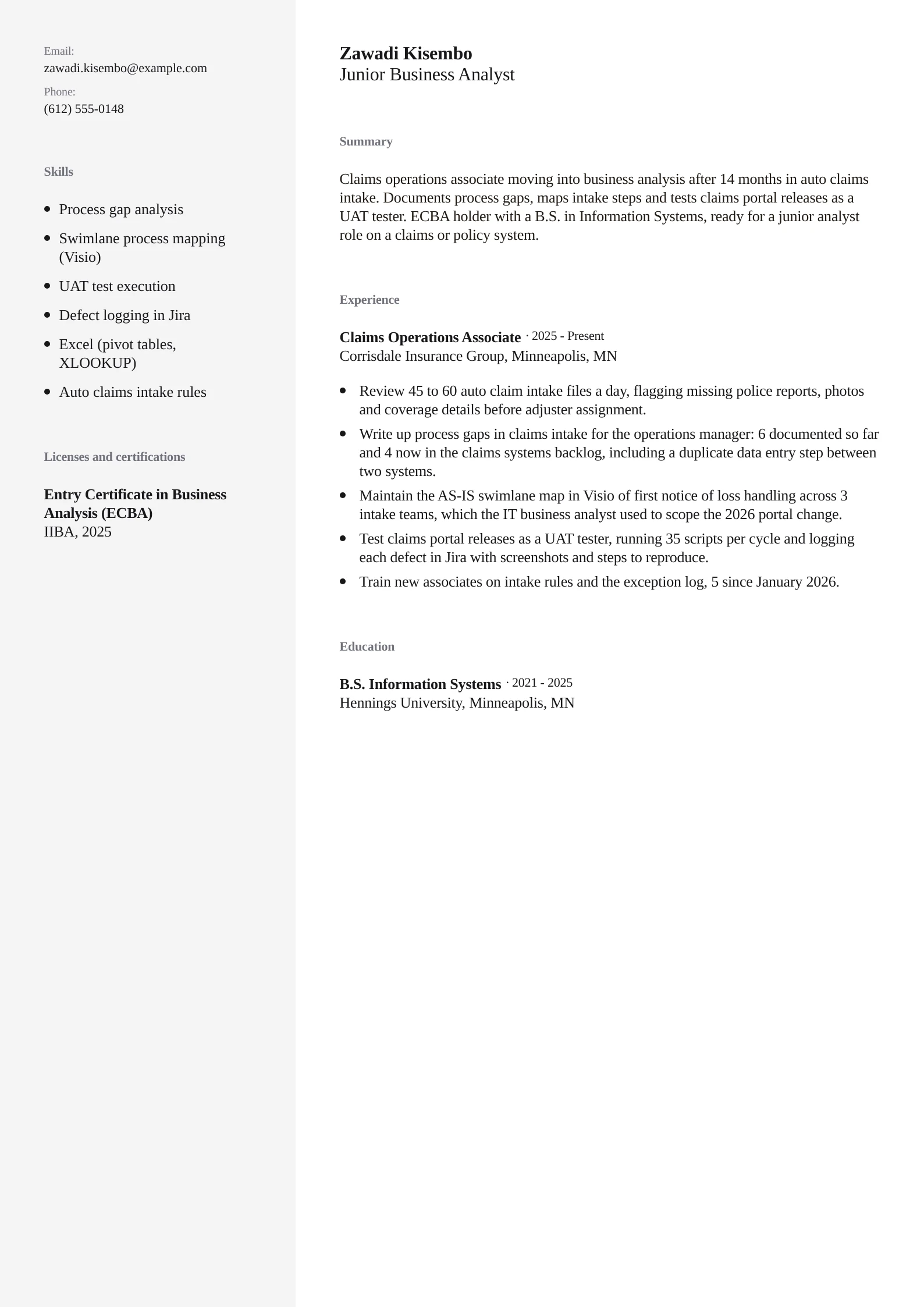
Zawadi has 14 months in auto claims intake and no BA title yet, so her bullets lead with the analysis she already does: 6 process gaps written up, an AS-IS swimlane map the IT analyst used for scoping, and 35-script UAT cycles. The ECBA and B.S. in Information Systems fill the space a longer work history would. Use it if you work in operations and want your first analyst job.
4 of 6 documented gaps now in the claims systems backlog
UAT testing written as analyst work
ECBA, which needs no logged hours
Business analyst intern with a retail internship and a client capstone
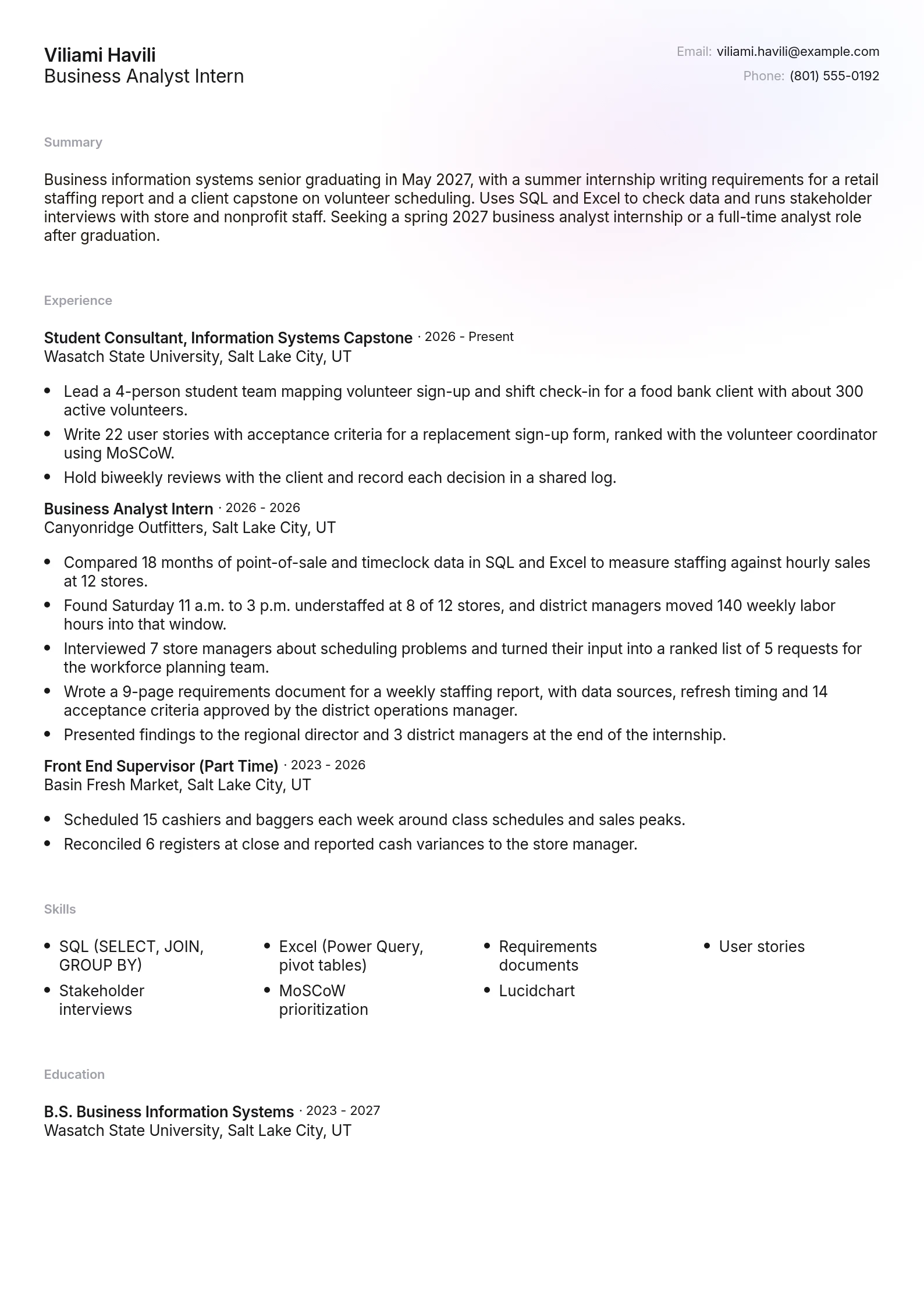
Viliami is a senior with one summer internship, so experience sits above education and the capstone is listed as a role with a client. The internship bullets move from a SQL and Excel comparison to a finding and the 140 labor hours it shifted, then to a requirements document with 14 acceptance criteria. A part-time supervisor job gets two bullets. Use it for internship and new graduate applications.
Capstone listed as a role, with 22 user stories
Requirements document with 14 acceptance criteria
Part-time job cut to two bullets
Senior business analyst on a multi-team bank program
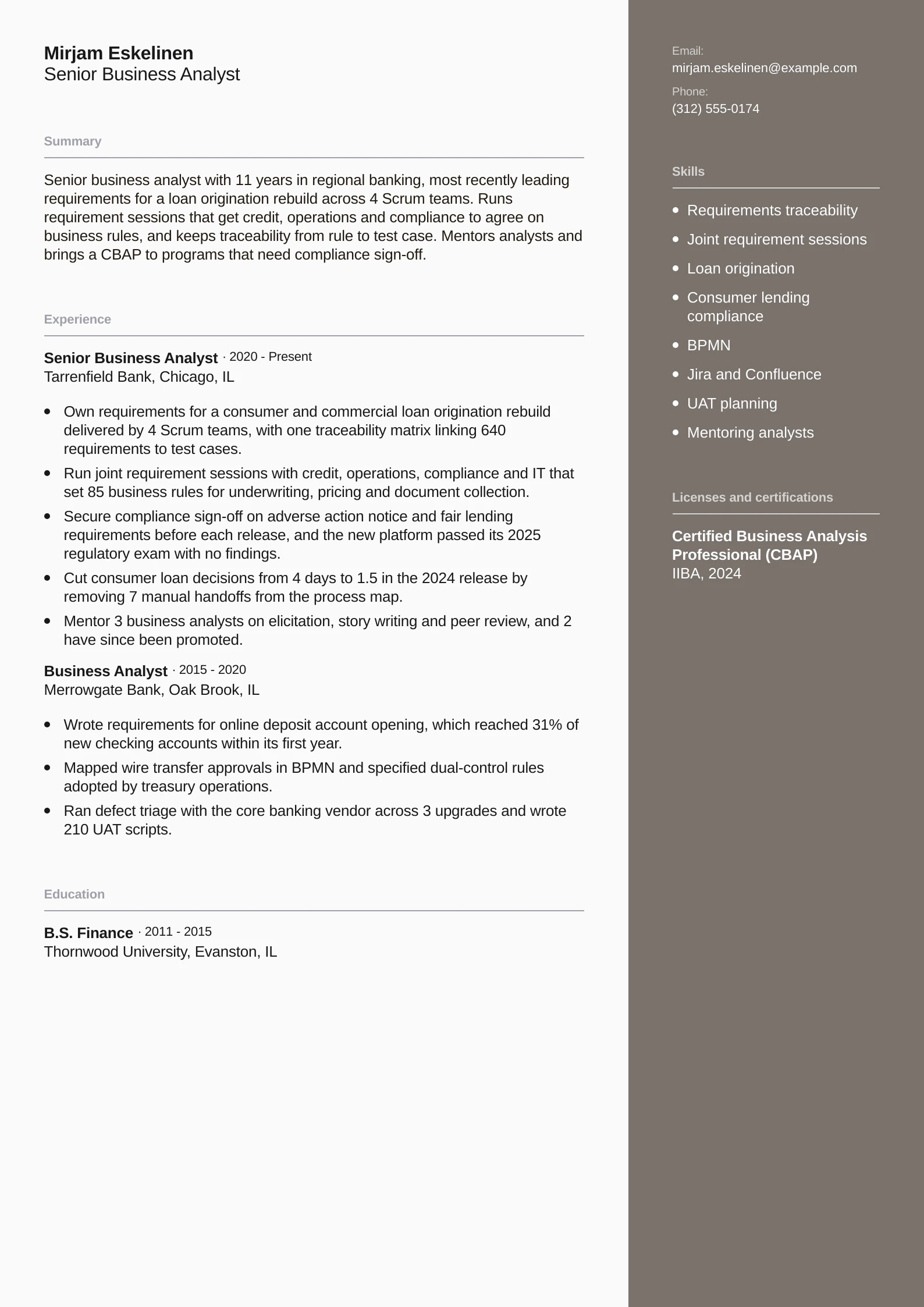
Mirjam's resume is built around one large program, a loan origination rebuild across 4 Scrum teams. Her bullets show scale through a traceability matrix of 640 requirements, the 85 business rules credit and compliance agreed, and a regulatory exam that closed with no findings. Mentoring gets one bullet with an outcome. Use it if your best evidence is a single program you carried from requirements to release.
Traceability matrix linking 640 requirements to test cases
Compliance sign-off before each release
CBAP backed by 11 years of BA work
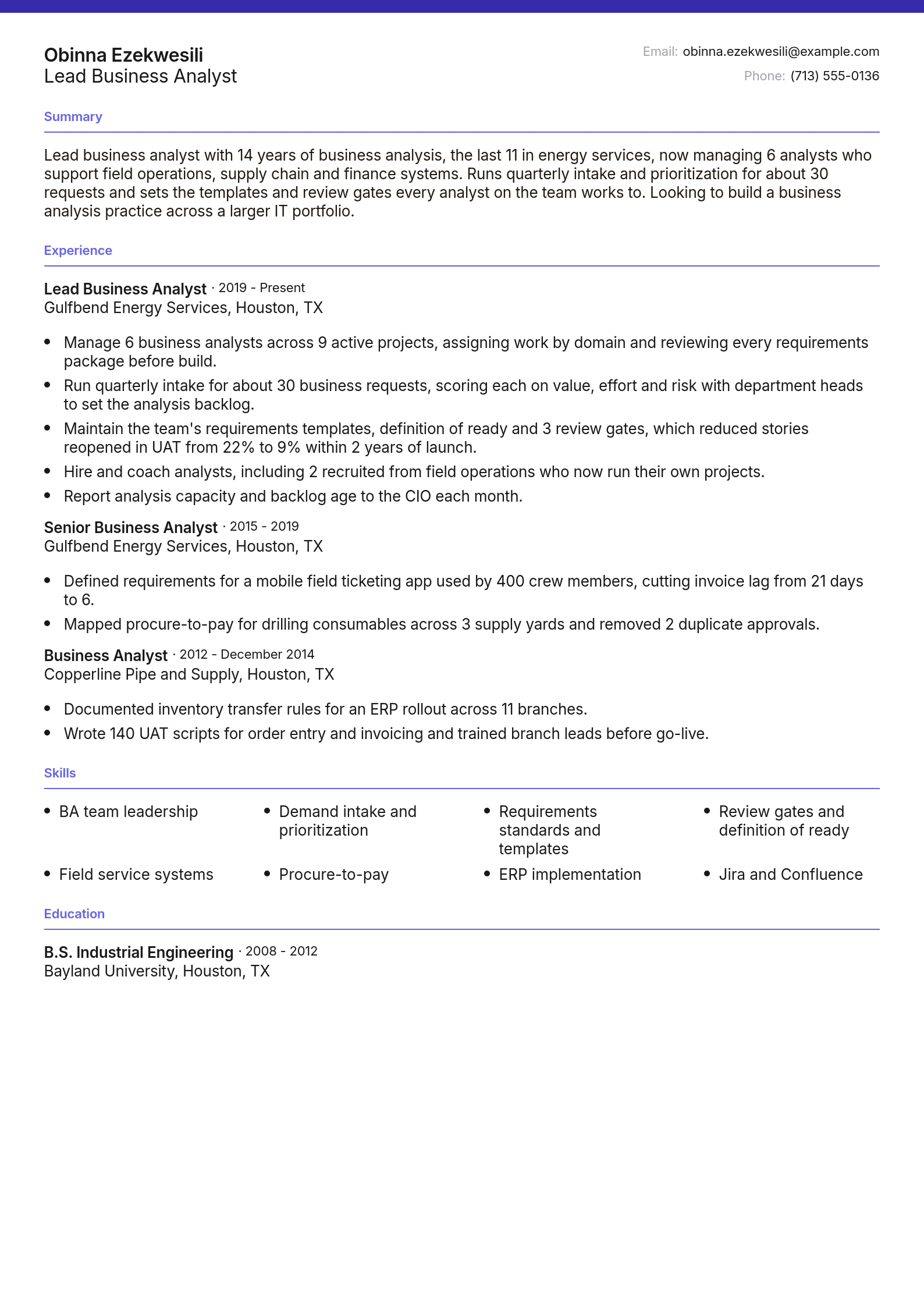
Lead business analyst managing a team of six
Obinna manages analysts, so his current role leads with team size, quarterly intake of about 30 requests and the standards every analyst works to. The review gates bullet carries a before and after number: stories reopened in UAT fell from 22% to 9%. Earlier roles keep the field ticketing and ERP projects to two bullets each. Use it if you run a BA team or are next in line to.
Intake scored on value, effort and risk
Templates and 3 review gates with a measured result
Promoted from senior to lead at the same company
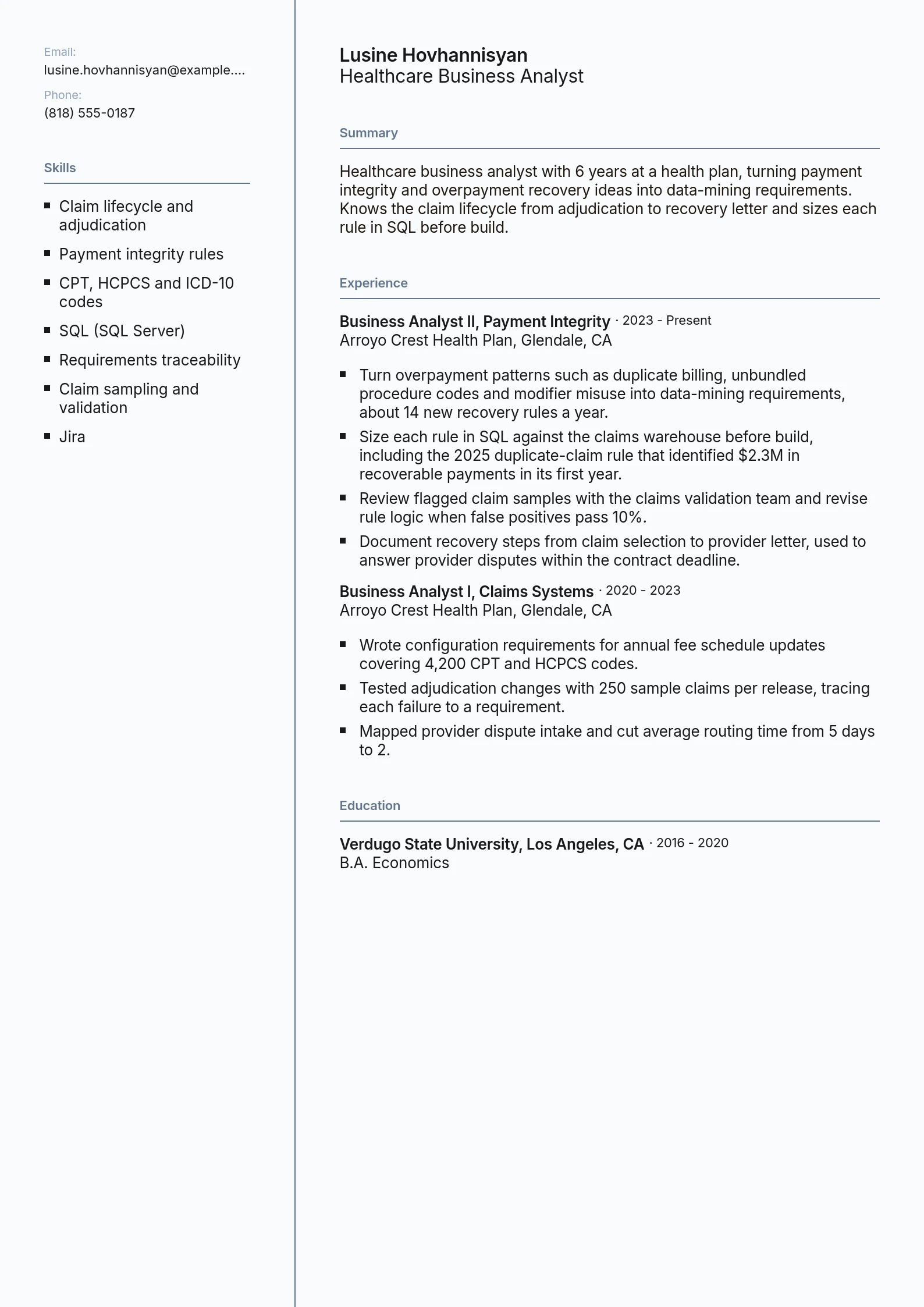
Healthcare business analyst in payment integrity
Lusine works at a health plan, so her resume uses the claims terms payer ads ask for: claim lifecycle, CPT and HCPCS codes, duplicate billing and modifier misuse. Her payment integrity bullets move from rule idea to SQL sizing to validation with the claims team, and one rule found $2.3M in recoverable payments in its first year. Use it if you work in claims, payment integrity or another payer system and want that domain read first.
Recovery rules sized in SQL before build
A false positive threshold for revising rules
Coding systems named in the skills list
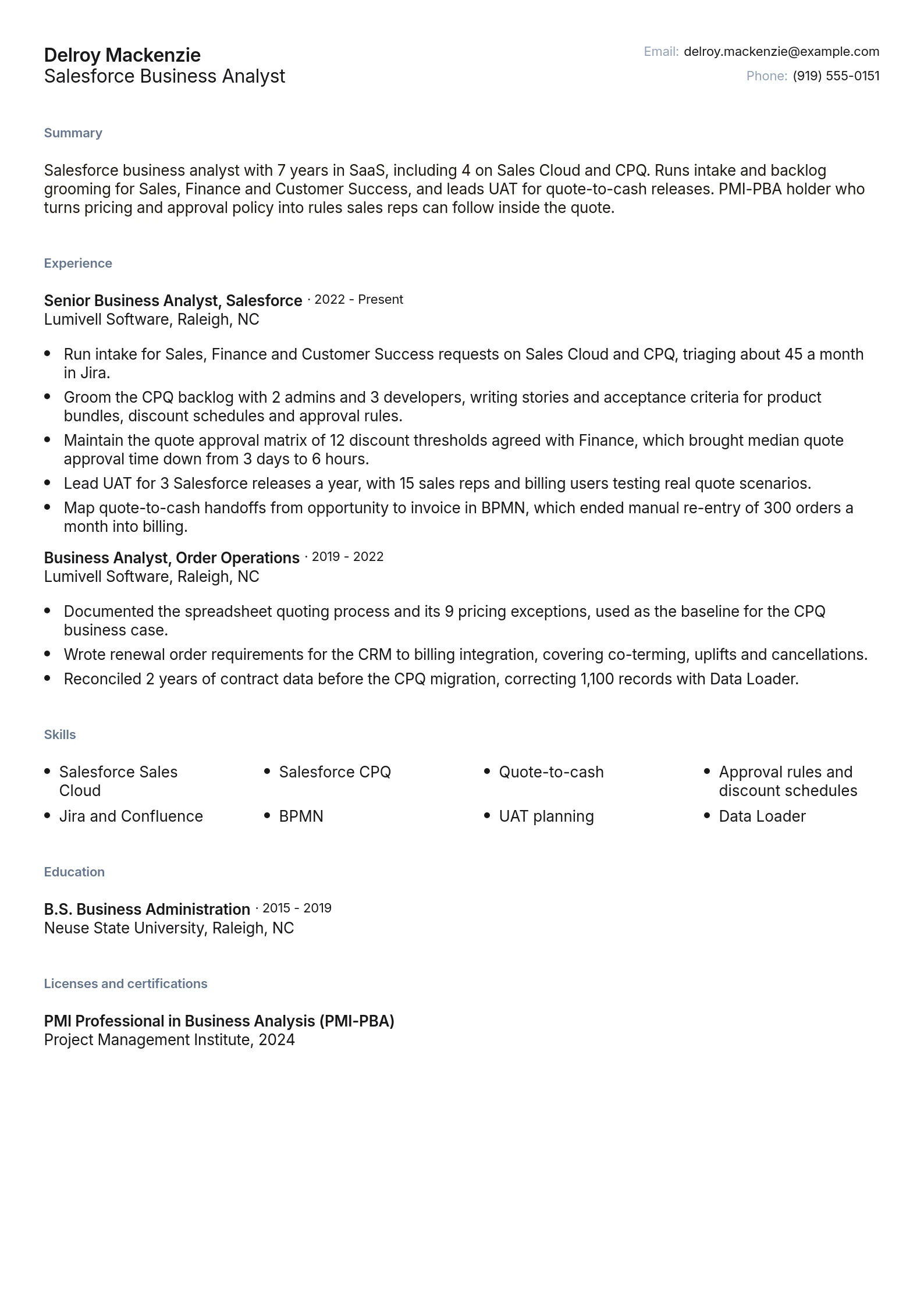
Salesforce business analyst on Sales Cloud and CPQ
Delroy's headline names Salesforce and his summary gives his 4 years on Sales Cloud and CPQ, because Salesforce ads can ask for years on the platform. His bullets cover the quote-to-cash loop: intake from three departments, CPQ backlog grooming, a 12-threshold approval matrix and UAT with sales reps. His earlier order operations role shows the spreadsheet process he later replaced. Use it for CRM, CPQ or revenue systems roles.
Platform years stated in the summary
Quote approval cut from 3 days to 6 hours
PMI-PBA listed with issuer and year
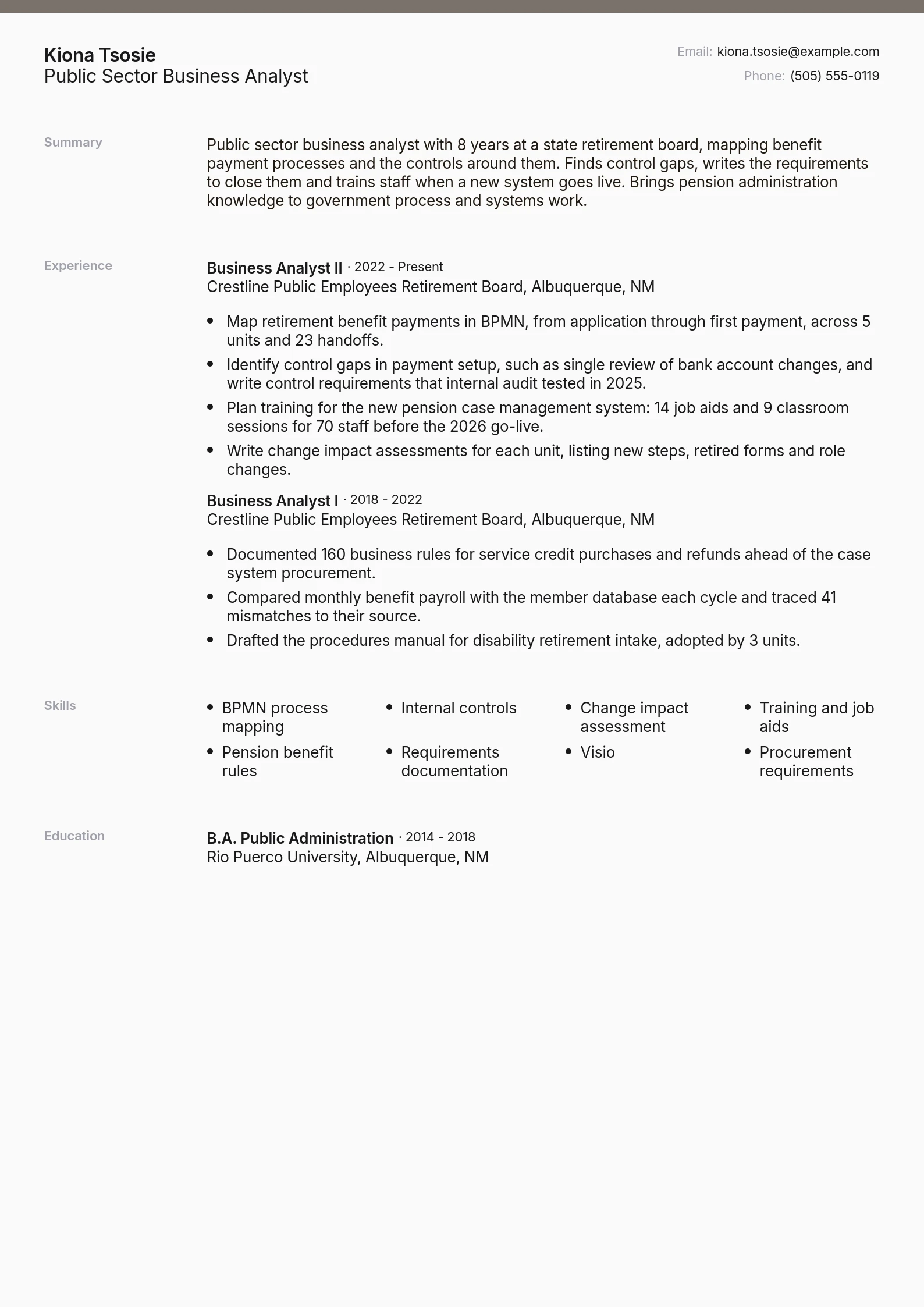
Government business analyst at a state retirement board
Kiona's resume fits public sector ads that ask for process mapping, controls and change management. One bullet maps benefit payments across 5 units and 23 handoffs, another names a specific control gap and the audit test that followed, and a third counts the job aids and classes behind a go-live. Use it for government, pension or other regulated back-office roles.
Control gap named, with the audit that tested it
Training counted in job aids and sessions
Change impact assessments for each unit
Workday business analyst for payroll and benefits
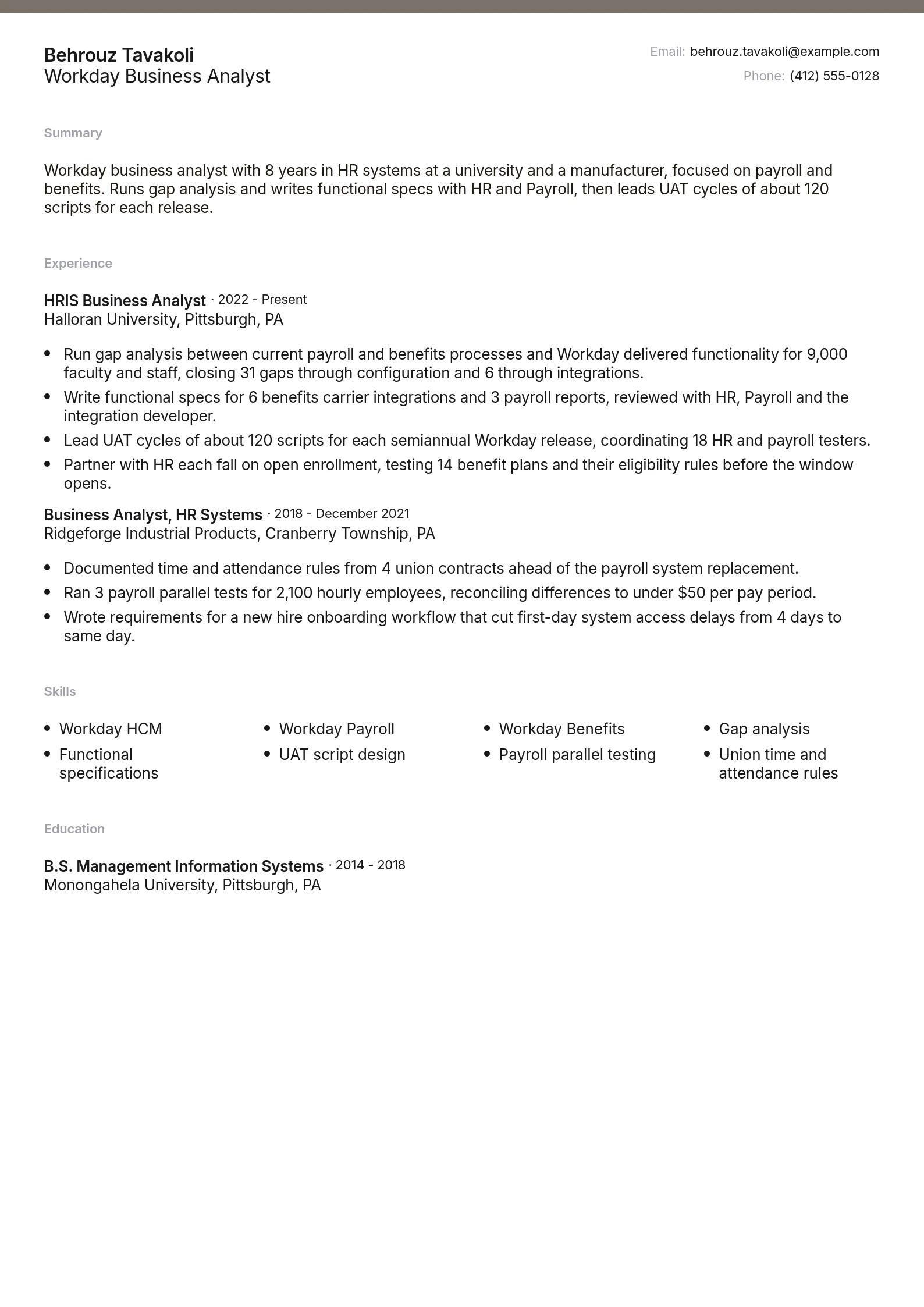
Behrouz names the Workday modules in his skills and the population in his first bullet: 9,000 faculty and staff. His gap analysis result is split between gaps closed by configuration and by integration. UAT is counted in scripts and testers per release, and open enrollment gets its own bullet. Use it for HRIS, Workday or other ERP implementation roles where payroll and benefits are in scope.
Workday Payroll and Benefits in the skills list
UAT cycles of about 120 scripts with 18 testers
Parallel payroll test reconciled to under $50
Financial services business analyst writing SQL and specs
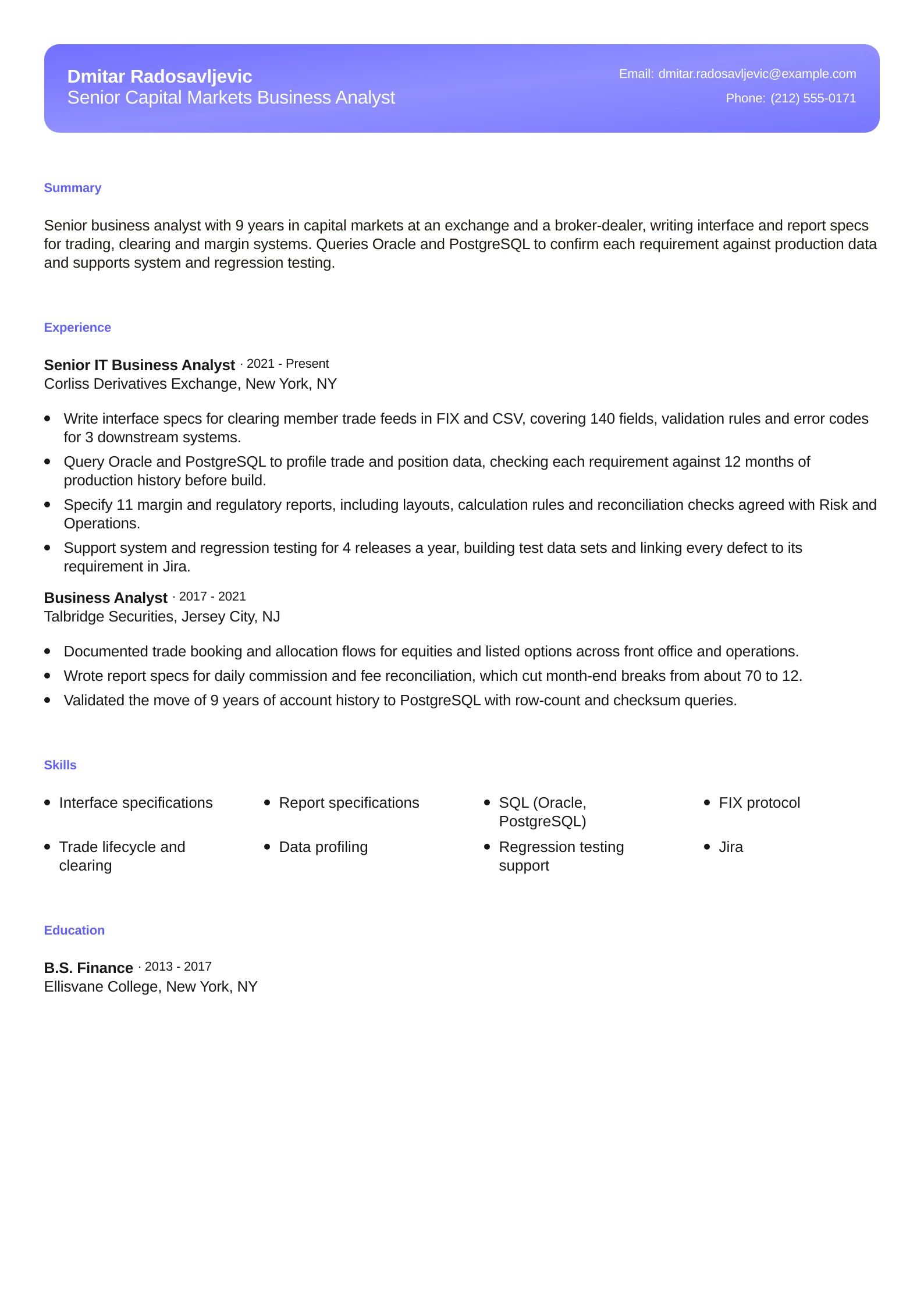
Dmitar's bullets match the technical ads he applies to: interface specs with field counts and error codes, 11 margin and regulatory report specs, and Oracle and PostgreSQL queries that check each requirement against production data. SQL appears as validation inside the analysis work, not as a separate reporting job. Use it if you're an IT business analyst in trading, clearing or another data-heavy financial system.
140-field interface spec for 3 downstream systems
SQL tied to requirement checks
Month-end breaks cut from about 70 to 12
Career change to business analyst from school data work
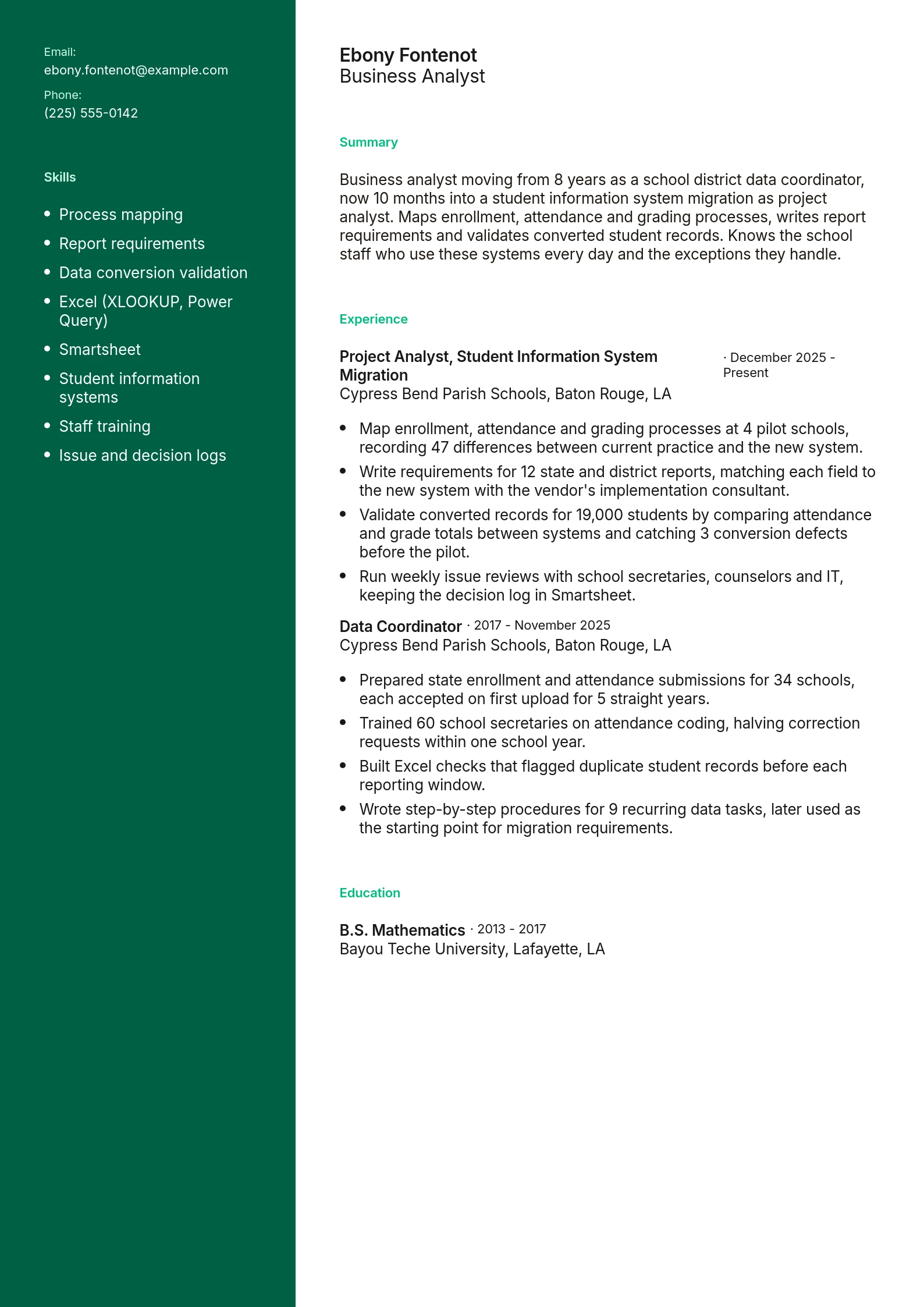
Ebony spent 8 years as a district data coordinator and is 10 months into a student information system migration as project analyst. Her headline says Business Analyst, her current role carries the BA work (process maps, report requirements, conversion checks) and the older role shows the procedures that became requirements. Use it if your analysis happened under another title and you're moving into BA work.
Target title in the headline, real titles in experience
Conversion checks on 19,000 student records
Older procedures linked to new requirements
Process automation business analyst using UiPath
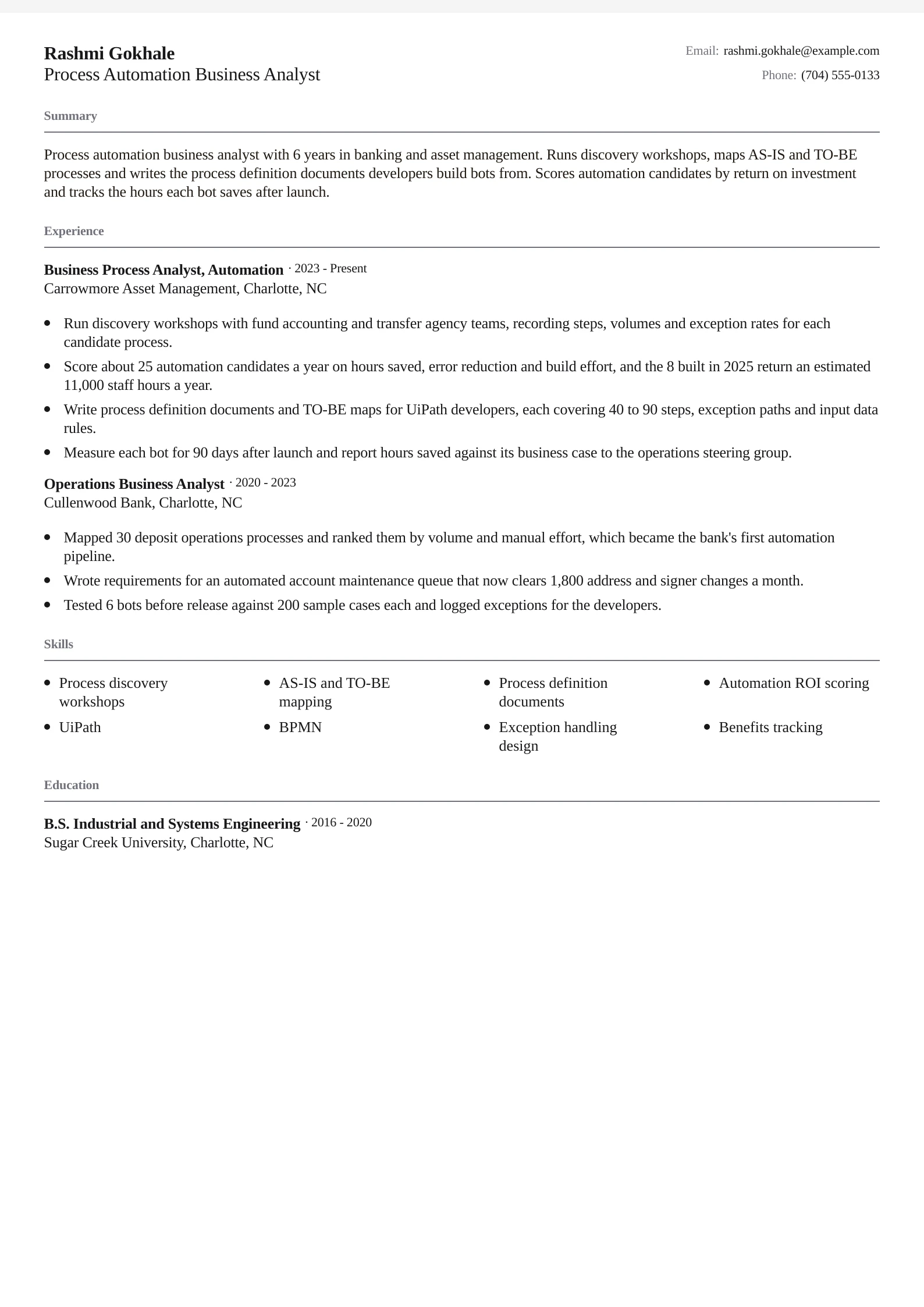
Rashmi's resume follows an automation candidate from discovery to results: workshops that capture volumes and exception rates, ROI scoring for about 25 candidates a year, process definition documents for UiPath developers, and 90 days of measurement after launch. Use it if you work in RPA, intelligent automation or operations excellence and want the business case visible in your bullets.
ROI scoring with estimated hours saved
Process definition documents with step counts
Bot results tracked against the business case
Name the platform in your headline and the artifacts in your bullets
Use the ad's exact words for the platform, the business area, the documents you produce and the method, then put each where a reader checks for it. Ads for this job repeat a short list: elicitation, user stories, acceptance criteria, BPMN, UAT, SQL and Jira, plus a platform such as Salesforce CPQ or Workday.
Copy the ad's spelling. If it says 'acceptance criteria', don't shorten it to 'AC', and write out 'Business Process Model and Notation (BPMN)' once if the ad does. Put a platform keyword in a bullet with a number as well as in your skills list, because a skills list alone doesn't show how long or how deeply you used it.
Map retirement benefit payments in BPMN, from application through first payment
Artifact
User stories, acceptance criteria, process maps, functional specs, UAT scripts, traceability matrix
Bullets, with a count
Write 22 user stories with acceptance criteria for a replacement sign-up form
Technique
Elicitation, gap analysis, AS-IS and TO-BE mapping, MoSCoW prioritization
Bullets first, then skills
Run gap analysis between current payroll processes and Workday delivered functionality
Tool
Jira, Confluence, Visio, Lucidchart, SQL, Excel
Skills list, plus one bullet that shows the tool in use
Lead UAT for 4 quarterly releases and triage defects in Jira
Method
Agile, Scrum, Waterfall, hybrid
Summary, or the bullet that shows the practice
Run weekly backlog refinement with the product owner and tech lead
Replace 'gathered requirements' with the change that shipped
Write each bullet so it names the system or process, the people who agreed to it, the document you produced and what changed after release. Every analyst gathers requirements, so that phrase alone tells a hiring manager nothing about your work.
For requirements, give the artifact and its size: 22 user stories, 85 business rules, a 140-field interface spec. Then say who signed off, such as credit, compliance or the product owner.
For process maps, say whether you mapped the current (AS-IS) or future (TO-BE) process, how many handoffs or units it covered, and which measure moved afterward: wait time, days to a loan decision, or orders re-keyed by hand.
For UAT, count the scripts or scenarios, the testers you coordinated and the defects you found before release. If you left before release or never saw the numbers, end the bullet with who used your work instead, as in 'replacing a spreadsheet queue used by 22 dispute agents.'
The system, the document and the result
Mapped dock appointment scheduling in BPMN with 14 warehouse supervisors for a new scheduling module. Average truck wait fell from 52 to 31 minutes after release.
A task anyone could claim
Gathered requirements from stakeholders and created process maps and test scripts for the new scheduling system.
Match ECBA, CCBA, CBAP or PMI-PBA to your logged hours
List a business analysis credential only after you've passed it, and check its experience rule against your work history first. Employers that mention CBAP, CCBA or PMI-PBA often list them as preferred, not required.
Write the full name with the acronym in parentheses, then the issuer and year: 'Certification of Capability in Business Analysis (CCBA), IIBA, 2024.' If an ad names one you hold, repeat the acronym in your summary, as the Salesforce example does with PMI-PBA.
The IIBA hours must be business analysis work, so a career changer with years in operations usually starts with the ECBA, which has no experience requirement.
Credential
Issuer
Experience needed
Earliest most candidates qualify
Entry Certificate in Business Analysis (ECBA)
IIBA
None
Any time, including as a student
Certification of Capability in Business Analysis (CCBA)
IIBA
3,750 hours of BA work in the last 7 years, 21 hours of professional development in the last 4 years and 2 references
After 2 to 3 years of BA work
Certified Business Analysis Professional (CBAP)
IIBA
7,500 hours of BA work in the last 10 years, 35 hours of professional development in the last 4 years and 2 references
After 5 years of BA work
PMI Professional in Business Analysis (PMI-PBA)
PMI
35 contact hours plus 36 months of BA practice in the last 8 years with a bachelor's degree, or 60 months with a high school diploma or associate's degree
After 3 years of BA work, for degree holders
Lead with the analysis you've done under another title
Put 'Business Analyst' as your resume title, keep your real job titles in the experience section, and make your bullets show the BA work you've already done. Never rename a past job to Business Analyst. Keep the title your employer used.
Start with work that matches BA artifacts. An operations associate who wrote up process gaps, mapped an intake process or ran UAT scripts has done analysis. Say how many gaps, which process and how many scripts, as the entry-level example does with 6 gaps and 35-script UAT cycles.
Use your domain as the selling point. Years of school attendance coding, claims intake rules or deposit operations mean you know the people and exceptions a new system has to handle. Name that domain in your summary, then show one bullet where your knowledge became a requirement or a procedure.
If you've worked on a system project as a project analyst, super user or tester, list it as its own role with dates, or as a dated bullet if it ran alongside your main job. The career change example lists 10 months on a student information system migration as its own role above 8 years of data coordination.
Add the ECBA if you have no logged BA hours. List SQL, Visio or Jira in your skills only when a bullet above shows you using them.
Systems, process and HRIS analyst titles count when the work was analysis
Count any role where you elicited needs, wrote requirements or specs, mapped processes or tested system changes, whatever the title said. Systems analyst, business process analyst, IT business analyst and operations analyst all appear in ads for the same work.
In your summary, total the years across those titles, as in '9 years of business analysis as a systems analyst and IT business analyst.' Then make the first bullet under each title name the kind of analysis, so a reader doesn't have to guess from the title.
Title
Counts as BA experience when you
A first bullet that shows it
Systems analyst
Wrote functional, interface or report specs
Wrote interface specs for 3 downstream systems, covering 140 fields
Business process analyst
Mapped AS-IS and TO-BE processes or wrote process definition documents
Mapped 30 deposit operations processes and ranked them by manual effort
Operations analyst
Documented process gaps and tested system changes
Documented 6 claims intake gaps, 4 of them now in the systems backlog
HRIS or Workday analyst
Ran gap analysis, wrote functional specs or led UAT for HR systems
Led UAT cycles of about 120 scripts for each Workday release
Project analyst or super user
Recorded requirements, issues and decisions during an implementation
Mapped grading processes at 4 pilot schools before the new system's pilot
Data or reporting analyst
Wrote report requirements with business users
Specified 11 margin and regulatory reports with calculation rules agreed with Risk
Product owner
Wrote and prioritized user stories with acceptance criteria
Kept 30 refined user stories ready for a 9-person Scrum team
Questions analysts ask about length, SQL and methodology