A title of Owner tells an employer nothing about size, so these resumes open with revenue, staff, locations or clients, and several name who checked the numbers.
Each one is written for a different next job, including general manager, franchise business consultant, construction project manager and customer success.
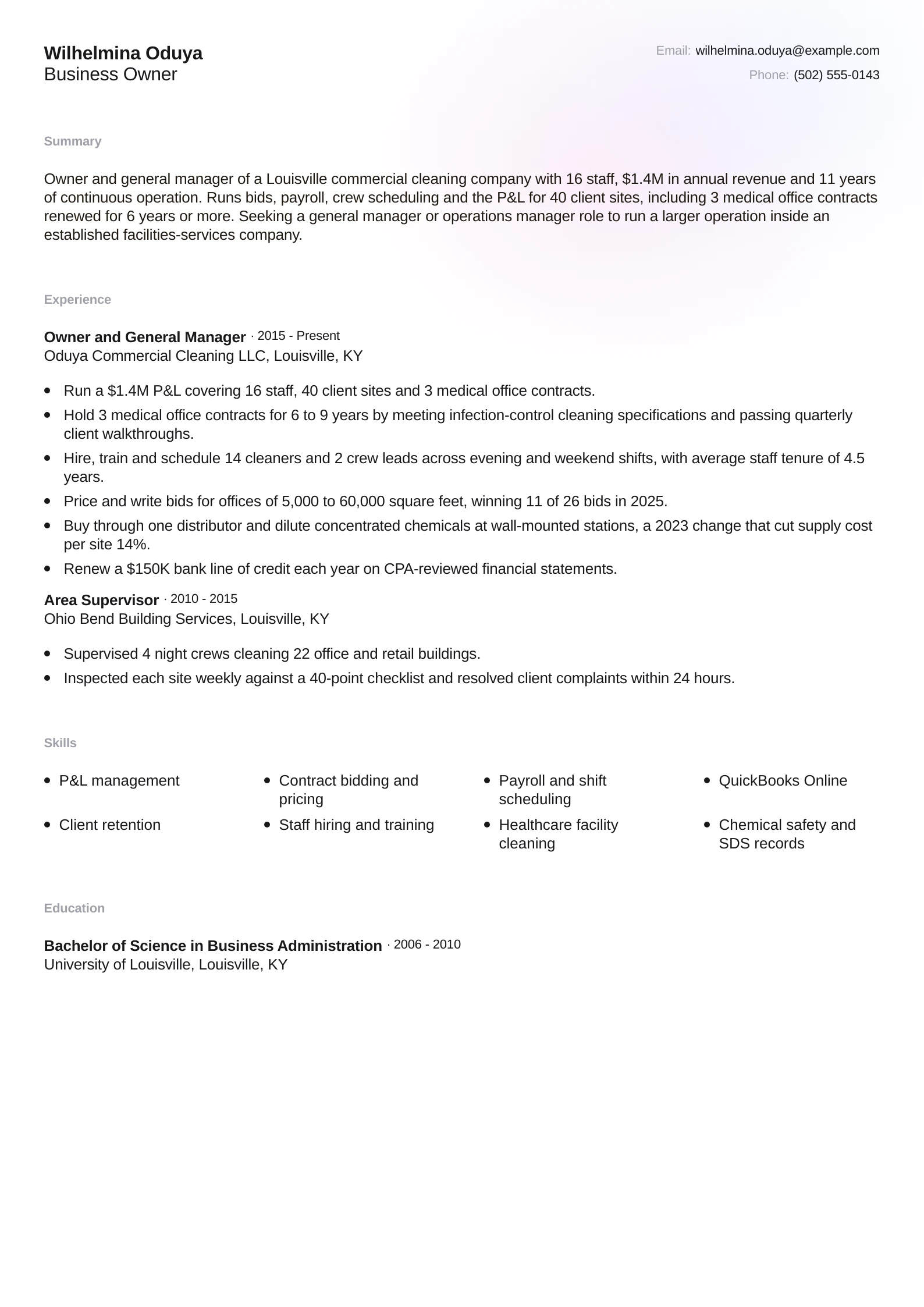
A cleaning company owner applying for general manager jobs
Wilhelmina Oduya has run a Louisville commercial cleaning company for 11 years and wants a general manager job at a larger facilities-services firm. Her first bullet gives the size a hiring manager reads for: a $1.4M P&L, 16 staff, 40 client sites and 3 medical office contracts.
Her title reads Owner and General Manager, which matches the job she wants. One bullet shows that a bank and an outside CPA review her books every year, and her summary says in one clause why she is moving: to run a larger operation inside an established company.
Pick the owner whose next job looks like yours
The eight resumes below differ by business type and by the job each owner wants next. Match on the target job first, because a franchisee applying to a franchisor needs different bullets than a franchisee applying to run a restaurant group.
Early-career owner moving into field operations
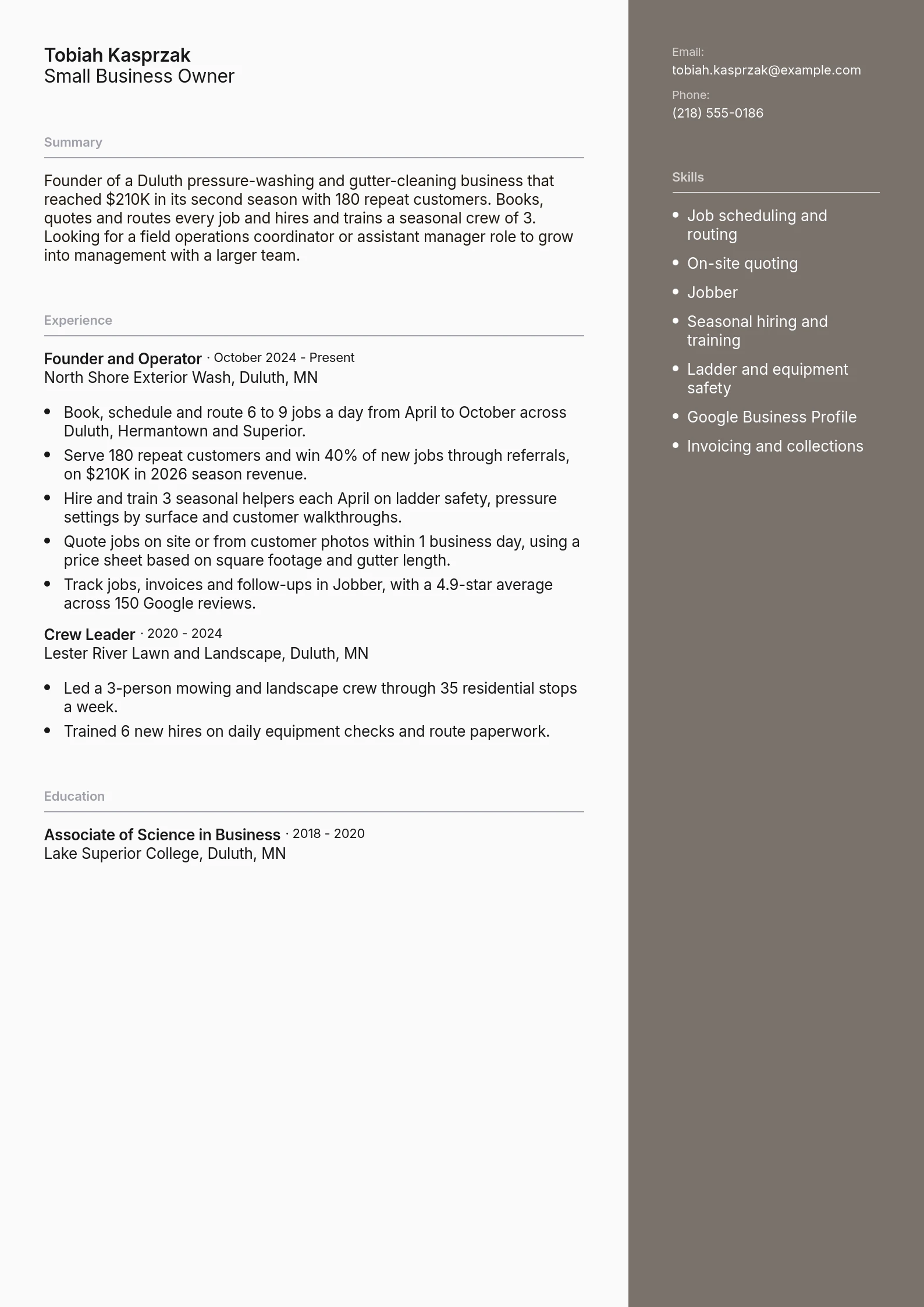
Tobiah Kasprzak has run a pressure-washing and gutter business for two seasons, so his numbers are small and he shows them anyway: $210K in revenue, 180 repeat customers and 3 seasonal helpers he hires and trains. His crew leader job sits below the business to show he has worked for someone else. Use it if your business is young and you want coordinator or assistant manager jobs.
Revenue and repeat customers in one bullet
Daily routing and quotes within one business day
Associate degree in business
Founder who built and sold the company
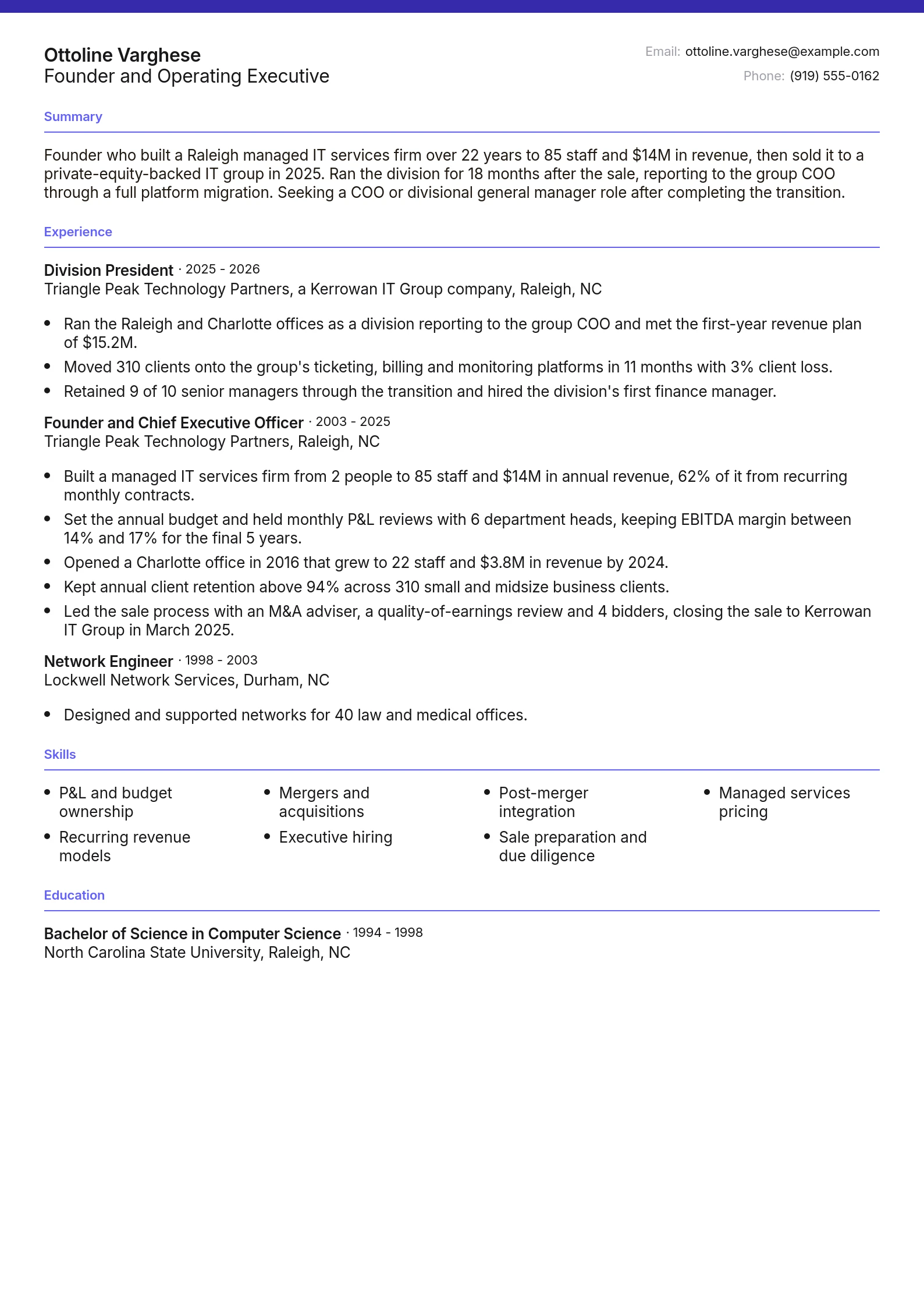
Ottoline Varghese founded a managed IT firm, grew it to 85 staff and $14M, and sold it. The sale gets its own bullet with the bidders and closing year, and her 18 months as division president after the sale are a separate job that reported to the group COO. Use this layout if you sold your company or stayed on after an acquisition and want COO or general manager roles.
Sale listed as a result, with bidders and closing year
Post-sale role reporting to a group COO
EBITDA margin and client retention
Restaurant owner aiming for multi-unit management
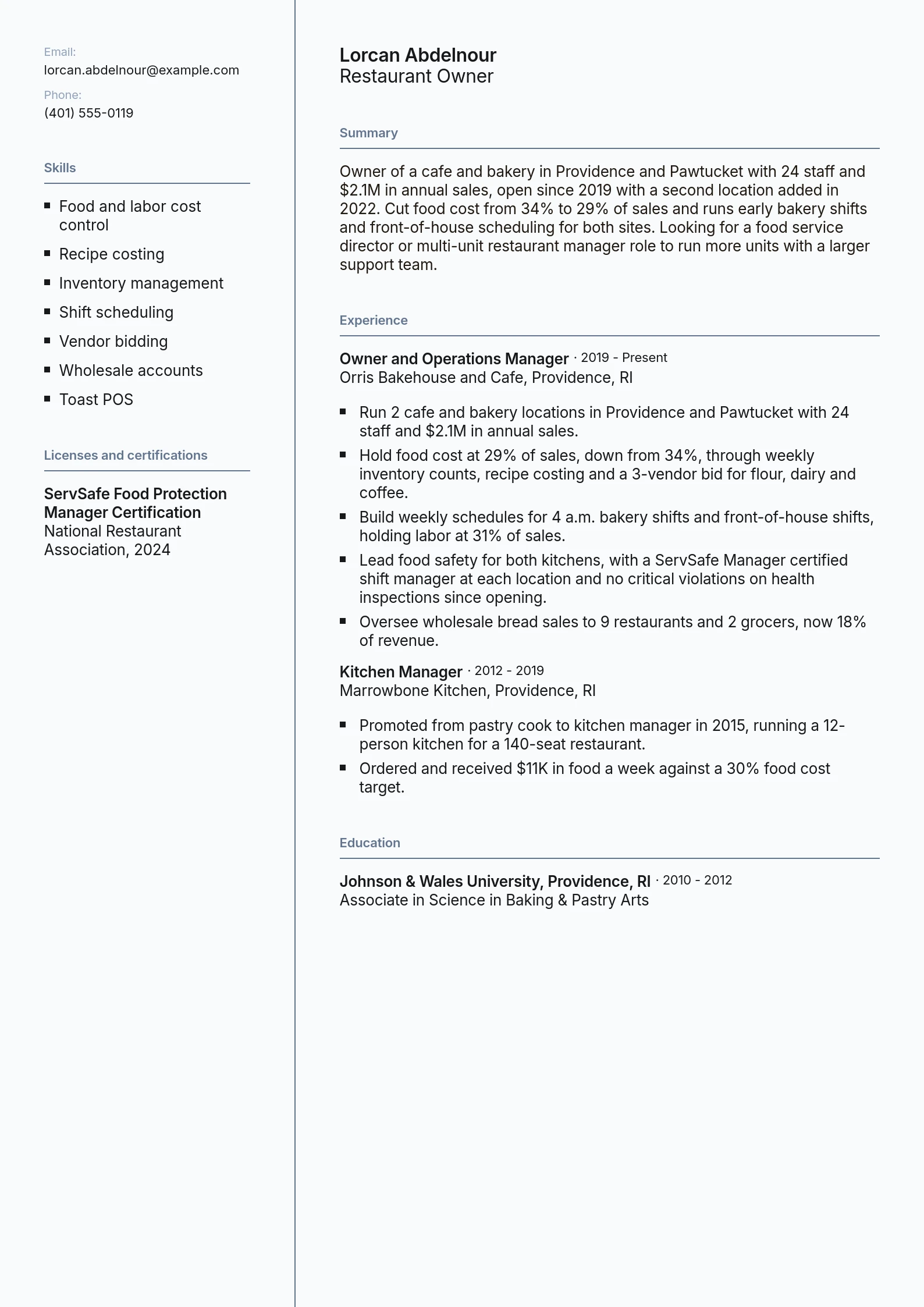
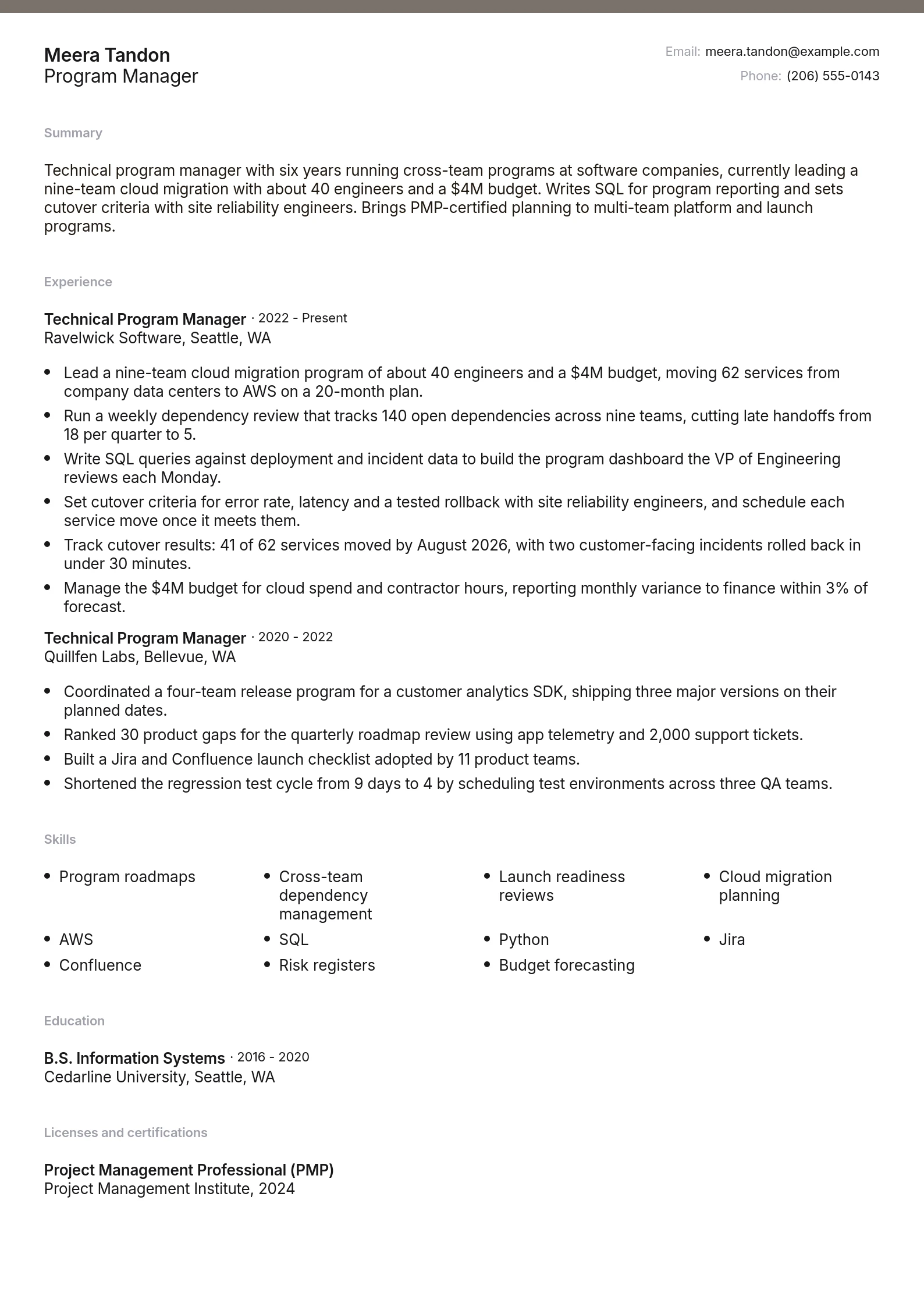
Lorcan Abdelnour owns a two-location cafe and bakery, and his bullets use the numbers a food service director is judged on: food cost cut from 34% to 29%, labor at 31% of sales and no critical health inspection violations. ServSafe Manager sits in the credentials section. Use it if you own a restaurant, cafe or bakery and want multi-unit manager or food service director jobs.
Food cost and labor as a percent of sales
Wholesale accounts as a share of revenue
ServSafe Manager certification
Remodeling contractor moving into project management
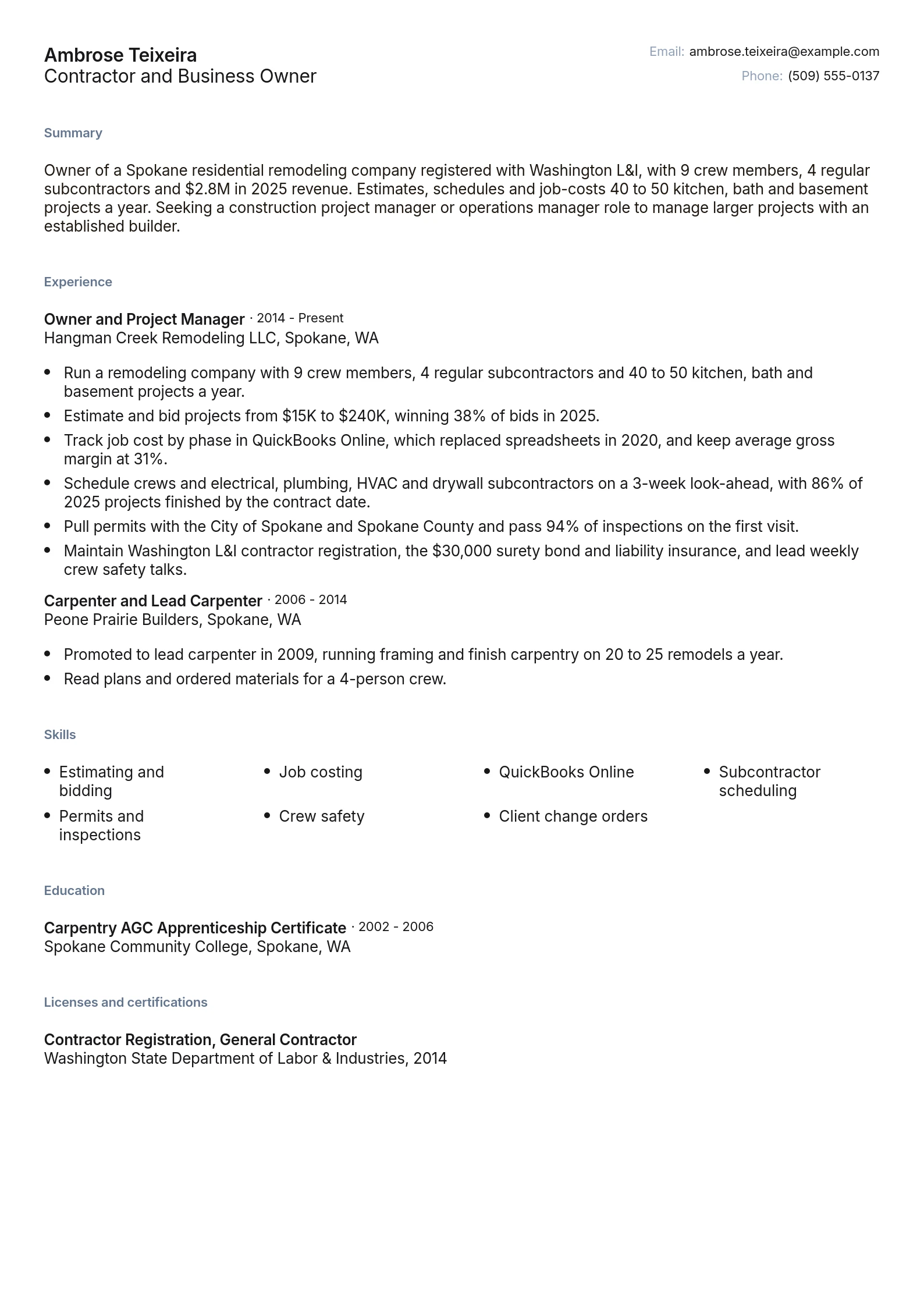
Ambrose Teixeira runs a Spokane remodeling company and writes it the way a construction employer reads it: projects a year, bid range and win rate, job cost in QuickBooks Online and the share of jobs finished by the contract date. His Washington L&I registration is listed without a number. Use it if you own a trades business and want construction project manager or operations manager roles.
Bid range and win rate
On-time finish rate and first-visit inspection rate
Subcontractor trades named
Online store owner targeting e-commerce operations
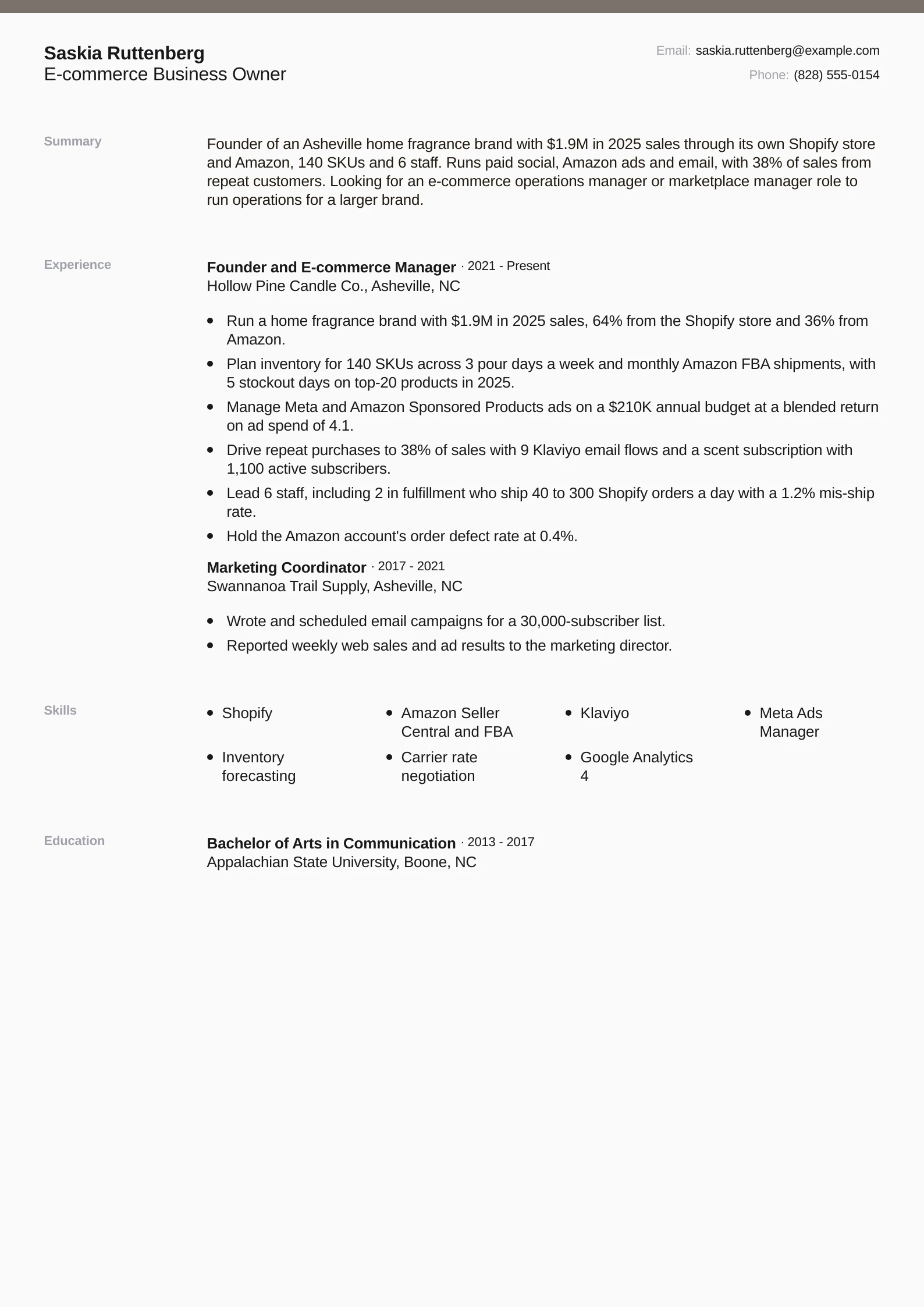
Saskia Ruttenberg sells candles through her own Shopify store and Amazon, and splits revenue by channel in her first bullet. Her other bullets name the measures an e-commerce operations manager tracks: SKU count, return on ad spend for a stated budget, Klaviyo flows, mis-ship rate and Amazon order defect rate. Use it if you run an online store and want marketplace or e-commerce operations jobs.
Sales split by channel
Ad budget with blended return on ad spend
Order volume and mis-ship rate
Franchisee moving to the franchisor side
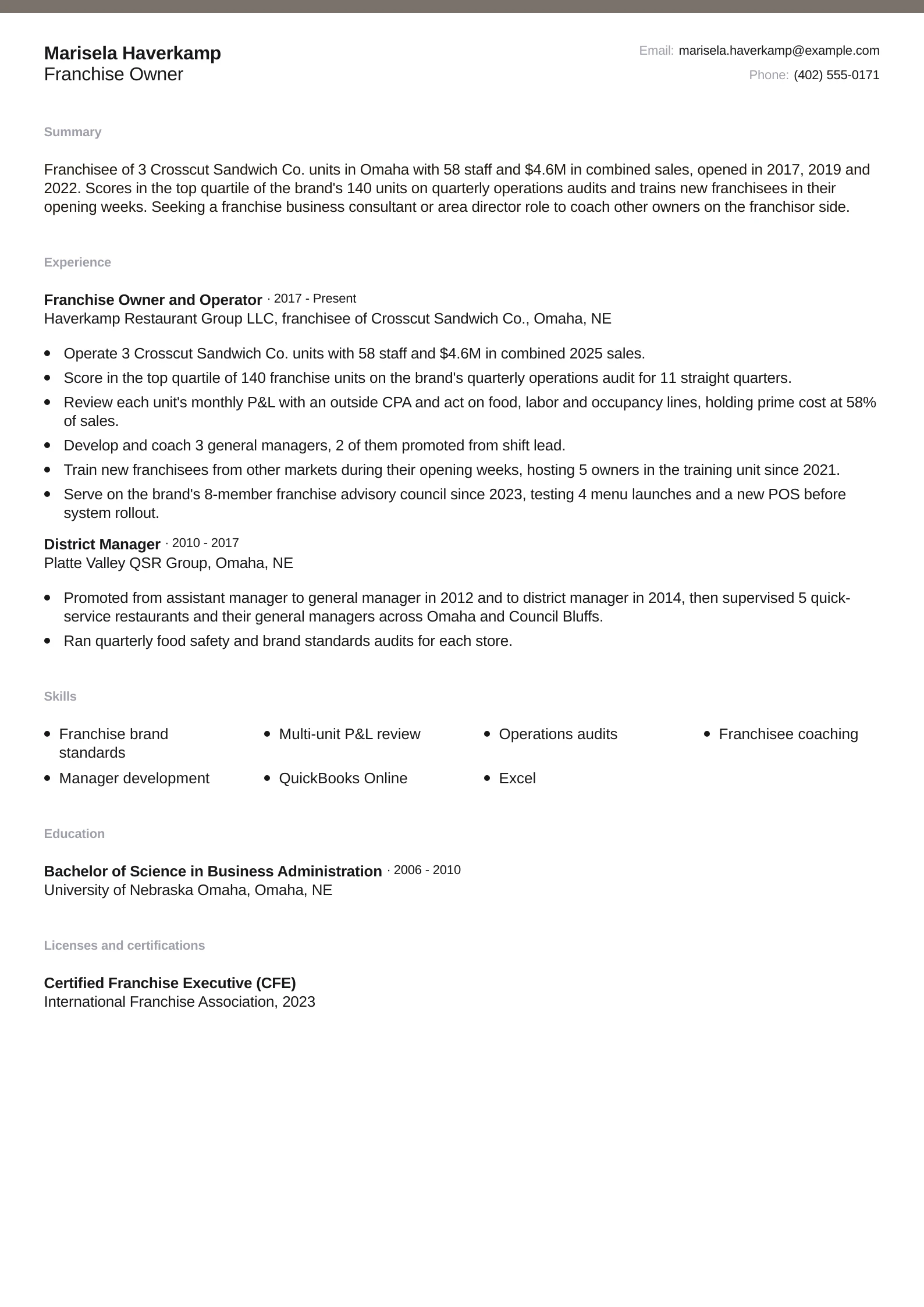
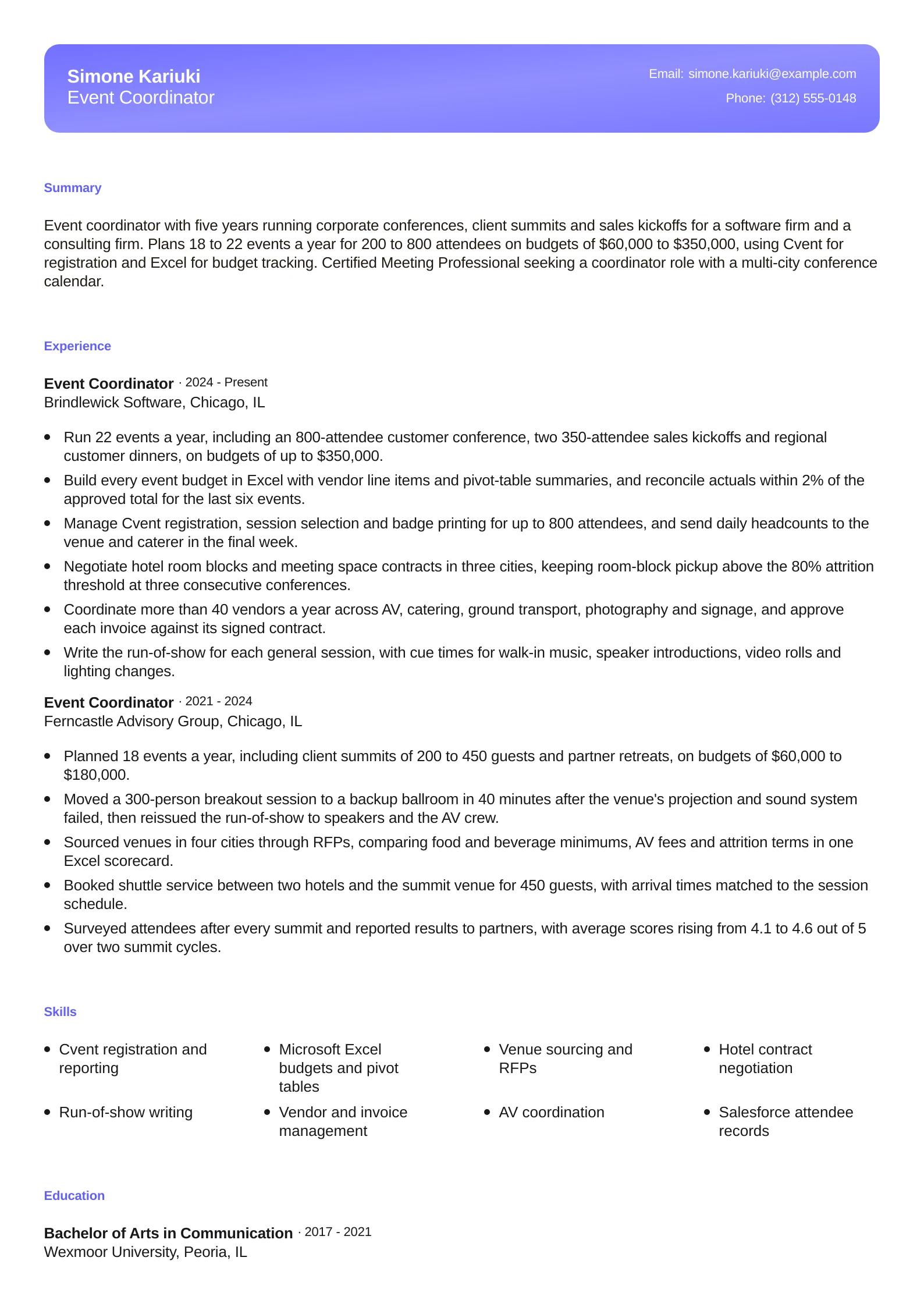
Marisela Haverkamp owns three sandwich franchise units and is applying to work for a franchisor. Her bullets lead with brand audit rankings, prime cost, the managers she developed and the new franchisees she trained, which is the daily work of a franchise business consultant. Her IFA Certified Franchise Executive designation is listed. Use it if you're a franchisee aiming for consultant or area director roles.
Audit rank among 140 units
Franchise advisory council seat
Certified Franchise Executive (CFE)
Solo consultant joining an in-house team
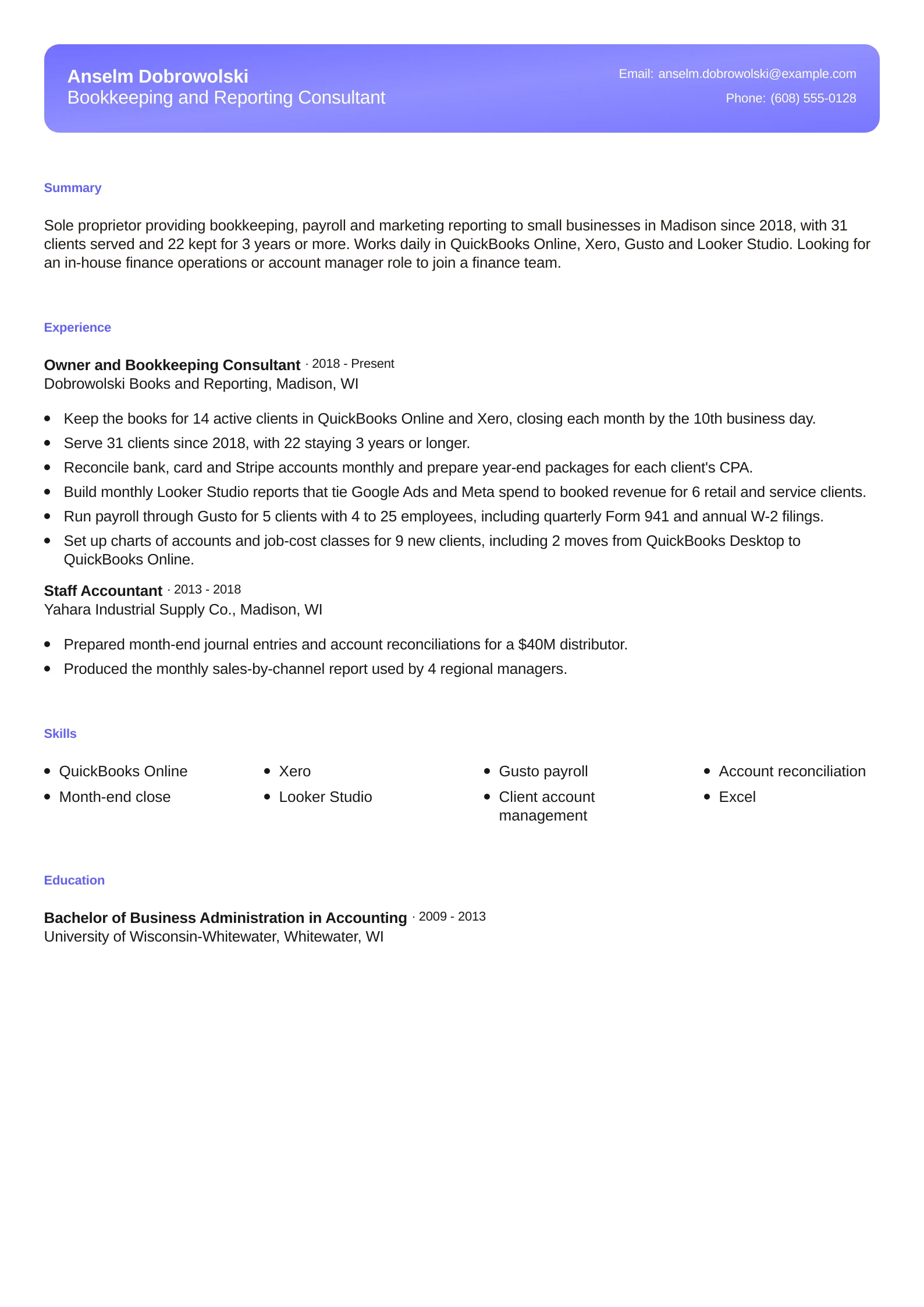
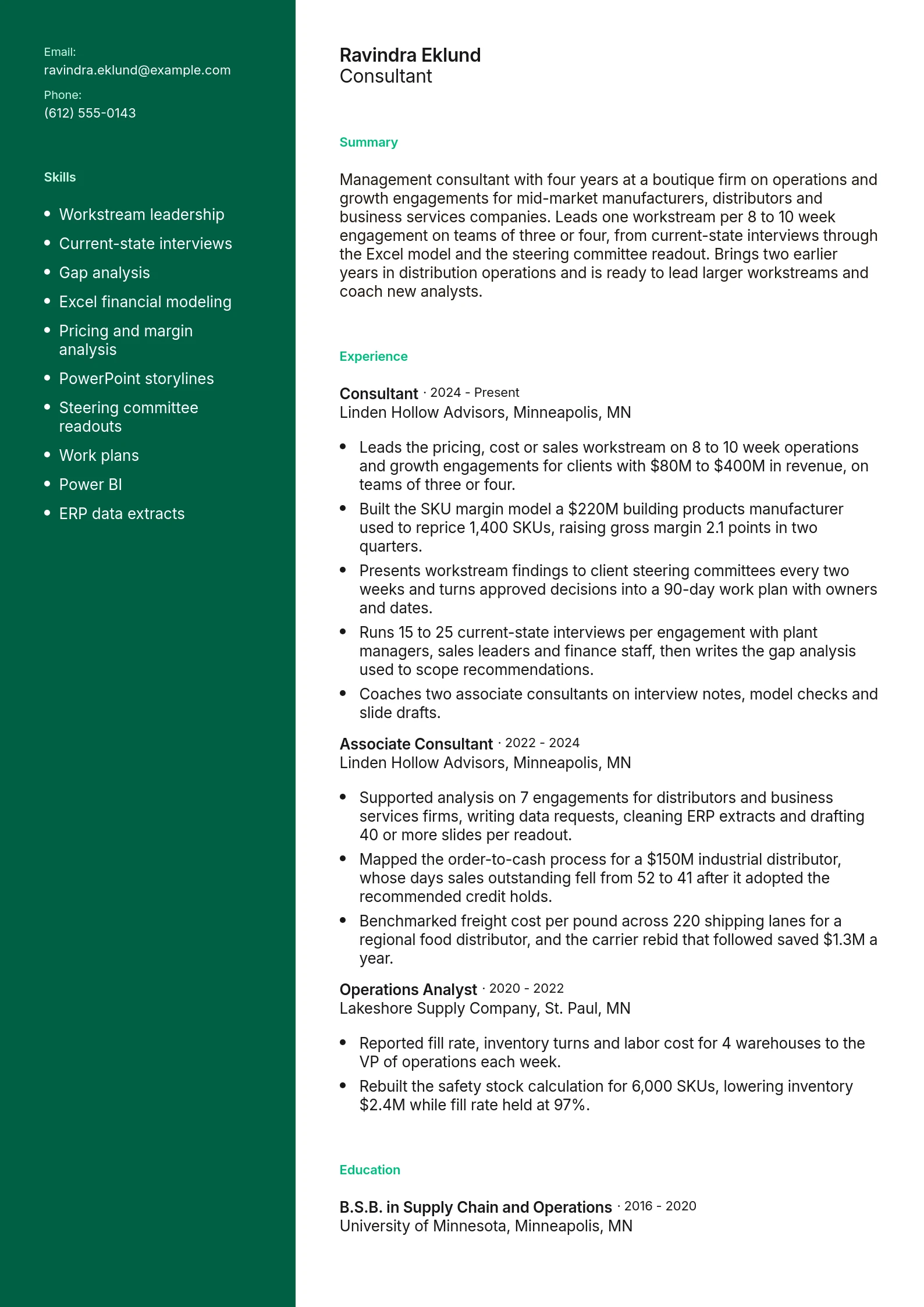
Anselm Dobrowolski is a sole proprietor with no staff, so his scope is clients: 31 served since 2018, 22 kept for three years or more and 14 active now. His bullets name the systems he works in, including QuickBooks Online, Xero, Gusto and Looker Studio, and the 10th-business-day close he meets each month. Use it if you freelance or consult alone and want an in-house finance operations or account manager job.
Client count and retention in place of headcount
Month-end close deadline
Payroll filings named by form
Former studio owner changing careers after a closure
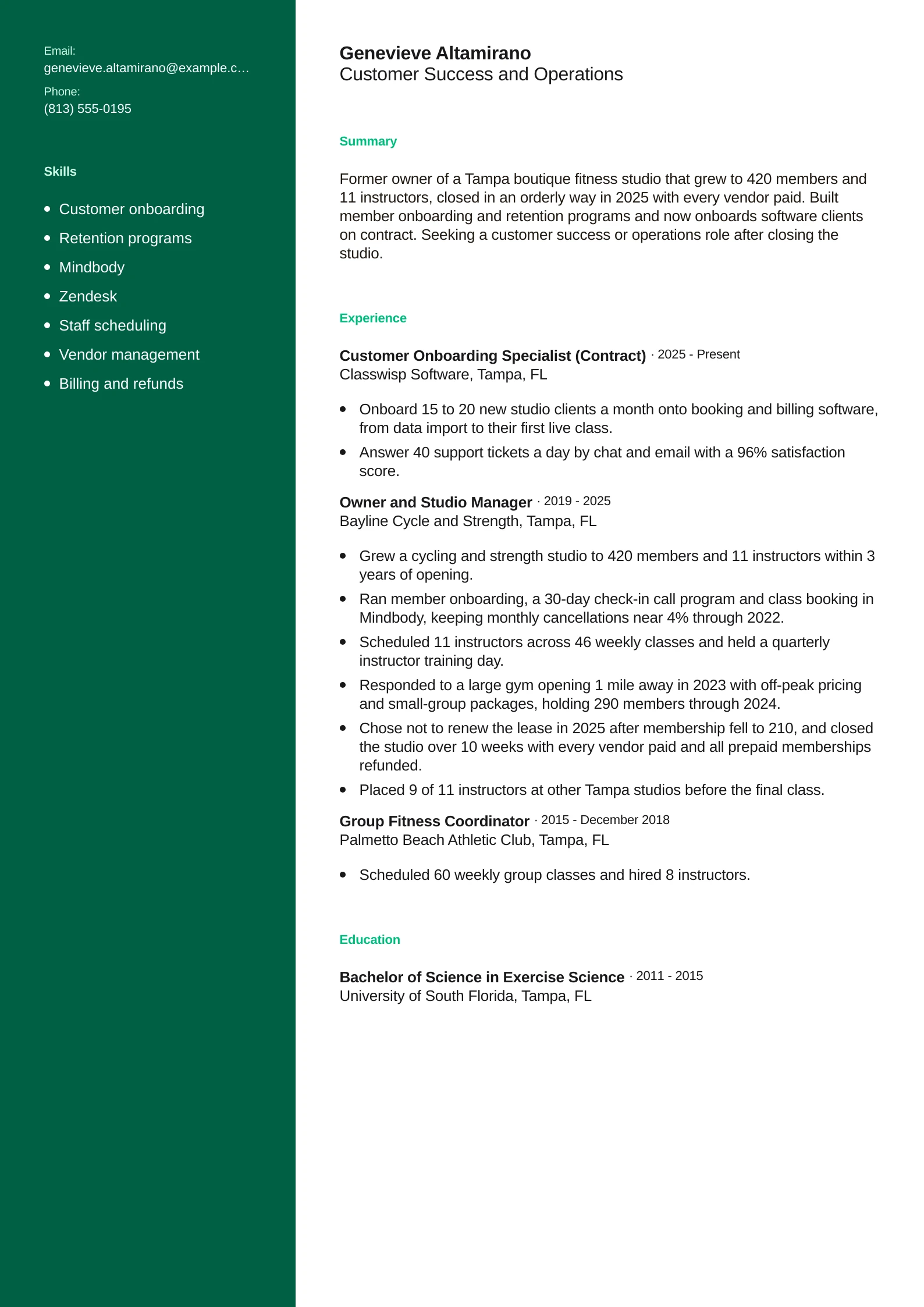
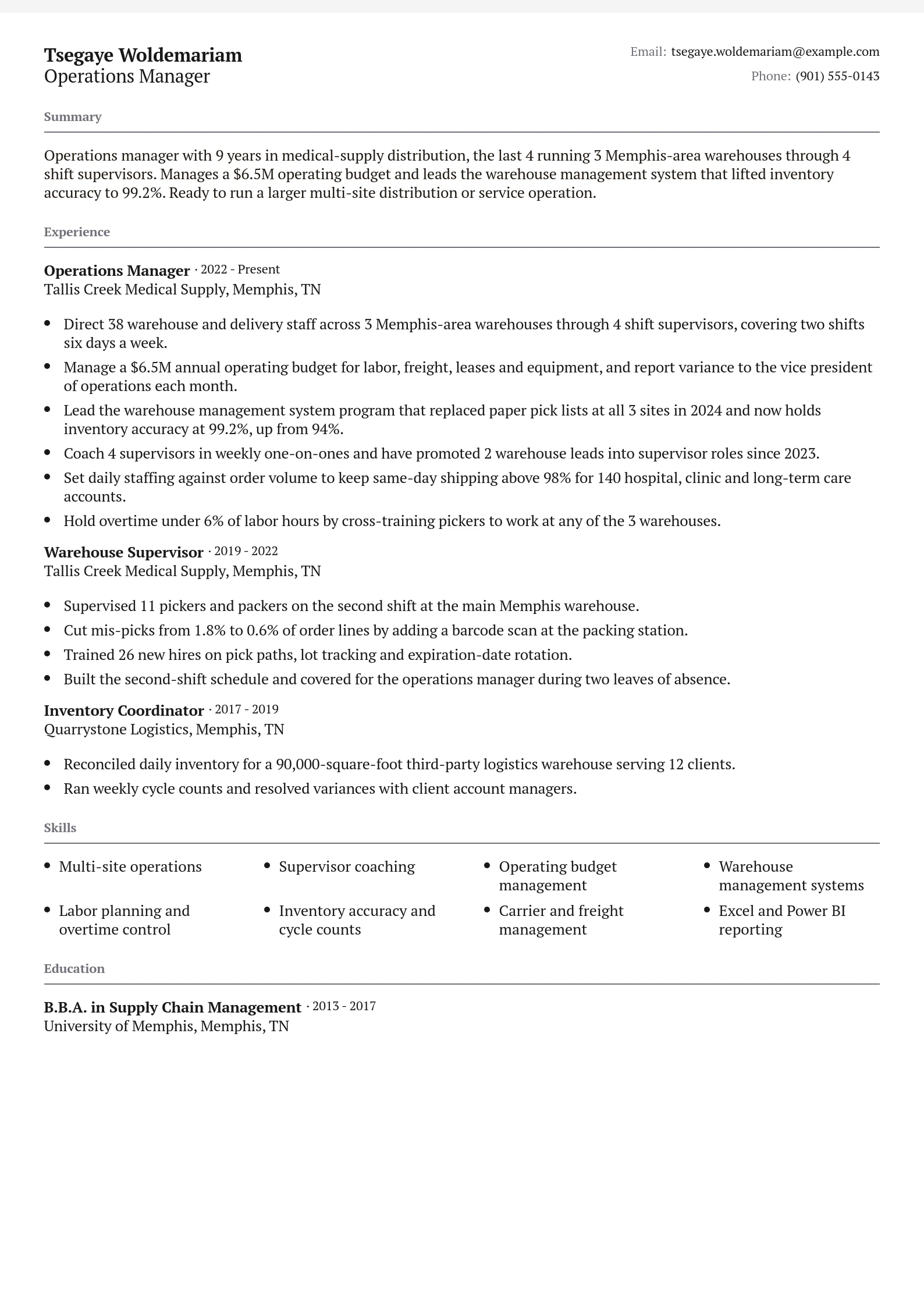
Genevieve Altamirano closed her fitness studio two years after a large gym opened nearby. One bullet states the closure with the numbers: membership down to 210, a 10-week wind-down, vendors paid and prepaid memberships refunded. Her onboarding and retention bullets point to customer success work, and a contract role shows what she has done since. Use it if your business closed and you're moving into a new field.
Closure stated in one plain bullet
Onboarding and retention program results
Current contract role after the closure
Turn the owner role into the job you're applying for
Write the business as a job you held, with a title the employer recognizes, the size of the business in the first bullet and a summary that names the role you want next. Hiring managers reading an owner's resume ask two things: how big was it, and will this person take direction?
Pair Owner with the function you performed every week: Owner and General Manager, Owner and Project Manager, Founder and Chief Executive Officer. Choose the second half to match the target ad, so a remodeling owner who estimated and ran jobs applies for project manager roles as Owner and Project Manager.
Show who you answered to. Owners still report to someone: a franchisor's audit team, a bank that reviews statements each year, an outside CPA, a board, or anchor clients who walk the site every quarter. One bullet naming that check answers the worry that you can't work inside someone else's structure.
State the reason for the move in one clause of the summary, such as "to run a larger operation", "to join a finance team" or "after selling the company in 2025". Keep personal finances, such as personal guarantees on a lease or loan, for the interview if they come up.
Working title, size and an outside check
Owner and General Manager, 2015 to present. Run a $1.4M P&L covering 16 staff, 40 client sites and 3 medical office contracts. Renew a $150K bank line of credit each year on CPA-reviewed financial statements.
Owner title with a task list
Owner, commercial cleaning company, 2015 to present. Responsible for all aspects of the business, including sales, payroll, hiring, scheduling and customer service.
Put revenue, people and locations in the first two lines
Open the owner role with revenue, headcount, locations or client count, then use later bullets for the operating numbers your target job is judged on. When a general manager ad states the P&L and team size it expects, as one home-services posting did with a $15M to $30M P&L and 60 or more people, readers compare your numbers to theirs.
Round to two figures, such as $2.8M rather than $2,812,400, and put a year on any number that changed, such as "$210K in the 2026 season". If revenue is small or private, use units a reader can still judge: projects a year, orders a day, members or active clients.
Owners with no employees count clients, retention and scope of work. "22 of 31 clients kept 3 years or more" tells a reader more than "built long-term client relationships".
Business type
Size numbers for the first bullet
Operating numbers for later bullets
Service business
Annual revenue, staff, client sites or contracts
Years each anchor contract has renewed, bid win rate, staff tenure
Restaurant or cafe
Locations, staff, annual sales
Food cost and labor as a percent of sales, health inspection results
Contractor
Revenue, crew, subcontractors, projects a year
Bid win rate, gross margin by job, share finished by the contract date
E-commerce
Sales by channel, SKUs, orders a day
Ad budget and return on ad spend, repeat purchase rate, mis-ship rate
Franchise
Units, staff, combined sales
Brand audit rank, prime cost, managers promoted
Solo consultant
Active clients, total clients, clients kept 3 years or more
Deadlines met, systems used, filings or reports delivered
Founder who sold
Peak headcount, revenue, recurring share
EBITDA margin, sale year and buyer type, results after the sale
Say how the business ended in one bullet
Put the ending in the last bullet of the owner role, with the year, the cause in a few words and how you treated staff, customers and creditors. A reader who sees a closed business with no explanation fills the gap with the worst case.
Give one cause the reader can picture, such as a lease, a buyer or a competitor opening nearby, and blame no one. Then add what you handled well: vendors paid, deposits or prepaid memberships refunded, staff placed with other employers.
If you sold, the sale is a result. Name the buyer type and year, and list any time you stayed for the transition as its own job when your title or your boss changed.
Situation
End date on the owner role
Bullet to write
Summary line
Sold
Month and year the sale closed
Sold the company to a private-equity-backed IT group in 2025 after a sale process with 4 bidders.
Founder who built and sold a $14M IT services firm.
Closed
Last month you traded
Closed the studio over 10 weeks with every vendor paid and all prepaid memberships refunded.
Former studio owner moving into customer success after closing in 2025.
Winding down or for sale
Present, until the last day
Selling the business to its operations lead, with handover set for March 2027.
Owner moving into an employed operations role in 2027.
Use your accountant, lender and best clients as references
Your references are the people who saw your results from outside the business: your accountant, bank lender, largest customers, key suppliers, landlord, a franchisor's field consultant and former employees. Pick three whose view matches the job you want, and list them on a separate page rather than on the resume.
Choose by target role. A general manager job calls for a major client and a former manager of yours who now works elsewhere. A franchise consultant role calls for the franchisor's field consultant or a new owner you trained. A finance role calls for the CPA who received your year-end packages.
Put the same proof into bullets so the resume carries it before anyone calls. "Renew a $150K line of credit each year on CPA-reviewed statements" tells a reader that a bank and an accountant check the books. "Hold 3 medical office contracts for 6 to 9 years" tells them clients kept coming back.
Ask each person before you list them. Tell them the job title you're applying for and the two results you'd like them to confirm, such as the food cost drop or the on-time finish rate.