A board hires a chief executive by reading three things in each role: who you answered to, how much you ran and what changed under you.
The examples cover a private-equity-backed manufacturer, a human-services nonprofit and a COO promoted to CEO at a founder-led freight brokerage, and each one leads with the proof its own board reads first.
PE-backed manufacturing CEO with two add-ons and a prior exit
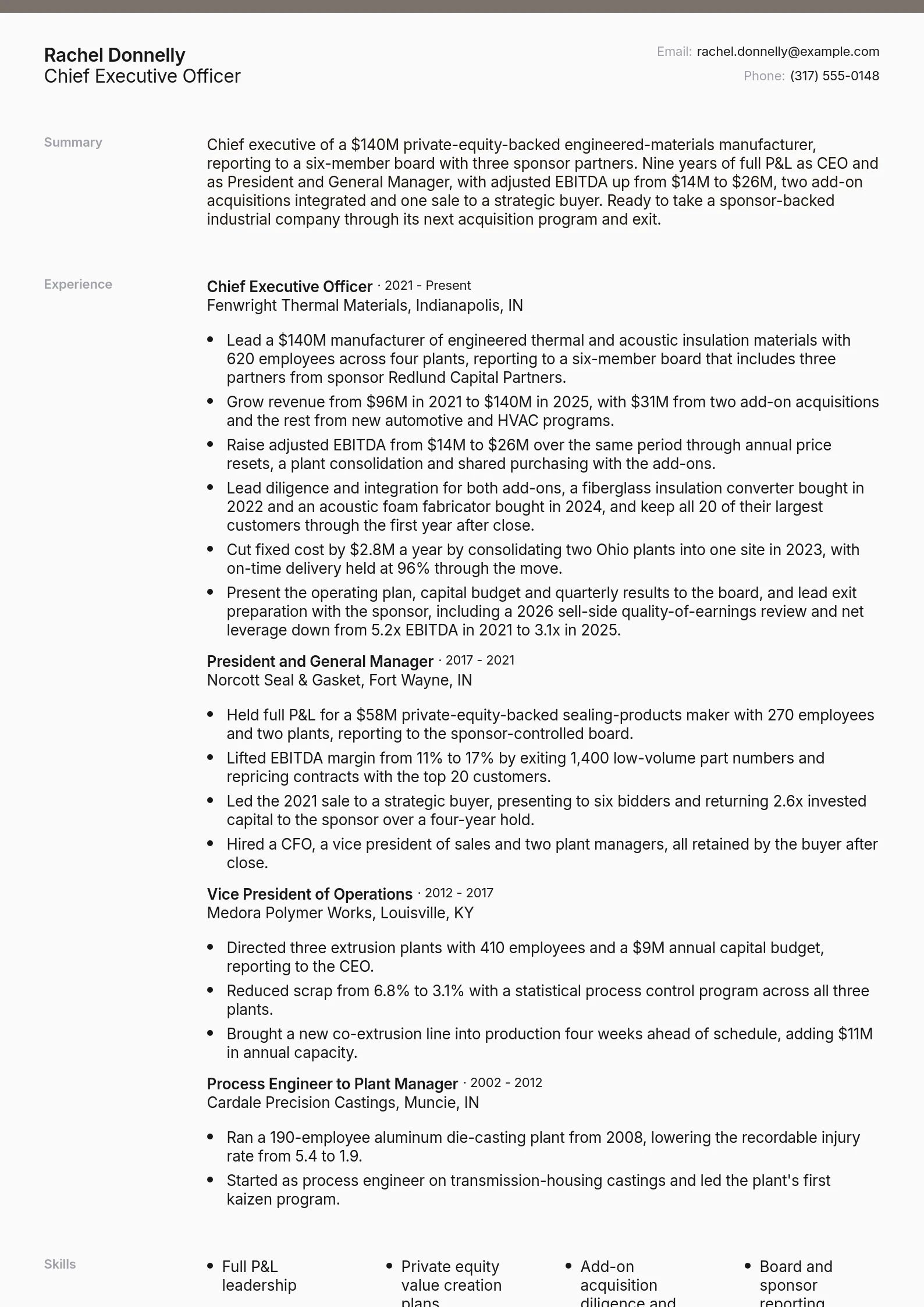
Rachel Donnelly runs a $140M engineered-materials manufacturer for a private equity sponsor, and her resume reads the way a sponsor-led board reads a candidate. Each role opens with the reporting line and the size of the business, then gives one measured change: adjusted EBITDA from $14M to $26M at Fenwright, a sale to a strategic buyer at Norcott.
Copy this structure if you run a company with a board and an outside investor. Keep the acquisition and exit bullets specific: how many deals, what revenue they added, how long integration took and what the sponsor got back. A board hiring its next CEO checks those numbers against each other, so revenue, EBITDA and leverage have to agree from bullet to bullet.
Nonprofit and first-time CEO resumes for a different board
The nonprofit example leads with giving, budget and audits because a volunteer board and its donors read for those. The first-time example shows how COO and general manager years carry a CEO case when the founder still chairs the board.
Nonprofit CEO reporting to a 12-member board
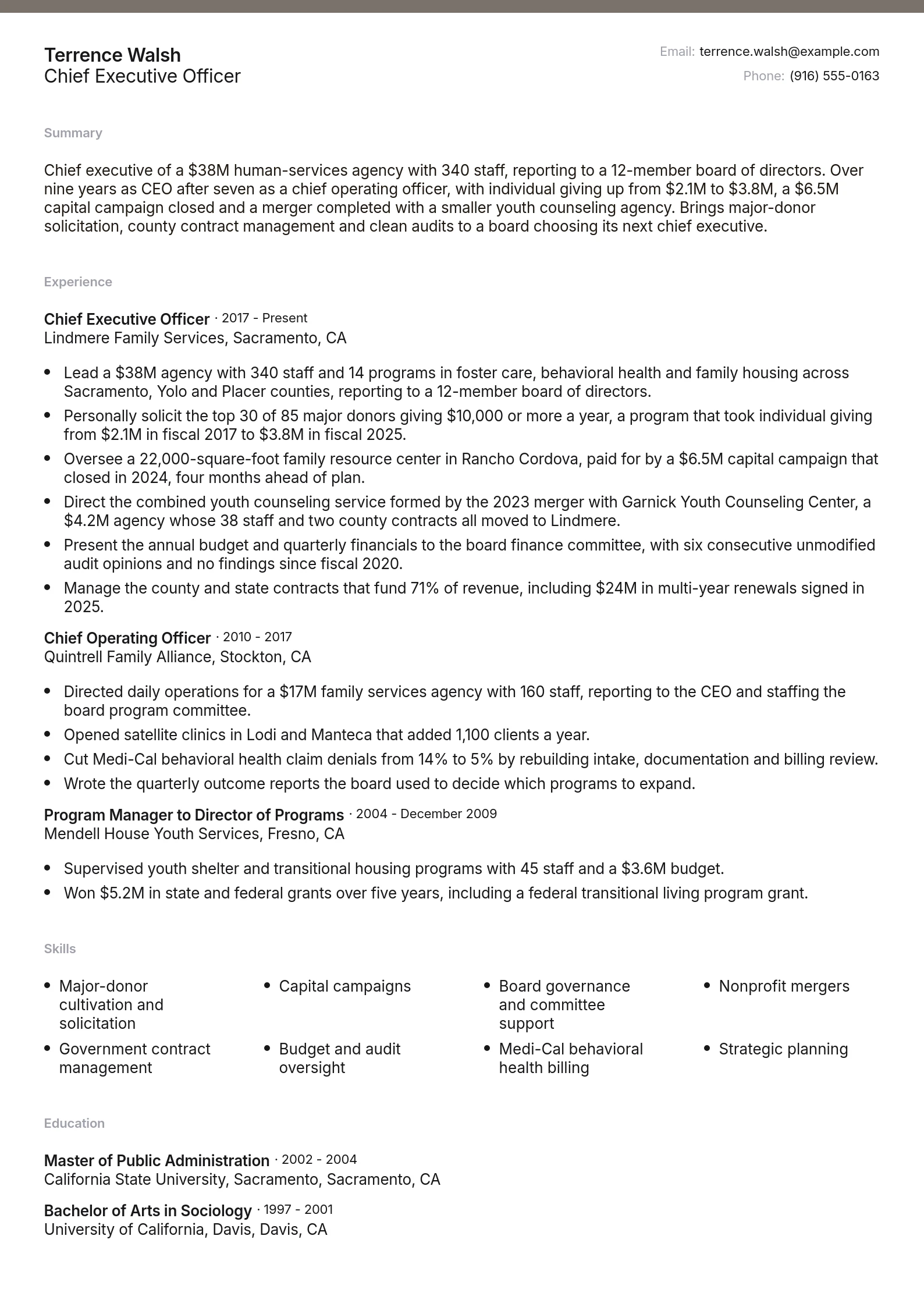
Terrence Walsh leads a $38M human-services agency, and his resume puts fundraising and stewardship where a PE resume puts EBITDA. Individual giving rising from $2.1M to $3.8M sits beside his personal solicitation of the top 30 donors, and the $6.5M capital campaign is tied to the building it paid for. It suits a nonprofit executive director or COO whose board will ask about donors, county contracts and audits first.
Individual giving from $2.1M to $3.8M, with the donor tier named
Six unmodified audit opinions presented to the finance committee
A 2023 merger with every staff member and county contract transferred
COO promoted to CEO at a founder-led company
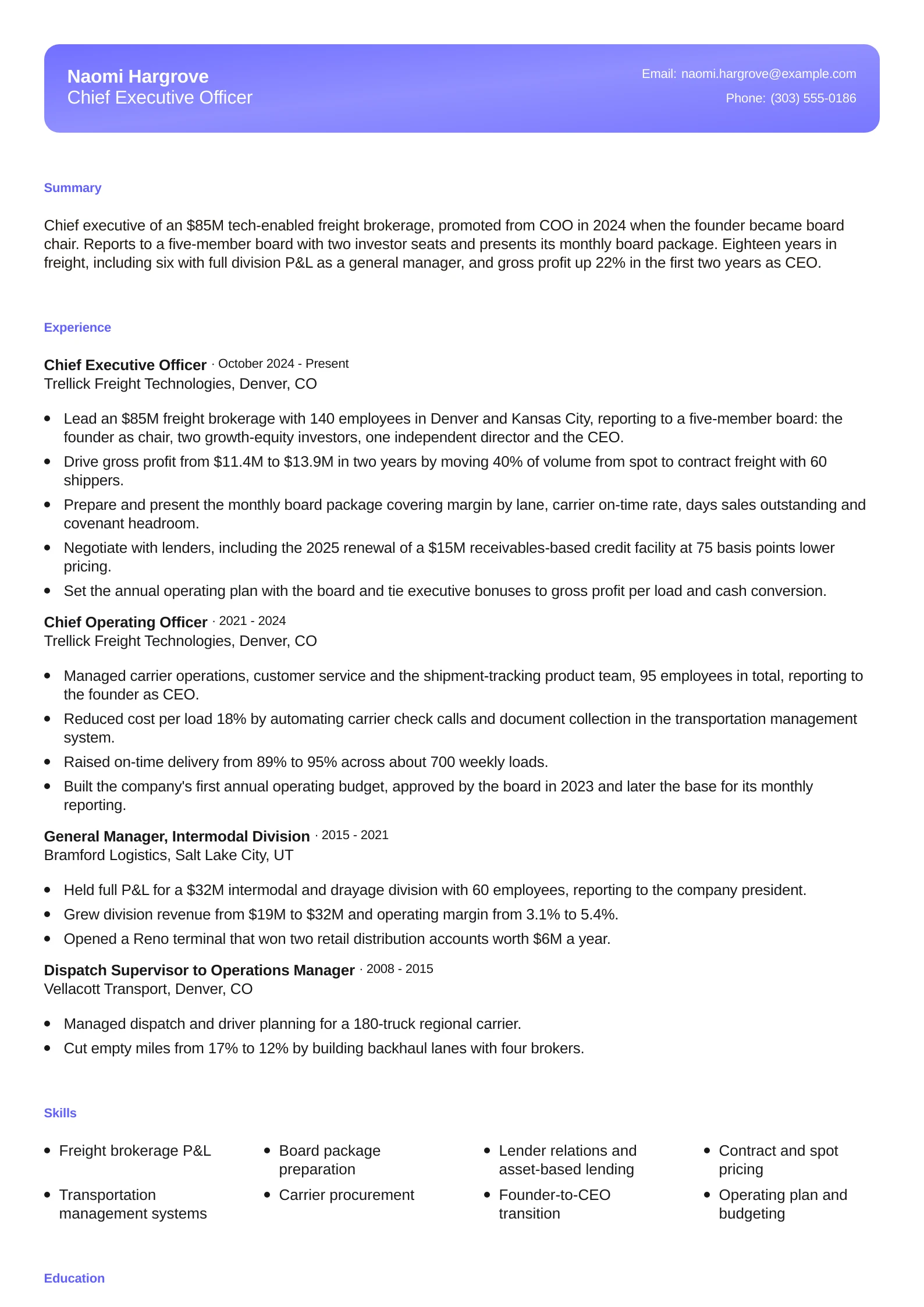
Naomi Hargrove became CEO when the founder of Trellick moved to board chair, and her resume names that board seat by seat. Her COO and general manager roles carry P&L numbers, cost per load and on-time rates, so the CEO case rests on results she had already delivered. It suits a COO, GM or division president making a first CEO move at a company with growth-equity investors and a lender to manage.
Board composition listed in the first bullet
Promotion from COO dated, with the founder's new board role
$15M credit facility renewal with the pricing change
Put the reporting line and the size of the company in the first bullet
Open every CEO, president or general manager role with one bullet that names who you reported to and the size of what you ran. A board reading your resume is deciding whether to hand you a whole organization, and it can't judge that until it knows the size of the last one.
Name the reporting line exactly: "a six-member board that includes three sponsor partners", "a 12-member board of directors", "the founder as chair, two growth-equity investors and one independent director". Then give the scale a board would check: revenue or operating budget, employees, and plants, sites or programs. Use revenue for a company and the operating budget for a nonprofit, and use the figure from your audited statements or board materials so a reference check matches.
Put the measured change in the next bullet, not in the scope line. EBITDA, gross profit, funds raised, an acquisition closed or an exit completed each make one clear claim. If you ran a division rather than a company, give division revenue and margin and name the executive you reported to, as the general manager role in the first-time example does.
Board, scale and a result a sponsor can check
Lead a $140M engineered-materials manufacturer with 620 employees across four plants, reporting to a six-member board that includes three sponsor partners. Raise adjusted EBITDA from $14M to $26M through annual price resets, a plant consolidation and shared purchasing with two add-ons.
Functions listed with no board or size
Responsible for overall company leadership, including operations, sales, finance and HR. Drove growth and profitability while building a strong culture.
Lead with EBITDA for a sponsor and with giving for a nonprofit board
The setting decides which result comes first. A PE sponsor reads for EBITDA, add-on acquisitions and readiness for exit. A nonprofit board reads for major gifts, a budget it can audit and the size of the staff. A founder-led or investor-backed company sits between them and reads for gross profit, cash and the lender relationship.
For a PE role, give EBITDA as a start and end figure with years ("$14M in 2021 to $26M in 2025") and say whether it is adjusted. Add net leverage if you brought it down, because a sponsor preparing an exit watches it closely. For a nonprofit, separate individual giving from government contracts. A human-services board knows contracts fund most of the budget and wants to see what you raised yourself.
If you led a sale, name the buyer type and the return to investors only when the deal is public or you have permission to share it. Use the table to pick the lead number for each role, then put the supporting proof in the next two or three bullets.
Setting
PE-backed company
Nonprofit
Founder-led or investor-backed company
Who reads it first
Sponsor partners on the board and the search firm
Board chair and search committee, often with major donors
Founder chair and investor directors
Lead number
Adjusted EBITDA, start and end, with years
Individual or contributed giving, start and end
Gross profit growth, with margin
Supporting proof
Add-ons closed, revenue they added, integration time, net leverage
Capital campaign total, audit results, contract renewals
Credit facility terms, cash conversion, operating plan delivered
Milestone to name
Sale to a strategic or sponsor buyer and the return on invested capital
A merger completed or a new site funded and opened
A founder transition, new financing or the first full-year budget
Terms that place the setting
Sponsor, add-on, quality of earnings, hold period
Board of directors, major donors, unmodified audit opinion, county contracts
Board package, growth-equity investors, borrowing base
Show board, sponsor and donor work through what they approved
Describe board and investor work by what the board approved, funded or decided with you, never by the number of meetings you attended. "Attended 11 board meetings a year" tells a search committee nothing it can use. "Present the operating plan, capital budget and quarterly results to the board" shows you set the agenda.
For a sponsor, name the materials and the decisions: the annual operating plan, the capital budget, a sell-side quality-of-earnings review, the add-on pipeline. For a lender, name the facility, its size and what changed at renewal, as the first-time example does with a $15M receivables-based facility repriced 75 basis points lower.
For donors, give the tier, the count and your part in it. "Personally solicit the top 30 of 85 major donors giving $10,000 or more a year" tells a nonprofit board you can make the ask yourself. One human-services CEO posting listed personal solicitation of major donors as a requirement. Tie a capital campaign to its total, the year it closed and what it paid for.
Name the committees you present to when they matter to the next board: the finance committee for budget and audit, a program committee for outcomes, a compensation committee if you set executive pay. One bullet is enough. A full section of governance duties reads like a job description.
Turn COO and general manager years into a first CEO case
A COO or general manager makes a first CEO case by showing full P&L ownership and a board or investor audience before the CEO title. Some searches say outright that this route qualifies. One 2025 nonprofit CEO posting asked for CEO, GM or COO-type roles with direct P&L, and one PE-backed manufacturing search accepted five years as CEO, president or GM at a business of $50M or more.
Give each GM or division role its own P&L line: revenue, margin and who you reported to. "Held full P&L for a $32M intermodal and drayage division with 60 employees, reporting to the company president" says more than "general manager with P&L experience". Add the margin change, because a board reads it as proof you can manage a whole company's numbers.
Write the board exposure you had as COO into that role. If you built the first annual budget, presented to investors or worked on a credit facility, say so with the year. Naomi Hargrove's COO entry includes the first operating budget the board approved, which explains why it handed her the monthly board package the following year.
If you were promoted when a founder stepped back, say so once in the summary and then describe the board as it stands now: "promoted from COO in 2024 when the founder became board chair", followed by the seats. That answers the first question a reader has, whether you run the company or the founder still does.
If you are still a COO applying for CEO roles, keep your real title and put the CEO aim in the last line of your summary. If the COO role itself is your next step, our chief operating officer resume examples cover it in more depth.