Boards and CEOs hire a chief operating officer to run the plan, so the top of your resume should say what you run, how big it is and who you answer to. Each example below comes from a different sector (insurance software, heavy civil construction and a two-hospital health system) and leads with the results that sector's board reviews.
A software COO who turns the CEO's plan into delivery
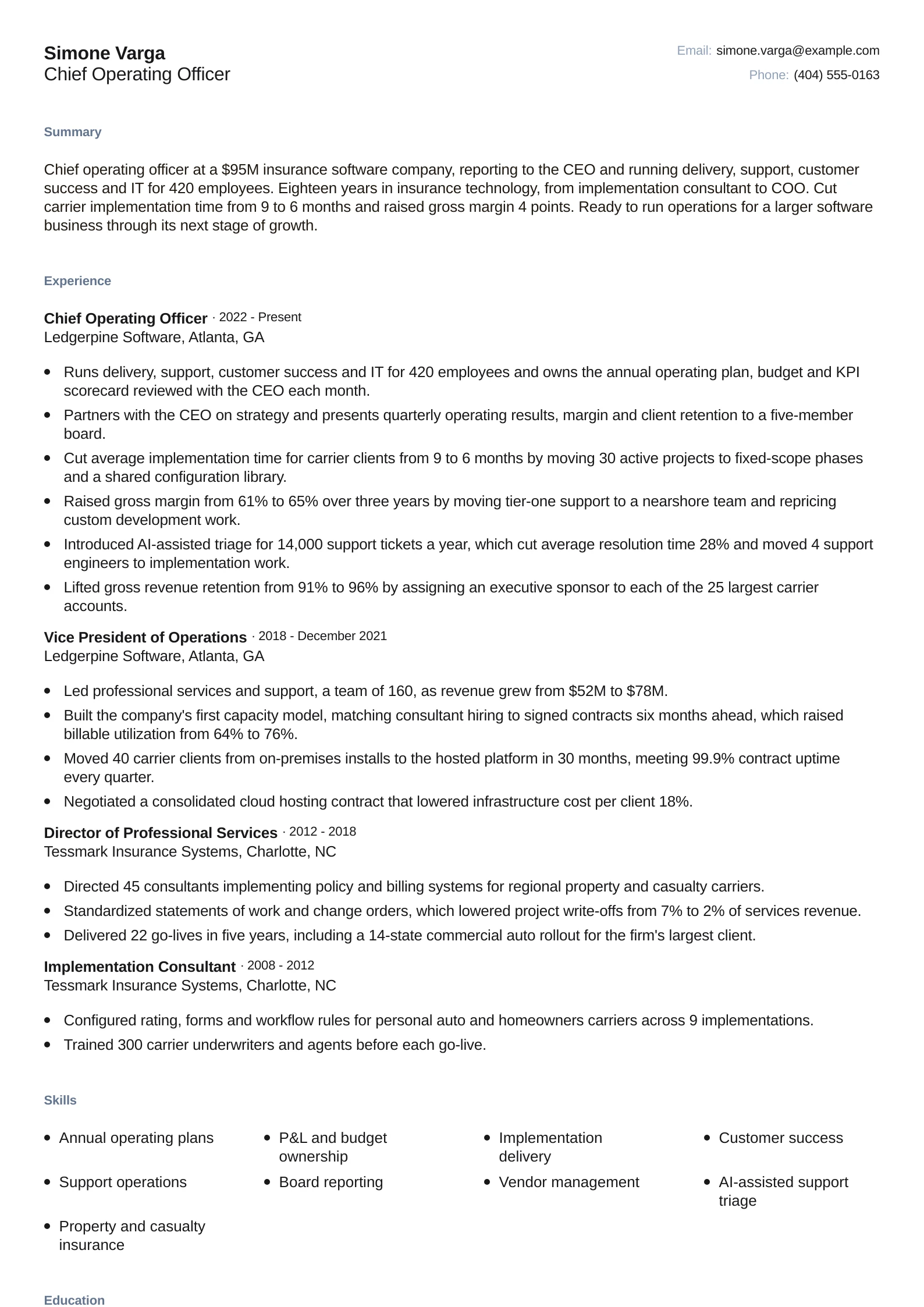
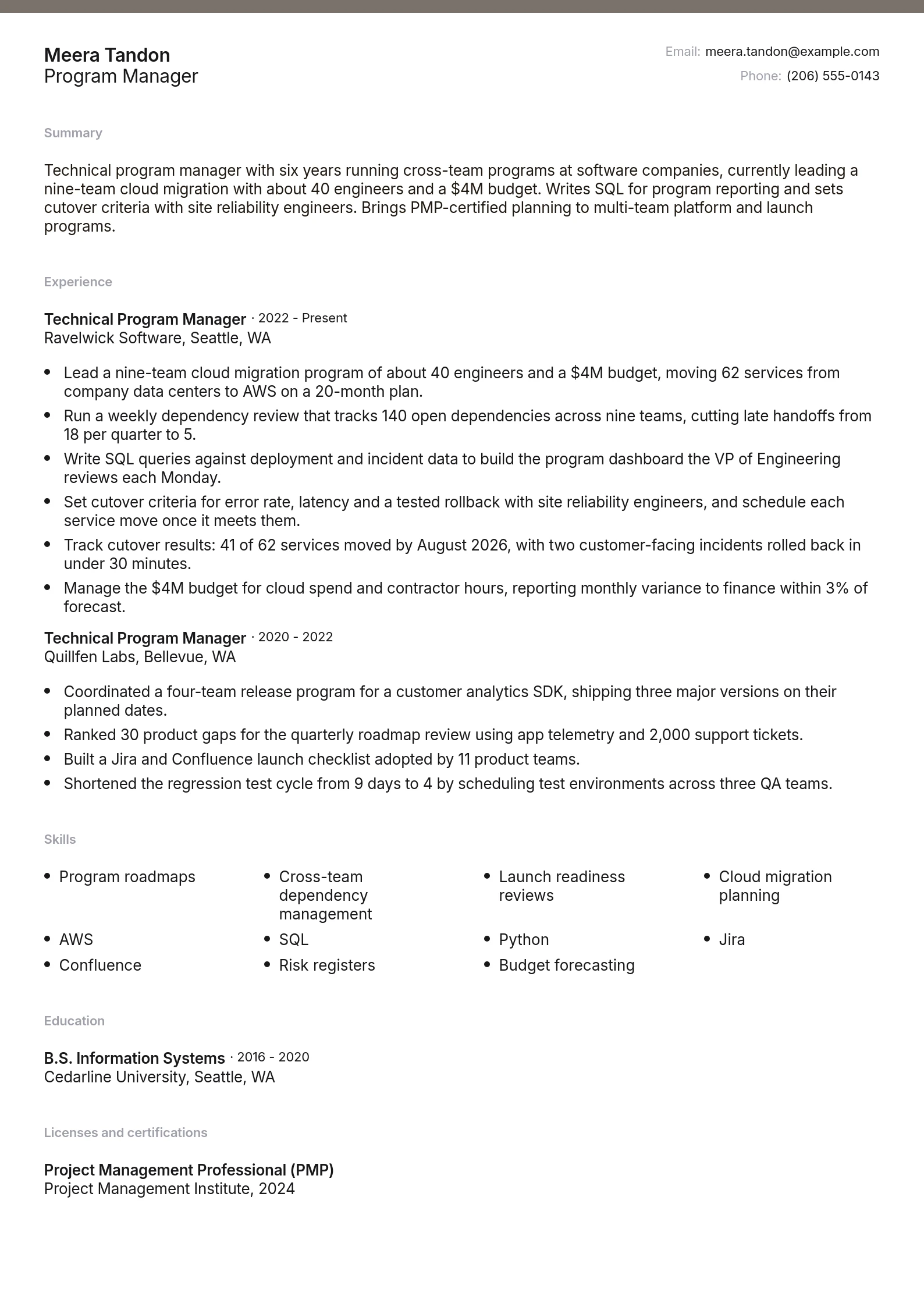
Simone Varga reports to the CEO of a $95M insurance software company and runs delivery, support, customer success and IT. Her first bullet names those four functions, the 420 employees and the monthly KPI review, so a recruiter knows her span before reading a single result.
Her results are ones finance can confirm: carrier implementations cut from 9 to 6 months, gross margin raised from 61% to 65%, and support resolution time down 28% after AI-assisted triage. Copy this structure if you run several functions under a CEO at a company of a few hundred people.
COO resumes for field crews and hospital systems
A construction COO and a hospital COO answer to different people and are judged on different numbers. Pick the example closest to your sector, then copy how it states span, reporting line and results.
Construction COO resume with bid margins and safety
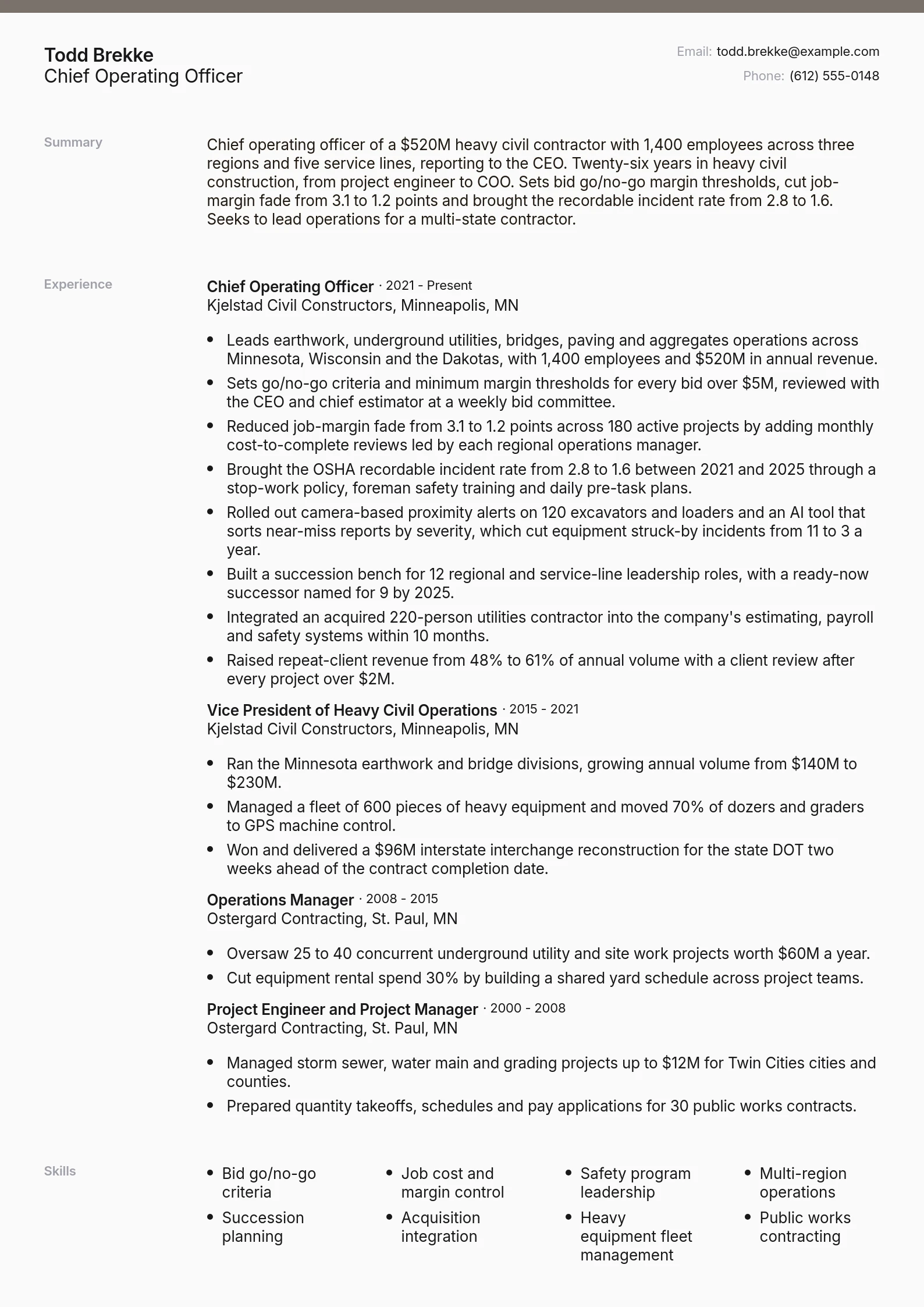
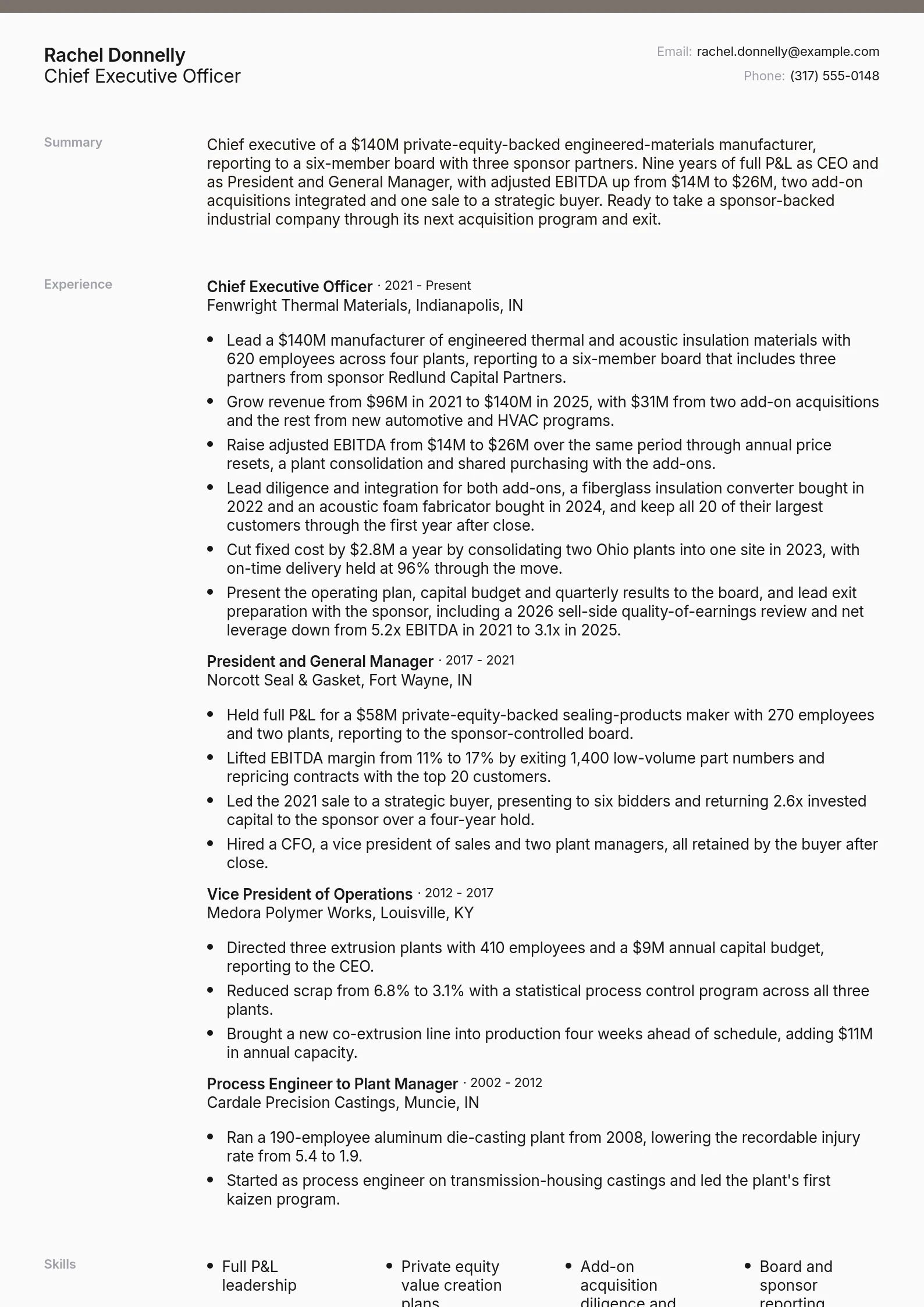
Todd Brekke runs operations for a $520M heavy civil contractor across three regions and five service lines. His bullets lead with the bid go/no-go thresholds he sets with the CEO, job-margin fade cut from 3.1 to 1.2 points, and a recordable incident rate brought from 2.8 to 1.6. A succession bench and an acquisition integration show enterprise change. Use it if you came up through project engineering and operations management.
Go/no-go margin thresholds set at a weekly bid committee
Recordable incident rate cut from 2.8 to 1.6
Ready-now successors named for 9 of 12 leadership roles
Hospital COO resume reporting to a system president
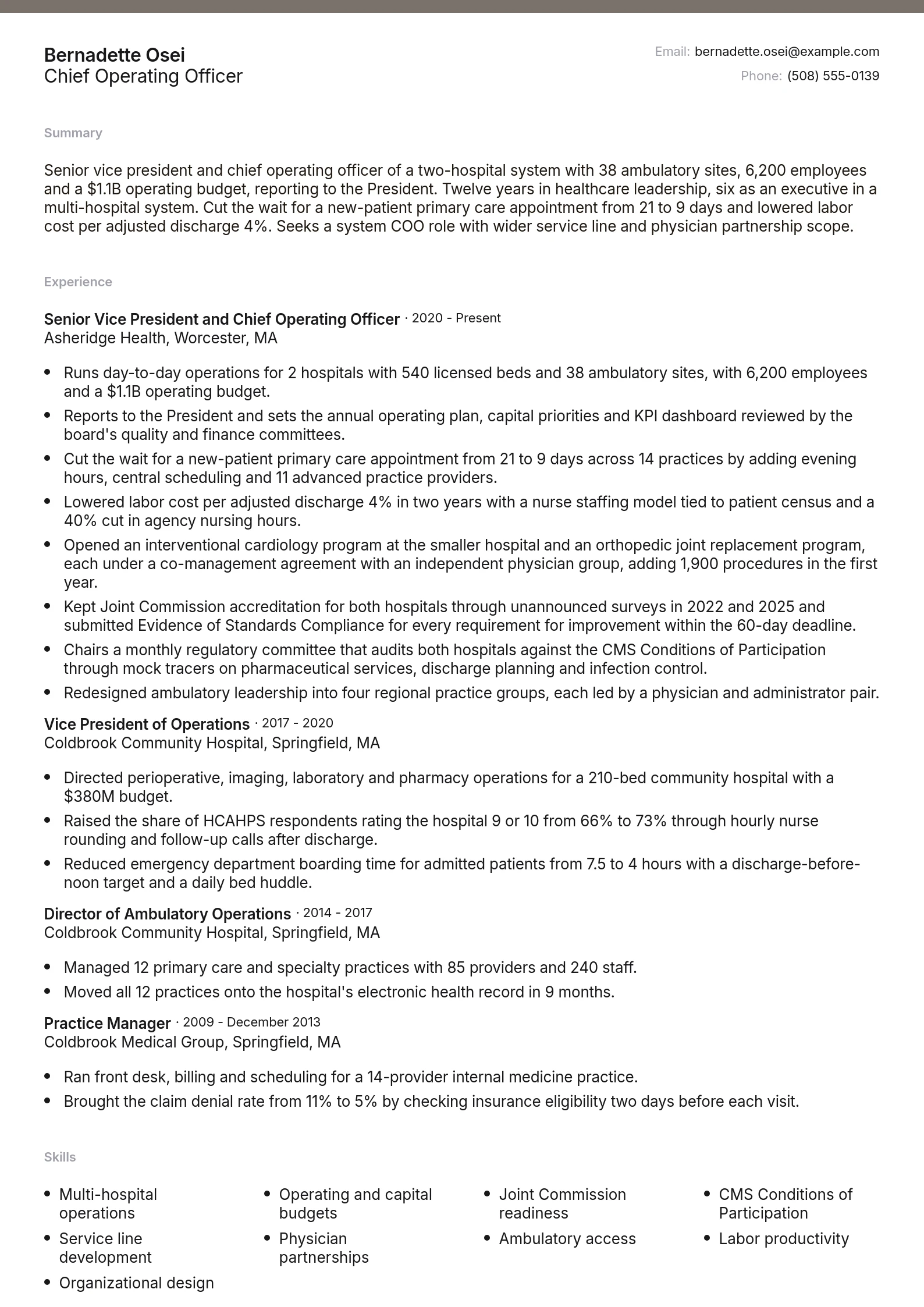
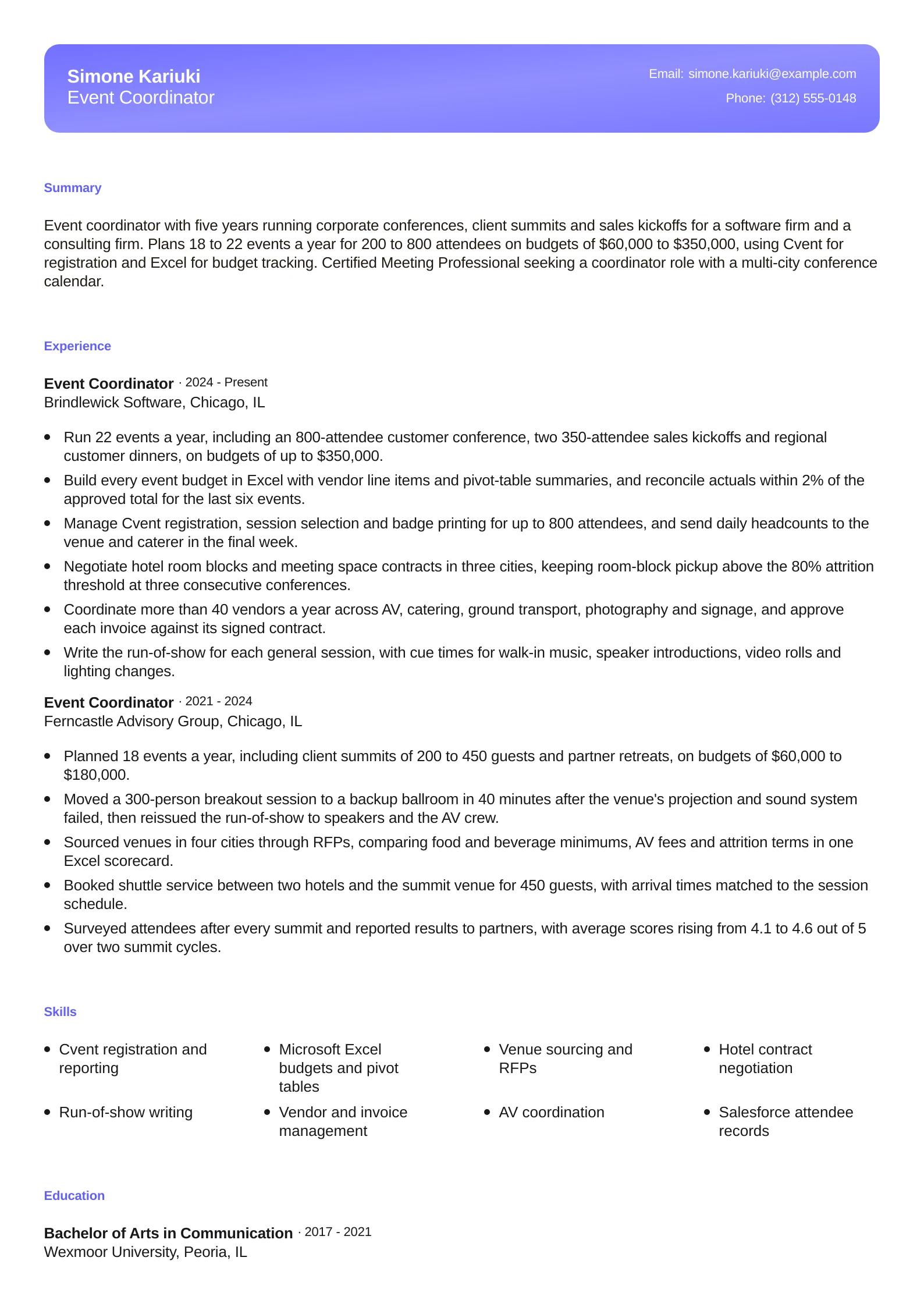
Bernadette Osei is SVP and COO of a two-hospital system with 38 ambulatory sites and a $1.1B operating budget. She reports to the President, so her bullets cover access, labor cost, physician-partner service lines and accreditation readiness. Joint Commission surveys and the CMS Conditions of Participation appear as work she leads. Use it if you are a hospital administrator moving from one hospital to a system role.
New-patient primary care wait cut from 21 to 9 days
Two service lines opened with physician groups
Joint Commission accreditation kept through 2022 and 2025 surveys
Name what you run before what you achieved
Your first bullet under the COO title should state the functions you run, the headcount, the number of sites and the revenue or budget. Those four facts tell a board how big a job you can take on next, and "oversaw operations" can't tell a 40-person firm from a 6,000-person health system.
List functions by name. A software COO writes delivery, support, customer success and IT. A contractor writes estimating, field operations, equipment and safety. A hospital COO writes perioperative services, imaging, pharmacy and ambulatory practices.
Count sites the way your sector counts them: regions and service lines for a contractor, hospitals, licensed beds and ambulatory sites for a health system, active client projects for a software firm. Use revenue if you run a company's operations and the operating budget if you run a hospital or nonprofit, because health systems usually describe their size by operating budget.
If you were COO of a company under 50 people, give the headcount anyway and list every function you ran. A small-company COO who covered finance, HR and operations together should name all three, because that breadth is the case for the next role.
States span, reporting line and plan ownership
Runs delivery, support, customer success and IT for 420 employees and owns the annual operating plan, budget and KPI scorecard reviewed with the CEO each month.
Could describe any operations job
Oversaw all aspects of company operations and drove operational excellence across the organization.
Split the work between you and the CEO in plain verbs
Show the partnership by naming what the CEO handed you to run and what you bring back to the CEO and board. The CEO sets direction and manages investors and the board. The COO turns that direction into a plan, a budget and weekly operating numbers, and your bullets should read that way.
Write one bullet about the plan you own and its cadence, such as "owns the annual operating plan, budget and KPI scorecard reviewed with the CEO each month." Write a second about what you present upward: "presents quarterly operating results, margin and client retention to a five-member board." Keep both in the current COO role so the reader sees the cadence before any results.
A construction COO can name the forum the two of you share instead, as in "reviewed with the CEO and chief estimator at a weekly bid committee." That one phrase shows who sets the margin floor and who sits at the table when a large bid goes out.
In a hospital the COO often reports to a president and works beside the chief medical officer and chief nursing officer. Name the board committees you report to, such as quality and finance, and the physician groups you partner with. That tells a system recruiter you can run clinical operations without a clinical title.
Skip "right hand to the CEO" and "trusted advisor." Both describe a relationship without saying what you ran. If you stood in for the CEO during a leave or a search, say for how many months and which decisions you made, because that is direct evidence you can run the company.
Lead with the numbers your sector's board reviews
Lead with results finance would sign off on, such as margin, cost, cycle time, retention and safety, each measured against a starting figure. Department tasks belong under earlier roles. The table shows what to put first in the three sectors on this page.
Give every result a start figure, an end figure and the time it took, as in "job-margin fade from 3.1 to 1.2 points" or "implementation time from 9 to 6 months." If a figure is confidential, use a percentage or a ratio instead of dropping the result.
Use each sector's own terms. Hospital readers expect patient experience reported by survey name, such as HCAHPS, and accreditation as an outcome you led. Construction readers expect the OSHA recordable incident rate by name, with the years it covers.
If you are moving into a new sector, lead with the result that carries across, such as margin, cost per unit or on-time delivery, and translate your old sector's term once. A plant COO applying to a contractor might write "cut cost per ton 9%" and let the contractor's reader map it to job cost.
Sector
Results to lead with
Span to state
Example line
Insurance and vertical software
Implementation time, gross margin, gross revenue retention, support resolution time
Functions, employees, revenue, active client projects
Cut average implementation time for carrier clients from 9 to 6 months
Cut the wait for a new-patient primary care appointment from 21 to 9 days
Give integration, succession and AI their own bullets
Current COO postings ask for change as well as steady running: integrations, new structures, succession plans and automation with a measured effect. Give each one a bullet with a count and a result, so a reader can see you have moved an organization from one state to another.
For an integration, name what you merged and how long it took: "integrated an acquired 220-person utilities contractor into estimating, payroll and safety systems within 10 months." For a new structure, say what it looks like now, such as four regional practice groups, each led by a physician and an administrator.
Write succession as a count of roles and how many now have a named successor: "ready-now successor named for 9 of 12 regional roles." A contractor's board reads that as proof the company won't stall when a regional leader retires, and a health system reads it the same way for service line directors.
Report AI or automation by the work it changed and the measured effect, such as 28% faster ticket resolution or equipment struck-by incidents cut from 11 to 3 a year. Name the process, not the vendor, and never list AI as a skill unless a bullet shows what it changed.