A hiring manager reads a Scrum Master resume for how many teams you serve, how big they are and what release train or program surrounds them, then looks for delivery results with a baseline. The seven examples differ by starting point: a mid-level Scrum Master with two teams, a QA analyst seeking a first role, a senior Scrum Master in a release train, a developer who runs the team's events, and federal, clearing-firm and project-manager backgrounds.
A mid-level Scrum Master resume that leads with team scope
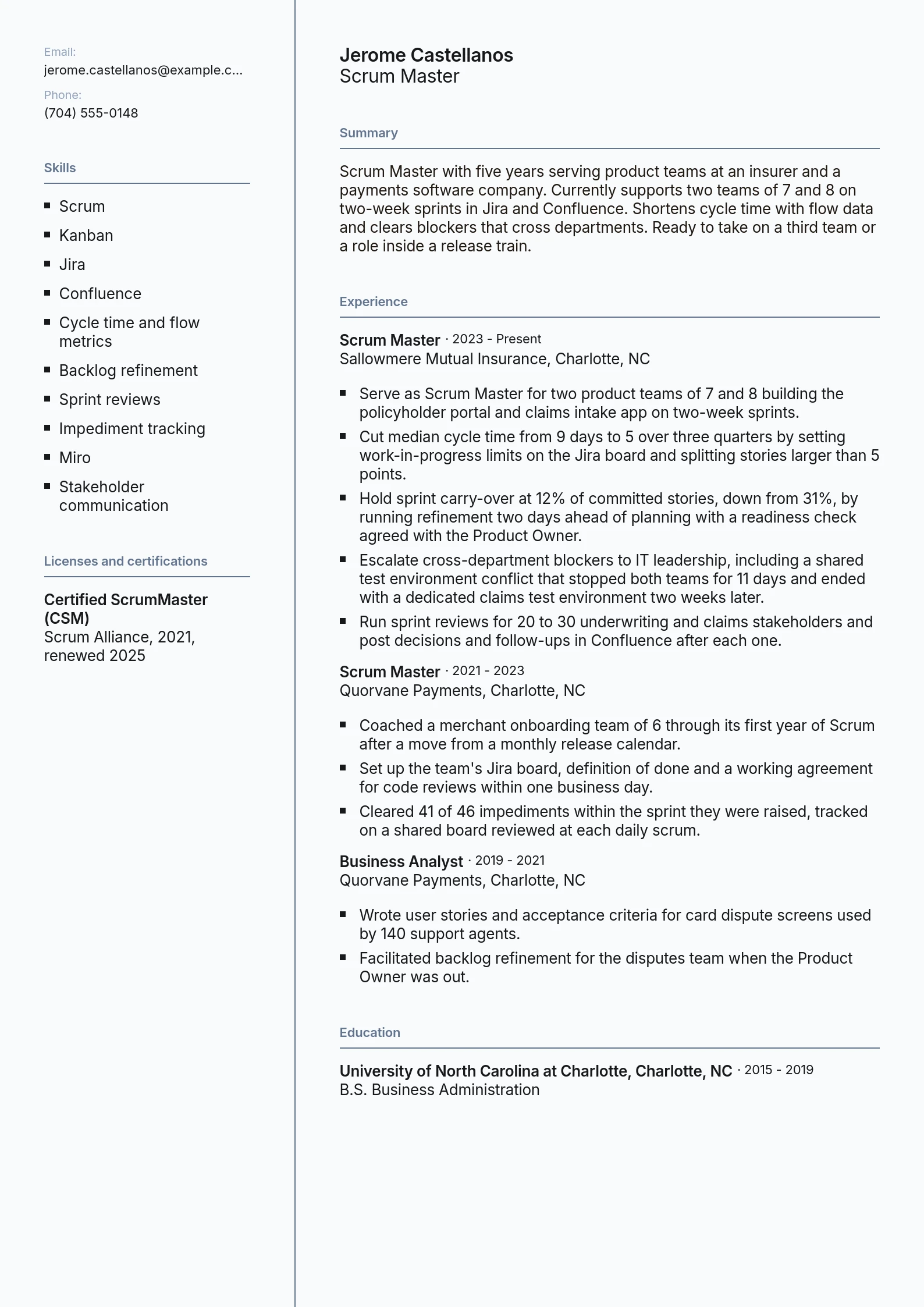
Jerome's resume answers the two questions a hiring manager asks first: how many teams, and how did delivery change. His opening bullet names two teams of 7 and 8, what they build and the sprint length. The next two give baselines, with median cycle time down from 9 days to 5 and sprint carry-over from 31% to 12%, each tied to the change that caused it.
Copy this structure if you have three to six years as a Scrum Master in a commercial setting. Keep the escalation bullet's format, which names the blocker, how long it lasted, who it went to and what replaced it. His CSM line shows the year earned and the latest renewal, so a reader can see it's current.
Find the resume that matches your teams and setting
Each example below changes what leads the resume: an acting Scrum Master stint, a release train, a clearance, a time split between code and facilitation, control evidence or a move from waterfall to Scrum.
Entry-level Scrum Master moving from QA
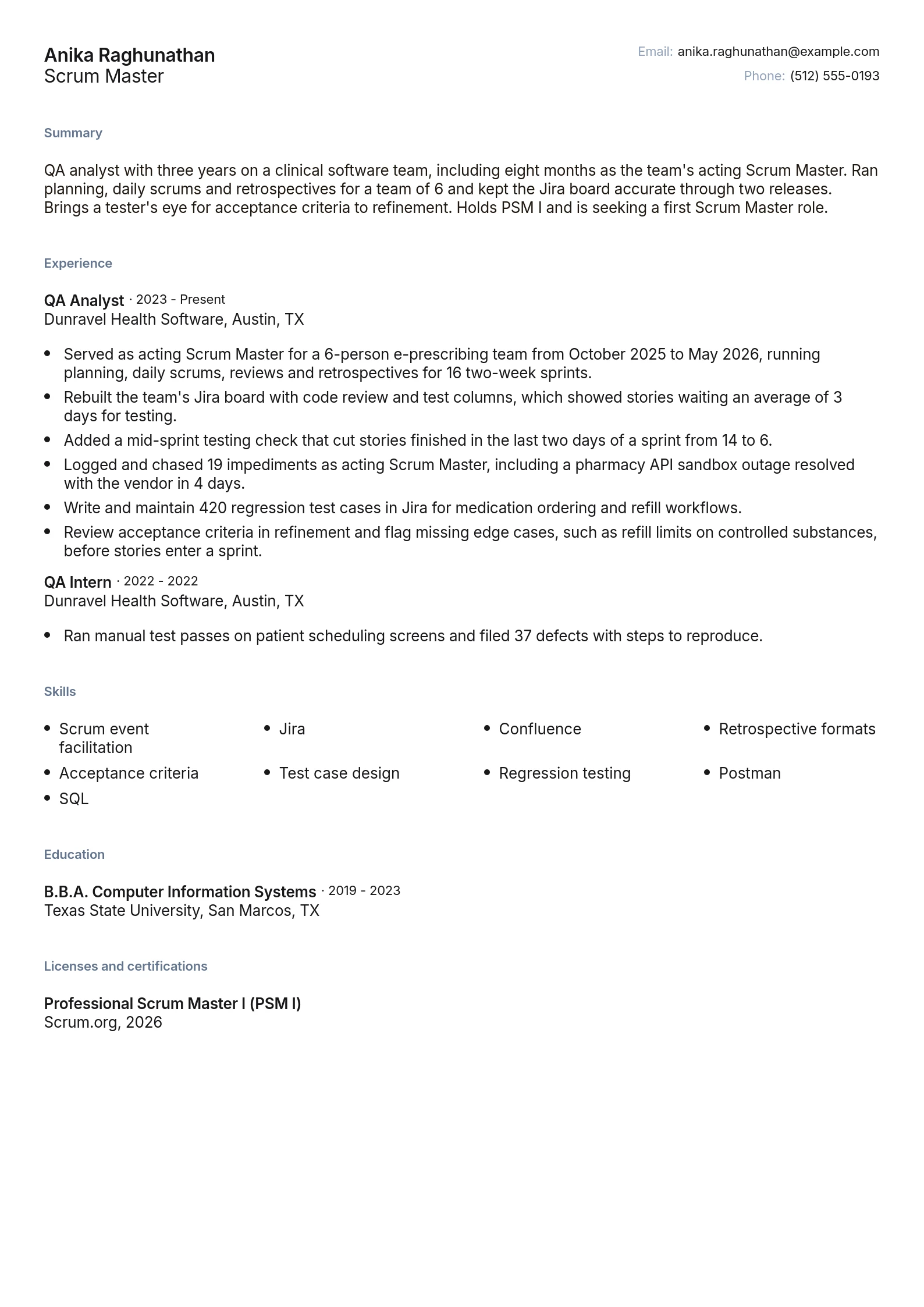
Anika keeps her real title, QA Analyst, and opens with the 8 months she spent as acting Scrum Master for a 6-person e-prescribing team over 16 sprints. Her bullets show a rebuilt Jira board that exposed a 3-day wait for testing and the mid-sprint check that followed. PSM I, earned in 2026, sits in credentials. Suits developers, testers and analysts applying for a first Scrum Master role.
Acting Scrum Master period with exact dates
Jira board change tied to a measured wait
PSM I, which never needs renewal
Senior Scrum Master in a SAFe release train
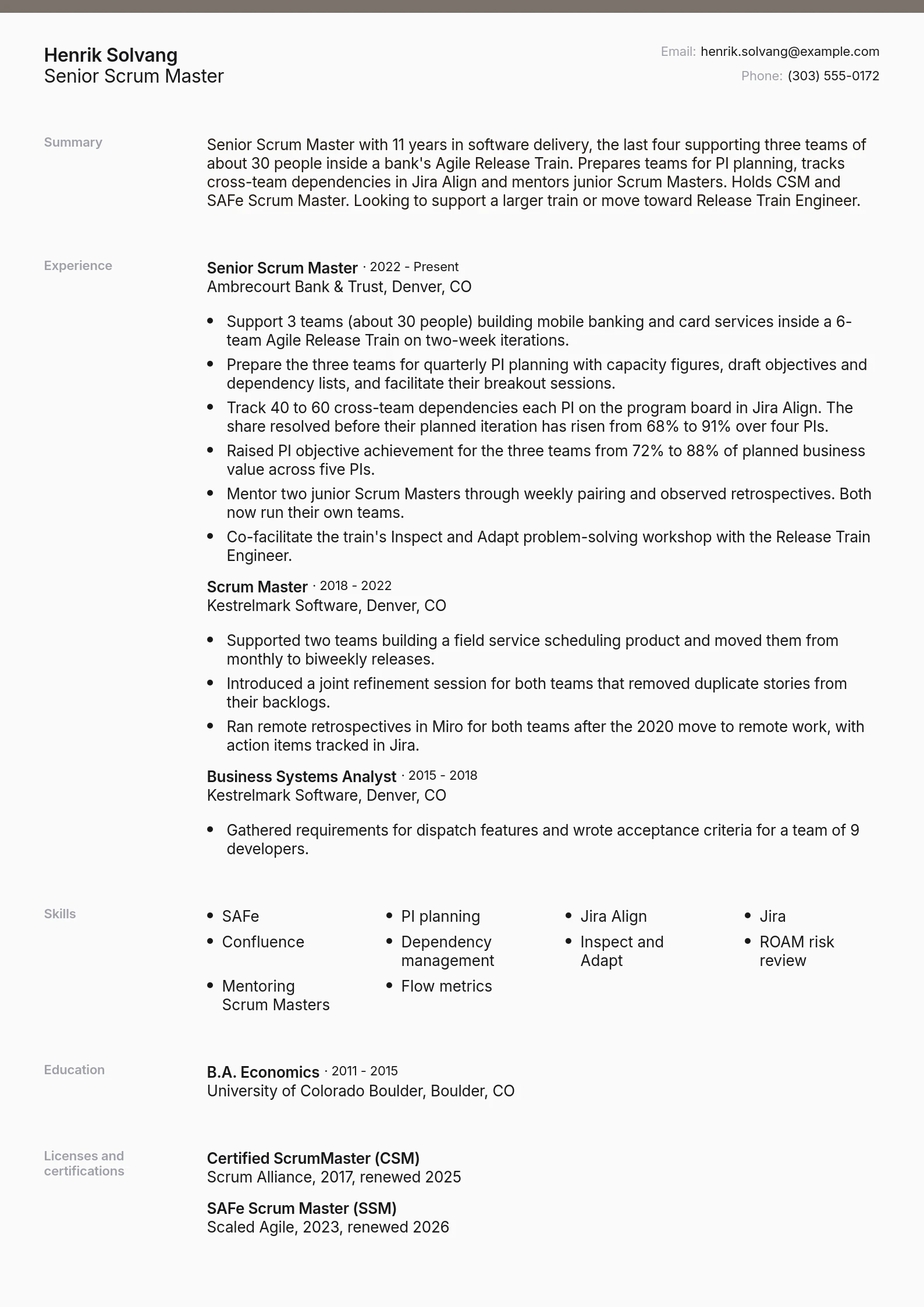
Henrik's first bullet places him: three teams, about 30 people, inside a 6-team Agile Release Train at a bank. His results are program-level, with PI objective achievement up from 72% to 88% and on-time dependency resolution up from 68% to 91%. Mentoring two junior Scrum Masters gets its own bullet. Fits Scrum Masters with eight or more years who support several teams and want senior or Release Train Engineer roles.
PI objectives met in place of velocity
Dependency tracking in Jira Align
CSM and SAFe Scrum Master, both renewed
Federal contractor Scrum Master with a Secret clearance
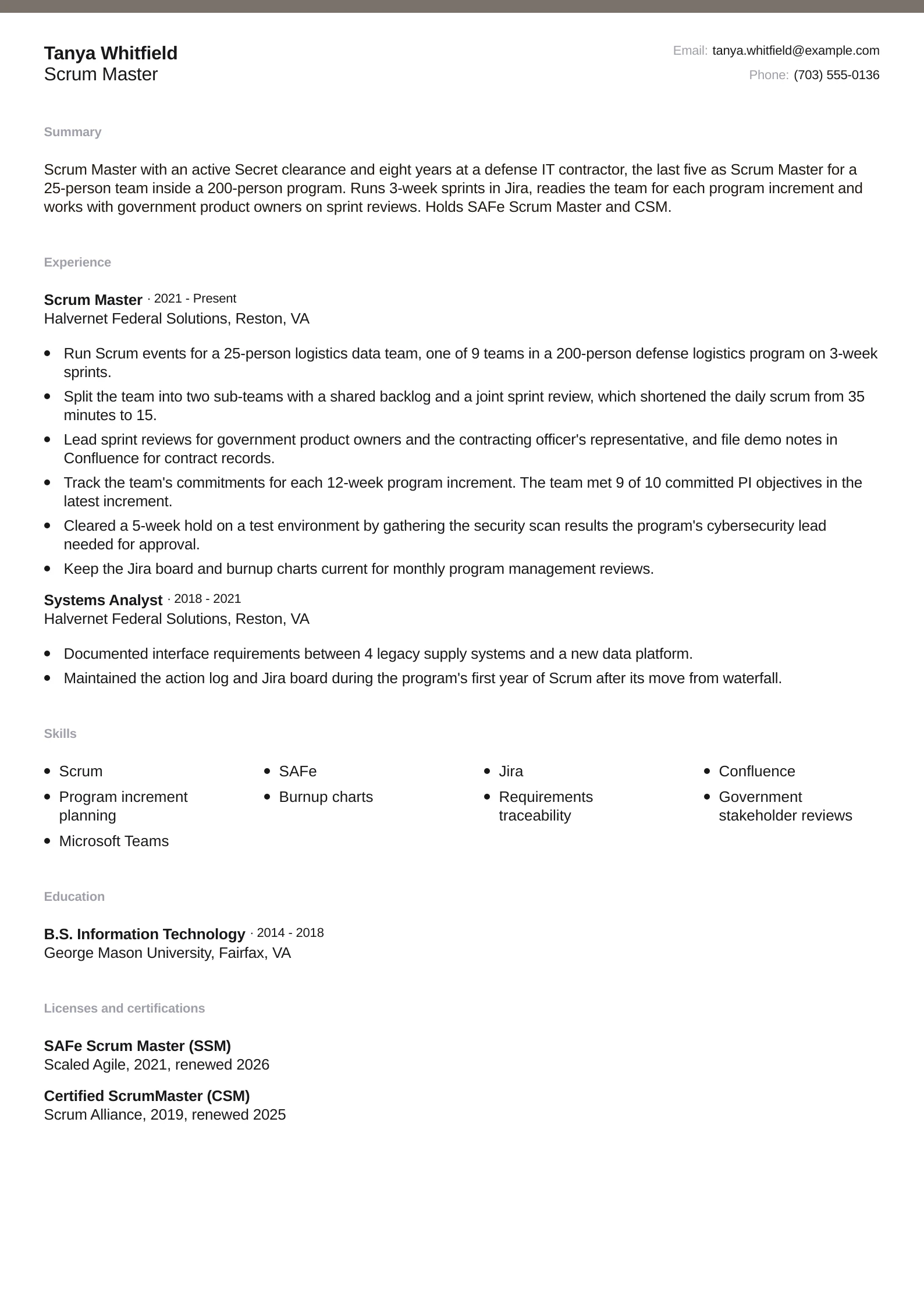
Tanya's summary opens with an active Secret clearance and the program's shape: a 25-person team inside a 200-person defense logistics program on 3-week sprints. Her bullets cover sprint reviews with government product owners, 9 of 10 PI objectives met and a 5-week environment hold cleared with security scan evidence. Use it if you already hold a clearance through a federal contractor and want the program details to lead.
Clearance level in the first line
Large team split into two sub-teams
3-week sprints and 12-week increments
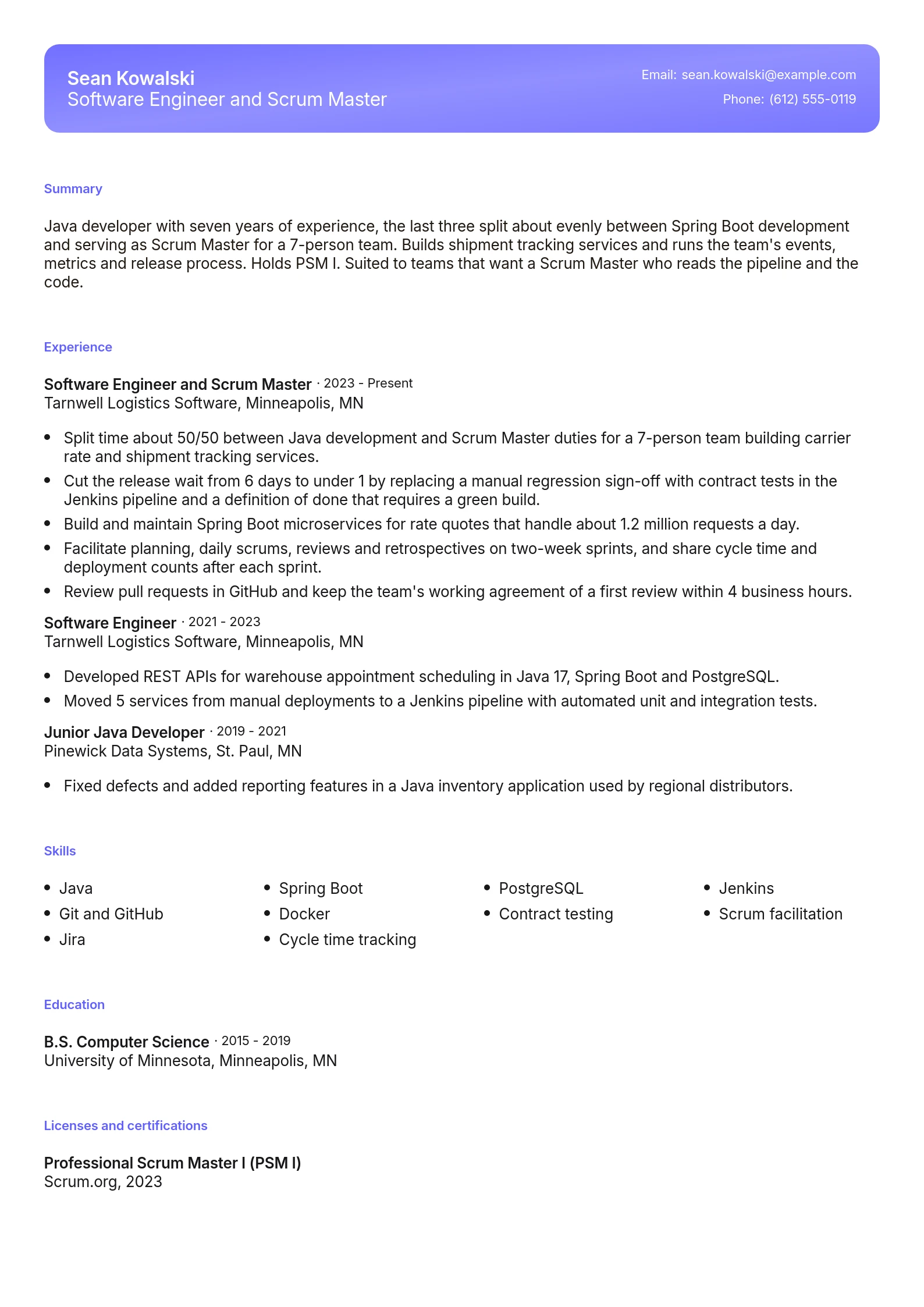
Developer who is also the team's Scrum Master
Sean's title names both jobs, and his first bullet gives the split: about half Java development, half Scrum Master for a 7-person team. The release bullet traces a 6-day manual sign-off wait to its cause and shows the pipeline change that cut it to under a day. Engineering skills such as Spring Boot and Jenkins lead the skills list. Suits hybrid ads that ask for code and facilitation in one hire.
Time split stated in the first bullet
Release bottleneck with a before and after
Engineering tools ahead of Scrum terms
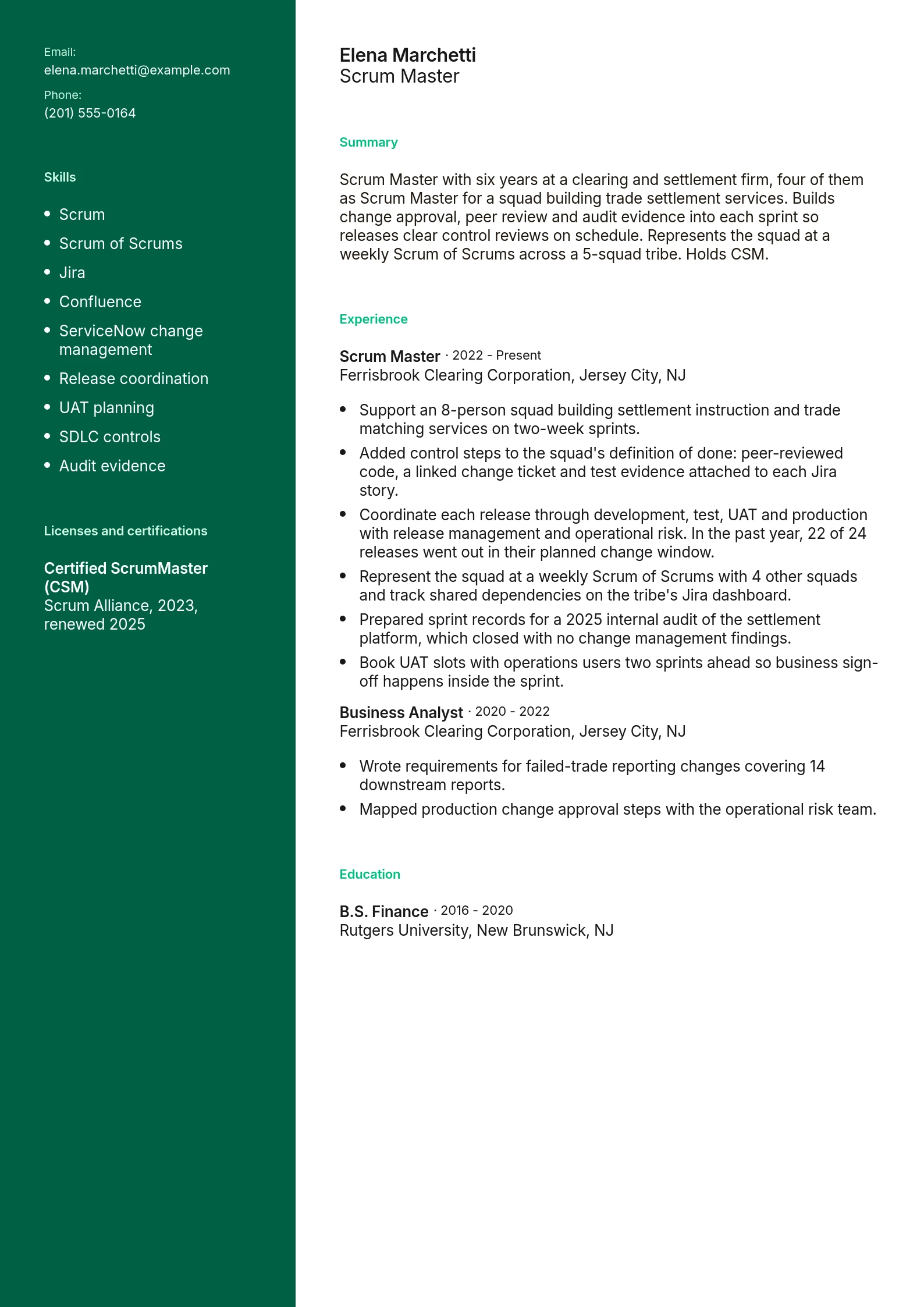
Financial services Scrum Master with controls in each sprint
Elena works at a clearing firm, so her bullets put controls inside the sprint: a definition of done that requires a linked change ticket and test evidence, releases through four environments, and 22 of 24 releases in their planned change window. She also prepared sprint records for an internal audit that closed with no change management findings. Fits banks, brokers, insurers and other regulated delivery teams.
Control evidence in the definition of done
Release window record in place of velocity
Weekly Scrum of Scrums across five squads
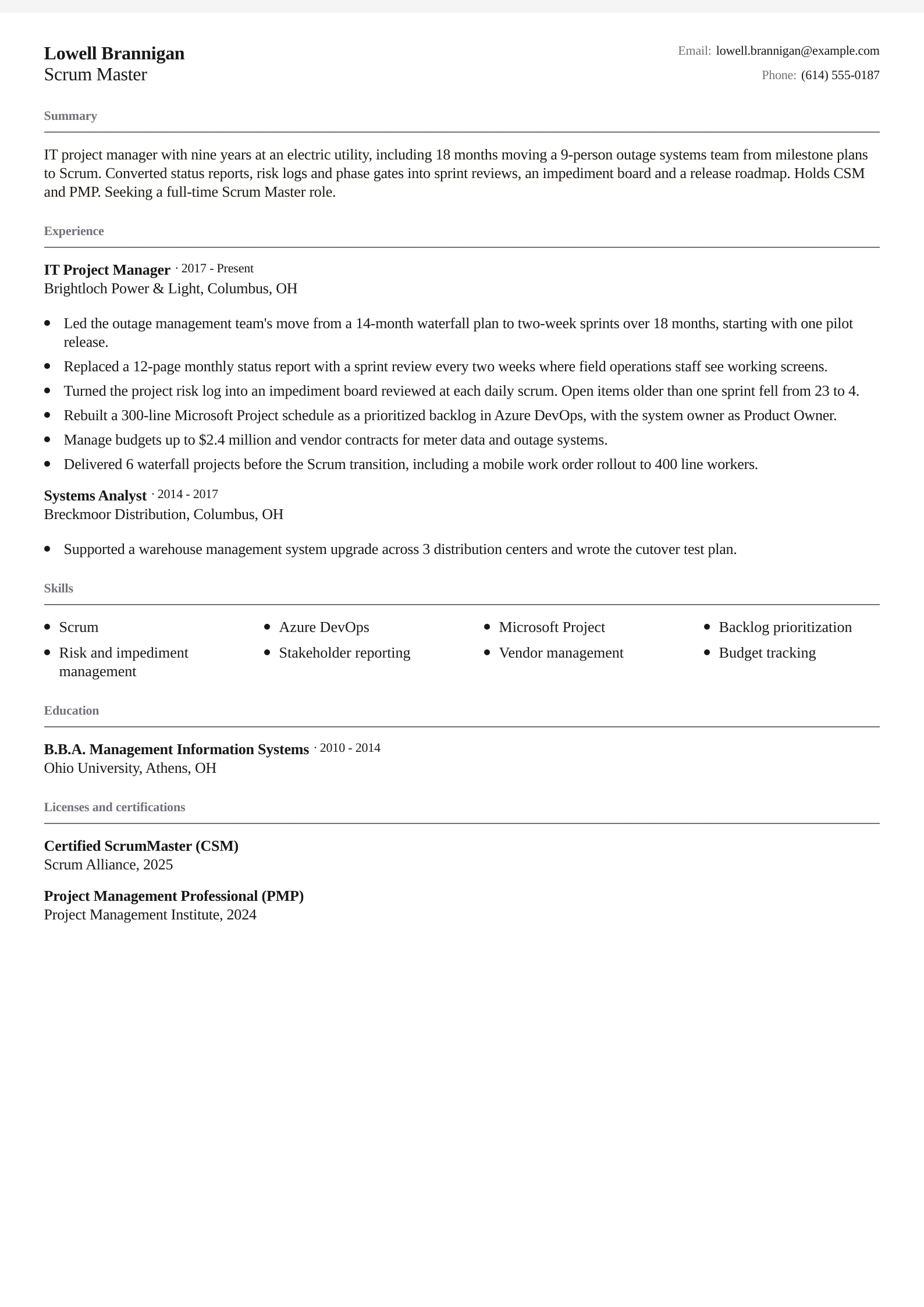
Project manager moving into a Scrum Master role
Lowell keeps his IT Project Manager title and shows the move: an outage systems team taken from a 14-month waterfall plan to two-week sprints over 18 months. His bullets translate project tools into Scrum terms, turning a status report into a sprint review and a risk log into an impediment board. CSM sits above PMP in credentials. Suits project managers who have already run Scrum on their own projects.
Waterfall artifacts translated into Scrum terms
Transition timeline that starts with a pilot release
CSM listed ahead of PMP
Open with team count, team size and sprint length
Your first bullet in each Scrum Master role should say how many teams you serve, how many people are on each, how long the sprints run and what structure sits around them. A line that lists sprint planning, stand-ups and retrospectives could describe any Scrum Master, so it tells the reader nothing about your scope.
Use the structure words the employer uses. In a SAFe setting, name the release train and its size: "inside a 6-team Agile Release Train." If your teams coordinate through a Scrum of Scrums, say how many squads meet and how often. If you serve one large team, give the headcount and the program around it, as the federal example does with a 25-person team in a 200-person program.
Add what the teams build in the same line. "Policyholder portal and claims intake app" tells an insurer you know its products, and "carrier rate and shipment tracking services" does the same for a logistics company. If you split your week between development and facilitation, give the split, such as "about 50/50," because hybrid ads ask for both halves.
State the cadence exactly. Two-week sprints are common, but some programs run 3-week sprints inside 12-week program increments, and a reader comparing your background with their calendar looks for that number.
Shows scope and setting
Serve as Scrum Master for two product teams of 7 and 8 building the policyholder portal and claims intake app on two-week sprints.
Lists the events every Scrum Master runs
Facilitated sprint planning, daily stand-ups, sprint reviews and retrospectives for agile teams.
Report cycle time, carry-over and commitments met instead of velocity
Show results that describe how work flows and whether the team kept its commitments. Velocity is a team's own planning number, so "improved velocity 30%" makes a hiring manager ask what the baseline was and whether the story points changed size.
Give every number a before, an after and the change that caused it. "Cut median cycle time from 9 days to 5 over three quarters by setting work-in-progress limits" answers the three questions an interviewer will ask. If you never tracked a baseline, describe the change and one effect you observed, such as stories that no longer waited 3 days for testing.
Pick the measures your setting cares about. Release trains read PI objectives and dependencies, regulated firms read release windows and audit results, and developer-heavy teams read lead time from done to production.
Result
What it shows
Example line
Best for
Cycle time
How long a story takes from start to done
Cut median cycle time from 9 days to 5 by setting work-in-progress limits on the Jira board
Any team with a Jira, Rally or Azure DevOps board
Sprint carry-over
Whether the team plans what it can finish
Hold sprint carry-over at 12% of committed stories, down from 31%
Teams that often miss sprint goals
PI objectives met
Whether committed program work landed
Raised PI objective achievement from 72% to 88% of planned business value
SAFe release trains
Dependencies resolved on time
How well several teams coordinate
Share of dependencies resolved before their planned iteration rose from 68% to 91%
Senior and multi-team roles
Impediments cleared
How quickly blockers get removed
Cleared 41 of 46 impediments within the sprint they were raised
Every level, including first roles
Release wait
Bottlenecks between done and shipped
Cut the release wait from 6 days to under 1 with contract tests in the pipeline
Developer and Scrum Master hybrids
Releases in their planned window
Predictability under change control
22 of 24 releases went out in their planned change window
Banks, clearing firms and insurers
Write each Scrum credential with its issuer, year and renewal
List the full credential name, the abbreviation and the issuer, then the year earned and the latest renewal where one applies: "Certified ScrumMaster (CSM), Scrum Alliance, 2021, renewed 2025." Employers treat certification differently. One insurer's Senior Scrum Master ad asked for a first-level certification such as CSM or PSM I, one federal contractor's ad listed CSM, SAFe Scrum Master or PMI-ACP, and one consulting firm's ad named none.
Check the renewal rule before you list a credential, because the three common ones behave differently. A CSM lasts two years and a SAFe Scrum Master one, so a credential you haven't renewed has lapsed. Renew it or leave it off.
If you hold none, put the evidence a credential stands for in your first bullets: the number of sprints you facilitated, for how many people, and one result. Scrum Alliance itself says certification isn't required to get a Scrum Master job. A project manager with a PMP should list the Scrum credential first so the reader sees the target role before the old one.
Credential
Issuer
Exam
Renewal
How to list it
Certified ScrumMaster (CSM)
Scrum Alliance
16-hour course required, then 50 questions in 60 minutes, 37 correct to pass
Every two years, with 20 Scrum Education Units (SEUs) and a $100 fee
Put trackers in skills and Scrum terms in your bullets
Scrum Master keywords belong in two places: tool and framework names in the skills section, and event and artifact names inside the bullets that describe your work. A skills line reading "Scrum, Kanban, SAFe" carries less weight than a bullet showing you prepared three teams for PI planning.
Copy tool names as the ad spells them. Recent ads for the role named Jira, Rally, VersionOne and Confluence, and a SAFe train may run its program board in Jira Align, as the senior example does. If you know only one tracker, list that one, since boards, filters and burnup charts work the same way across them.
Use your setting's vocabulary in bullets. For SAFe roles, write PI planning, Agile Release Train, program board and Inspect and Adapt. For firms organized in squads, write Scrum of Scrums, squad and tribe. Any Scrum team reads definition of done, refinement and sprint goal. If you also write code, add the engineering terms the ad lists, such as Spring Boot, CI/CD or contract testing.
Add an ad's extra terms only when a bullet backs them up. One insurer's ad asked for DevOps and CI/CD knowledge and for guiding teams in using AI tools. For an ad like that, name the pipeline gate or the AI tool rollout you helped with.
If you hold a security clearance, put the level in the first line of your summary, such as "active Secret clearance," so a federal contractor's recruiter sees it first. Leave the line out if you don't hold one. Contractor clearances are sponsored by the employer, so a clearance isn't something you can get on your own before applying.