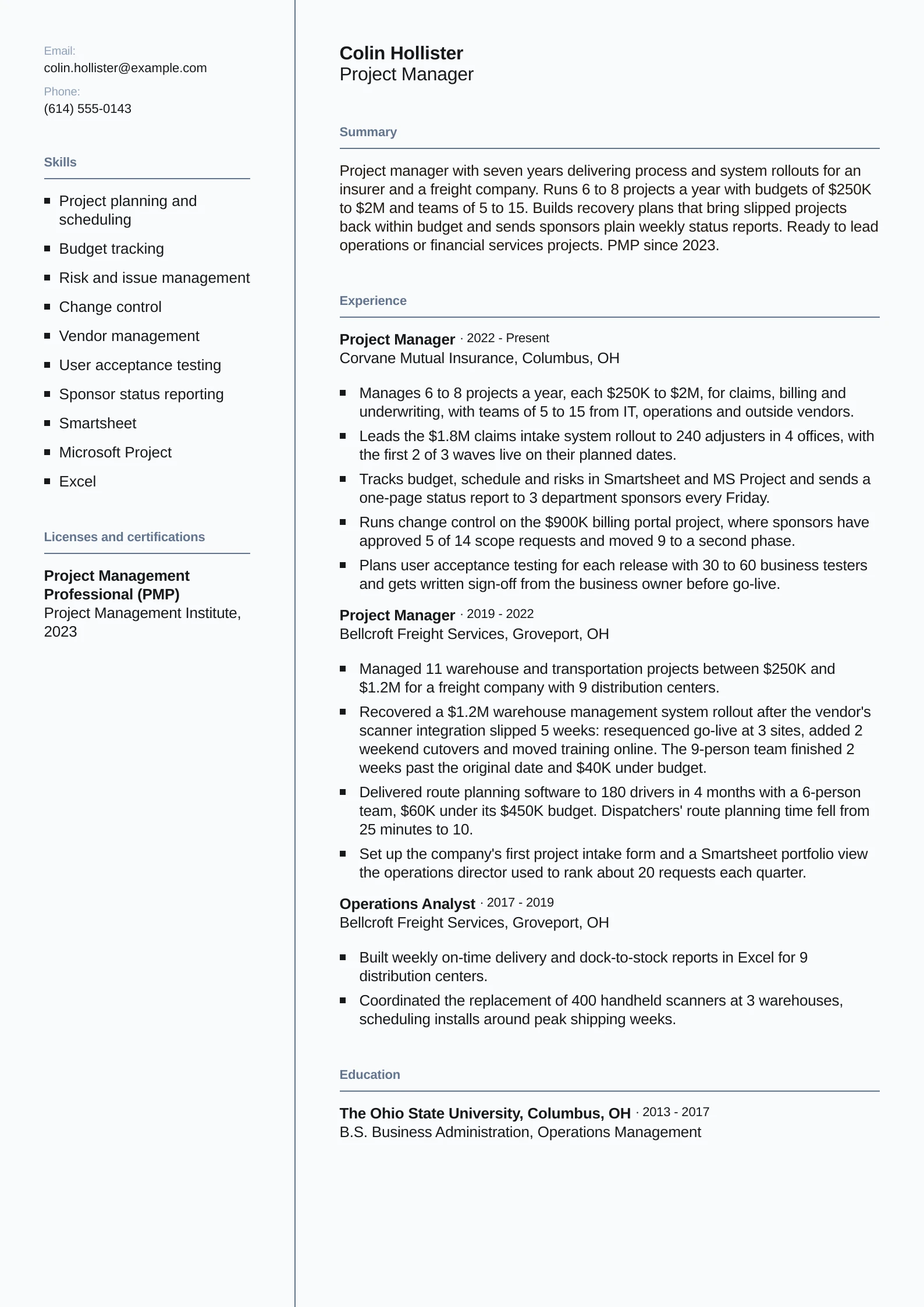
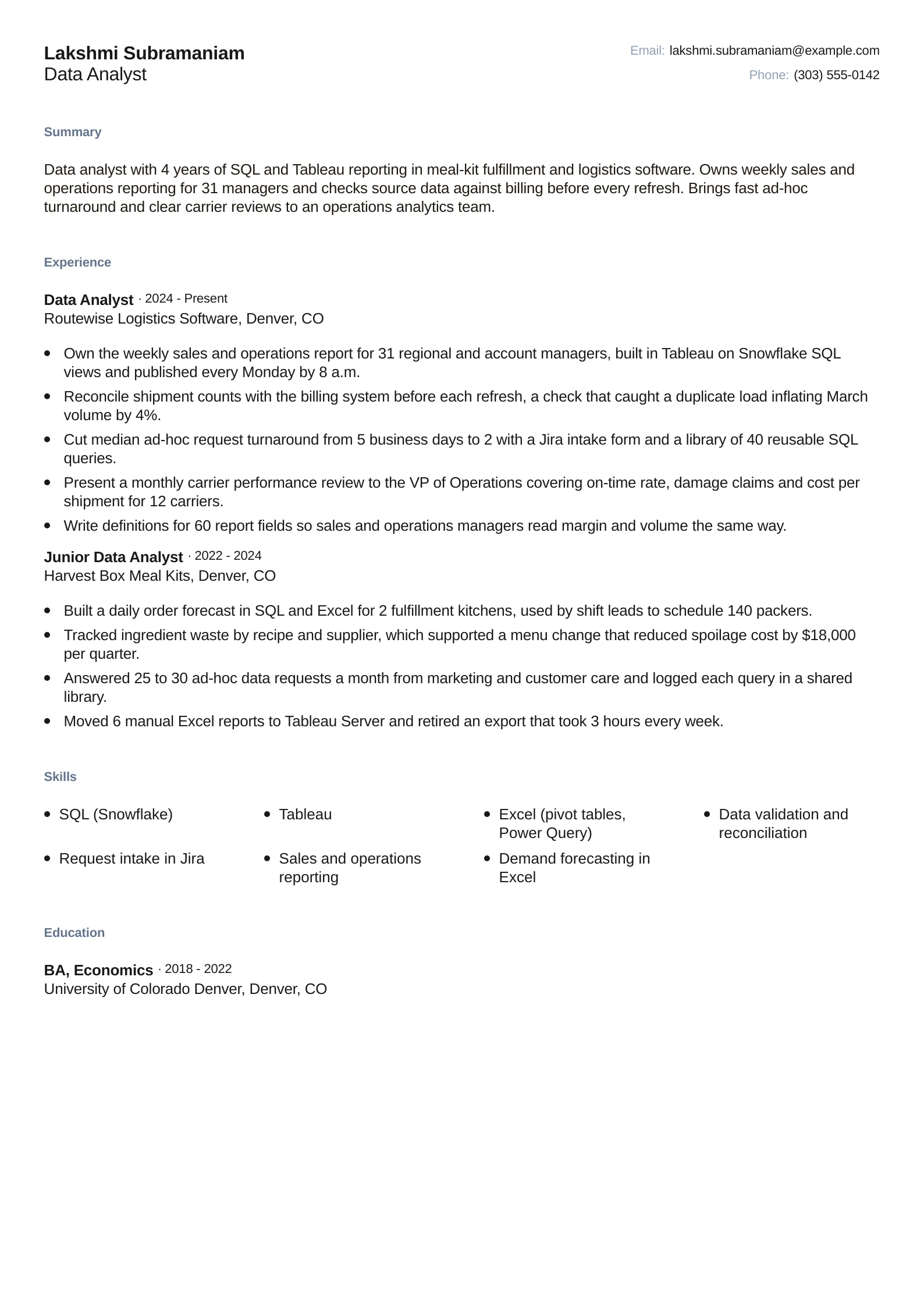
Hiring managers place a property manager by the property before the person: how many units or square feet, what occupancy and delinquency looked like, and who reported to you.
The examples below cover conventional, affordable, commercial, association, lease-up, 55-and-over and single-family work at assistant, community and regional levels.
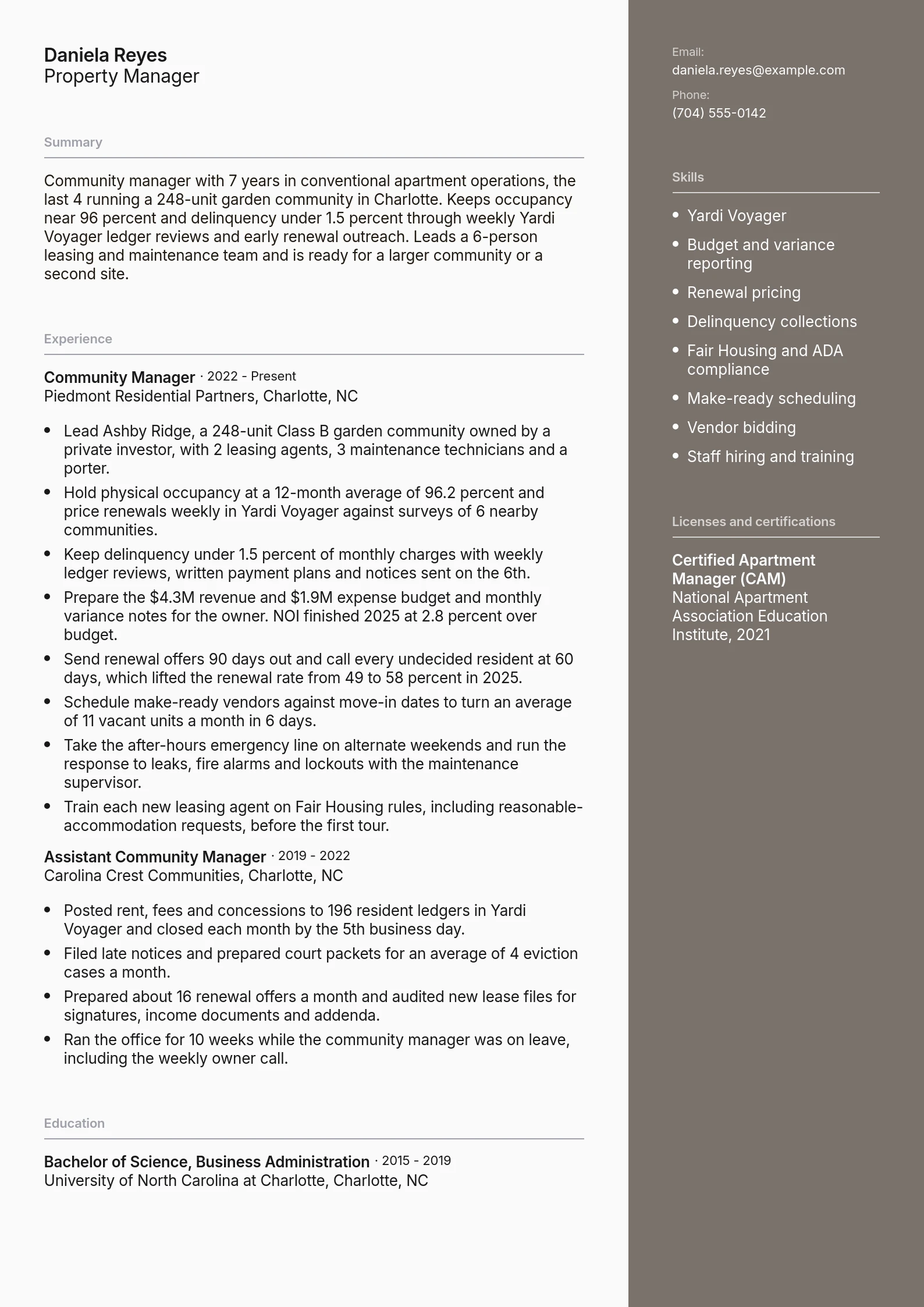
Daniela's resume opens her current job with the property: 248 units, Class B garden, a private owner, and a team of 2 leasing agents, 3 maintenance technicians and a porter. Her bullets then give the four numbers an apartment owner checks first: occupancy, delinquency, NOI against budget and renewal rate.
Use this layout if you run one conventional community today. Her NAA Certified Apartment Manager credential has its own section, and Yardi Voyager appears in the bullets where she uses it, so a reader sees what she does with it.
Pick the example that matches your property and level
Choose by the property you manage or want to manage first, then by level. Borrow lines from the others where your work overlaps, such as Fair Housing training, renewals or after-hours emergency response.
Assistant property manager promoted from leasing
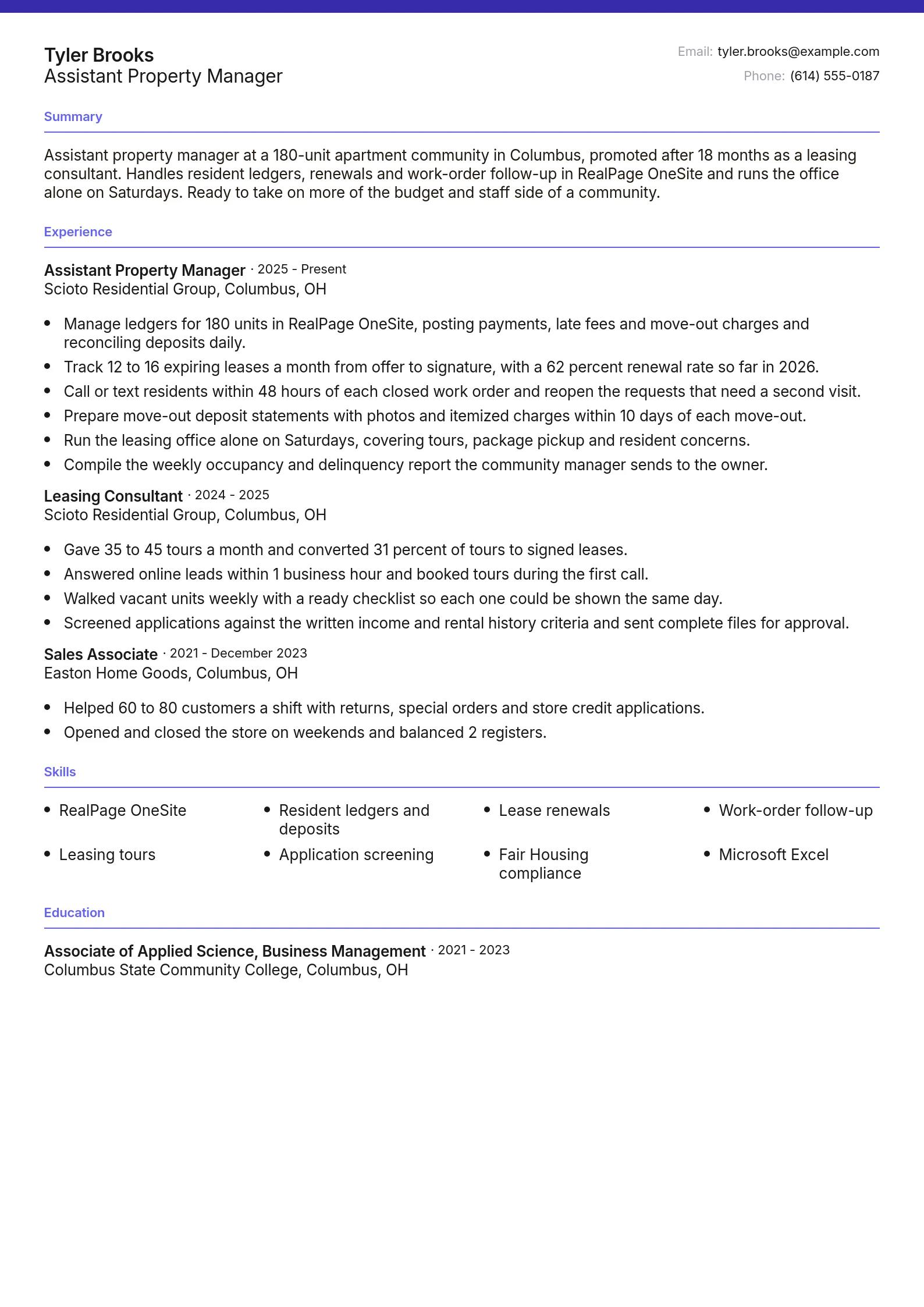
Tyler's resume shows the promotion as two titles at the same firm, so his 18 months of leasing count toward his experience. His assistant bullets cover the ledger, renewal and work-order tasks a community manager hands off first, with a number for each. Use it if you're a leasing consultant or new assistant manager with no credentials yet and want your back-office work to read as manager training.
Renewal rate and monthly count of expiring leases
Saturday office coverage as a solo responsibility
Tour-to-lease conversion rate from the leasing role
Regional manager over 9 communities
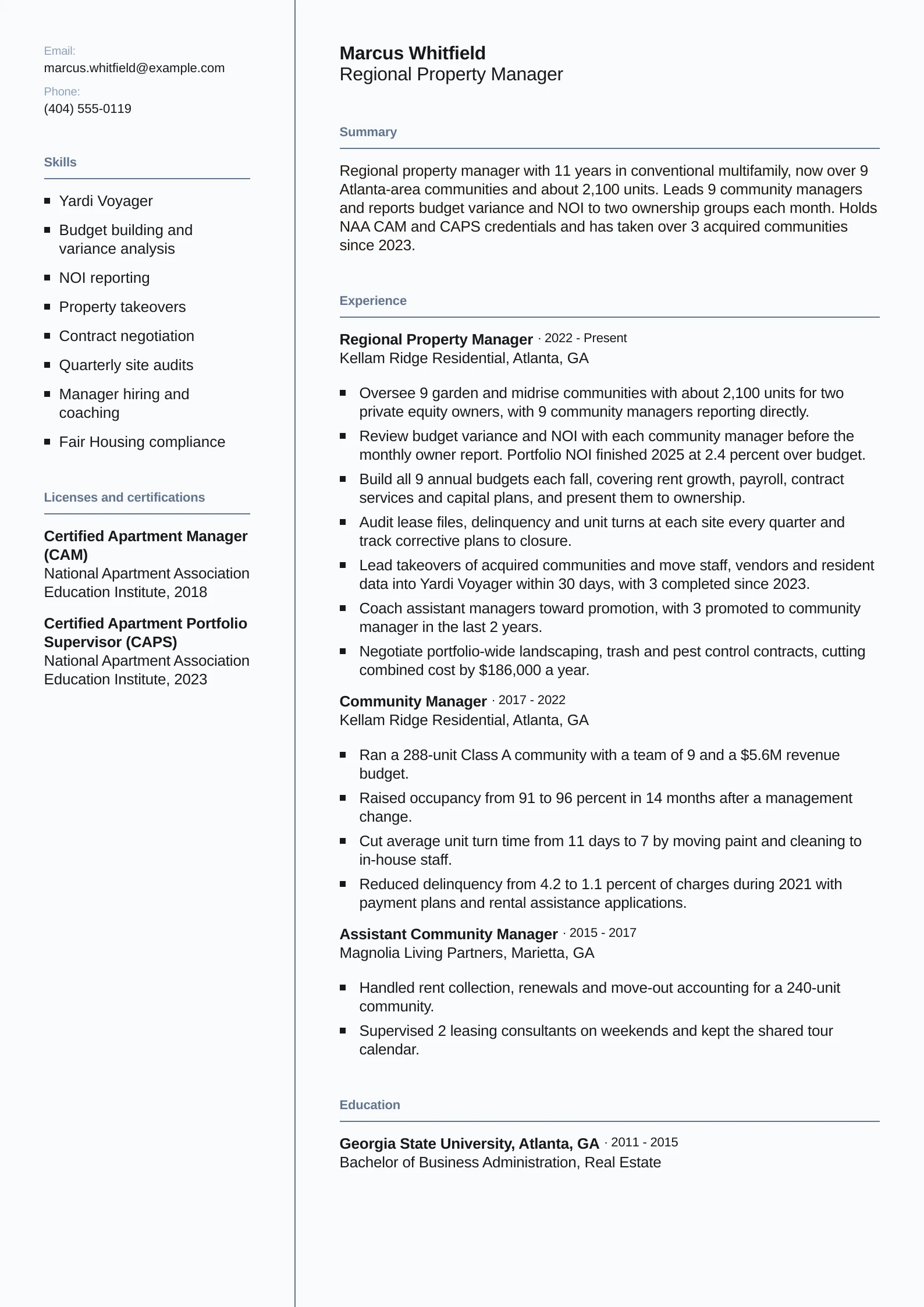
Marcus leads with the portfolio: 9 communities, about 2,100 units, two ownership groups and 9 community managers reporting to him. His bullets are about managers, budgets, audits and contracts rather than residents, because that is the regional job. Use it if you supervise community managers or run more than one site, and copy his takeover line if you've moved acquired properties onto your company's systems.
Portfolio NOI against budget for the year
Takeovers of acquired communities within 30 days
NAA CAM and CAPS listed with the year earned
Affordable housing manager for LIHTC and Section 8
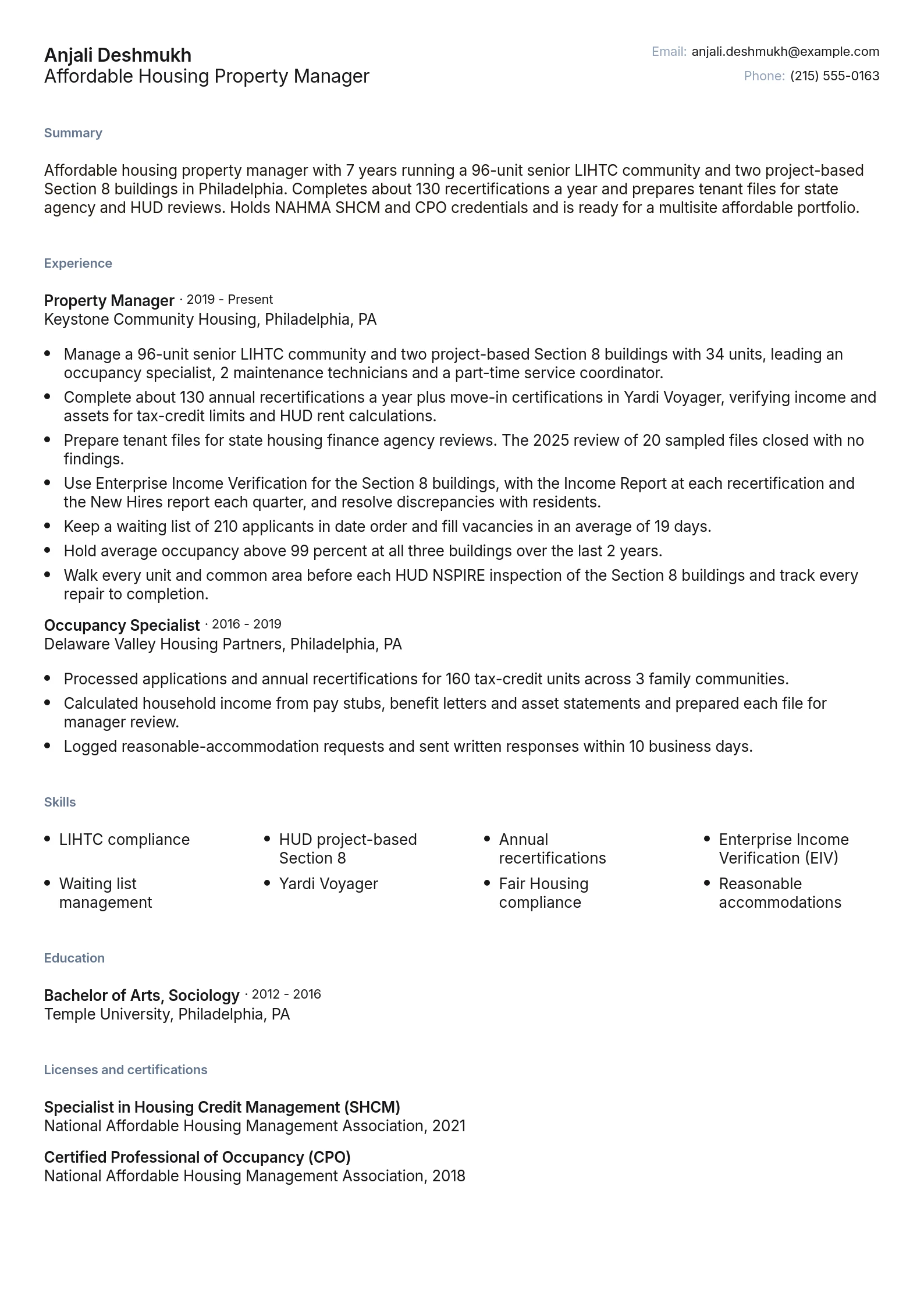
Anjali's resume reads as compliance work first: about 130 recertifications a year, Enterprise Income Verification checks, a 210-name waiting list and a state agency file review with no findings. She names the program for every building, LIHTC or project-based Section 8, because the rules differ. Use it if you work in tax-credit or HUD housing, and spell out NAHMA credentials as she does with SHCM and CPO.
Program named for each building she manages
File review result with the number of files sampled
SHCM and CPO spelled out with NAHMA as issuer
Commercial manager for office and flex buildings
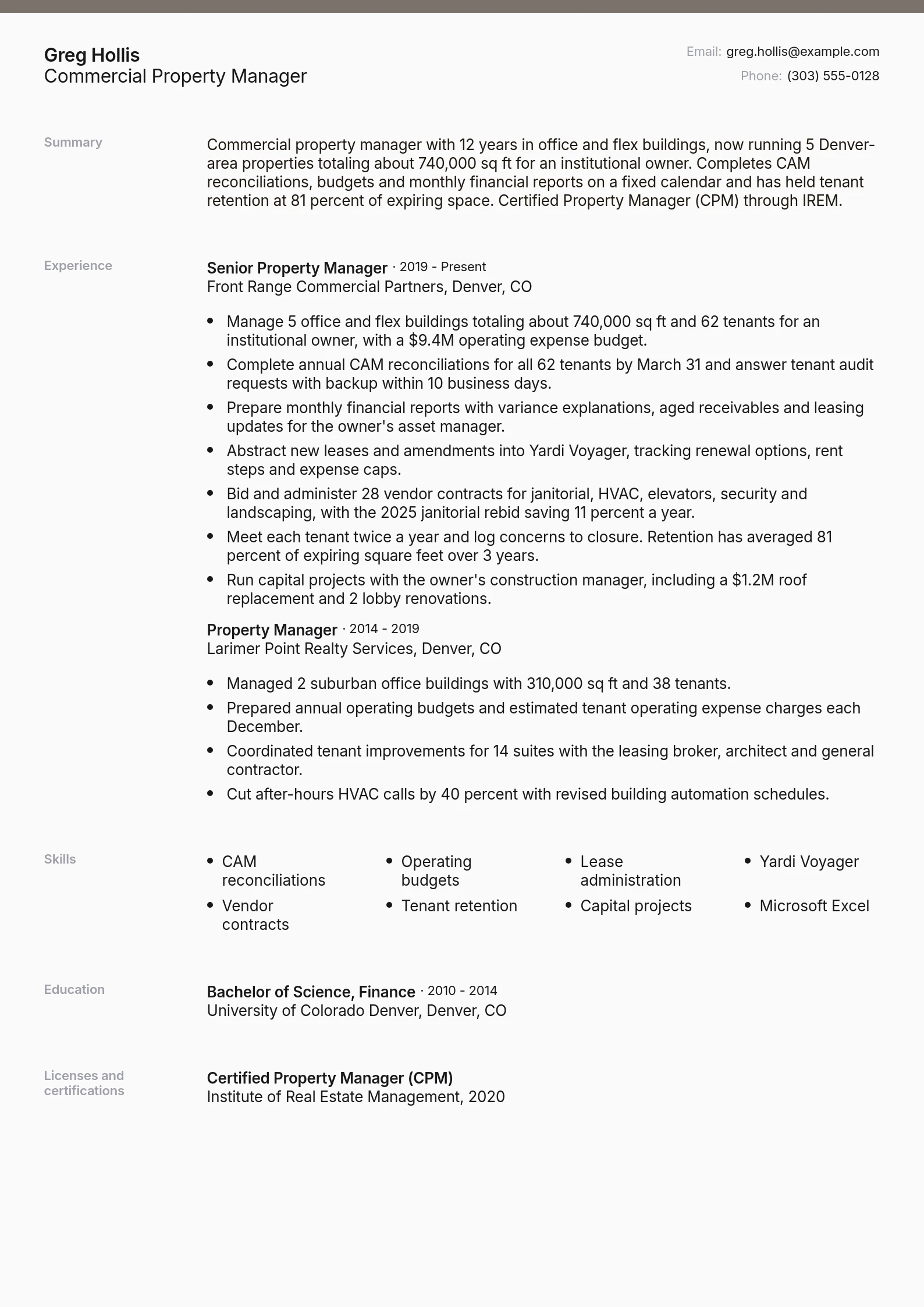
Greg's resume measures his job in square feet and tenants instead of units: about 740,000 sq ft, 62 tenants and a $9.4M expense budget for an institutional owner. His bullets cover CAM reconciliations, lease abstracts, vendor contracts and capital projects. Use it for office, flex, industrial or retail management, and note how his CPM from IREM sits beside a finance degree, which commercial employers may prefer.
CAM reconciliation deadline and tenant audit turnaround
Tenant retention measured by expiring square feet
Lease abstracting in Yardi Voyager
HOA manager with a Florida CAM license
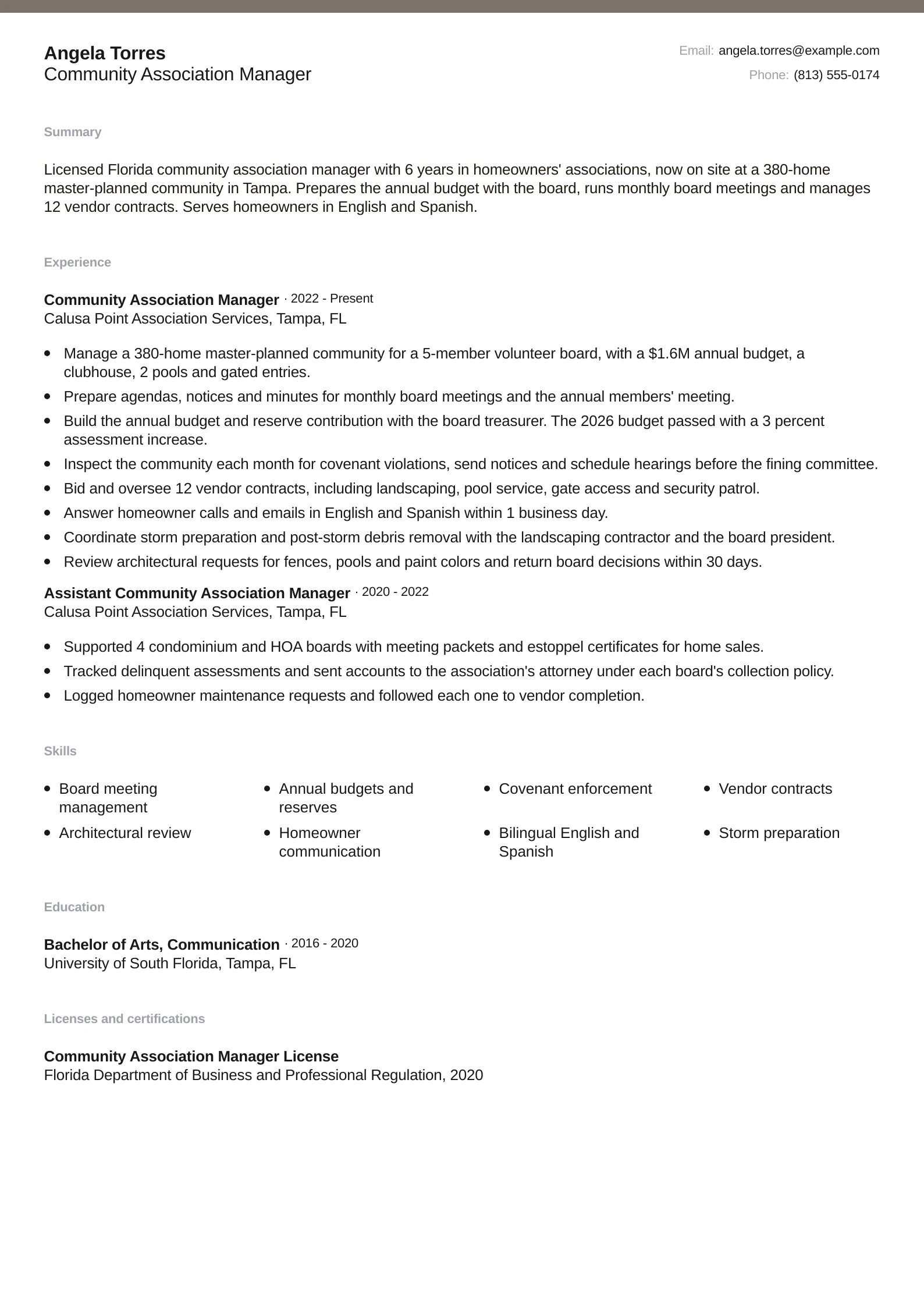
Angela works for a volunteer board, so her resume is built around meetings, budgets and enforcement: monthly board meetings, an annual budget built with the treasurer, monthly covenant inspections and 12 vendor contracts. Her Florida community association manager license is listed with the state department that issues it. Use it for HOA or master-planned community roles, and list Spanish or another language if you serve homeowners in it.
5-member board and $1.6M budget in the first bullet
Florida CAM license with the issuing state department
Bilingual service shown in a bullet and in skills
Lease-up manager for a new 312-unit community
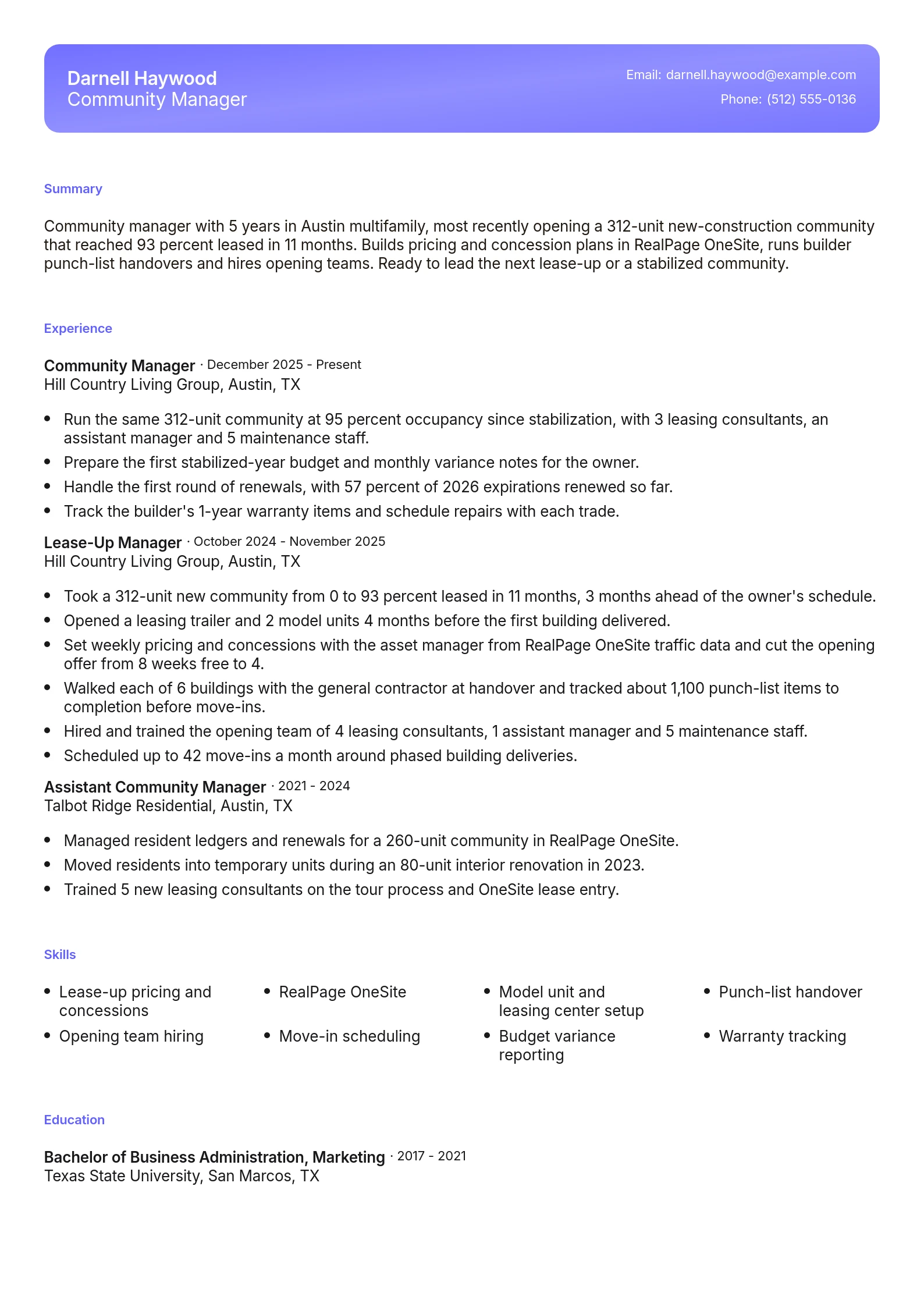
Darnell lists lease-up manager and community manager as two titles at the same property, so the opening work and the stabilized work each get their own bullets. His lease-up numbers are the ones a developer asks about: 0 to 93 percent leased in 11 months, concessions cut from 8 weeks to 4, and about 1,100 punch-list items closed. Use it if you've opened a new building or want to.
Lease-up pace measured against the owner's schedule
Opening team hired and trained, counted by role
Builder warranty tracking after stabilization
55+ community manager focused on residents and families
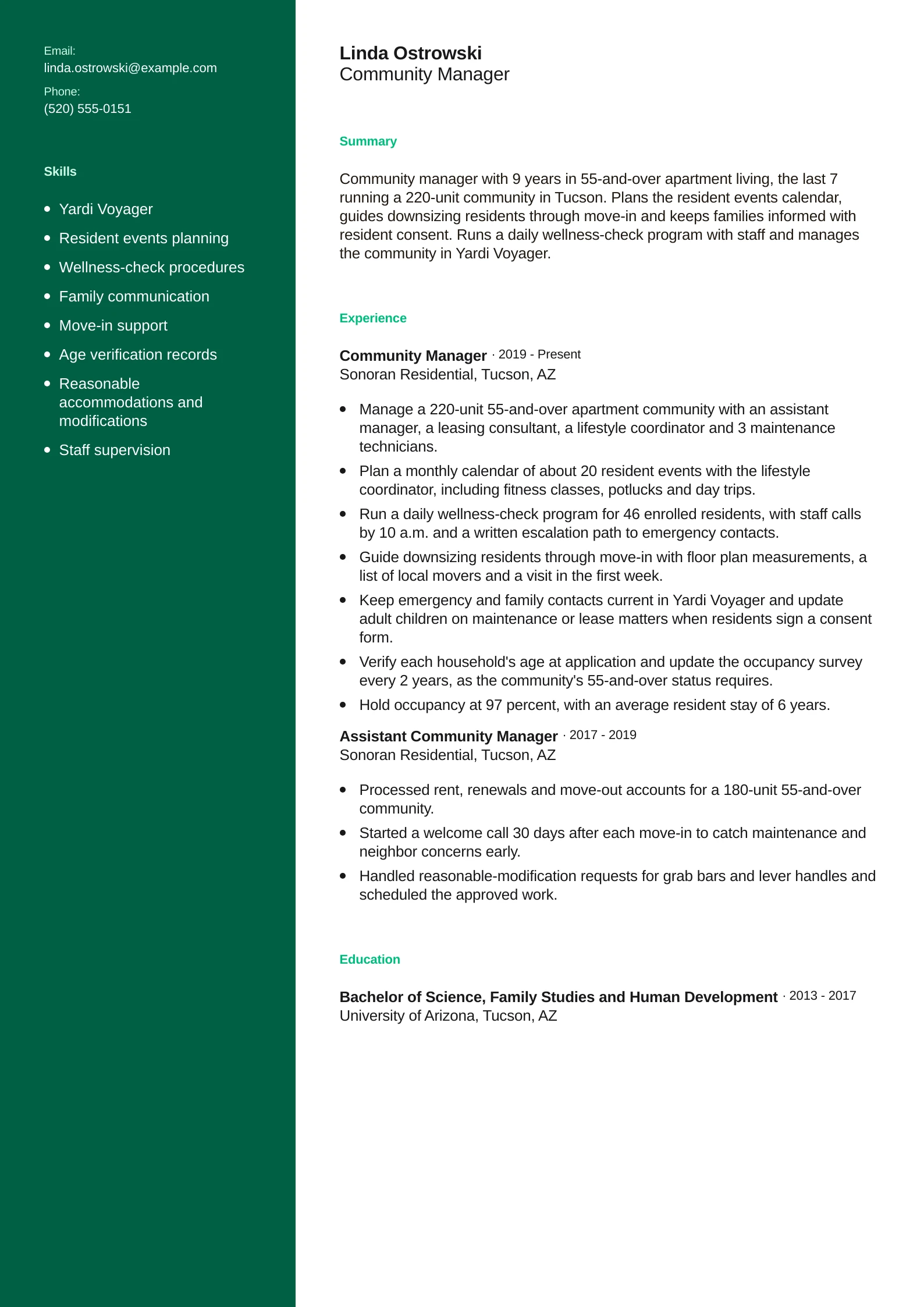
Linda's resume gives as much space to residents as to rent: a monthly events calendar, a daily wellness-check program for 46 residents, move-in help for people downsizing and family updates with written consent. Her occupancy and average-stay numbers show the result. Use it for active-adult or age-restricted apartment communities, and describe wellness checks as calls and escalation rather than care, unless your community is licensed to provide it.
Wellness-check program with enrollment count and call time
Family contact handled through resident consent
Average resident stay alongside occupancy
High-rise condominium manager with building staff
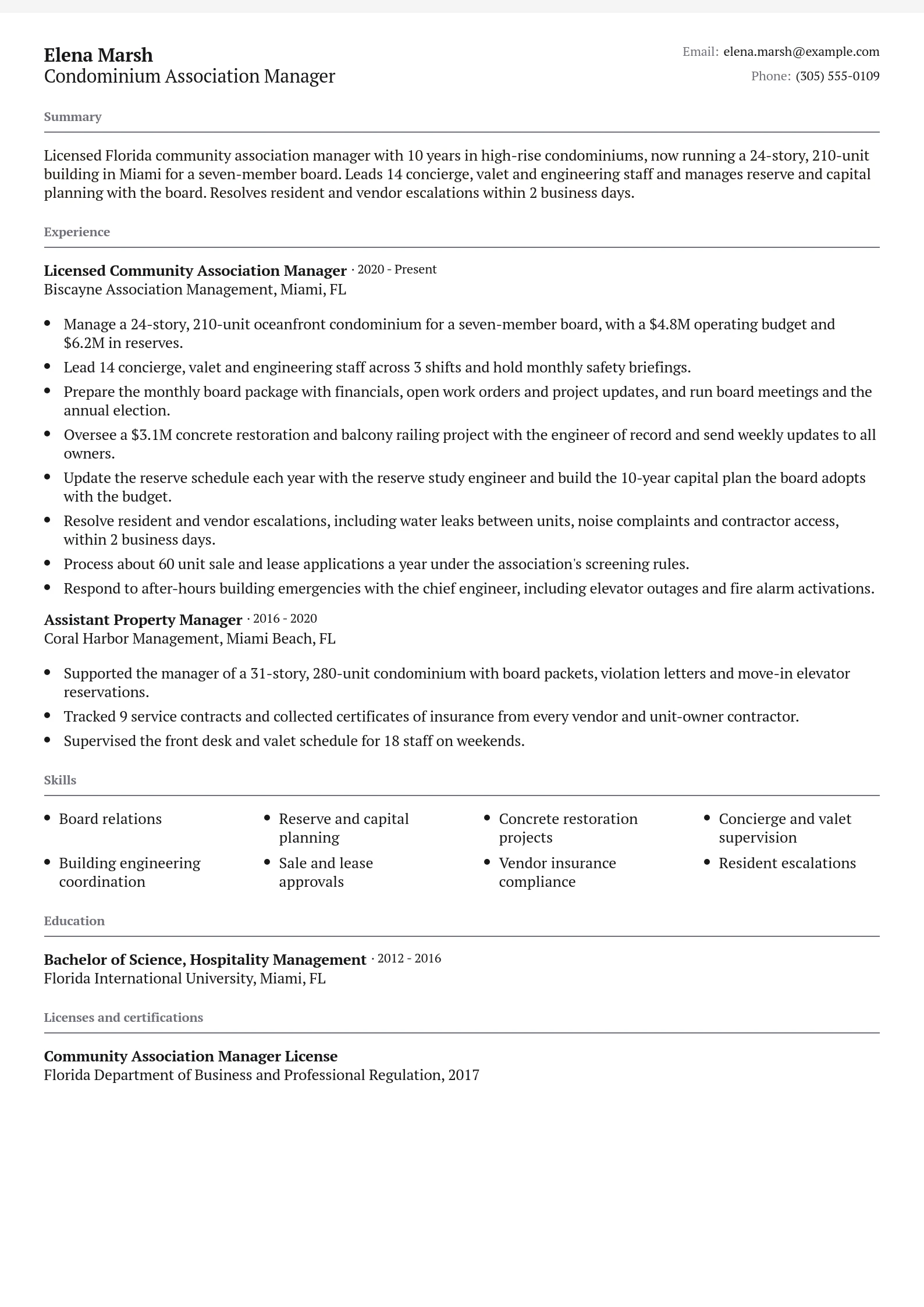
Elena manages a 24-story, 210-unit condominium where the building itself is much of the job: 14 concierge, valet and engineering staff, a $3.1M concrete restoration and a reserve schedule updated every year. Her board work and sale and lease approvals show the association side. Use it for high-rise condo or luxury building roles, and in Florida list the community association manager license the way she does.
Reserve balance and capital project value in dollars
Staff count and departments across 3 shifts
After-hours emergencies handled with the chief engineer
Residential manager for single-family and small multifamily
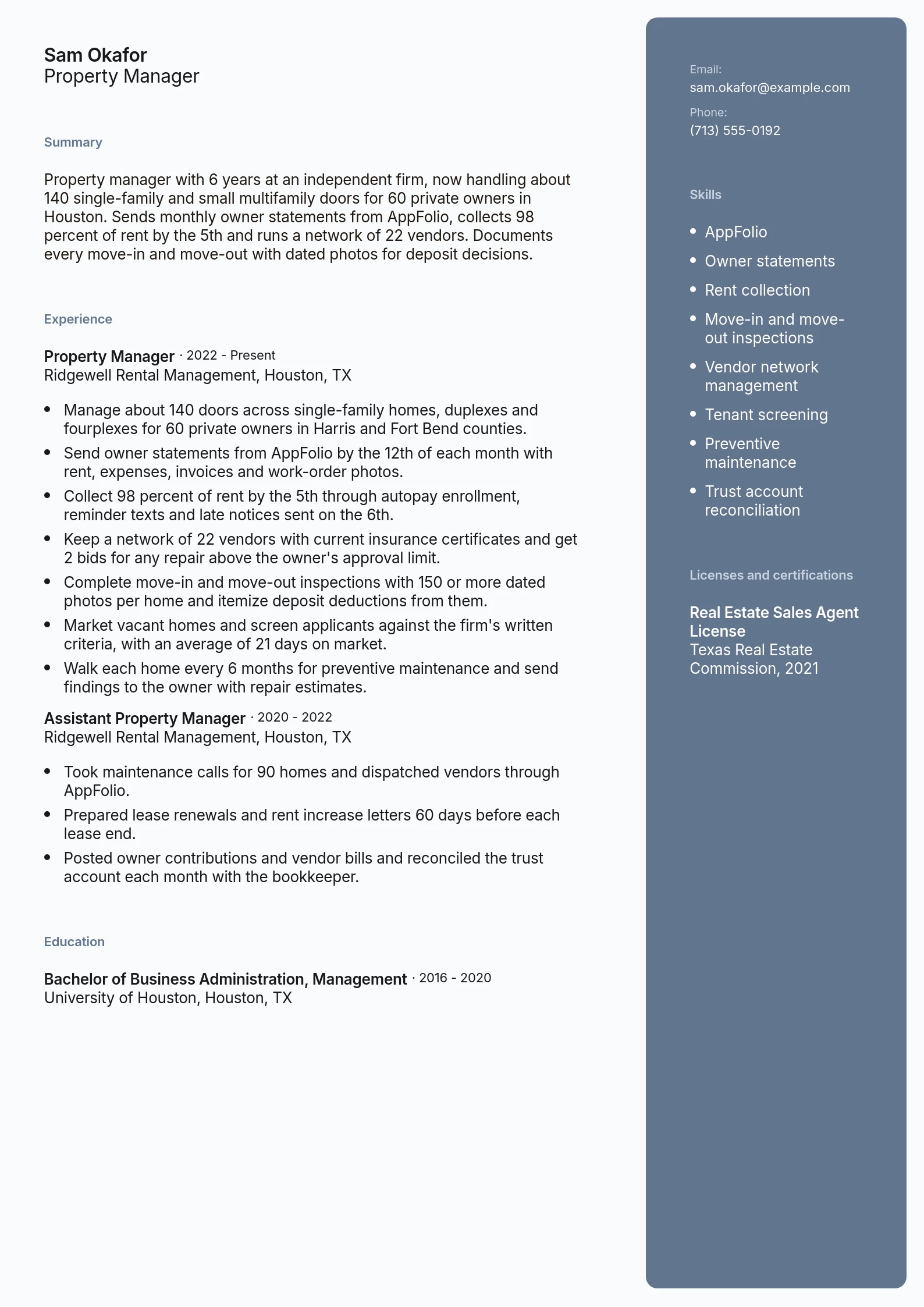
Sam counts doors and owners rather than units in one building: about 140 doors for 60 private owners across two Houston-area counties. His bullets cover owner statements from AppFolio, rent collected by the 5th, a 22-vendor network and photo-backed move-in and move-out inspections. Use it if you work for a small or independent firm and report to many owners, and list your state real estate license, as he does, if your state requires one to lease homes and collect rent.
Door and owner counts in the first bullet
Owner statement deadline each month
Inspection photos tied to deposit deductions
Hotel front office manager moving into property management
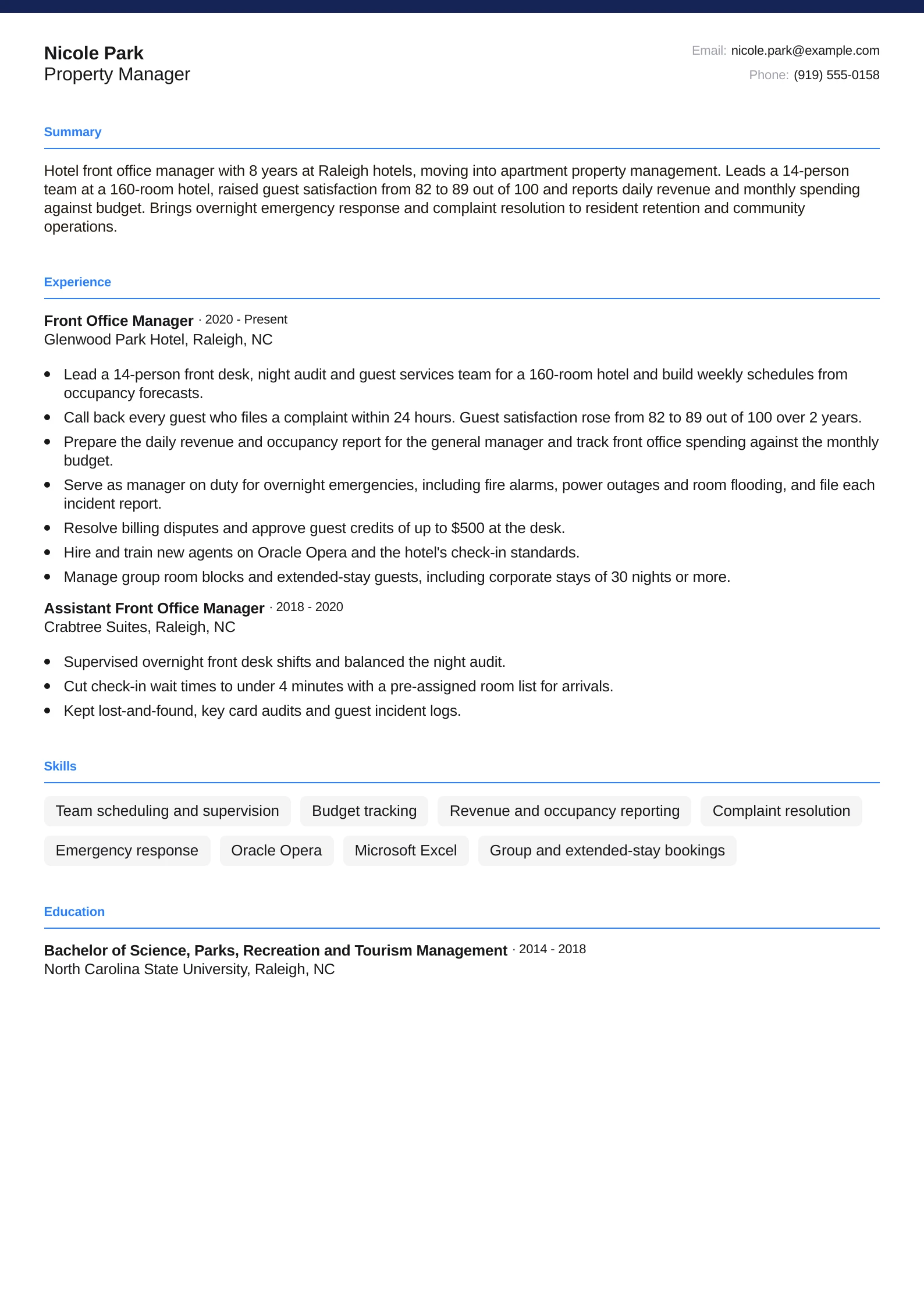
Nicole's resume keeps her hotel titles and lets the bullets show work that carries over: a 14-person team scheduled around occupancy forecasts, guest satisfaction up from 82 to 89, daily revenue reports and overnight emergency response. Her extended-stay line is the closest match to leasing. Use it if you're coming from hotels, retail or another people-heavy operation and have no property credentials yet.
Hotel titles kept, with property management in the summary
Overnight emergencies listed by type
Extended-stay guests as a bridge to leasing
Lead each job with occupancy, delinquency and budget results
Put the property's size in the first bullet of each job and its results in the next two or three. For apartments, the results an owner checks first are physical occupancy, delinquency as a percent of monthly charges, NOI or budget variance, and renewal rate.
Write occupancy as an average over a stated period, such as "a 12-month average of 96.2 percent," because one good month proves little. Write delinquency as a percent of charges rather than a dollar amount, so a reader can compare a 90-unit property with a 400-unit one.
For budget results, name the line and the direction: "NOI finished 2025 at 2.8 percent over budget" or "controllable expenses came in $41,000 under budget." If you don't see the full financials, use the numbers you do control, such as turn time in days, renewal rate or make-ready cost per unit.
Commercial and association managers need different numbers. Commercial readers look for square feet, tenant count, CAM reconciliation timing and retention of expiring space. Association boards look for budget size, reserve balance, delinquent assessments and how many board meetings you run a year.
Repeat one or two of these numbers in your summary so they appear in the first lines of the page. Choose the ones the job ad names. If it mentions budget variance or NOI, lead with those rather than occupancy.
Name the property type, size, class and owner before the duties
Units, class, building style, owner and team in one line
Community Manager, Halverson Living. Lead a 164-unit Class A midrise managed for a third-party owner, with 2 leasing consultants, 2 maintenance technicians and a $3.8M revenue budget.
Could describe any property
Property Manager, Halverson Living. Responsible for day-to-day operations of the property, including leasing, maintenance, resident relations and financial reporting.
Match your software and compliance terms to the property type
Ads in each segment name different systems and rules. List the ones you use by product name in skills, then show one in a bullet with a number attached.
Property type
Software to name
Compliance terms to show
A bullet that shows it
Conventional apartments
Yardi Voyager, RealPage OneSite
Fair Housing Act reasonable accommodations and modifications
Train each new leasing agent on Fair Housing rules and accommodation requests before the first tour
Affordable housing (LIHTC, HUD)
Yardi Voyager
LIHTC income limits, HUD recertifications, Enterprise Income Verification, agency file reviews
Complete about 130 recertifications a year, with no findings on the last agency review of 20 files
Commercial office, flex and retail
Yardi Voyager
CAM reconciliations, lease abstracts, tenant audits of expense charges
Complete CAM reconciliations for 62 tenants by March 31
Homeowner and condo associations
Your firm's association accounting system, by name
Send owner statements by the 12th of each month with invoices and work-order photos
Separate state licenses from optional property certifications
In most states a property manager needs a property management license or a real estate broker's license, and the rules vary by state, so check with your state's real estate regulator before you apply. Everything else in this table is optional unless the ad asks for it, and affordable housing ads often do.
Three different things are called CAM on property resumes: the NAA Certified Apartment Manager credential, Florida's community association manager license, and CAM (common area maintenance) reconciliations in commercial leases. Write the full name the first time so a reader knows which one you mean.
Credential
Issuer
Who lists it
Required or optional
State property management or real estate broker license
Your state's real estate regulator
Managers who lease or collect rent for owners
Required in most states, with rules that vary
Community association manager (CAM) license
Florida Department of Business and Professional Regulation
HOA and condo managers in Florida
Required by Florida law to manage, for pay, an association with more than 10 units or a budget over $100,000, after prelicensure education and a state exam
Certified Apartment Manager (CAM)
National Apartment Association Education Institute
Community managers at conventional apartments
Optional
Certified Apartment Portfolio Supervisor (CAPS)
National Apartment Association Education Institute
Regional and portfolio managers
Optional
Certified Apartment Leasing Professional (CALP)
National Apartment Association Education Institute
National Affordable Housing Management Association
Tax-credit and HUD housing staff
Often preferred in affordable ads, and some ads require a LIHTC certification
Certified Property Manager (CPM) and Accredited Residential Manager (ARM)
Institute of Real Estate Management
Senior residential and commercial managers
Optional
Show on-call coverage and the team you lead in your bullets
Write after-hours coverage and supervision into your bullets, with the rotation and the incident types, because ads for these roles list weekends, evenings and emergency response as part of the job. A line such as "Take the after-hours emergency line on alternate weekends" tells a reader you've already done it.
Name the emergencies you've handled: water leaks, fire alarms, lockouts, elevator outages or storm preparation. Add what you did, such as calling restoration vendors, moving households to hotels or filing the insurance claim, and how many units were affected.
Count your team by role rather than as a headcount. "2 leasing agents, 3 maintenance technicians and a porter" shows a mixed team, which is what separates a manager from a senior leasing agent. Regional managers should count the managers who report to them and the sites they cover.
Add the people work around that team: hiring, Fair Housing training, schedules and coaching an assistant toward promotion. If you're an assistant manager, show the times you ran the office alone, such as Saturday coverage or a 10-week leave.
Some on-site jobs require living at the property, and association jobs involve evening board meetings. If you can do either, say so in your summary or cover letter so the reader doesn't have to ask.