Hiring managers want to see what kind of projects you run, how big they were and how they finished against plan, long before they care whether you work in Agile or Waterfall. The five examples show that record at three levels and in two settings: mid-level, senior, junior, construction and software.
Mid-level example: rollouts with budgets, team sizes and one recovery
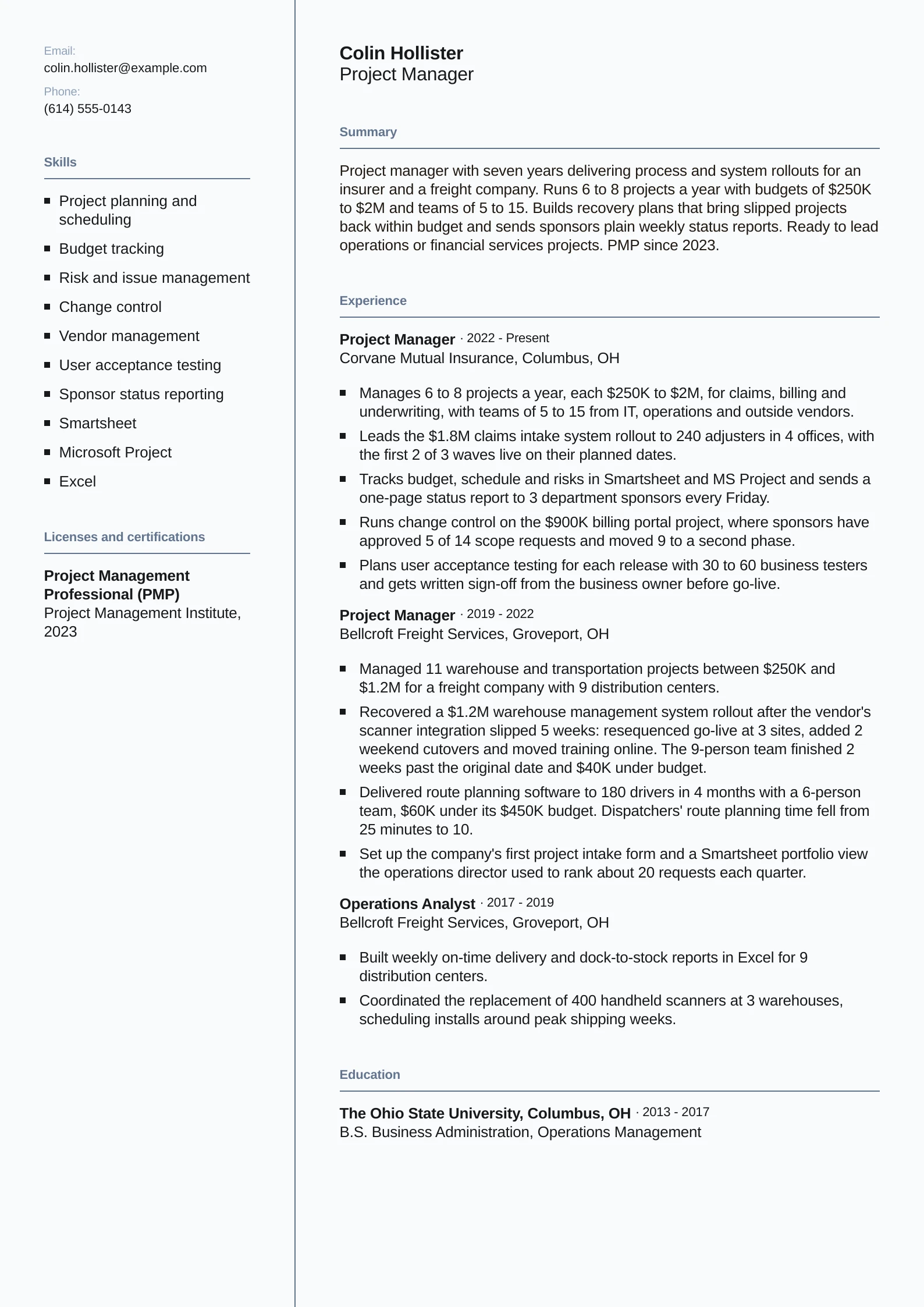
Colin's summary opens with his kind of work (process and system rollouts), his load of 6 to 8 projects a year and the $250K to $2M budget range. A hiring manager can match him to an operations or financial services role from that one line. PMP closes the summary with the year he earned it.
His most useful bullet is the warehouse system rollout at the freight company. It names the slip (a vendor's scanner integration 5 weeks late), the three changes he made, and how the project finished against the original date and budget. Start from this example if you run internal business or systems projects and want your record to read as delivered work.
Senior, junior, construction and IT project manager resumes
Each of the next four examples changes one thing from Colin's: the level (senior or junior) or the setting (construction or software). Each uses the tools and document names that appear in job ads for that setting.
Senior project manager resume
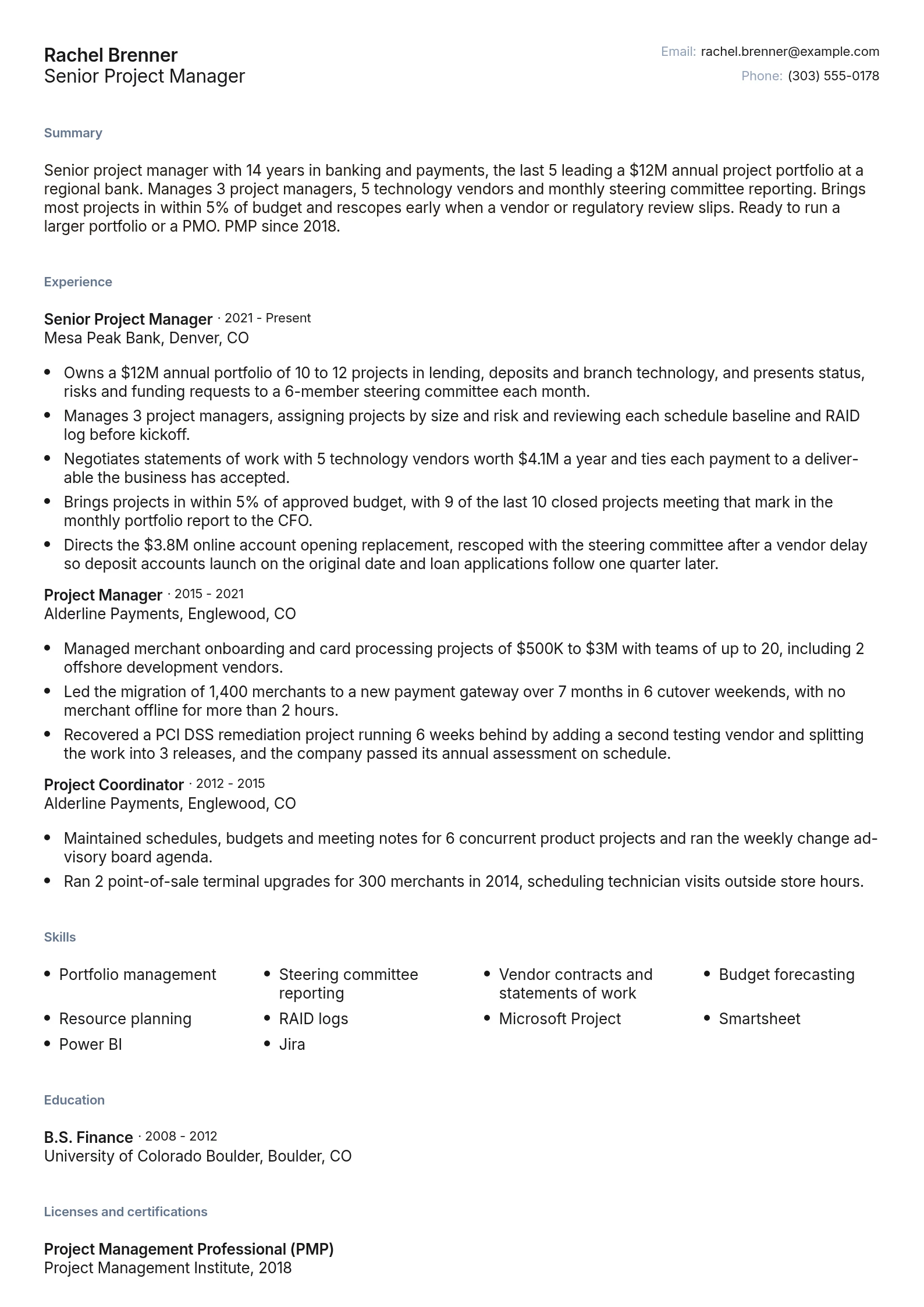
Rachel's resume opens with the size of what she oversees: a $12M annual portfolio, 3 project managers and 5 technology vendors. Her current bullets cover portfolio decisions, steering committee reporting and vendor payment terms instead of single-project tasks, and one shows a $3.8M account opening replacement rescoped after a vendor delay. Use it if you manage other project managers or report to a steering committee in banking, insurance or another regulated business.
$12M portfolio and 3 project managers in the summary
Vendor statements of work tied to milestone payments
Budget record: 9 of the last 10 projects within 5%
Junior project manager resume
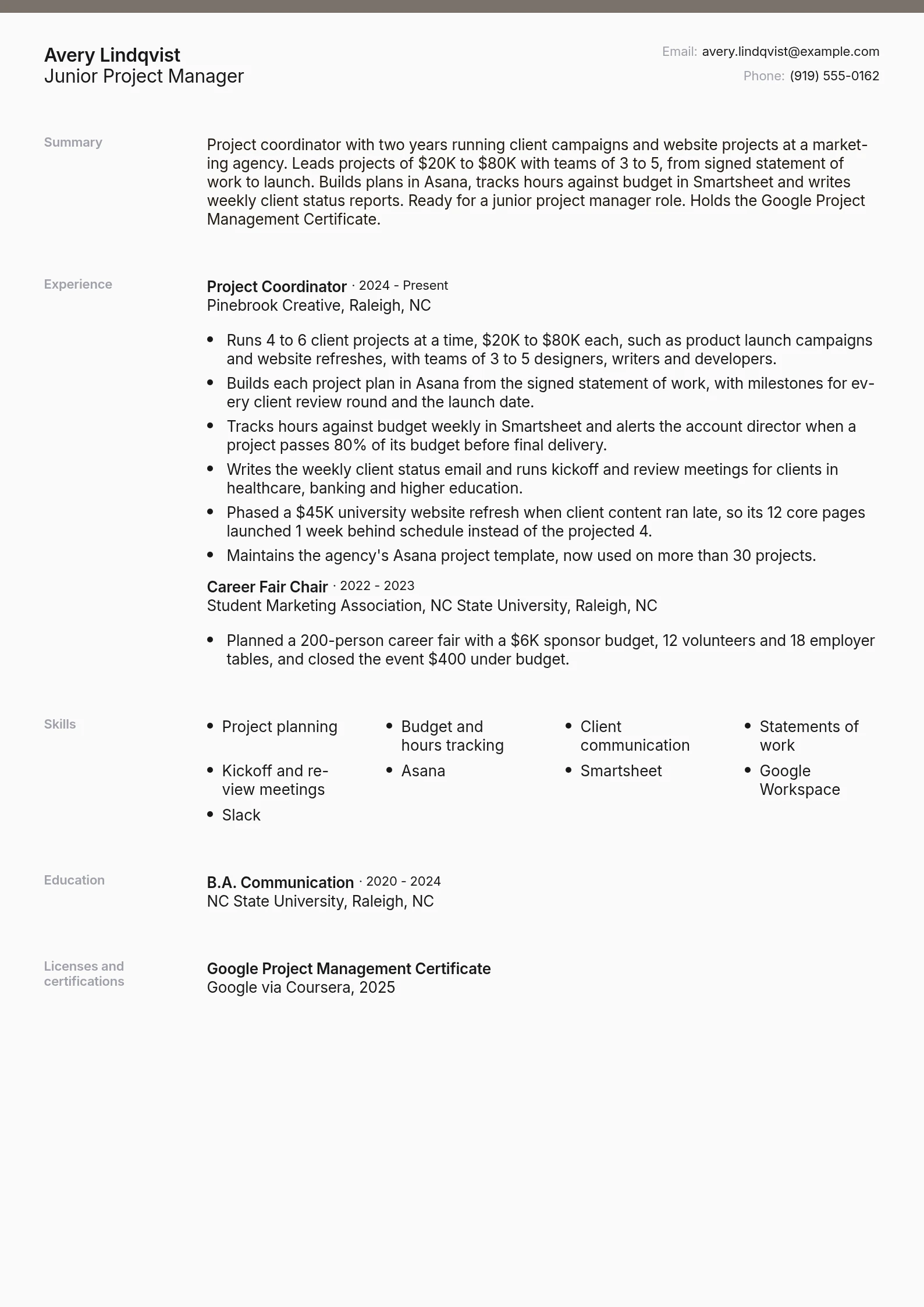
Avery has run client projects for two years under a project coordinator title, so the first bullet gives the budget ($20K to $80K) and team size, and later bullets show the plans, budget tracking and client reporting Avery owns. The Google Project Management Certificate fills the credentials section. A student career fair with a $6K budget adds early evidence. Use it if you coordinate projects at an agency or in-house team and want your first project manager title.
Coordinator title with project-level bullets
Asana plans built from each statement of work
Google certificate in place of PMP
Construction project manager resume
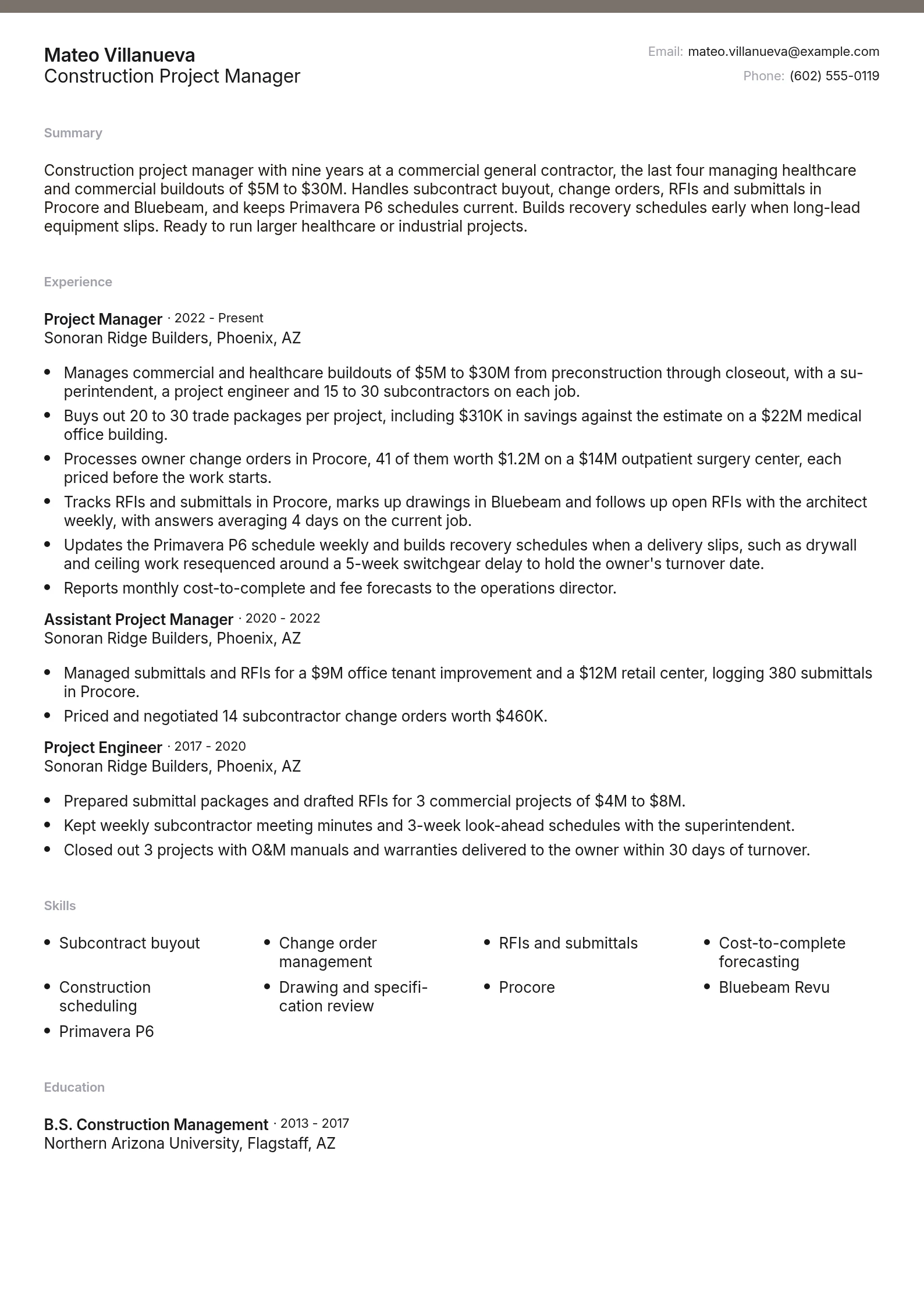
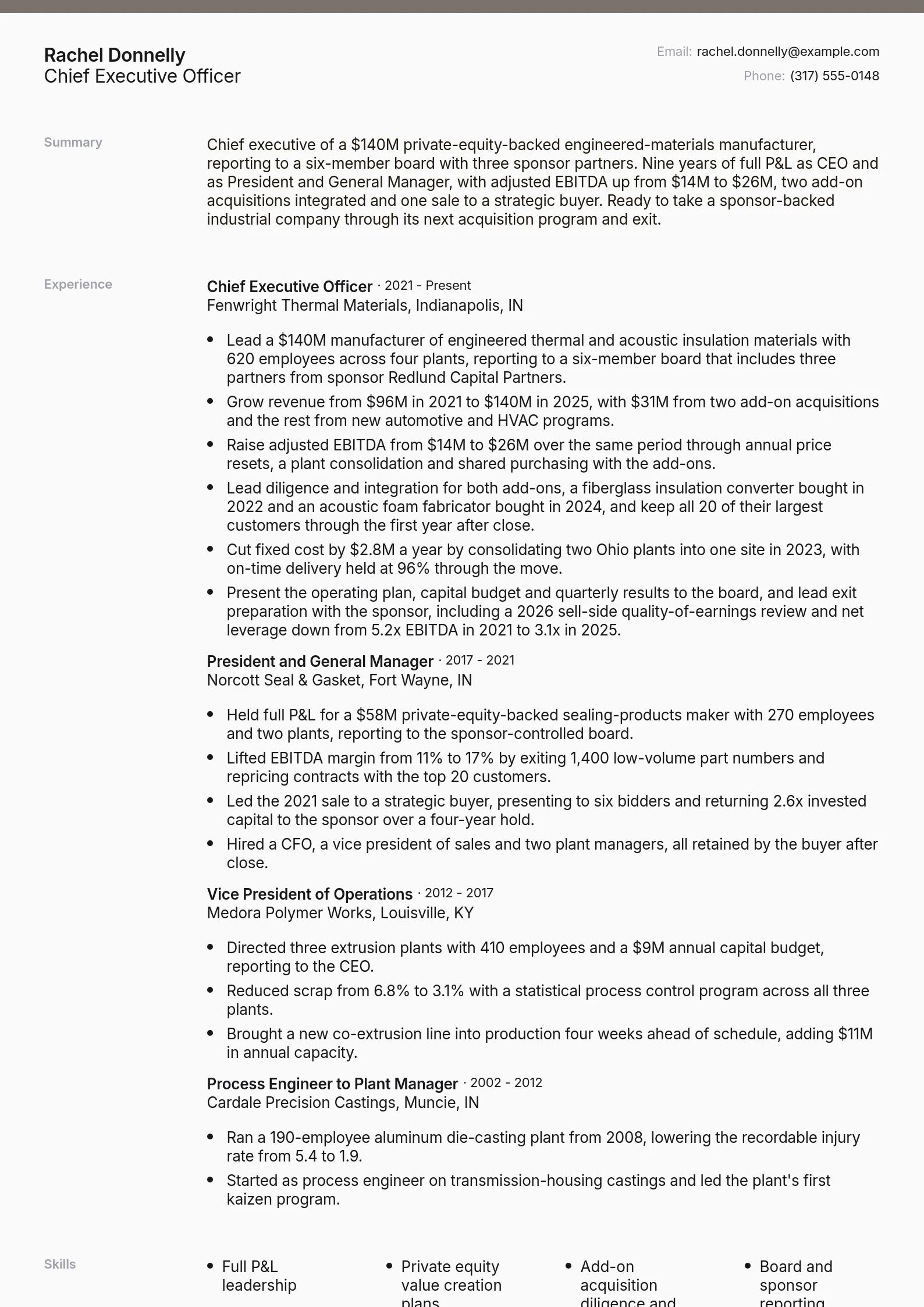
Mateo writes for general contractor hiring managers, so his bullets use their terms: subcontract buyout, RFIs, submittals, change orders and cost-to-complete. Each project carries its contract value and building type, such as a $22M medical office building. His titles run from project engineer to assistant project manager to project manager, the path most contractors expect. Use it for commercial, healthcare or industrial buildout roles where Procore and P6 appear in the ad.
Contract values from $5M to $30M
Change orders counted and priced
P6 recovery schedule around a switchgear delay
IT project manager resume
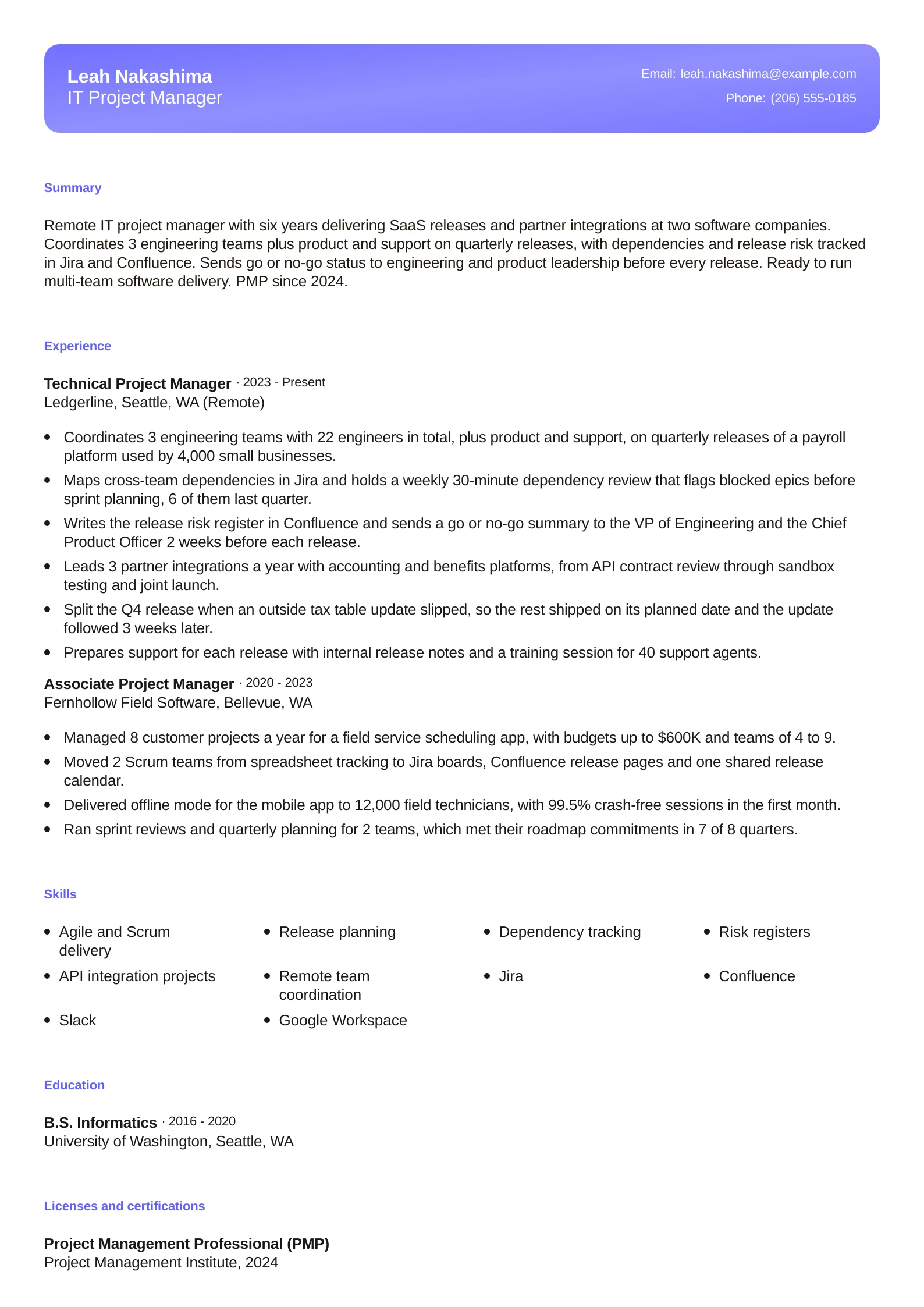
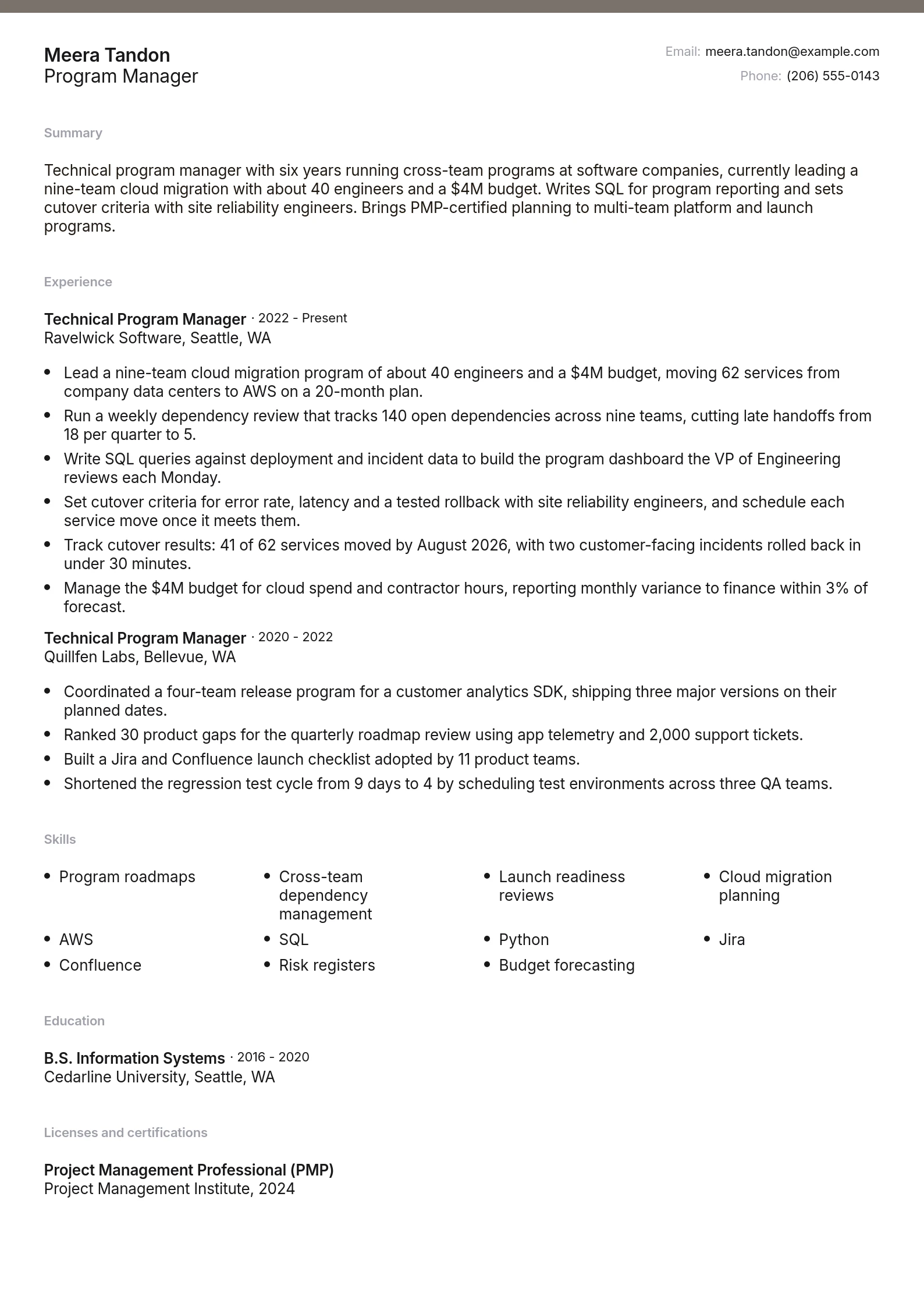
Leah's resume is written for remote software teams. Her first bullet names the platform, its 4,000 small business customers and the 3 engineering teams she coordinates. Later bullets cover a weekly dependency review in Jira, a release risk register in Confluence and go or no-go summaries for the VP of Engineering. It suits project managers in SaaS or internal IT who run quarterly releases and partner API integrations.
Teams, headcount and customer base in one bullet
Dependency and release risk tracking in Jira and Confluence
Three partner API integrations a year
Use the tool and document names from your setting's job ads
The keywords that matter on a project manager resume are the tools and terms in the ad you are answering, and they change with the setting. A construction ad asks for change order processes and Primavera P6. A software ad asks for Jira, dependencies and releases.
Put each tool in two places: the skills list, and the bullet where you used it, as in "Tracks budget, schedule and risks in Smartsheet and MS Project." A tool that appears only in the skills list is a claim. In a bullet, it shows what you used it for.
Copy the ad's exact wording for methods and documents. If it says "recovery plan", "RAID log" or "change order process", use that phrase in a bullet about work you did. Leave out tools you have only seen in a demo, because interviewers ask how you set them up.
Setting
Tools that appear in ads
Terms to use in bullets
Business and operations projects
Smartsheet, Microsoft Project, Excel, Microsoft Teams
Sponsor, change control, user acceptance testing, go-live, status report
Software and SaaS
Jira, Confluence, Slack, Google Workspace
Sprint, release, dependency, API integration, go or no-go
Construction and industrial
Procore, Bluebeam, Primavera P6, Microsoft Project
Bid documents, cost estimate, cost and schedule, recovery plan
Healthcare organizations
Smartsheet
Concurrent projects, performance metrics, escalation to sponsors, Lean
Agencies and marketing teams
Asana, Smartsheet
Statement of work, client review round, launch, hours against budget
Give each project a budget, team, length and finish
A strong project manager bullet tells the reader how big the project was and how it finished against plan, in one sentence. Write the budget, the team size, the length and the result against the original date and budget.
Use the budget you managed or tracked. If you never saw the budget, give another measure of size: sites, users, contract value or the number of trade packages. Add the people the project reached when that was its point, such as 240 claims adjusters or 12,000 field technicians.
State the finish plainly, including when it was late. "2 weeks past the original date and $40K under budget" is more believable than "on time and on budget" on every project. For a portfolio, give the rate instead, as in "9 of the last 10 closed projects within 5% of approved budget."
Budget, team, length and finish
Delivered route planning software to 180 drivers in 4 months with a 6-person team, $60K under its $450K budget.
Duties with no size or result
Responsible for planning, scheduling and coordinating projects with cross-functional stakeholders to ensure on-time delivery.
Write your PMP status exactly as it stands today
Claim PMP only after PMI confirms you passed the exam, and show your real status if you haven't. Most ads call it preferred, and some give you time after hire: one health system asks for PMP within a year, and an engineering firm hiring for electric power projects would like it within two.
PMI requires 36 months of experience leading projects in the past 10 years if you have a bachelor's degree, or 60 months with a high school diploma, plus 35 hours of project management training. Most junior candidates can't meet that yet, so they list a credential they hold, such as the Google Project Management Certificate.
When you hold PMP, put it in the credentials section with the year and end your summary with it too, as the mid-level, senior and IT examples do.
Your status
Credentials section
Summary
PMP held
Project Management Professional (PMP), Project Management Institute, 2023
End with "PMP since 2023."
Eligible, exam booked
PMP exam scheduled, with the month and year you booked
Leave PMP out of the summary until you pass
Not yet eligible
Google Project Management Certificate, Google via Coursera, with the year, or another course you finished
Name the certificate you hold
Experienced, no PMP
Leave the line out
Lead with project type, contract values and results, as the construction example does
Show the slip, what you changed and where the project landed
Your best bullet is often a project that went off plan, because it shows the judgment a hiring manager is paying for. Name the cause in a few words, list what you changed, and give the finish against the original date and budget.
Make the cause specific: a vendor integration 5 weeks late, a 5-week switchgear delay, a tax table update that arrived late, or client content that missed its date. "Overcame challenges" doesn't tell the reader how big the problem was.
Describe the actions as changes to the plan. Colin resequenced three site go-lives, added two weekend cutovers and moved training online. Mateo resequenced drywall and ceiling work around late switchgear. Leah split a release so most of it shipped on its planned date.
Close with the landing, even when the project was late. Colin's warehouse rollout finished 2 weeks past the original date and $40K under budget. Avery's website refresh launched its core pages 1 week behind instead of 4.
Scope changes count too. Show the requests that came in and what happened to them, as in "sponsors have approved 5 of 14 scope requests and moved 9 to a second phase." Use one recovery bullet per job, two at most, so the resume doesn't read as a run of rescued projects.
Senior resumes describe a portfolio, junior ones show projects under another title
A senior project manager resume describes a portfolio and the people running it, a mid-level one describes projects you ran yourself, and a junior one shows project work done under a coordinator, analyst or engineer title.
If you're senior, open the summary with the annual portfolio budget, the number of projects and the number of project managers you lead. Then write bullets for decisions only a senior person makes: what you paused or rescoped with the steering committee, which vendor terms you negotiated, and what you report each month and to whom.
Keep one or two bullets about individual projects with their numbers, because senior hiring managers still check that you have delivered. A budget record across the portfolio, like Rachel's 9 of 10 projects within 5%, covers the rest in one line.
At mid level, give your yearly project count and budget range in the first bullet of your current job, then pick the two or three projects that best match the ad for their own bullets.
If you're junior, keep your real title and let the bullets show ownership. Write "Runs 4 to 6 client projects at a time, $20K to $80K each" instead of "Supported project managers." Early in your career, add a student or volunteer project that had a budget and a team, like Avery's 200-person career fair.
In construction the usual ladder is project engineer, assistant project manager, then project manager. List each title with its own bullets, as Mateo does, so the reader sees when you started pricing change orders and buying out subcontracts.