Home care agencies read your state credential, CPR, TB result and background check before your experience, and the credential that counts depends on the state where you work. The examples cover a Florida agency aide, a senior aide in New York, an overnight caregiver in a Washington adult family home and a California family caregiver moving into paid work.
An agency caregiver who assists with self-administered medication
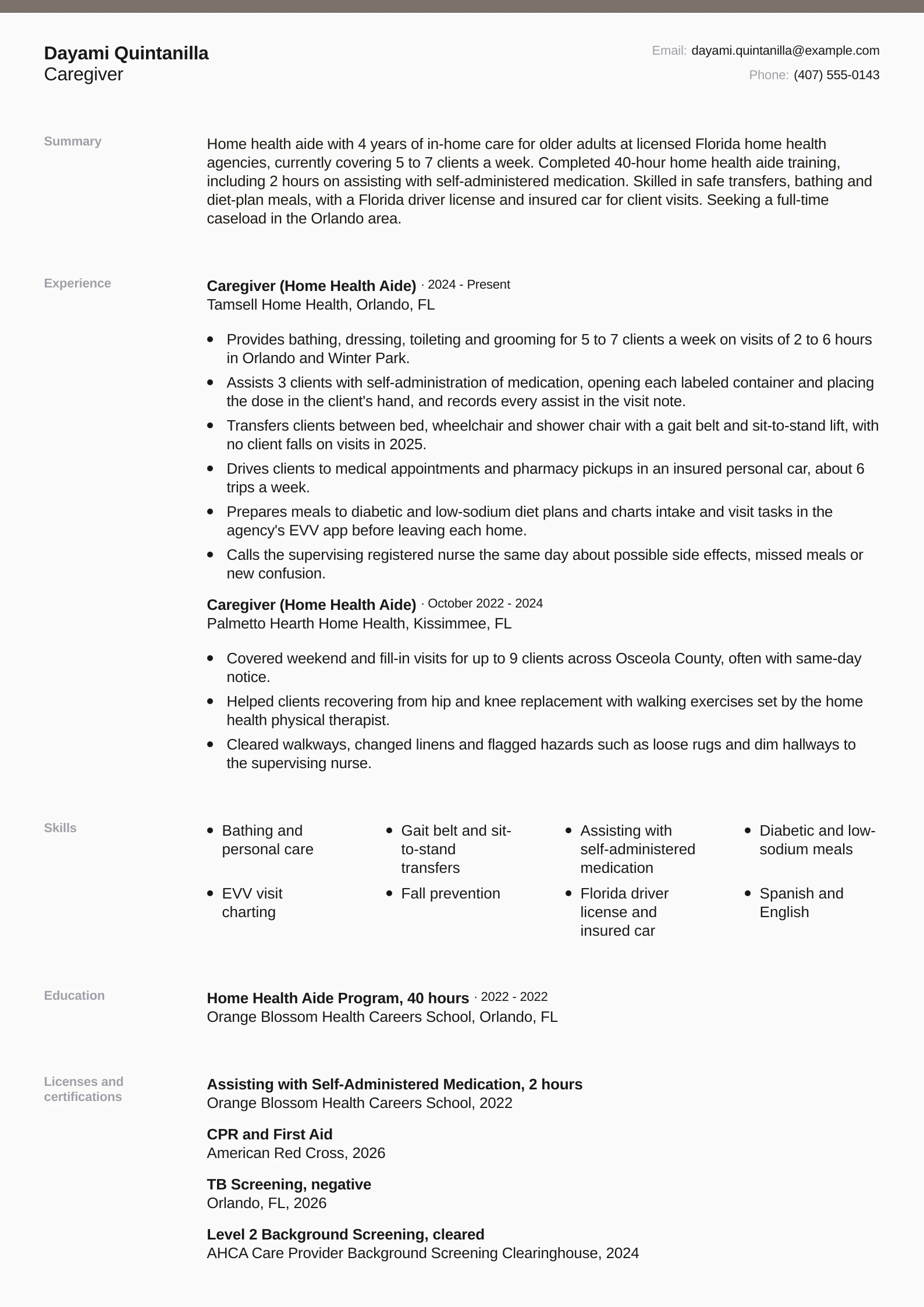
Dayami covers 5 to 7 clients a week for a licensed Florida home health agency. Her resume lists the 40-hour home health aide program and the separate 2-hour medication training, because Florida requires that training before an aide assists with self-administered medication.
Copy how each bullet pairs a task with its scale: visit length, transfer equipment, trips a week and the EVV app she charts in. If your agency has you only remind clients about medication, write that instead of her medication line.
Caregiver examples for New York, Washington and California
Each example uses its own state's credential title and a different kind of care: a lead aide who takes complex cases, overnight dementia care in a six-resident home, and five years of unpaid family care. Pick the one closest to your state and shift, then swap in your own clients and numbers.
Senior caregiver with 11 years at one New York agency
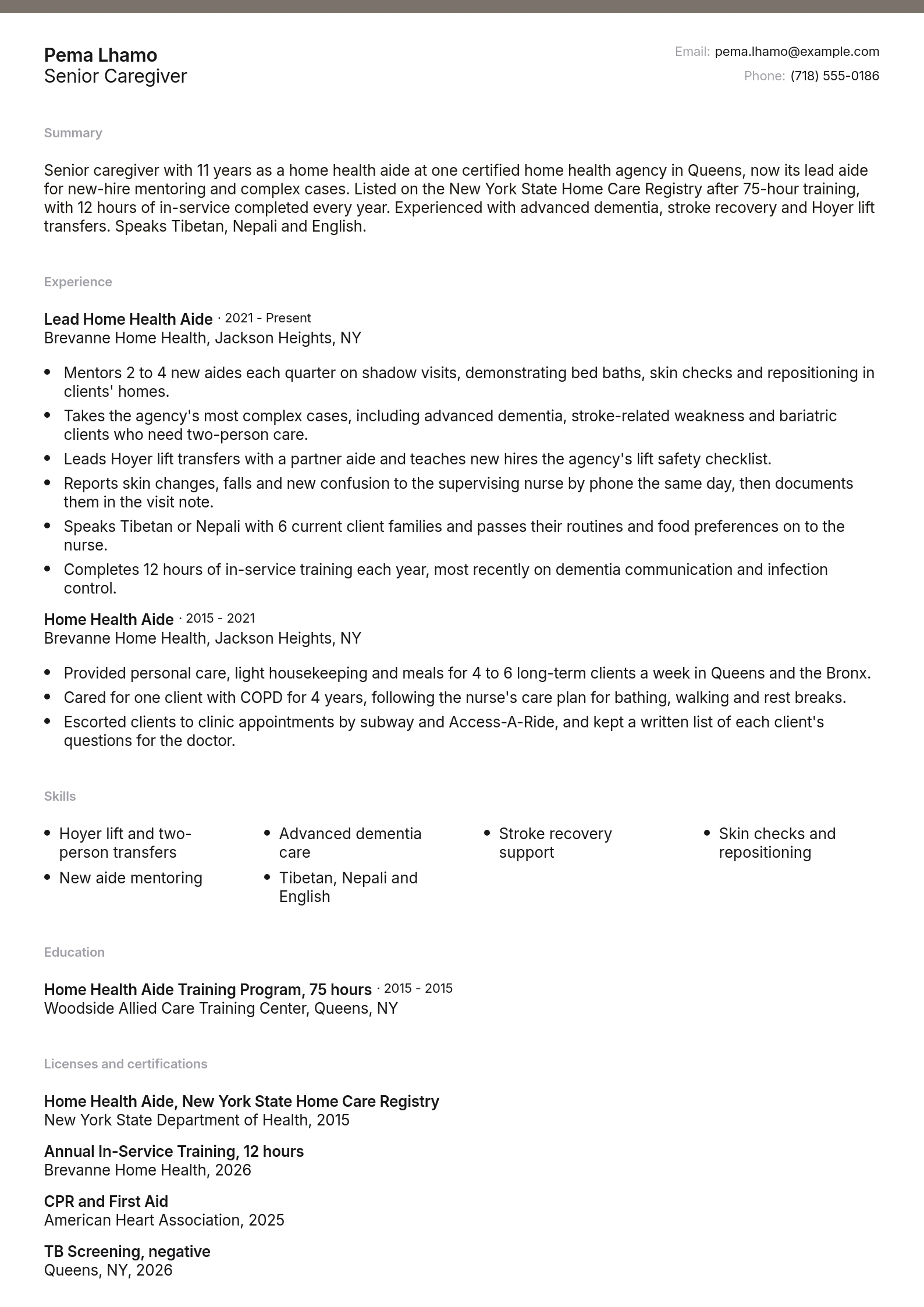
Pema's resume suits an aide with long service who now trains others. The credential section names the New York State Home Care Registry and the 12 hours of in-service she completes each year. Her lead role separates mentoring and Hoyer lift training from her earlier client work, and a bullet shows her Tibetan and Nepali in use with client families. Use it if you take the cases newer aides are not ready for.
Lead aide title with mentoring and lift training
New York State Home Care Registry listing after 75-hour training
Tibetan and Nepali used with current client families
Adult family home caregiver on overnight dementia shifts
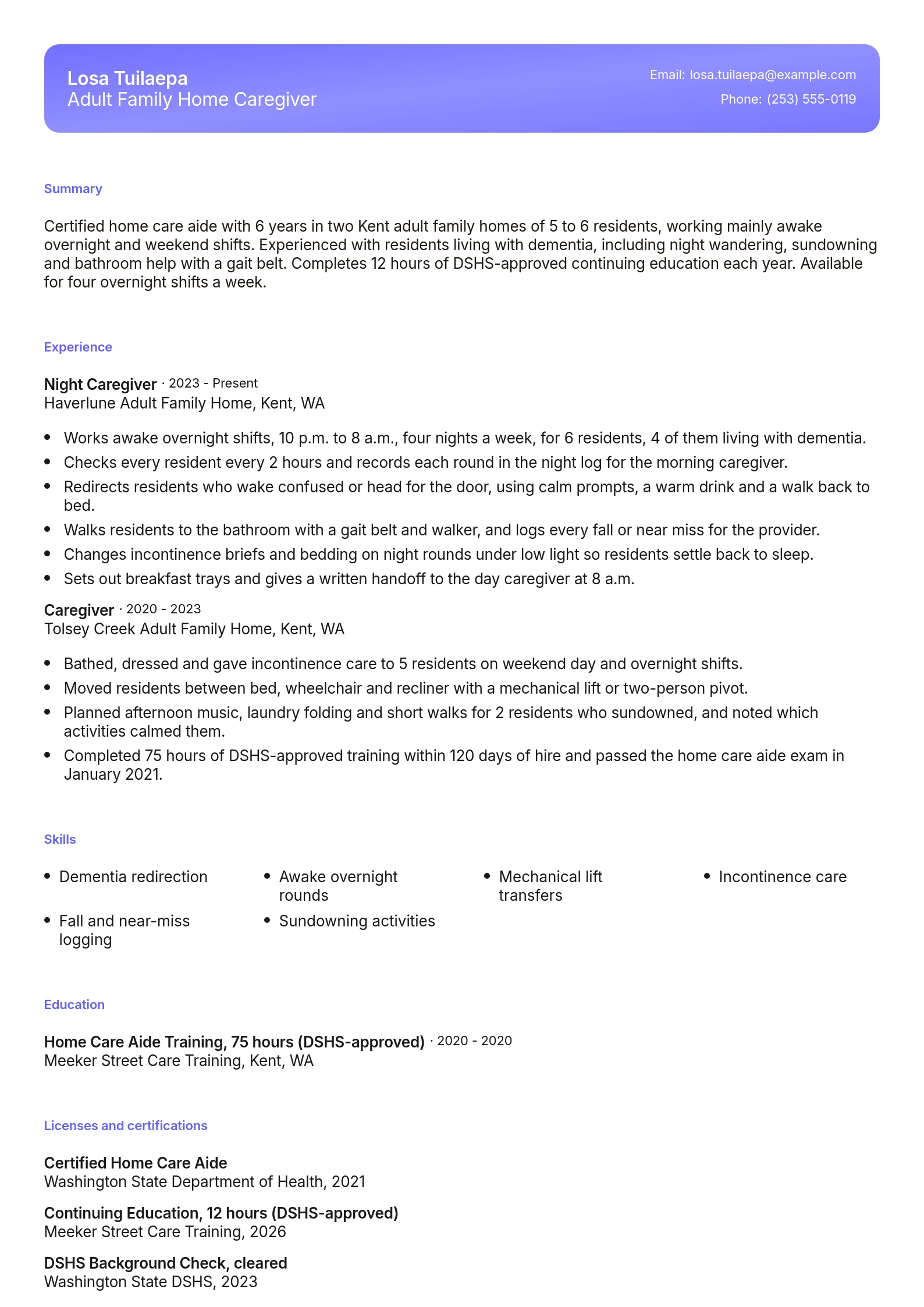
Losa's resume fits a caregiver in a small residential home who works nights and weekends. The first bullet gives the shift hours, the nights a week and how many of the 6 residents live with dementia. Night checks, redirection and fall logging each get their own line. Her Washington credentials show the Department of Health certification, the 75-hour training and this year's 12 hours of continuing education. Use it for awake overnight or adult family home roles.
Awake overnight shift hours in the first bullet
Night checks and dementia redirection as separate lines
Washington certified home care aide with 2026 continuing education
Family caregiver returning to paid work in California
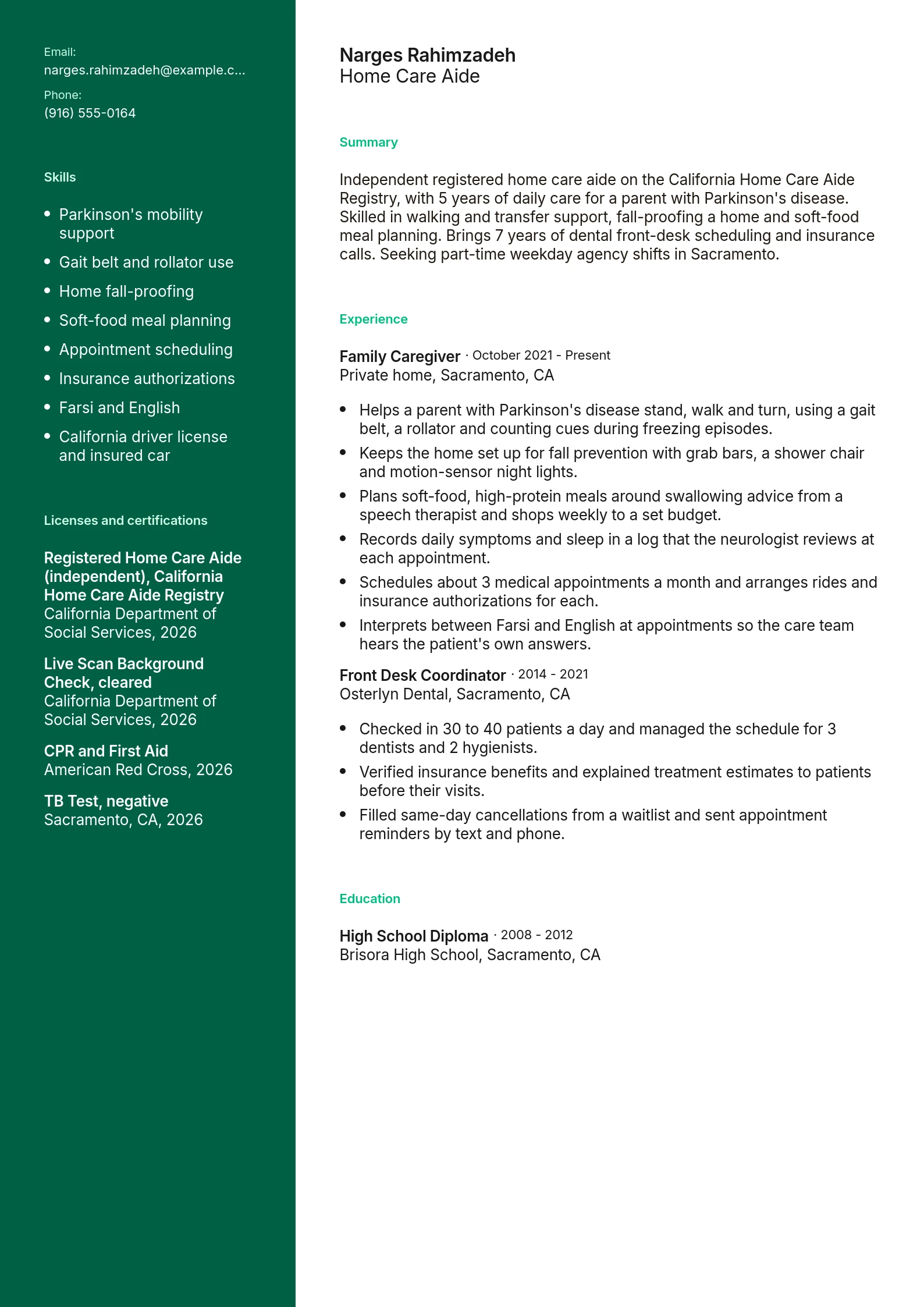
Narges's resume suits someone whose recent care was unpaid. Five years caring for a parent with Parkinson's appear as a dated role, with transfers, fall-proofing, soft-food meals and a symptom log written like paid work. She registered as an independent home care aide after a Live Scan check, and her future agency gives the 5-hour entry-level training. Her dental front-desk years add scheduling and insurance calls. Use it if you are moving from family care into part-time agency shifts.
Unpaid family care listed as a dated role
Independent registry listing with Live Scan clearance
Front-desk scheduling carried into appointment coordination
Put the state credential and clearances in your first lines
Agencies screen for the credential, CPR, a TB result, a background check and a driver license before they read your duties, so list them in a credentials section near the top and repeat the credential in your summary. Write the state and the exact title. "Certified Home Care Aide, Washington State Department of Health, 2021" reads as a credential, while "HCA certified" leaves a recruiter to work out which state and which title you mean.
Give every clearance a year so the reader can see it's current: "CPR and First Aid, American Red Cross, 2026" and "TB screening, negative, 2026". For the background check, name the system your state uses, such as Live Scan in California or the DSHS background check in Washington. Add your driver license and auto insurance if you'll drive to clients.
The table covers the four states in these examples and the federal rule for Medicare-certified agencies. Some states require only on-the-job training and others require a formal course and an exam, so confirm your title and hours with your state health or social services department before you write them. If you're a CNA on a state nurse aide registry, use our nursing assistant examples instead, because that title and registry lead a different resume.
Where you work
Title to write
Training to list
Record to name
Florida
Home health aide
At least 40 hours of training or a passed competency test, plus 2 hours before you assist with self-administered medication (it can be part of the 40), then in-service training each year and current CPR
Your training certificate, which the agency must hold before your first visit
Florida, companion or homemaker service
Companion or homemaker
No hands-on personal care to list
AHCA registration
New York
Home health aide
75 hours (59 classroom, 16 supervised practical) finished within 60 days, then 12 hours of in-service a year
New York State Home Care Registry
New York
Personal care aide
At least 40 hours using the state Home Care Curriculum
Training program name and year
Washington
Certified home care aide
75 hours of DSHS-approved training within 120 days of hire, a passed exam and certification within 200 days, then 12 hours of continuing education a year
Department of Health credential and DSHS fingerprint background check
California
Registered home care aide
If a home care organization employs you: 5 hours before client contact (2 orientation, 3 basic health and safety), then 5 hours a year
CDSS Home Care Aide Registry, after a Live Scan check. You can register without an employer as an independent aide
Medicare-certified agency, any state
Home health aide
At least 75 hours, including 16 hours of supervised practical training, then 12 hours of in-service a year
Your training program. A new one is needed after 24 months without paid aide work
Use the medication verb your training allows
Write each duty with the verb that matches your state rule and your agency's license, because an overstated duty is one of the quickest ways to fail a caregiver screen. "Administered medication" describes a licensed nurse's task, and a recruiter will read it that way.
In Florida, write "assisted with self-administration of medication" only after you've completed the 2-hour training, and list that training as its own credential line. Florida's rule covers bringing the labeled container, opening it and placing the dose in the client's hand, and it excludes injections, medication through a tube and doses that call for the aide's judgment. Where your agency allowed only reminders, write "reminded clients of medication times", which matches the "medication reminders" wording in agency ads.
Treat hands-on care and companion care as different jobs. If you bathed, toileted or transferred clients, name the task and the equipment, such as "bed-to-wheelchair transfers with a gait belt". If you worked for a Florida companion or homemaker service, list meals, errands, laundry and conversation, and leave personal care off, because those services provide no hands-on care.
Name who set the plan when a task came from one: "walking exercises set by the home health physical therapist" or "reported skin changes to the supervising nurse". A screener reading those lines can see where you fit in the care team.
Matches the Florida rule
Assists 3 clients with self-administration of medication, opening each labeled container and placing the dose in the client's hand, and records every assist in the visit note.
Overstates the duty
Administered daily medications and managed prescriptions for elderly clients.
Name the condition, the shift and the caseload in each bullet
Agency ads ask outright for dementia experience, awake overnight shifts and Hoyer lift transfers, so put those words in your bullets with a number attached. A manager matching you to a client looks for the condition, the hours and how many people you cared for at once.
For dementia care, name the behavior and what you did about it: "redirects residents who wake confused or head for the door" or "planned afternoon music and short walks for residents who sundowned". Add how many of your clients or residents had the diagnosis, such as "6 residents, 4 of them living with dementia". If you cared for one person with Parkinson's or Alzheimer's at home, name the condition and the years.
For overnight and live-in work, write the shift pattern exactly: "awake overnight, 10 p.m. to 8 a.m., four nights a week" or "live-in, 4 days on and 3 off". Say whether the shift was awake or asleep, because ads for night caregivers ask for staff who stay awake and alert. Then add what the night involved, such as checks every 2 hours, bathroom help and a written handoff to the morning caregiver.
Agency aides should give the caseload as clients per week and visit length: "5 to 7 clients a week, visits of 2 to 6 hours". Caregivers in adult family homes and assisted living give residents per shift. Private caregivers with one long-term client give the years instead, such as "4 years with one client".
Name transfer equipment by type, since ads list it by type: gait belt, sit-to-stand lift, Hoyer lift or two-person pivot. "Assisted with mobility" tells a manager nothing about whether you can handle a client who can't bear weight.