Physical therapy managers check your DPT, your license in their state and any ABPTS specialist title before they read a single bullet, so those lines have to be exact. Each example below is built for one setting, such as outpatient, acute care, schools, home health or travel contracts, with the numbers that setting is judged on.
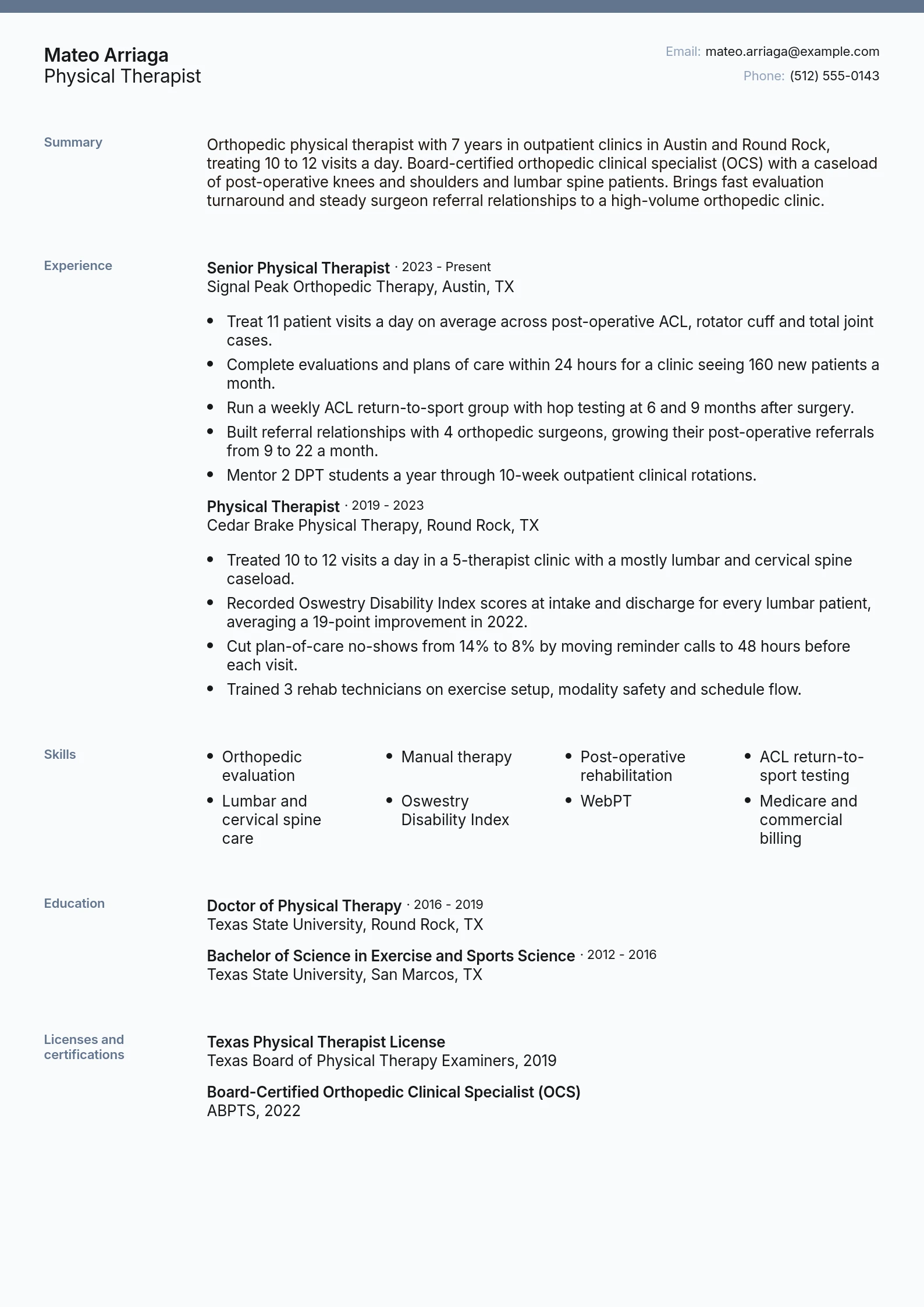
Outpatient orthopedic PT with an OCS and a Texas license
Mateo's resume puts his Texas license and OCS in a credentials section, then fills each role with the measures outpatient managers ask about: visits a day, new patients a month, referral growth and Oswestry scores. Copy this structure if you treat a full outpatient caseload and hold, or are working toward, a specialist title.
Physical therapist resumes by setting and career stage
Choose the example that matches the setting you're applying to, since that decides which numbers a manager expects. A skilled nursing PT applying to home health should start from the home health example.
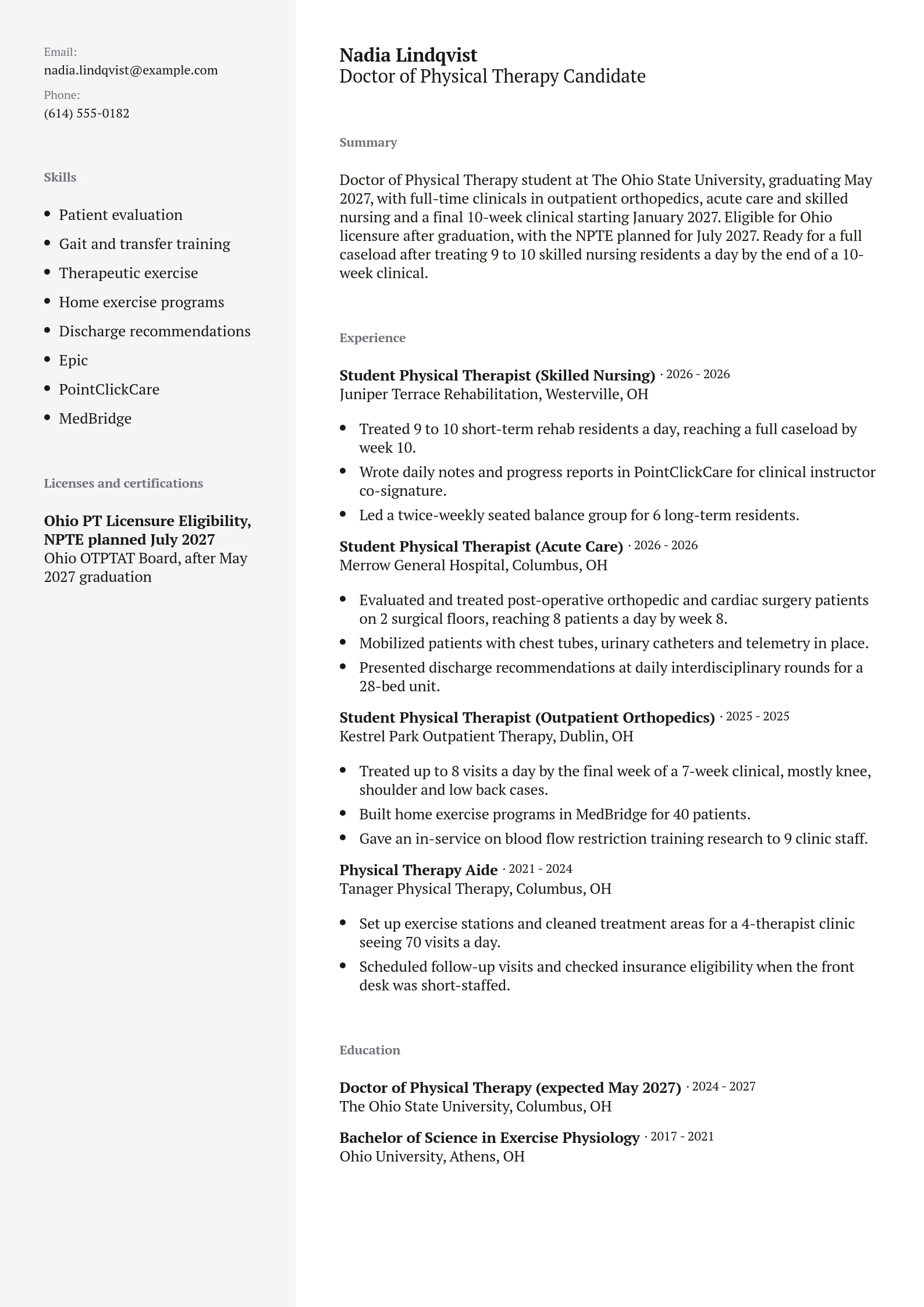
Final-year DPT student before the NPTE
Nadia graduates in May 2027, so her credentials line gives Ohio licensure eligibility after graduation and her planned NPTE date instead of a license. Each full-time clinical is its own entry with the setting in the title, the site and the caseload she reached by the final weeks. An aide job shows clinic experience from before school. Use it if you're finishing a DPT or waiting on your first license.
Ohio licensure eligibility and planned NPTE date
Clinicals listed as roles with caseload numbers
Aide job from before the DPT
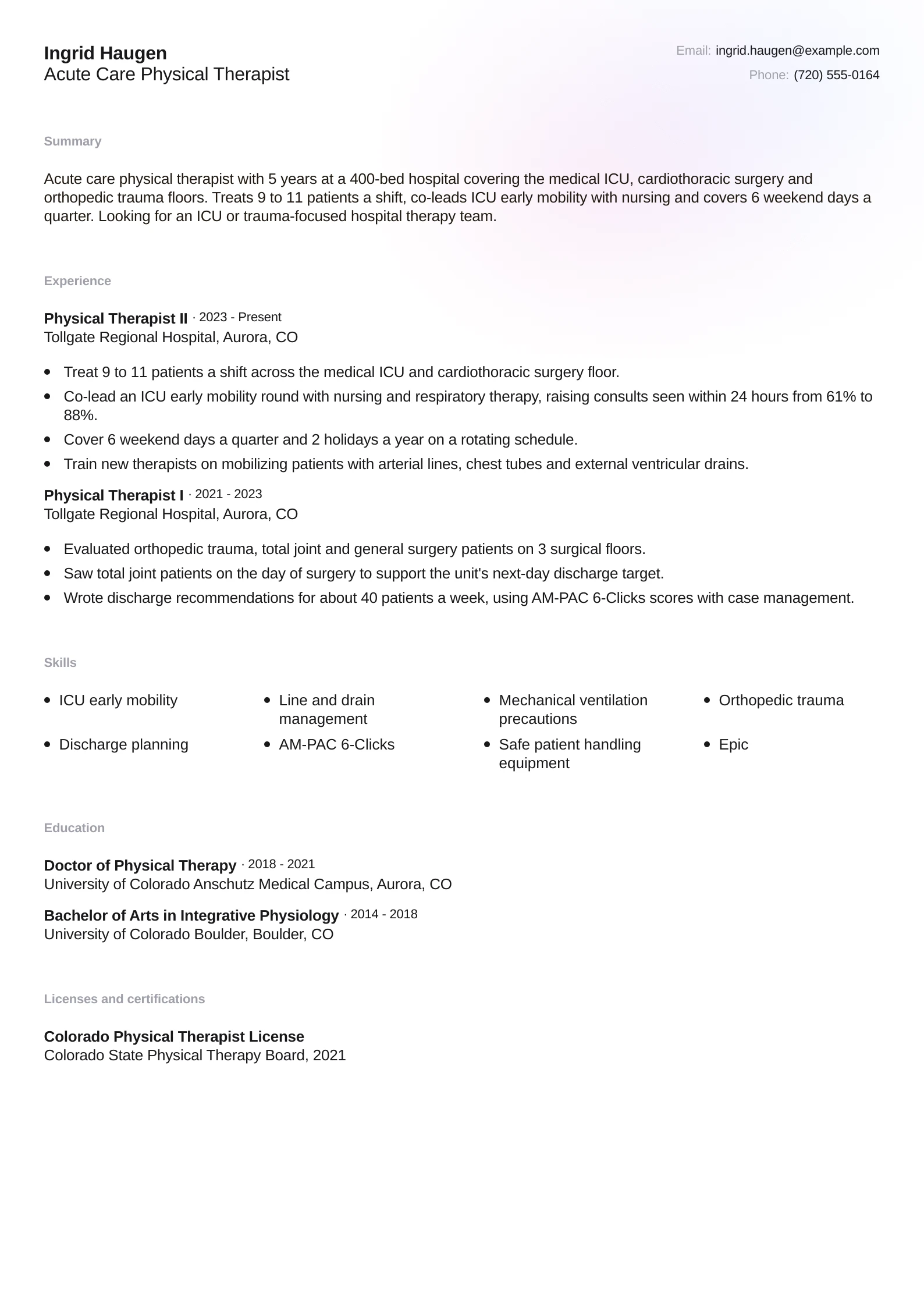
Acute care PT on ICU and surgical floors
Ingrid's two roles at one hospital show a promotion from PT I to PT II, with patients a shift, the units she covers and her weekend rotation stated plainly. Bullets name the lines and drains she works around, an ICU mobility round with nursing and a consult-response result. Use it if you're applying to a hospital that asks about ICU experience and weekend coverage.
PT I to PT II promotion at one hospital
Patients a shift and weekend days a quarter
Consults seen within 24 hours, before and after
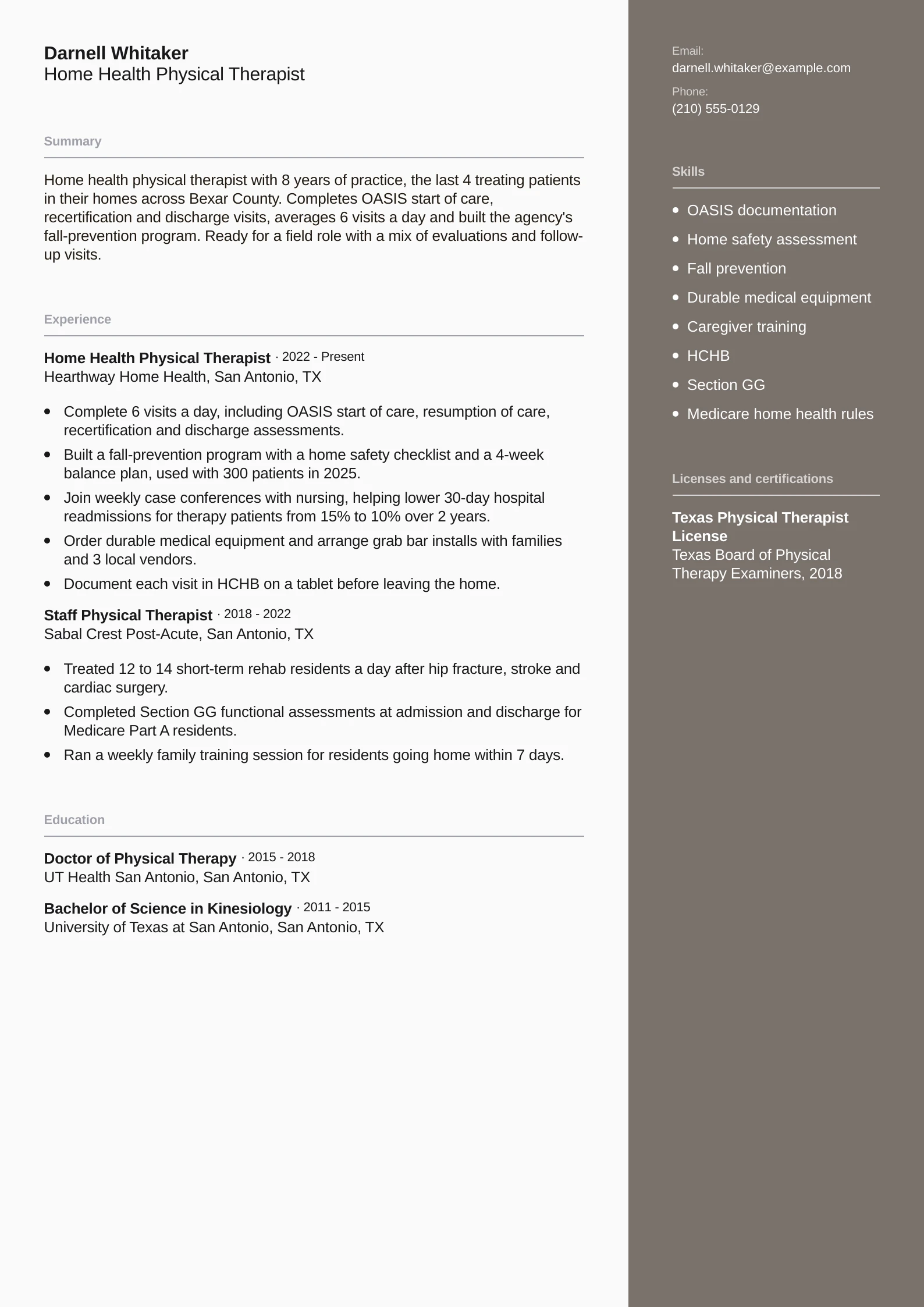
Home health PT with OASIS visits
Darnell names each OASIS visit type he completes, gives a visits-a-day figure and describes a fall-prevention program with a patient count. His earlier skilled nursing role adds Section GG assessments and family training before discharge. Use it if you work in home health, or you're moving there from a facility and need to show you can assess, document and plan care alone in a patient's home.
OASIS start of care, recertification and discharge
Fall-prevention program used with 300 patients
Skilled nursing role kept to three bullets
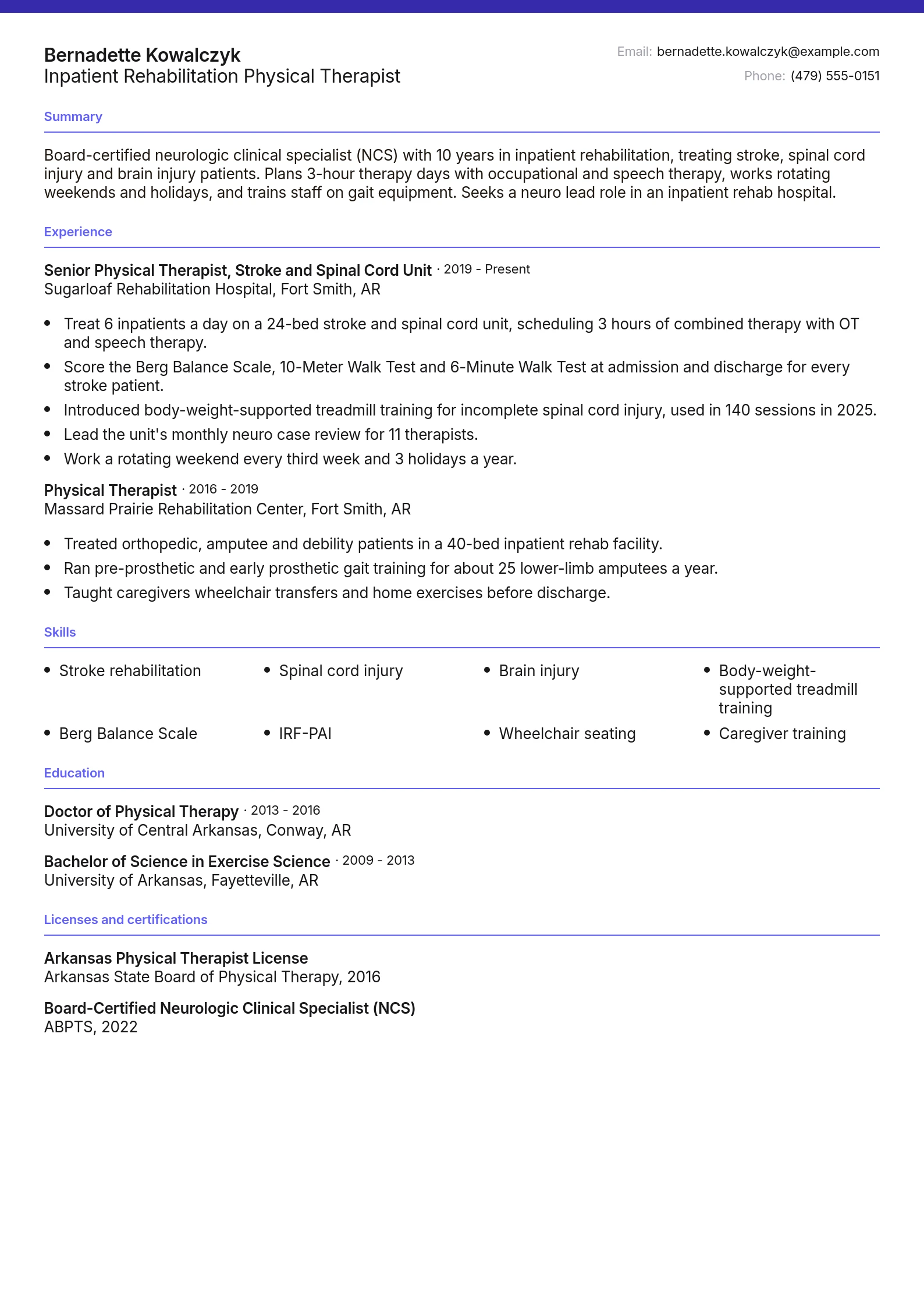
Inpatient rehab PT with an NCS
Bernadette's summary opens with her neurologic specialist title, and her bullets name the stroke and spinal cord unit, the outcome measures she scores at admission and discharge and the 3-hour therapy days planned with OT and speech therapy. Her rotating weekend and holiday schedule sits in its own bullet. Use it if you work in an inpatient rehab facility or hold a neuro certification you want read first.
NCS in the summary and credentials
Berg, 10-Meter Walk and 6-Minute Walk named
Rotating weekends written as a schedule
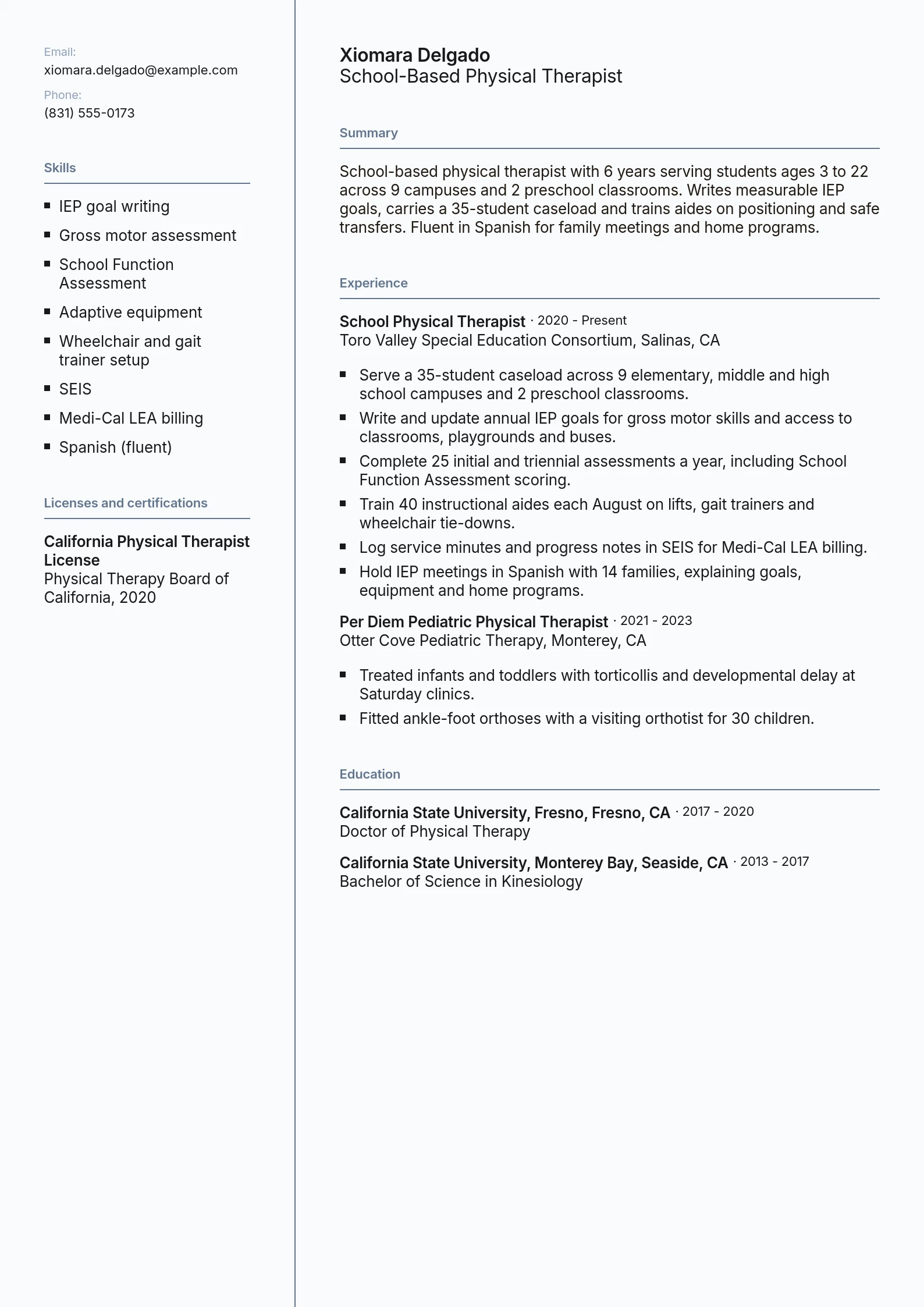
School-based PT with an IEP caseload
Xiomara gives her caseload size, the number of campuses and the assessments she completes each year, and names SEIS and Medi-Cal LEA billing. IEP goal writing, August aide training and Spanish-language family meetings each get a bullet. Use it if you work for a district, county office or special education consortium, or you're moving into schools from pediatric outpatient care.
35 students across 9 campuses
IEP goals, assessments and LEA billing
Per diem pediatric clinic as a second role
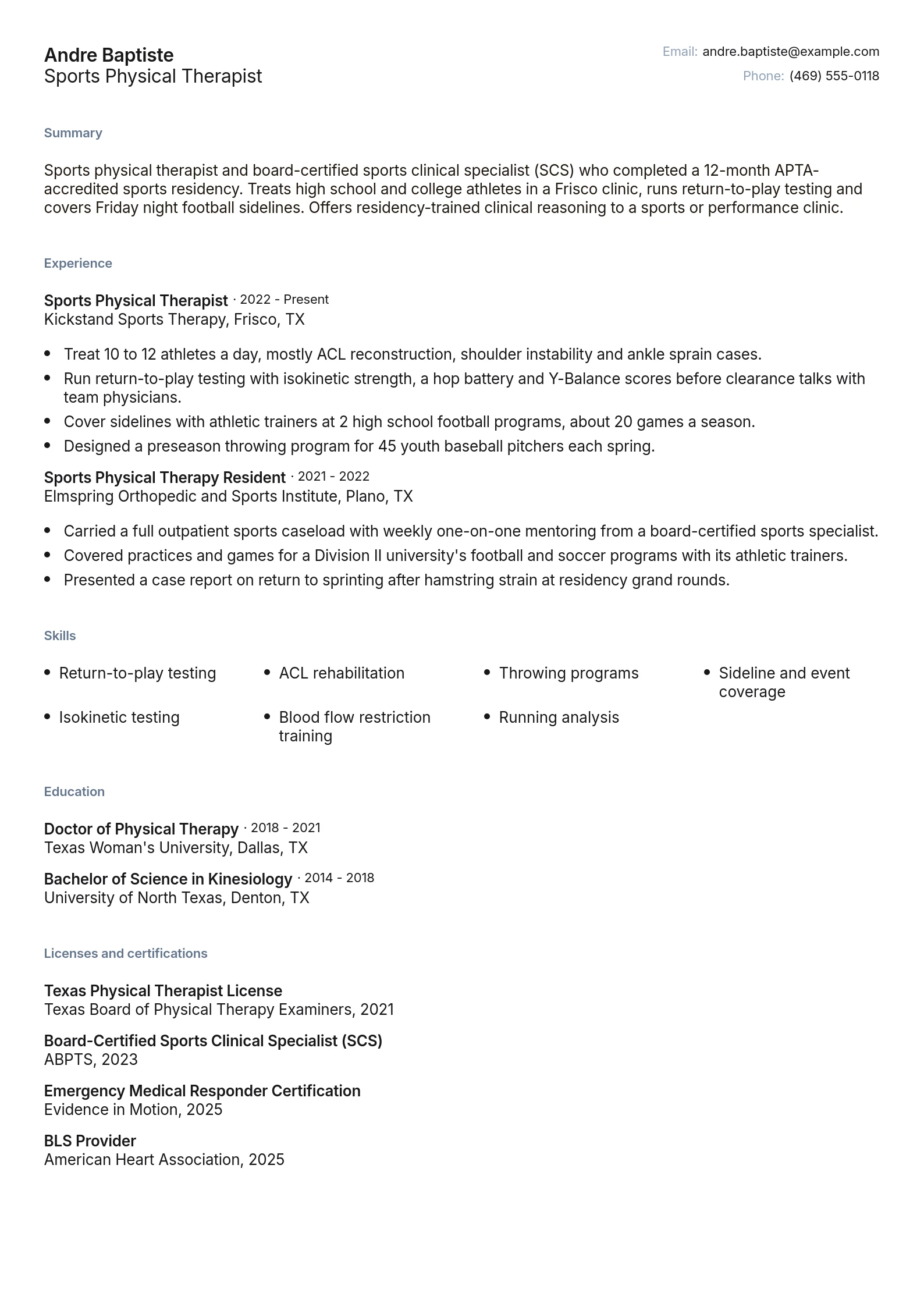
Sports PT with a residency and SCS
Andre lists his 12-month sports residency as its own role, so the mentoring, event coverage and case presentation count as experience. His current role names the return-to-play tests he runs, the two high schools whose sidelines he covers and a youth throwing program. Use it if you completed a residency or hold the SCS and want both read ahead of general orthopedic work.
Residency listed as a role with its own bullets
Return-to-play tests named
SCS with the year earned
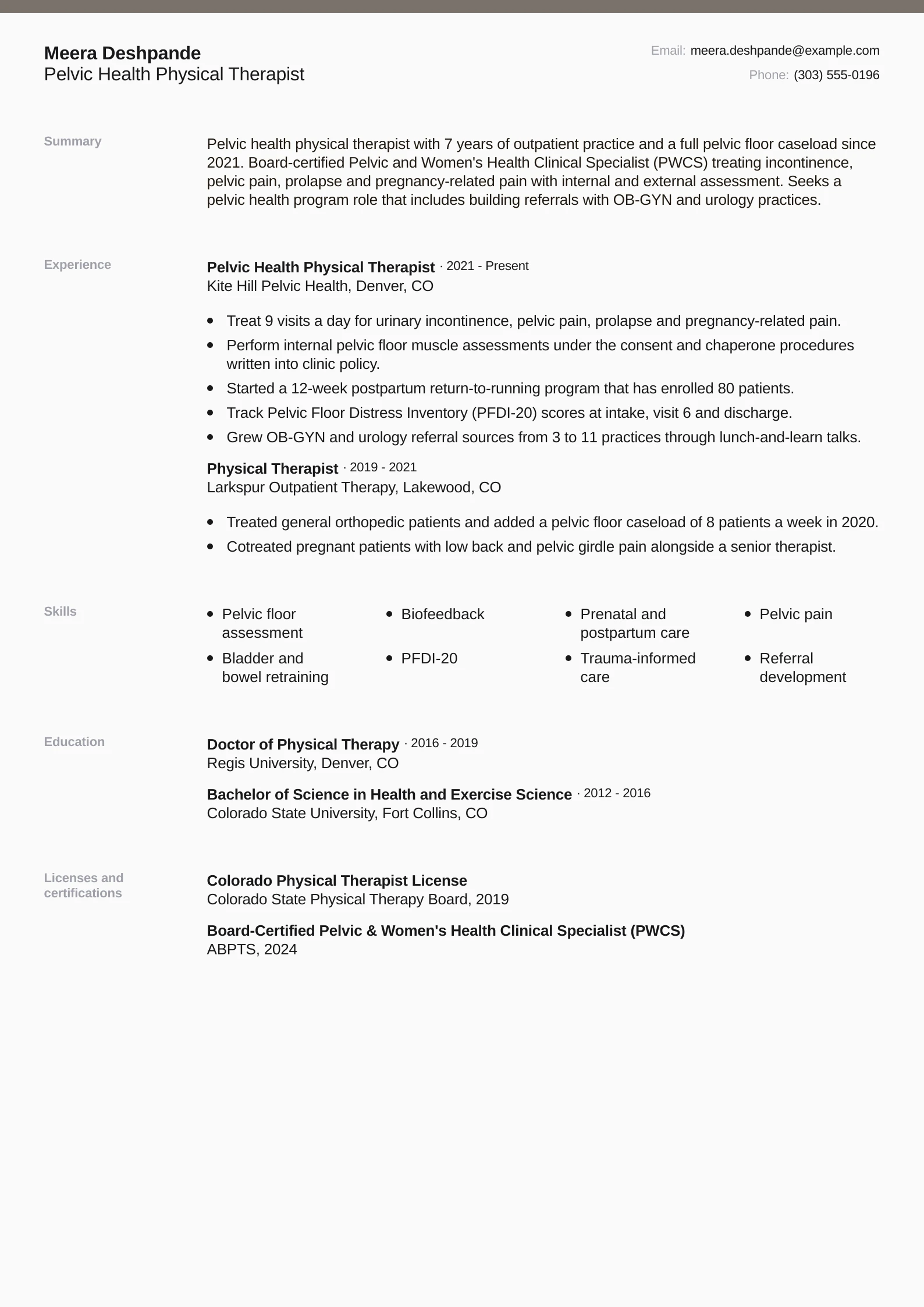
Pelvic health PT with a PWCS
Meera's credentials use the current PWCS title, and her bullets name the conditions she treats, the PFDI-20 scores she tracks and the consent and chaperone process for internal exams. A referral bullet shows growth from 3 to 11 OB-GYN and urology practices. Use it if you treat pelvic floor patients full time or are building that caseload inside a general outpatient job.
Current PWCS title in credentials
PFDI-20 tracked at three points
Referral sources grown from 3 to 11
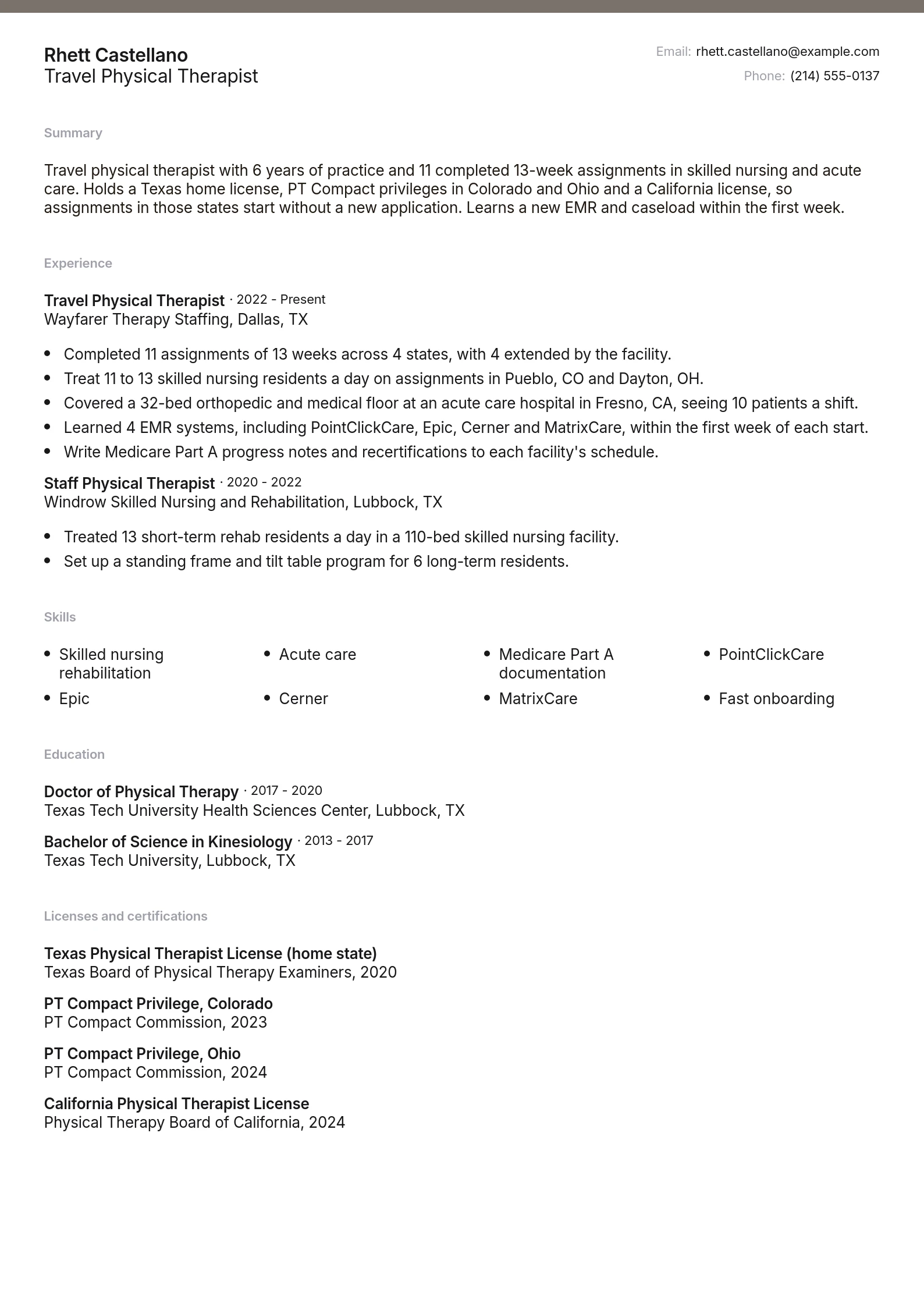
Travel PT with Compact privileges and a California license
Rhett's credentials section gives his Texas home license, two PT Compact privileges and a separate California license as four lines, each with the issuer and year. Bullets count assignments and extensions, put a city and state on each setting and list the EMR systems he has learned. Use it if you take contract work across state lines or plan to start.
Home license, two privileges and a California license
Assignments and extensions counted
City and state on every assignment
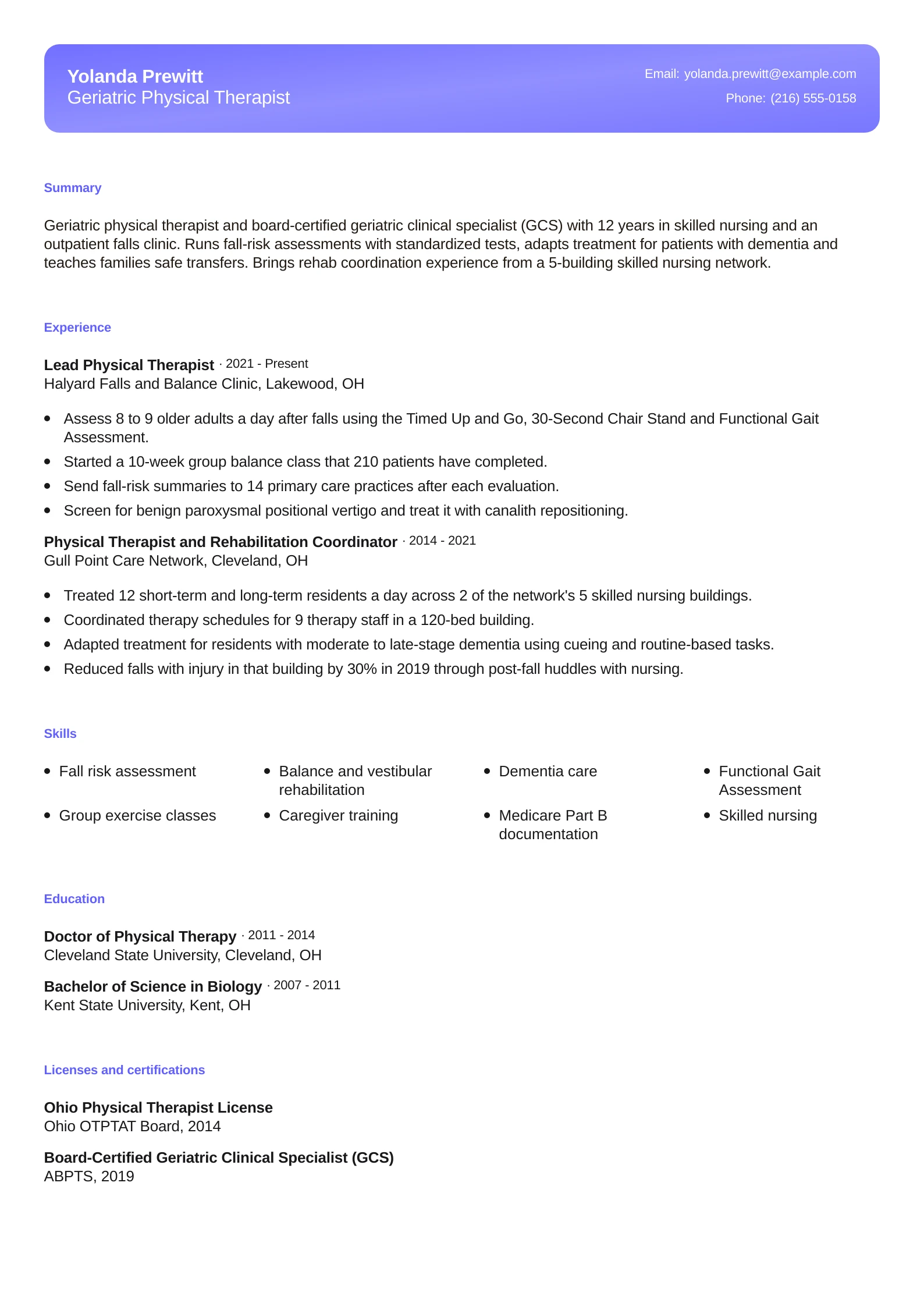
Geriatric PT with a GCS and a falls clinic
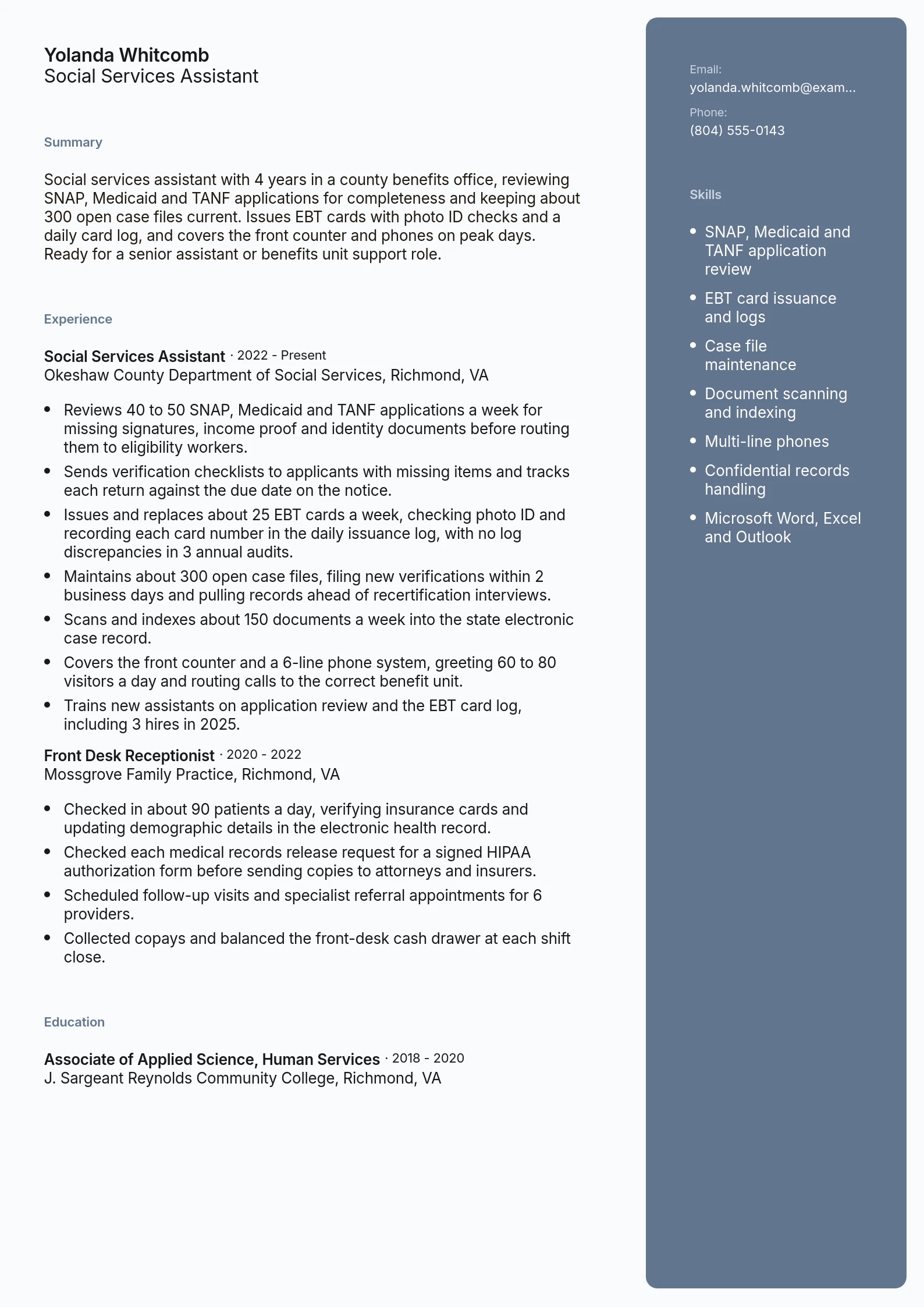
Yolanda's resume pairs an outpatient falls clinic role with 7 years in a skilled nursing network. Bullets name the Timed Up and Go, 30-Second Chair Stand and Functional Gait Assessment, a group balance class with a completion count and a drop in falls with injury in one building. Use it if you work with older adults in skilled nursing, outpatient or home settings.
GCS with the year earned
Fall-risk tests named in the first bullet
Falls with injury down 30% in one building
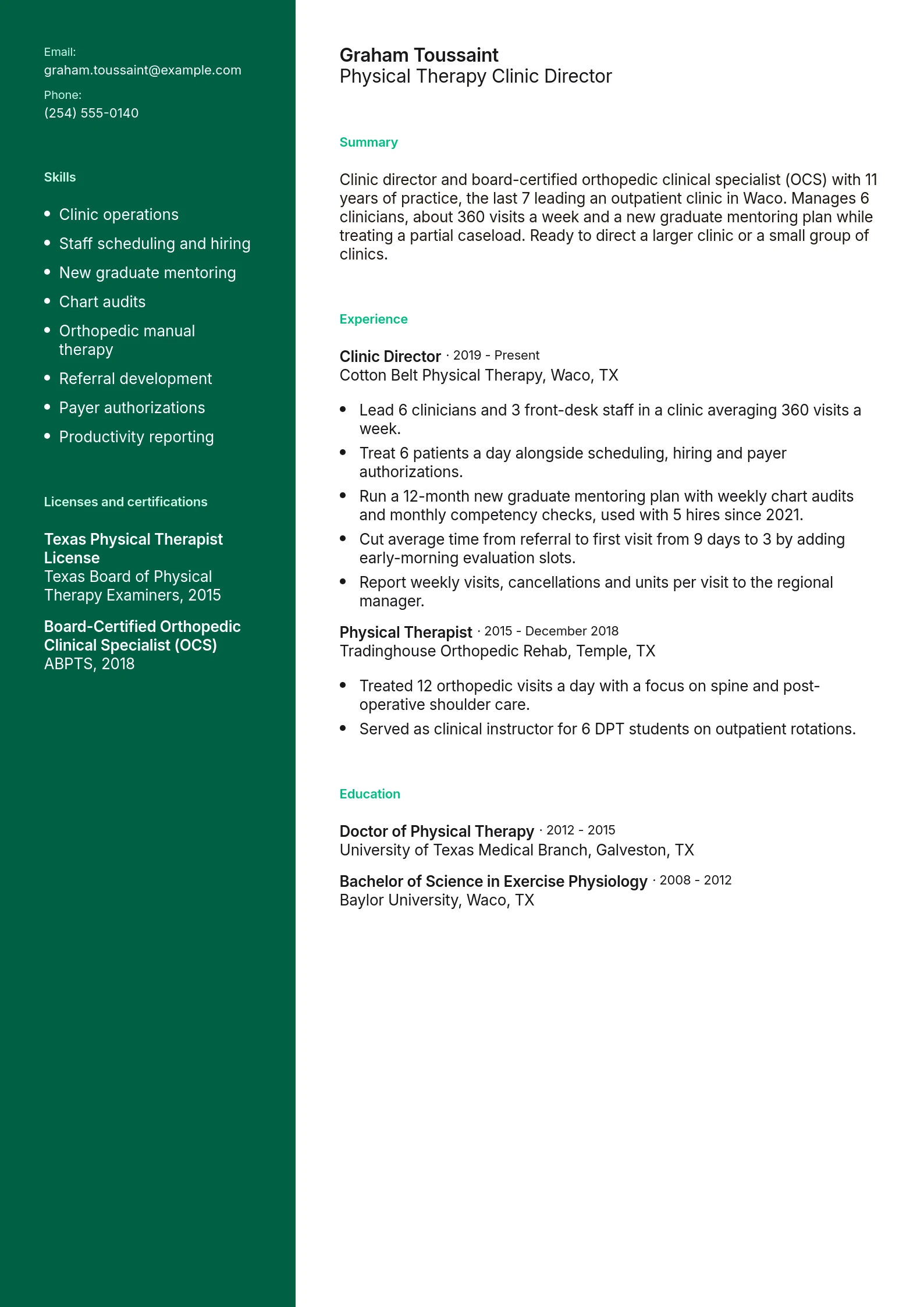
PT clinic director who still treats
Graham's director role leads with team size and weekly visits, then gives a referral-to-first-visit result, a new graduate mentoring plan and the reports he sends each week. One bullet keeps his 6-a-day caseload in view. Use it if you manage a clinic, or you're applying for your first director or clinic manager job and need clinical and business numbers on one page.
6 clinicians and 360 visits a week
Referral to first visit cut from 9 days to 3
Caseload kept alongside director duties
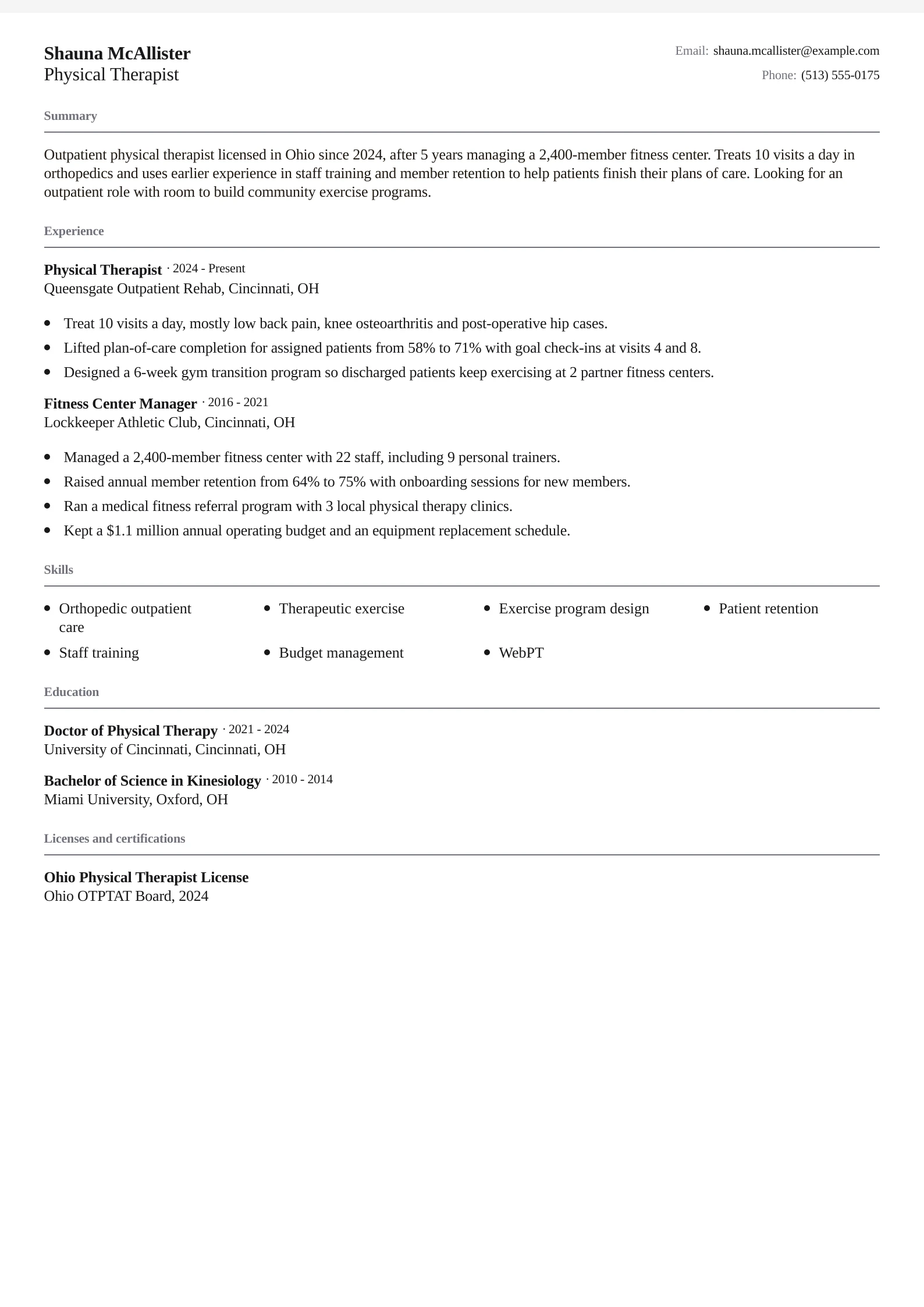
Career changer from fitness management to PT
Shauna's summary puts her Ohio license and outpatient caseload first and the fitness center second. Her earlier job keeps the numbers a clinic director cares about: members, staff, budget and retention. Her current bullets connect that background to plan-of-care completion and a gym transition program for discharged patients. Use it if you came to physical therapy from fitness, coaching or another field.
License and caseload ahead of the earlier career
Members, staff and budget from fitness management
Plan-of-care completion from 58% to 71%
Put the license and board title where managers look first
Put the DPT under education and everything else in a credentials section near the top of the page, written the way the issuing body names it, with the year. Managers confirm these before they read your experience, and many ads screen on 'licensed in the state of employment'.
After your name, write PT, then DPT, then any specialist title, as in 'PT, DPT, OCS'. Leave license numbers off. Employers look them up on the state board's site.
Credential
Where it goes
How to write it
Example line
Doctor of Physical Therapy
Education
Degree, school, city and years. Add 'CAPTE-accredited' only if the ad asks for it.
Doctor of Physical Therapy, Texas State University, Round Rock, TX, 2016 to 2019
State license
Credentials, first line
State and title, then the board that issued it and the year.
Write licensure eligibility and the NPTE date until the license arrives
Before your license is issued, write the stage you're at: eligible for licensure, the NPTE month and the state board you're applying to. Outpatient and sports residency ads often hire on 'licensure or eligibility', so this line meets the requirement without a license you don't hold yet.
Use DPT after your name once the degree is conferred, and add PT only when the license is issued. Repeat the NPTE month in your summary so a recruiter can plan a start date.
List each clinical rotation as its own entry titled 'Student Physical Therapist' with the setting in parentheses, then the site, dates and the caseload you reached, such as 'up to 11 visits a day by week 10'.
States the exact stage
DPT expected May 2027. Eligible for Ohio PT licensure after graduation, NPTE planned for July 2027.
Each setting measures a PT differently, so lead your bullets with the counts its managers use. Pair a count with a standardized outcome measure where you can, such as visits a day plus an average Oswestry or Berg change.
Put weekend and holiday rotations in a bullet when the ad mentions them, as hospital and inpatient rehab ads often do. Give outpatient productivity as visits a day, the figure most clinic ads quote.
Setting
Numbers to include
Example bullet
Outpatient orthopedics
Visits a day, new evaluations a month, referral sources, Oswestry or LEFS change
Treat 11 visits a day across post-operative knee, shoulder and spine cases.
Acute care
Patients a shift, units covered, weekend days, consults seen within 24 hours
Treat 9 to 11 patients a shift across the medical ICU and cardiothoracic floor.
Home health
Visits a day, OASIS visit types, counties covered, readmission rates
Complete 6 visits a day, including OASIS start of care and recertification.
Inpatient rehab
Patients a day, 3-hour therapy schedule, weekend rotation, admission and discharge scores
Score the Berg Balance Scale and 10-Meter Walk Test at admission and discharge.
Skilled nursing
Residents a day, facility beds, Section GG assessments, Medicare Part A notes
Treated 13 short-term rehab residents a day in a 110-bed facility.
Schools
Students on caseload, campuses, IEPs and assessments a year
Serve 35 students across 9 campuses and write their annual IEP goals.
Give each state license and Compact privilege its own line
List every active license and PT Compact privilege on a separate line, starting with your home-state license. A privilege depends on that home license and expires on the same date, so a manager reading 'PT Compact Privilege, Colorado' expects to see the home state directly above it. Renewing the home license doesn't renew the privilege.
California and New York are not part of the PT Compact, so working there takes a full license from that state's board. Write it like any other license: 'California Physical Therapist License, Physical Therapy Board of California, 2024'. Check each Compact state's jurisprudence rule before you buy a privilege, since Texas and Ohio require their exam first and Colorado requires none.
Travel PTs should put a city and state next to each assignment, such as 'Pueblo, CO' or 'Fresno, CA', so the reader can match it to a license or privilege. List a privilege you haven't used yet too, because it tells a staffing agency where you can start without a new application.
An ABPTS title isn't tied to a state, so it moves with you unchanged. Keep it on its own line below your licenses with the year earned.
Choose a template that keeps credentials on the first screen
The right physical therapist resume template is one where your license and specialist title appear without scrolling. A two-column layout handles this well, because short items such as licenses, outcome measures and EMR systems fit in the narrower column.
Pick a layout with more room for credentials if you have several: a home license, Compact privileges, a second state license and an ABPTS title can run to five lines. If you have one license and no specialist title, a layout that gives more width to experience suits you better.
Put the setting in your job titles where it applies, such as 'Acute Care Physical Therapist' or 'Student Physical Therapist (Outpatient Orthopedics)'. Titles are the first words read in each role, and they tell a hiring manager in seconds whether your experience matches their unit.
Copy the credential and setting terms from the PT ad
The physical therapy resume keywords that matter most are the credentials and the setting, written the way the ad writes them: 'Doctor of Physical Therapy', 'licensed in the state of employment', 'eligibility for licensure', 'OCS' or 'sports residency', and a setting such as 'inpatient rehabilitation' or 'home health'. Use each once in your summary or credentials and again in a bullet.
Then add the clinical terms for that setting. Outpatient ads use manual therapy, post-operative rehab and plan of care. Hospital ads use early mobility, discharge planning and AM-PAC. Home health ads use OASIS and fall prevention, and school ads use IEP goals and gross motor assessment.
Name documentation systems you have used, such as Epic, WebPT, HCHB or PointClickCare, in your skills list. Skip soft-skill words like 'team player'. A bullet about training aides or leading case conferences shows the same thing with evidence.