An SLP resume is read credential first, so your state license, your CCC-SLP and, for school jobs, your state education credential each need their own line with the issuer named. The nine examples cover a Clinical Fellow on a Texas intern license, a former music teacher and clinicians in schools, hospitals, nursing facilities, early intervention, telepractice, bilingual practice and AAC.
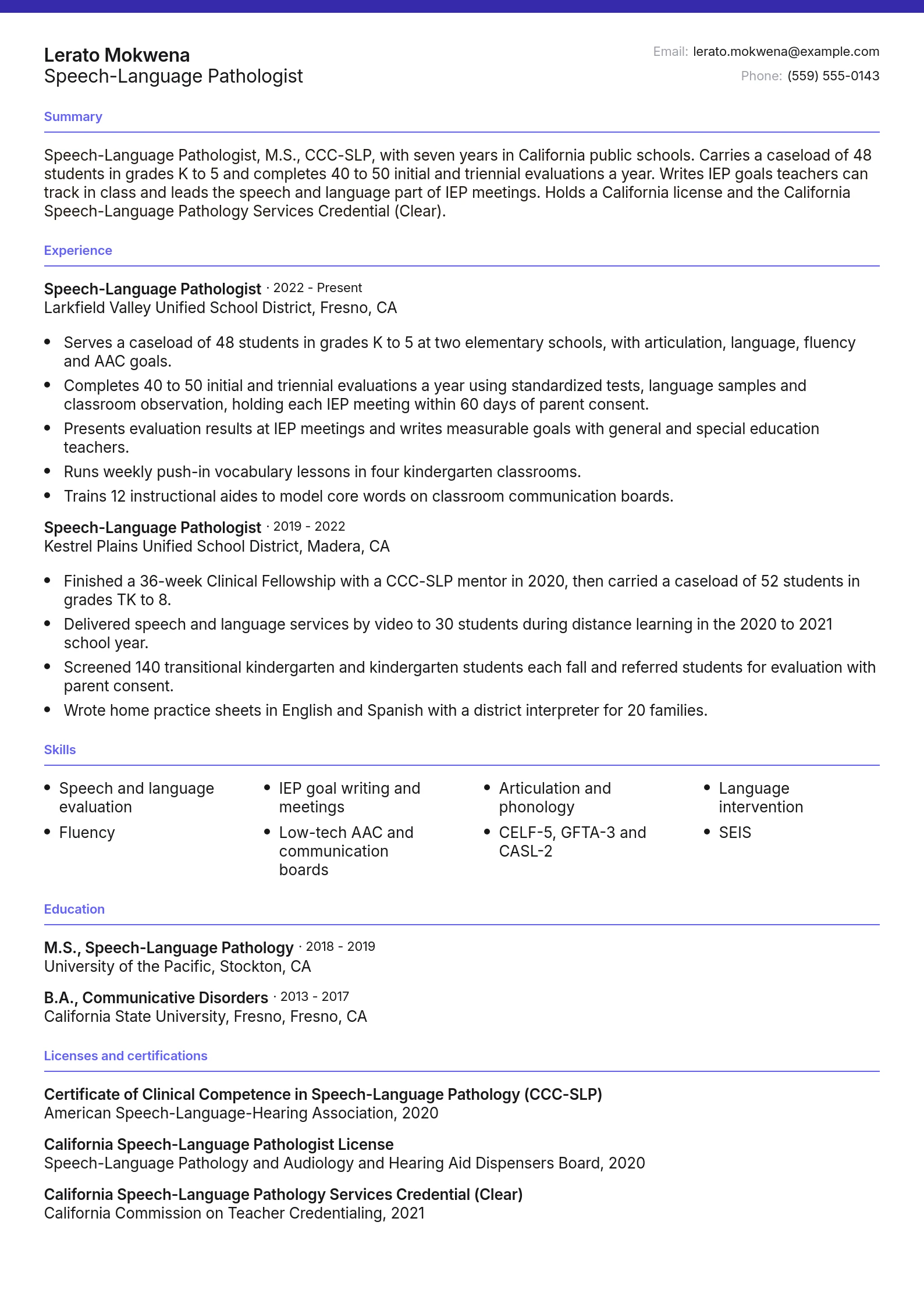
School SLP with the CCC-SLP, a California license and a Clear credential
Lerato's resume is the layout most school SLPs need. Her credentials section lists three separate items, each with its issuer and year, the same way California district postings list them as requirements. Her current role opens with caseload size, grade range and evaluation count.
If you work in another state, keep the structure and swap in your state's license and education credential names exactly as they appear on your documents. Keep the IEP and evaluation bullets near the top, since school postings stress evaluating students for special education.
Clinical Fellow, medical, contract and specialist SLP resumes
Pick the example closest to your setting first, then your career stage. Each one handles the credential line differently: the Clinical Fellow shows an intern license and a fellowship in progress, the contract and telepractice examples list a license for each state, and the career changer keeps the teaching experience that supports therapy work.
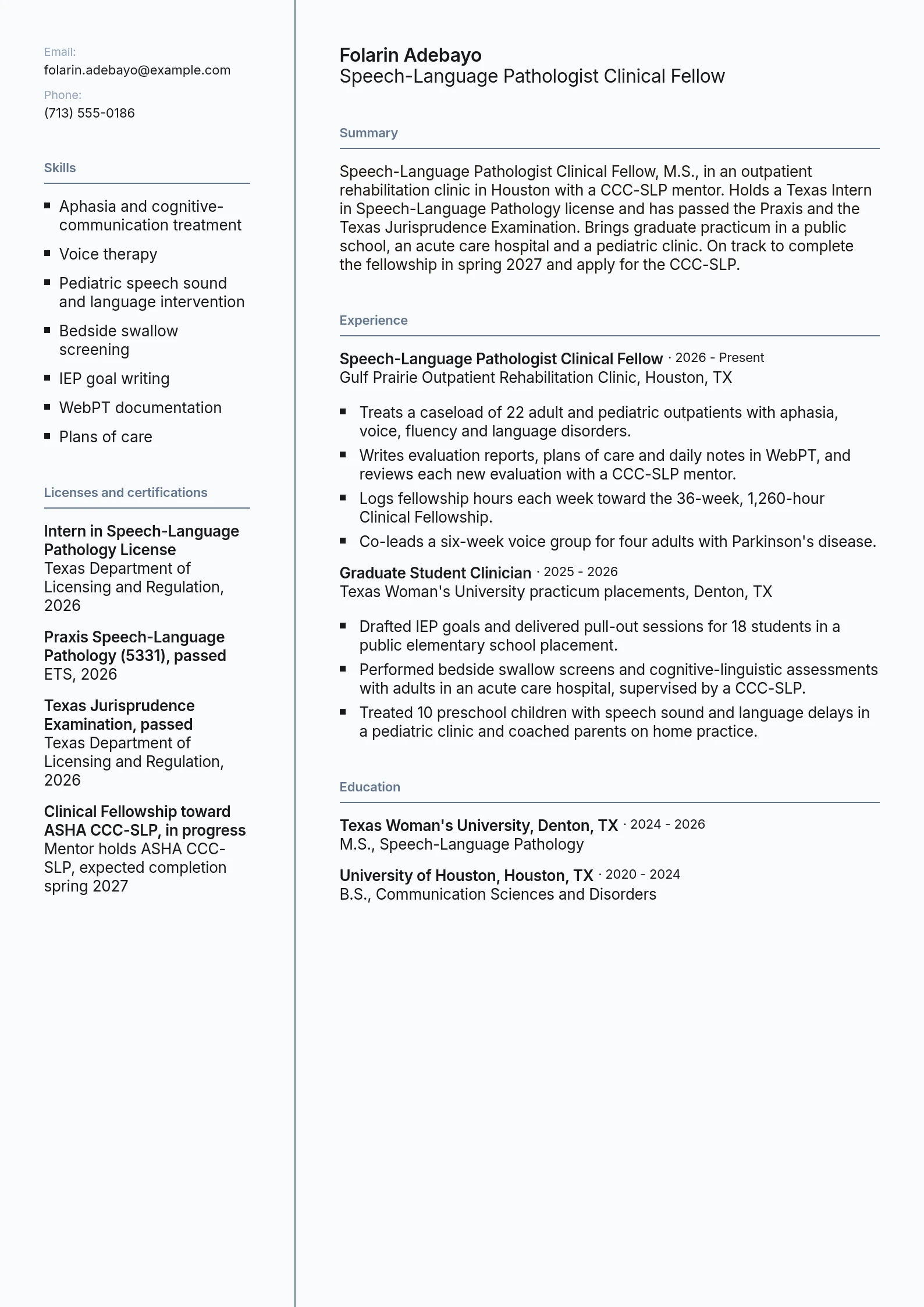
Clinical Fellow on a Texas intern license
Folarin's credentials section lists what a Clinical Fellow actually holds: a Texas Intern in Speech-Language Pathology license, a passed Praxis and the Texas Jurisprudence Examination, plus a fellowship line with the expected finish. The job title reads Clinical Fellow, and the CCC-SLP appears only as the fellowship's goal. Practicum gets its own entry with one bullet per setting. Use this layout if you graduated recently and your CCC-SLP application hasn't gone in yet.
Texas intern license, Praxis and jurisprudence exam on separate lines
Fellowship line names the mentor's CCC-SLP and a spring 2027 finish
Practicum bullets cover a school, an acute care hospital and a pediatric clinic
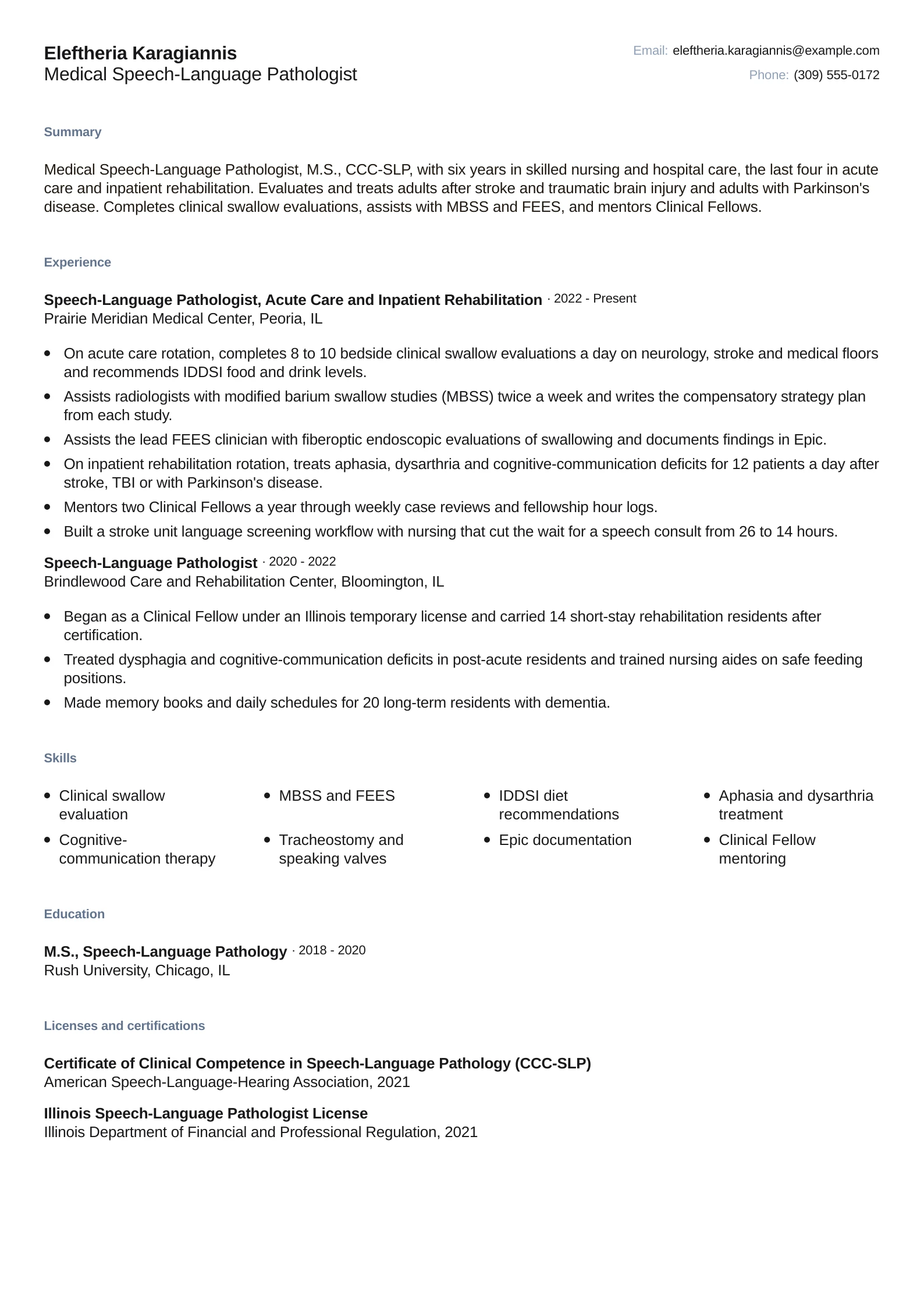
Acute care and inpatient rehab SLP
Eleftheria's bullets name the procedures hospital postings list: bedside clinical swallow evaluations, MBSS and FEES, with daily volume and the IDDSI food and drink levels she recommends. Her rehab bullet gives diagnoses and a daily patient count, and a mentoring bullet shows she trains Clinical Fellows, which hospital ads often prefer. Choose this example if you work in acute care, inpatient rehab or another medical setting and want dysphagia work up front.
8 to 10 bedside swallow evaluations a day with IDDSI recommendations
MBSS and FEES shown as studies she assists with
Earlier skilled nursing role kept to three bullets
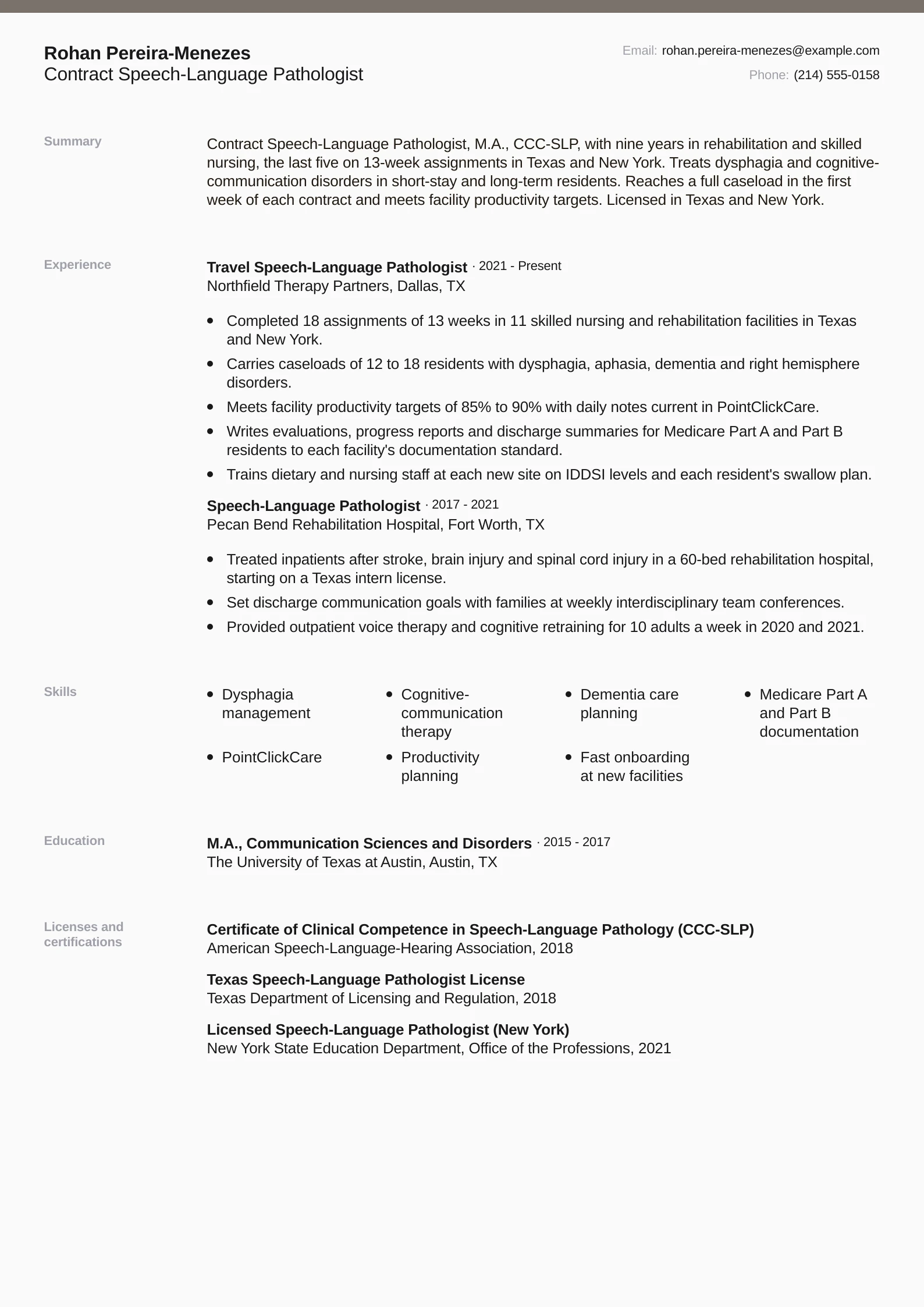
Contract SLP licensed in Texas and New York
Rohan groups five years of 13-week assignments under one agency entry instead of listing 11 facilities. His bullets give the assignment count, caseload range and productivity target, which are the first things a staffing recruiter asks about. Two state licenses sit on separate lines with each licensing body named. Use this layout for travel, per-diem or PRN work in skilled nursing and rehab facilities, or for any role with assignments in more than one state.
One agency entry covering 18 assignments in two states
Productivity of 85% to 90% with PointClickCare documentation
Separate Texas (TDLR) and New York (NYSED) license lines
Early intervention SLP for birth to three
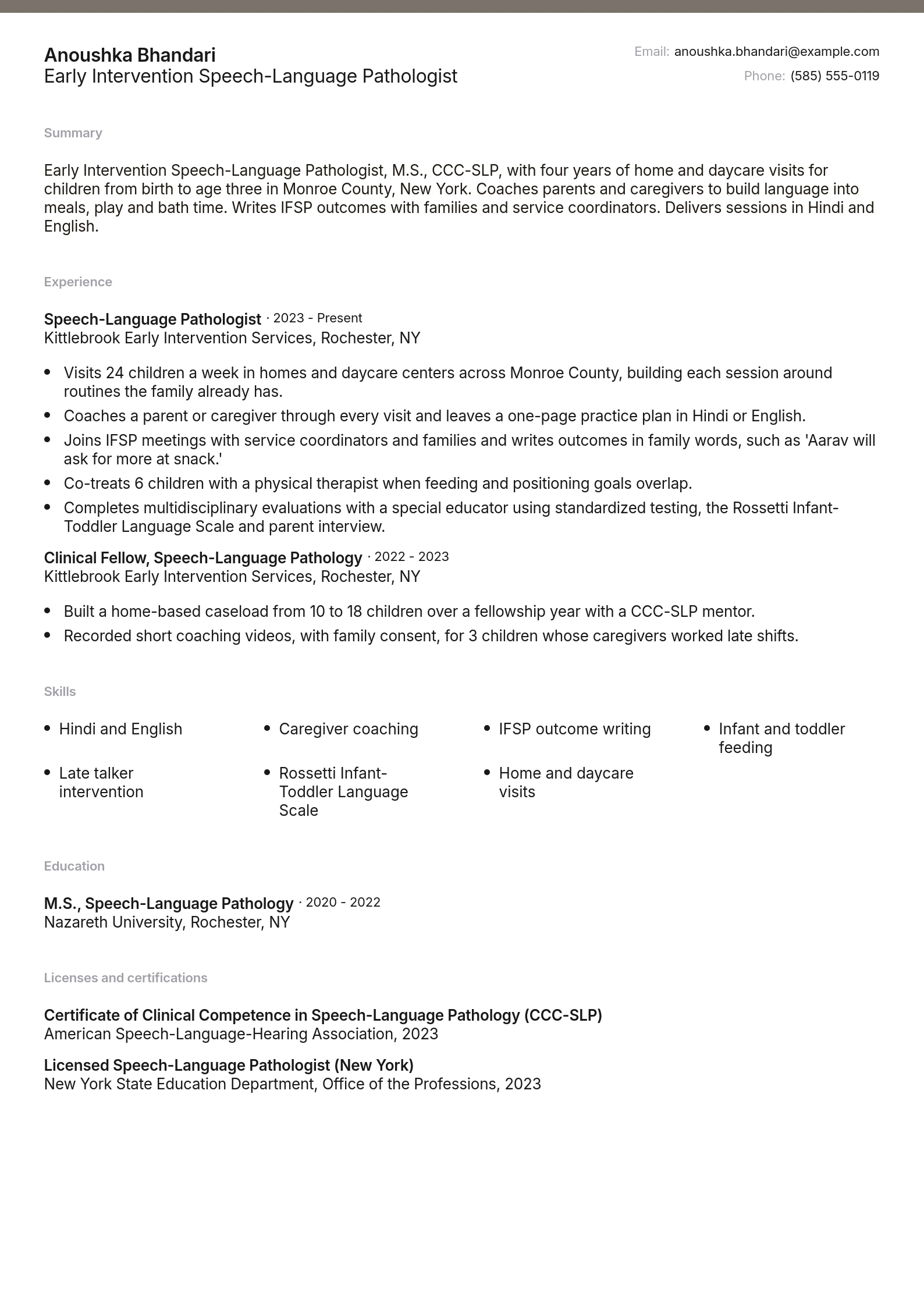
Anoushka's resume is written for home-based early intervention: visits per week, homes and daycare centers as the settings, and caregiver coaching as the main method. One bullet quotes an IFSP outcome in family words, and another names the infant-toddler language scale she uses in evaluations. Hindi appears in the summary, a bullet and the skills list. Pick this one if your sessions happen inside family routines rather than a therapy room.
24 home and daycare visits a week across one county
IFSP outcome quoted in the family's own words
Clinical Fellowship shown as its own role at the same agency
Telepractice SLP with two state licenses
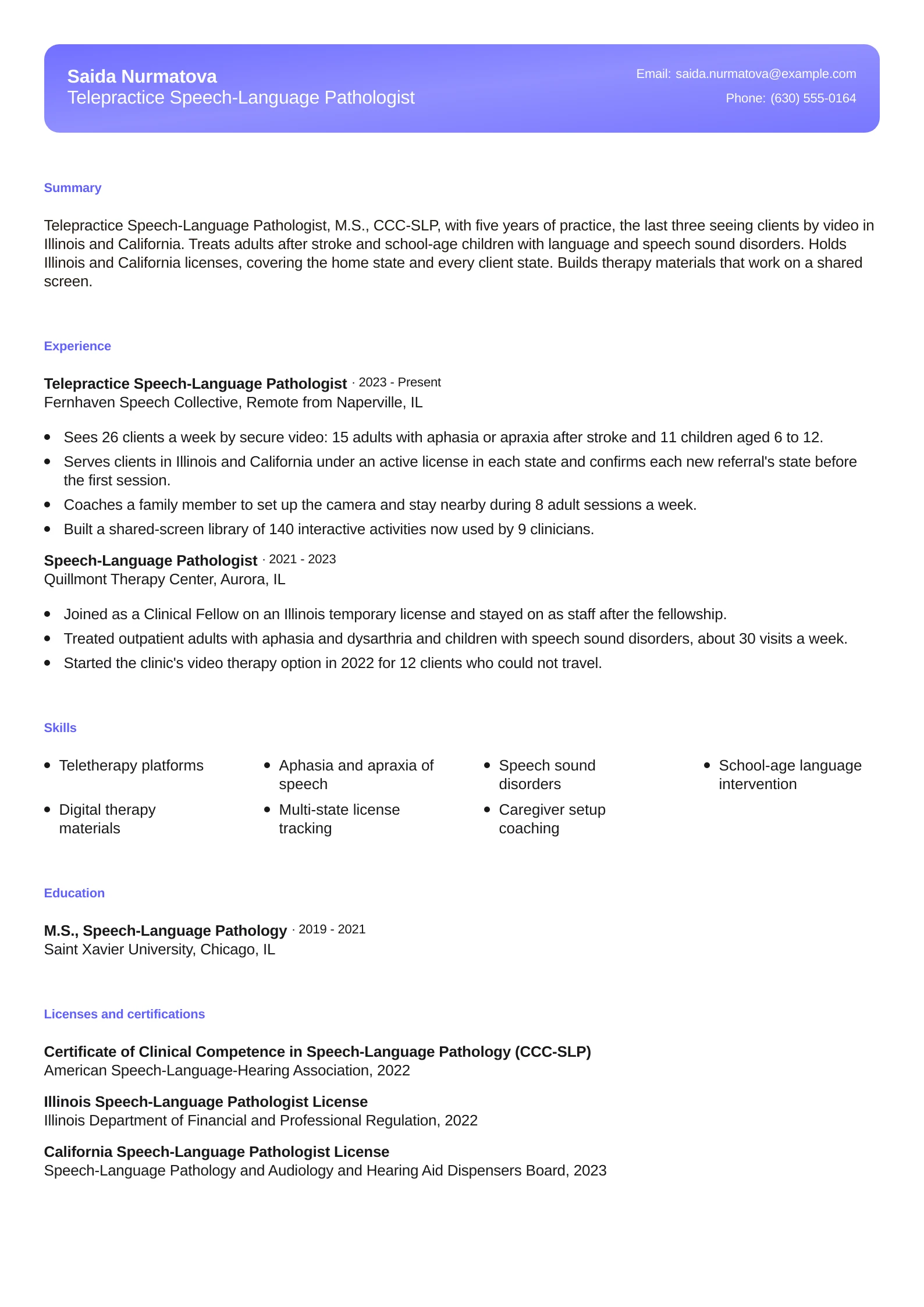
Saida's resume answers the first telepractice question, which states she can serve, in her summary, a bullet and her credentials: Illinois, where she works from, and California, where some clients live. Bullets give the weekly client mix by age and diagnosis and a shared-screen materials library other clinicians use. Her earlier clinic role shows she started video therapy before going fully remote. Use it for remote or hybrid roles with clients in several states.
Illinois and California licenses with the issuing boards
26 clients a week split between adults and children
140-activity shared-screen library used by 9 clinicians
Bilingual Spanish-English pediatric SLP
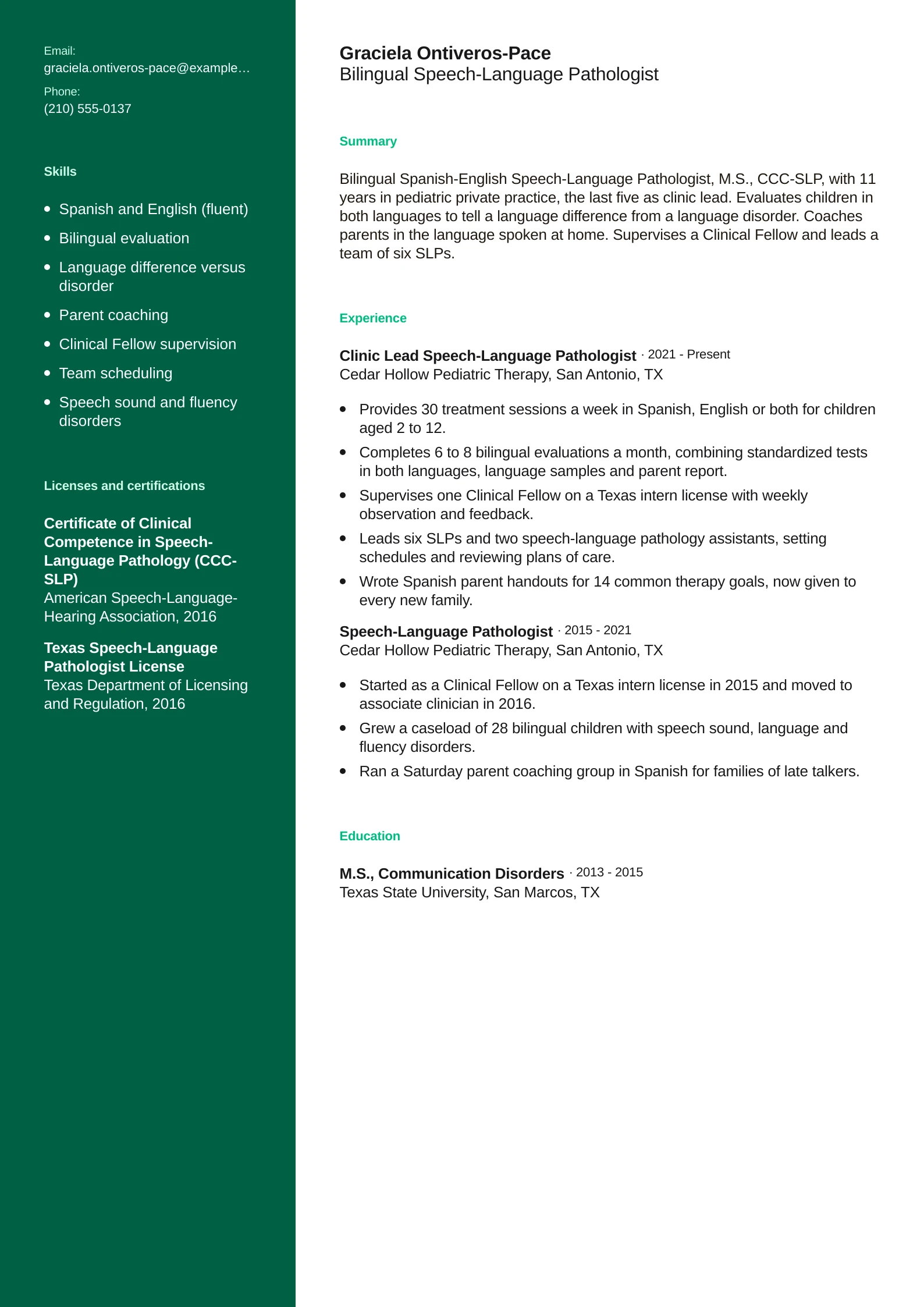
Graciela shows bilingual skill through the work itself: evaluations in both languages, sessions in Spanish, English or both, and the Spanish parent handouts she wrote. Eleven years at one practice appear as two titles, so the move to clinic lead is easy to see. Supervising a Clinical Fellow and leading six SLPs sit in the current role. Use this example if you're bilingual, you lead a pediatric clinic, or you supervise fellows.
Bilingual evaluations with tests in both languages, language samples and parent report
Promotion shown as two titles at one practice
Supervises a Clinical Fellow on a Texas intern license
AAC specialist SLP
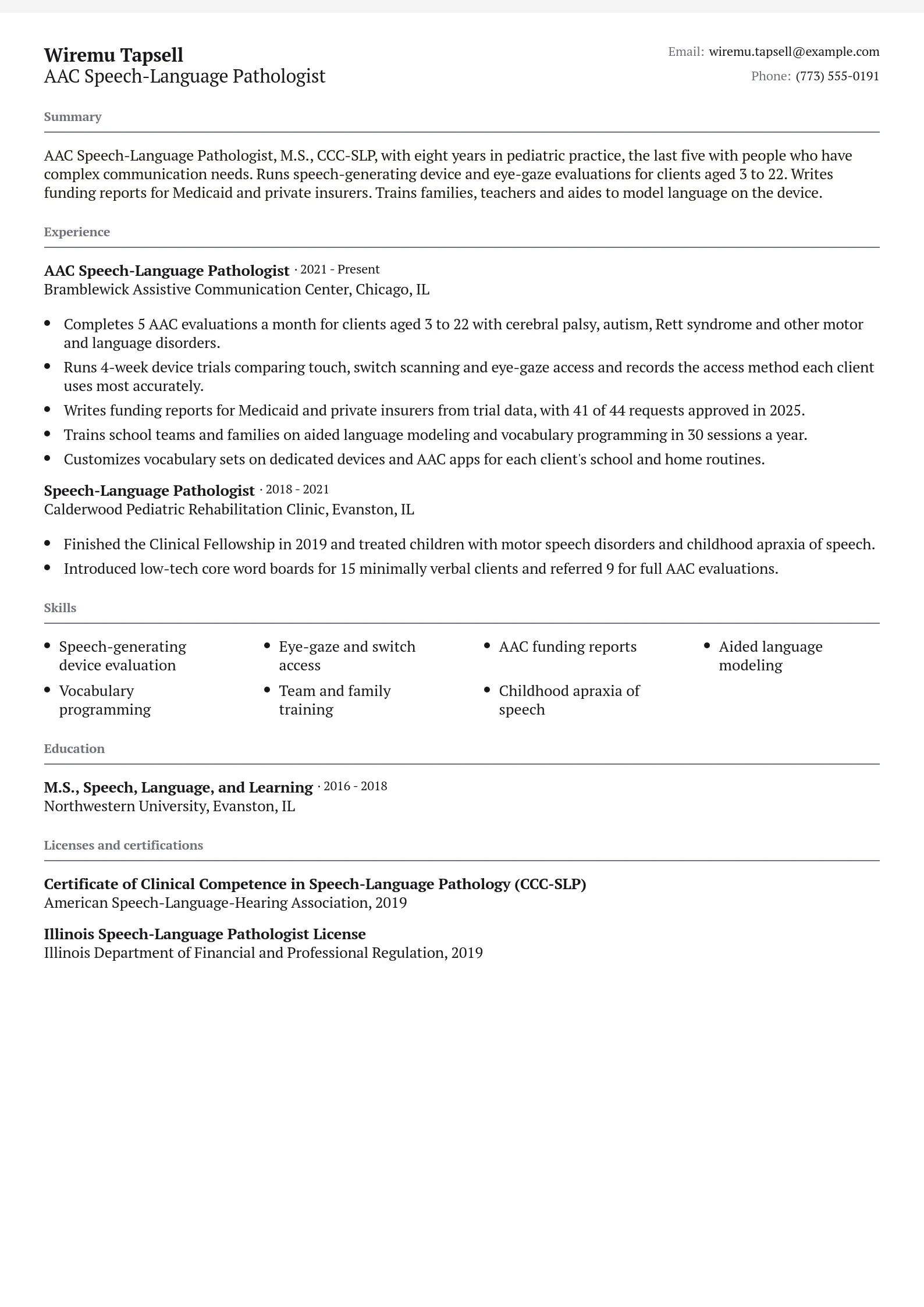
Wiremu's resume is built around complex communication needs: device trials comparing touch, switch scanning and eye-gaze access, funding reports with an approval count, and training for school teams and families. The age range and diagnoses he serves are in the first bullet. AAC appears as experience and skills, not as a certification. Use it if most of your caseload uses speech-generating devices or communication boards, or you want to move into an AAC center.
4-week trials comparing touch, switch and eye-gaze access
41 of 44 funding requests approved in 2025
Earlier pediatric clinic role leads into the AAC specialty
Career change from music teacher to SLP
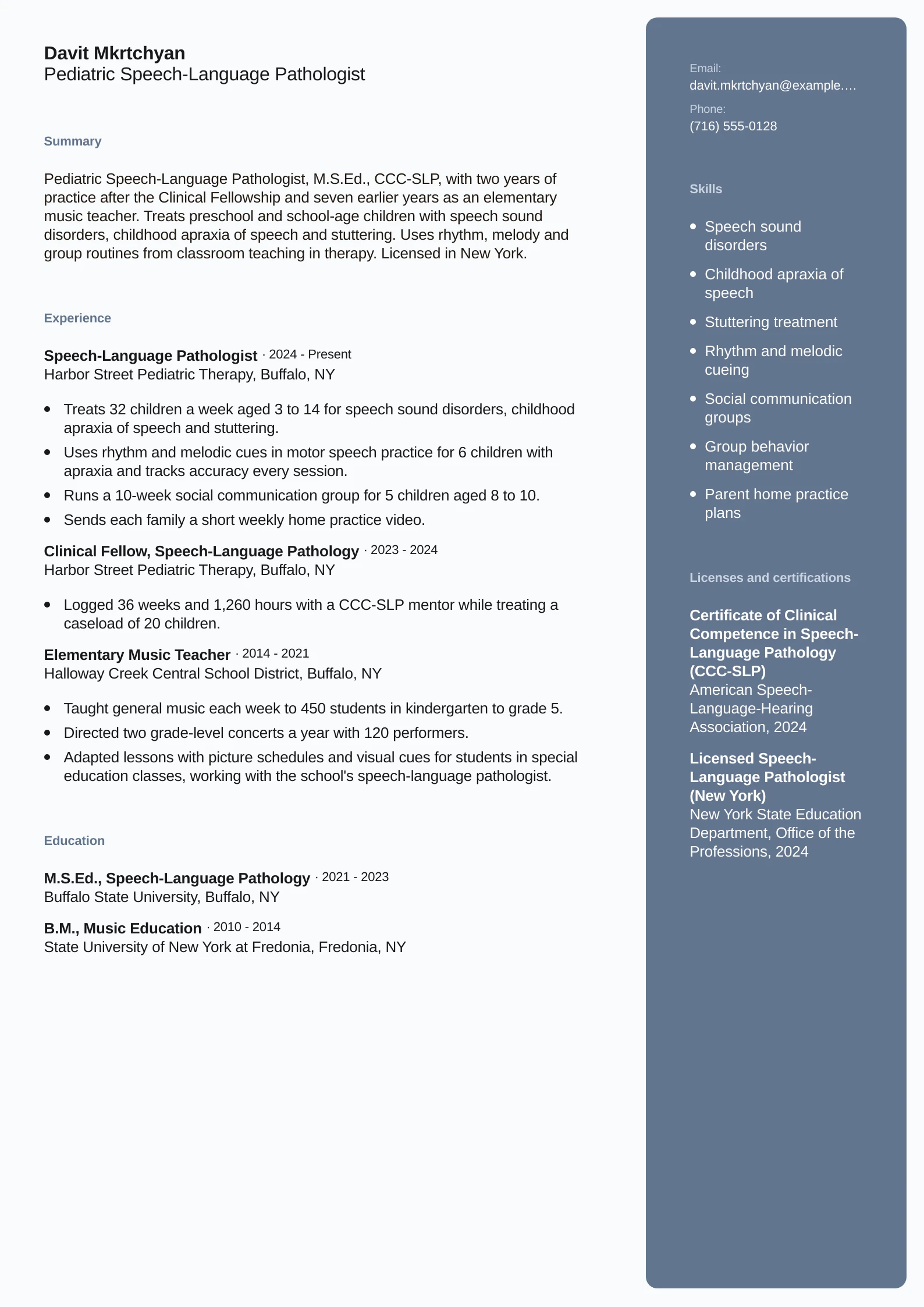
Davit keeps seven years of music teaching but trims it to three bullets that matter for therapy: teaching large groups, directing concerts and adapting lessons alongside a school SLP. His current role shows rhythm and melodic cues used in apraxia practice. The Clinical Fellowship is a separate entry with its hours and mentor. Use this layout if you came to speech-language pathology from teaching or another field and have a few years of practice.
Teaching role cut to three bullets
Melodic cues in apraxia treatment
Fellowship listed with 36 weeks and 1,260 hours
List the license, CCC-SLP and school credential as three separate lines
Put your credentials in their own section near the top, one line per credential, each with the issuer and the year. School districts and hospitals list them as separate requirements, and a reader looking for one shouldn't have to pick it out of a combined line.
Write each name the way it appears on the document. In California that means 'California Speech-Language Pathology Services Credential (Clear)', not 'school credential' or 'teaching credential'. If yours is still Preliminary, write 'Preliminary' in the same place.
Repeat your strongest credentials in the header after your name, such as 'M.S., CCC-SLP', so they show on the first line. The table shows how each credential type is written.
Credential
Who issues it
How to write it
Who needs it
State license
Your state's licensing board, such as TDLR in Texas, IDFPR in Illinois or NYSED in New York
Texas Speech-Language Pathologist License, Texas Department of Licensing and Regulation, 2018
Every state licenses SLPs. Telepractice clinicians also need a license in each client's state, or an interstate compact privilege where both states issue them.
CCC-SLP
American Speech-Language-Hearing Association (ASHA)
Certificate of Clinical Competence in Speech-Language Pathology (CCC-SLP), American Speech-Language-Hearing Association, 2020
Most hospital, clinic and contract postings ask for it or for fellowship eligibility. Some states license without it.
School credential
Your state education agency, such as the California Commission on Teacher Credentialing
California Speech-Language Pathology Services Credential (Clear), California Commission on Teacher Credentialing, 2021
Public school SLPs where the state requires one. Some California districts accept the license or the credential.
Clinical Fellow license
Your state board, where the state issues one
Intern in Speech-Language Pathology License, Texas Department of Licensing and Regulation, 2026
Clinical Fellows in states such as Texas (intern license) and Illinois (temporary license)
Show the fellowship and intern license until ASHA approves your CCC-SLP
List what you hold today: your state's Clinical Fellow license, your Praxis result and the fellowship itself. The CCC-SLP goes on your resume only after ASHA approves it, which ASHA says takes about six weeks from a complete application.
Name the fellow license the way your state issues it. Texas issues an 'Intern in Speech-Language Pathology' license through TDLR, and Illinois requires a temporary license from IDFPR before supervised experience starts. Add a fellowship line with the expected finish, since a fellowship runs at least 36 weeks and 1,260 hours with a mentor who holds current ASHA certification.
Give practicum its own entry with one bullet per setting, such as a public school, an acute care hospital and a pediatric clinic, and name the task in each, like bedside swallow screens or draft IEP goals. When a posting asks for 'CFY eligible', your fellowship line answers it.
Lists what the Clinical Fellow holds now
Folarin Adebayo, M.S.
Speech-Language Pathologist Clinical Fellow
Intern in Speech-Language Pathology License, Texas Department of Licensing and Regulation, 2026
Praxis Speech-Language Pathology (5331), passed, ETS, 2026
Clinical Fellowship toward ASHA CCC-SLP, in progress: mentor holds ASHA CCC-SLP, expected completion spring 2027
Match experience bullets to your setting's caseload and procedures
Write bullets in the terms of the setting you're applying to, with the numbers a manager there would ask about. A school bullet counts students, grades and evaluations. A hospital bullet names procedures and diagnoses.
If you're moving between settings, rewrite your most recent bullets for the new one. A school SLP applying to a skilled nursing facility should lead with any dysphagia, cognitive or adult work, including practicum, and drop IEP detail to one line.
Setting
Numbers to include
Terms postings use
Example bullet
Public school
Caseload size, grade range, evaluations a year
IEP, initial and triennial evaluations, special education, push-in
Completes 40 to 50 initial and triennial evaluations a year
Hospital, acute care or inpatient rehab
Swallow evaluations a day, studies a week, patients a day
Dysphagia, cognitive-communication, Medicare Part A and Part B, productivity
Meets facility productivity targets of 85% to 90%
Early intervention
Visits a week, age range, settings visited
IFSP, caregiver coaching, birth to three, home visits
Visits 24 children a week in homes and daycare centers
Outpatient pediatric clinic
Sessions a week, age range, disorder types
Speech sound disorders, childhood apraxia of speech, parent coaching
Treats 32 children a week aged 3 to 14
Give each state license its own line and name the states your clients live in
List every active state license as a separate credential, naming the state and the body that issued it, such as 'Licensed Speech-Language Pathologist (New York), New York State Education Department, Office of the Professions'. A recruiter filling a New York assignment can then confirm it at a glance.
For telepractice, ASHA's guidance is that you need a license in the state you provide services from and in the state where each client is located, and state law takes precedence. The Audiology and Speech-Language Pathology Interstate Compact can replace a second license with a privilege to practice, but only between member states that issue privileges, and most member states weren't issuing them in 2026. Put your home state and every client state in your credentials. Then say in your summary or first bullet where your clients live, as in 'serves clients in Illinois and California'.
Contract and travel SLPs can group assignments under the agency and give the count of assignments, facility types and states in the first bullet. Name individual facilities only when a posting asks for a site type you've worked in, such as inpatient rehab.
List only licenses that are active. If a new state's license is in process, add a line such as 'California Speech-Language Pathologist License, application submitted 2026' so the recruiter knows to expect it.