Before anyone reads your clinical experience, a dental office checks two things: your state RDH license and whether that state lets you give local anesthesia.
Each example lists those credentials the way its own state words them, for an experienced Pittsburgh hygienist, a 2026 California graduate, a Kansas community health center hygienist and a part-time hygienist splitting the week across Lancaster offices.
Pennsylvania RDH with a local anesthesia permit and a heavy perio schedule
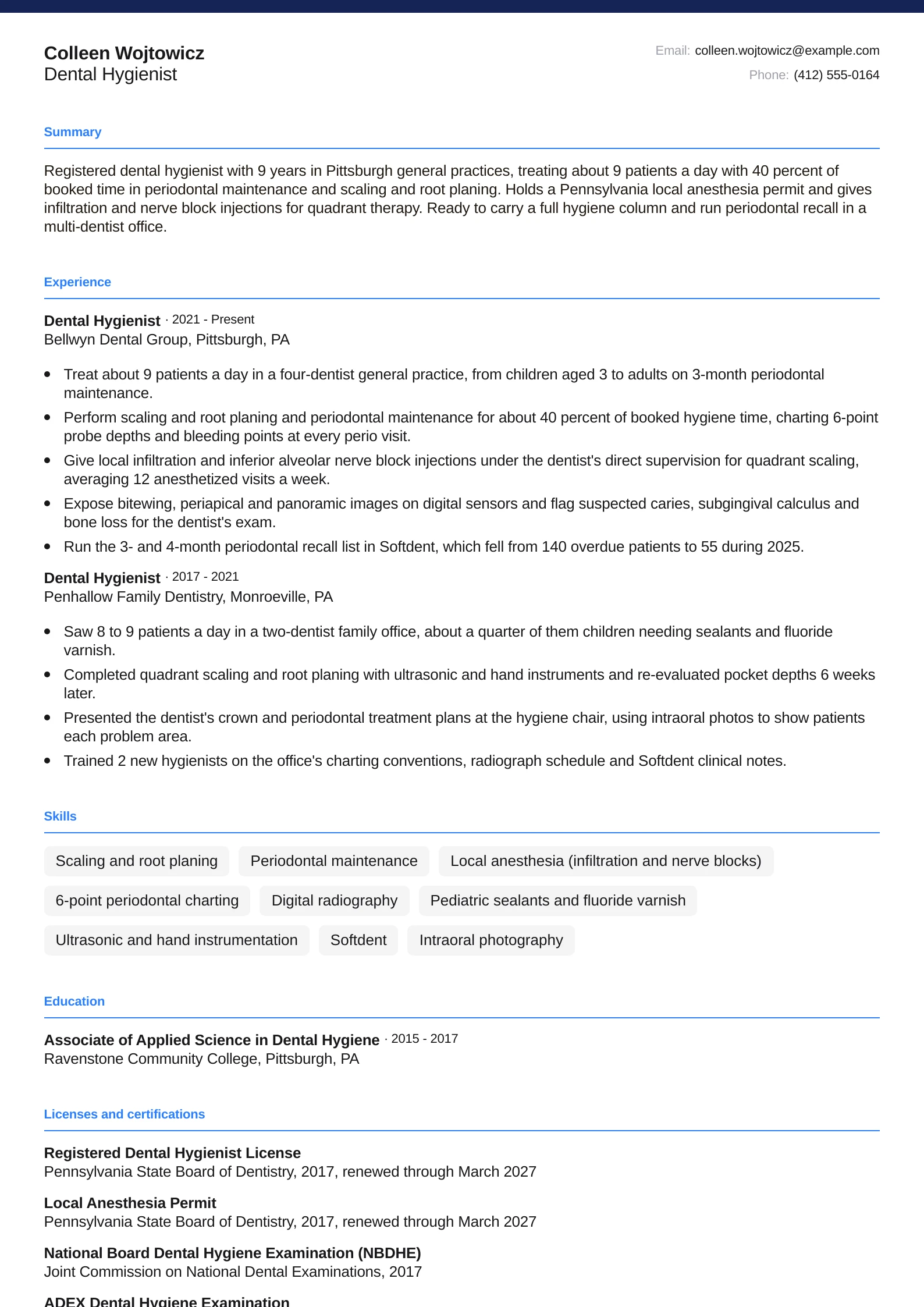
Colleen has 9 years in two Pittsburgh general practices. Her credentials section gives the Pennsylvania license and the Board-issued local anesthesia permit separate lines, each renewed through March 2027, then the NBDHE and the clinical exam under the name of the agency that gave it in 2017.
Her bullets give the numbers a hiring dentist uses to picture her column: about 9 patients a day, 40 percent of booked time in periodontal care and roughly 12 anesthetized visits a week. If you're an experienced hygienist in a general office, copy her order: patients per day, perio share, anesthesia, imaging, then the software you chart in.
Hygienist resumes for new graduates, community health and part-time work
Pick the example that matches your license state and how your week is booked. Each one keeps the credential lines its state uses and puts the work that setting hires for at the top of each job.
New graduate dental hygienist with clinic hours
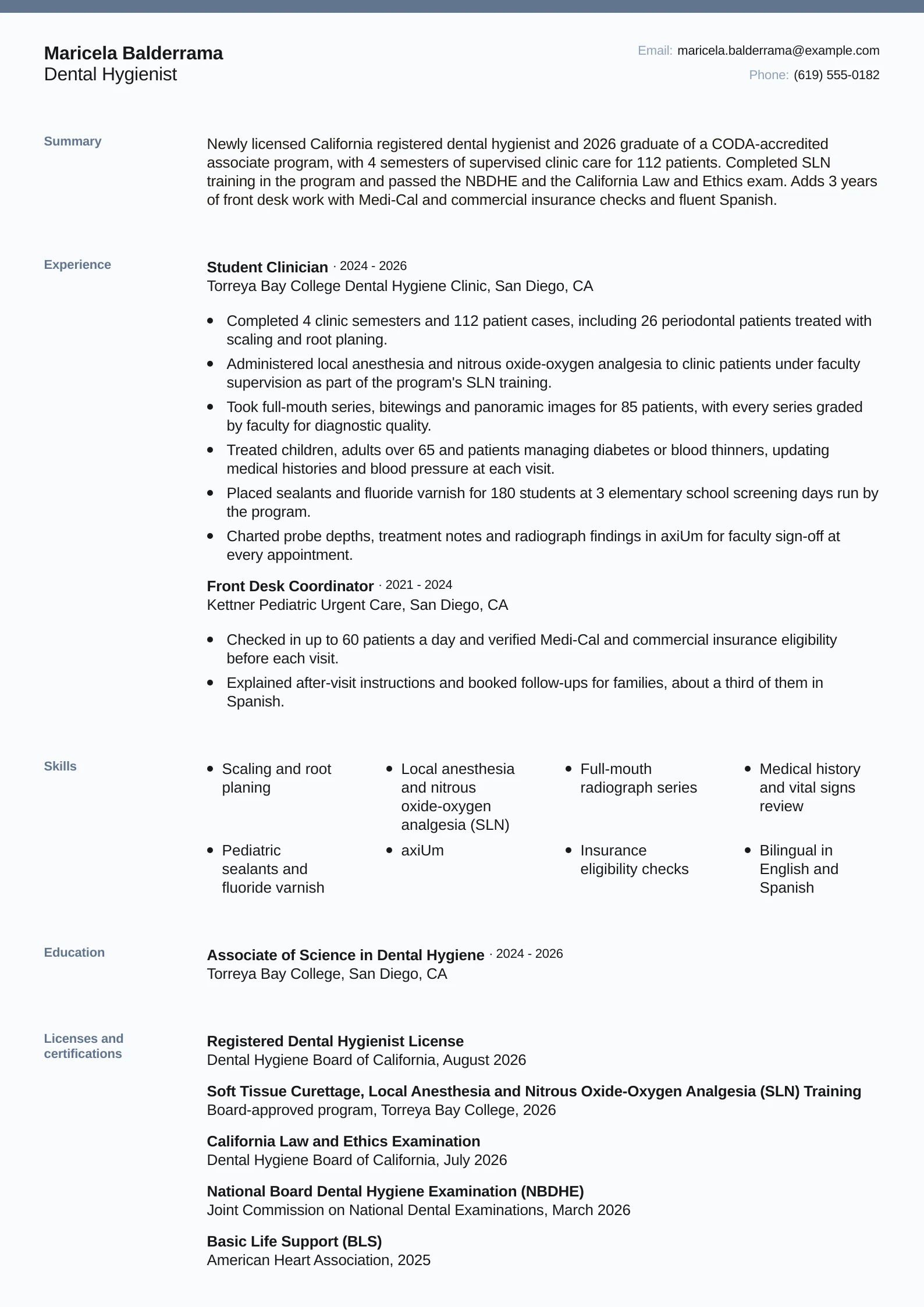
Maricela graduated in May 2026 and has no paid hygiene job yet, so her program clinic sits in the experience section with patient counts, perio cases and radiograph series graded by faculty. Her credentials date the NBDHE, the Law and Ethics exam and her August 2026 license by month, and credit SLN training to her program. There's no clinical exam because California waived it for her. Use it if your strongest evidence is clinic work.
112 clinic patients, 26 of them periodontal cases
SLN training credited to her Board-approved program
Front desk insurance work kept to two bullets
Community health center hygienist in Kansas
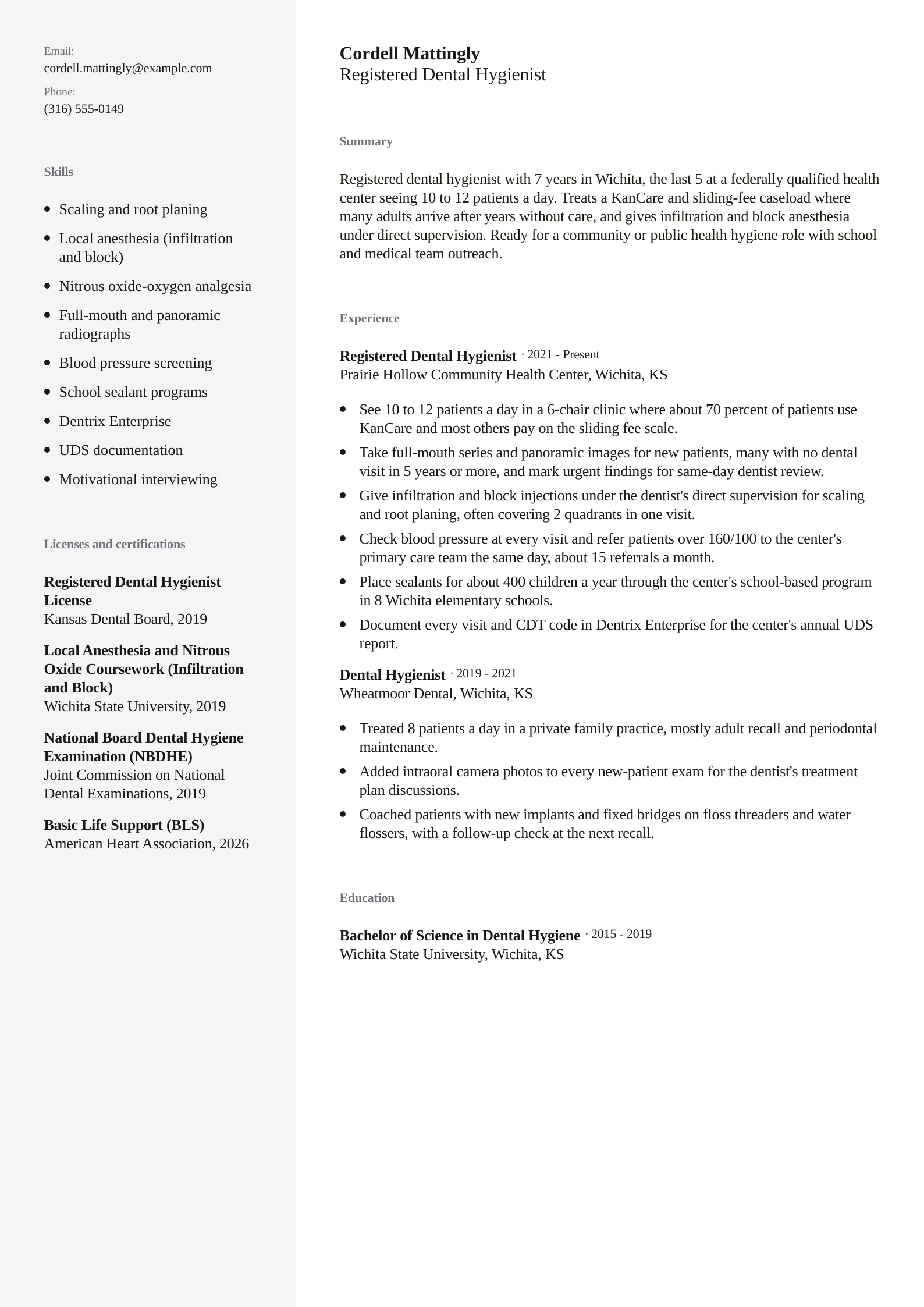
Cordell works at a federally qualified health center where most patients use KanCare or pay on a sliding fee scale. His bullets show what that setting hires for: 10 to 12 patients a day, full-mouth imaging for patients who haven't seen a dentist in years, blood pressure referrals to primary care and a school sealant program. Use it if you're moving into community or public health dentistry.
Payer mix stated as a percentage
Same-day referrals to the center's medical team
UDS charting named next to Dentrix Enterprise
Part-time hygienist working for several dentists
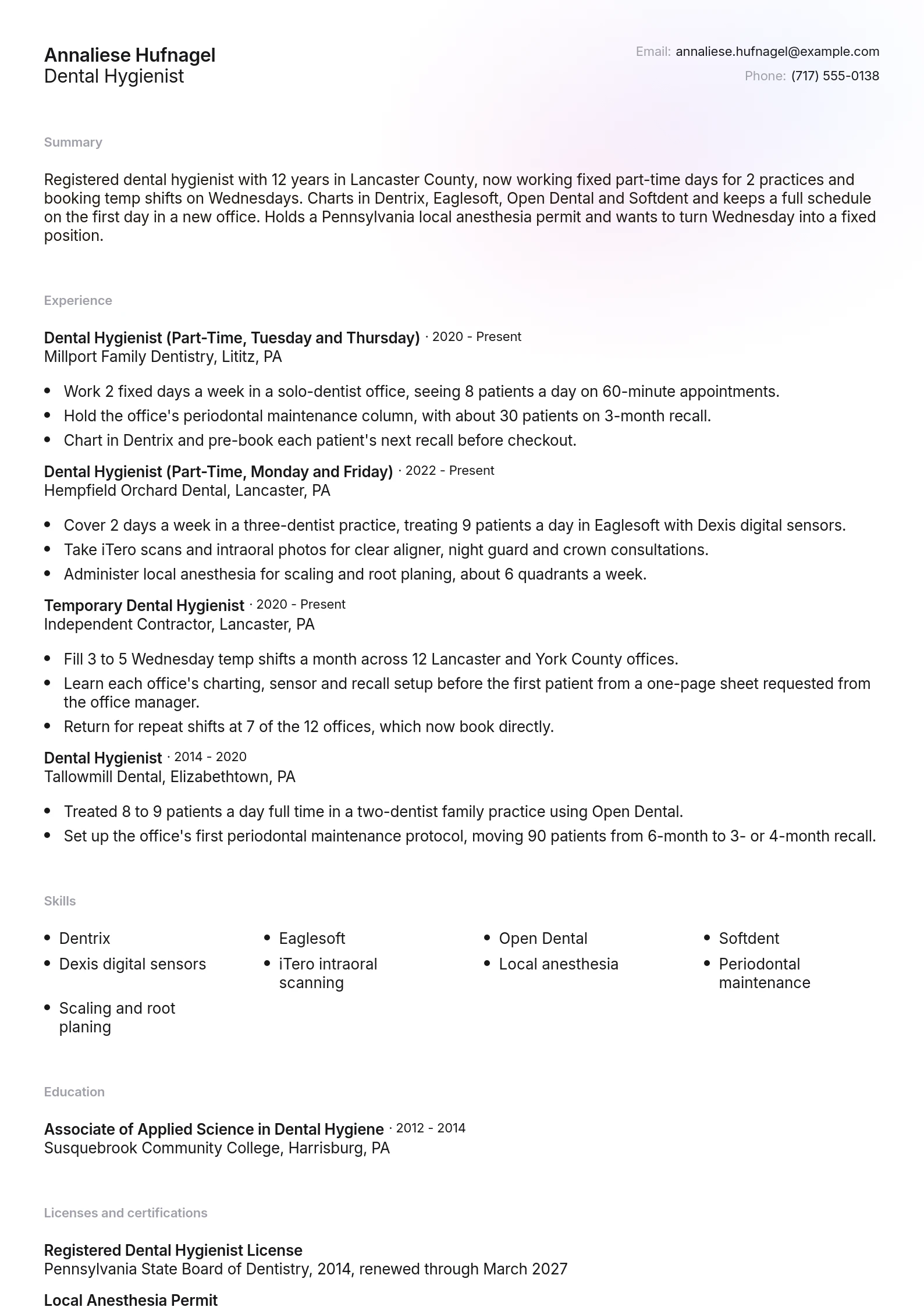
Annaliese works fixed days at two practices and books temp shifts on Wednesdays. Each office gets its own entry with the weekdays in the job title, and her temp work sits under one entry with a monthly shift count and the number of offices that rebook her. Her skills list four practice management systems. Use it if you split your week between dentists or temp across several offices.
Weekdays written into each job title
Temp shifts grouped under one entry
Dentrix, Eaglesoft, Open Dental and Softdent listed
List the license, NBDHE and clinical exam as separate credential lines
Give each credential its own line with the issuing body and year, because the office manager checks each one against a different requirement. A single line reading "RDH, licensed" doesn't say which state issued the license or which exams you passed.
Name the clinical exam and the agency that gave it, using the agency's name in the year you passed. Annaliese tested in 2014, so she lists the ADEX exam under NERB, which became CDCA in 2015 and has since merged with WREB and CITA into the American Board of Dental Examiners (ADEX). Others took WREB or CRDTS exams.
If you hold licenses in two states, list both, with the state where you're applying first.
Name your license state in the first line of your summary as well. On many layouts the credentials section sits below experience, and an office manager screening applications often decides from the top third of the page.
Credential
What to write
Issuer and date
Who lists it
State license
Registered Dental Hygienist License
Your state board, such as Pennsylvania State Board of Dentistry, with the year issued and the current renewal date
Every licensed hygienist
Written exam
National Board Dental Hygiene Examination (NBDHE)
Joint Commission on National Dental Examinations, year passed
Every hygienist, including new graduates as soon as they pass
Clinical exam
The exam you took, such as ADEX Dental Hygiene Examination
The testing agency as it was named then, such as NERB, CDCA, WREB or CRDTS, with the year passed
Hygienists whose state required a clinical exam when they were licensed
State law exam
California Law and Ethics Examination
Dental Hygiene Board of California, year passed
California applicants
Local anesthesia
Local Anesthesia Permit, or the course your state requires
State board for a permit, or the program that taught the course
Hygienists authorized in their license state
Life support
Basic Life Support (BLS)
American Heart Association or American Red Cross, with a current year
Everyone, since many offices require current CPR or BLS
Name the state and injection type next to local anesthesia
Every state now lets hygienists give local anesthesia, but supervision, injection types and course hours differ, so "local anesthesia" alone doesn't tell an office what you can do in its state. Write the state, the credential name and the injections it covers.
Pennsylvania issues a Board permit for infiltration and nerve blocks of the second and third trigeminal divisions, and it renews with your license. California teaches it inside the hygiene program as SLN, together with soft tissue curettage and nitrous oxide-oxygen analgesia. Kansas issues no separate permit: you complete Board-approved local anesthesia and nitrous oxide courses of at least 12 hours at an accredited school, then give infiltration and block injections under direct supervision. Texas certifies infiltration only.
Only 35 states let hygienists give nitrous oxide. List nitrous as its own line, and only when your license state allows it and you've finished the training.
Put the permit or course in your credentials section and the injections you give in a bullet. If anesthesia is a regular part of your schedule, add a weekly count of anesthetized visits or quadrants.
Specific
Credential: Local Anesthesia Permit, Pennsylvania State Board of Dentistry, 2017. Bullet: Give local infiltration and inferior alveolar nerve block injections under the dentist's direct supervision for quadrant scaling, averaging 12 anesthetized visits a week.
Vague
Skills: Local anesthesia certified, nitrous
Put patients per day, perio share and imaging in your bullets
A hiring dentist reads your bullets to estimate how much of a schedule you can carry, so give the counts they'd ask about in an interview. "Cleaned teeth and educated patients" fits any hygienist and says nothing about capacity.
Start with patients per day and appointment length, such as "8 patients a day on 60-minute appointments". Then give the share of your time in periodontal care, meaning scaling and root planing and periodontal maintenance, as a percentage or as quadrants a week. Experienced hygienists in perio-heavy offices should lead with that number.
Say which patients you treat when it matches the job: children from age 3, older adults on blood thinners, implant maintenance or orthodontic patients. Ads ask for pediatric and general patients by name, and a pediatric-heavy office will look for sealant and fluoride varnish counts.
Name the imaging you take: bitewings, periapicals, full-mouth series, panoramic images, and iTero scans if your office uses one. If you flag findings for the dentist, say what you flag, such as suspected caries or bone loss.
List practice management and imaging software by name. Job ads ask for Dentrix, Eaglesoft, Open Dental, Softdent and Dexis, and an office that uses one of them will look for it. New graduates can name the school clinic's system, such as axiUm, and add any systems they used on rotations.
Community health hygienists should add the payer mix and the public health work around the chair: the share of Medicaid and sliding-fee patients, school sealant counts and referrals to the medical team. Those numbers show you can keep pace with a caseload that often needs more scaling and more imaging per visit.
Give each office its own entry and put the weekdays in the title
Many hygienists work part time for several dentists, and a resume that merges them into one job hides how much you already handle. Give each fixed part-time position its own entry, with the days in the job title: "Dental Hygienist (Part-Time, Tuesday and Thursday)".
Keep overlapping dates as they are and list the entries newest first. The weekdays in each title show the jobs fit into one week, so the reader won't mistake two current jobs for a gap or a double booking.
Group temp shifts under one entry, such as "Temporary Dental Hygienist, Independent Contractor", instead of listing every office. Give the number of shifts a month, the number of offices and how many book you again. Repeat bookings are the clearest evidence a temp hygienist has.
Use your temp entry or your skills list to name every charting and imaging system you've worked in. An office filling a vacancy fast wants to know you can open Eaglesoft or Open Dental on day one without a training shift.
If you want more days, name the day you'd add in your summary, as Annaliese does with Wednesday. That tells the office where you fit around your other practices.