Put three things where a hiring pharmacist will see them first: which CPhT you hold, your state registration or license, and the pharmacy setting you know. The 12 examples below cover retail, hospital, IV room, mail-order, long-term care and specialty work, plus trainee, newly certified, career-change and veteran resumes from Texas, California, Florida and Ohio.
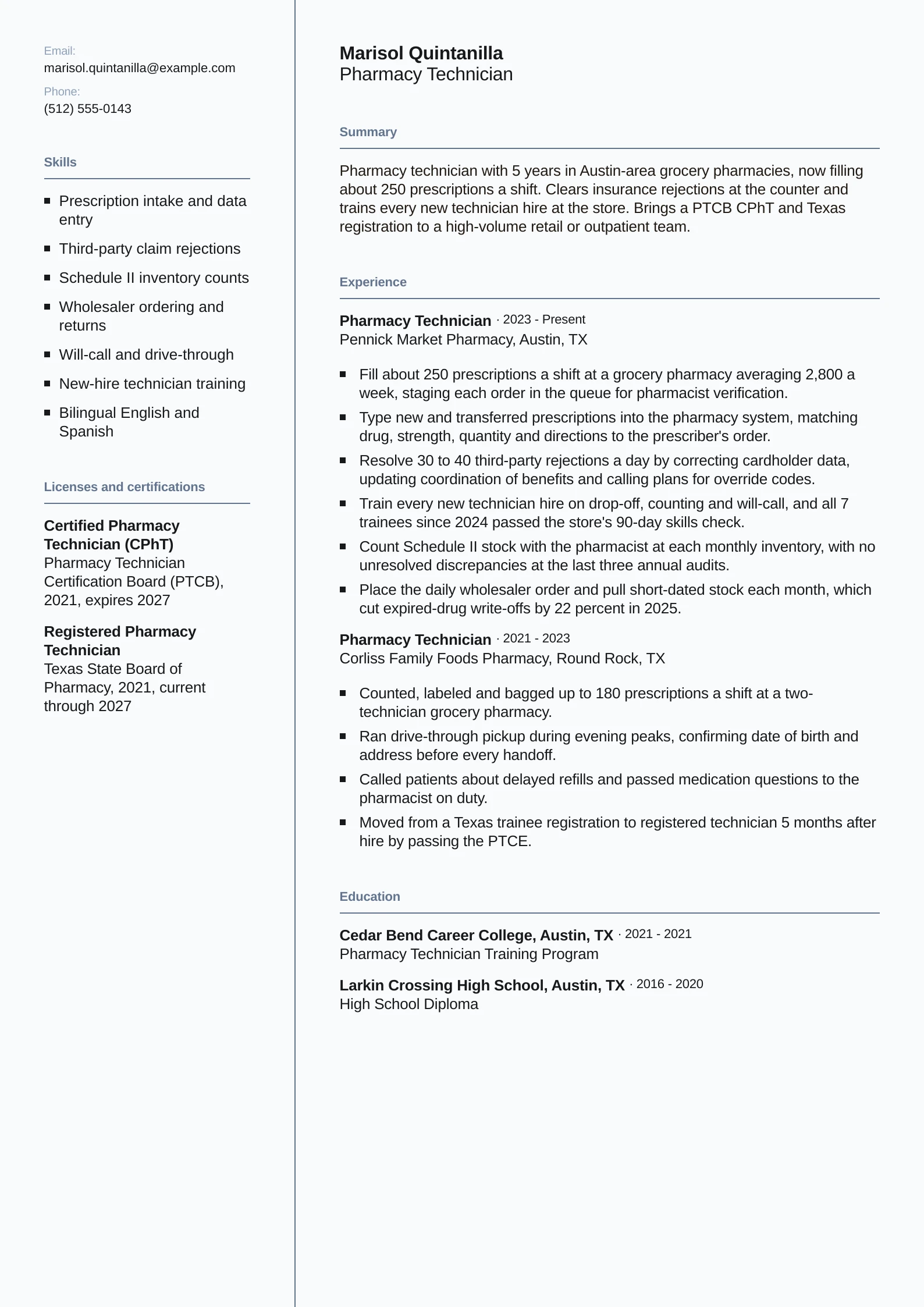
A retail CPhT with Texas registration and 250 fills a shift
Marisol's credentials section answers the two questions a hiring pharmacist checks first: a PTCB CPhT with the year it expires, and a Texas registered pharmacy technician registration with the year it runs through. Her first bullet gives volume in context, about 250 fills a shift at a store averaging 2,800 prescriptions a week.
Her other bullets cover the work retail pharmacies hire for, each with a number: insurance rejections cleared a day, Schedule II counts with no unresolved discrepancies and a 22 percent drop in expired-stock write-offs. Copy this structure if you have a few years in retail or grocery pharmacy and want a similar or busier store.
Match your setting, state and credential status
Each example below is set in one pharmacy setting or career stage and lists the credentials a technician in that state would hold. Pick the one closest to your work and replace the numbers with your own.
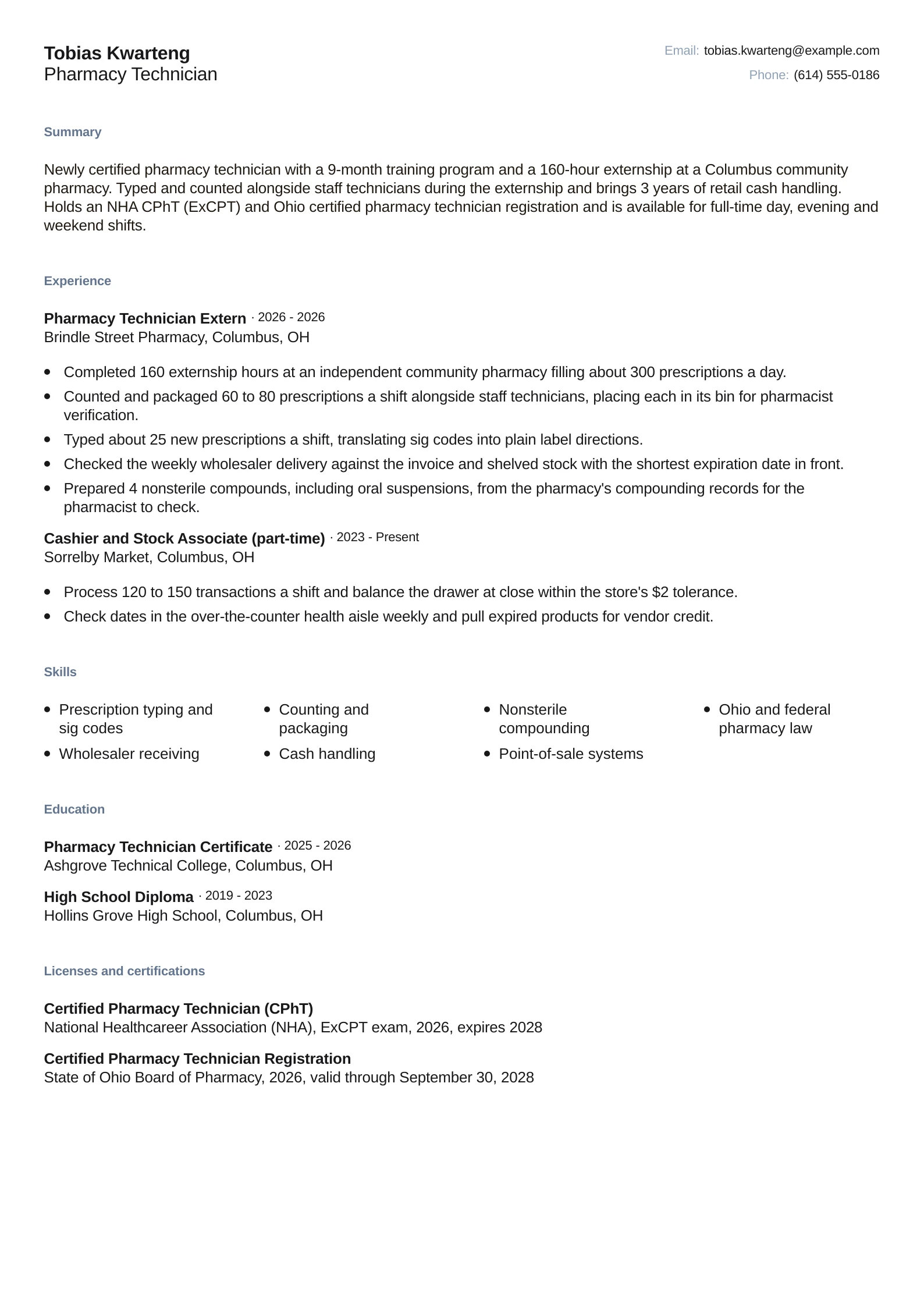
Entry-level pharmacy technician with an externship
Tobias lists his 160-hour externship as his first job, with the pharmacy's daily volume and the counts he handled each shift, so the experience section reads as pharmacy work. His NHA CPhT names the ExCPT exam and its expiration year, and his Ohio certified pharmacy technician registration sits beside it. Use this layout if you've just passed the ExCPT or PTCE and your paid work so far is outside pharmacy.
160-hour externship as the first job
NHA CPhT naming the ExCPT exam
Ohio certified technician registration
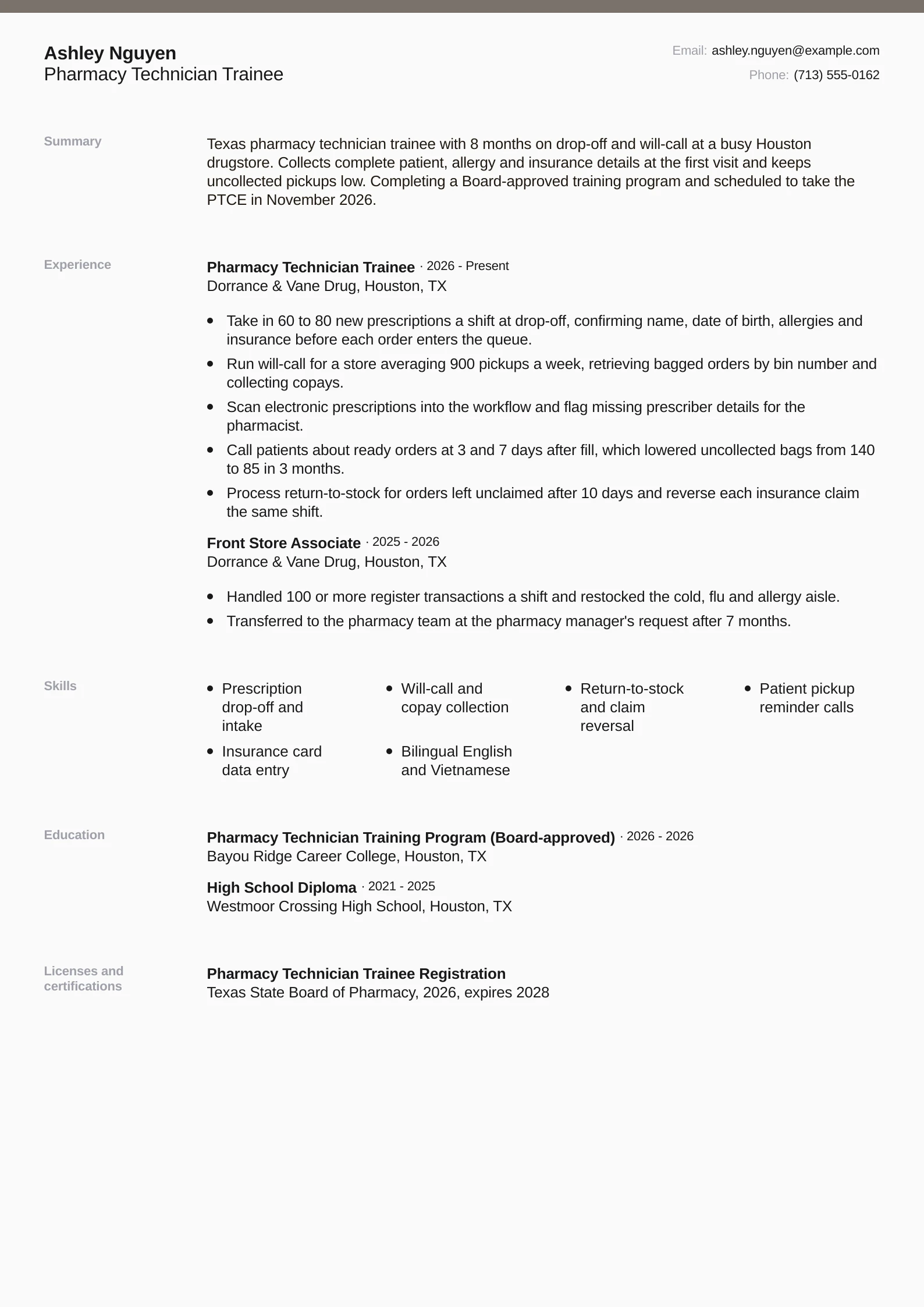
Pharmacy technician trainee in Texas
Ashley's resume is built around a Texas trainee registration with its 2028 end date and a PTCE date in the summary, so a pharmacist can see when she'll be eligible to upgrade. Her bullets stay on drop-off, will-call and return-to-stock, with numbers like 900 pickups a week. It suits trainees who already work in a pharmacy and are still finishing a Board-approved program.
Texas trainee registration with its end date
PTCE date in the summary
Drop-off and will-call numbers
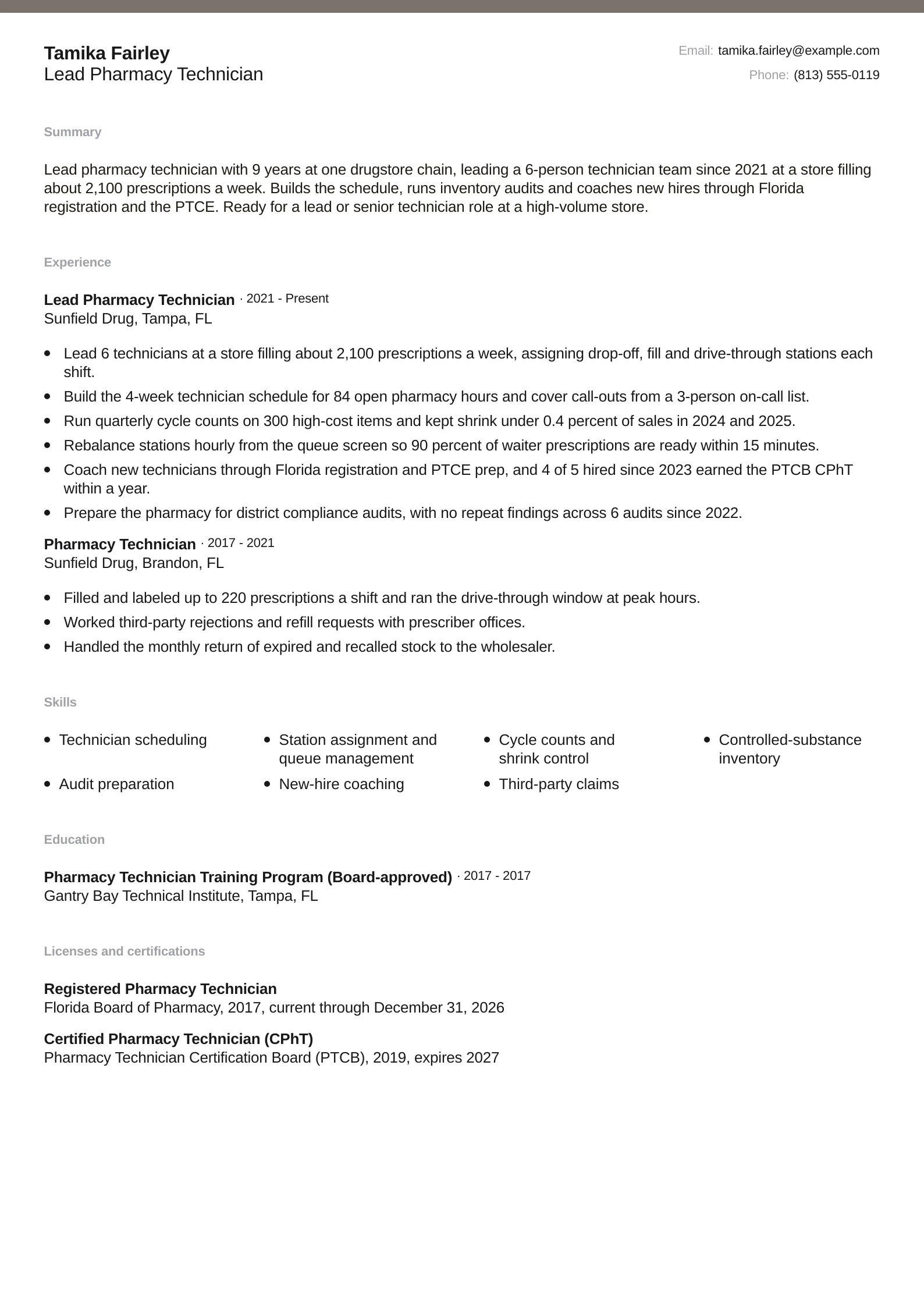
Lead pharmacy technician running a store team
Tamika's resume shows lead work in numbers: 6 technicians, a schedule covering 84 open hours a week, quarterly cycle counts on 300 items and 6 audits with no repeat findings. Her earlier technician years at the same chain sit in a separate entry, so the promotion is easy to see. Copy it if you schedule, train or run inventory for a technician team and want a lead or senior title.
Team of 6 technicians
Schedule and audit results
Promotion within one chain
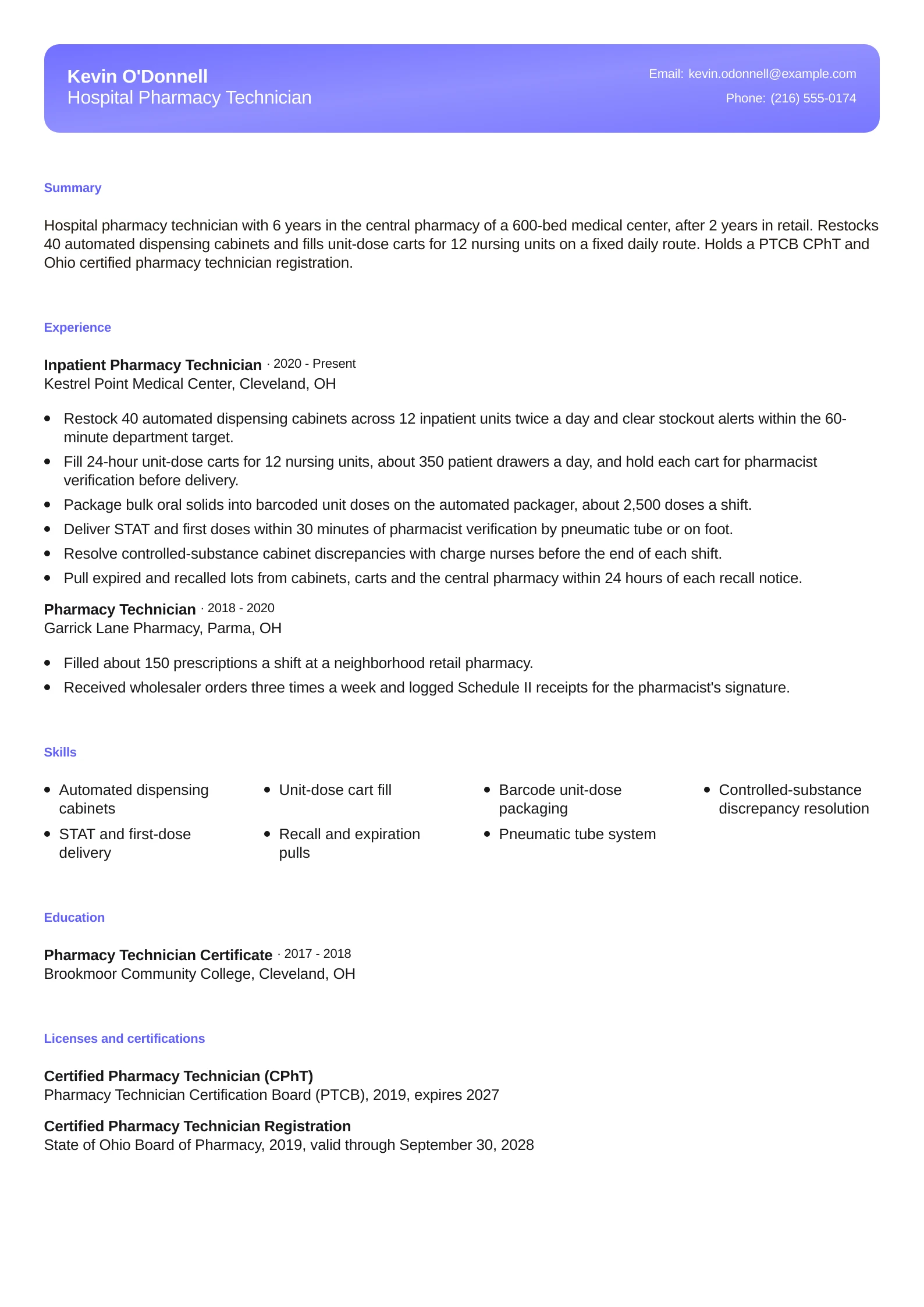
Hospital pharmacy technician on cabinets and carts
Kevin opens with the systems he keeps running in a 600-bed hospital: 40 automated dispensing cabinets, unit-dose carts for 12 units and a 60-minute stockout target. His 2 years of retail sit underneath, showing a route many hospital technicians take. It suits inpatient technicians, and retail technicians applying to hospitals, who need to show they can work a cabinet route and a cart fill.
40 automated dispensing cabinets
Unit-dose carts for 12 units
Retail-to-hospital path
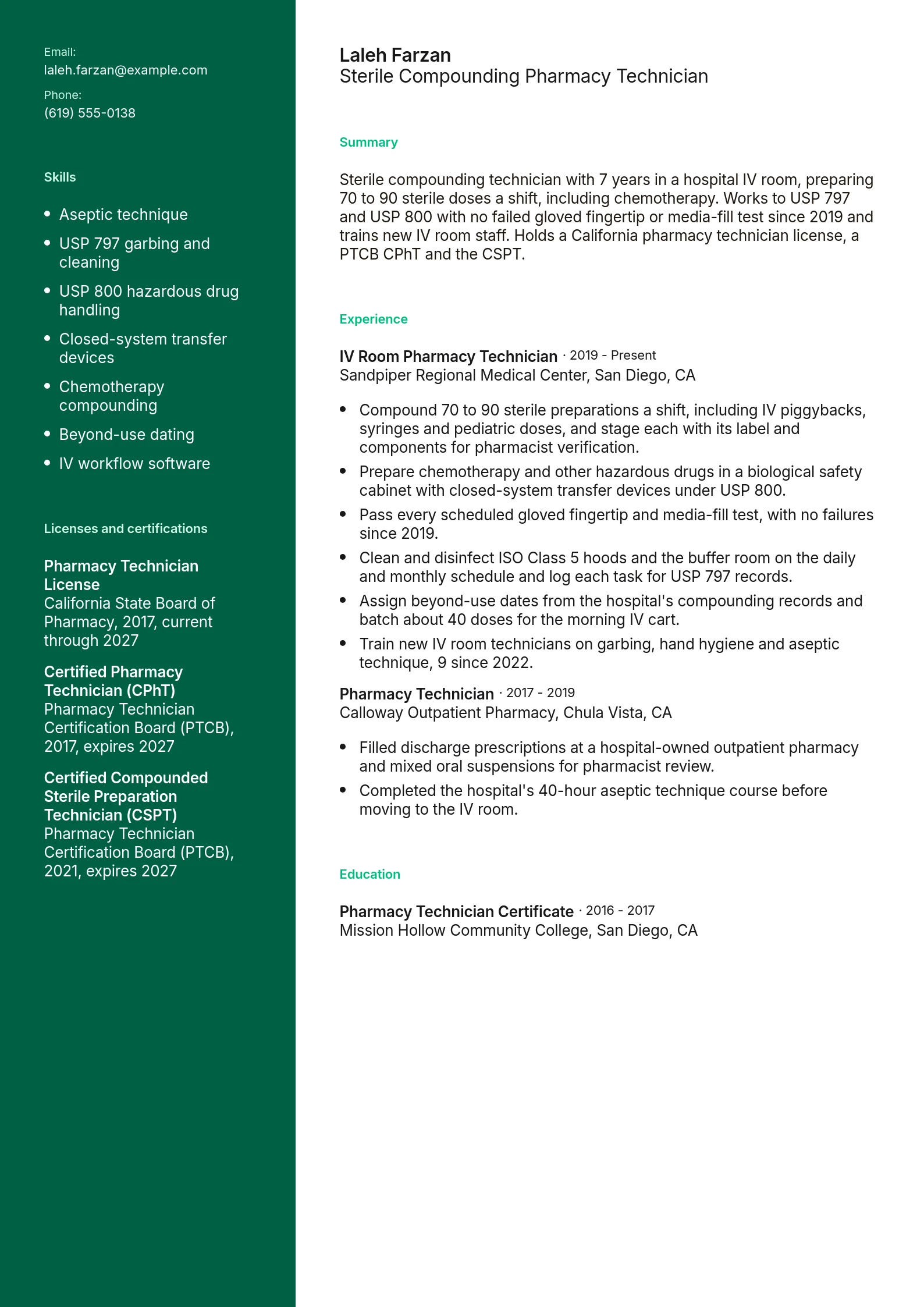
Sterile compounding technician with a CSPT
Laleh's resume is for IV room and sterile compounding jobs. She gives 70 to 90 preparations a shift, names USP 797 and USP 800 in the bullets that apply them, and lists a clean gloved fingertip and media-fill record. Her CSPT sits under her PTCB CPhT with its renewal year. Use it if you compound sterile or hazardous preparations and want an infusion, oncology or hospital IV role.
CSPT listed under the PTCB CPhT
USP 797 and USP 800 work
70 to 90 preparations a shift
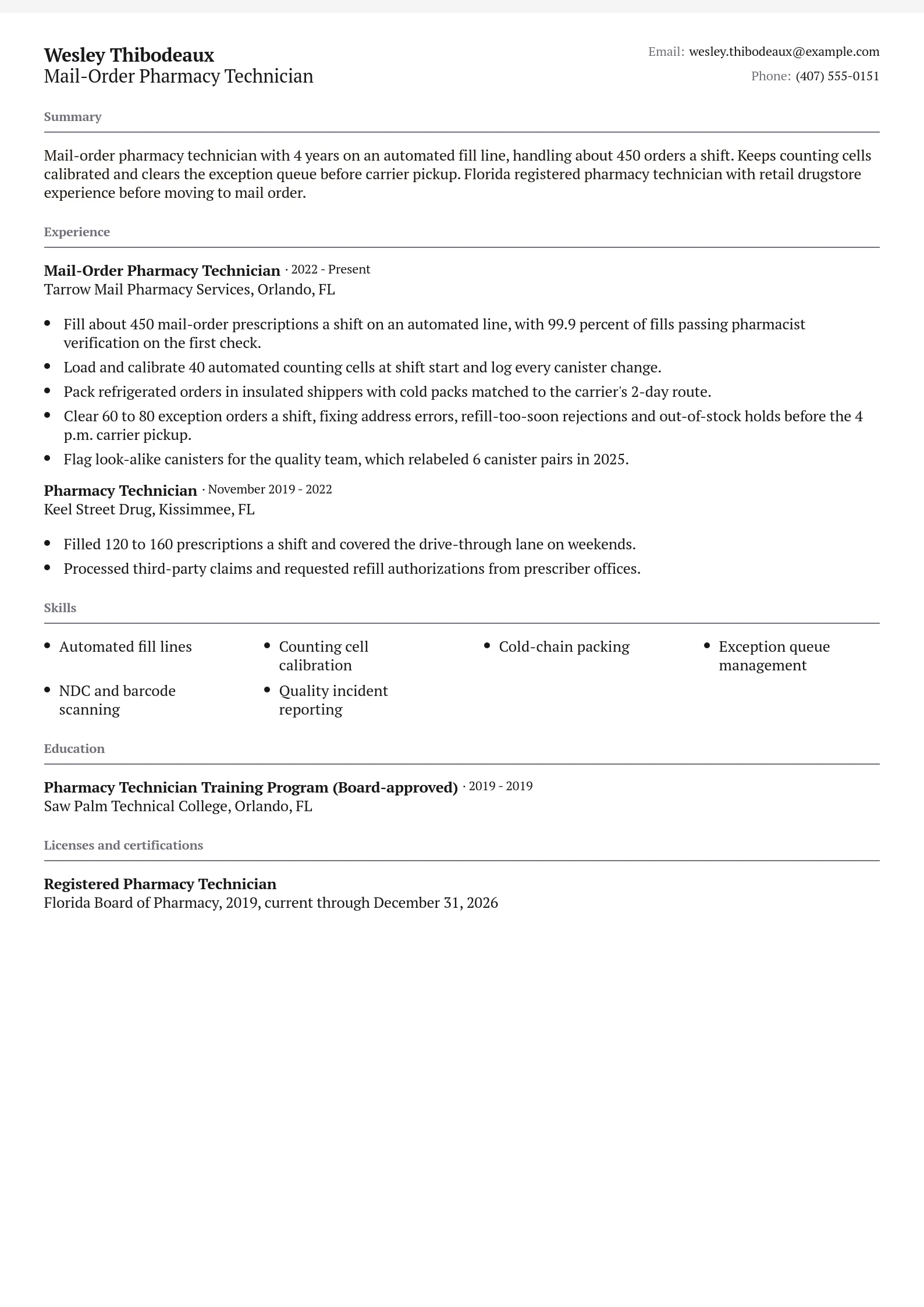
Mail-order technician measured on accuracy
Wesley's resume measures central-fill work the way mail-order pharmacies do: 450 orders a shift, 99.9 percent of fills passing pharmacist verification on the first check, and 60 to 80 exception orders cleared before carrier pickup. He lists a Florida registration without a national certification, which matches his state and setting. It suits technicians in mail-order, central-fill or automated fulfillment roles.
99.9 percent first-pass verification
450 orders a shift
Florida registration on its own
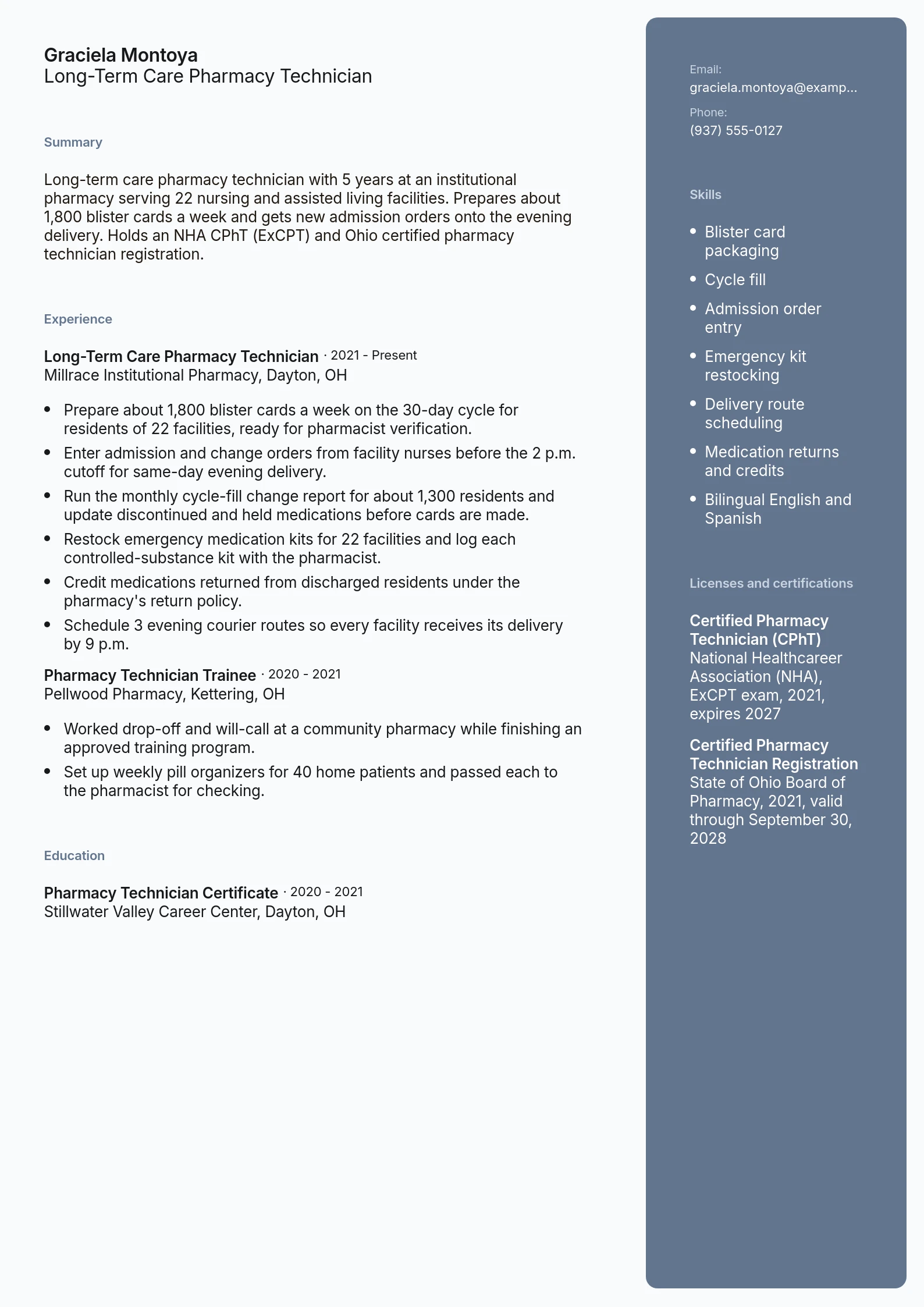
Long-term care technician serving 22 facilities
Graciela's resume shows long-term care in its own terms: 22 facilities, about 1,800 blister cards a week, a 2 p.m. order cutoff and emergency kit restocking. Her earlier trainee job, building weekly pill organizers for home patients, shows where the packaging work started. Pick this one if you work in institutional or nursing-facility pharmacy, or you build compliance packs in a community pharmacy and want to move into long-term care.
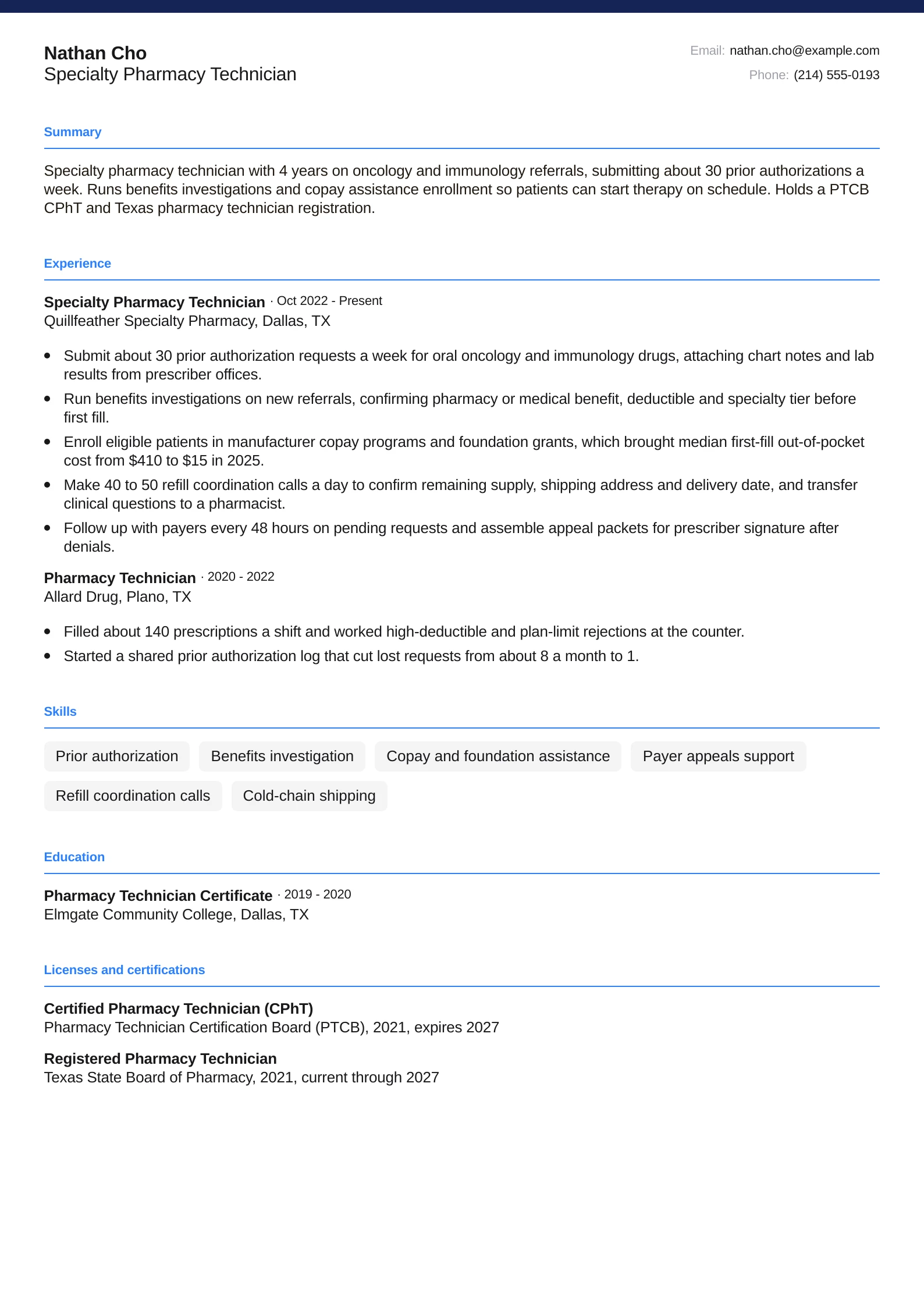
Nathan's bullets are about getting patients onto expensive therapy: 30 prior authorizations a week, benefits investigations before first fill, and copay programs that cut median out-of-pocket cost from $410 to $15. His refill calls send clinical questions to a pharmacist. Use it if you work in specialty or infusion pharmacy, or you handle prior authorizations in retail and want to move into specialty.
30 prior authorizations a week
Copay assistance results
Benefits investigation before first fill
Advanced technician with PTCB certificates
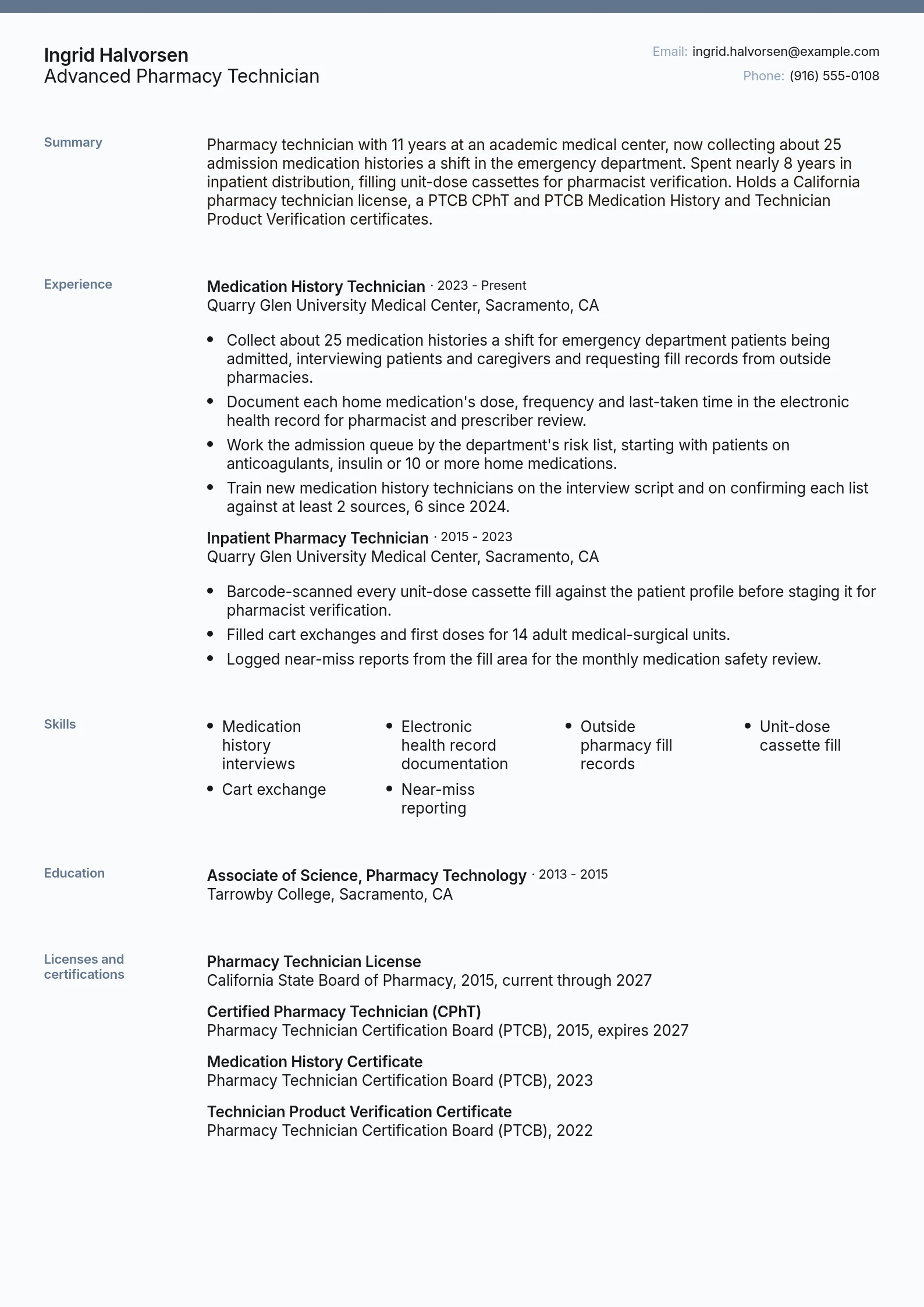
Ingrid's resume pairs each PTCB certificate with the work it supports: 25 medication histories a shift in the emergency department, and barcode checks on her unit-dose cassette fills before pharmacist verification. Her two roles at one academic medical center show a move from distribution into a specialized position. It suits experienced hospital technicians aiming for medication history, product verification or other advanced technician roles.
Medication History certificate in use
Technician Product Verification certificate
11 years at one medical center
Career changer from retail management
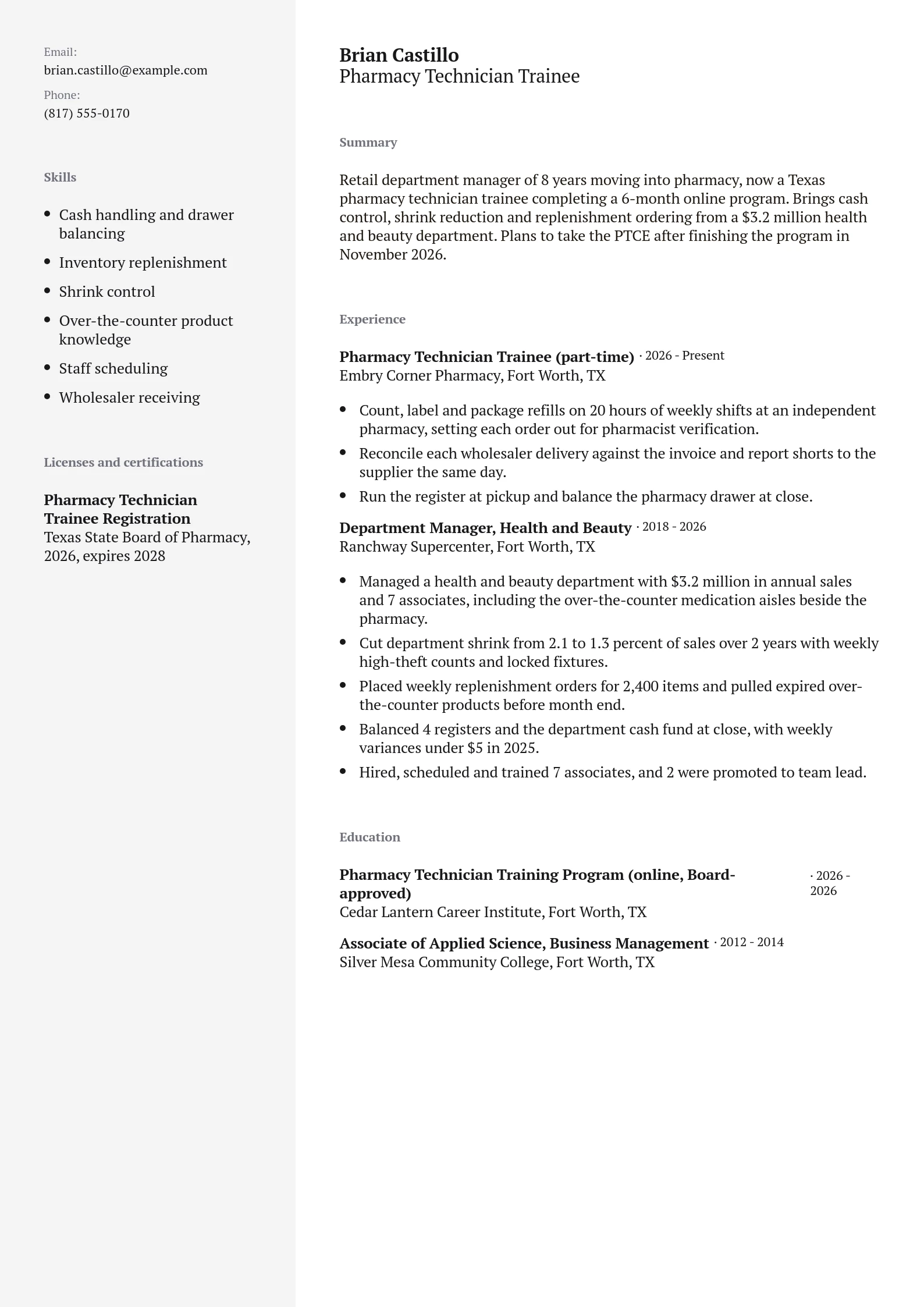
Brian leads with a Texas trainee registration and a 6-month online program, then gives 8 years of retail management bullets a pharmacy can use: cash variances under $5 a week, shrink cut from 2.1 to 1.3 percent and weekly orders for 2,400 items. A part-time trainee role shows current pharmacy work. Use it if you're changing careers and your strongest numbers come from another job.
Retail management numbers
Texas trainee registration
Online program with its end date
Army pharmacy specialist moving to civilian work
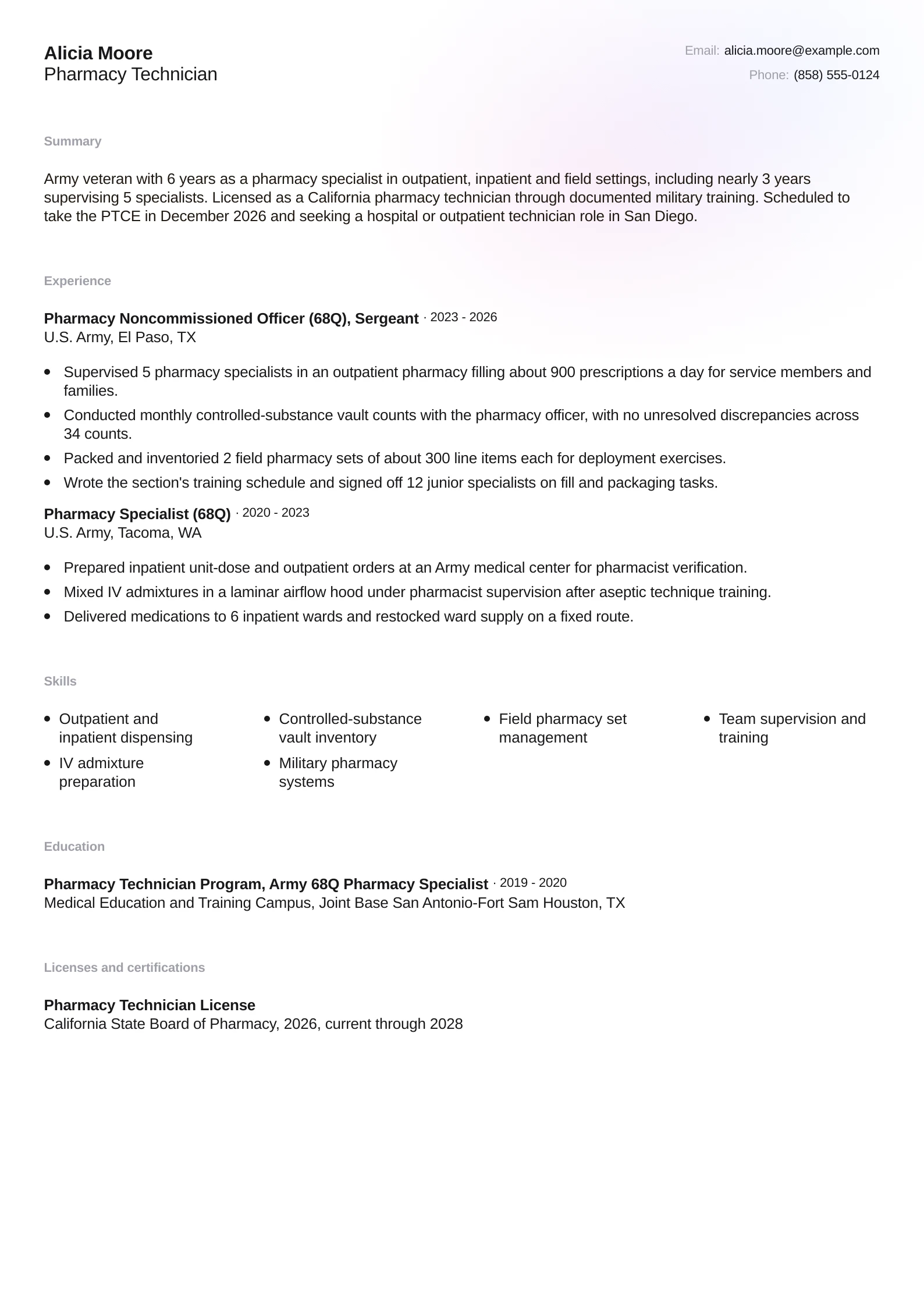
Alicia translates 6 Army years into civilian terms: daily prescription volume, controlled-substance vault counts, field pharmacy sets and the number of specialists she supervised. Her California license through documented military training is listed with its end year, and the PTCE date sits in her summary. Use it if you're leaving a military pharmacy role and applying for a civilian license or first civilian technician job.
Army 68Q work in civilian terms
California license through military training
PTCE date in the summary
Write CPhT with its issuer and expiration year
Write the full credential name, the CPhT abbreviation, the issuer and the year the current cycle ends. PTCB and NHA both award a credential called Certified Pharmacy Technician (CPhT), and many job ads accept either, so "CPhT" alone doesn't tell a hiring pharmacist which exam you passed.
If you passed the PTCE, write "Certified Pharmacy Technician (CPhT), Pharmacy Technician Certification Board (PTCB)". If you passed the ExCPT, write "Certified Pharmacy Technician (CPhT), National Healthcareer Association (NHA), ExCPT exam". Both renew every two years with 20 continuing education hours, including 1 hour of pharmacy law and 1 hour of patient safety, so "expires 2027" shows the credential is current.
Put the credential in two places: the last line of your summary and the credentials section. If you're scheduled for the exam, write the month in your summary, such as "scheduled to take the PTCE in November 2026", and add the credential to the list once you pass.
Copy your state's registration title and status word for word
Write the exact title your board of pharmacy issues, the board's name and the year it runs through. Requirements vary by state, and most states regulate technicians, so the table covers only the four states used in these examples. For any other state, copy the title from your board's license lookup.
Show your status in the title: trainee, registered, certified or licensed. If you're moving states, list the registration you hold and put the new state's status in your summary, such as "Florida registration application submitted, September 2026". In California, a license not renewed within 90 days of expiring is cancelled, so check the date before you list it.
State
What the board issues
Route in or trainee status
How to write it
Texas
Registered pharmacy technician, renewed every two years with continuing education
Pharmacy Technician Trainee registration for up to 2 years while you finish a Board-approved program. It is issued once and can't be renewed. Trainees upgrade after earning a PTCB or NHA ExCPT certification
Registered Pharmacy Technician, Texas State Board of Pharmacy, 2021, current through 2027
California
Pharmacy technician license
Qualify through an associate degree in pharmacy technology, a course of at least 240 hours, an ASHP-accredited program, pharmacy school, PTCB or NHA certification, or documented military training
Pharmacy Technician License, California State Board of Pharmacy, 2015, current through 2027
Florida
Registered pharmacy technician, renewed every two years. Current registrations expire December 31, 2026
Complete a Board-approved training program and be at least 17. A PTCB certification can't replace the program, so list the program in your education section
Registered Pharmacy Technician, Florida Board of Pharmacy, 2017, current through December 31, 2026
Ohio
Certified pharmacy technician registration, valid until September 30 of each even-numbered year
Trainee registration valid for 18 months. The certified registration needs a current PTCB or ExCPT certification and an approved training program
Certified Pharmacy Technician Registration, State of Ohio Board of Pharmacy, 2021, valid through September 30, 2028
Count what you handled and what passed the pharmacist's check
Show accuracy with numbers your pharmacy already tracks: volume per shift, the share of fills that pass pharmacist verification the first time, and inventory or audit results. A pharmacist checks every fill, so "accurate" on its own gives the reader nothing to weigh.
Retail and mail-order candidates should give fills or orders per shift next to the store's weekly volume, as in "250 prescriptions a shift at a store averaging 2,800 a week". If your site reports first-pass rates, write it the way Wesley's mail-order resume does: "99.9 percent of fills passing pharmacist verification on the first check".
Hospital candidates should count the systems they keep running. Name the automated dispensing cabinets on your route, the units your carts cover and the response time you meet, such as "clear stockout alerts within the 60-minute department target". IV room technicians give preparations per shift and the testing they pass, such as gloved fingertip and media-fill tests.
Inventory work is accuracy work too. Write the controlled-substance count result ("no unresolved discrepancies at the last three annual audits"), shrink as a percentage of sales or a drop in expired-stock write-offs. If your pharmacy doesn't share accuracy data, use volume, turnaround and audit results, and never estimate an error rate you can't source.
Describe filling, compounding and packaging as work prepared for pharmacist verification, as in "Prepared 1,800 blister cards a week for pharmacist verification". Never write that you verified prescriptions or counseled patients, because those are pharmacist duties and a hiring pharmacist reads them as a scope error.
Name the setting in your first bullet, then use its numbers
Name the setting and its scale in your first bullet, so a hiring pharmacist sees at once where you've worked. Then use the numbers and terms from your row of the table.
If you're moving settings, put the overlapping work first. A retail technician applying to a hospital leads with controlled-substance counts, inventory ordering and any nonsterile compounding, then names hospital systems from a training program, such as automated dispensing cabinets or a sterile compounding lab.
Setting
Name in the first bullet
Numbers to show
Terms hiring pharmacists look for
Retail or grocery
Store type and weekly prescription volume
Fills per shift, insurance rejections cleared a day, waiter turnaround
Drop-off, will-call, third-party rejections, Schedule II counts
Hospital inpatient
Bed count and the units you cover
Cabinets on your route, carts or patient drawers a day, STAT delivery time
Prior authorizations a week, out-of-pocket cost reduced, refill calls a day
Benefits investigation, prior authorization, copay assistance, foundation grants
List CSPT and PTCB certificates when the job does that work
Add an advanced PTCB credential when the job you want does the work it covers, and list it under your CPhT. The Certified Compounded Sterile Preparation Technician (CSPT) fits IV room and infusion roles, and the Medication History and Hazardous Drug Management certificates fit admission medication histories and hazardous drug handling. If an ad names one as preferred, mention it in your summary too.
Write the CSPT the same way as the CPhT, with its renewal year: "Certified Compounded Sterile Preparation Technician (CSPT), PTCB, 2021, expires 2027". PTCB grants it only to CPhTs in good standing, so it always sits below a PTCB CPhT. The CSPT renews every year in the same month as your CPhT, so update the year after each renewal.
PTCB certificates such as Medication History, Hazardous Drug Management and Technician Product Verification don't expire and carry no letters after your name. List each by its full name and the year you earned it, and keep them out of your name line.
Pair each certificate with a bullet that uses it. Ingrid's resume lists the Medication History certificate beside "about 25 medication histories a shift" and the Technician Product Verification certificate beside barcode checks on her unit-dose cassette fills. A technician can do final product verification only where state law and the employer allow it, so describe the checks you actually ran.
Leave out certificates that don't match the job. A retail technician applying to another retail store gets more from a clear CPhT line and volume numbers than from a Hazardous Drug Management certificate with no bullet behind it.
Questions about certification, trainees and hospital jobs