Phlebotomy managers check your credential and its issuer first, then look for the mix of draws you handle and numbers that fit your setting.
The 12 examples count different work: inpatient rounds, a draw station, a home route, plasma and blood donors, children, a California state certificate, training draws, and a lead's and a supervisor's staff results.
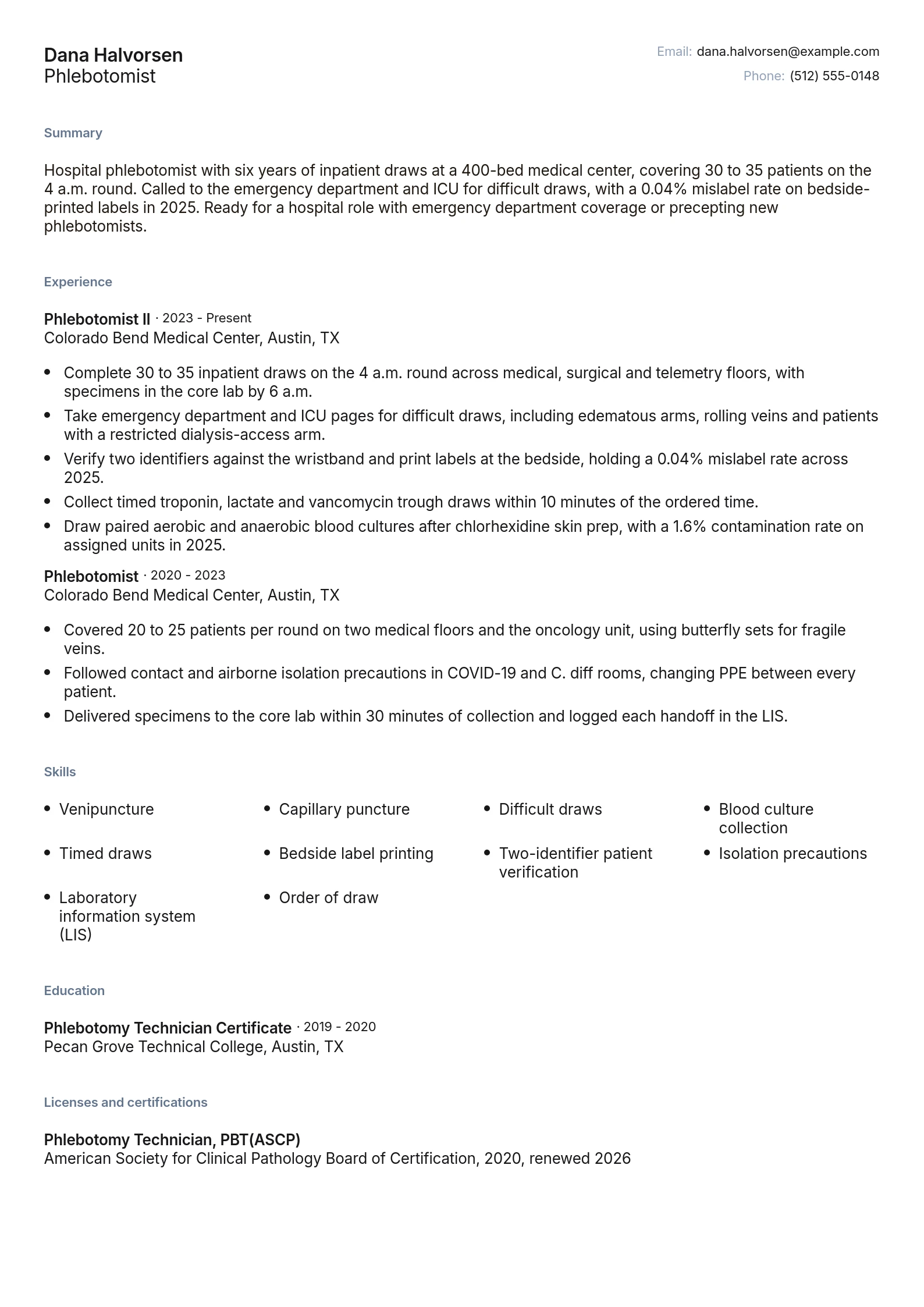
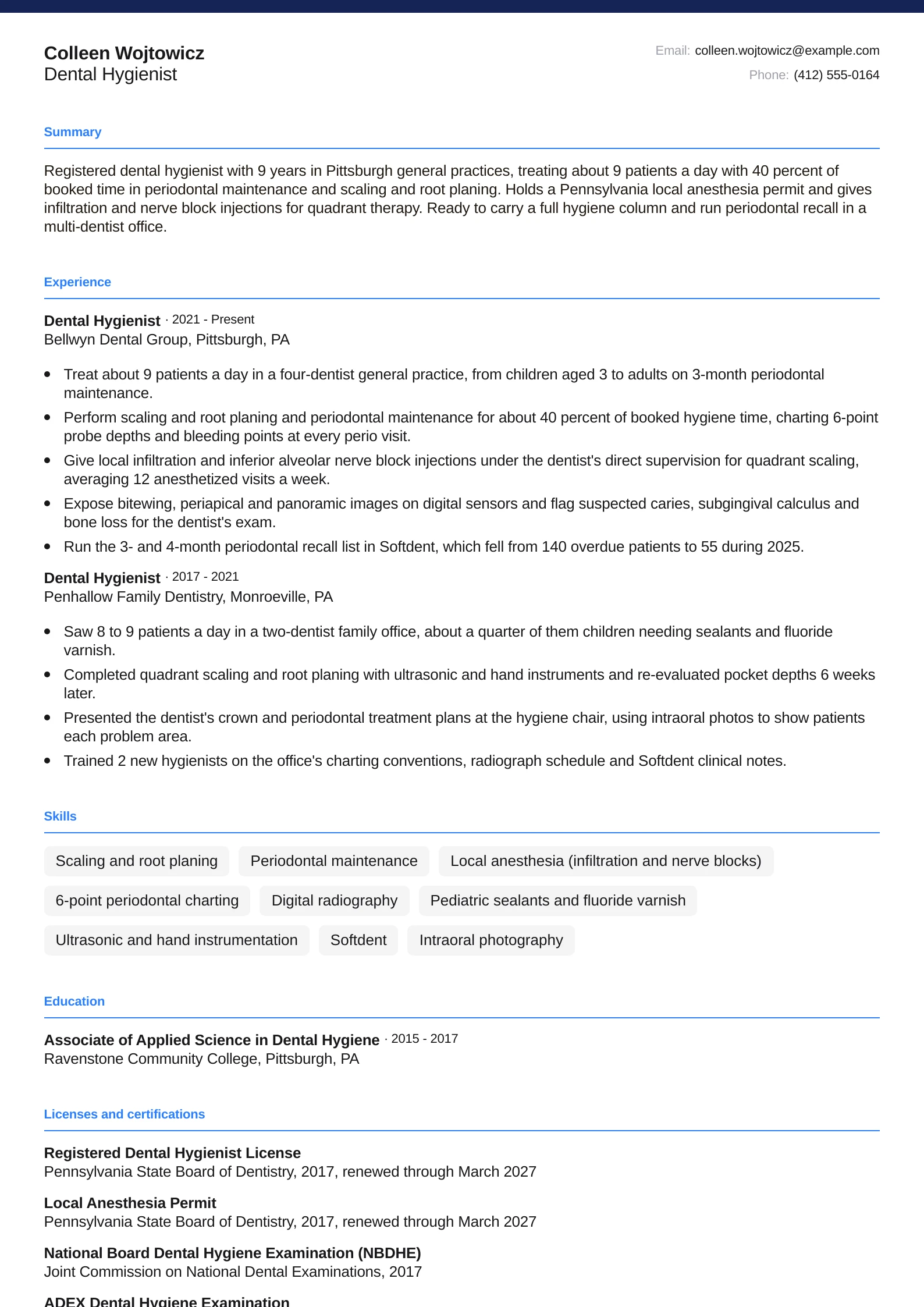
Dana Halvorsen's resume is written for a hospital lab manager. Her PBT(ASCP) line names the issuer and her last renewal, her bullets count the 4 a.m. round, and her difficult draws name the units that page her.
Copy this shape if you work inpatient: patients per round, the floors you cover, timed draws, blood cultures and your mislabel rate.
Choose by where you draw, then by experience
Start with the resume closest to your setting. A plasma center resume and a pediatric resume count different things even at the same experience level, so the setting tells you which numbers to copy.
Entry-level phlebotomist with externship draws
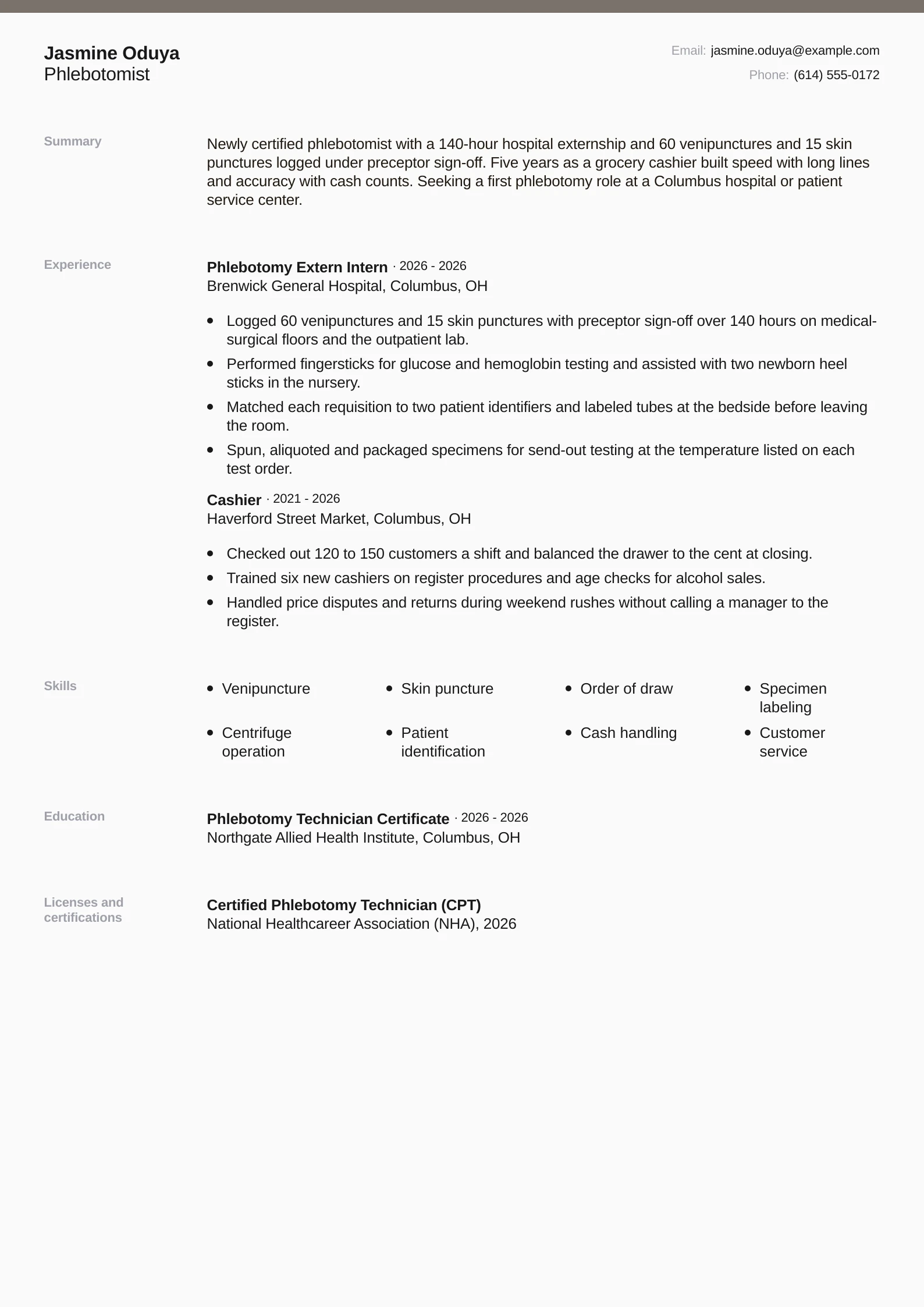
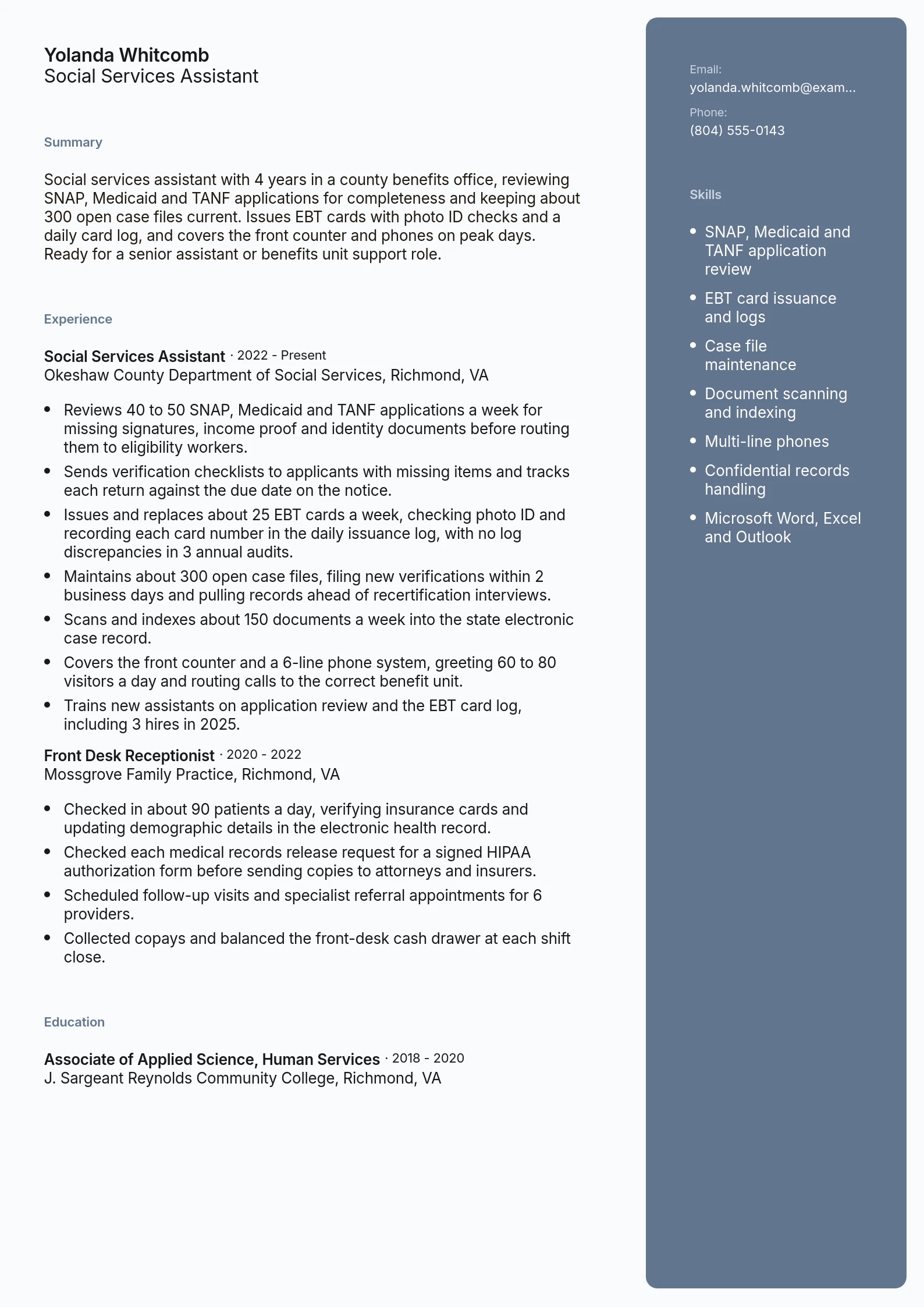
Jasmine has a new NHA certificate and no paid phlebotomy job, so her externship is the first entry under experience. It gives the hours, the 60 venipunctures and 15 skin punctures she logged, and the floors she worked. Her cashier job sits below it with checkout counts and a balanced drawer. Use this layout if you finished a program this year and your draws came from training.
Externship listed as experience with logged draw counts
Credential written with NHA as the issuer
Cashier bullets that show speed and cash accuracy
Lead phlebotomist who trains and schedules
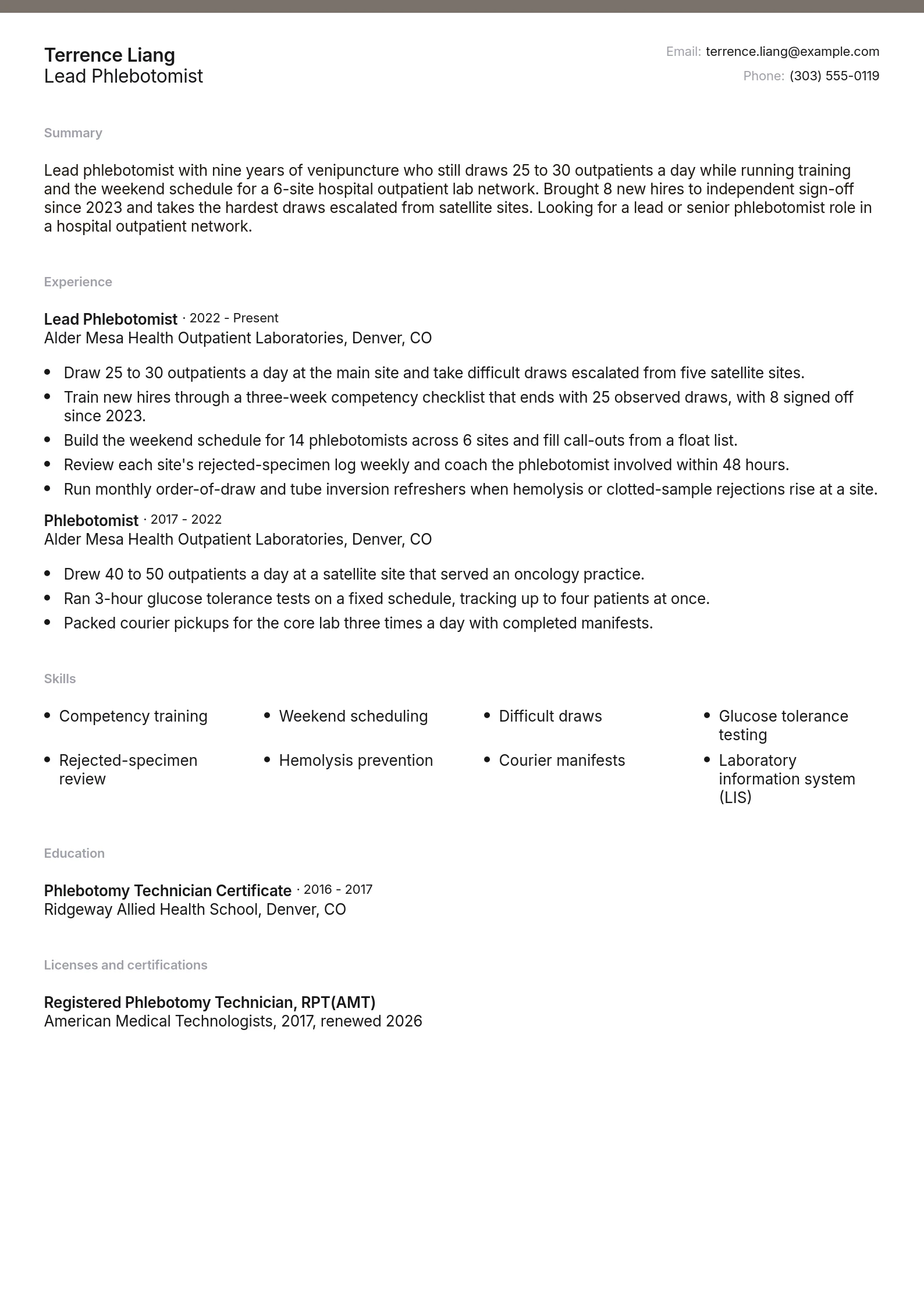
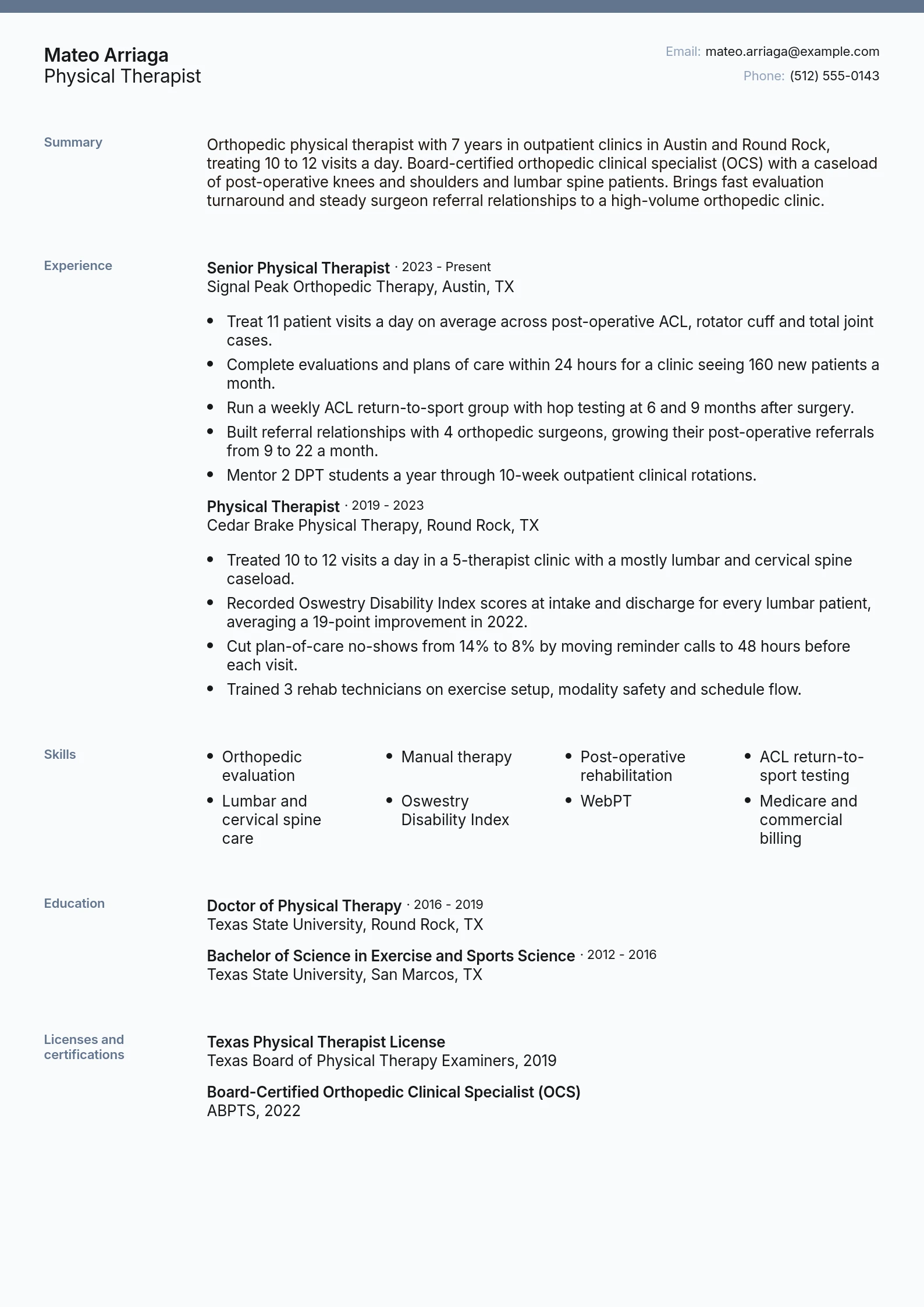
Terrence still draws 25 to 30 outpatients a day, and his first bullet says so before any lead duties. The rest count what a lead does: new hires taken through a three-week competency checklist, a weekend schedule for 14 phlebotomists at 6 sites, and weekly rejected-specimen reviews. Use it if you train staff and take the hardest draws at your site but do not run hiring or budgets.
Daily draw count listed before lead duties
Competency checklist with observed draws before sign-off
Weekend schedule and rejected-specimen reviews
Phlebotomy supervisor across nine draw sites
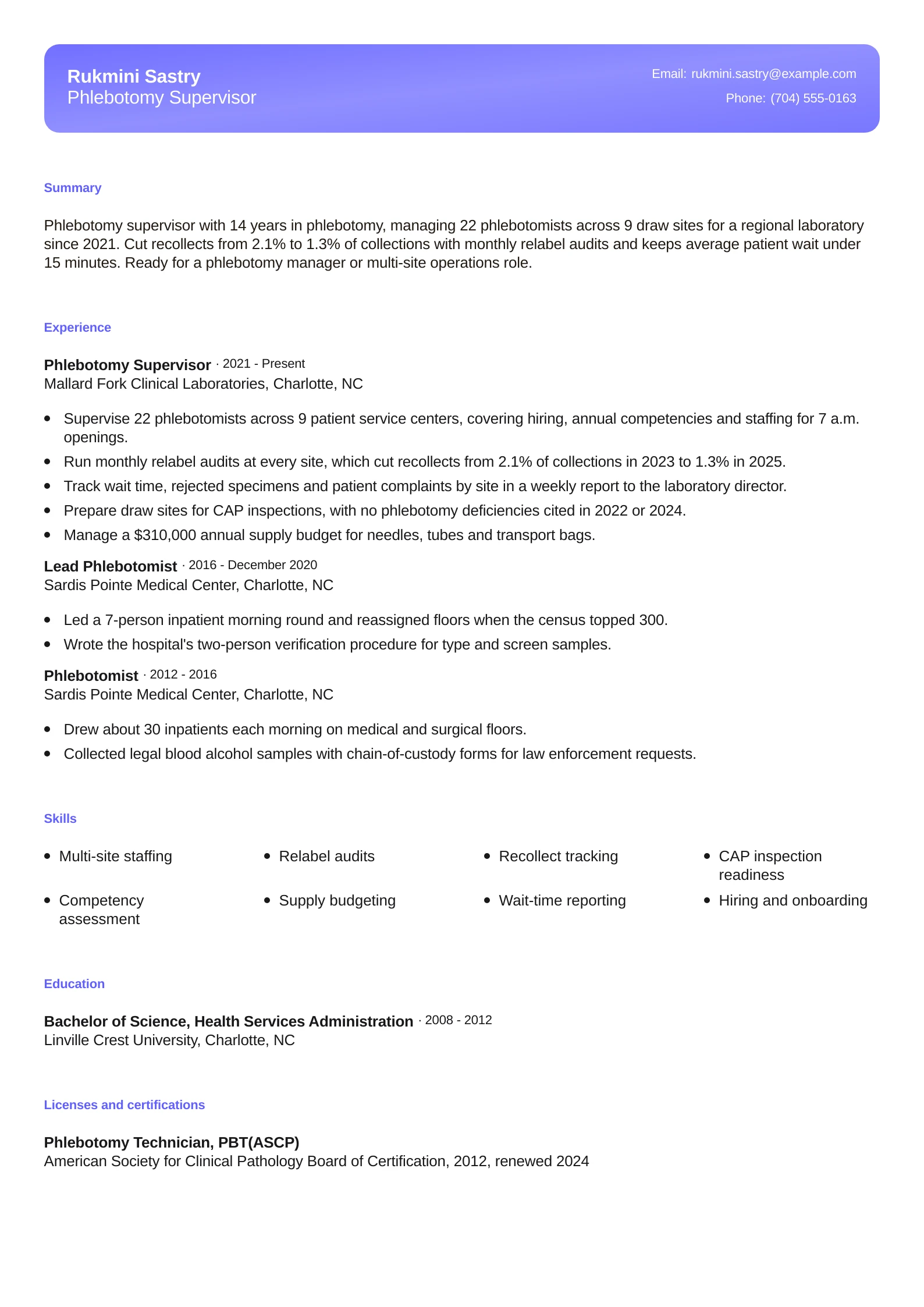
Rukmini's resume reads like a manager's: 22 phlebotomists, 9 patient service centers, a supply budget and inspection results. Her strongest line ties a process change to a number, with monthly relabel audits that cut recollects from 2.1% to 1.3% of collections. Her earlier hospital roles stay short. Use this if you hire, schedule and report site metrics to a laboratory director.
Relabel audits tied to a drop in recollects
Staff, site and budget numbers in the first role
Short earlier roles that show the path from the bench
Outpatient draw station phlebotomist
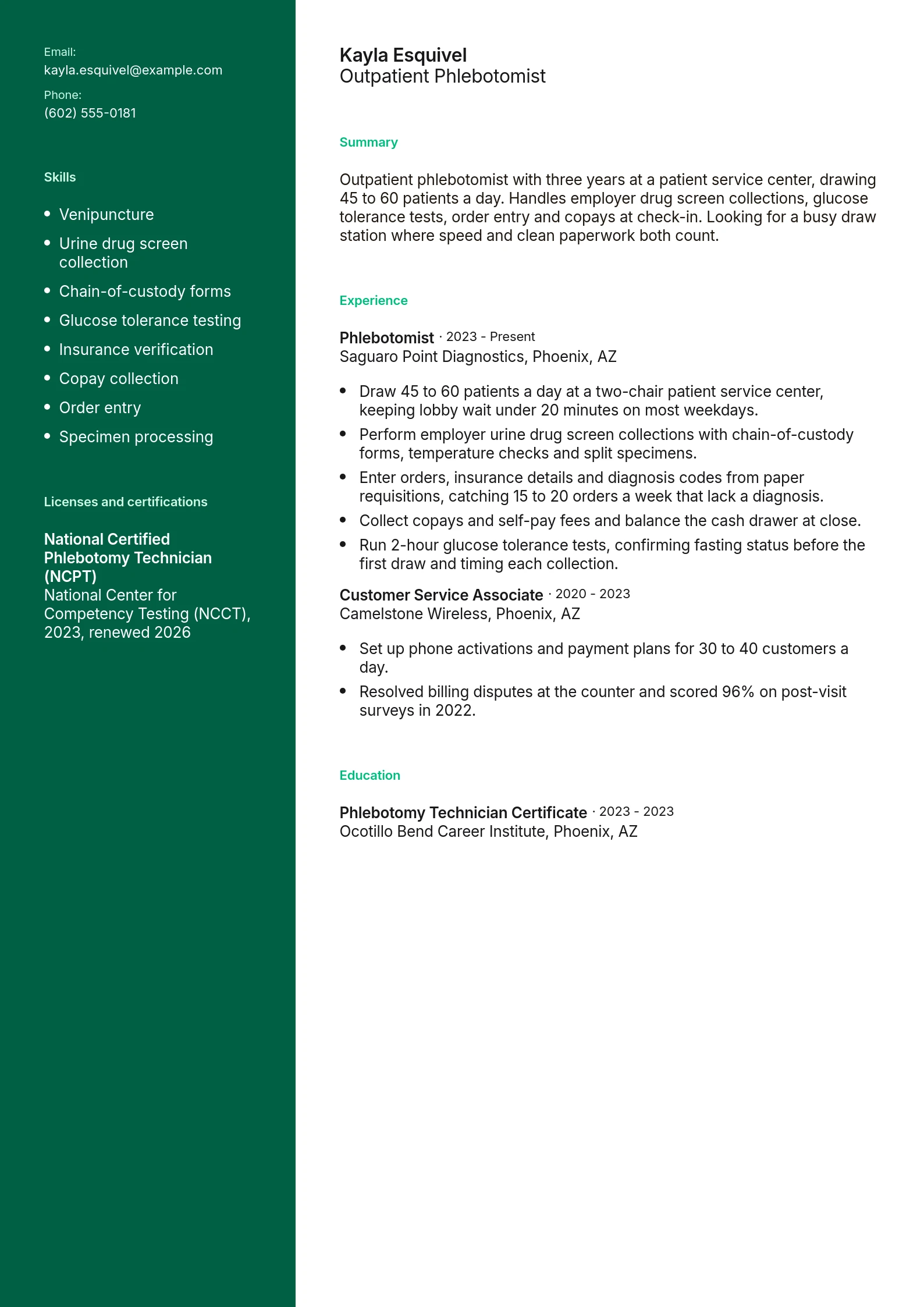
Kayla works a two-chair patient service center, so her bullets count patients per day and lobby wait, then add the extra work outpatient ads ask for: employer drug screen collections with chain-of-custody forms, glucose tolerance tests, order entry and copays. Her NCCT credential shows how to write a national certificate other than NHA. Use this if you work a walk-in draw station or a lab's patient service center.
Patients per day and lobby wait time
Drug screens, order entry and copay collection
NCPT credential with NCCT as the issuer
Mobile phlebotomist on a home and facility route
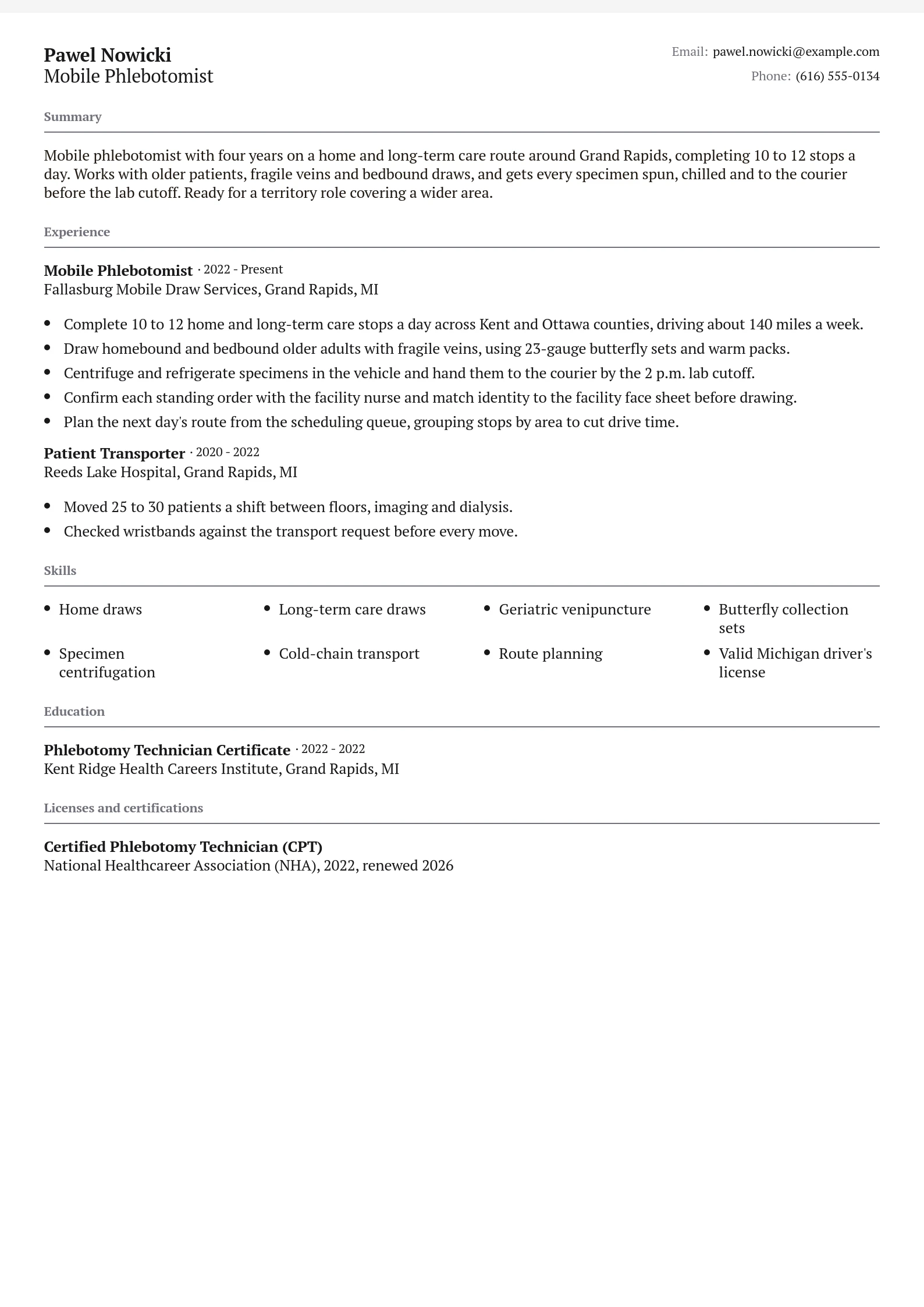
Pawel counts stops, not patients: 10 to 12 home and long-term care visits a day and about 140 miles a week. His bullets cover fragile geriatric veins, keeping specimens spun and cold in the vehicle, and meeting the lab's 2 p.m. courier cutoff. His driver's license is listed under skills. Use this if you drive a territory, visit homebound patients or draw at care facilities.
Stops per day and miles per week
Specimen handling in the vehicle and courier cutoff
Driver's license listed under skills
Plasma center phlebotomist trained on the job
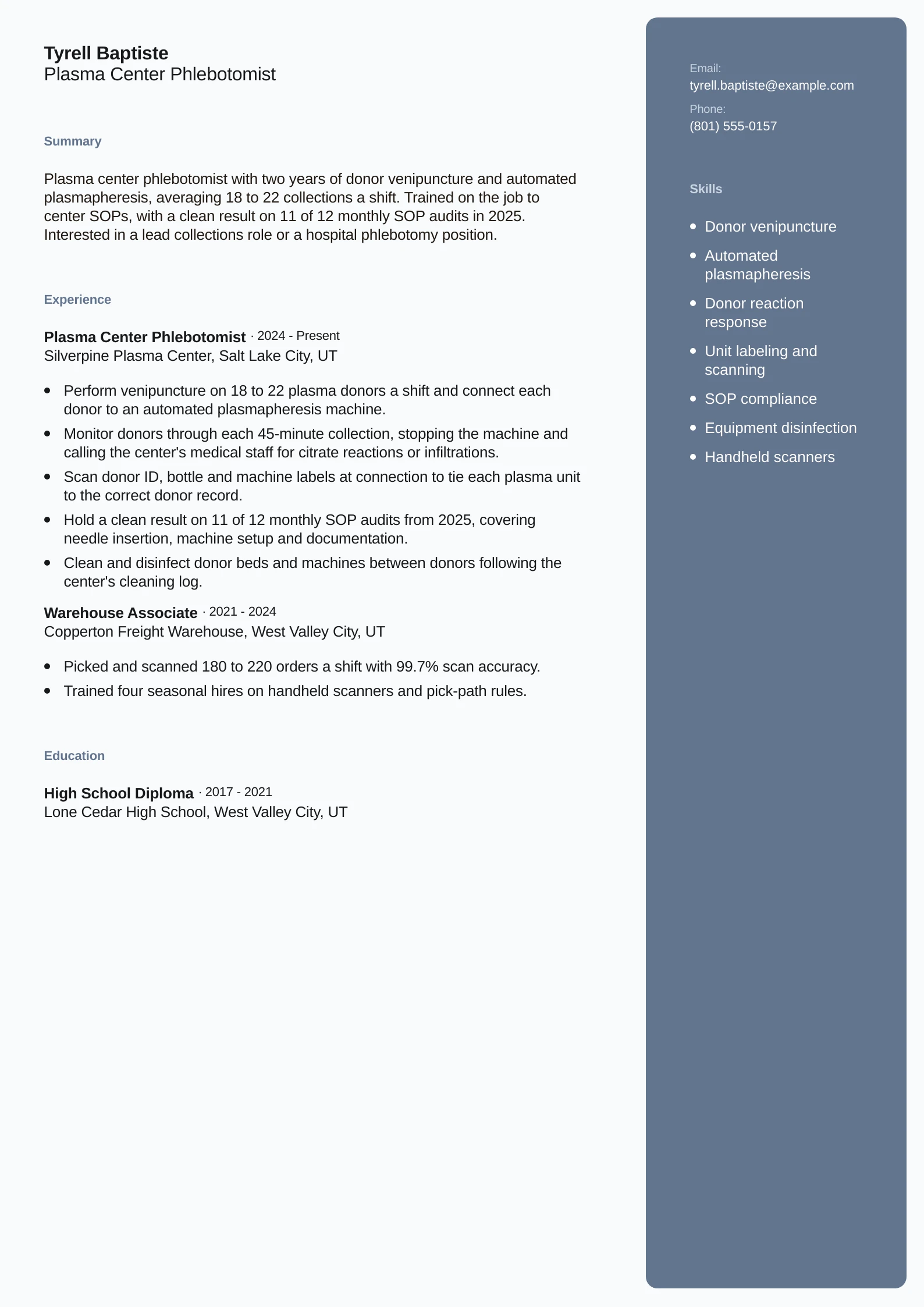
Tyrell learned venipuncture at a plasma center and holds no phlebotomy certificate, which Utah does not require. His resume leads with 18 to 22 collections a shift and his monthly SOP audit record. Bullets name the machine work, donor reactions and the label scan that links each unit to its donor. Use this if you collect plasma and want another collections job or a lead role.
Collections per shift and SOP audit results
Plasmapheresis machine and donor reaction work
Warehouse job that shows scan accuracy
Blood donor center phlebotomist on mobile drives
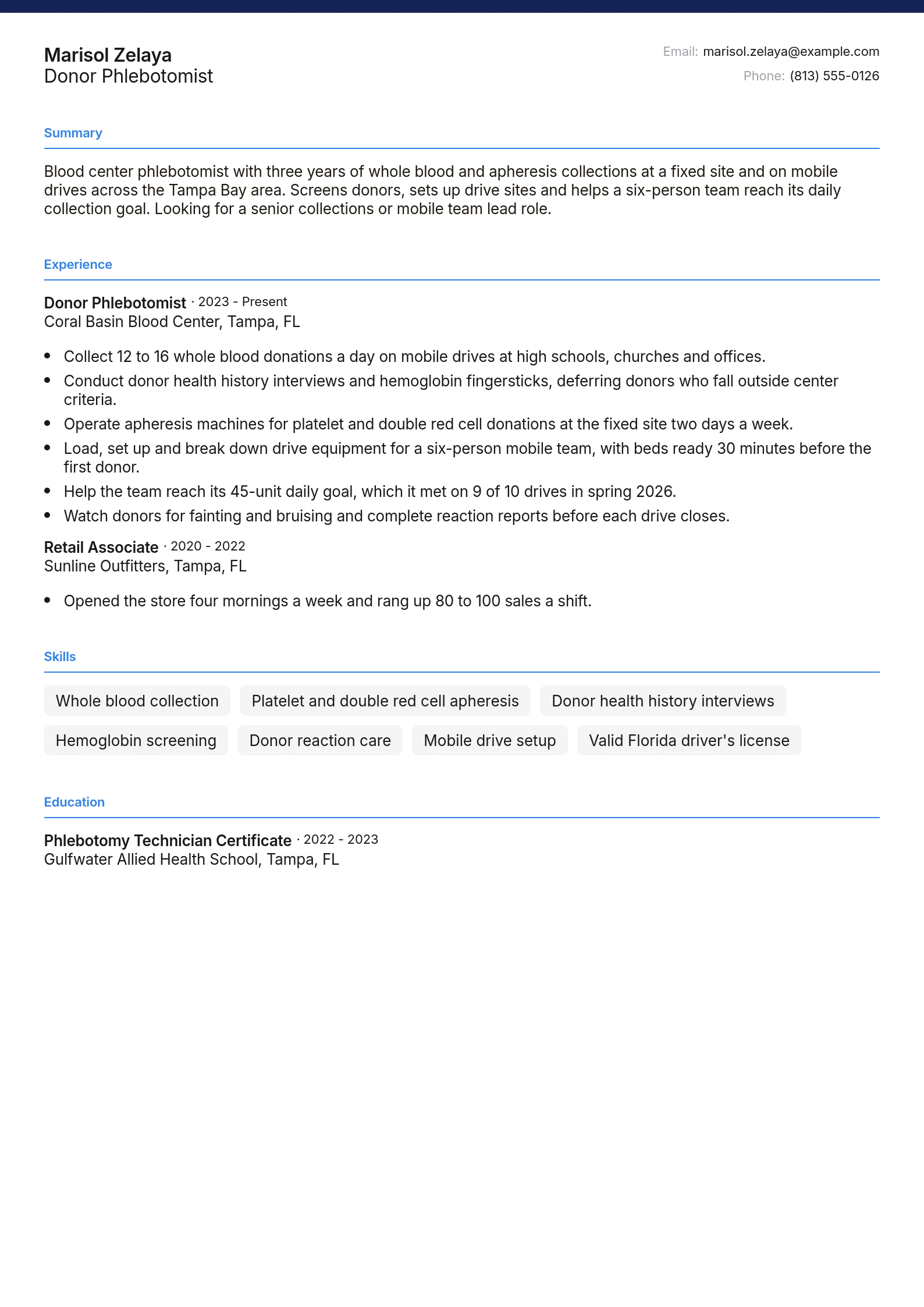
Marisol's numbers come from blood drives: whole blood donations a day, a team goal of 45 units met on 9 of 10 spring drives, and apheresis days at the fixed site. She lists donor health history interviews and hemoglobin screening before each donation, work hospital phlebotomists don't do. Her Florida driver's license is in skills because drive teams often ask for one. Use this for blood center or mobile drive jobs.
Team collection goal with drives met
Donor interviews and hemoglobin screening
Apheresis days at the fixed site
Pediatric phlebotomist at a children's hospital
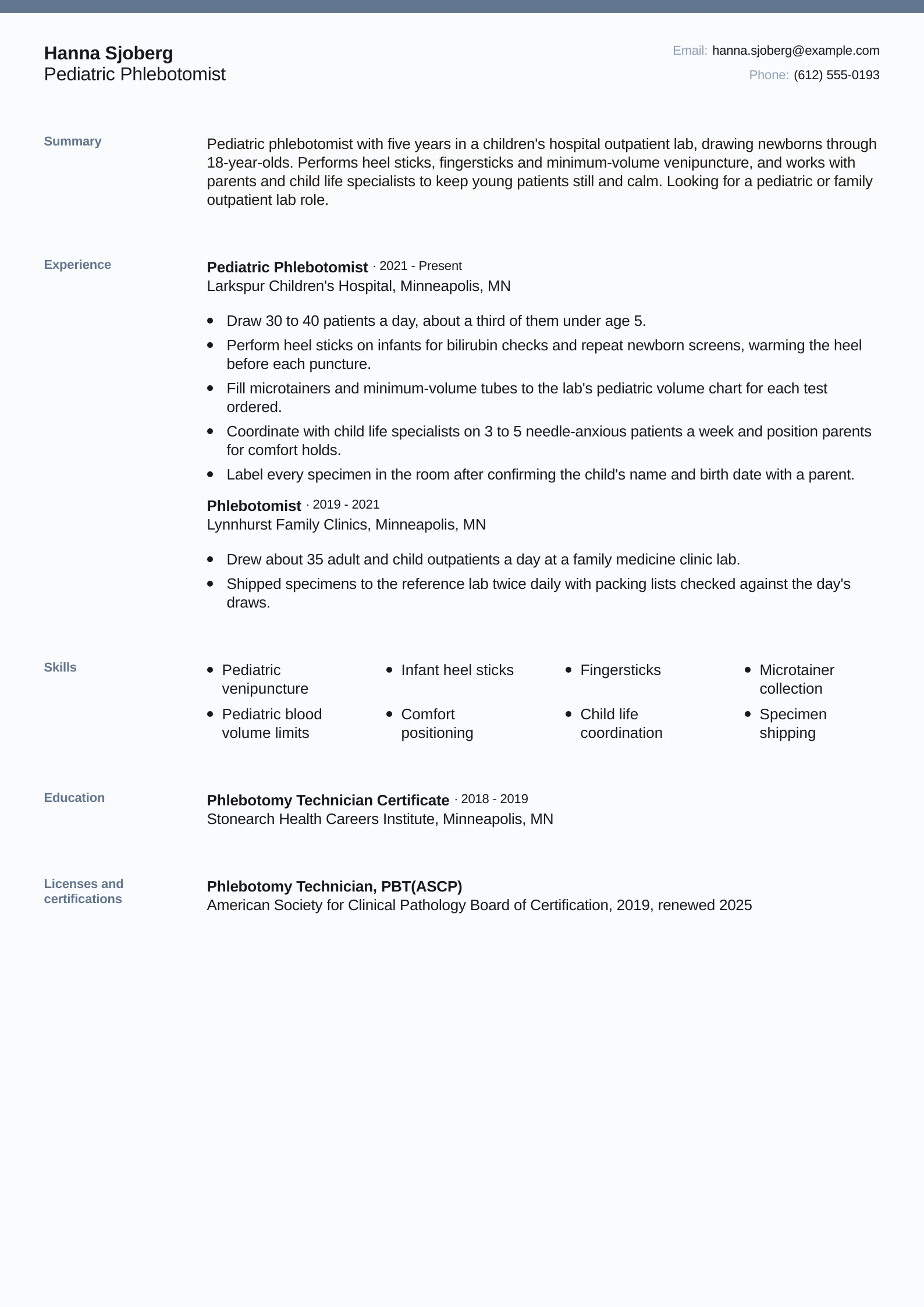
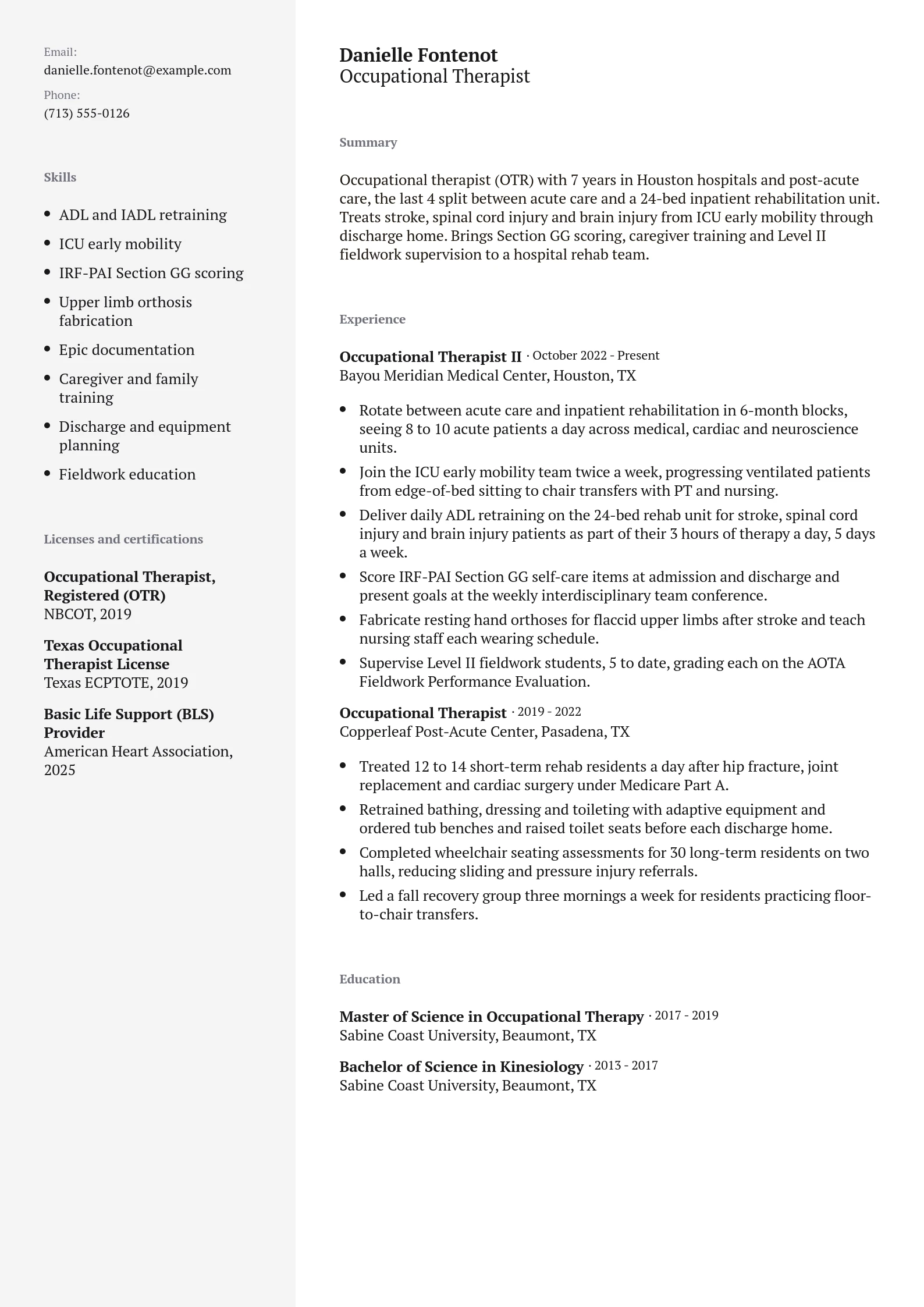
Hanna's bullets split patients by age, with about a third under 5, and name the techniques that go with them: heel sticks on infants, microtainers, minimum-volume tubes and comfort holds with parents. A line on child life coordination shows how she handles needle-anxious children. Use this if you draw children every day or want to move from an adult outpatient lab into a children's hospital.
Share of patients under age 5
Heel sticks and minimum-volume collection
Child life coordination for anxious patients
California phlebotomist with a state CPT I
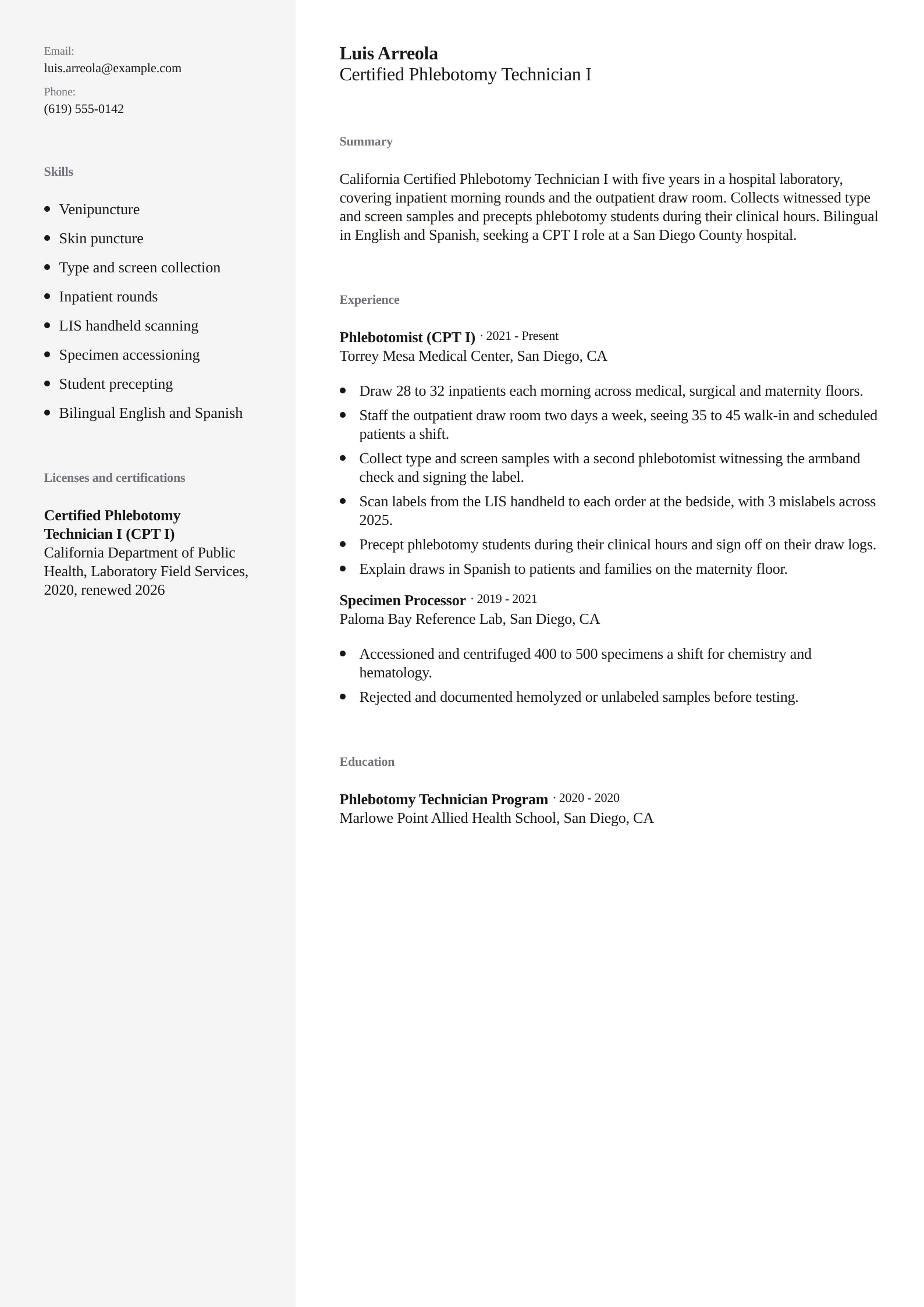
Luis lists his Certified Phlebotomy Technician I with the California Department of Public Health as the issuer, so no one confuses it with NHA's CPT. His current job title repeats the credential. His bullets split inpatient rounds from outpatient draw room shifts and include witnessed type and screen collections. Use this if you work in California or hold any state-issued phlebotomy credential.
CPT I with CDPH Laboratory Field Services as the issuer
Inpatient and outpatient counts kept separate
Witnessed type and screen collections
Career change phlebotomist from restaurant work
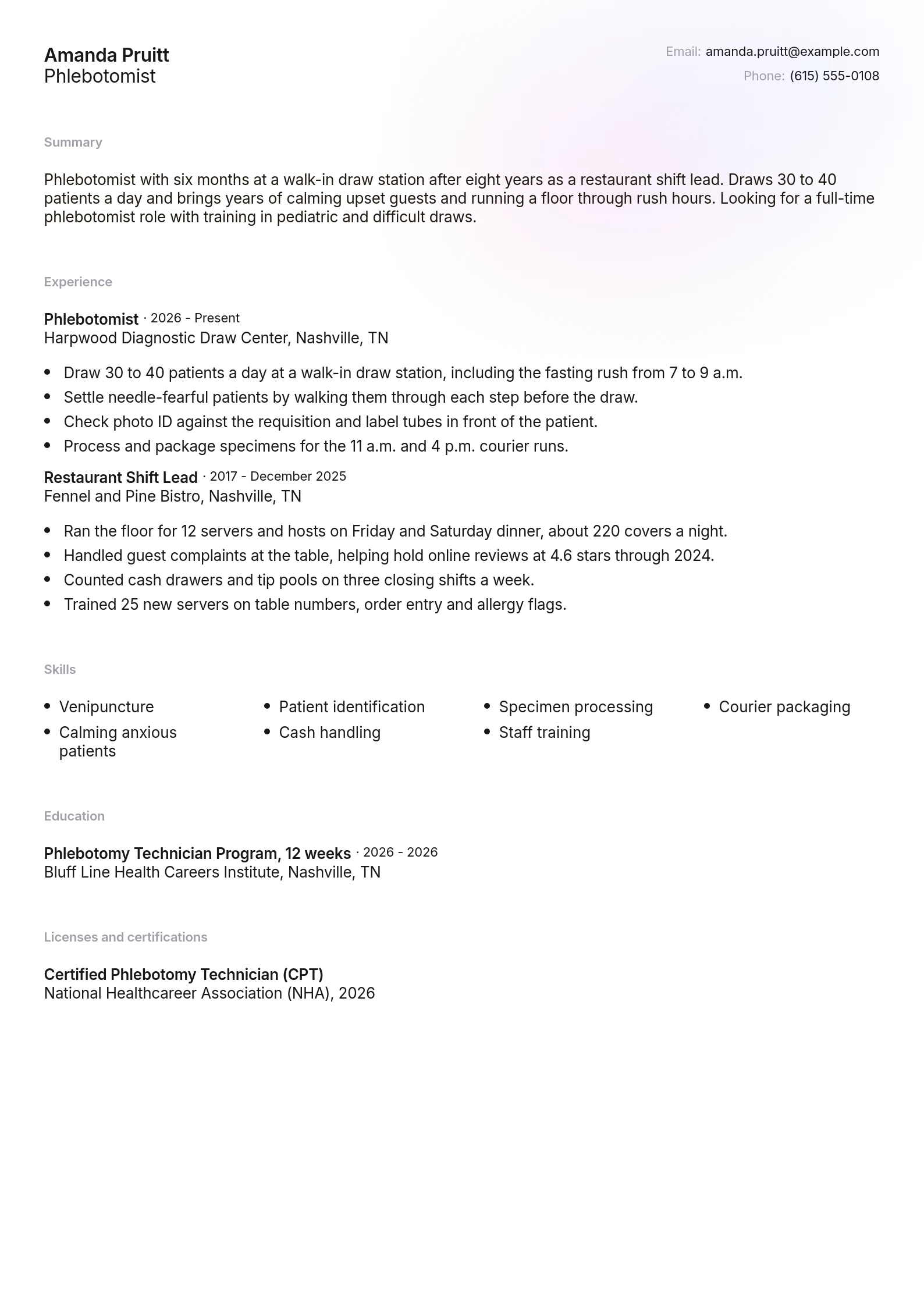
Amanda has six months of draws and eight years running a restaurant floor. Her phlebotomy job sits on top with patients per day and the morning fasting rush, and her 12-week program is under education. The shift lead bullets keep what transfers to a draw station: calming upset people, counting cash and training new staff. Use this if you are changing careers with under a year of draws.
New phlebotomy job placed above eight years of restaurant work
Restaurant bullets chosen for skills a draw station uses
12-week program listed under education
Part-time phlebotomist and biology student
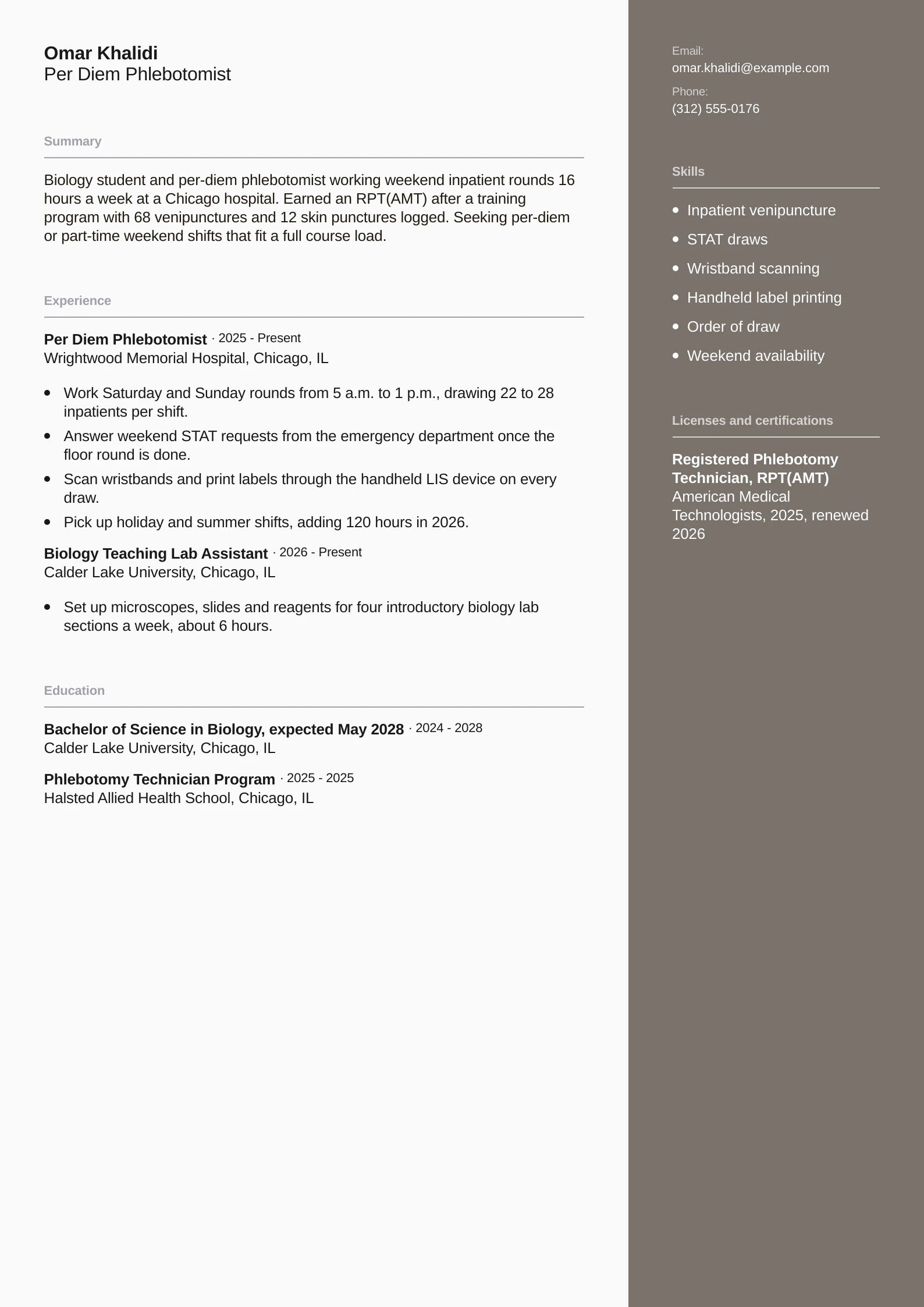
Omar works 16 hours a week on weekend inpatient rounds while carrying a full course load. His resume gives the exact days and hours, so a manager can see when he is free, and his RPT(AMT) line points to the training draws behind it. A teaching lab job accounts for his other hours. Use this if you are a pre-health student looking for per-diem or weekend shifts.
Weekend days and hours stated in the first bullet
RPT(AMT) with training draw counts in the summary
Expected graduation date under education
Write the credential name, issuer and renewal year on one line
Put the full credential name, its abbreviation and the issuer on one line, followed by the year you earned it and the year you last renewed. A manager looks it up before reading your experience, and "CPT" alone could mean NHA's national certificate or California's state certificate.
Only California, Louisiana, Nevada and Washington require a state phlebotomy credential, so check the current rule with your state agency before you apply. Everywhere else a national certificate is voluntary, but many ads list one as preferred. If you hold a state credential and a national one, list the state credential first.
Credential
Issuer to name
Status
Certified Phlebotomy Technician (CPT)
National Healthcareer Association (NHA)
Voluntary national certificate
Phlebotomy Technician, PBT(ASCP)
American Society for Clinical Pathology Board of Certification
Voluntary national certificate
Registered Phlebotomy Technician, RPT(AMT)
American Medical Technologists
Voluntary national certificate
National Certified Phlebotomy Technician (NCPT)
National Center for Competency Testing (NCCT)
Voluntary national certificate
Certified Phlebotomy Technician I (CPT I)
California Department of Public Health, Laboratory Field Services
California state certificate for venipuncture and skin puncture, renewed yearly
Phlebotomist license
Louisiana State Board of Medical Examiners
Louisiana state license
Laboratory Assistant or Office Laboratory Assistant certificate
Nevada Division of Public and Behavioral Health
Nevada state certificate
Medical Assistant-Phlebotomist
Washington State Department of Health
Washington state credential, renewed every two years
Count your draws by type, patient age and difficulty
Show the mix of draws you do and how accurate your labeling is, with a number for each. Managers read for venipuncture and capillary collections, adult, pediatric and geriatric patients, difficult draws, and how often your specimens come back.
Name the hard cases by unit or condition: ED, ICU, oncology, a dialysis patient's restricted arm, rolling or fragile veins. Give your mislabel or recollect rate if your lab reports one. If you draw children, say the youngest age you draw and whether you do heel sticks.
Counted draw mix
Complete 30 to 35 inpatient draws on the 4 a.m. round, take ED and ICU pages for difficult draws, and print every label at the bedside after a two-identifier check, with a 0.04% mislabel rate in 2025.
Duty list
Performed venipuncture and capillary draws on patients of all ages. Responsible for labeling specimens accurately.
Treat your externship as a job when it is your only draw experience
List the externship or clinical rotation under experience, with the facility, its hours and the draws you logged. A program that ended with 60 venipunctures and 15 skin punctures should say exactly that, because the count is the first thing a manager would ask about.
Break the count down where your log allows: adult and pediatric patients, fingersticks, heel sticks you assisted with, blood cultures and timed draws. Name the floors or clinics, such as "medical-surgical floors and the outpatient lab", so a hospital can tell you have drawn inpatients.
If you hold an RPT(AMT), your route to it needed at least 50 venipunctures and 10 skin punctures, so a log above that is worth stating. For other credentials, give the numbers from your own clinical log.
Keep a previous job underneath when it shows something a draw station needs, such as a cashier who balanced a drawer or a server who ran a dinner rush. Two or three bullets are enough, and they should count people served or cash handled.
What to count at a hospital, draw station, route or donor center
Count what your setting produces and say which unit you are counting. A hospital reads "30 patients" as a morning round, a draw station reads it as a slow day, and a blood center counts units, not patients.
If you are moving to a new setting, keep your own numbers and add the work the new ad names. A plasma center phlebotomist applying to a hospital should give venipunctures per shift and the ID scan on every unit, then add any capillary or pediatric draws from training.
Setting
Numbers to give
Work to name
Example to copy
Hospital inpatient
Patients per round, floors covered, mislabel or recollect rate
Pick a template that keeps the credential in the top third
A plain one-page template with your credential near the top works for almost every phlebotomy job. Managers check the certificate, your setting and your draw counts, so none of them should sit on a second page.
If you are new, use a layout like Jasmine's or Omar's, where education and the credential are easy to find. With five or more years, use a layout like Dana's or Rukmini's, where experience fills most of the page and skills form a short list.
Show month and year for every job and training entry. A phlebotomy manager checks whether your draws are recent, and a gap of more than a few months since your last draw is worth closing with a refresher or a per-diem shift.
Skip photos, skill ratings and icons. They take space your draw counts and credential line need.
Use the words phlebotomy ads use for the same work
Copy the exact terms from the ad into your bullets where they describe work you do. Phlebotomy ads repeat a short list: venipuncture, capillary or skin puncture, order of draw, specimen processing, LIS data entry, patient identification and infection control.
Hospital ads add bedside labeling, timed draws, blood cultures and STAT draws. Draw station ads add drug screens, insurance verification, payment collection and courier pickups. Mobile ads add route, territory, home draws and a valid driver's license, and donor centers use donor screening, apheresis and collection goals.
Name the tools you use: the LIS, the handheld label printer or scanner, the centrifuge and the courier manifest. Put each keyword inside a bullet with a number where you can, such as "Enter orders and insurance details for 45 to 60 patients a day", and keep the skills section to 8 to 10 items that repeat those terms.
Leave out duties from other clinical jobs, such as rooming patients or giving injections, unless the ad is for a combined role. A phlebotomy manager is hiring for identification, the draw, labeling and specimen handling.
Questions about phlebotomy credentials and settings