Before reading a nursing assistant's duties, the hiring nurse checks for an active state registry listing and a current BLS card, then looks for the setting and how many residents or patients you cared for per shift. Each CNA resume example below gets the credential line right for its state, then names the workplace, the shift and the resident or patient count for every aide role.
Nursing home CNA with five years on long-term care halls
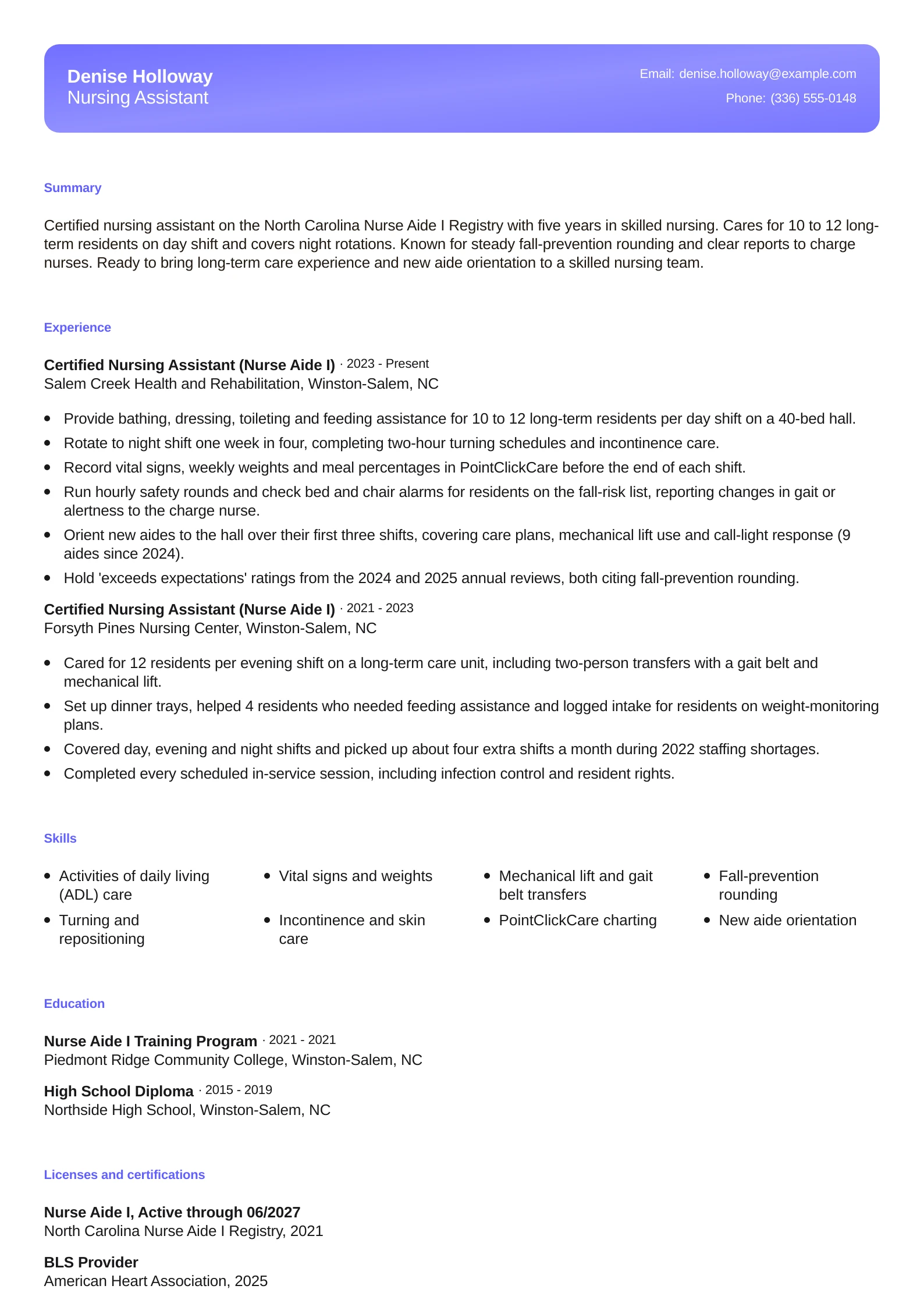
Denise has five years at two North Carolina skilled nursing facilities, the background most nursing homes hire for. Her summary opens with her Nurse Aide I listing, and her certifications section repeats it with 'Active through 06/2027' so the hiring nurse can match it to the registry in seconds.
Both jobs name the residents per shift and the shifts she worked, and the current role adds the hall size, orienting new aides and two annual review ratings. Use it if you're a working aide moving to another nursing home or rehab center, and swap in your own hall, ratio and dates.
New aide, hospital nights, memory care or career change
The next four are set in Texas and California, in a nursing facility clinical rotation, a hospital, a memory care unit and a skilled nursing wing. Each one names its state's credential, its shift and how many residents or patients the aide cares for, so open the example closest to the job you're applying for.
Newly certified aide with clinical hours and a cashier job
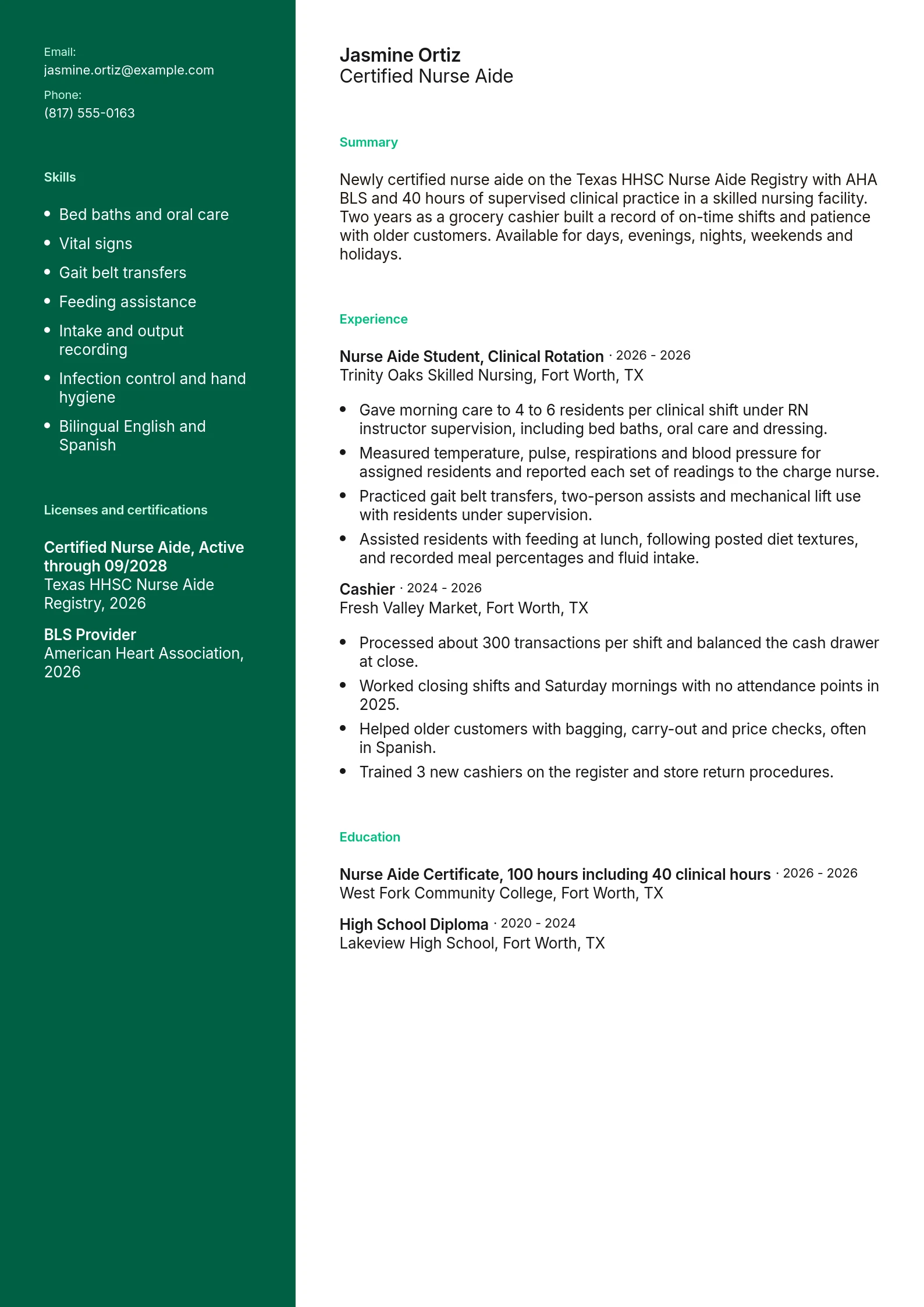
Jasmine joined the Texas registry this year and has no paid aide work yet, so her clinical rotation sits first under experience, written with the tasks a charge nurse asks about: bed baths, vital signs, gait belt transfers and feeding help. Two years as a grocery cashier show attendance and patience with older customers. Use it if you've just finished training and are applying to nursing homes or hospital programs that hire new aides.
Clinical rotation listed as experience, with residents per shift
Program hours and clinical hours in the education line
Availability for every shift stated in the summary
Hospital CNA on 12-hour med-surg nights
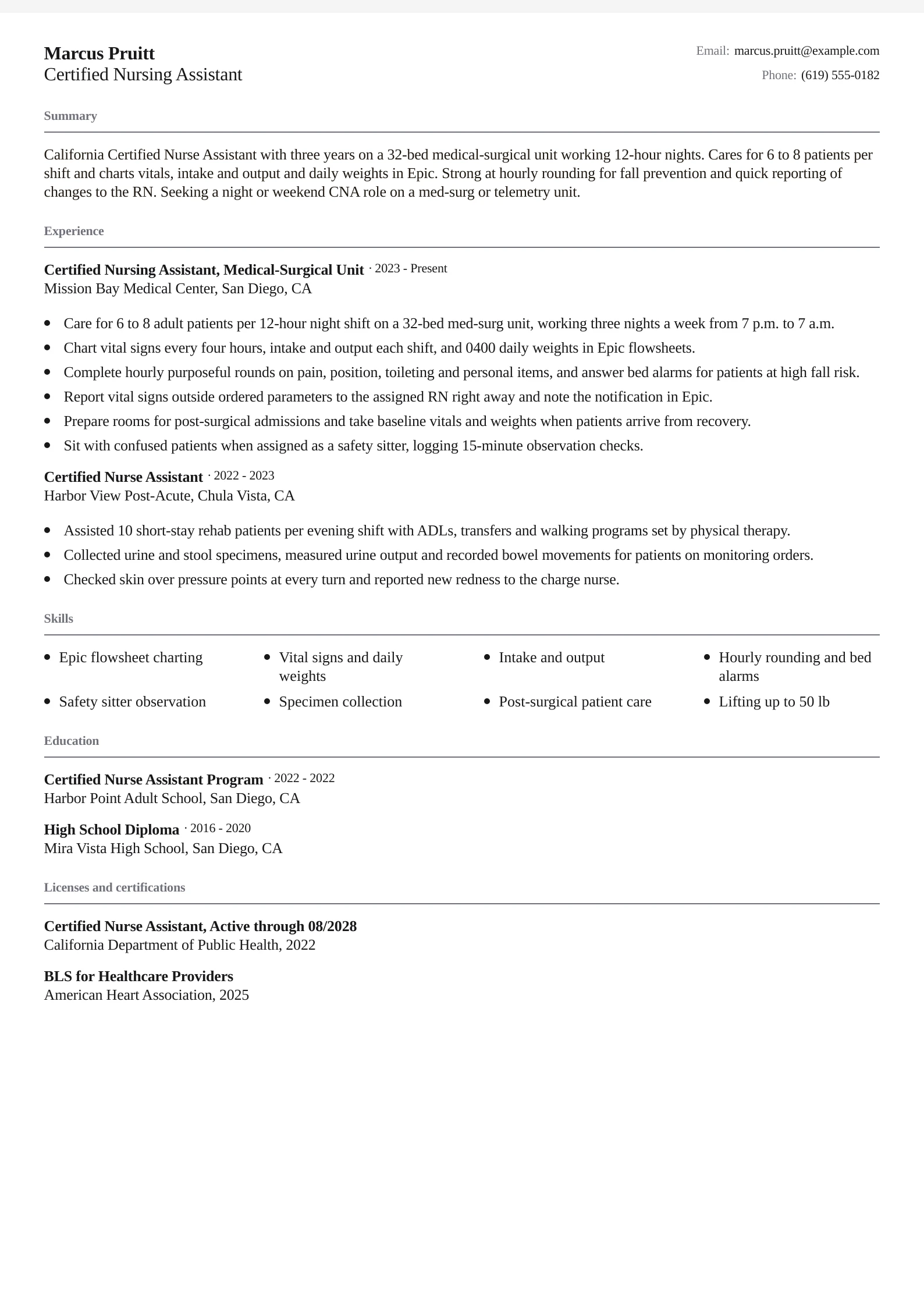
Marcus works three 12-hour nights a week on a 32-bed medical-surgical unit, and every bullet ties a task to that unit: 6 to 8 patients, vitals every four hours, 0400 weights, and intake and output charted in Epic flowsheets. A year in post-acute rehab sits below it. Use it if you're applying to a hospital, or moving from a nursing home or rehab center to a hospital floor where patients turn over every few days.
Unit, bed count and shift pattern in the first bullet
Epic charting named alongside the readings he records
BLS listed under the name hospitals use in their postings
Memory care aide with sundowning routines and dining help
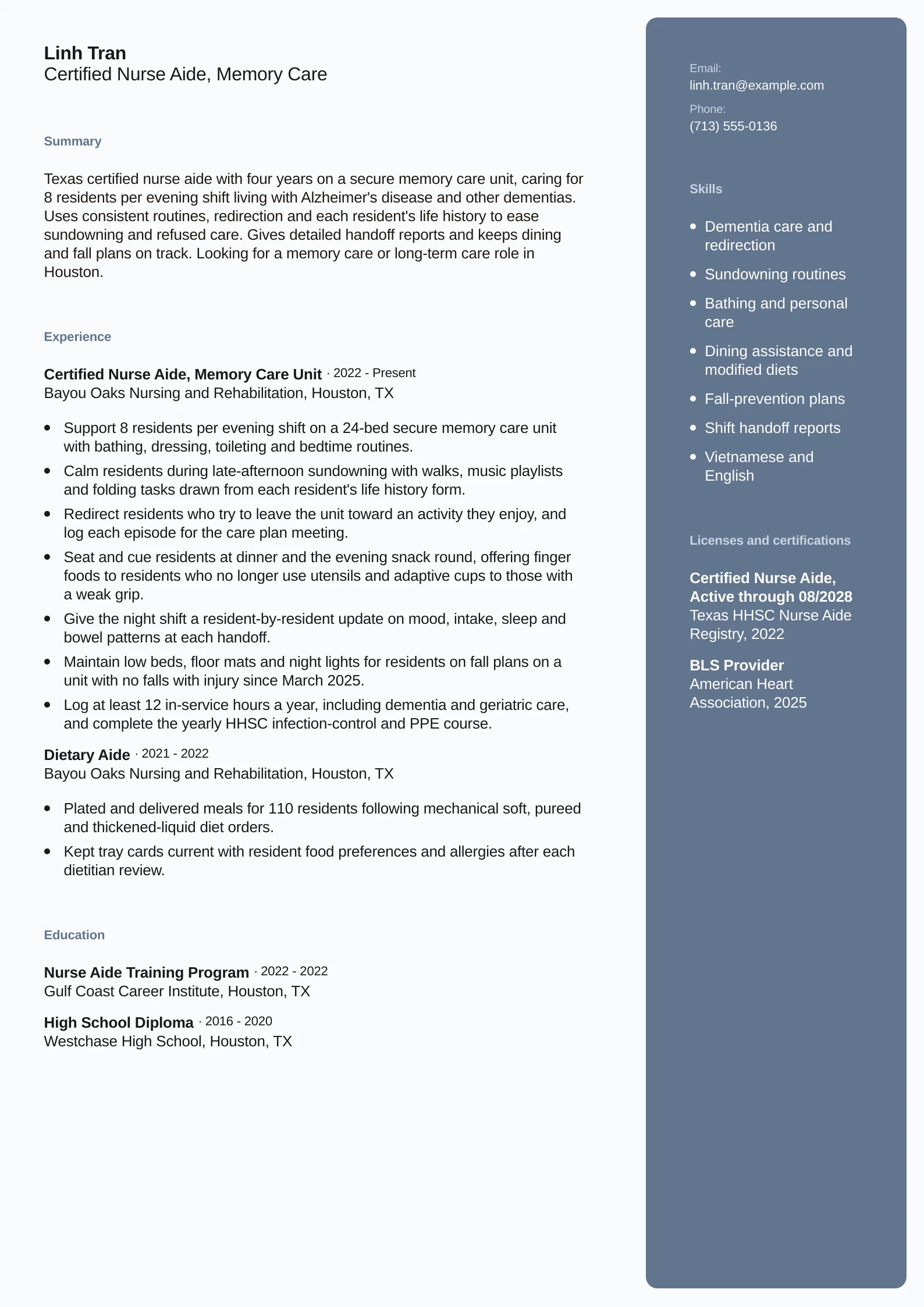
Linh's four years on a secure memory care unit show up as methods, not adjectives: life-history activities during sundowning, redirection for residents who try to leave, finger foods and adaptive cups at dinner, and a resident-by-resident handoff. Her Texas in-service hours, including dementia care, appear as a bullet. Choose it for a memory care unit, assisted living or dementia care community, or if you worked in dietary or housekeeping before becoming an aide.
8 residents per evening shift on a 24-bed secure unit
Sundowning and redirection described by what she does
Dietary aide job shown below the CNA role at the same facility
Restaurant supervisor turned skilled nursing CNA
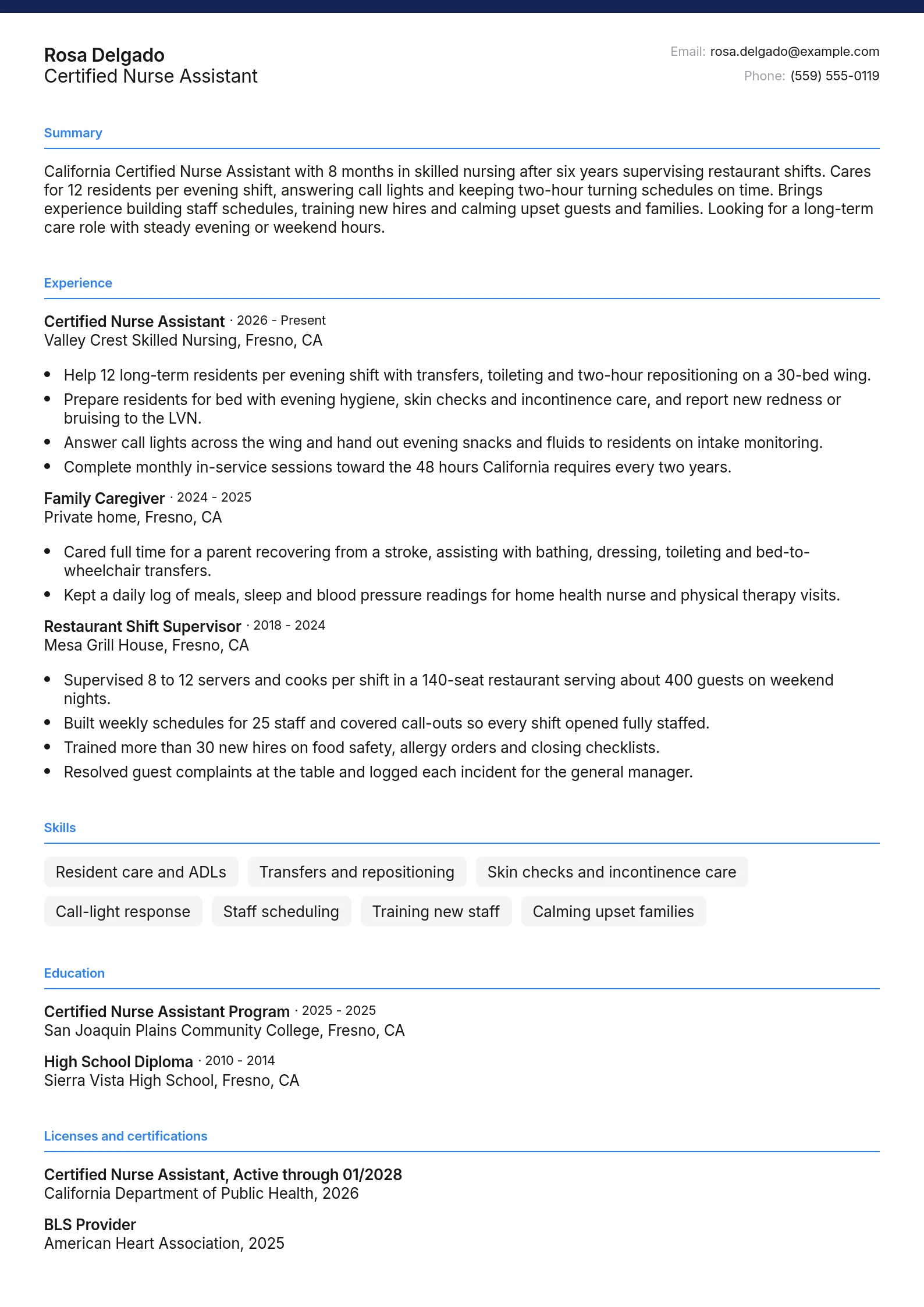
Rosa has eight months as a CNA, so that job comes first and six years of restaurant supervising sit below it, cut down to staffing, training and calming upset guests. A family caregiver entry covers 2024 and 2025 with the care she gave a parent after a stroke. Use it if you're coming from food service, retail or another field, or need to account for time spent caring for a relative.
Current CNA job first, earlier career below it
Family caregiving listed as a dated role with real tasks
Restaurant bullets trimmed to skills a nursing home uses
Copy your state's exact aide title and registry name
Write your credential the way your state registry lists it: the title, the registry's name, your status and the date it runs through. A facility has to verify your registry listing before it can use you as an aide, so the hiring nurse looks you up, and a line that matches the record saves a phone call.
Put that line in two places, the first sentence of your summary and your certifications section. Add your BLS card right after it with the issuer and year, because hospitals such as Denver Health ask for American Heart Association BLS by name.
There is no national CNA license, so always name the state. If your registry uses a title not shown here, such as STNA (State Tested Nurse Aide) in Ohio or LNA (Licensed Nursing Assistant) in New Hampshire and Vermont, copy it from your registry record instead of writing CNA.
State
Title to write
Registry or agency to name
What keeps the listing active
Example credential line
North Carolina
Nurse Aide I
North Carolina Nurse Aide I Registry
The listing runs 24 months. Renewal needs at least 8 hours of paid nursing or nursing-related work in that time, verified by an RN. The registry sends no reminder.
Nurse Aide I, Active through 06/2027, North Carolina Nurse Aide I Registry
Texas
Certified Nurse Aide
Texas HHSC Nurse Aide Registry
Expires 24 months after issue or after your last verified employment, whichever is earlier. Renewal needs employer verification, a yearly infection-control course and 24 hours of in-service every two years, including geriatrics and dementia care.
Certified Nurse Aide, Active through 08/2028, Texas HHSC Nurse Aide Registry
California
Certified Nurse Assistant
California Department of Public Health (CDPH)
Renew every two years with 48 hours of in-service training, at least 12 in each year and up to 24 online.
Certified Nurse Assistant, Active through 01/2028, California Department of Public Health
After 24 months without paid aide work, you retest before you return
If you've gone 24 months in a row without paid nursing or nursing-related work, federal rules say you must complete a new competency evaluation, with or without a new training program, before a nursing home can use you as an aide. That makes the dates on your last aide job more important than on most resumes, because the hiring nurse reads them to judge whether your listing is still good.
Give a month and year for every aide job, including the end date of your last one. If you've worked any paid nursing shifts since, such as PRN or agency shifts, list them with dates. In North Carolina, 8 paid hours in 24 months, verified by an RN, is enough to renew the listing.
Never write 'Active' on a listing that has lapsed, because the facility checks the registry before your first shift. Write the step you've reached and its date instead, for example 'Certified Nurse Assistant, California Department of Public Health, reactivation exam scheduled 11/2026'. California lets you reactivate a certificate that expired less than two years ago by passing the competency exam, so the exam date is the detail to show.
If the gap came from caring for a relative, list it as a dated role with the tasks you did, such as bathing, transfers and keeping a log for home health visits, as the career change example does. A dated entry with care tasks answers the question before the interview does.
If your state counts in-service hours toward renewal, put them in a bullet so the nurse can see renewal is on track. Texas asks for 24 hours every two years and a yearly infection-control course, and California asks for 48 hours every two years. The memory care example shows one way to write it: 'Log at least 12 in-service hours a year, including dementia and geriatric care, and complete the yearly HHSC infection-control and PPE course.'
Attach the setting, shift and resident count to every duty
Nursing homes, hospitals and senior living communities all list bathing, vital signs and repositioning, so those duties only tell a manager something once you add where, when and for how many. Put the facility type in the employer line or first bullet, then build the bullets around the facts that kind of employer screens for.
For a nursing home or skilled nursing facility, write residents per shift, the hall or unit size, and every shift you've worked. Life Care Center's posting asks for skilled nursing experience on days, evenings and nights, so 'rotate to night shift one week in four' answers it directly. Add mechanical lift and gait belt transfers if you do them.
For a hospital, name the unit (med-surg, telemetry, ED), patients per shift, your 12-hour night or weekend pattern, and what you chart and where. Name the readings you chart, such as vitals, intake and output and daily weights, and the system you chart them in, such as Epic or MEDITECH.
For senior living or memory care, describe dining help, start- and end-of-shift resident updates and the routines you use with residents who have dementia. A line such as 'give a resident-by-resident update on mood, intake and sleep at each handoff' shows you already do it.
Setting, shift and resident count attached
Provide bathing, dressing, toileting and feeding assistance for 10 to 12 long-term residents per day shift on a 40-bed hall, and rotate to night shift one week in four.
Duties with no setting or load
Assisted residents with activities of daily living, took vital signs and repositioned patients as needed.
No paid aide job yet? List your clinical rotation as experience
Your clinical rotation is the closest thing you have to aide experience, so put it under experience with the facility name, its type and the dates. Write the bullets the way a working aide would, with residents per clinical shift and the care you gave under your RN instructor's supervision. 'Gave morning care to 4 to 6 residents per clinical shift' tells a nurse more than 'completed clinical hours'.
In the education line, give the program name, school, total hours and clinical hours, as in 'Nurse Aide Certificate, 100 hours including 40 clinical hours'. The federal minimum is 75 hours with at least 16 of supervised practical training, and states can require more, such as Texas at 100 hours with 40 clinical, so the number shows how much hands-on time you've had.
Choose bullets from the skills you were checked off on with real residents, such as bed baths, oral care, vital signs, gait belt transfers, feeding help, and intake and output. Name the reading, not just the skill: 'temperature, pulse, respirations and blood pressure' is more useful than 'vital signs'.
Keep one or two earlier jobs and trim them to what a nursing home uses: attendance, weekend shifts, lifting and patience with older people. Two years as a cashier with no attendance points in 2025 says more about reliability than a skills list, and the entry-level example shows how short those bullets can be.
State your availability in the summary. Nursing homes and hospitals staff nights, weekends and holidays, so 'available for days, evenings, nights, weekends and holidays' tells the scheduler which gaps you can fill.