Your license line is the first thing a pharmacy employer checks: the state that licensed you, the exams behind it and whether you're a certified immunizer, followed by the setting you practice in.
The six examples cover retail, hospital and long-term care pharmacists, a new graduate, a student intern and a pharmacist moving states, and each lists the credentials its setting asks for.
A retail pharmacist resume built on volume, vaccines and MTM
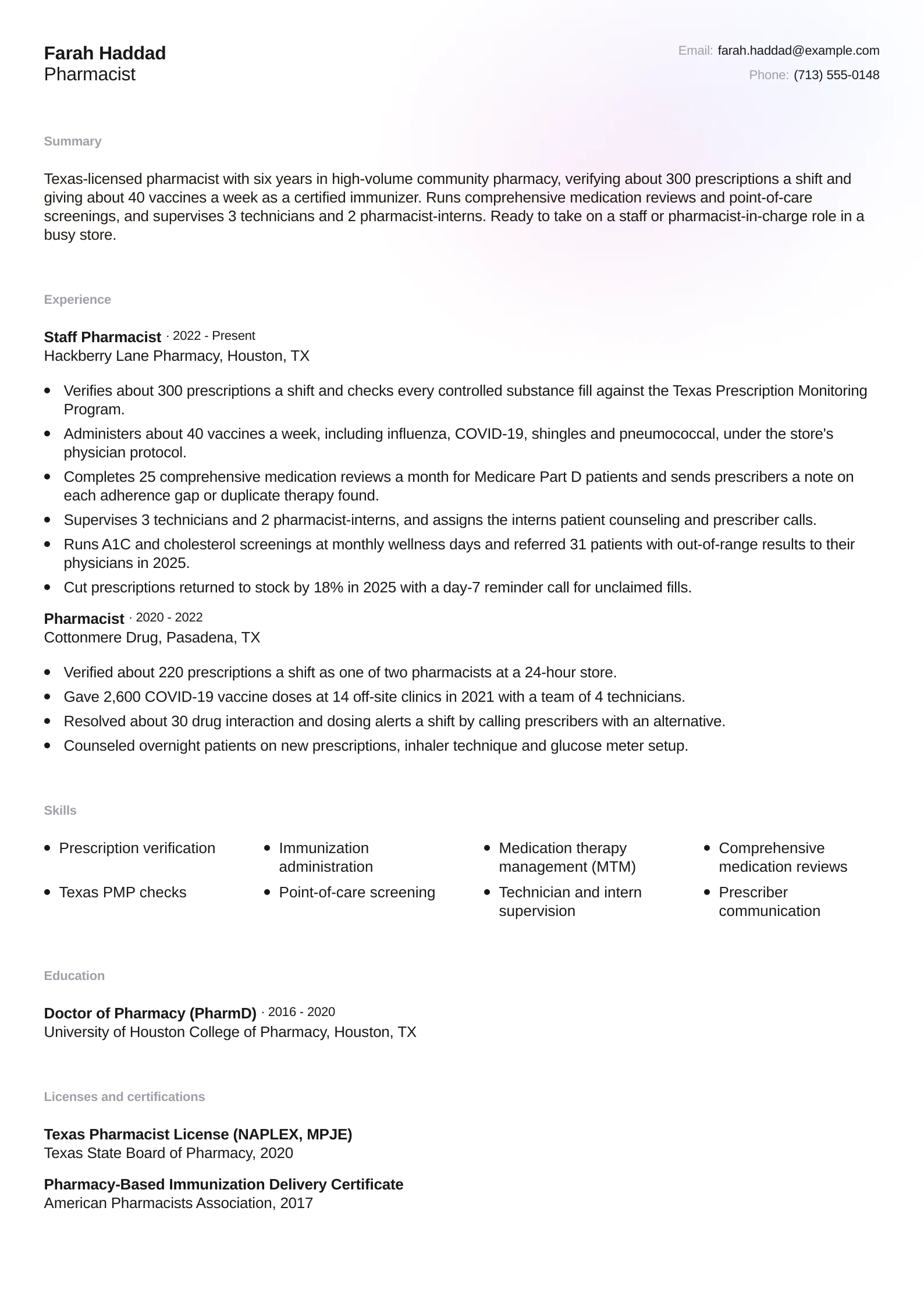
Farah Haddad's resume opens with a Texas license that names both exams, then puts numbers on the three things community pharmacy ads ask about: prescriptions verified a shift, vaccines given a week and medication reviews completed a month.
Copy this layout if you work in a chain or independent store. Swap in your own state board, your volume and the technicians and interns you supervise.
Pharmacist and pharmacy intern resumes by setting and license status
Pick the example whose setting and license situation match yours. A hospital resume and a long-term care resume prove different things, and a student with an intern license needs a different credentials section from a pharmacist who is moving states.
Entry-level pharmacist resume for a new PharmD graduate
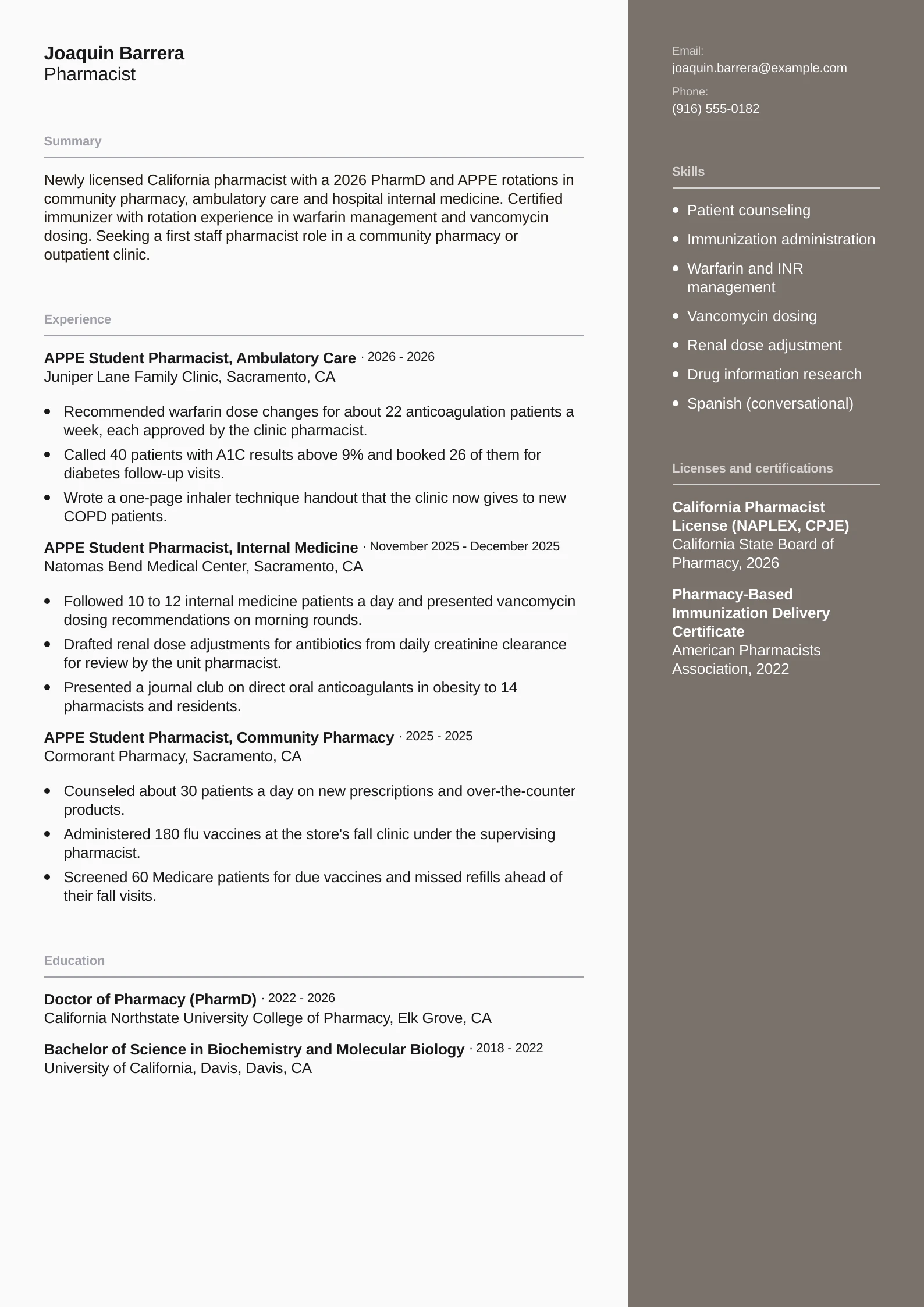
Joaquin Barrera has just passed the NAPLEX and CPJE, so his California license sits at the top of his credentials with its 2026 issue year. Three APPE rotations take the place of paid pharmacist jobs, and each one names the site and a counted task, such as warfarin dose recommendations or vancomycin dosing on rounds. Use it if you graduated this year and your license is new or about to be issued.
Rotations listed as experience with site, setting and dates
California license written with the NAPLEX and CPJE
Clinic work framed as recommendations the pharmacist approved
Pharmacy intern resume for a student pharmacist
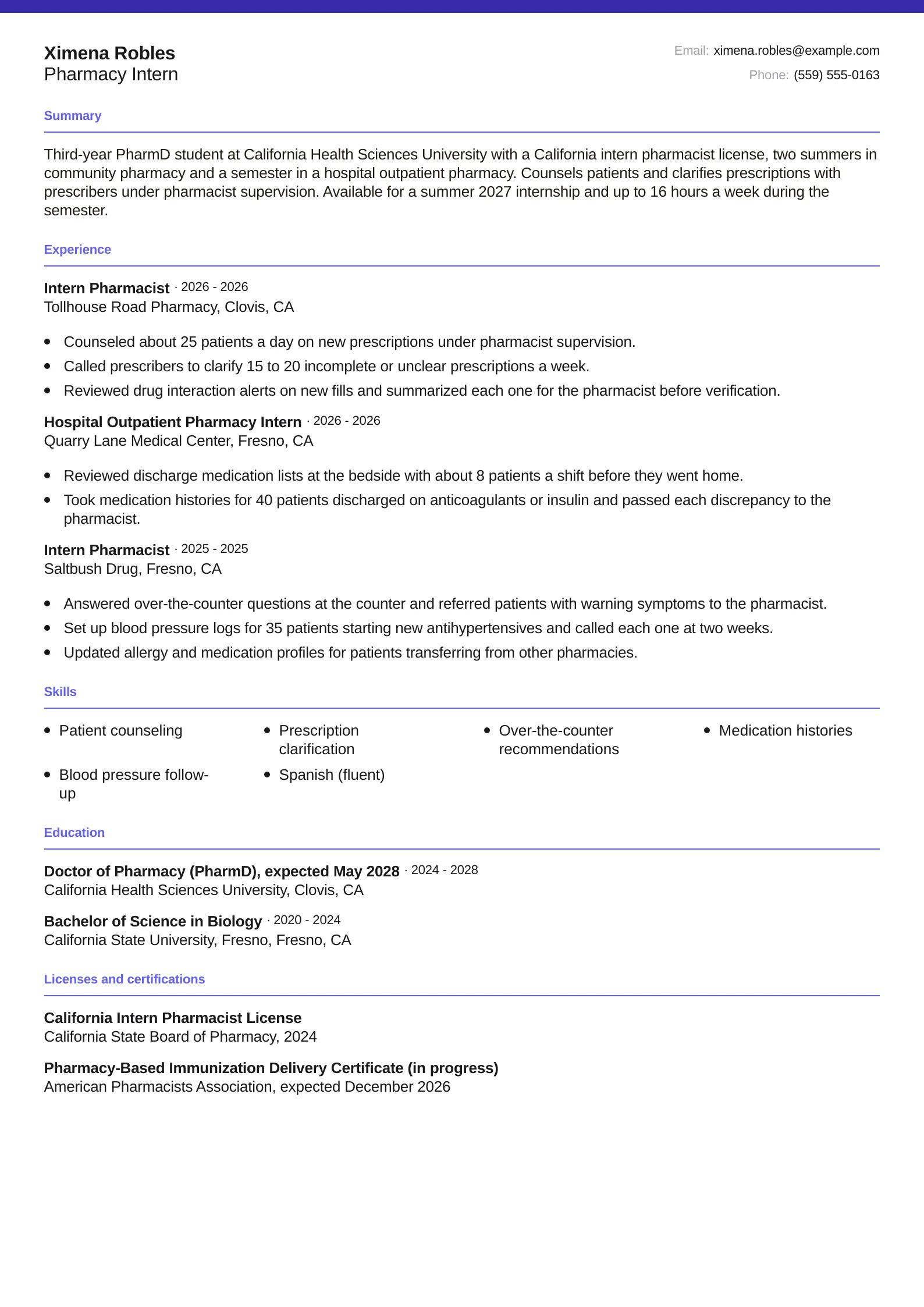
Ximena Robles is a third-year PharmD student with a California intern pharmacist license. Her resume lists two community pharmacy summers and a semester in a hospital outpatient pharmacy, with patient counseling written under pharmacist supervision. The immunization certificate she is finishing appears with an expected month. Use it if you are applying for a summer internship or a part-time intern job before you sit the licensure exams.
Intern pharmacist license listed with the issuing board
In-progress certificate shown with an expected month
Semester availability stated in the summary
Hospital clinical pharmacist resume with PGY1 and BCPS
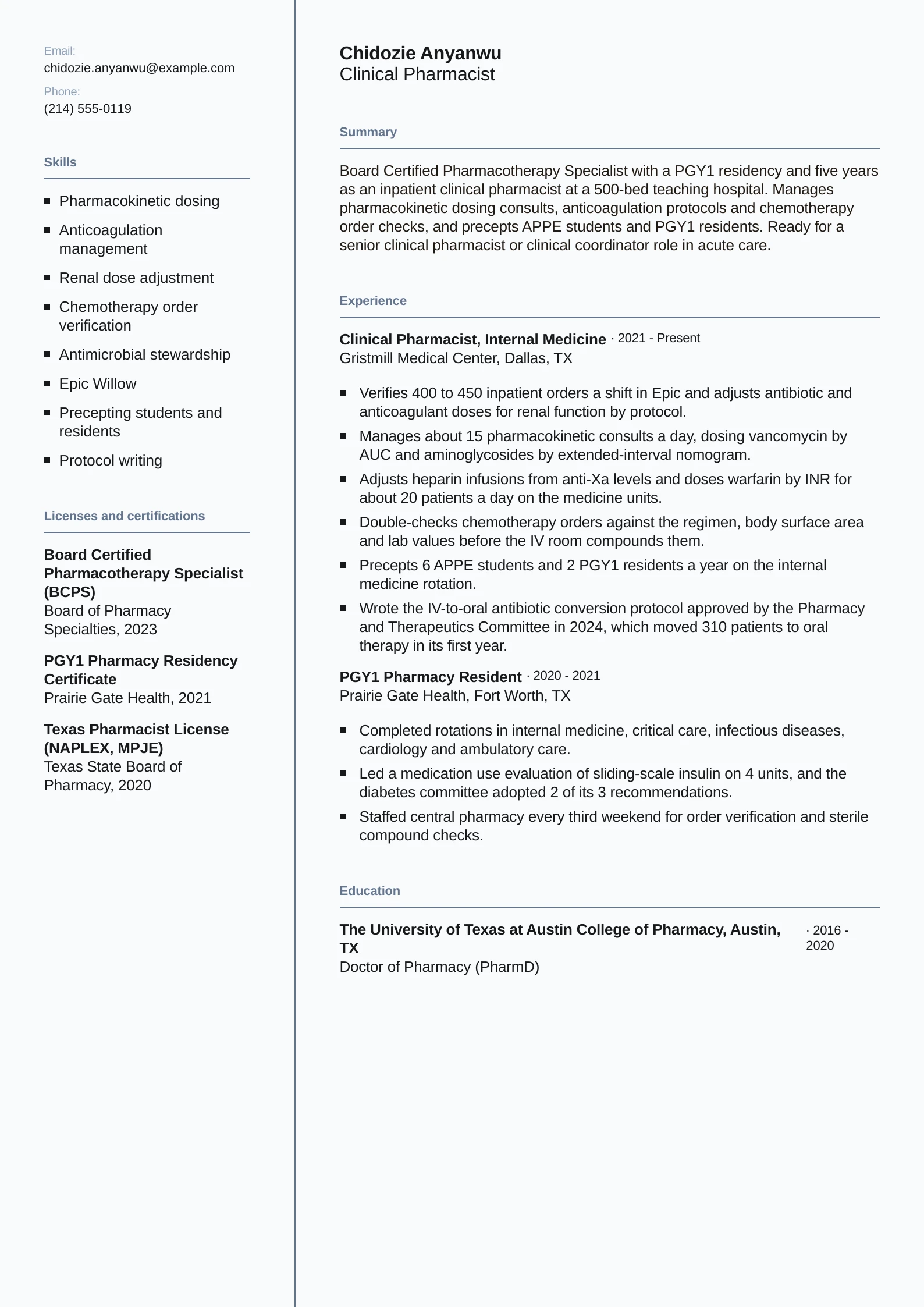
Chidozie Anyanwu's resume leads with BCPS and a PGY1 residency, the two signals acute care ads prefer. His bullets count pharmacokinetic consults, heparin and warfarin patients and the students and residents he precepts, and name the chemotherapy checks he makes before IV compounding. The residency gets its own experience entry with its rotations named. Use it if you work inpatient and want your clinical work to carry the page, with order verification as one line of it.
Residency listed as its own job with rotations named
Vancomycin AUC dosing and anticoagulation counted per day
Protocol tied to a Pharmacy and Therapeutics Committee approval
Long-term care pharmacist resume for institutional pharmacy
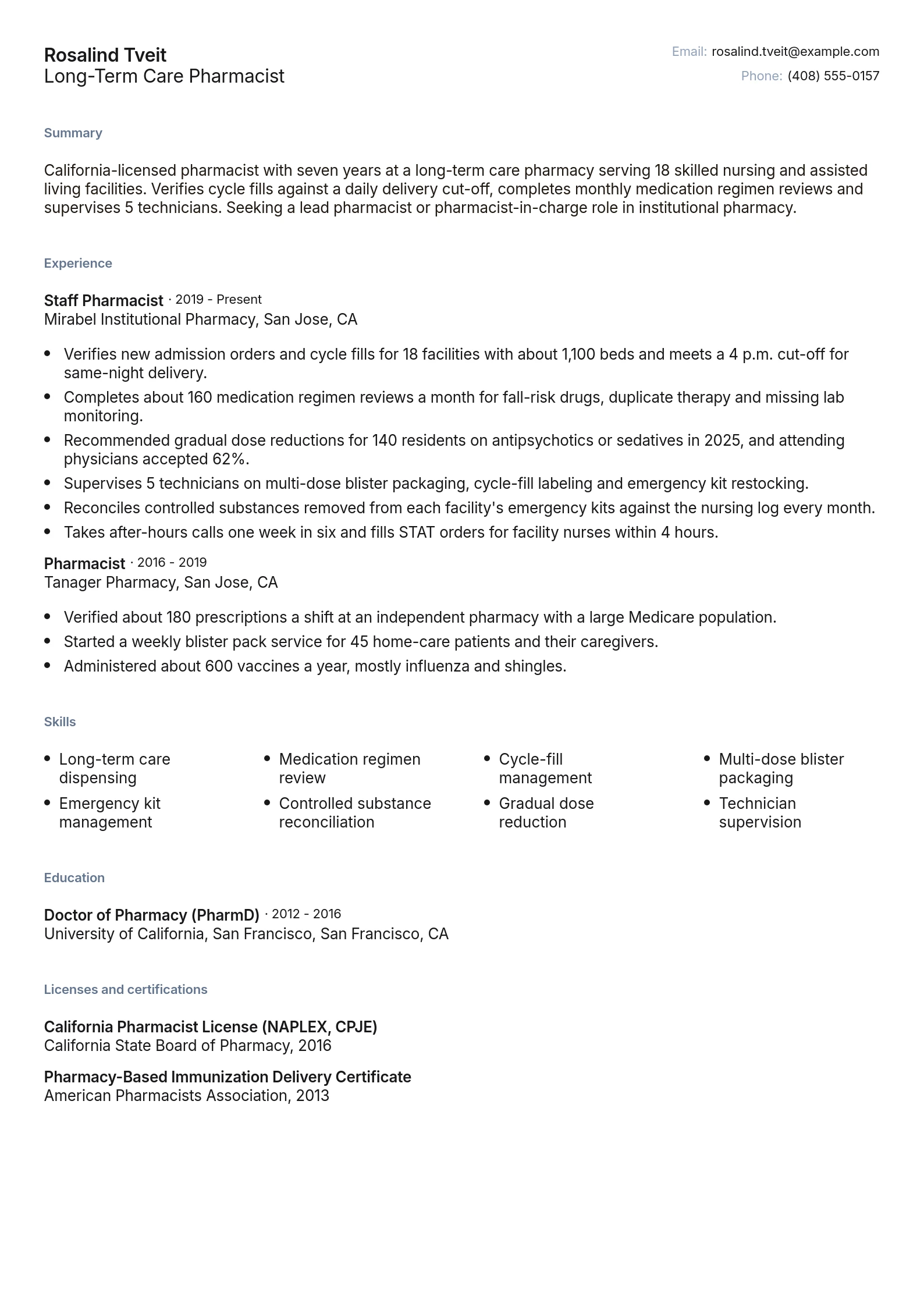
Rosalind Tveit works at a long-term care pharmacy serving 18 nursing and assisted living facilities. Her resume counts the beds served, the daily delivery cut-off she meets, monthly medication regimen reviews and how many of her dose-reduction recommendations physicians accepted. An earlier community job shows where she started packaging medications for home-care patients. Use it if your work runs on cycle fills, emergency kits and facility nurses rather than walk-in customers.
Delivery cut-off and bed count in the first bullet
Dose-reduction recommendations with an acceptance rate
Technician supervision tied to packaging and kit restocking
Relocating pharmacist resume with a license transfer in progress
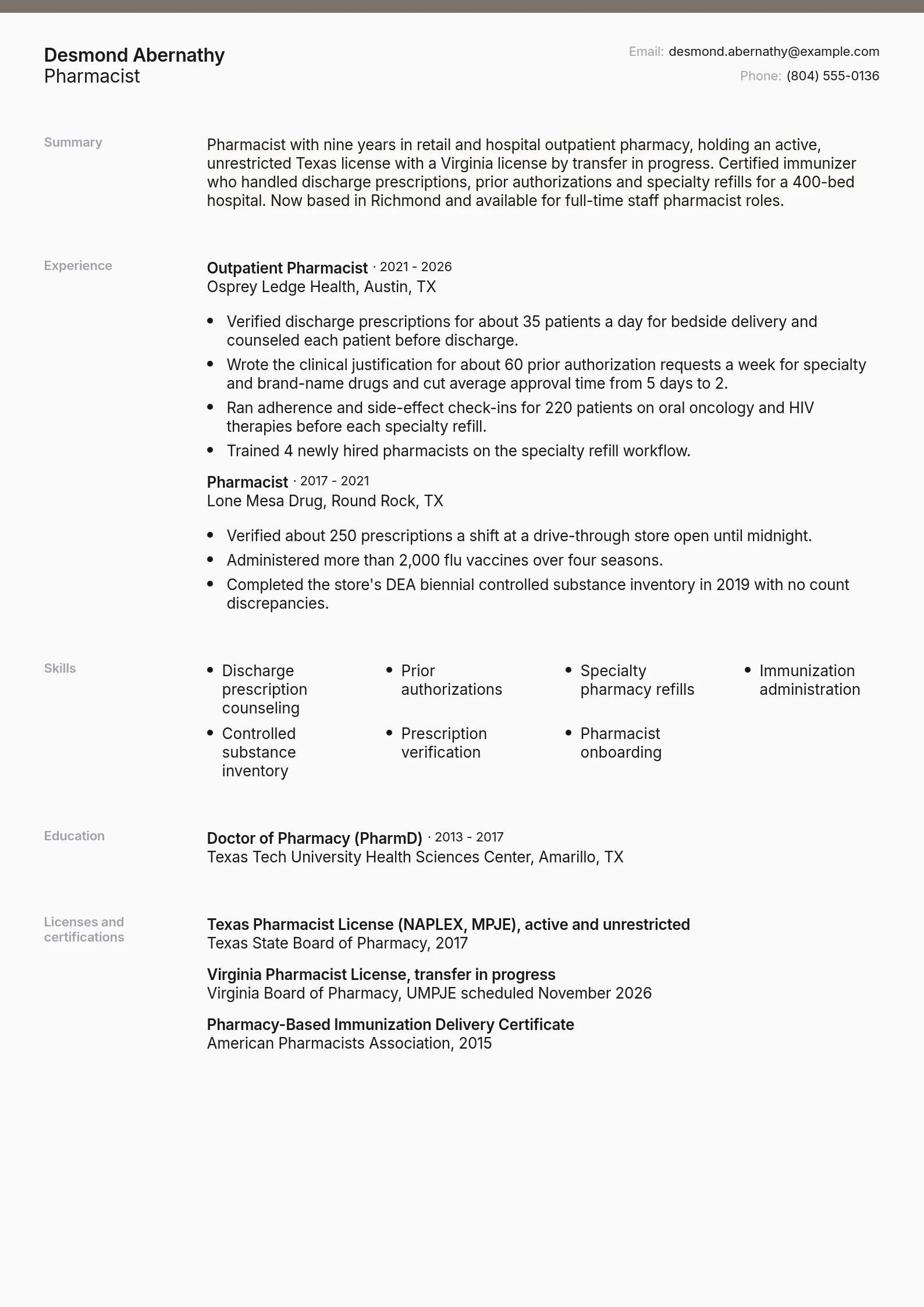
Desmond Abernathy holds an active, unrestricted Texas license and has started a transfer to Virginia. His credentials list both, and the Virginia line names the scheduled UMPJE so a reader sees exactly where the transfer stands. Nine years of retail and hospital outpatient work cover discharge prescriptions, prior authorizations and specialty refills. Use it if you are moving states and applying before your new license is issued.
Current license and pending license on separate lines
Transfer status written with the exam and its month
Hospital outpatient work kept apart from earlier retail work
Write your license as state, board, exams and status
Put your pharmacist license first in the credentials section and name the state board that issued it. Employers screen for an active, unrestricted license in the state where you'll practice, and "Licensed Pharmacist" with no state gives them nothing to check.
Add the exams in parentheses after the license. Every state uses the NAPLEX for pharmacy practice knowledge and most use the MPJE for pharmacy law, so a Texas line reads "Texas Pharmacist License (NAPLEX, MPJE)". California writes its own law exam, the CPJE, so a California line reads "California Pharmacist License (NAPLEX, CPJE)". Some states now use the Uniform MPJE (UMPJE), which NABP launched in 2026, in its place.
Give the year the license was first issued. Leave out the license number and your exam scores, because employers confirm license status on the state board's online lookup.
If your results are still pending, write the license with its status: "California Pharmacist License, NAPLEX passed, CPJE scheduled November 2026". Remove the status words once the license is issued.
A license line a recruiter can check in one search
Texas Pharmacist License (NAPLEX, MPJE), Texas State Board of Pharmacy, 2020, active and unrestricted
A license line nobody can verify
Licensed Pharmacist, State of Texas
Give every state license its own line, pending transfers included
List each pharmacist license you hold on a separate line, with the state you're applying in first. A pending license belongs on the resume too, written so the reader can see which step you've reached.
Transfers usually run through NABP's Electronic Licensure Transfer Program (eLTP), which needs one license that is current, active, unrestricted and in good standing. Whether you also need to pass a law exam depends on the target state. Virginia, for example, has required the UMPJE for transfers since October 1, 2026.
Your situation
What to write
Example line
One license, in the state you're applying in
State, board, exams and the year first issued
Texas Pharmacist License (NAPLEX, MPJE), Texas State Board of Pharmacy, 2020
Licenses in two or more states
One line per state, target state first, each marked active
California Pharmacist License (NAPLEX, CPJE), 2023, active, followed by Texas Pharmacist License (NAPLEX, MPJE), 2019, active
Transfer started, law exam still ahead
The pending license with the exam and its month
Virginia Pharmacist License, transfer in progress, UMPJE scheduled November 2026
Law exam passed, application with the board
The pending license with the month you applied
Virginia Pharmacist License by transfer, application submitted December 2026
Moving soon, transfer not started
No line for the new state. Put the move in your summary
Relocating to Richmond, VA in March 2027
Count vaccines, MTM reviews and interventions alongside your fills
Every pharmacist verifies prescriptions, so a resume that lists only that tells a hiring manager nothing new. Give verification one bullet with a number, such as prescriptions a shift, then spend the rest on the clinical work your setting asks for.
In community pharmacy, count vaccines given per week or per season and name them: "Administers about 40 vaccines a week, including influenza, COVID-19, shingles and pneumococcal." Add medication therapy management as a monthly count of comprehensive medication reviews, and list point-of-care tests such as A1C or cholesterol screening if your store runs them.
In a hospital, name the protocols you dose under and how often: vancomycin consults a day, heparin infusions adjusted from anti-Xa levels, warfarin managed by INR, renal dose adjustments and chemotherapy orders checked before the IV room compounds them. VA and acute care ads list these duties by name, so use the same words.
For interventions, write the problem, the change you recommended and who accepted it. "Recommended gradual dose reductions for 140 residents in 2025, and attending physicians accepted 62%" shows judgment that a phrase like "strong clinical skills" can't.
Supervision counts as well. Say how many technicians and interns you oversee and what you check for them, such as fills, sterile compounds or blister packaging.
Put PGY1 and BCPS beside hospital work, the immunizer certificate beside retail
Place each credential where the employer you're applying to looks for it. Retail ads ask for a license and immunizer certification and rarely mention residency, while hospital ads often prefer a PGY1 residency or BCPS.
List a residency twice: as an experience entry with the rotations you completed, and as a certificate line under credentials. For BCPS, write the year you earned or last recertified it, since the Board of Pharmacy Specialties runs it on a seven-year recertification cycle.
Credential
Where it goes
How to write it
Who looks for it
State pharmacist license
First line of credentials
California Pharmacist License (NAPLEX, CPJE), California State Board of Pharmacy, 2016
Every employer
Immunization certificate
Credentials, and the summary for retail jobs
Pharmacy-Based Immunization Delivery Certificate, American Pharmacists Association, 2017
Community pharmacies, whose ads usually call it Certified Immunizer
PGY1 residency
An experience entry with rotations, plus a credentials line
Board Certified Pharmacotherapy Specialist (BCPS), Board of Pharmacy Specialties, 2023
Hospital and acute care clinical teams
Certificate in progress
Credentials, with the expected month
Pharmacy-Based Immunization Delivery Certificate, expected December 2026
Students and new hires applying to retail
Pharmacy intern resumes open with the program, graduation year and intern license
A pharmacy intern resume should open with your PharmD program, your expected graduation year and your intern license, because those decide which shifts you can legally work. California issues an intern pharmacist license, so a Fresno student writes "California Intern Pharmacist License, California State Board of Pharmacy, 2024". Use the exact title on your own board's license or registration.
Write patient work with the supervision in the sentence: "Counseled about 25 patients a day on new prescriptions under pharmacist supervision." Then count what you handled yourself, such as prescriber calls to clarify prescriptions, medication histories taken or blood pressure follow-up calls. A busy pharmacist reads those numbers as tasks you can take off their list.
List paid intern jobs and IPPE or APPE rotations together in date order, each with the site, the setting and the dates. A bachelor's degree goes below the PharmD, and an immunization certificate you're still completing goes in credentials with its expected month.
State the schedule you can work: a summer, a set number of hours a week during the semester or a rotation block. Licensure depends on intern hours, and Texas requires 1,740, the ACPE minimum, so stores hiring interns plan around your availability.