Your book of business comes first on a customer success manager resume: how many accounts you carried, what they were worth, which segment, and how much of the renewal number was yours.
The 11 examples differ by motion, segment and background, so you can start from the one closest to your high-touch, scaled, technical or renewals role.
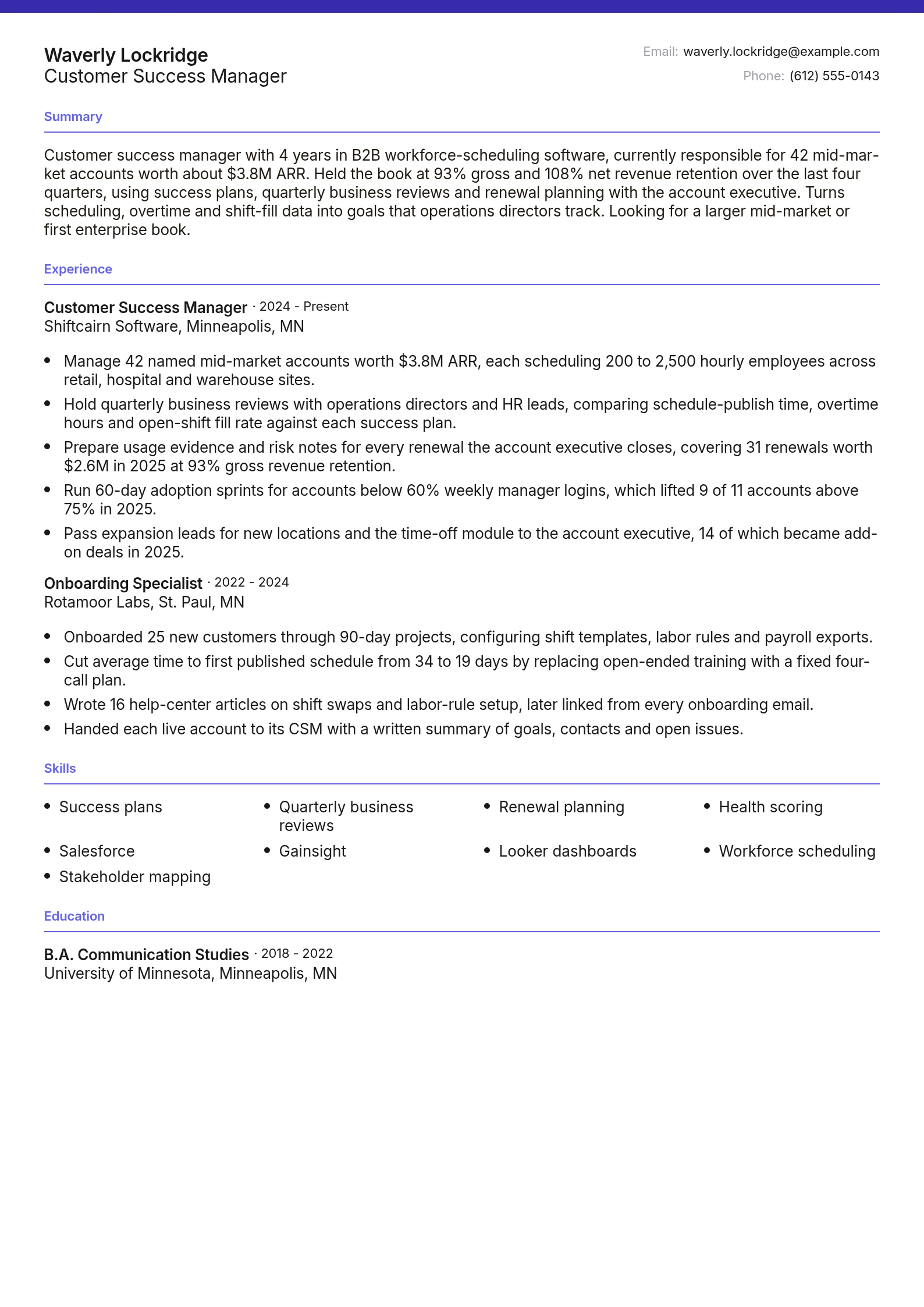
Waverly carries 42 named mid-market accounts and puts the count, the ARR and both retention rates in her summary, before any bullet. Her renewal bullet says what she prepares and that the account executive closes, so the reader knows who signed each renewal.
Start here if you hold a named book, run quarterly reviews and work renewals alongside an account executive.
Ten more CSM resumes by motion, segment and background
Pick the example that matches how you worked your accounts before you look at years of experience. A scaled CSM with 220 pooled accounts and an enterprise CSM with six accounts write very different bullets, even at the same level.
Entry-level CSM promoted from support
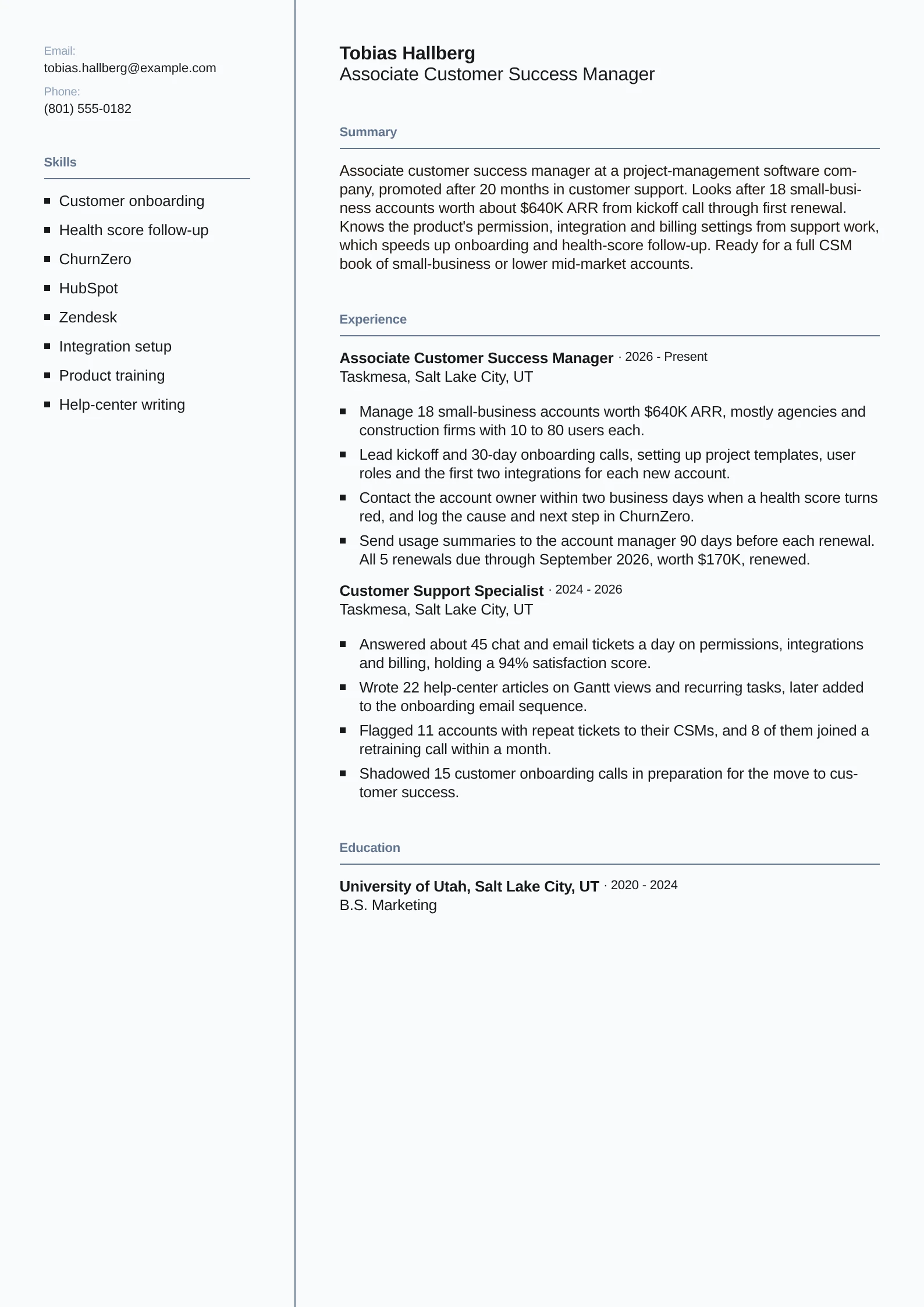
Tobias moved from support specialist to associate CSM at the same project-management company, and the resume lists the two jobs as separate dated roles so the promotion is easy to see. The CSM role leads with 18 accounts and $640K ARR, then onboarding calls, health-score follow-up and his first five renewals. Use it if you're moving into customer success from support, onboarding or implementation and have less than a year in the title.
Promotion from support shown as two dated roles
18 small-business accounts worth $640K ARR
Red health scores followed up within two business days
Senior enterprise CSM with six accounts worth $11M
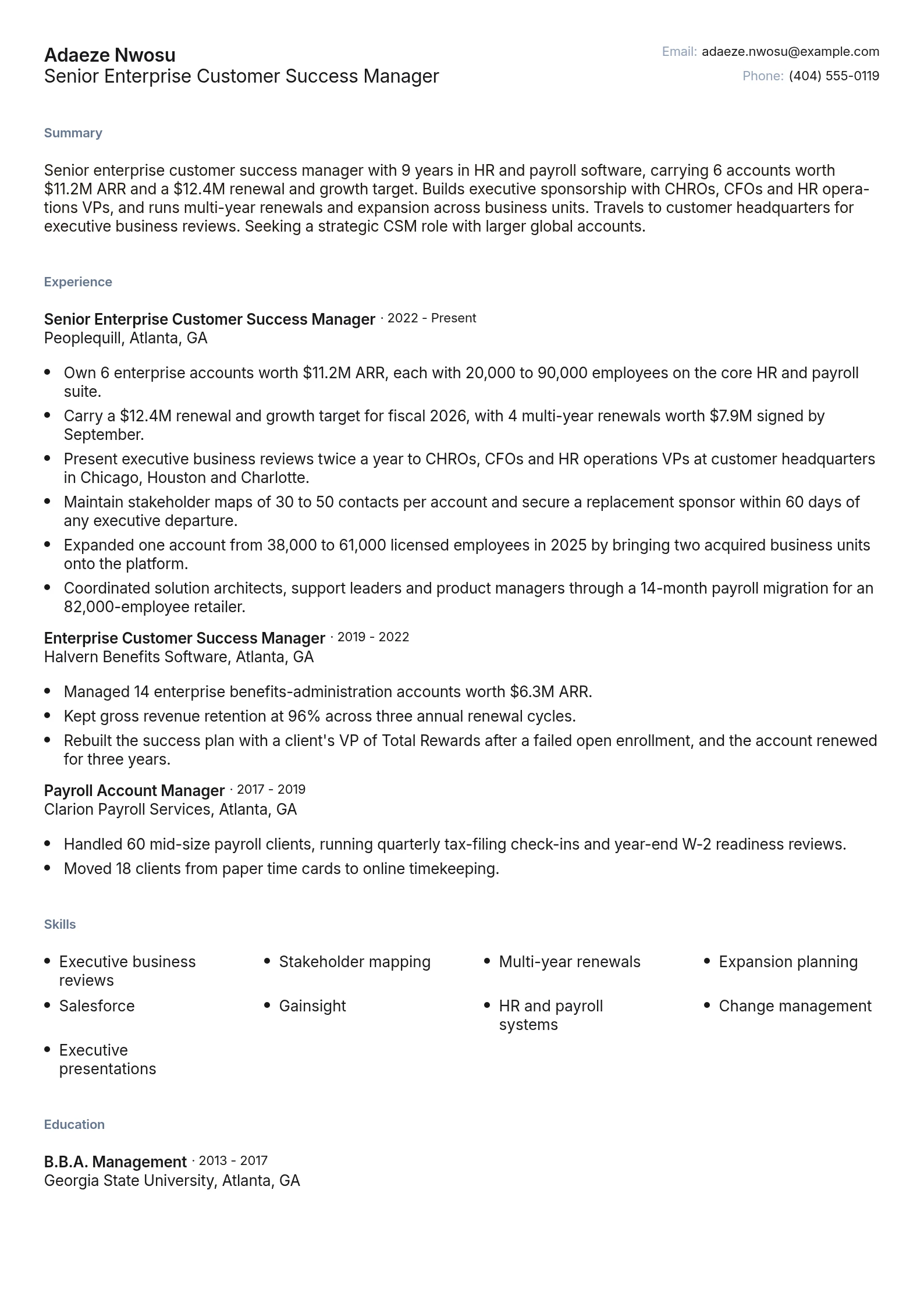
Adaeze carries six enterprise HR-technology accounts and a renewal and growth target, so her bullets give the target, the multi-year renewals signed against it and the expansion she brought in. Executive business reviews name the audience, CHROs and CFOs, and the cities she travels to. Stakeholder maps and sponsor replacement show how she protects a large account. Use it for strategic or enterprise roles that ask for C-suite relationships and eight or more years.
$12.4M renewal and growth target with signed totals
Executive business reviews with CHROs and CFOs
Stakeholder maps of 30 to 50 contacts per account
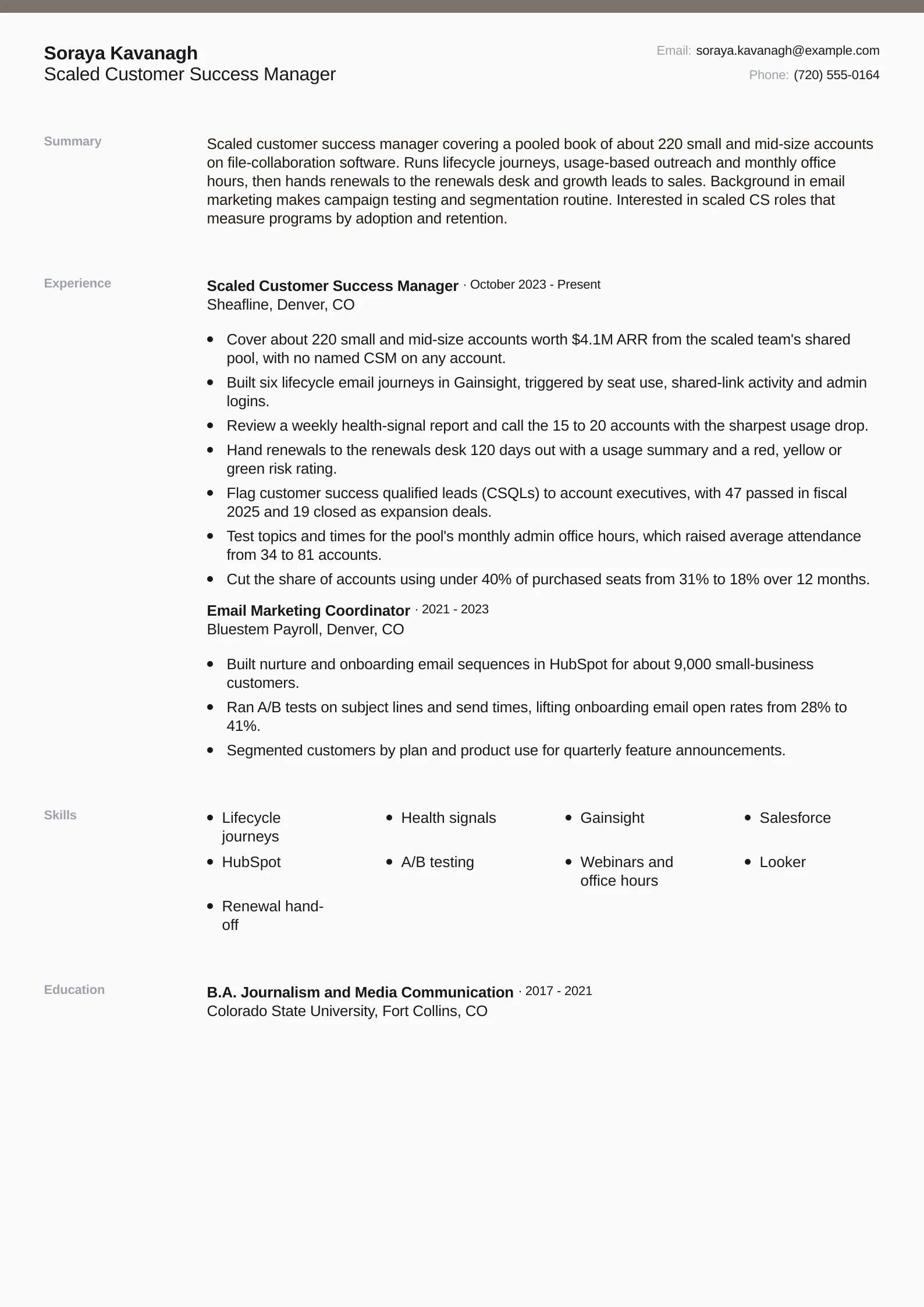
Scaled CSM working a pooled book of 220 accounts
Soraya covers about 220 small and mid-size accounts from a shared pool, so her resume is about programs rather than relationships: lifecycle journeys triggered by usage, a weekly health-signal review, and office hours she tested and grew. Renewals go to a renewals desk and growth goes to sales as qualified leads, and both hand-offs carry numbers. Use it for scaled, pooled or digital CSM roles, or if you came from marketing operations.
Lifecycle journeys triggered by seat use and admin logins
47 qualified leads passed to sales, 19 closed as expansion
Office hours attendance raised from 34 to 81 accounts
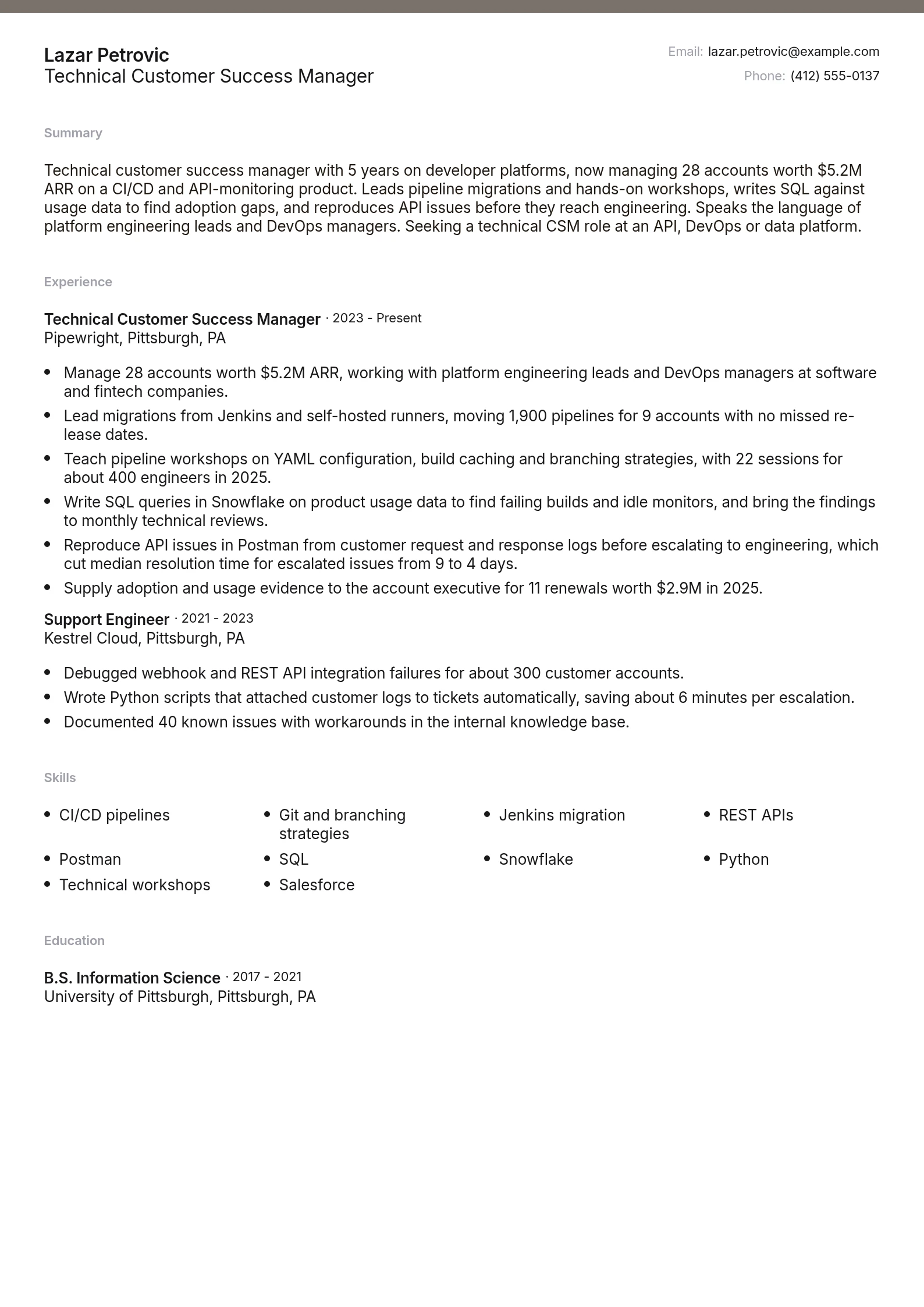
Technical CSM at a CI/CD and API platform
Lazar's bullets name the technical work a developer-platform employer screens for: Jenkins pipeline migrations, YAML and caching workshops, SQL on product usage data, and API issues reproduced in Postman before escalation. His skills list reads like an engineering ad because the job ads do. The earlier support engineer role shows where the technical depth came from. Use it for technical CSM or technical account manager roles at API, DevOps or data platforms.
1,900 pipelines migrated for 9 accounts
SQL on usage data turned into review findings
Escalated issues resolved in 4 days, down from 9
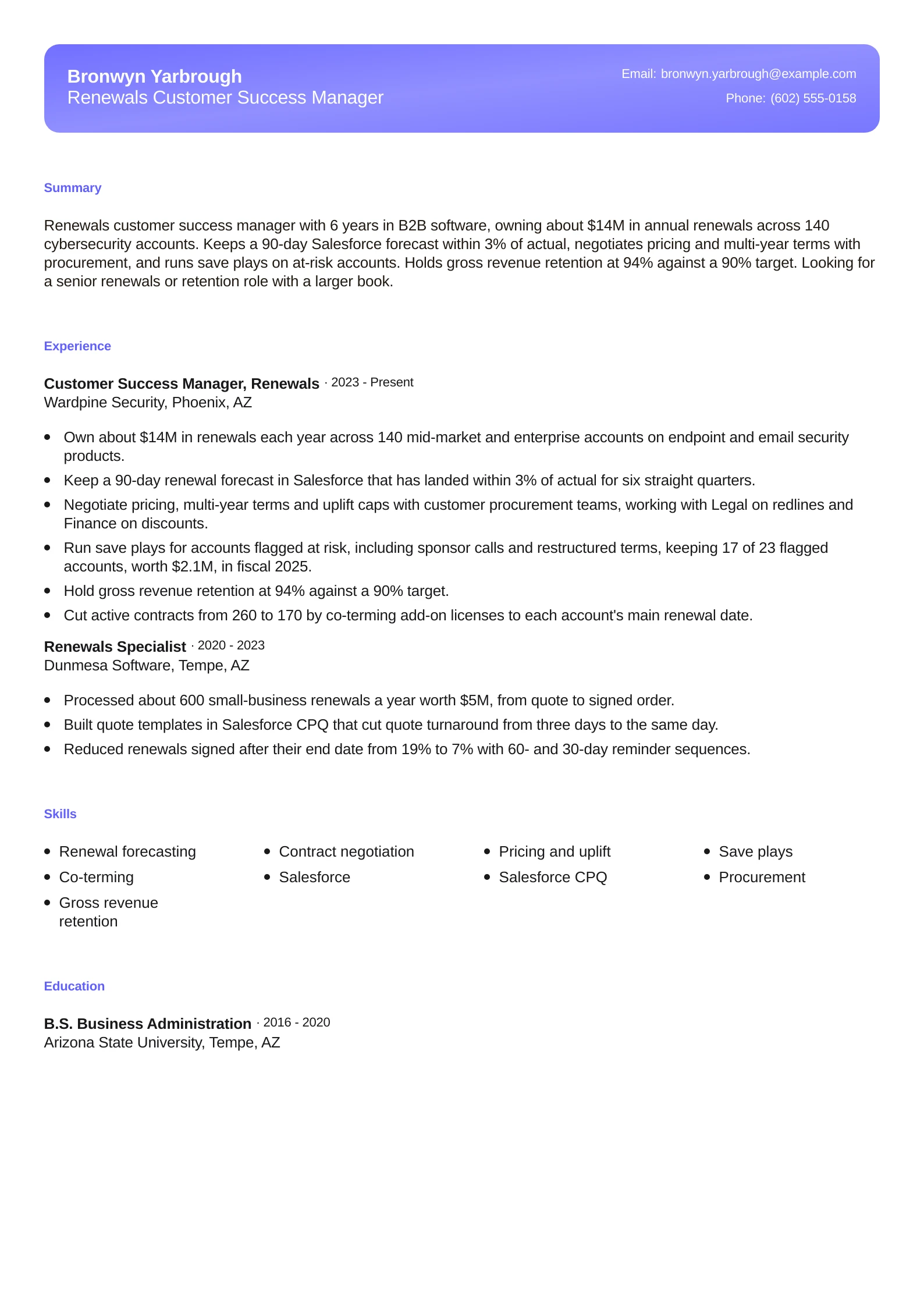
Renewals CSM who owns $14M a year
Bronwyn owns the renewal number at a cybersecurity software company, and the resume says so directly: about $14M a year, a 90-day Salesforce forecast within 3% of actual, and gross revenue retention against its target. Contract bullets name procurement, Legal and Finance, and the save-play bullet gives how many flagged accounts were kept. Use it if you carry a renewal quota or sit on a renewals desk and negotiate pricing and terms yourself.
About $14M in renewals owned each year
Forecast within 3% of actual for six quarters
17 of 23 at-risk accounts kept
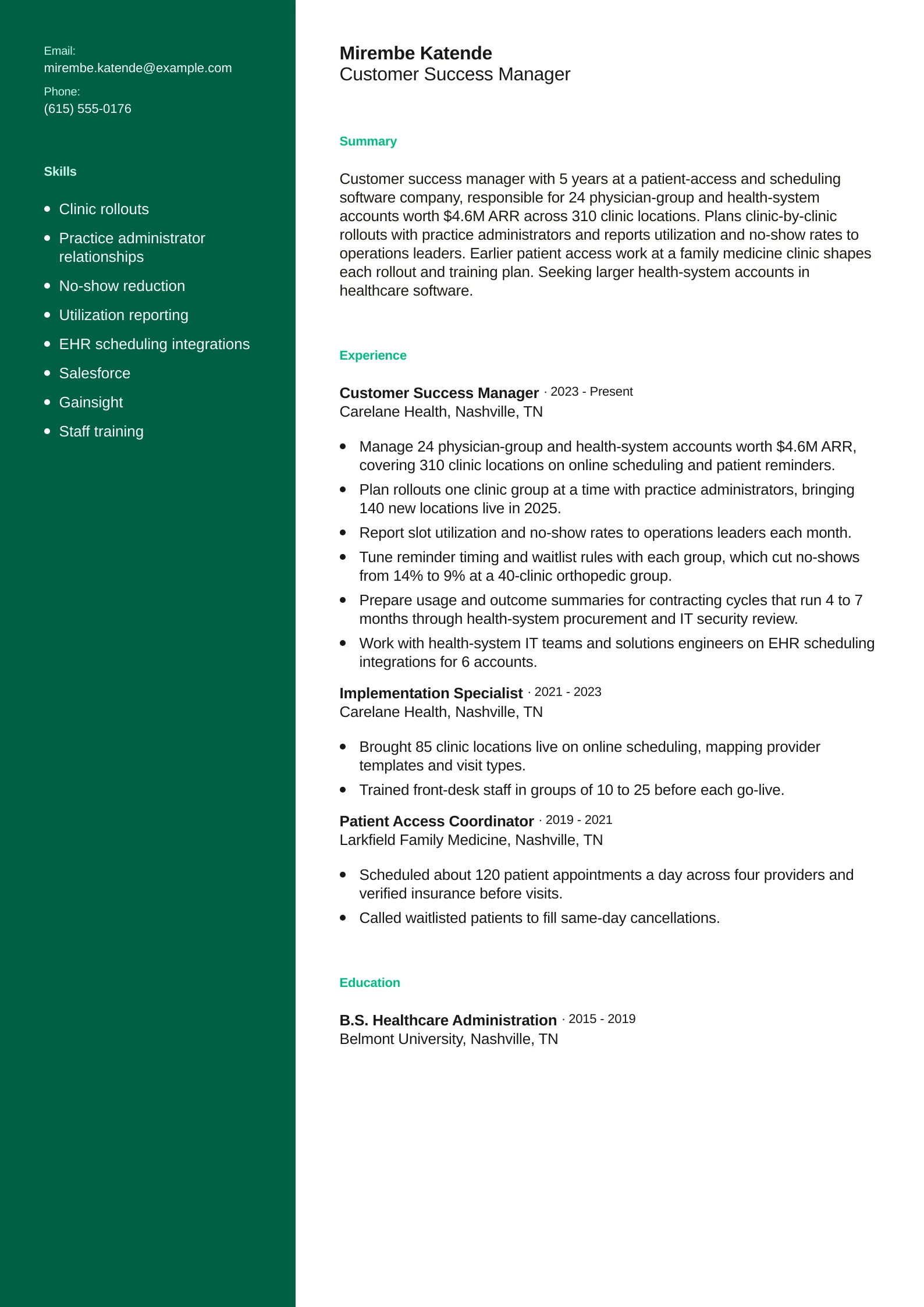
Healthcare CSM for physician groups and health systems
Mirembe works with practice administrators and health-system operations leaders, and her success measures are theirs: slot utilization and no-show rates by clinic. Rollouts are counted in clinic locations, and one bullet covers the four- to seven-month contracting cycle that health-system procurement brings. A patient access job before software explains how she knows the front desk. Use it for CSM roles selling into physician groups, hospitals or other multi-site healthcare organizations.
24 accounts covering 310 clinic locations
No-shows cut from 14% to 9% at a 40-clinic group
Patient access background listed as its own role
Fleet and IoT software CSM with 60 accounts
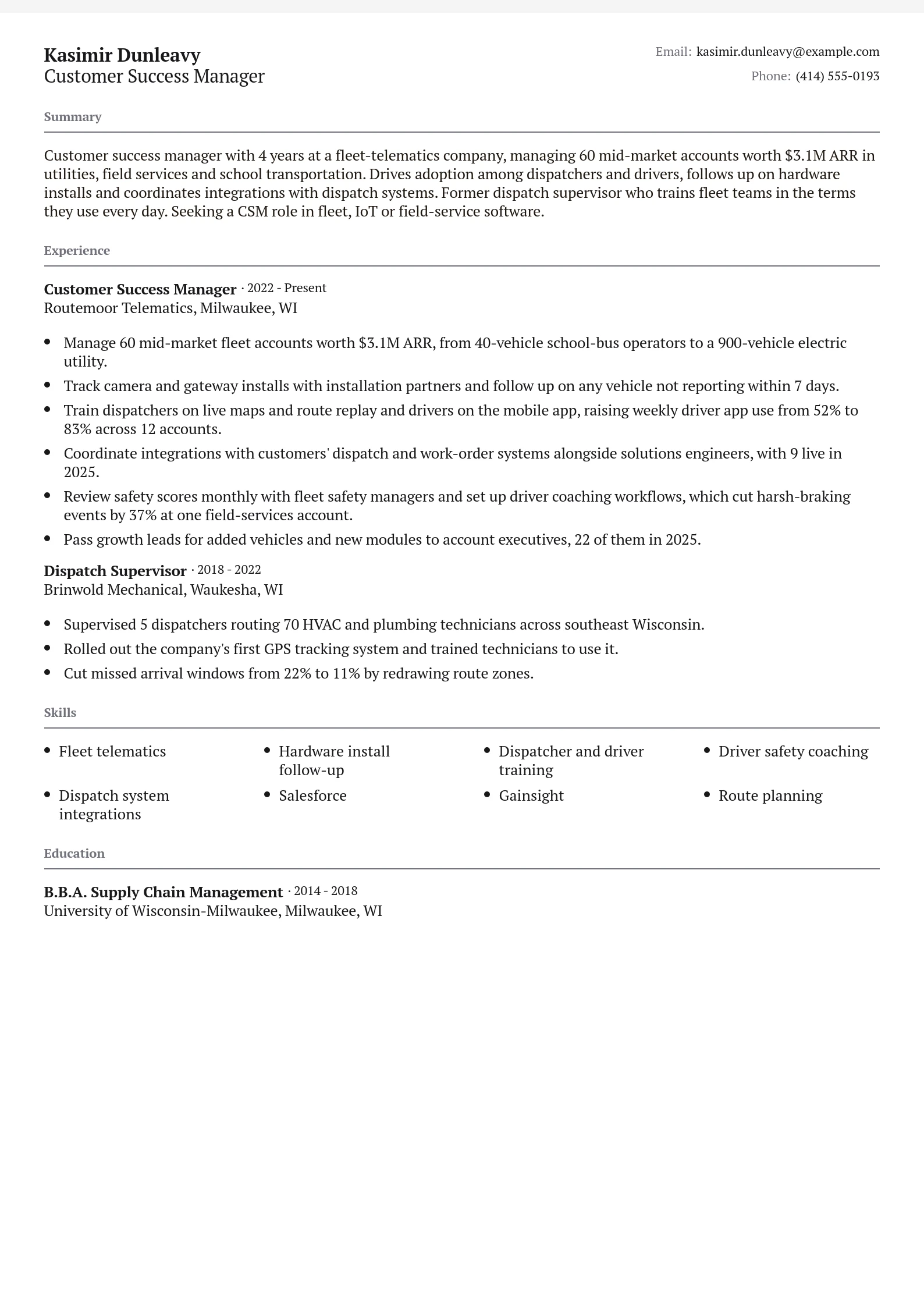
Kasimir's book is 60 mid-market fleets, and the resume counts what hardware-attached software depends on: vehicles reporting after install, weekly driver app use, and safety events after coaching. Dispatch integrations show he works with solutions engineers on customer systems. His years as a dispatch supervisor sit below the CSM role and explain how he trains dispatchers. Use it for telematics, IoT or field-service software where adoption happens in trucks and depots.
Follow-up on any vehicle not reporting within 7 days of install
Weekly driver app use raised from 52% to 83%
Harsh-braking events cut by 37% at one account
First customer success hire at an analytics startup
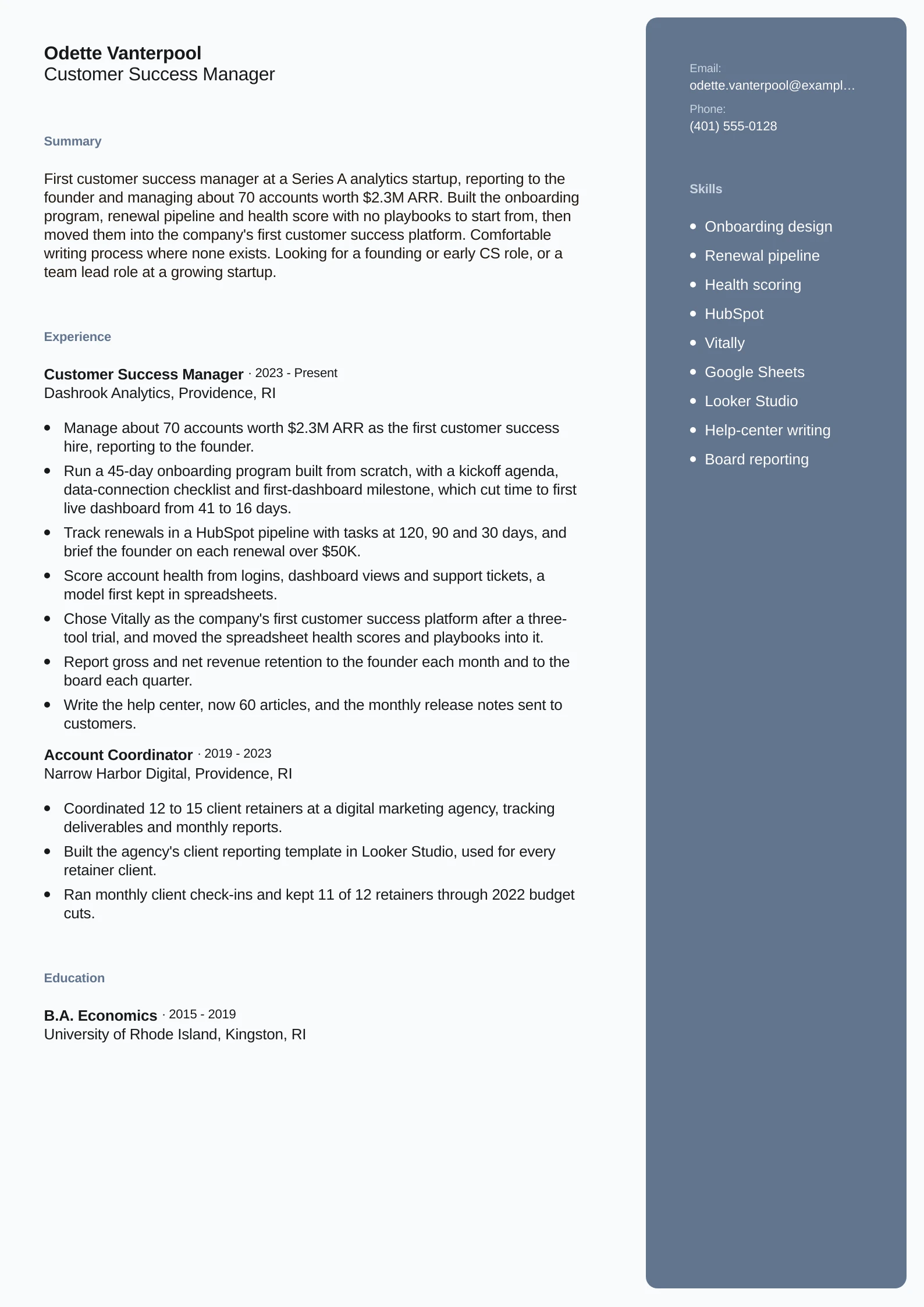
Odette was the first CSM at a Series A startup, so the resume shows what she built: the onboarding program, the HubSpot renewal pipeline, a health score and the move to the first CS platform. Each built process has a result, such as time to first dashboard dropping from 41 to 16 days. Reporting to the founder appears in the first bullet. Use it if you were the first or only CSM and set up the process yourself.
Time to first dashboard cut from 41 to 16 days
HubSpot renewal pipeline with 120-, 90- and 30-day tasks
Retention reported to the founder and the board
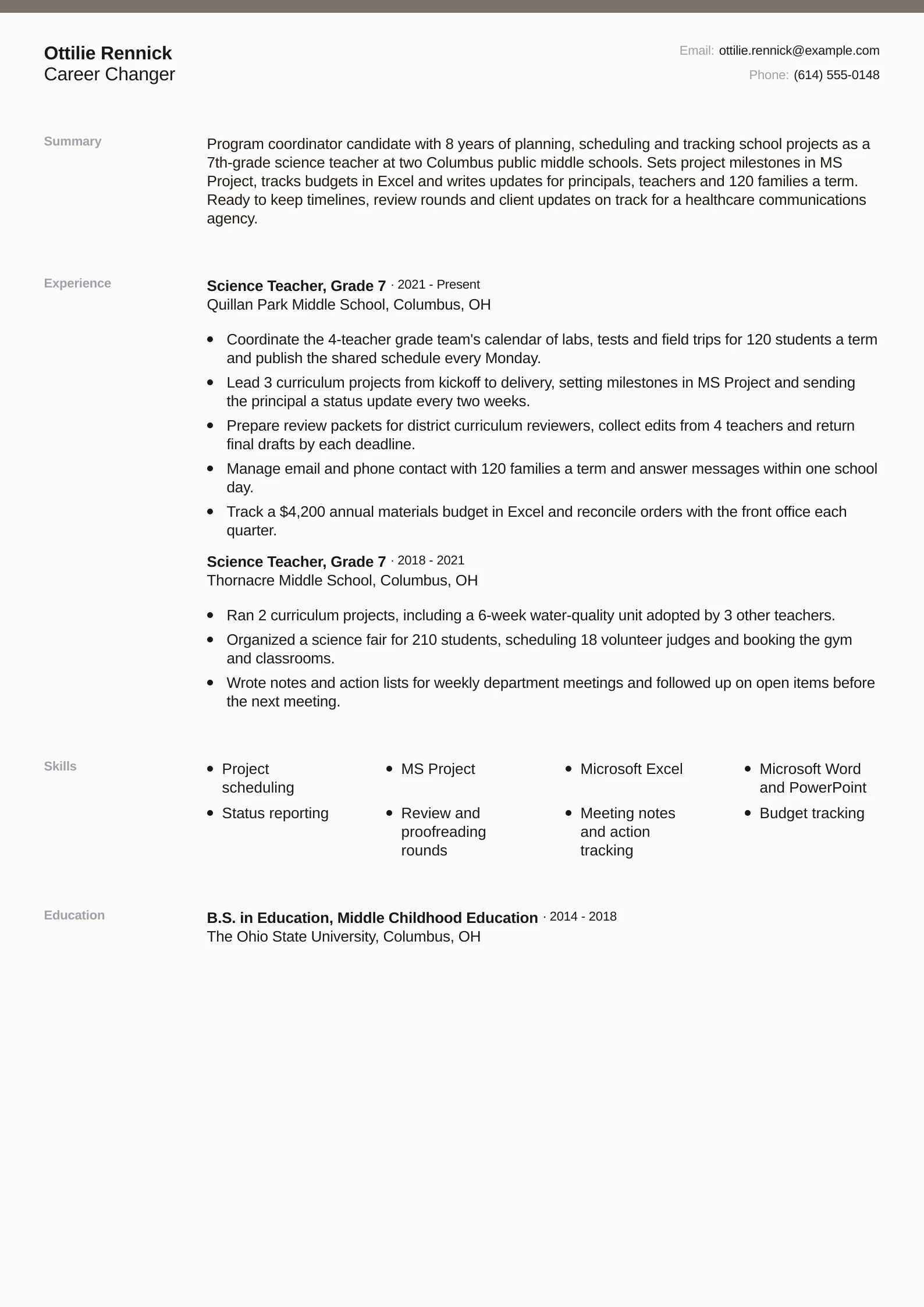
Teacher moving into customer success
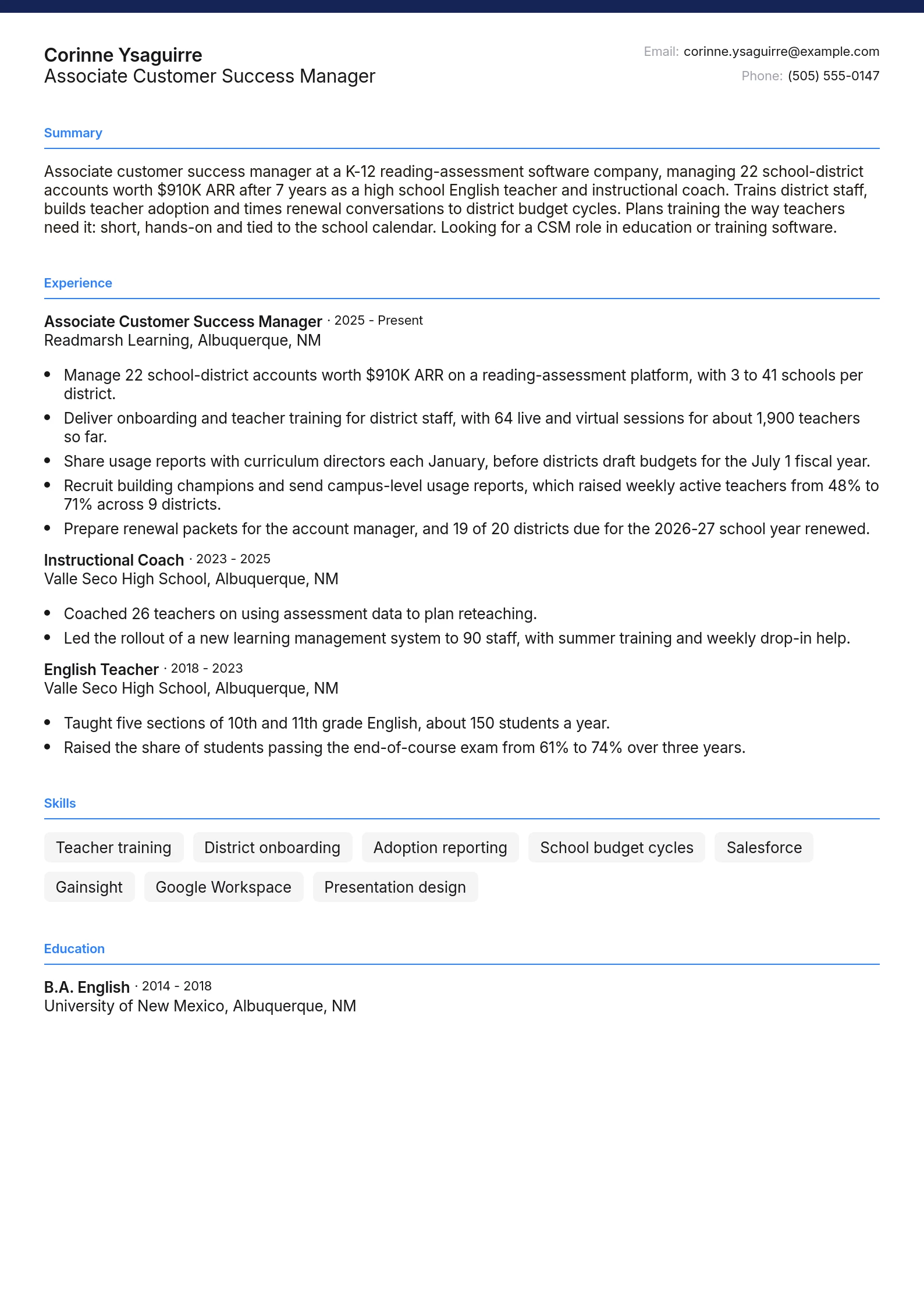
Corinne taught high school English and coached teachers for seven years before joining a K-12 software company, and the resume puts her 14 months as an associate CSM first. Her CSM bullets draw on what she knows from schools: training sessions, budget-cycle timing and teacher adoption. The teaching and coaching roles are short and written in CSM terms: staff trained, rollouts led, results measured. Use it if you're moving into customer success from education or training.
64 training sessions for about 1,900 teachers
Renewal conversations timed to January budget planning
Weekly active teachers raised from 48% to 71%
Customer success lead mentoring four CSMs
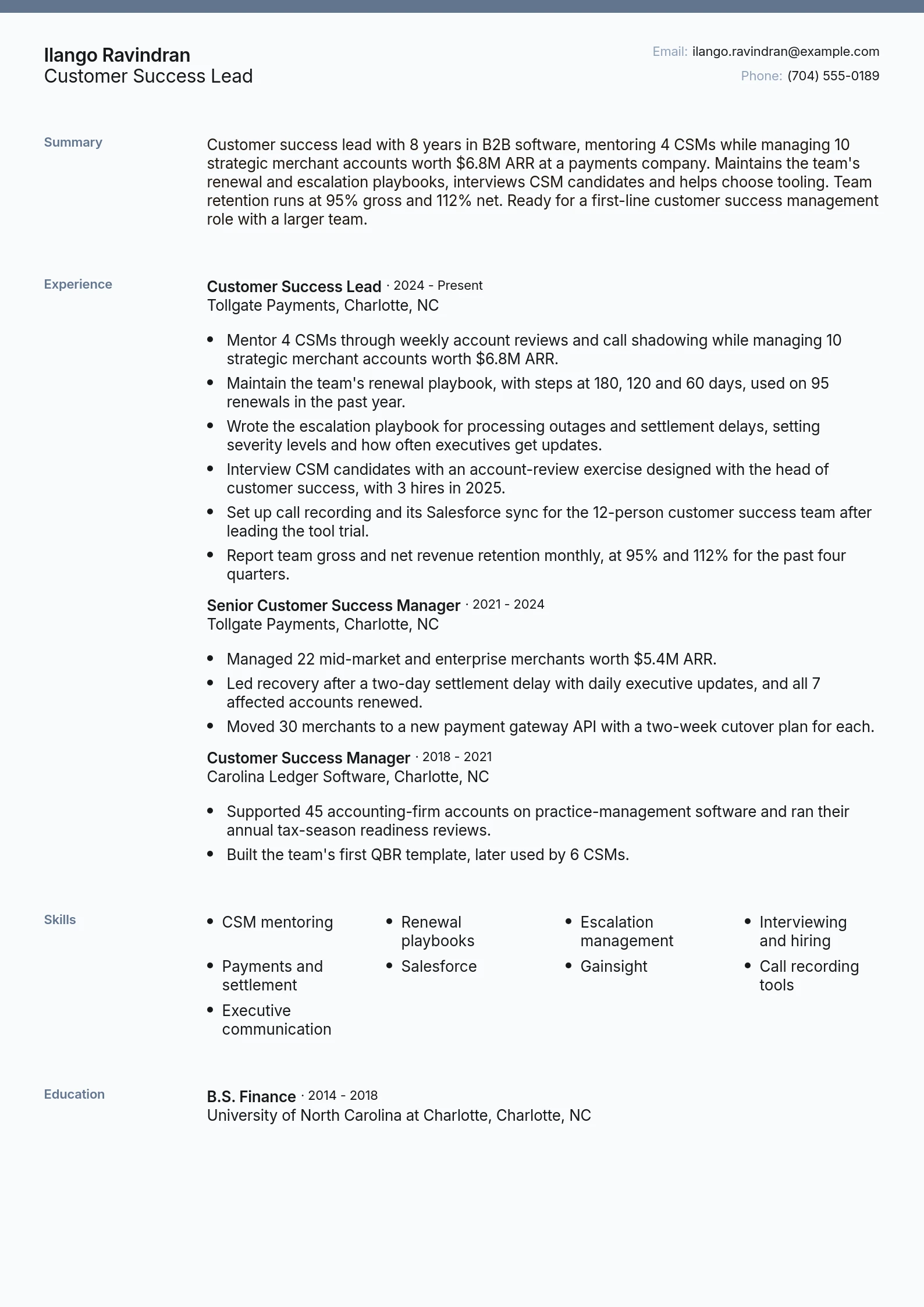
Ilango keeps 10 strategic payments accounts while mentoring four CSMs, and the resume separates those two jobs within one role. Team bullets cover the renewal and escalation playbooks he owns, CSM interviewing and a tooling rollout, with team retention reported monthly. His earlier senior CSM role shows the book that got him promoted. Use it for team lead, player-coach or first-line manager roles where you still carry accounts of your own.
Mentors 4 CSMs while managing 10 strategic accounts
Renewal playbook used on 95 renewals
Team retention at 95% gross and 112% net
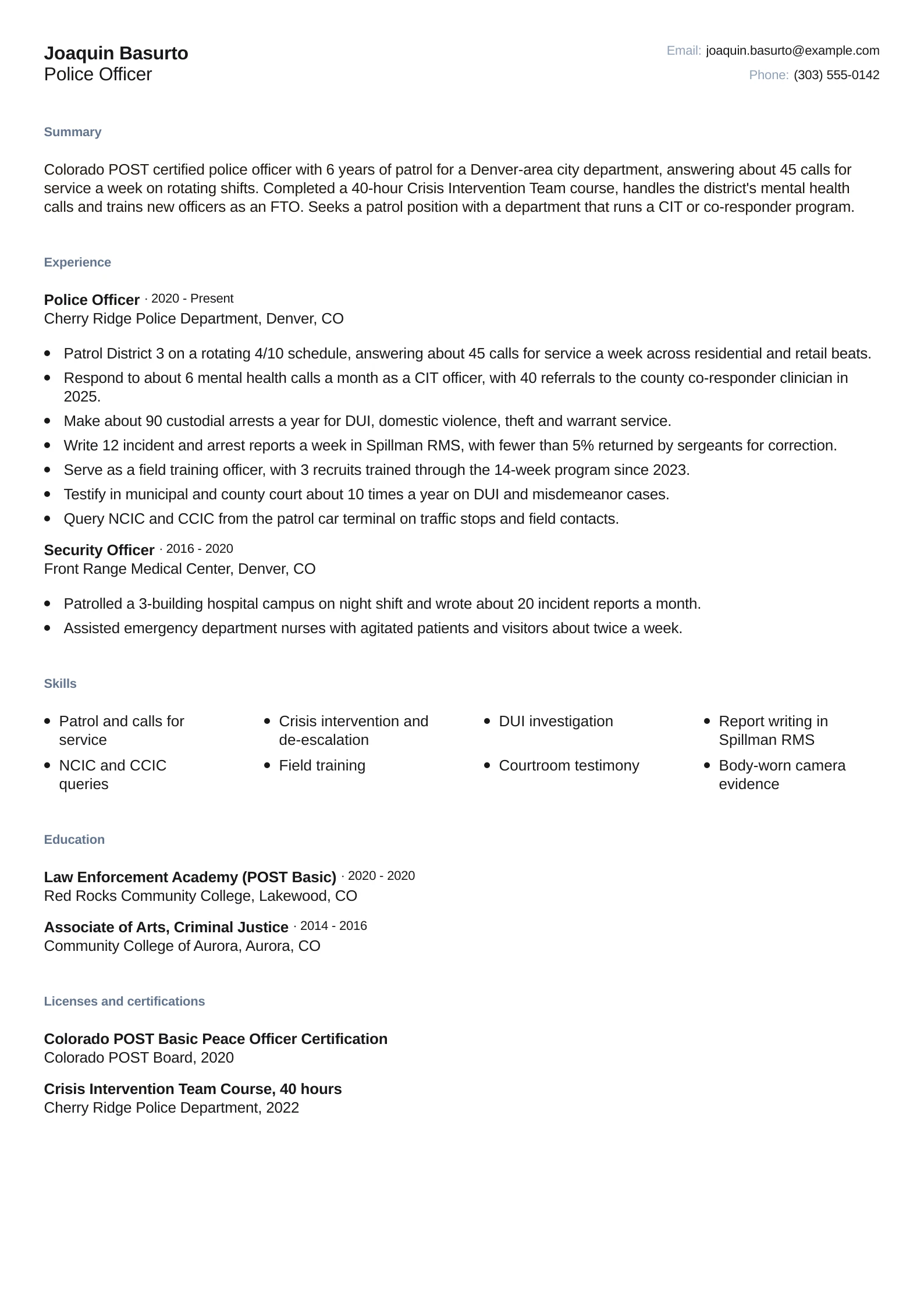
Lead with account count, ARR and segment
Describe your book in one line near the top of the resume: how many accounts, what they're worth in ARR, the segment, and whether the accounts were named to you or pooled. Waverly's summary says "42 mid-market accounts worth about $3.8M ARR", which tells a hiring manager the size of the job before any bullet.
Always give the count and the ARR together. Samsara's mid-market role covers about 100 to 200 named accounts, while enterprise roles are built around a few large ones, so "6 accounts" or "$11M" alone could describe either job. Use the segment words the ad uses, such as SMB, mid-market, enterprise or strategic, and write "pooled book of about 220 accounts" if your accounts sit in a shared pool rather than being named to you.
Then describe the customers and the people you work with. "Multi-site physician groups with 4 to 40 clinics" or "fleets of 40 to 900 vehicles" says more than an industry label. High-touch candidates should add the contact level, such as VP and C-suite sponsors, and technical candidates should name their users, such as platform engineering leads.
If your book changed during the role, give the current figure in the summary and the change in a bullet you could write as "Took on 12 accounts worth $900K ARR after a territory split." If you never held named accounts, count what you did carry, such as onboarding projects or accounts you supported, and label it as that.
Report GRR and NRR, then say who closed each renewal
List the retention numbers your company tracked for your book, and say plainly whether you closed each renewal or prepared it for the person who did. Dropbox's scaled CSM ad asks for fluency in renewal rate, gross and net revenue retention, churn, contraction and expansion, and for recent experience "directly managing or materially influencing customer renewals".
Gross revenue retention (GRR) is the recurring revenue kept from existing customers after churn and contraction, without counting expansion. Net revenue retention (NRR) is the same figure with expansion added, so it can go above 100%, while GRR never can. Put both in the summary if you have them, with the period: "93% gross and 108% net revenue retention over the last four quarters."
If you closed renewals, write "own" or "carry" with the dollar value and the target, as the renewals and enterprise examples do. If an account executive or renewals desk closed them, write the work you did and what happened: usage evidence prepared, risk flagged 120 days out, how many renewed. A clear influence bullet reads better than a vague "managed renewals".
If your company never shared retention rates with CSMs, use the count of accounts renewed out of accounts due, such as "29 of 31 accounts renewed in 2025".
Rate, value and role are clear
Prepare usage evidence and risk notes for every renewal the account executive closes, covering 31 renewals worth $2.6M in 2025 at 93% gross revenue retention.
Unclear number and role
Managed renewals for a portfolio of mid-market customers and helped drive retention and growth.
Use the ad's names for your tools, metrics and customer meetings
Use the exact terms from the job ad for the tools you used, the metrics you reported and the meetings you ran, and put each one in a bullet as well as the skills list. A skills line that says "Gainsight" tells a reader less than a bullet that says what you built in it.
For tools, name your CRM (Salesforce or HubSpot), your customer success platform (Gainsight, ChurnZero, Vitally or another) and any reporting tool, such as Looker or a SQL warehouse. Then write what you did with each: "Log the cause and next step in ChurnZero" or "Keep a 90-day renewal forecast in Salesforce."
For metrics, use the ad's own words. Current ads ask for customer health, adoption, renewal rate, GRR, NRR, churn, contraction and expansion. Spell out gross and net revenue retention once in the summary, then use the abbreviations in bullets, because readers may search for either form.
For meetings and documents, name the ones you ran: kickoff calls, success plans, quarterly business reviews (QBRs), executive business reviews (EBRs), stakeholder maps and workshops. Technical roles add Git and CI/CD, which GitLab's ad names, and API requests, Python or SQL, which Perplexity's API role names. Leave out labels such as "customer-centric" that any applicant could write.
High-touch, scaled and technical CSM resumes lead with different proof
The title is the same across these roles, but hiring managers screen for different evidence in each. Find your motion in the table and start from the matching example. If your role mixed two motions, lead with the one the ad describes and give the other one or two bullets.
Resume element
High-touch
Scaled or pooled
Technical
Book line to write
"6 enterprise accounts worth $11.2M ARR" plus the sponsor level
"Pooled book of about 220 small and mid-size accounts"
"28 accounts on a CI/CD and API-monitoring platform" plus who the users are
Lead bullets
Executive and quarterly business reviews, success plans, stakeholder maps, multi-year renewals
Lifecycle journeys, health-signal reviews, webinars and office hours, hand-offs to renewals and sales
Migrations, workshops, SQL on usage data, API troubleshooting, engineering escalations
Numbers to show
GRR, NRR, expansion, and the renewal target if you carry one
Accounts reached per program, seat-use lift, qualified leads passed to sales
Pipelines or integrations moved, engineers trained, escalation time