A retail manager resume gets read like a small profit and loss report, so put sales against plan, payroll, shrink and turnover where a hiring manager sees them first.
The examples differ in the store each candidate runs, with a district of nine stores, a 7-person discount store, a shrink turnaround and a restaurant manager moving into retail among them.
A mall store manager who leads with the store's numbers
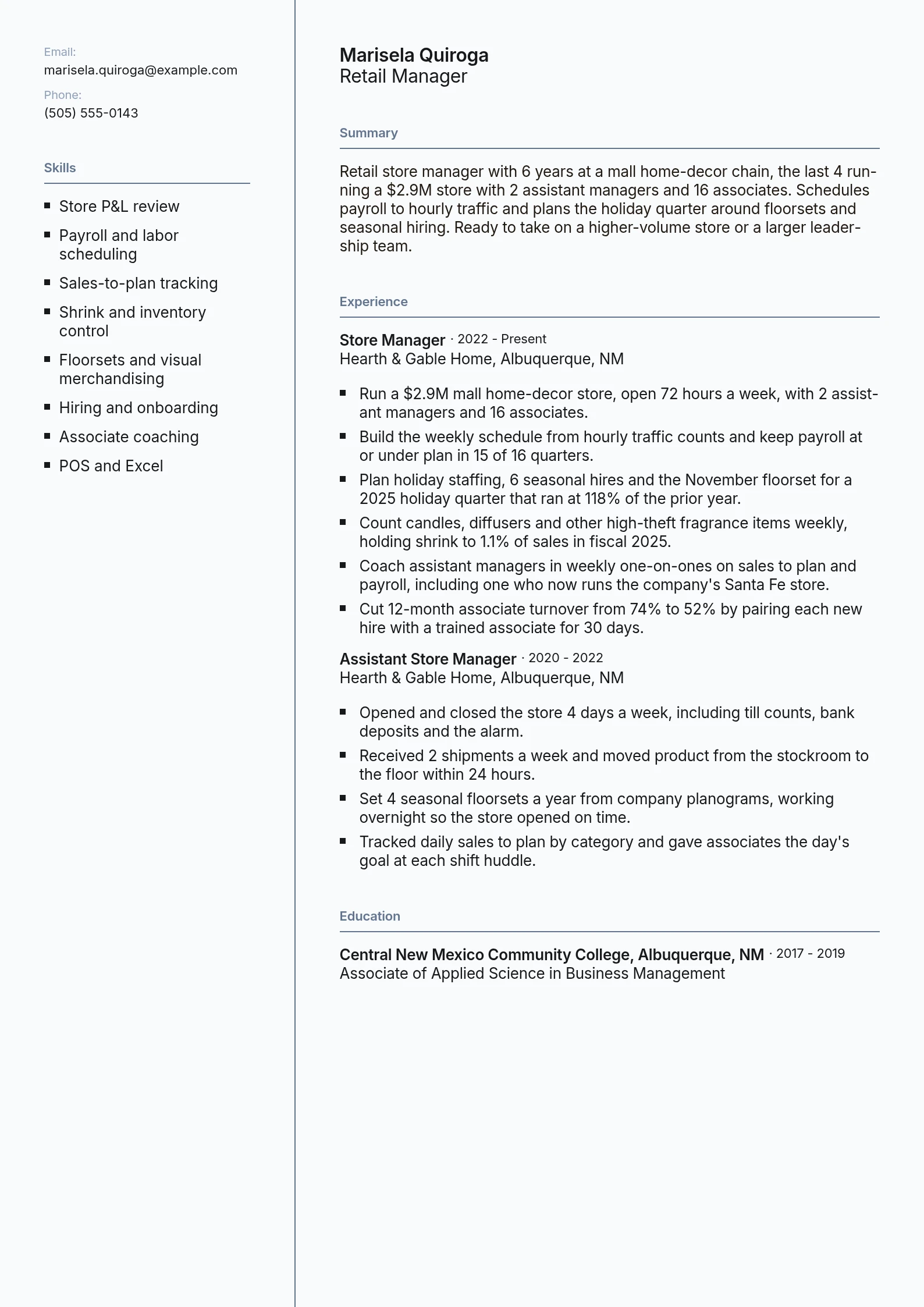
Marisela runs a $2.9M home-decor store with 2 assistant managers and 16 associates. Her first bullet gives the store's volume and team, and the bullets after it cover payroll against plan, a holiday quarter at 118% of last year, shrink and associate turnover.
Use this layout if you run one store and report to a district manager. Replace her numbers with yours and keep the order: store size first, then the results your district manager reviews each week.
Eight more retail manager resumes by store type and career step
Pick the example closest to the store you run now or the job you want next. Store size changes how much of the resume is about your own work on the floor and how much is about the people who run it for you.
Assistant manager applying to run a store
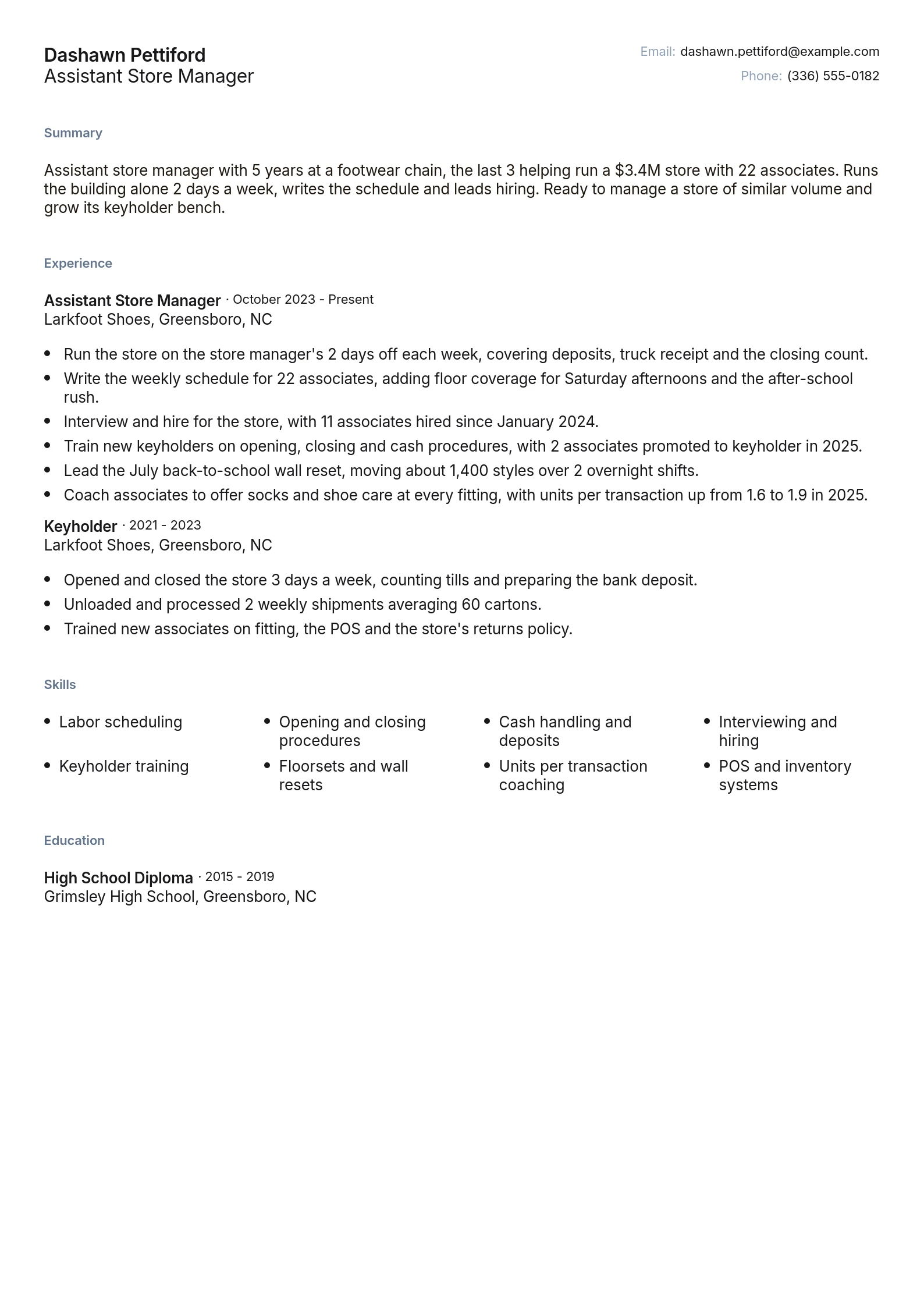
Dashawn's resume shows he already runs the building: he covers the store manager's 2 days off each week, writes the schedule for 22 associates and has hired 11 people since 2024. His keyholder years sit underneath as the earlier role. Use it if you're an assistant manager or co-manager applying for your first store manager job and want your own results next to the store's $3.4M volume.
Covers the store manager's 2 days off each week
Writes the schedule for 22 associates
Promoted 2 associates to keyholder in 2025
District manager over nine stores
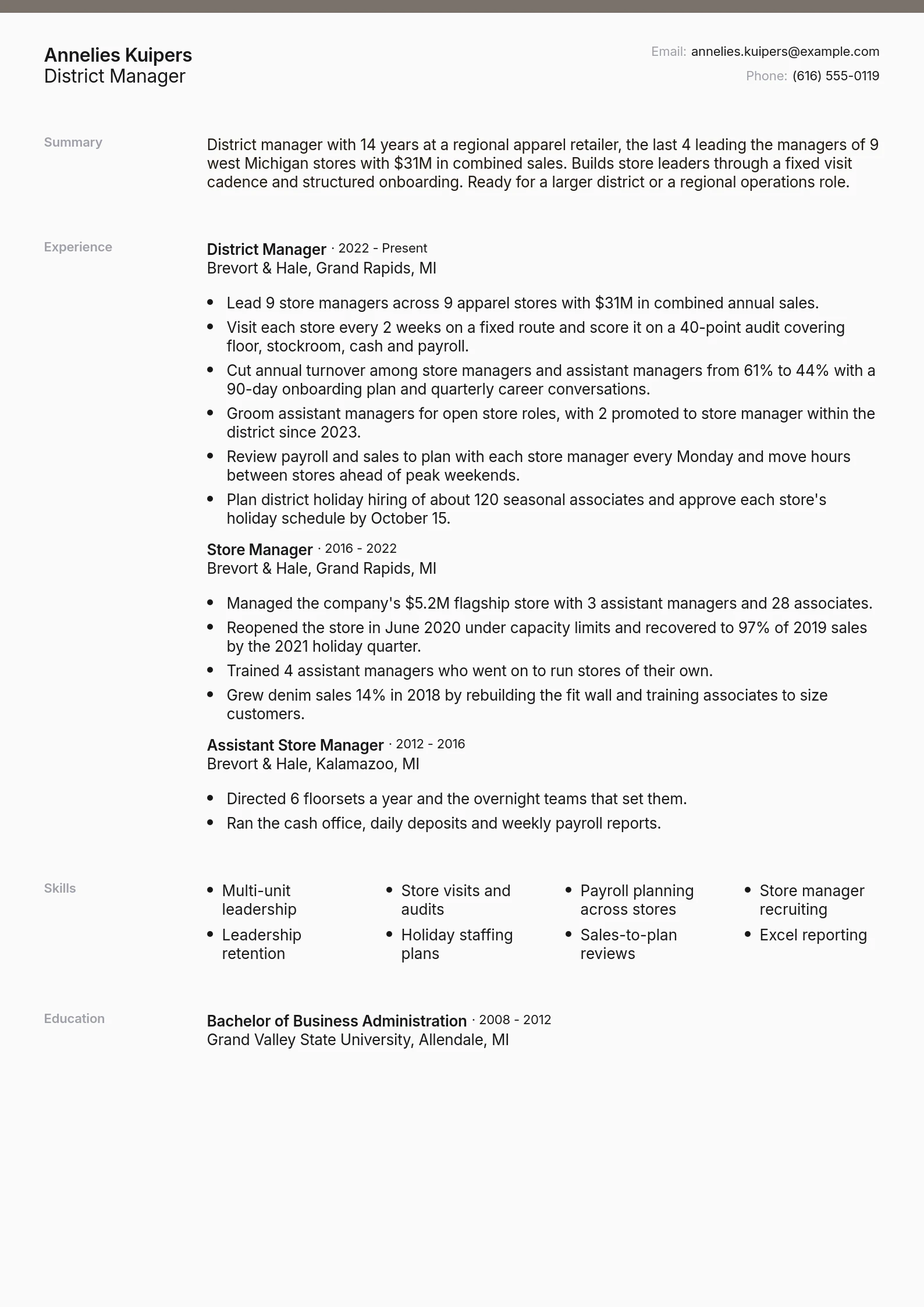
Annelies leads 9 store managers with $31M in combined sales, so her bullets count managers, store visits and leadership turnover instead of her own sales floor. The 40-point visit audit and the drop from 61% to 44% turnover show how she runs the district. Use it if you manage several stores or you're a store manager applying for your first multi-unit role.
9 store managers and $31M in combined sales
Store leader turnover down from 61% to 44%
2 assistant managers promoted to store manager
Big-box store manager with department supervisors
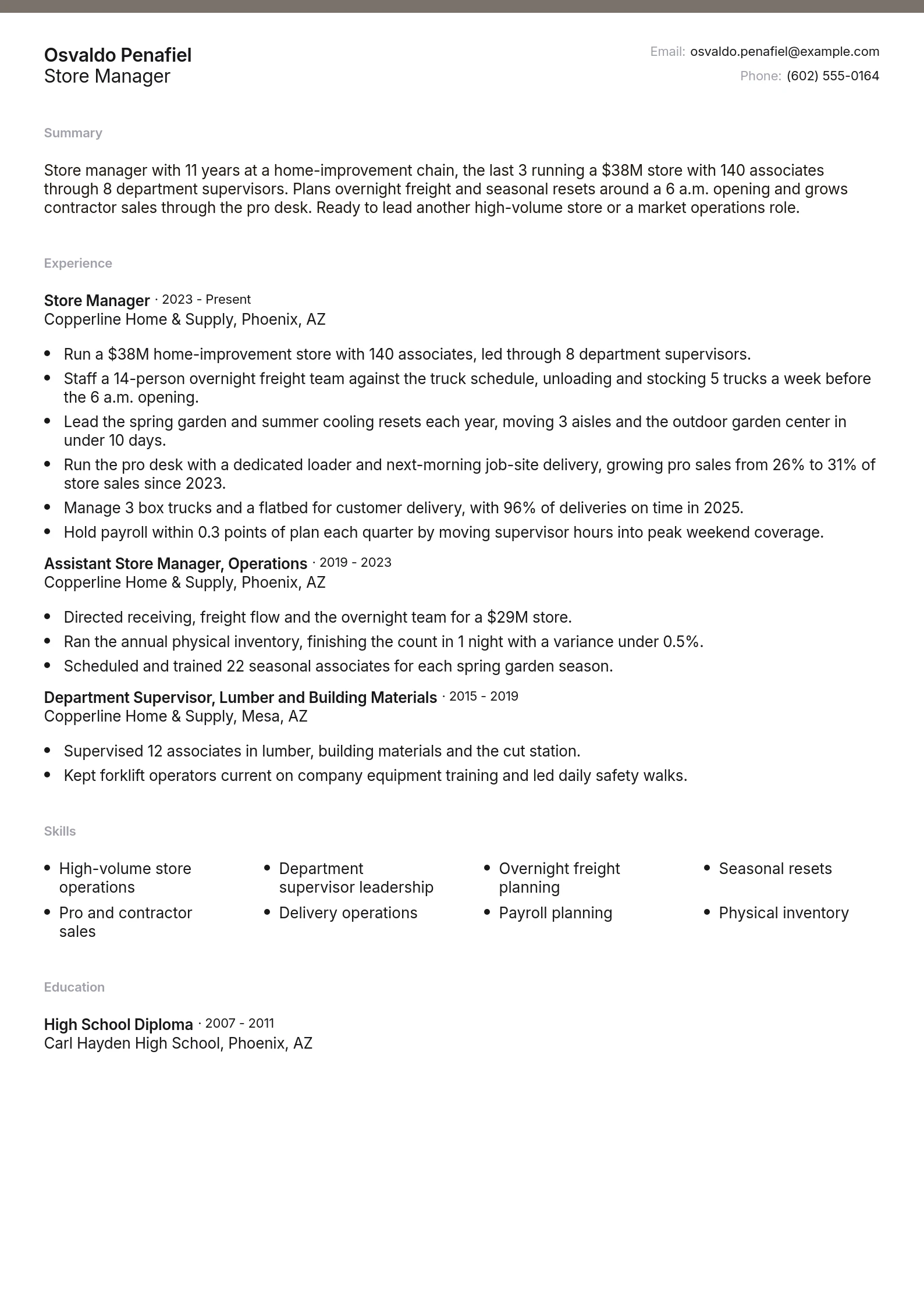
Osvaldo runs a $38M home-improvement store through 8 department supervisors, so the resume is about systems: a 14-person overnight freight team, 5 trucks a week, seasonal resets and pro sales that grew to 31% of the store total. A 96% on-time delivery rate sits in the same role. Use it if you run a high-volume store where most of the 140 associates report to someone other than you.
140 associates led through 8 department supervisors
5 trucks a week stocked before the 6 a.m. opening
Pro sales up from 26% to 31% of store sales
Small-format manager who works the floor
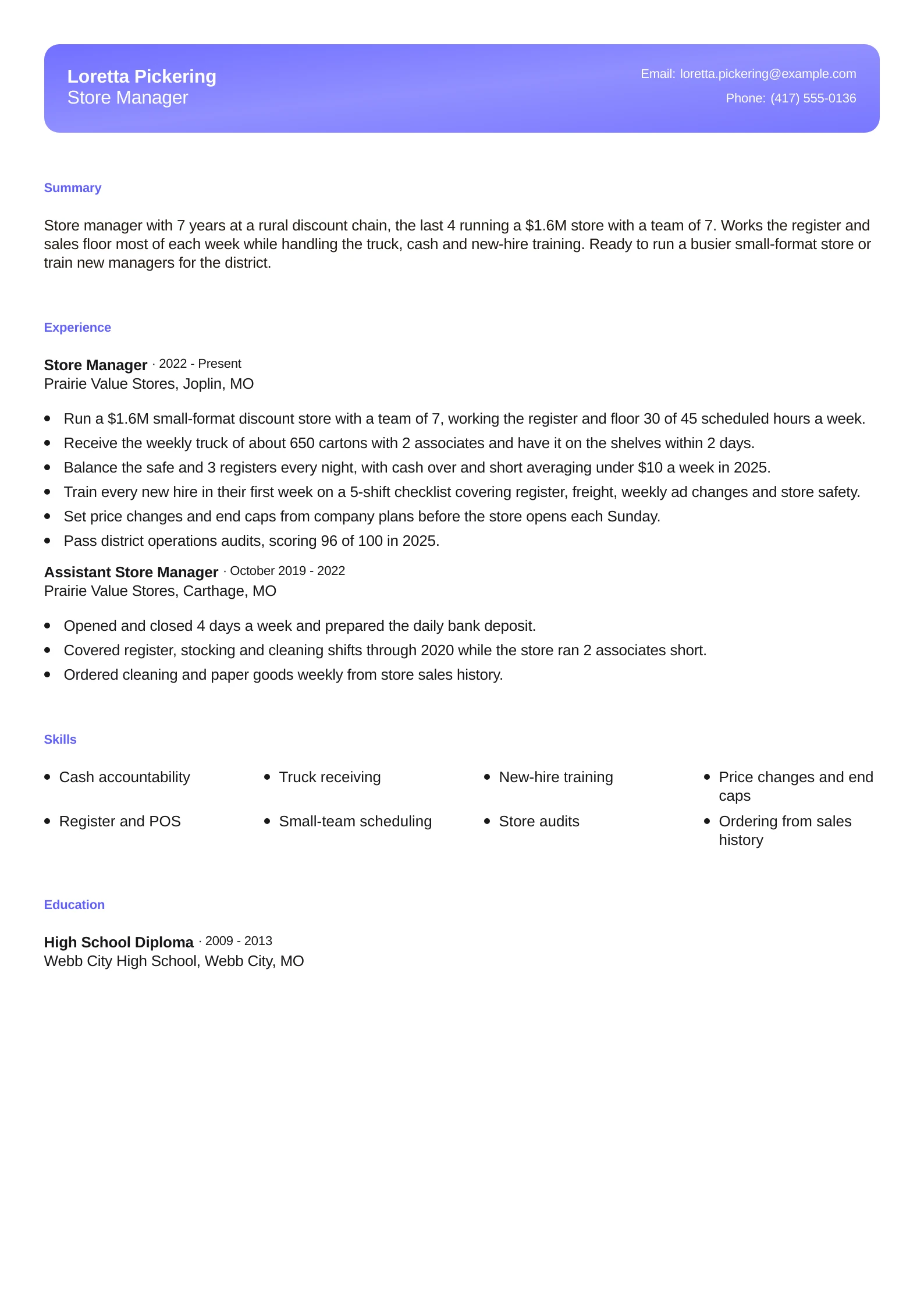
Loretta runs a $1.6M discount store with a team of 7 and works the register and floor 30 of her 45 hours. Her bullets cover the weekly truck, nightly cash balancing, first-week training for new hires and a 96 score on the district audit. Use it if you manage a dollar, variety or small-town store where you do much of the work yourself.
Works the floor 30 of 45 scheduled hours
Cash over and short under $10 a week
5-shift training checklist for every new hire
Prestige beauty store manager judged on clients
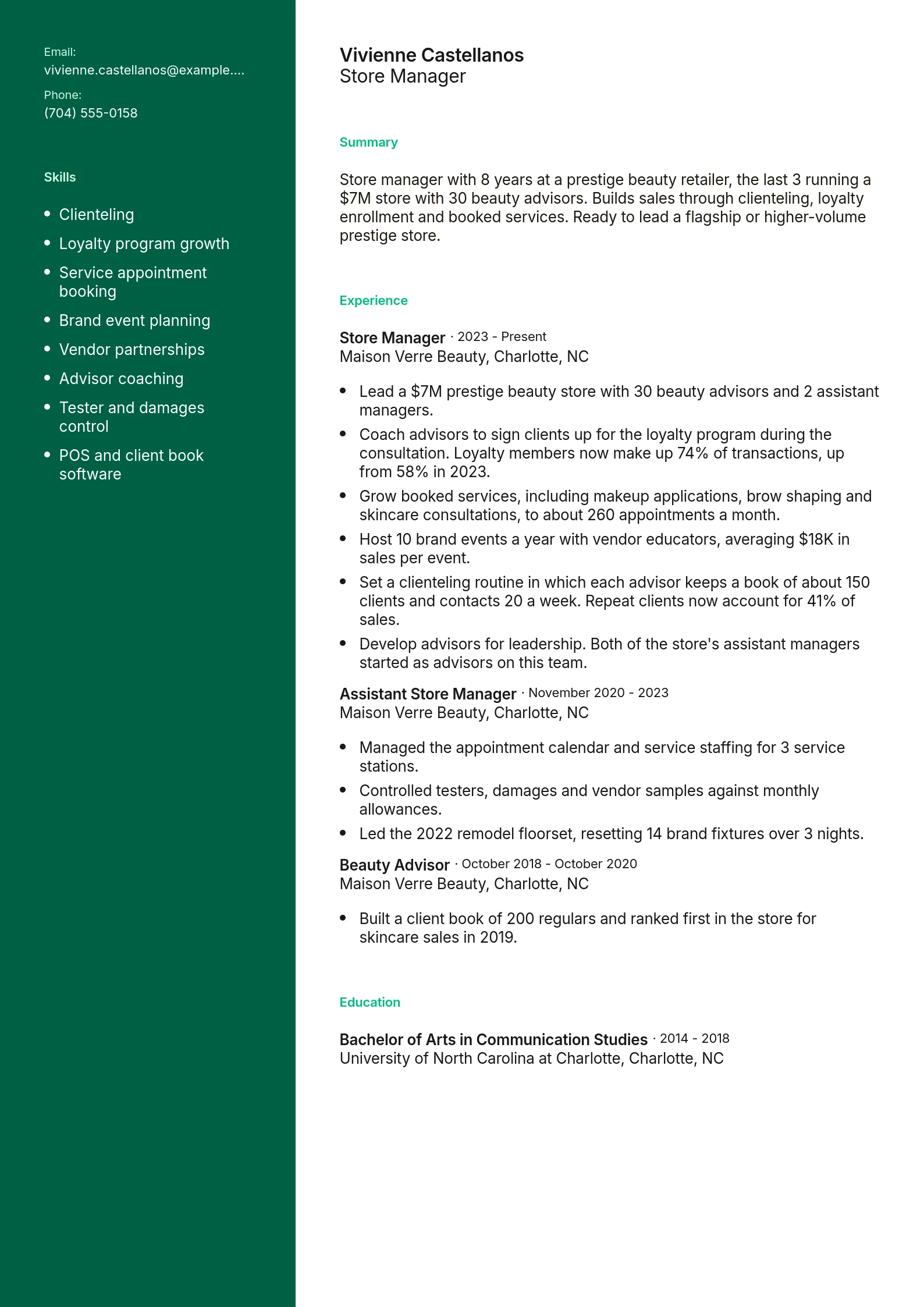
Vivienne leads 30 beauty advisors in a $7M prestige store, and her numbers are service numbers: loyalty members up from 58% to 74% of transactions, about 260 booked appointments a month, 10 brand events a year and 41% of sales from repeat clients. Use it if you manage beauty, luxury, jewelry or another store where repeat clients drive sales.
Loyalty members up from 58% to 74% of transactions
About 260 booked service appointments a month
Both assistant managers started as advisors on the team
Store manager who also runs online fulfillment
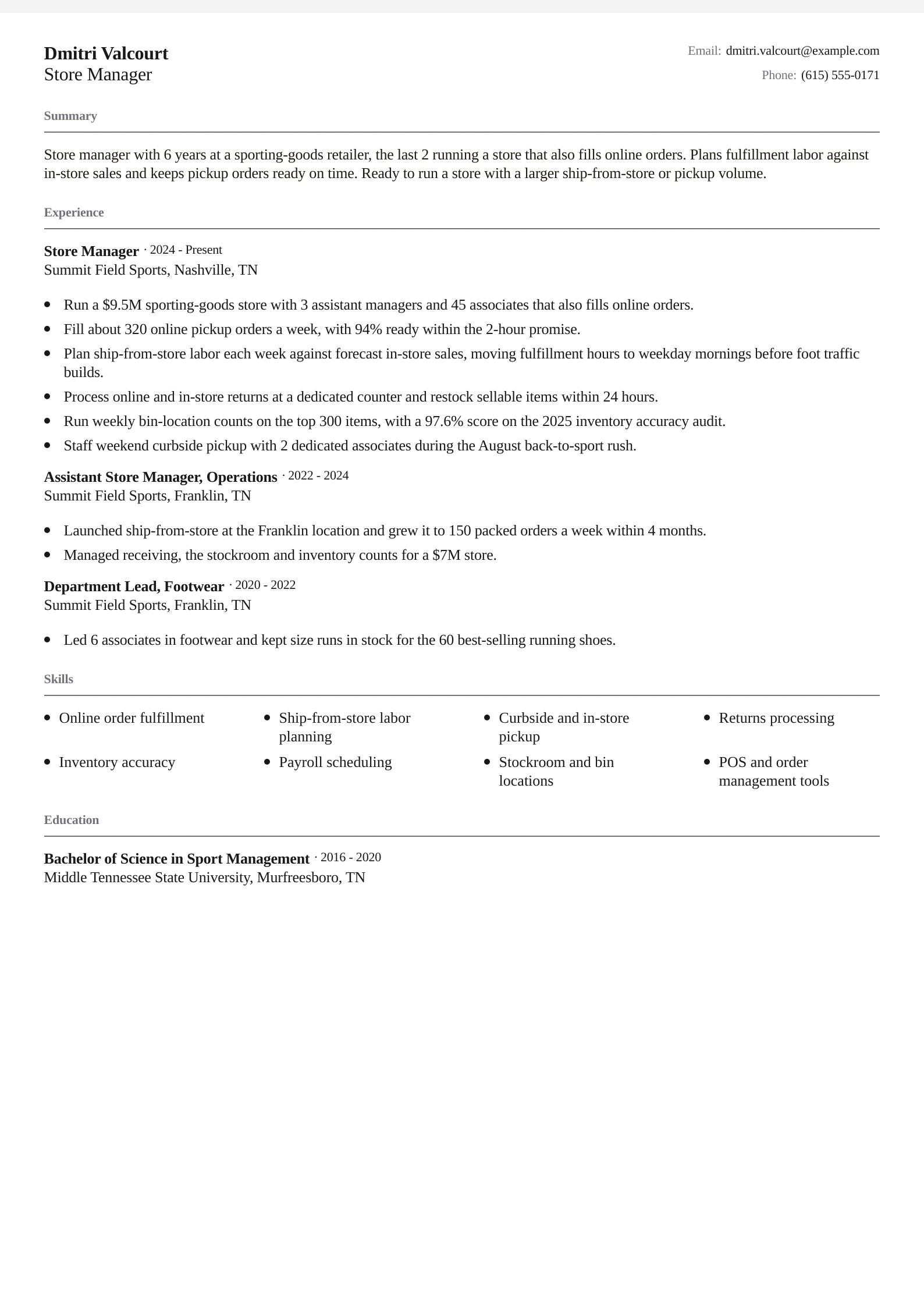
Dmitri's $9.5M sporting-goods store fills about 320 pickup orders a week, so his resume treats fulfillment as part of running the store. It shows 94% of orders ready on time, ship-from-store hours planned against in-store sales, a returns counter and a 97.6% inventory accuracy score. Use it if your store handles pickup, curbside, ship-from-store or online returns.
320 pickup orders a week, 94% ready on time
Ship-from-store labor planned against in-store sales
97.6% on the 2025 inventory accuracy audit
Store manager hired to fix shrink
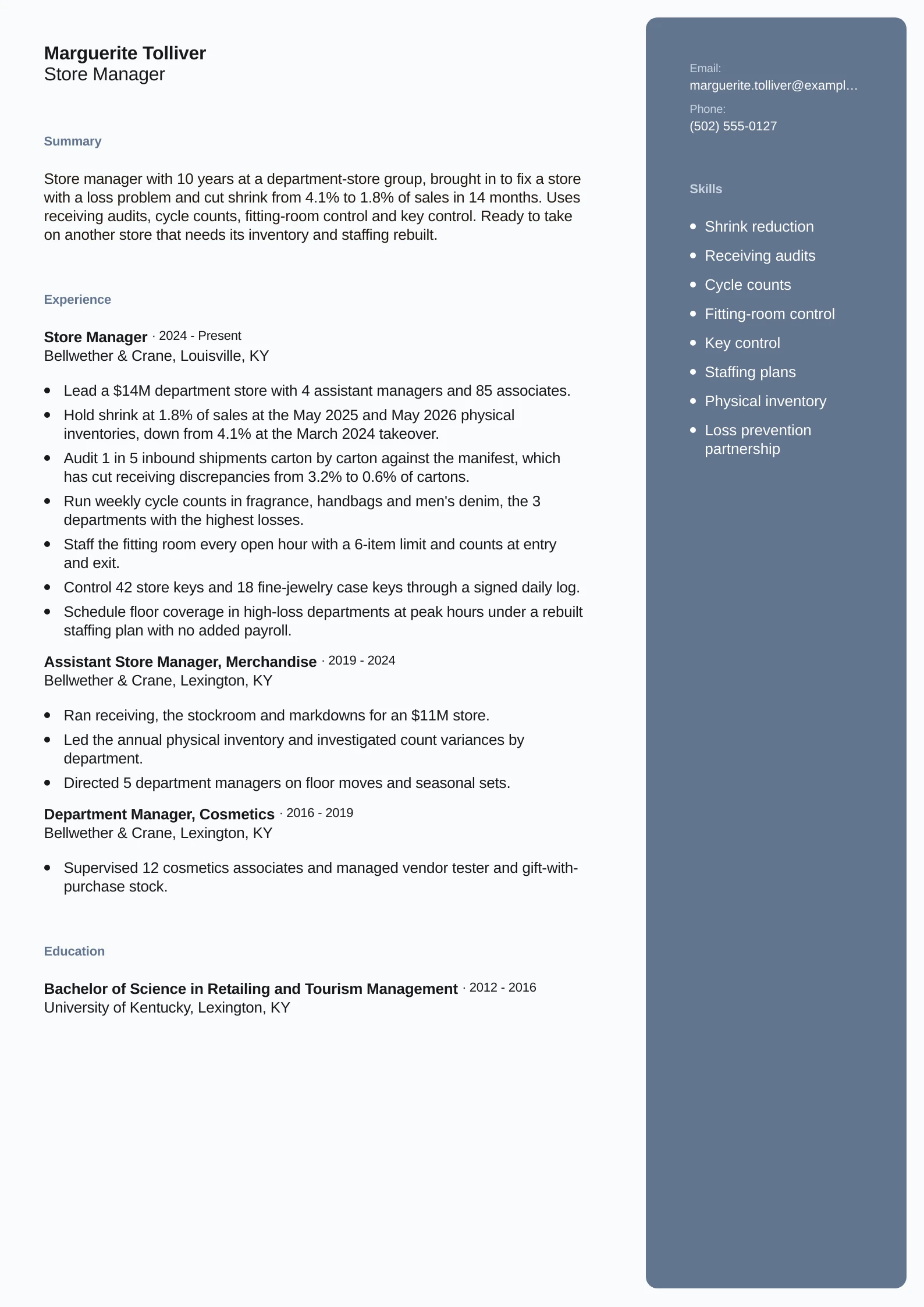
Marguerite took over a $14M department store at 4.1% shrink and brought it to 1.8% in 14 months. Her bullets name the controls behind that drop: receiving audits, weekly cycle counts in three high-loss departments, fitting-room limits and a signed key log. Use it if you've turned around a store with a loss, audit or staffing problem and want each fix on the page.
Shrink cut from 4.1% to 1.8% in 14 months
1 in 5 inbound shipments audited against the manifest
Weekly cycle counts in the 3 highest-loss departments
Restaurant general manager moving into retail
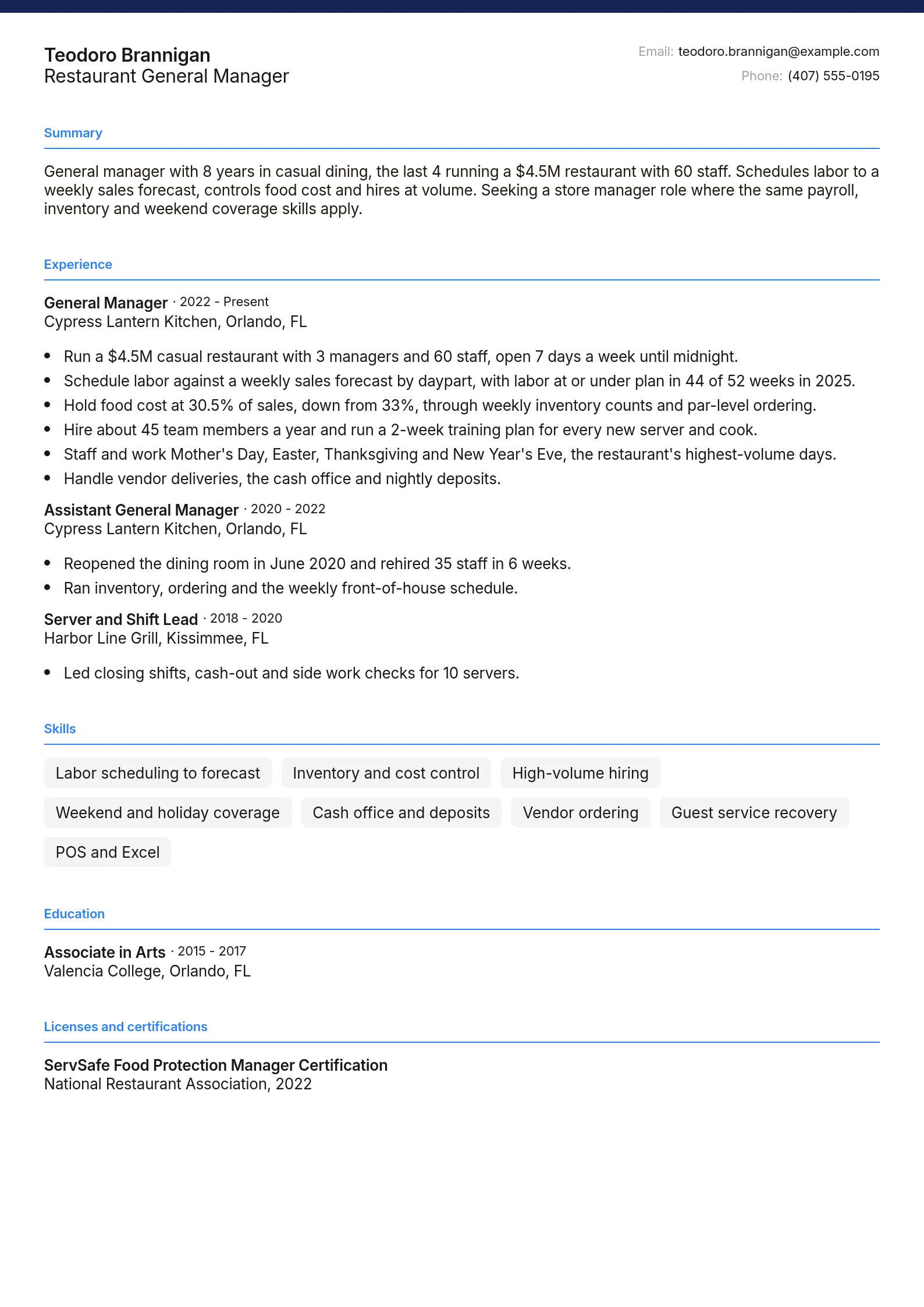
Teodoro has never held a retail title, so his summary names the store manager job he wants and his bullets use terms a district manager already reads: labor scheduled to a sales forecast, weekly inventory counts, food cost, hiring volume and holiday coverage. Use it if you run a restaurant, hotel or other hospitality operation and want a store manager job that accepts hospitality management.
$4.5M restaurant with 60 staff and 3 managers
Labor at or under plan in 44 of 52 weeks
About 45 hires a year with a 2-week training plan
Put store volume and your plan results in the top bullets
Put store volume and team size in your first bullet, then give one result each for sales, payroll, shrink and turnover in the bullets under your current job. Those are the numbers a district manager reviews every week, so a hiring manager looks for them first.
Write each number against something: last year, the plan, or where the store was when you took it over. "Shrink of 1.1%" means little alone, while "shrink at 1.1% of sales in fiscal 2025" gives the period and the base. If you're an assistant manager, use the store's volume for scale and your own numbers for the parts you run, such as the schedule or the truck.
If your company treats store sales as confidential, round the figure or give results as a percentage of plan.
Number
What it tells the reader
How to write it
Store volume and team
How big a store you can run
Run a $2.9M mall store with 2 assistant managers and 16 associates
Sales to plan or last year
Whether you hit the target the company set
Holiday quarter ran at 118% of the prior year
Payroll against plan
Whether you schedule to traffic or to habit
Kept payroll at or under plan in 15 of 16 quarters
Shrink
Whether receiving, cash and keys are under control
Brought shrink from 4.1% to 1.8% of sales in 14 months
Turnover
Whether people stay long enough to be trained
Cut 12-month associate turnover from 74% to 52%
Audit score
Whether the store meets company standards on a visit
Scored 96 of 100 on the 2025 district operations audit
Report payroll and shrink against your store's own plan
Compare payroll and shrink with your own store's plan or its starting point, because chains set different targets and a reader from another company can't judge your figure against theirs. A payroll line needs the plan you were given and how often you met it. A shrink line needs the starting rate, the ending rate and the time it took.
Name the controls that moved the number. For shrink, that's receiving audits, cycle counts by department, fitting-room limits or a key log. For payroll, it's how you built the schedule: hourly traffic counts, a sales forecast by daypart, or hours moved from slow mornings to Saturday afternoons.
The National Retail Federation's 2023 survey put average shrink at 1.6% of sales in fiscal 2022, with department stores, grocery and pharmacy above 2%. Rates differ that much by format, so your own store's before and after is still the number to put on the resume.
Plan, method and result
Built the weekly schedule from hourly traffic counts and kept payroll at or under plan in 15 of 16 quarters, with shrink at 1.1% of sales in fiscal 2025.
Duties with no result
Responsible for scheduling, payroll and loss prevention for the store.
Say who reported to you and how many you hired
Give the size and shape of your team in one line: how many assistant managers, department supervisors or keyholders reported to you, and how many hourly associates sat under them. "2 assistant managers and 16 associates" and "140 associates through 8 department supervisors" describe very different jobs, and a hiring manager needs to know which one you did.
Count the people you hired and the people you promoted. Hiring volume shows you can staff a store through turnover, and promotions show you build the next keyholders and assistant managers. Write the role they moved into, such as "promoted 2 associates to keyholder" or "2 promoted to store manager within the district."
Add turnover when you changed it, with the period and the group: 12-month associate turnover, or annual turnover among store managers and assistant managers. If you manage several stores, count the managers you lead, the stores, your visit cadence and how you score a visit, because your own sales floor is no longer the job.
Small-store managers can skip the org chart and show how they train. A first-week checklist, the number of shifts it covers and who now opens the store without you tell a district manager more than a team size of 7.
Use holiday and reset results to show you can run the hardest weeks
Give one result from your busiest weeks under your current job, because store manager postings list evenings, weekends and holidays as part of the role. A hiring manager wants proof you can staff and run the store when traffic is highest and much of the team is seasonal.
The holiday quarter is the clearest example for most store managers. Write how many seasonal associates you hired, when the floorset went in and how the quarter finished against last year or plan. Back-to-school, a spring garden reset, a remodel or a store opening work the same way when they're your store's peak.
Assistant managers can use the resets and overnight sets they led, with the nights it took and how many styles or fixtures moved. Restaurant managers can name the highest-volume days they ran, like Mother's Day or New Year's Eve.
Availability belongs on the application form, which almost always asks for it. The resume shows it through what you ran: holiday weeks, Sunday openings and overnight freight.
Carry assistant manager or restaurant results into a store manager application
Assistant managers and restaurant managers can both apply, because many postings ask for prior management experience rather than a store manager title, and some accept experience in high-volume hospitality. The resume has to show the store manager's work you already do, in the terms a district manager uses.
Assistant managers and co-managers should lead with the days they run the store alone, the schedule they write and the people they hired or promoted. Use the store's volume to show scale and your own numbers for the parts you run, such as units per transaction, truck processing time or the keyholders you trained.
Shift leads aiming for a first management job usually do better applying for assistant manager roles, because store manager postings ask for prior management experience, and some set a minimum of two years. List opening and closing, deposits and the associates you trained, and keep keyholder or shift lead as the title you held.
Restaurant and hotel managers should translate each result into retail terms: labor against a sales forecast is payroll to plan, food cost is inventory and cost control, and covers by daypart is traffic. Put the target job in the summary, as in "seeking a store manager role," so the reader knows why a restaurant resume is in the pile.