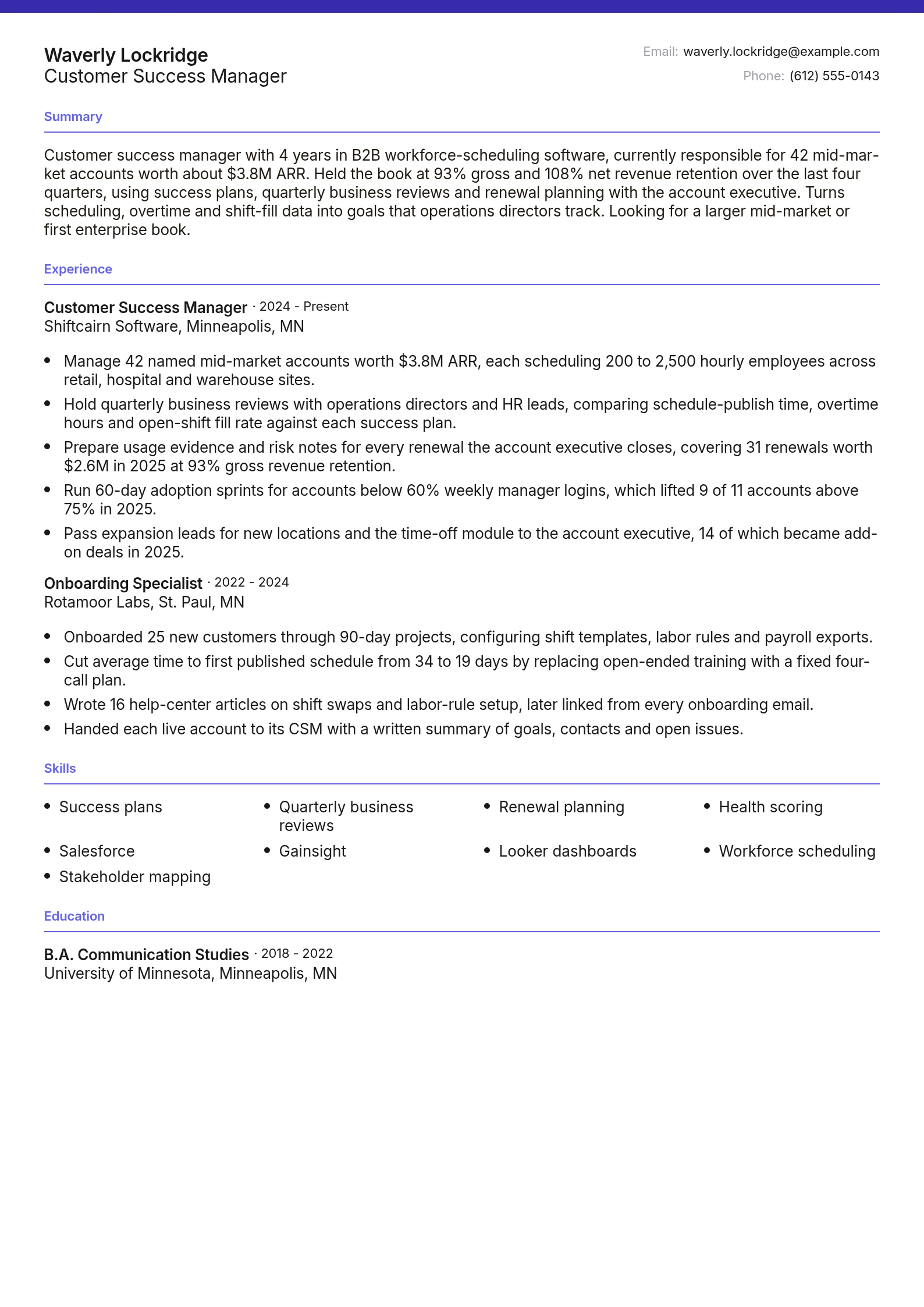
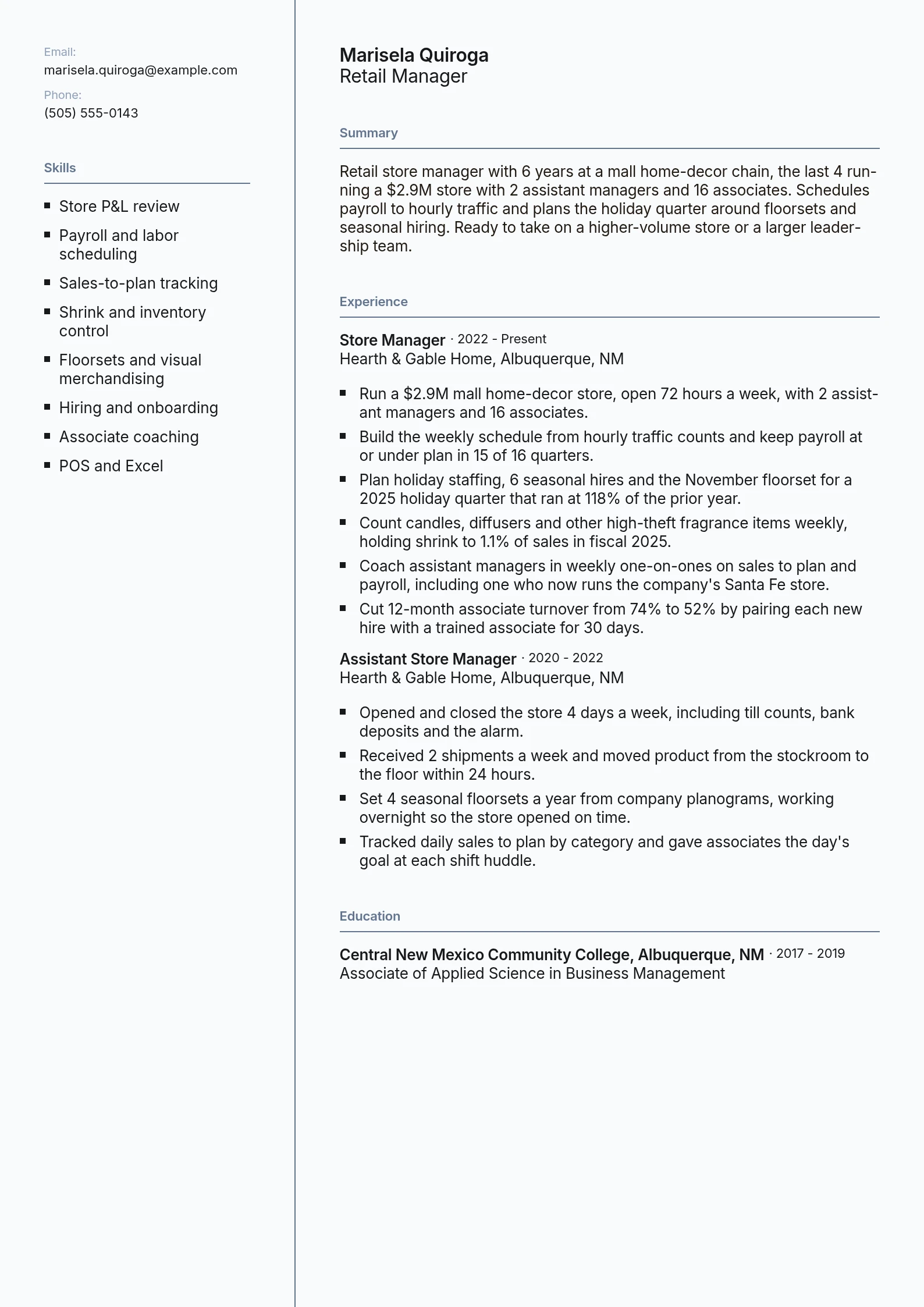
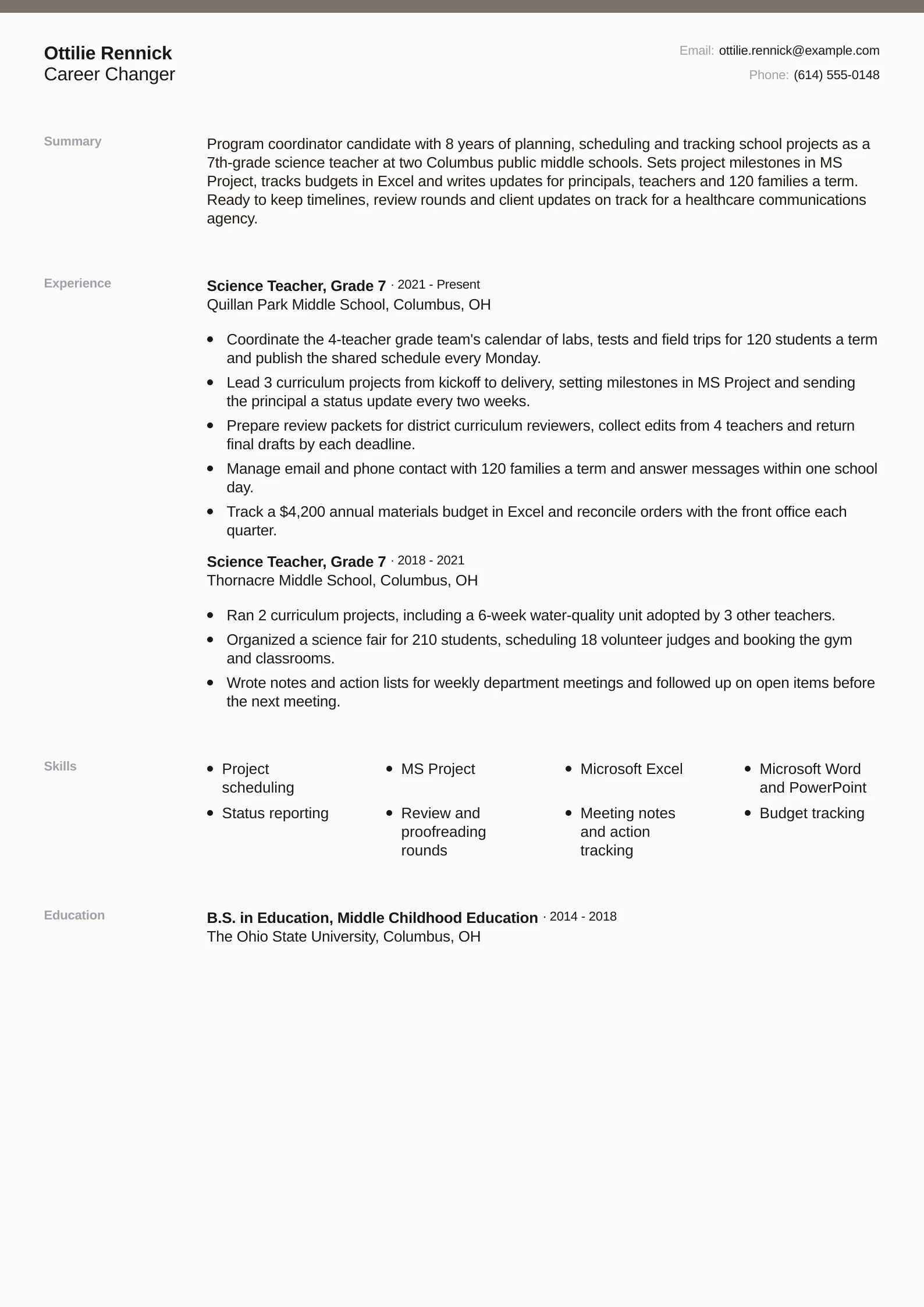
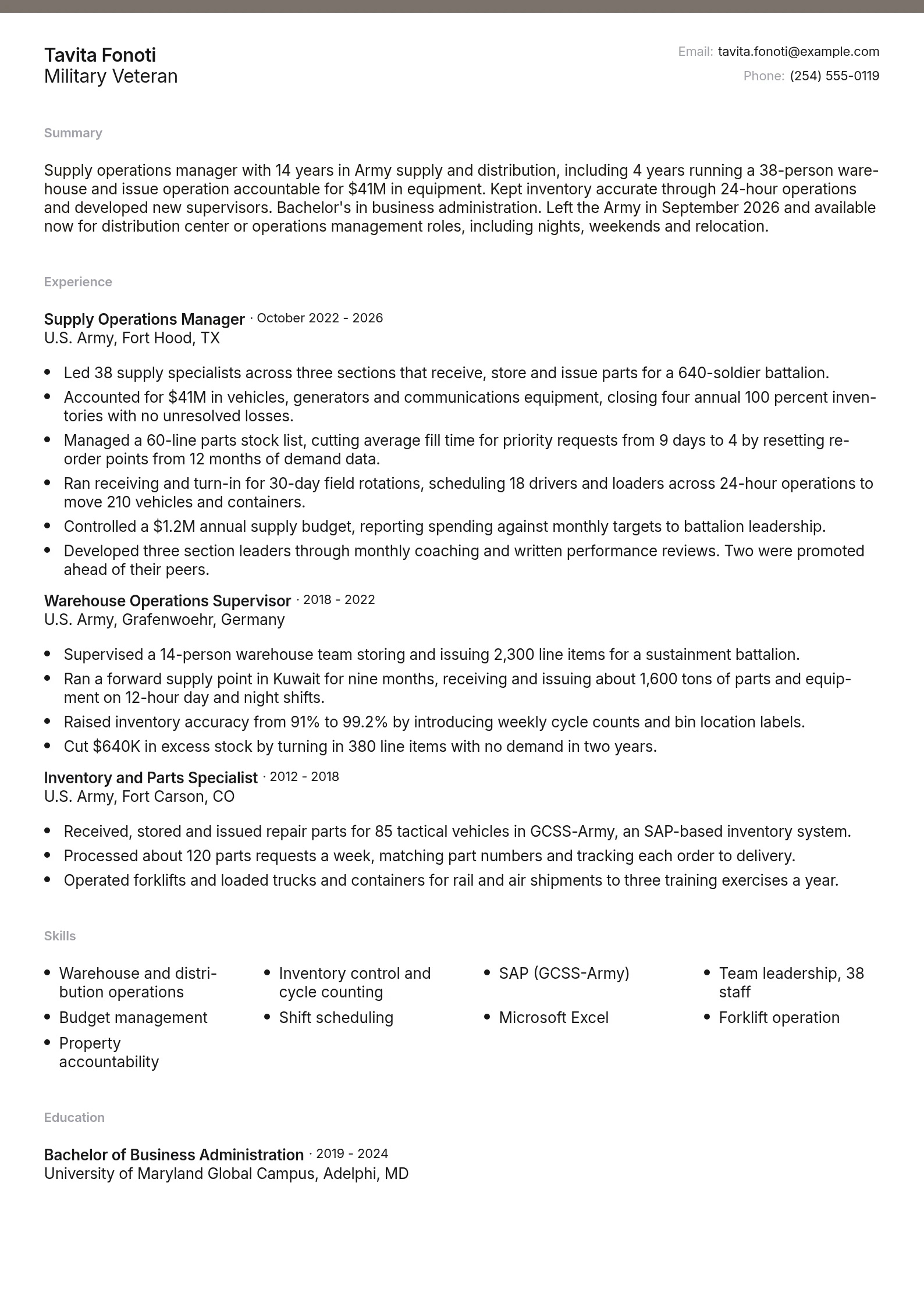
Police hiring boards check your certification path before anything else, so a recruit, a probationary officer and a certified lateral each need a different resume.
The 12 examples here cover those stages, sergeant and lieutenant ranks, and deputy, K-9, traffic, SWAT and detective assignments, each with the counts and credentials that assignment is judged on.
A certified patrol officer resume built on weekly and yearly counts
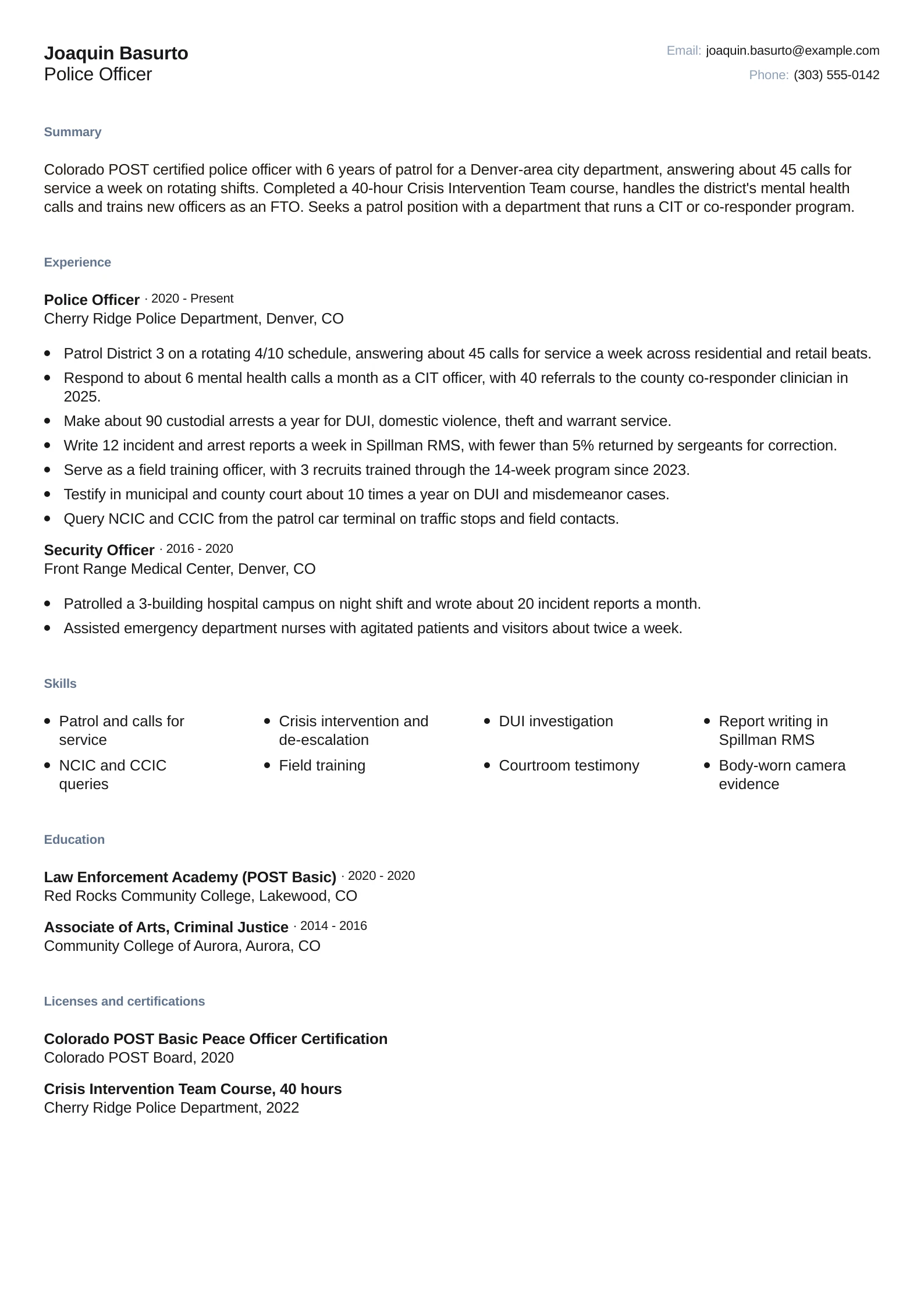
Joaquin's resume puts Colorado POST certification and 6 years of patrol in the first line of the summary. Each patrol bullet carries a count a sergeant would recognize from an activity report: about 45 calls for service a week, 90 custodial arrests a year and 12 reports a week in Spillman.
His Crisis Intervention Team course is listed with its 40 hours and the department that ran it, and one bullet shows the training in use on mental health calls. Field training work sits in experience as an assignment, with the number of recruits trained. Copy this layout if you are a certified patrol officer applying to a similar department or for a patrol opening with a CIT program.
Examples for each hiring stage and assignment
The first four examples follow the hiring path from civilian applicant to certified lateral. The rest show how a county patrol post, a specialty assignment or a promotion changes what goes in the summary and bullets.
No experience: retail loss prevention lead applying as a recruit
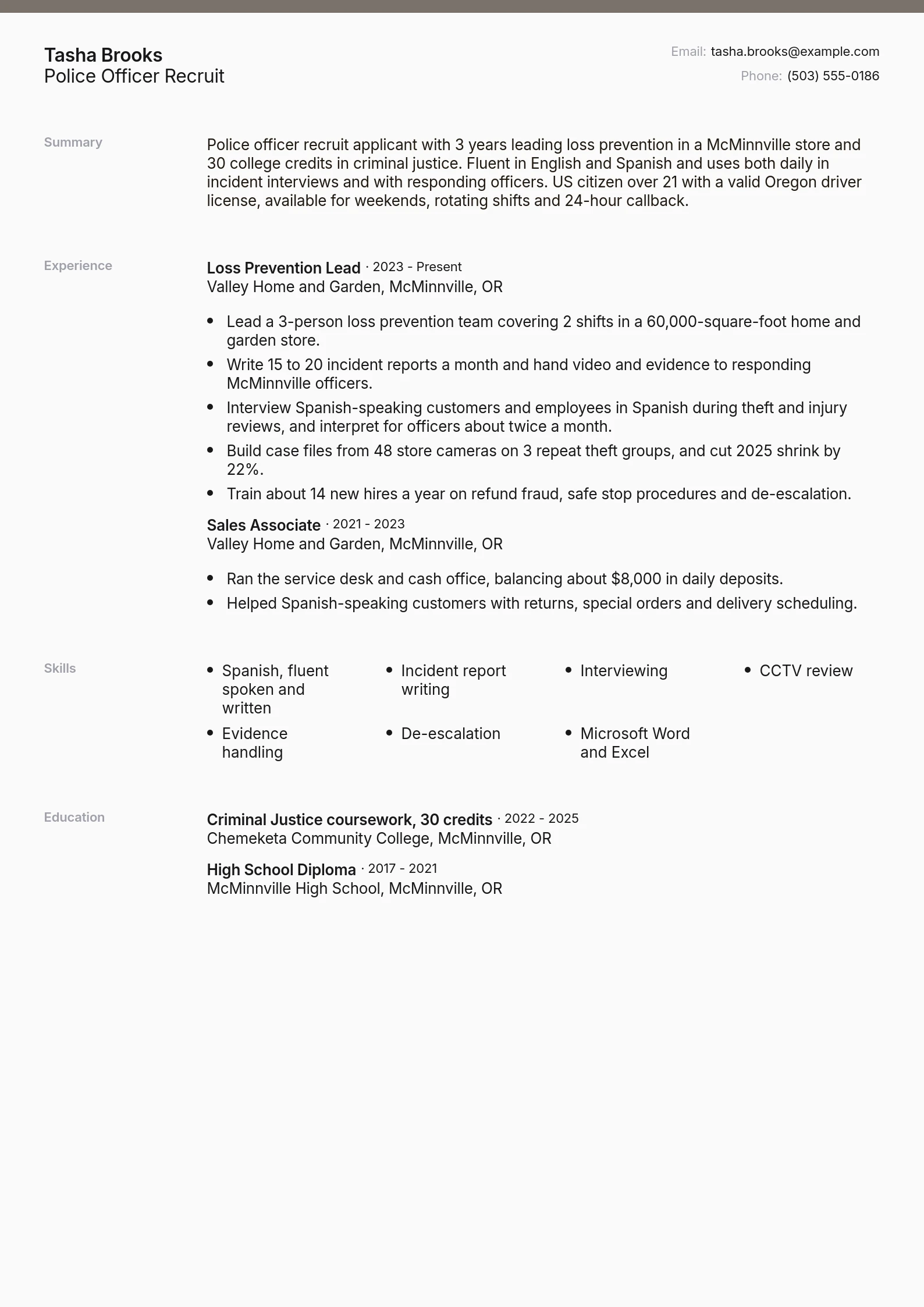
Tasha has no academy and no certificate, so her summary opens with what McMinnville lists as preferred: Spanish, 30 criminal justice credits and the eligibility facts. Her loss prevention bullets read like patrol work, with incident reports, interviews and evidence handed to responding officers. Use it if you are applying as a recruit from a civilian security or customer-facing job.
Eligibility facts and shift availability in the summary
Spanish shown in use during incident interviews
Military police corporal moving to a city recruit position
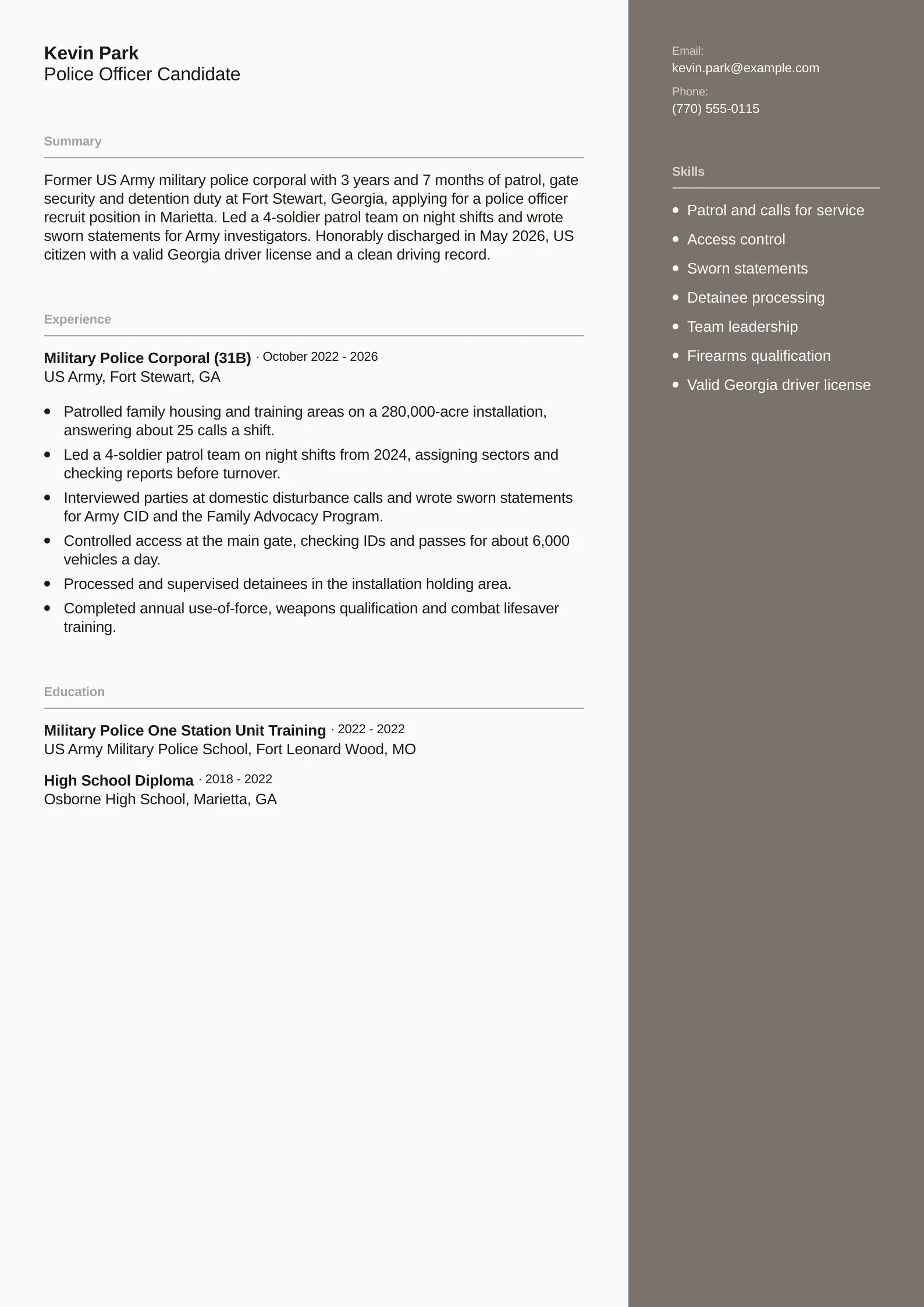
Kevin's Army duties are written in civilian police terms: calls per shift, gate access control, sworn statements and detainee processing. The summary names his honorable discharge, citizenship and Georgia driver license, and his MP training school sits under education. Use it if you are leaving military police or security forces for a recruit academy.
Army MP duties translated into patrol language
Team leader role on night patrols
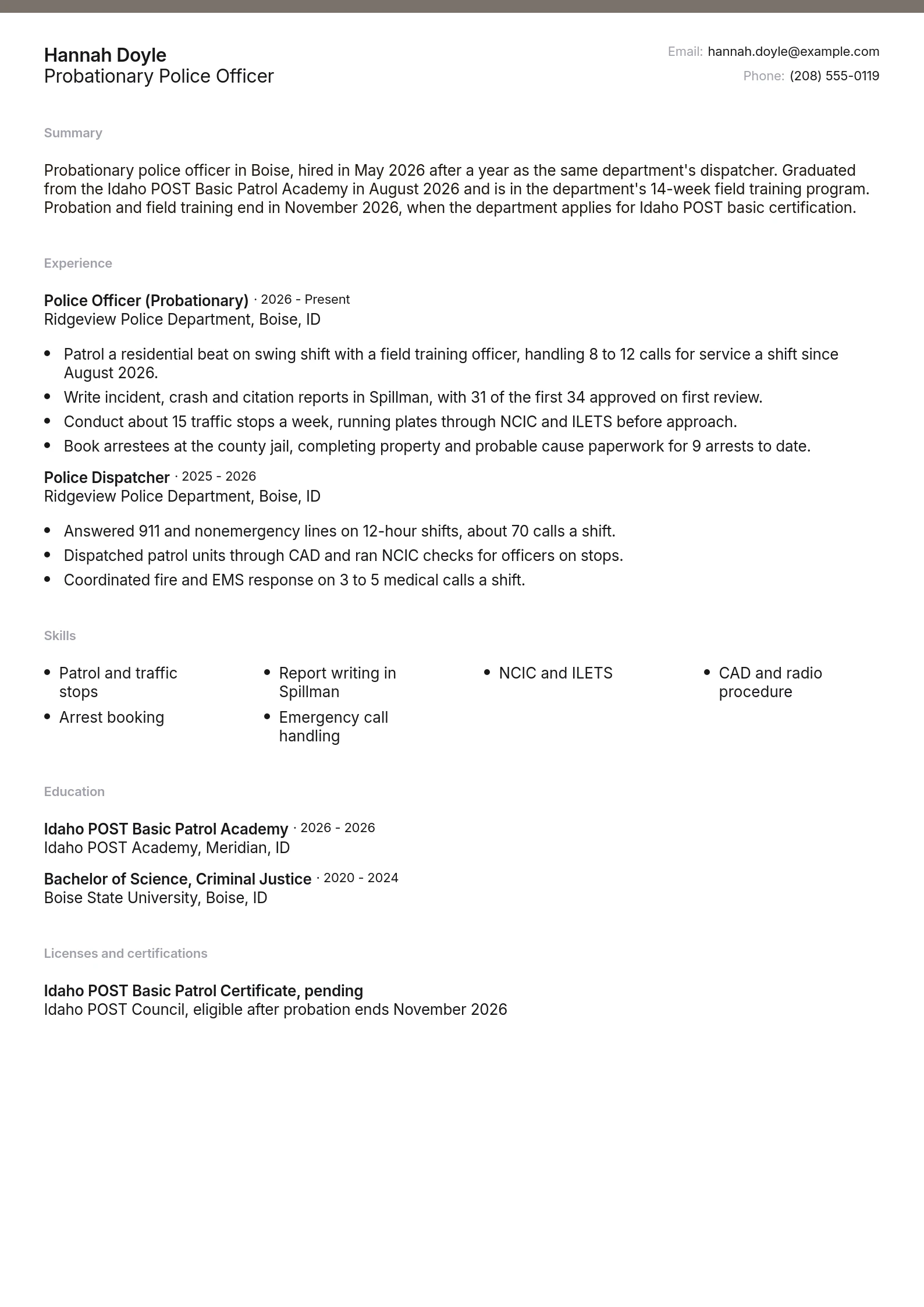
Probationary officer with a pending Idaho POST certificate
Hannah graduated from the academy in August 2026, so her credential reads as pending with the month probation ends. Her year as the department's dispatcher appears as its own role, and her current bullets count calls per shift and reports approved on first review. Use it if you are in field training or probation and need a resume for an assignment, a transfer list or a second agency.
Pending certificate with an eligibility date
Academy and field training dates in the summary
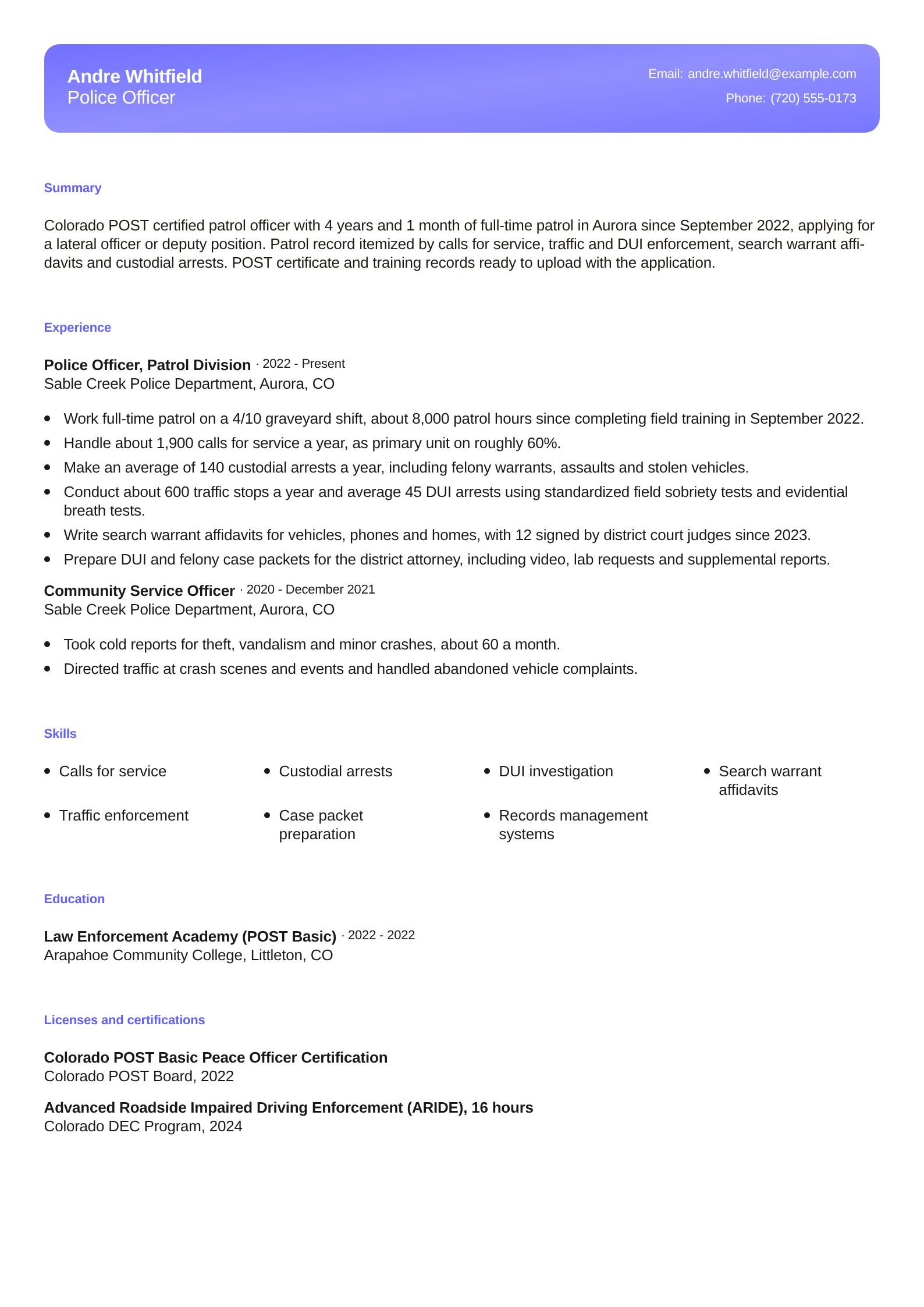
Lateral officer with patrol activity itemized for a posting
Andre's bullets follow a lateral posting's definition of patrol one activity at a time: calls for service, custodial arrests, traffic and DUI enforcement, and search warrant affidavits, each with a yearly count. His summary states the start month and total patrol time so a screener can check the minimum at a glance. Use it if you are certified and moving to another agency.
Full-time patrol time stated in years and months
One counted bullet per patrol activity
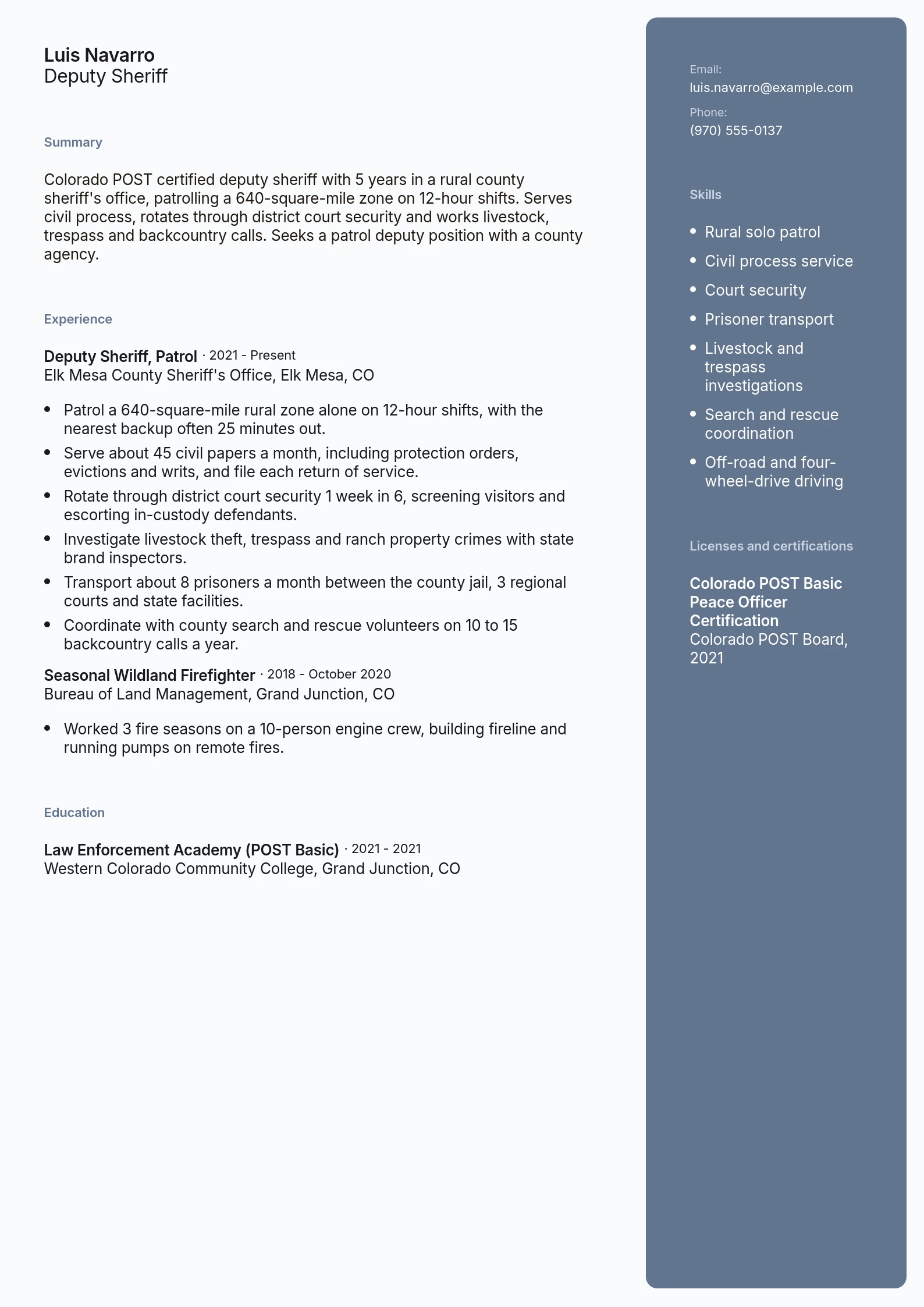
Rural deputy sheriff with civil process and court security
Luis's resume shows the work a county sheriff's office adds to patrol: civil papers served each month, a court security rotation and prisoner transports. His first bullet gives the size of his zone and how far backup is, which tells a rural agency he can work alone. Use it if you are a deputy or applying to a sheriff's office from a city department.
640-square-mile solo patrol zone
Civil process and court security counts
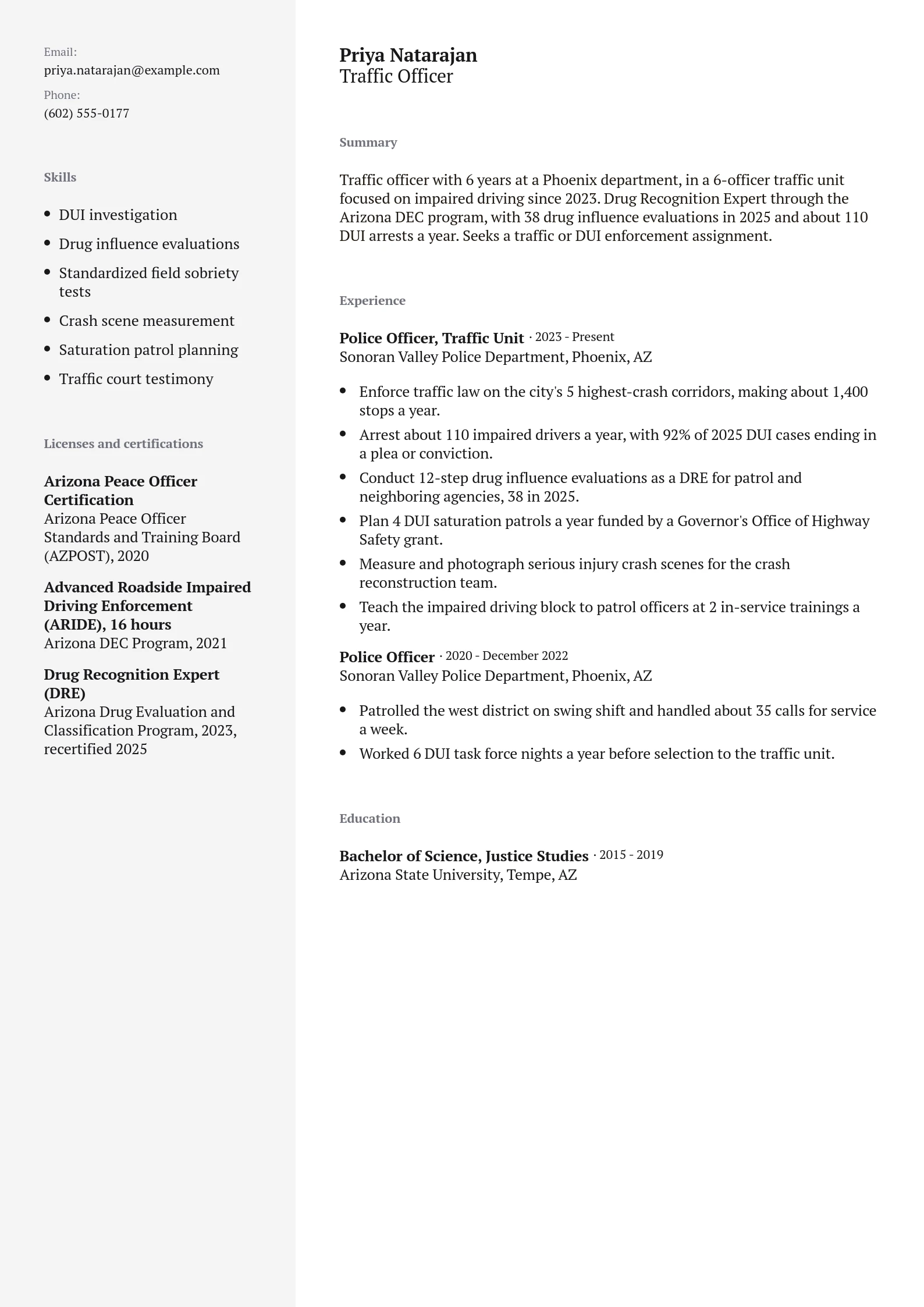
Traffic officer with ARIDE and DRE certification
Priya lists ARIDE, then DRE with the Arizona program and the year she recertified, in the order she earned them. Her bullets count stops, DUI arrests and drug influence evaluations, and add the saturation patrols she plans and the in-service class she teaches. Use it if you work traffic or DUI enforcement or want a traffic unit opening.
DRE listed with its state program and recertification
38 drug influence evaluations in one year
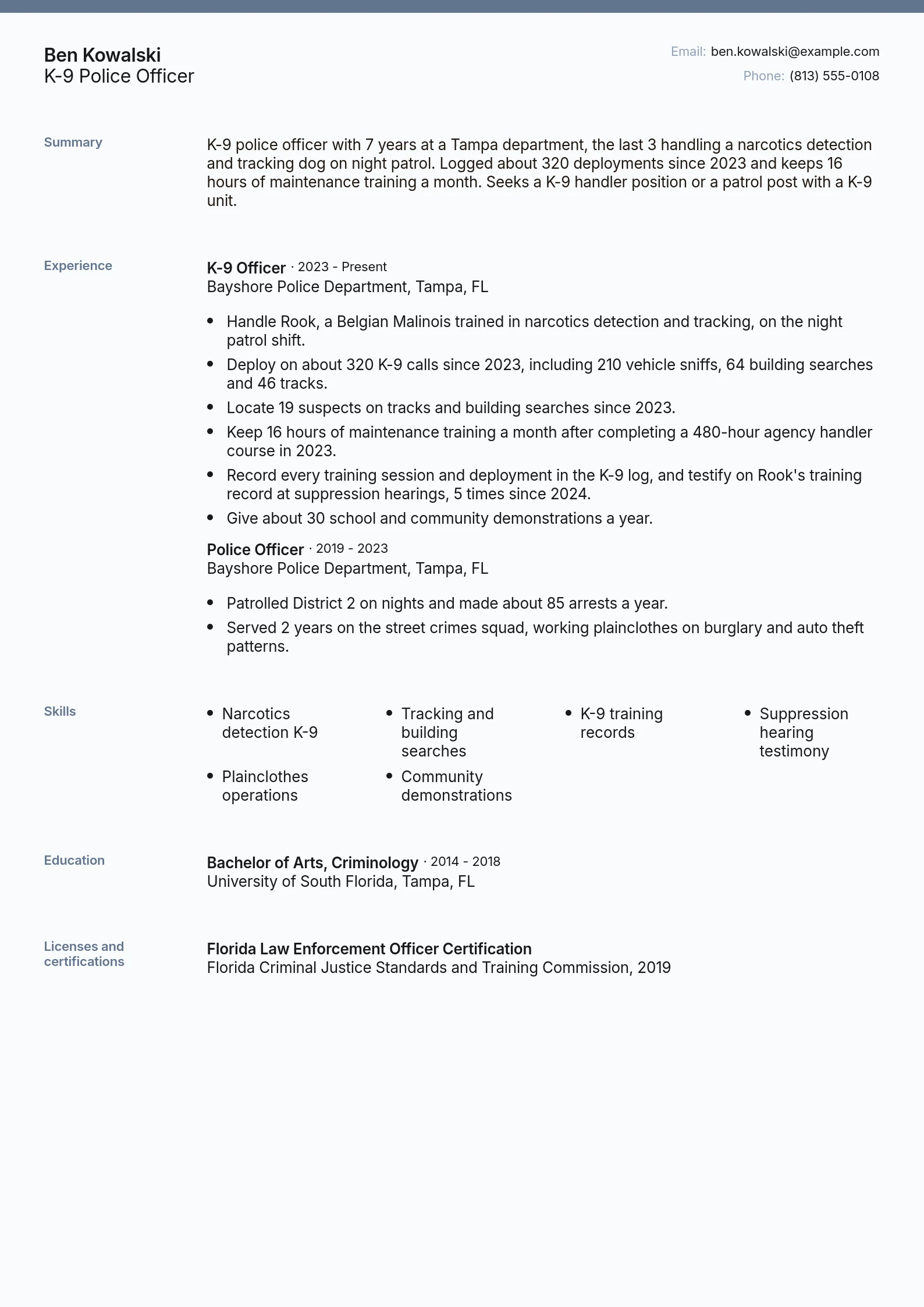
K-9 handler with deployment and training records
Ben breaks 320 deployments into sniffs, building searches and tracks, then gives his monthly maintenance training hours and his suppression hearing testimony. The dog's training sits in an experience bullet with the agency course hours, because the agency ran it. Use it if you handle a patrol or detection dog or are applying for a K-9 opening.
Deployments split by type
Court testimony on the dog's training record
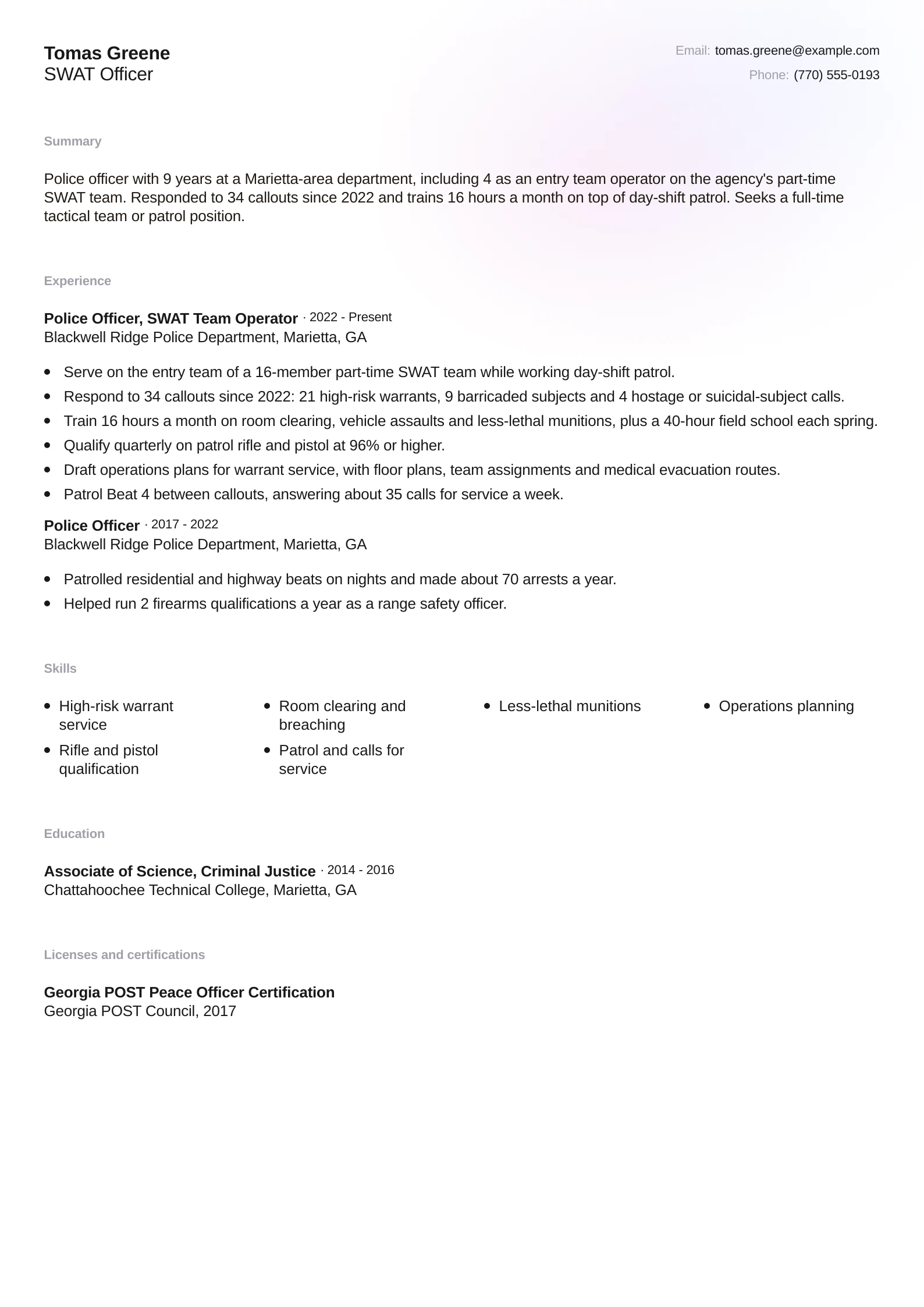
Part-time SWAT operator who still works patrol
Tomas lists 34 callouts by type, his monthly training hours and his quarterly firearms scores, and shows the patrol beat he works between callouts. One bullet covers the operations plans he drafts for warrant service. Use it if you serve on a part-time tactical team or are applying for a full-time one.
Callouts counted by type since 2022
Training hours and qualification scores
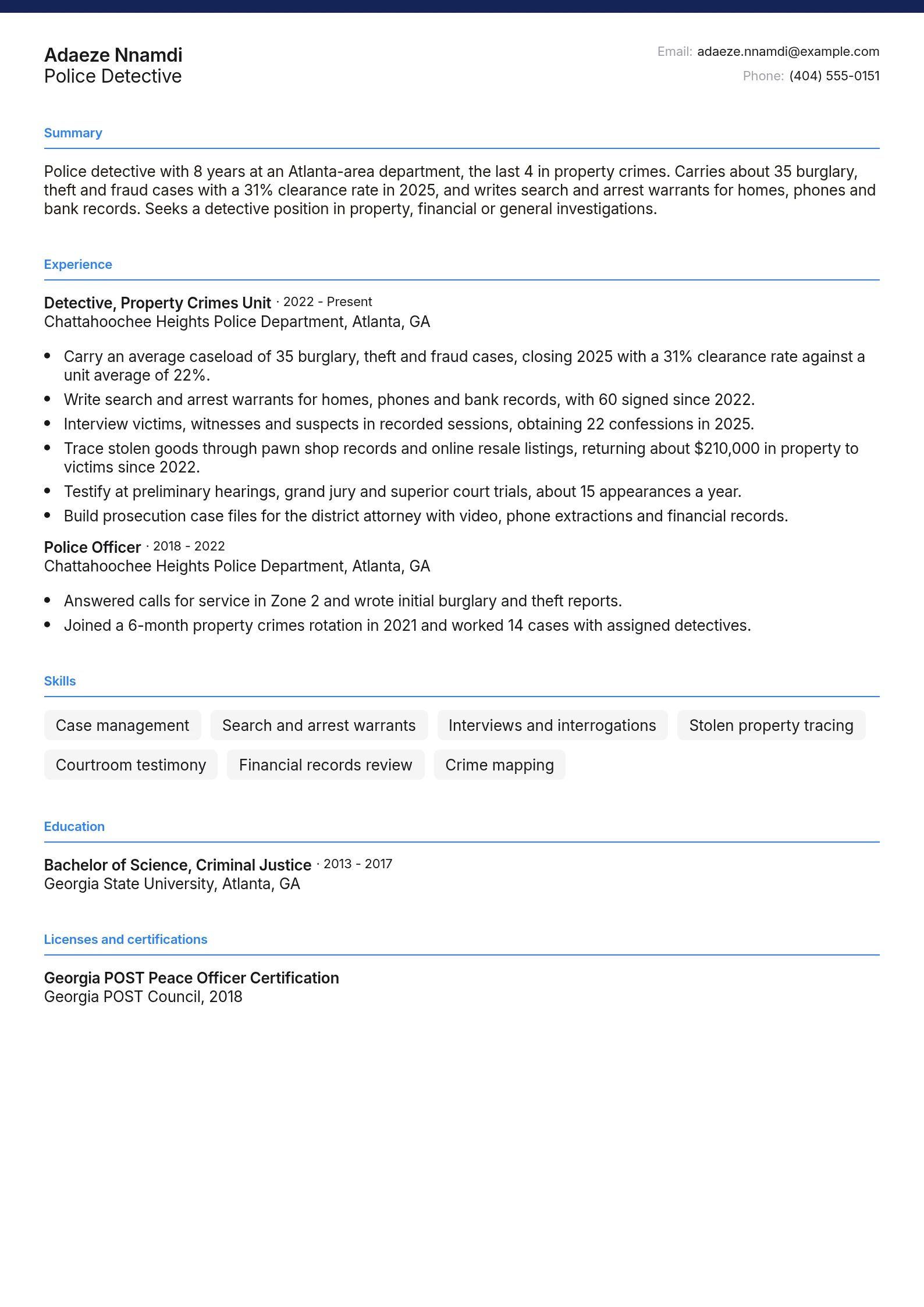
Property crimes detective with clearance rate and warrant counts
Adaeze gives her caseload and her 2025 clearance rate next to the unit average, then counts warrants signed, confessions and property returned to victims. Her patrol years stay short, with one bullet on her 2021 property crimes rotation. Use it if you are a detective or a patrol officer applying for an investigations opening.
Clearance rate compared with the unit average
Court appearances counted by year
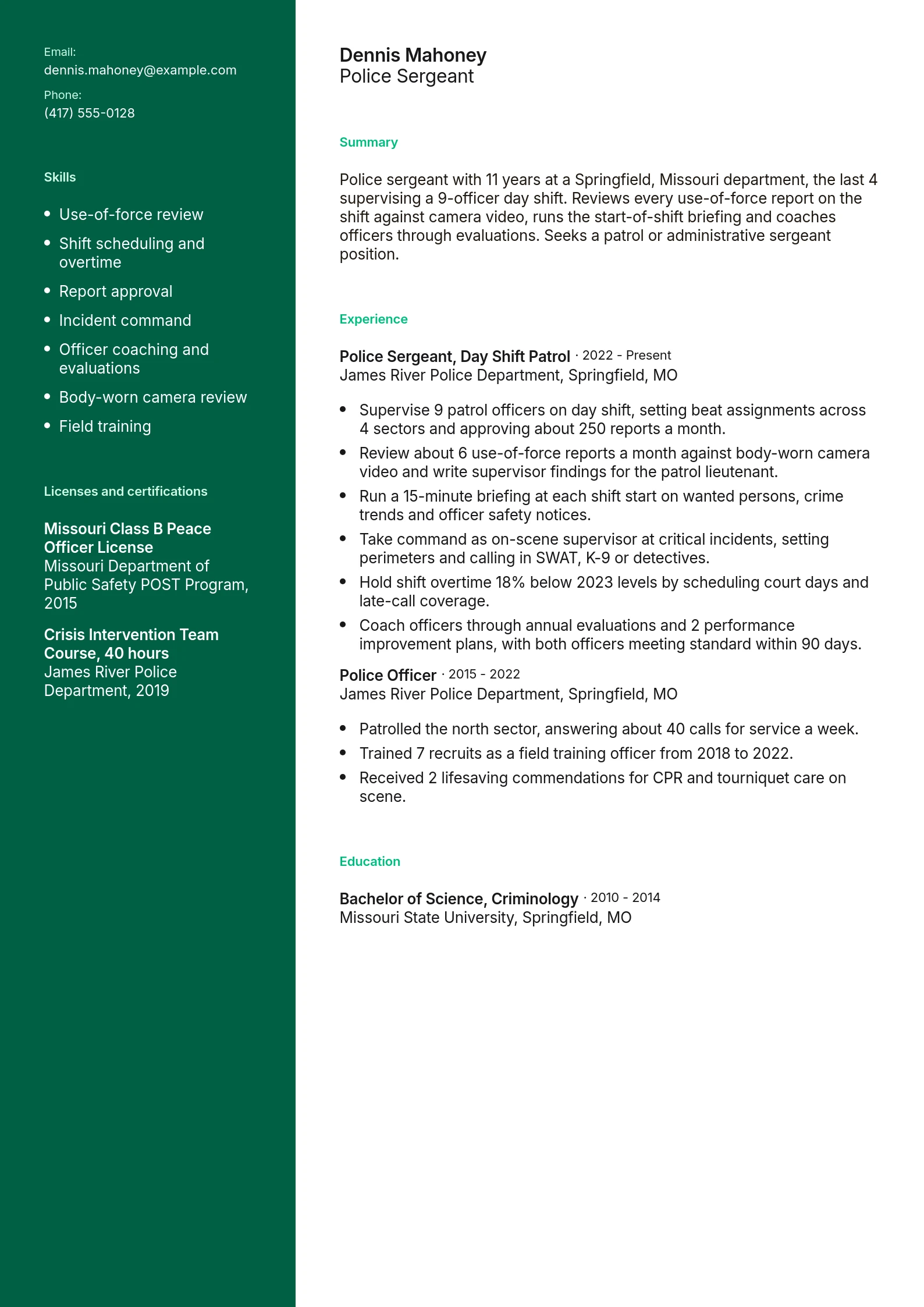
Day-shift sergeant who reviews force and runs briefings
Dennis's sergeant bullets cover supervision work a promotion board asks about: the 9 officers he supervises, use-of-force review against camera video, shift briefings and overtime. His officer years shrink to three past-tense bullets, including field training. Use it for a sergeant's test, a lateral sergeant posting or a supervisor role outside policing.
Use-of-force review with camera video
Overtime held 18% below 2023
Watch commander lieutenant with budget and accreditation work
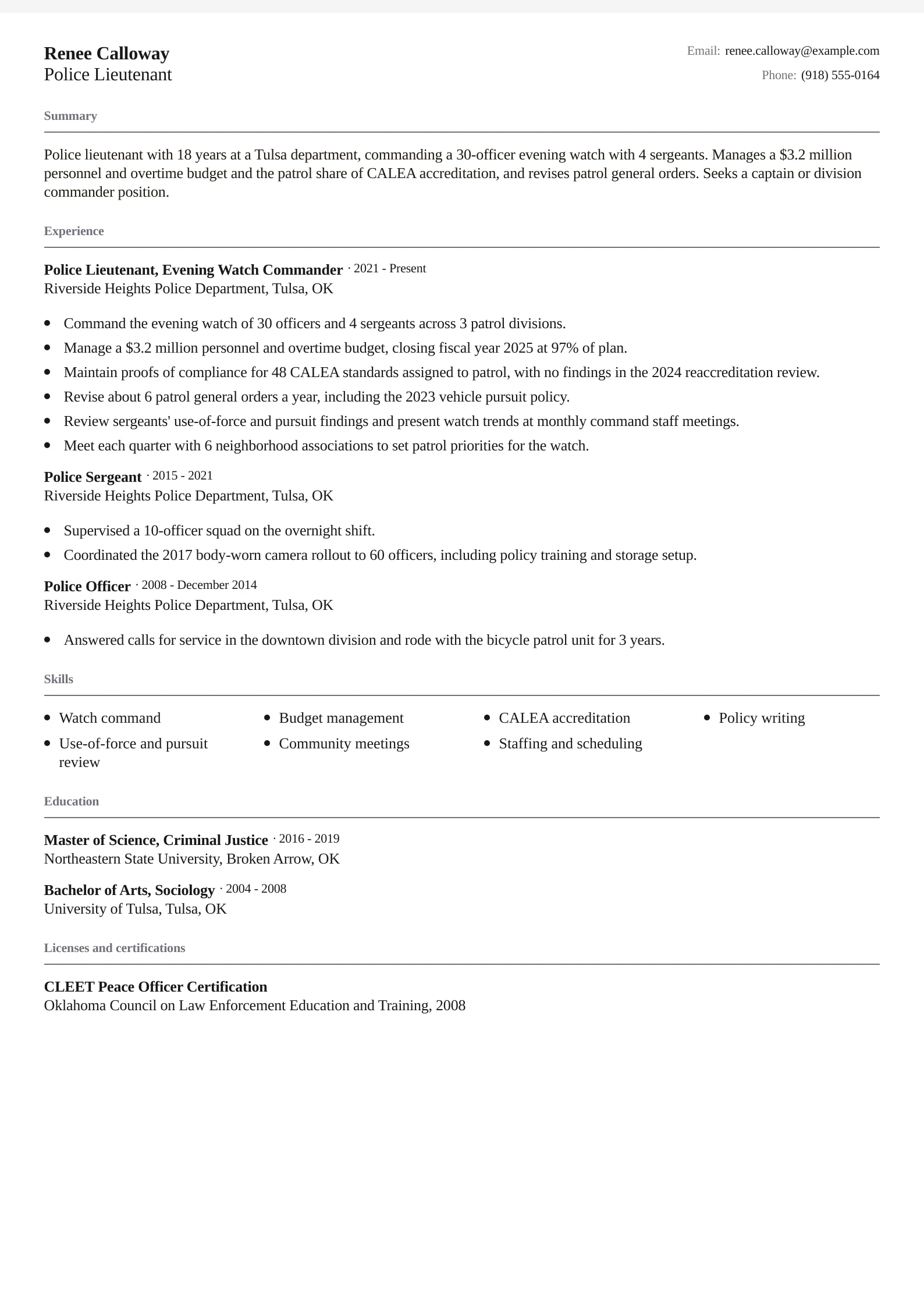
Renee's resume reads like a command resume: a 30-officer watch, a $3.2 million budget, CALEA standards and general orders she revises. Each earlier rank gets fewer bullets than the one above it, and a master's degree sits under education. Use it if you are a lieutenant or captain applying for a command post.
Budget result against plan
48 CALEA standards with no findings
Show POST status as it stands on the day you apply
List only the certificate your state has issued, and show where you are on the path to it. Many agencies hire recruits first and certify them later: in Idaho, an officer is certified only after hire, a POST academy, at least 40 hours of field training and a 6-month probation from the hire date.
Name the state body as the issuer, such as the Colorado POST Board, Oregon DPSST, Georgia POST or Florida's Criminal Justice Standards and Training Commission. A background investigator checks every certificate with the state, so a POST certificate listed before it is issued reads as a false statement.
Your stage
What to list
Example wording
Applying as a recruit
No certificate. Put eligibility facts, college credits and languages in the summary.
US citizen over 21 with a valid Oregon driver license and 30 college credits in criminal justice
Hired and in the academy
The academy under education, with the expected graduation month
Idaho POST Basic Patrol Academy, Meridian, ID, graduating December 2026
Academy graduate on probation
A pending credential with the state body and the month you become eligible
Idaho POST Basic Patrol Certificate, pending. Idaho POST Council, eligible after probation ends November 2026
Certified officer
The certificate, the state body and the year issued
Colorado POST Basic Peace Officer Certification, Colorado POST Board, 2020
Certified lateral
The certificate, plus full-time patrol time in years and months in the summary
Colorado POST certified, 4 years and 1 month of full-time patrol since September 2022
Count lateral patrol time by activity, with yearly numbers
Patrol experience on a lateral application means full-time work answering calls, and many postings define it by activity. Jefferson County, Colorado, asks for 2 years of full-time patrol that includes calls for service, traffic and impaired-driving enforcement, search warrant affidavits and custodial arrests.
Put your patrol start month and total full-time patrol time in the summary, so the screener can check the minimum without adding up dates. Then write one bullet for each activity the posting names, each with a yearly count from your activity report or CAD history.
List academy weeks, community service officer time, light duty and non-patrol assignments as separate roles with their own dates. That keeps your patrol total easy to verify and gives credit for the other work.
Activity a lateral screener can check
Full-time patrol since September 2022 (4 years, 1 month). Handle about 1,900 calls for service a year, make 140 custodial arrests and 45 DUI arrests a year, and have written 12 search warrant affidavits signed by district court judges.
Duty list
Responsible for patrol duties including responding to calls, traffic enforcement, arrests and report writing in an assigned area.
Give CIT, ARIDE, DRE and FTO each the entry its program supports
Put CIT, ARIDE and DRE under credentials with their hours and the program that delivered them, and put field training officer work in experience. Each has a different issuer, so the wording differs.
Add one bullet that shows each training in use, such as mental health calls a month for CIT or drug influence evaluations a year for DRE. For K-9 and SWAT, put agency course hours and monthly training hours in experience bullets, as the handler and operator examples do.
DRE status lapses unless it is recertified, so give the year of your last recertification next to the original year.
Training
Where it goes
What to write
Example
Crisis Intervention Team (CIT)
Credentials
Course name, 40 hours, the agency or provider that ran it and the year. CIT International certifies programs, not officers, so do not list it as the issuer.
DRE with the state Drug Evaluation and Classification program, the year certified and the last recertification
Drug Recognition Expert (DRE). Arizona Drug Evaluation and Classification Program, 2023, recertified 2025
Field training officer (FTO)
Experience
An assignment, not a certificate: recruits trained, years served and program length
Serve as a field training officer, with 3 recruits trained through the 14-week program since 2023
Lead a recruit resume with Spanish, service record and college credits
For a recruit, a second language, military service and college credits are the tie-breakers, so put them in the first lines of the summary. McMinnville, Oregon, lists bilingual English and Spanish and college-level law enforcement training as preferred, and BLS notes that some departments pay more for a second language or a degree.
Show the language at work, not only in skills: "interview Spanish-speaking customers during theft reviews" tells an agency more than "Spanish (fluent)". Write college credits as a number and a field, such as "30 credits in criminal justice", even without a finished degree.
Translate military police duties into civilian terms: calls per shift, gate access control, sworn statements, detainee processing. State an honorable discharge in the summary, and close it with the eligibility facts the posting lists, such as citizenship, age, driver license and availability for rotating shifts.
Paste this summary and replace the bracketed parts.
Recruit summary to adapt
Police officer recruit applicant with [3] years of [loss prevention / military police] experience and [30] college credits in criminal justice. Fluent in English and Spanish, used daily in [incident interviews with customers and staff]. US citizen over 21 with a valid [Oregon] driver license and a clean driving record, available for weekends, rotating shifts and callback.
Take keywords from the posting, then add systems and activity terms
Use the exact terms in the posting you are answering, then add the activities and systems a police screener searches for. A civil service screener may not be an officer, so spell each acronym out once, as in "Crisis Intervention Team (CIT)".
For patrol and lateral resumes, put calls for service, custodial arrests, traffic enforcement, impaired-driving or DUI enforcement, search warrant affidavits and report writing inside bullets with numbers. A keyword in a counted bullet reads as experience, while the same word in a skills list reads as a claim.
Name the systems you use every shift: NCIC and your state's crime information system, computer-aided dispatch (CAD), a records management system such as Spillman, and body-worn camera evidence software. Crime mapping and GIS belong on detective and command resumes when you use them for case work or deployment.
Supervisors should use use-of-force review, shift briefings, performance evaluations, scheduling and overtime. Lieutenants and above add budget, general orders, accreditation and community meetings. Recruits take keywords from the posting's eligibility list and from transferable work, such as incident reports, interviewing, de-escalation, CCTV review and evidence handling.