Fitness managers screen a trainer's resume for a current certification first and a client book that pays second, so the best resumes put both near the top with real numbers.
The examples below cover commercial gyms, studios, campus and workplace fitness centers, independent and online coaching, and specialist roles, and each one counts what its setting pays for.
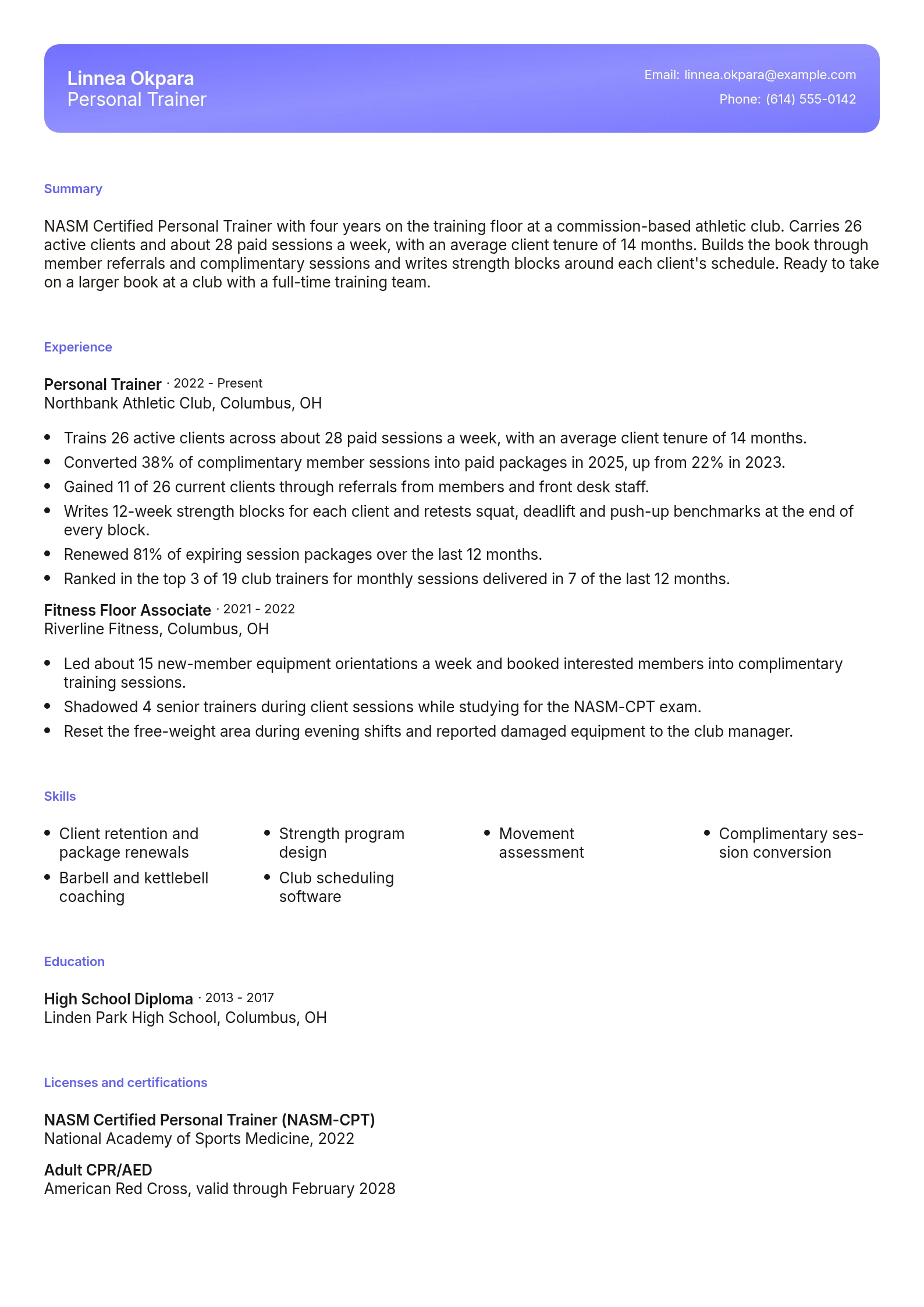
A commission-paid gym trainer with 26 active clients
Linnea's summary gives a manager the three numbers that decide a trainer's pay: 26 active clients, about 28 sessions a week and an average client stay of 14 months. Her NASM-CPT and CPR/AED sit in their own section, with the full credential name and issuer.
Each bullet ties a number to how she built or kept the book: member referrals, complimentary sessions converted to paid packages and package renewals. Start here if you train at a commercial gym and are paid per session or on commission.
Trainer resumes for studios, campuses, clinics, teams and online coaching
Pick the example closest to the job you're applying for. The numbers change with the setting: classes and attendance in a studio, members and assessments in a workplace, athletes and test results in a school weight room.
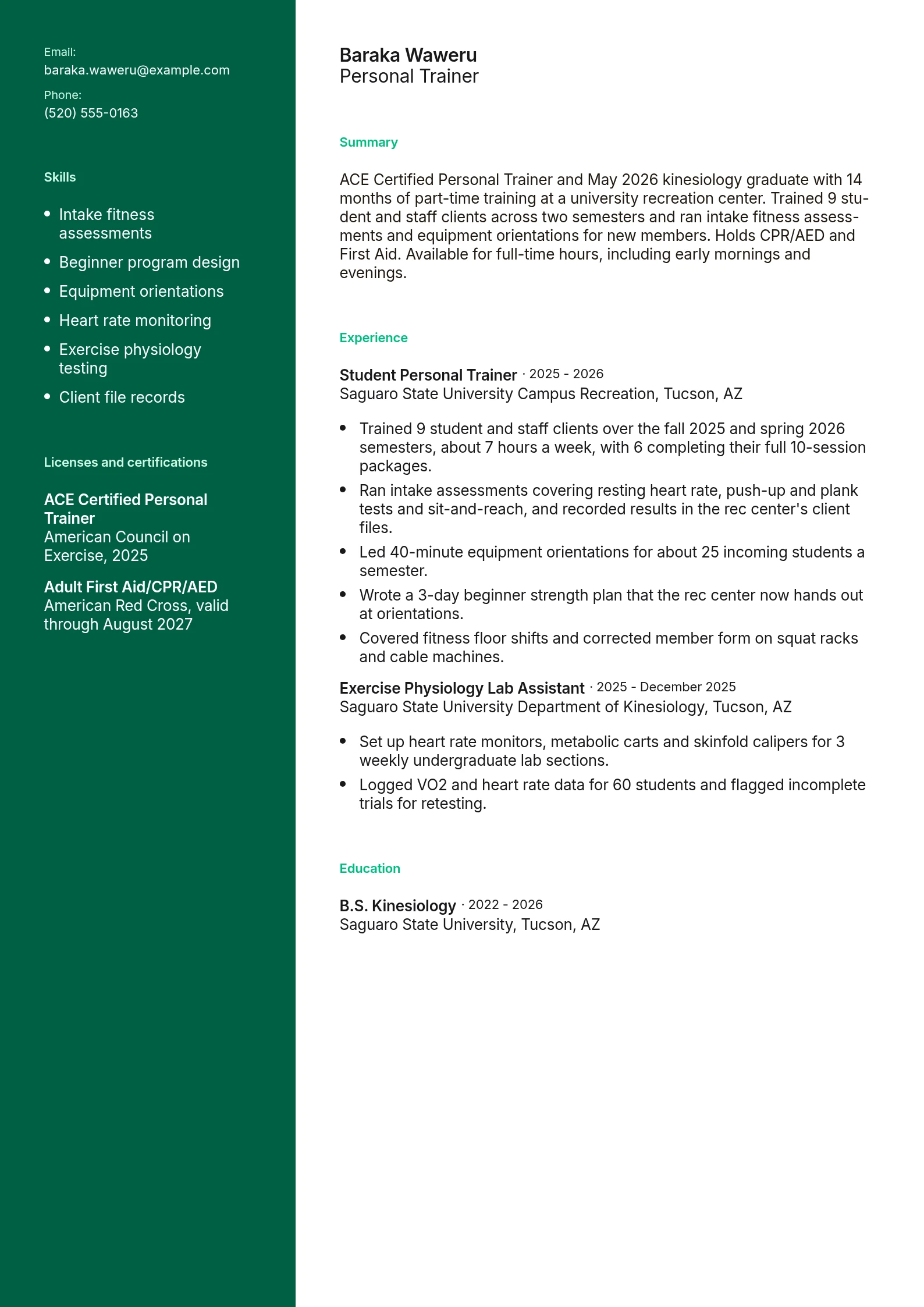
Entry-level personal trainer with campus recreation hours
Baraka has no commercial gym history, so his resume leads with the ACE certification, CPR/AED and First Aid and a B.S. Kinesiology, then shows 14 months of part-time training at a campus rec center. The bullets count real work: 9 clients over two semesters, named intake tests and about 25 orientations a semester. Use it if you're a recent graduate whose experience comes from campus jobs or labs.
9 clients over two semesters at about 7 hours a week
Intake assessment tests named in the bullet
Early-morning and evening availability in the summary
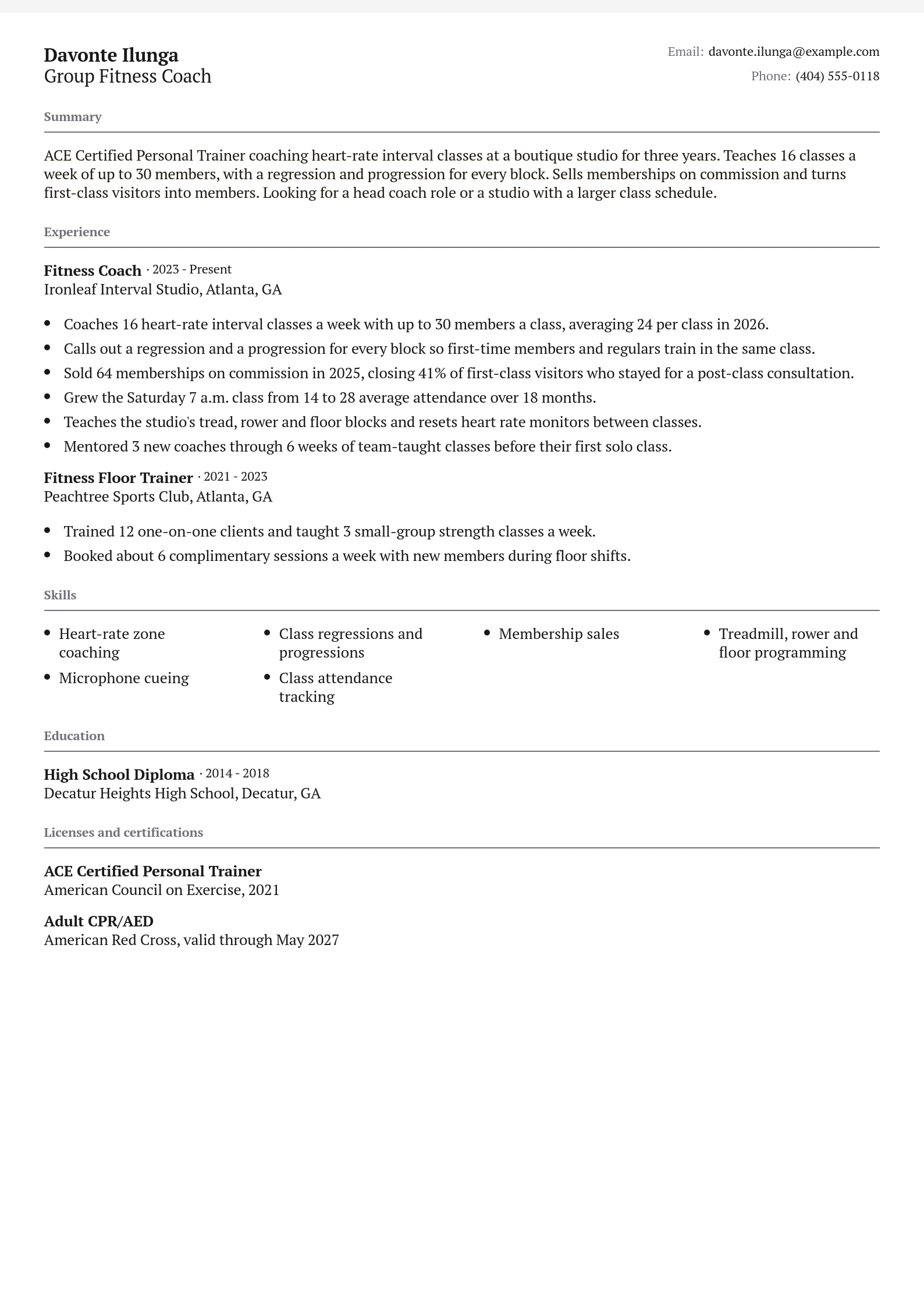
Group fitness coach at a heart-rate interval studio
Davonte's evidence is classes, not a client book: 16 classes a week, up to 30 members each, and a Saturday class that doubled its attendance. His resume also counts memberships sold on commission and the share of post-class consultations he closed. One bullet shows how he coaches mixed levels in one room. Use it if you coach classes at a boutique studio or want a head coach role.
Weekly class count, class size and average attendance
64 memberships sold on commission in 2025
Earlier gym role that shows one-on-one training
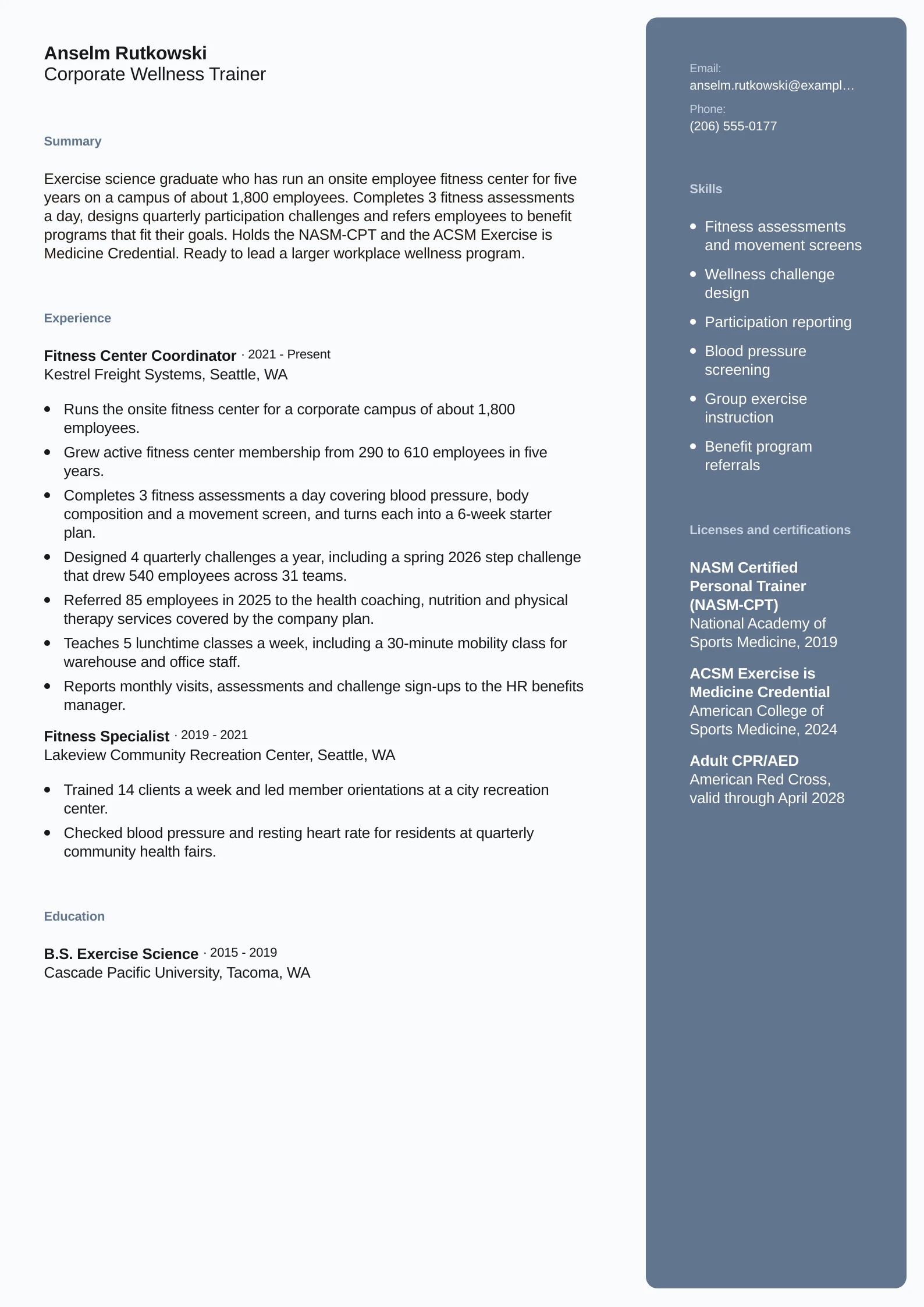
Corporate wellness trainer at an onsite fitness center
Anselm's resume measures participation across about 1,800 employees: active members, three assessments a day and a step challenge that drew 540 people. It names what each assessment covers and the plan-covered services he refers employees to. The ACSM Exercise is Medicine Credential sits next to his NASM-CPT because his exercise science degree qualifies him for it. Use it for employer fitness centers and staff wellness programs.
Active membership grown from 290 to 610
Assessments turned into 6-week starter plans
Monthly reports to the HR benefits manager
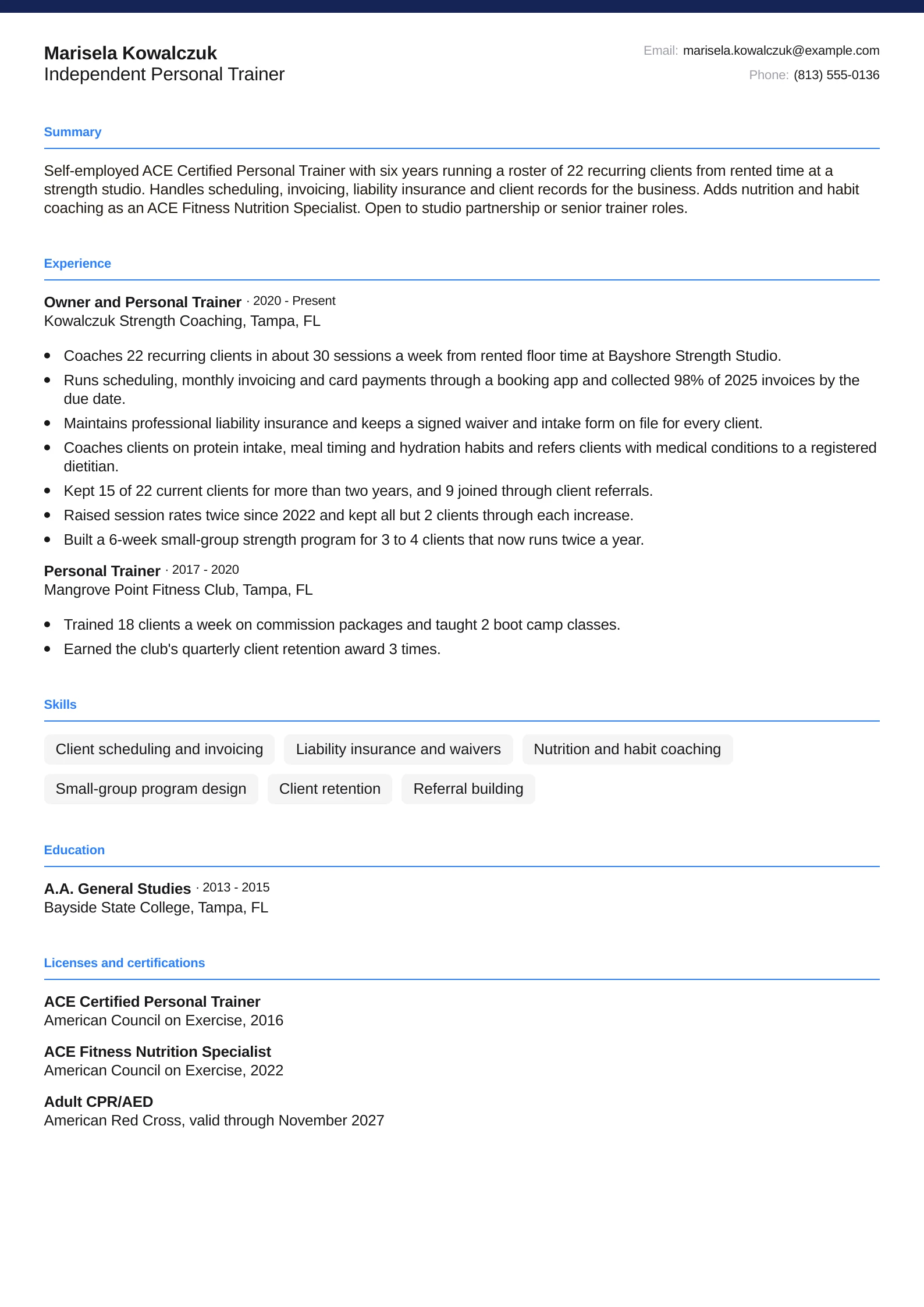
Independent personal trainer running her own business
Marisela's resume shows the business side of self-employment: 22 recurring clients, rented studio time, invoicing, liability insurance and client waivers. Her nutrition bullet names the habits she coaches as an ACE Fitness Nutrition Specialist and where she refers medical questions. Keeping clients through two rate increases shows they value the service. Use it if you train independently and are applying to a studio, a partnership or a club.
Clients kept through two rate increases
Nutrition coaching described by the habits it covers
Billing, insurance and waivers listed as business duties
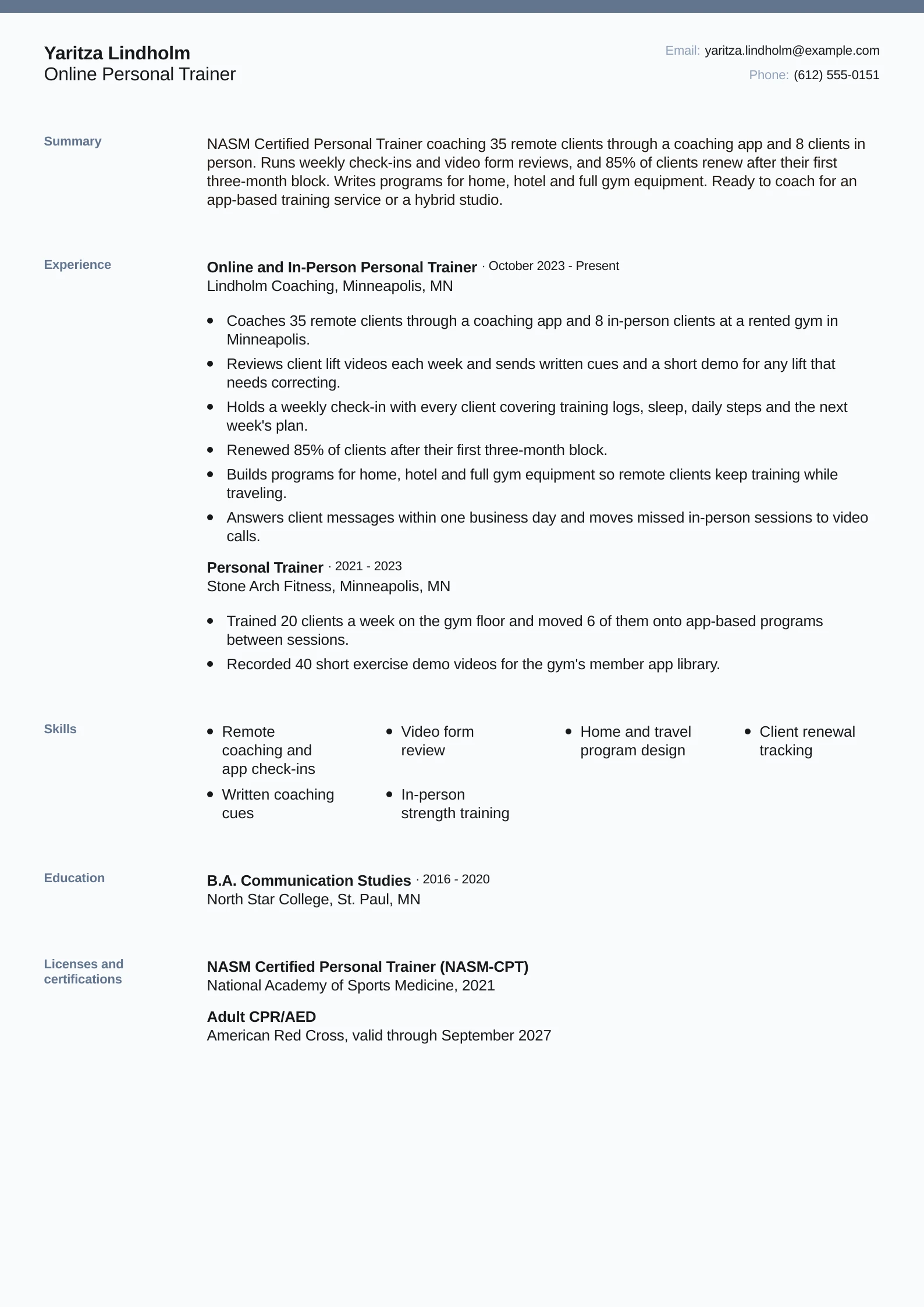
Online personal trainer with a hybrid client roster
Yaritza coaches 35 remote clients and 8 in person, and her resume shows how remote coaching works week to week: app check-ins, video form reviews and programs written for home, hotel or full gym equipment. Her renewal rate after the first three-month block shows that remote clients stay. Use it if most of your clients are remote or you're applying to an app-based coaching service.
85% of clients renew after three months
Weekly check-in and video review routine
Remote and in-person split in the first bullet
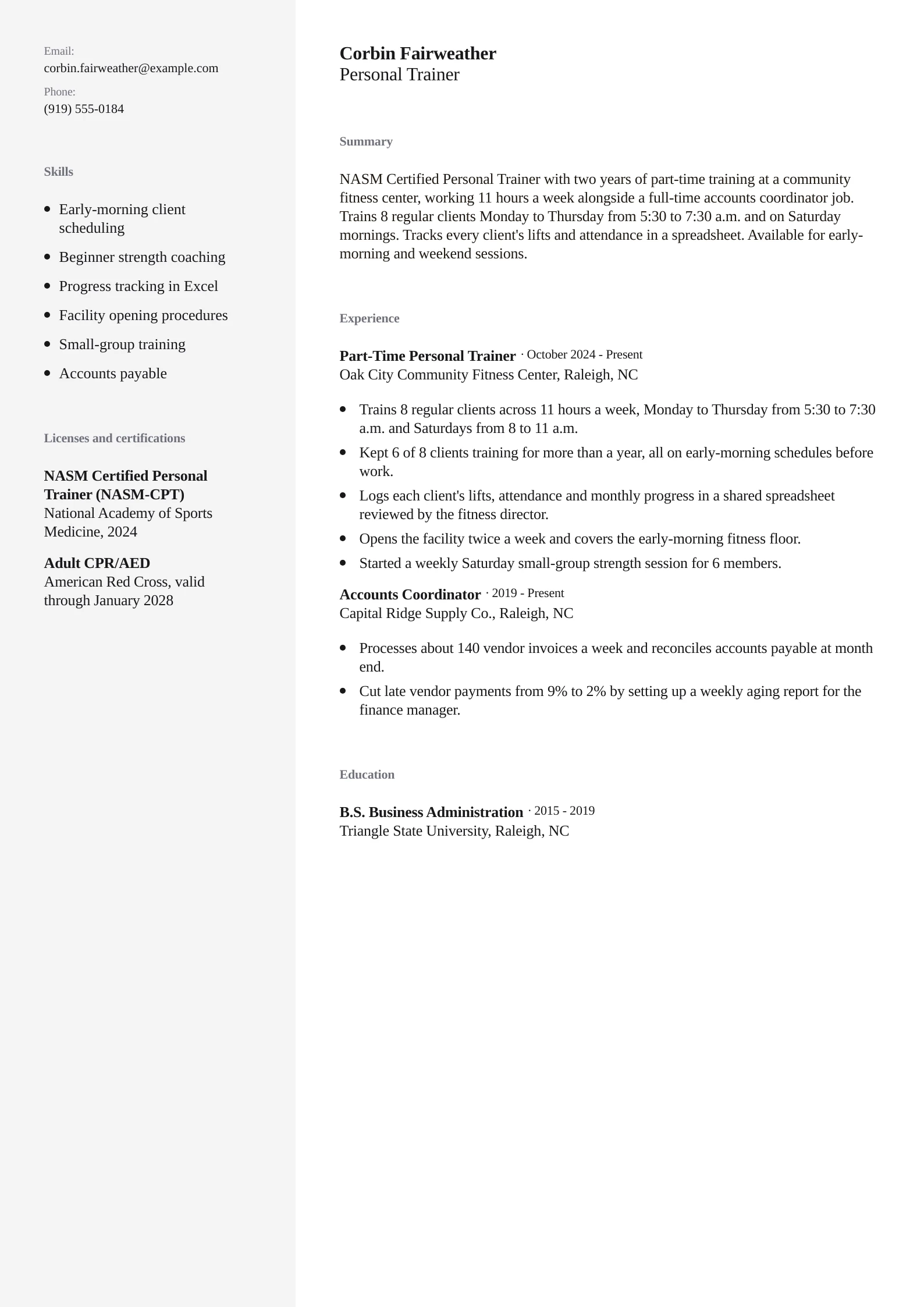
Part-time personal trainer with a full-time day job
Corbin trains 11 hours a week around an accounts coordinator job, and his resume gives the exact hours: Monday to Thursday from 5:30 to 7:30 a.m. and Saturday mornings. That tells a manager which slots he can fill. The day job stays on the page because its spreadsheet habits carry over to client records. Use it if you train mornings, evenings or weekends and want your availability read at a glance.
Weekly hours that add up to 11
6 of 8 clients kept for more than a year
Day job shown with its own result
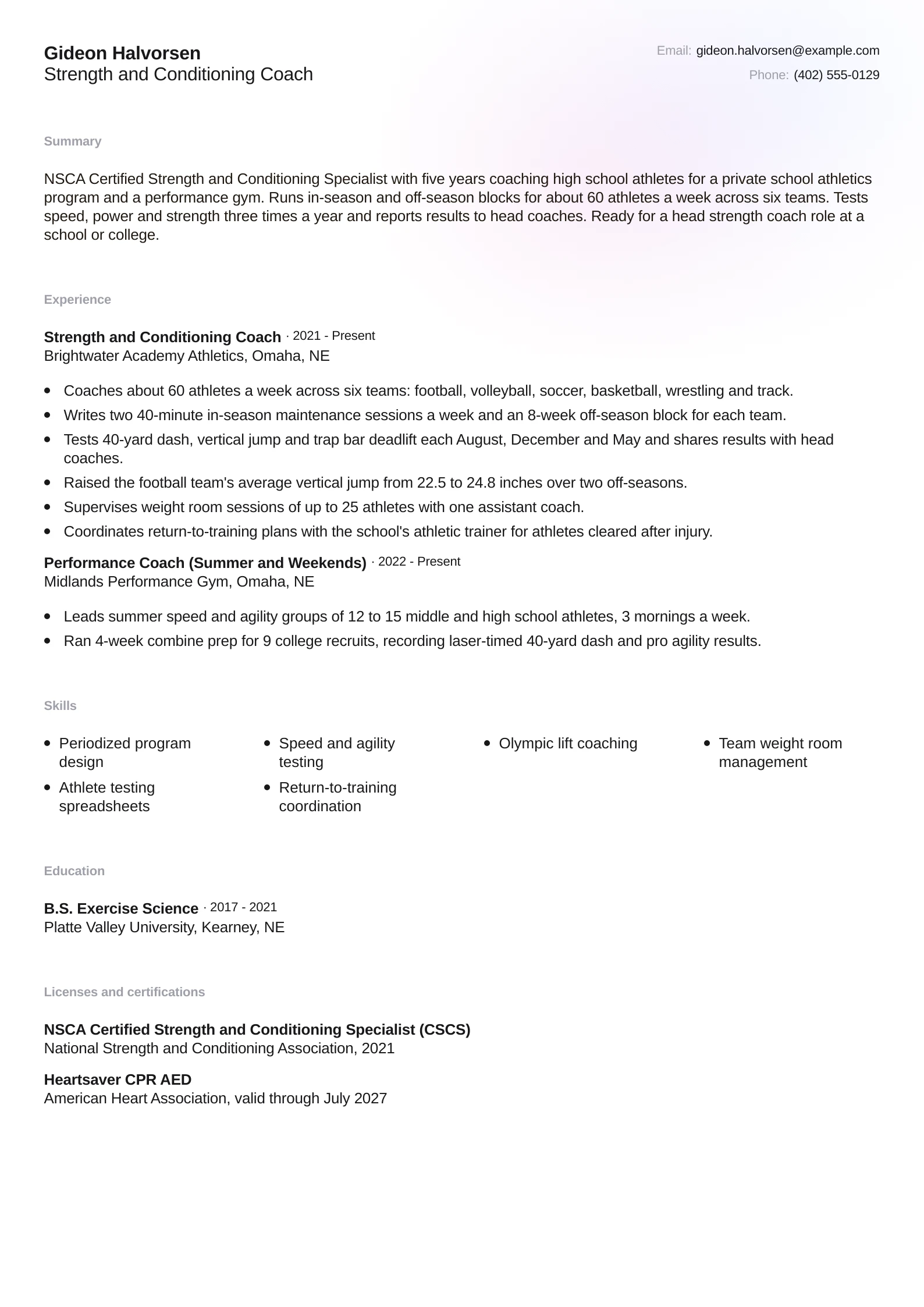
Strength and conditioning coach for school teams
Gideon coaches about 60 athletes a week across six teams, and his resume reads like a coaching plan: in-season and off-season blocks, three test dates a year and results shared with head coaches. The NSCA CSCS requires a bachelor's degree, so his B.S. Exercise Science matters here. A vertical jump gain gives one measured result. Use it for school, college or performance gym roles where you coach teams.
40-yard dash, vertical jump and trap bar deadlift tests
Vertical jump average raised from 22.5 to 24.8 inches
Summer performance gym work alongside the school role
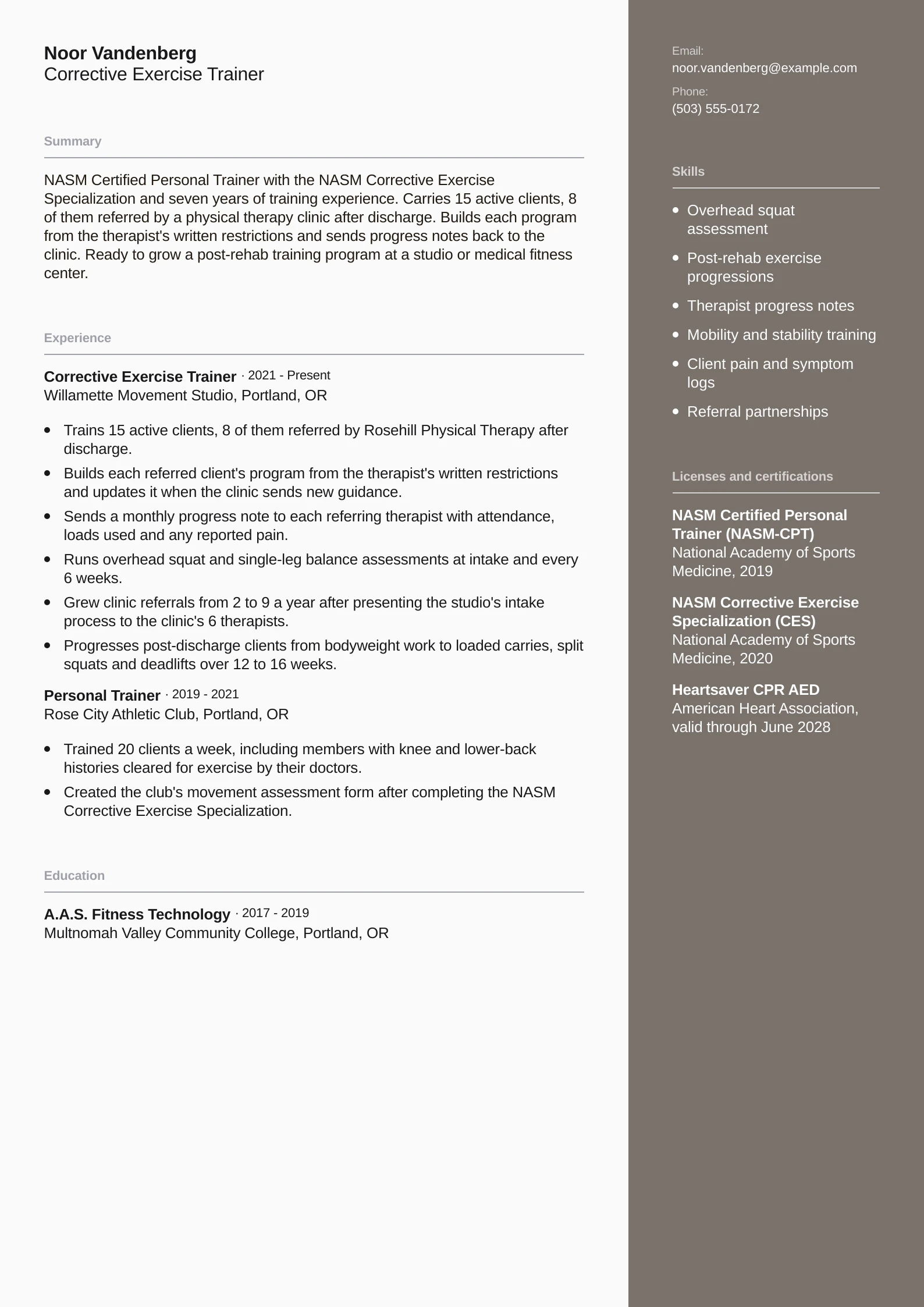
Corrective exercise trainer who takes physical therapy referrals
Noor trains clients after they finish physical therapy, and her resume shows the referral relationship: 8 of 15 clients from one clinic, programs built from the therapist's written restrictions and a monthly progress note sent back. The NASM Corrective Exercise Specialization is listed as a specialization with the year earned and no expiry date. Use it if you work with post-rehab clients or want referrals from a clinic.
Referral numbers from a physical therapy clinic
Reassessments every 6 weeks
Progressions from bodyweight work to loaded lifts
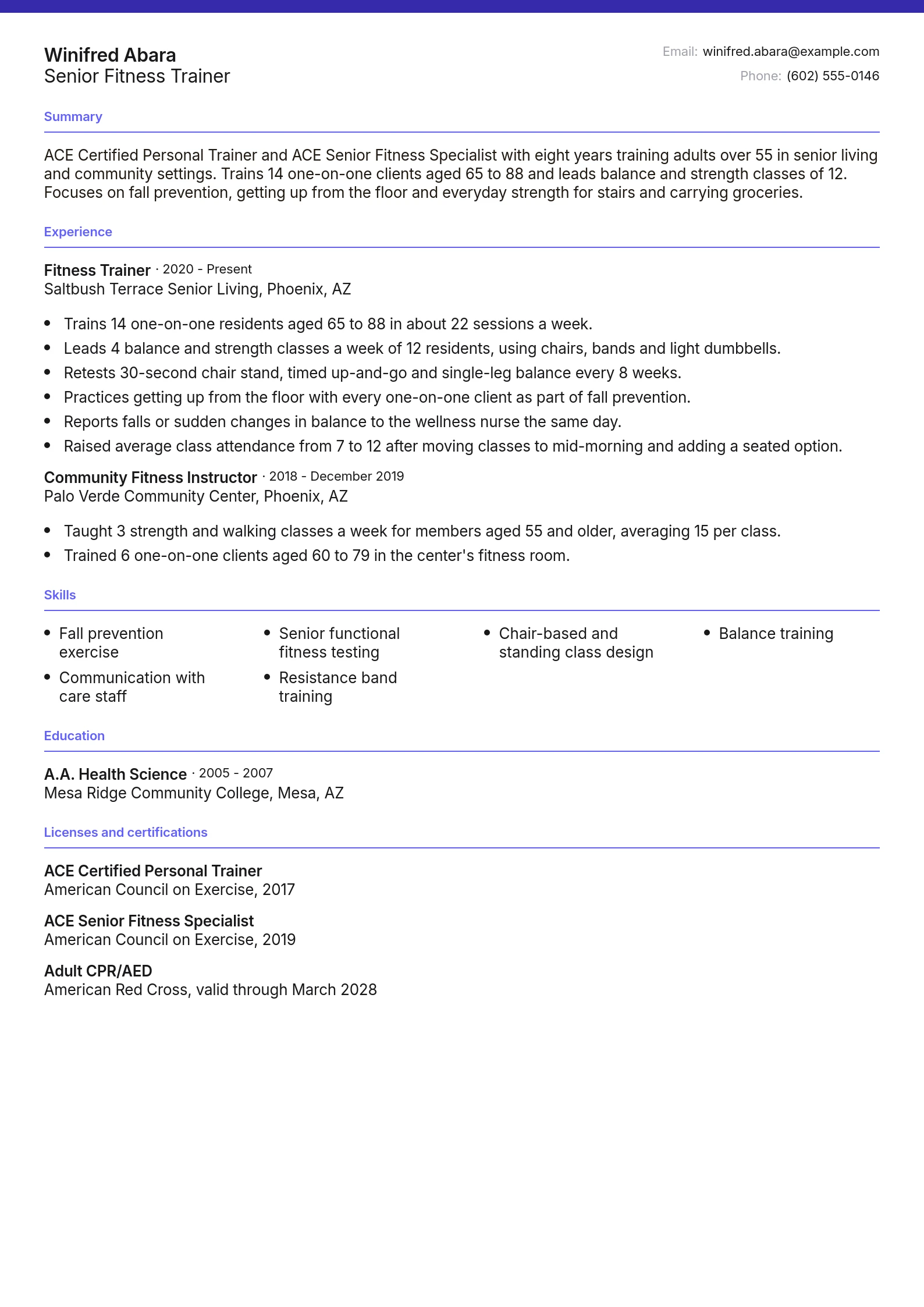
Senior fitness trainer focused on fall prevention
Winifred trains adults aged 65 to 88 at a senior living community, and her resume names the tests she repeats every 8 weeks: chair stands, timed up-and-go and single-leg balance. It shows how she works with care staff by reporting balance changes to the wellness nurse the same day. Class attendance growth shows residents keep coming. Use it for senior living, community center or older adult programs.
Functional tests named with how often they repeat
Classes of 12 with a seated option
Same-day reports to the wellness nurse
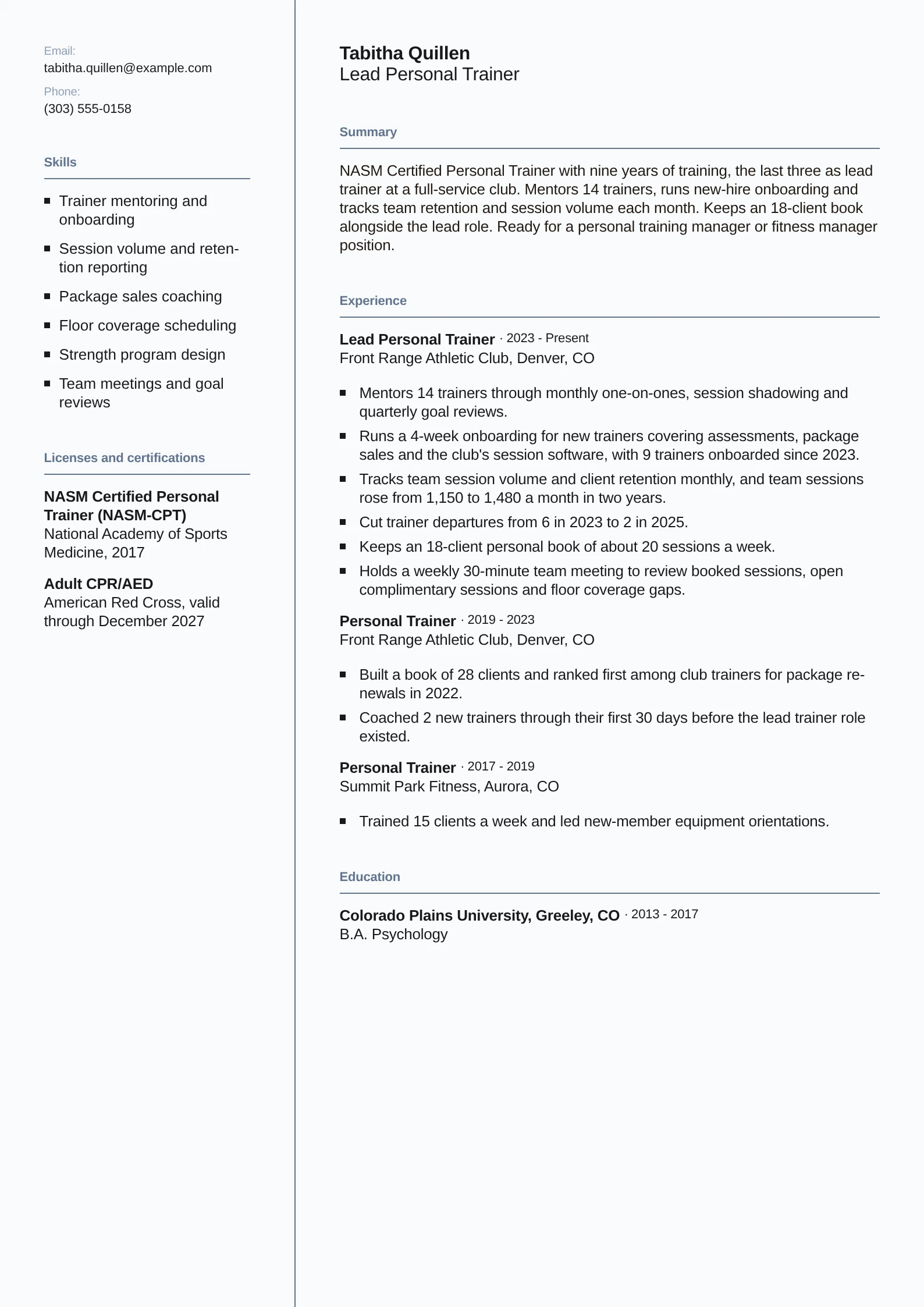
Lead personal trainer ready for a manager role
Tabitha mentors 14 trainers and still carries an 18-client book, and her resume gives a number for each part of the job: team sessions per month, trainer departures by year and new hires onboarded. Earlier roles show the 28-client book she built before the lead role. Use it if you're a senior trainer applying for lead trainer, fitness manager or personal training manager jobs.
Team sessions up from 1,150 to 1,480 a month
Trainer departures cut from 6 to 2 a year
Her own client book kept alongside the lead role
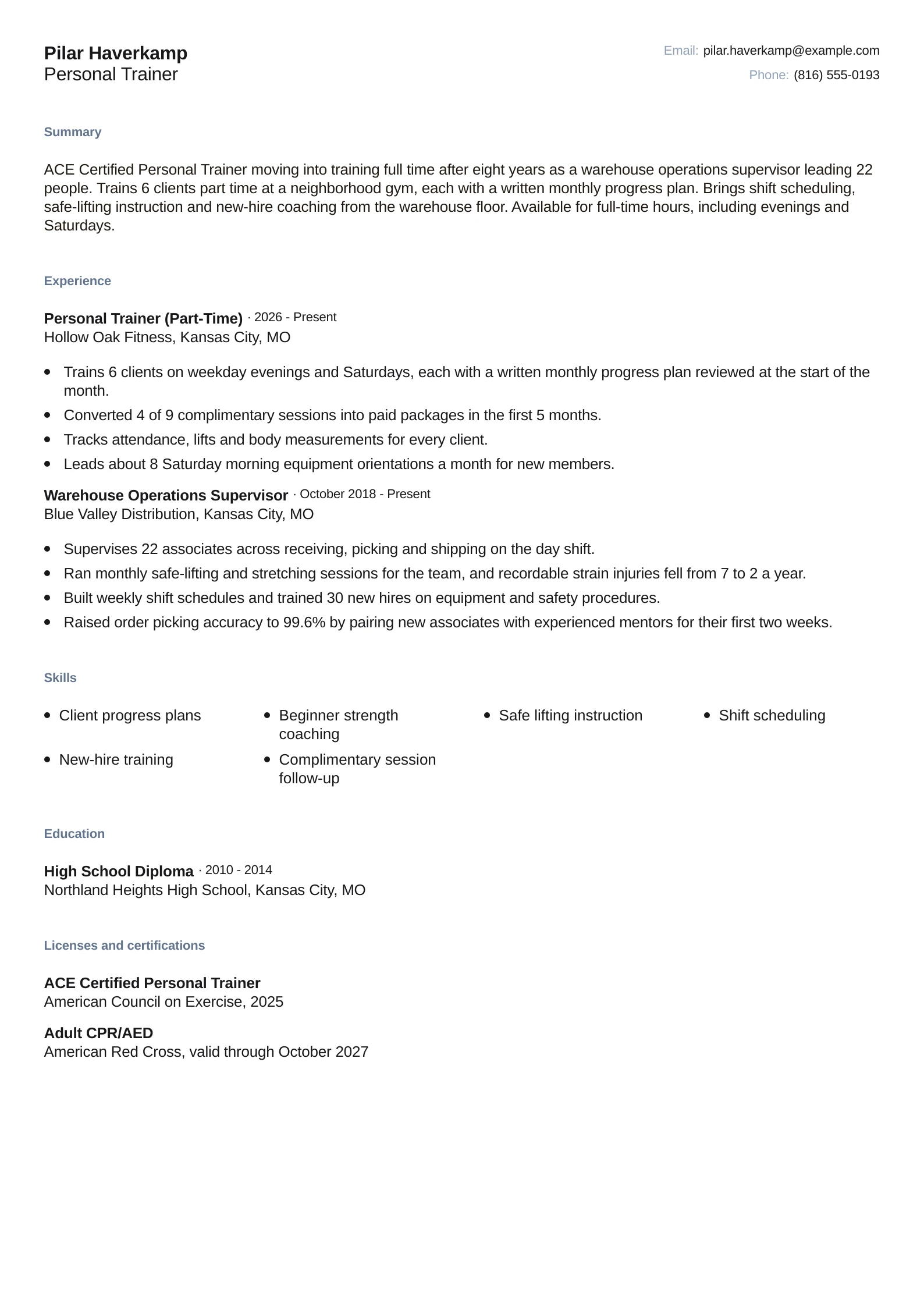
Career change to personal trainer from warehouse supervision
Pilar certified 10 months ago and has trained 6 clients part time for 7 months, so her resume puts the ACE certification and the training role above eight years as a warehouse supervisor. The warehouse bullets are the ones a gym cares about: safe-lifting sessions, fewer strain injuries and new-hire training. Use it if you're changing careers and your past job included coaching, safety or leading a team.
Written monthly progress plans for each client
Strain injuries cut from 7 to 2 a year at the warehouse
4 of 9 complimentary sessions converted to paid packages
Count active clients, weekly sessions and how long clients keep training
A fitness manager reads your experience for the size and health of your client book, because trainers are paid per session or on commission. "Designed customized workout programs to help clients reach their goals" fits every trainer and tells the manager nothing. "Trains 26 active clients across about 28 paid sessions a week, with an average client tenure of 14 months" tells them what you'd bring on day one.
Put three numbers in your summary or first bullet: active clients, sessions a week and average client tenure in months. If you're paid per session or on commission, add package renewals or the share of complimentary sessions you convert, such as "Converted 38% of complimentary member sessions into paid packages in 2025." Take the figures from the club's session reports or your booking app so you can repeat them in an interview.
Show how you built the book. Referrals from members, front desk staff or a physical therapy clinic prove that people send you clients, which a manager can't teach. Write the source and the count, such as "Gained 11 of 26 current clients through referrals from members and front desk staff."
Client results belong on the page when you tested every client the same way. Name the test and the change, such as squat, deadlift and push-up retests at the end of each 12-week block, or a team's vertical jump average rising from 22.5 to 24.8 inches. Leave out individual weight-loss stories, because a manager can't check them and they describe one client instead of your book.
Write the full credential name, issuer and year near the top
Job ads from Equinox, Northwestern University Recreation and the YMCA of Wichita Falls all ask for a personal training certification plus CPR/AED, and Northwestern and the YMCA add First Aid. Put a Certifications section above or beside your experience so a manager sees it first.
Ads ask for an "NCCA-accredited" certification, and accreditation belongs to the issuer, so write the full credential name and the organization. "Certified Personal Trainer" alone doesn't tell a manager which exam you passed. If an ad lists the certifications it accepts, as one Orangetheory franchise does with NASM, NCSF, NSCA, ISSA, ACE and ACSM, check yours is on it.
Credential
What it takes
Where it fits
Write it as
NASM Certified Personal Trainer
High school diploma or GED and current CPR/AED. Renew with 2.0 CEUs every two years
Commercial gyms, studios, online coaching
NASM Certified Personal Trainer (NASM-CPT), National Academy of Sports Medicine, 2022
ACE Certified Personal Trainer
Age 18, high school diploma or equivalent and CPR/AED. Renew with 2.0 CECs every two years
Gyms, studios, community and senior programs
ACE Certified Personal Trainer, American Council on Exercise, 2025
NSCA Certified Strength and Conditioning Specialist
Bachelor's degree or senior-year enrollment and CPR/AED. CEUs every three years
School, college and performance gym coaching
NSCA Certified Strength and Conditioning Specialist (CSCS), National Strength and Conditioning Association, 2021
CPR/AED and First Aid
A class from a provider such as the American Red Cross, valid for two years. Equinox wants CPR/AED on hire, and the YMCA of Wichita Falls allows 60 days
Every setting
Adult First Aid/CPR/AED, American Red Cross, valid through August 2027
Match your numbers to where you train
The setting decides which number a manager looks for first. Use the row for the job you're applying to, and move that number into your summary.
Setting
What the manager counts
Example line
Commercial gym
Active clients, sessions a week, package renewals, complimentary sessions converted
Trains 26 active clients across about 28 paid sessions a week
Boutique or group studio
Classes a week, class size, average attendance, memberships sold
Coaches 16 heart-rate interval classes a week with up to 30 members a class
Campus recreation
Clients per semester, hours a week, assessments and orientations
Trained 9 student and staff clients over two semesters, about 7 hours a week
Workplace wellness center
Active members out of the employee base, assessments, challenge sign-ups
Grew active fitness center membership from 290 to 610 employees
Independent
Recurring clients, billing, insurance, clients kept through rate changes
Coaches 22 recurring clients in about 30 sessions a week from rented floor time
Online or hybrid
Remote and in-person clients, check-in routine, renewal rate
Renewed 85% of clients after their first three-month block
School or team
Athletes a week, teams, test results by season
Coaches about 60 athletes a week across six teams
Add a specialization only when it matches the clients in the ad
A specialization helps when the job serves the same clients, such as older adults, people finishing physical therapy or school athletes. List it under your personal training certification by its exact name. NASM and ACE call these specializations or specialist programs, so don't call them certifications.
The NASM Corrective Exercise Specialization and the ACE Senior Fitness Specialist have no prerequisites, and neither expires, so write the issuer and the year you finished with no expiry date. Pair each one with a bullet that uses it, such as "Retests 30-second chair stand, timed up-and-go and single-leg balance every 8 weeks" for senior clients.
The NSCA CSCS and the ACSM Exercise is Medicine Credential both need a bachelor's degree, though college seniors can sit the CSCS exam, so put the degree in Education with its field. The ACSM credential asks for a degree in exercise science, exercise physiology or kinesiology, an ACSM or other NCCA-accredited fitness certification and a passed online course, and it renews every three years.
Write nutrition and injury work as coaching, because "wrote meal plans" or "rehabbed a knee" describes a dietitian's or physical therapist's job and reads as a liability. "Coaches clients on protein intake, meal timing and hydration habits" is a trainer's work. For post-rehab clients, say where the plan came from: "Builds each referred client's program from the therapist's written restrictions."
What a personal trainer resume template should show first
A personal trainer resume template should show your name and contact details, a summary with your client or class numbers, and your certifications before your work history. Managers screen for the certification first and the book second, so both belong where they can see them without scrolling.
Below that, give each role a first bullet with its main number, then list training skills such as movement assessment, heart-rate zone coaching or post-rehab progressions. Recent graduates and strength coaches can move Education up when the degree supports a credential like the CSCS.
Career changers keep the past job but choose bullets that carry over to a gym. Pilar's warehouse role lists the safe-lifting sessions she ran and strain injuries falling from 7 to 2 a year, which matters more to a fitness manager than her shipping volumes.