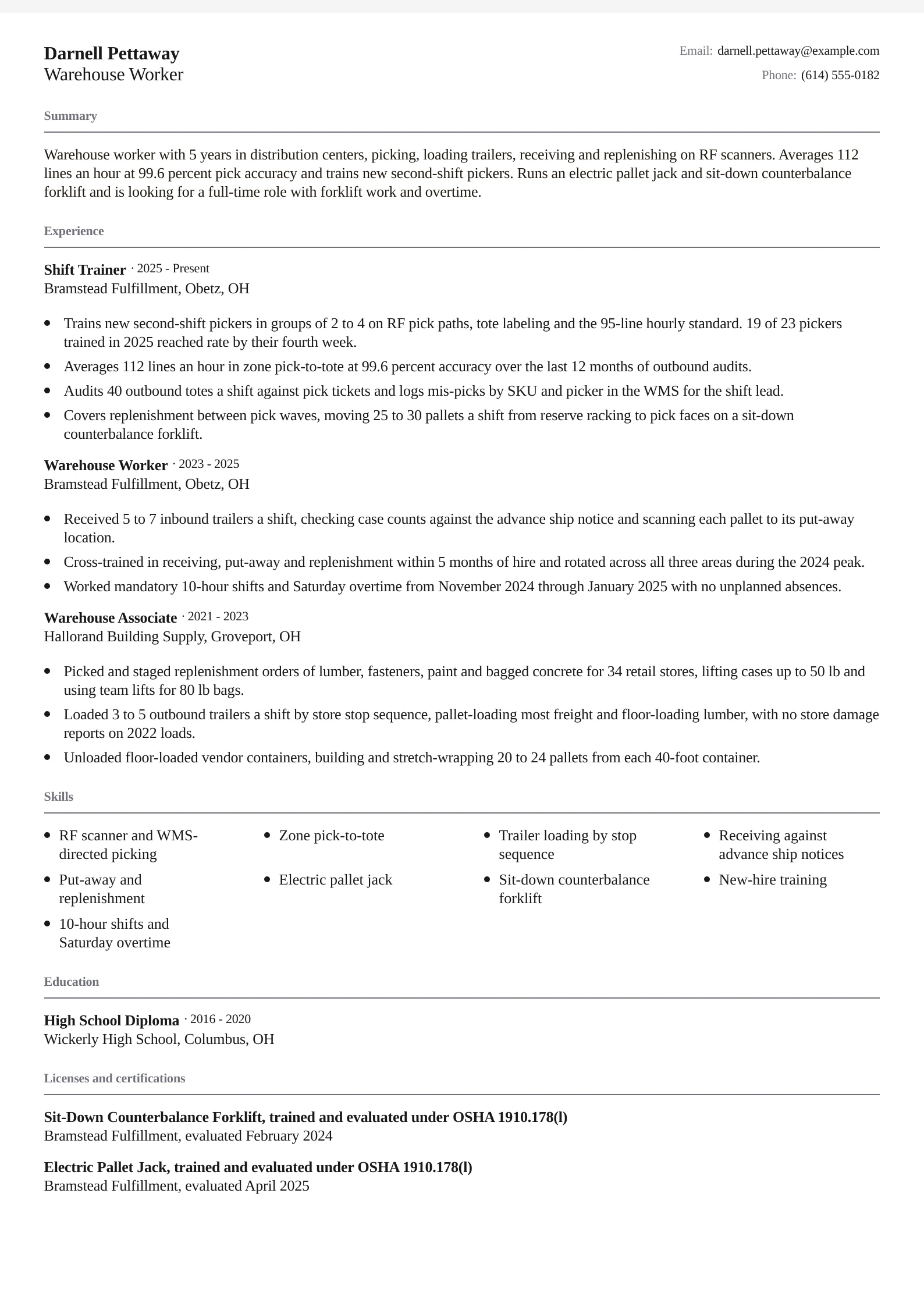
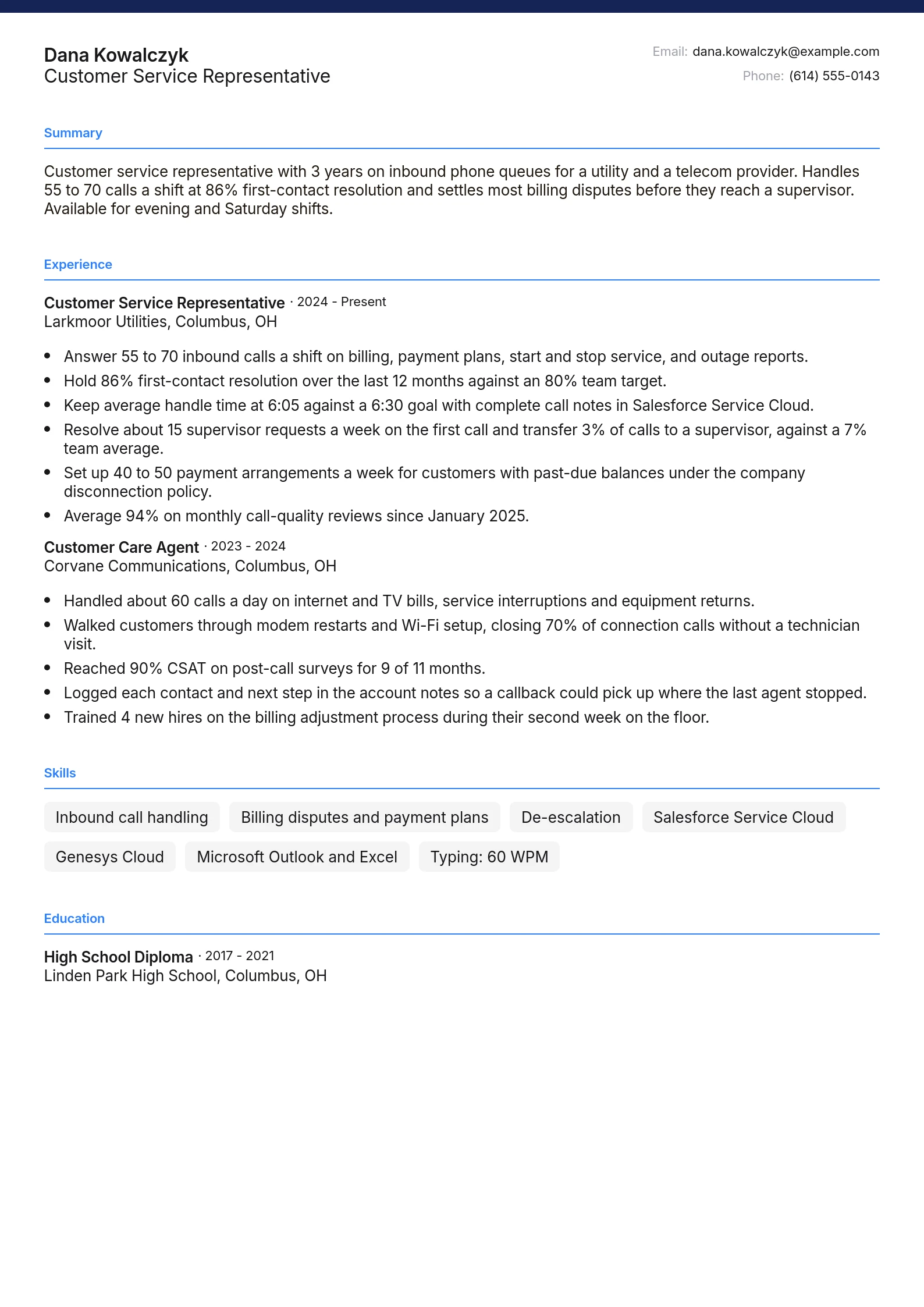
Your employer trains and evaluates you on each truck, so a forklift resume should name the trucks you run, who evaluated you and when, and the plant, yard or freezer you ran them in. The four examples cover a flooring plant, a sawmill yard, a high-reach freezer and a grocery backroom where the operator was trained this year.
A plant operator who runs three trucks and loads the trailers
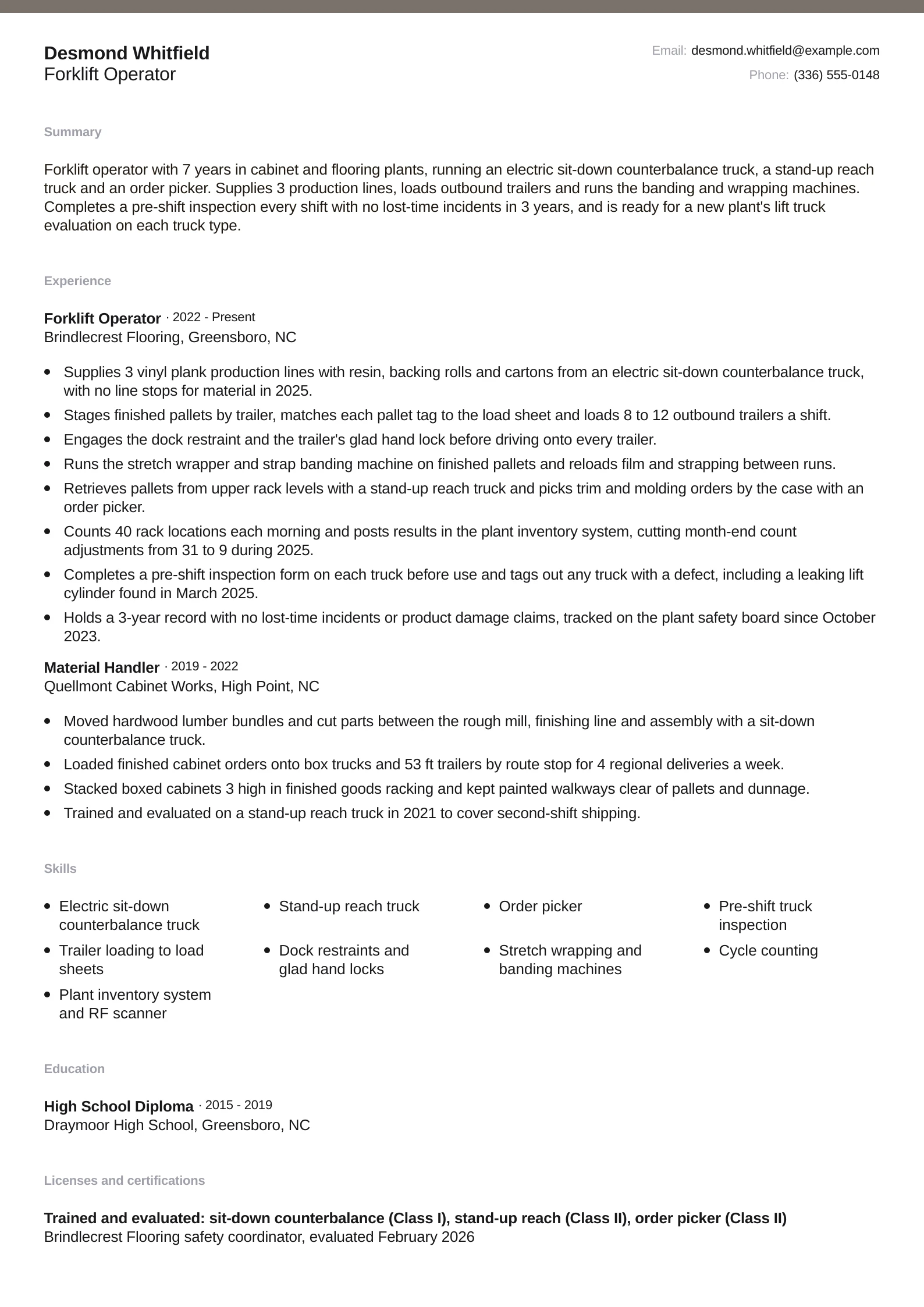
Desmond's credential line names each truck he runs, the person who evaluated him and the month: February 2026. A plant that runs its own lift truck test can see at a glance which trucks to test him on.
His bullets tie each truck to the work around it: feeding three production lines, loading trailers behind a dock restraint and glad hand lock, running the banding and wrapping machines and counting rack locations each morning. Copy that order if you work in manufacturing: the truck, the task, then the count or the check.
Pick the setting closest to the trucks you run now
Choose by where you drive today, not the job you want next. The setting decides which tasks, hazards and numbers go in your bullets, and the closest example gives you the most lines to adapt.
Lumber yard and sawmill forklift operator
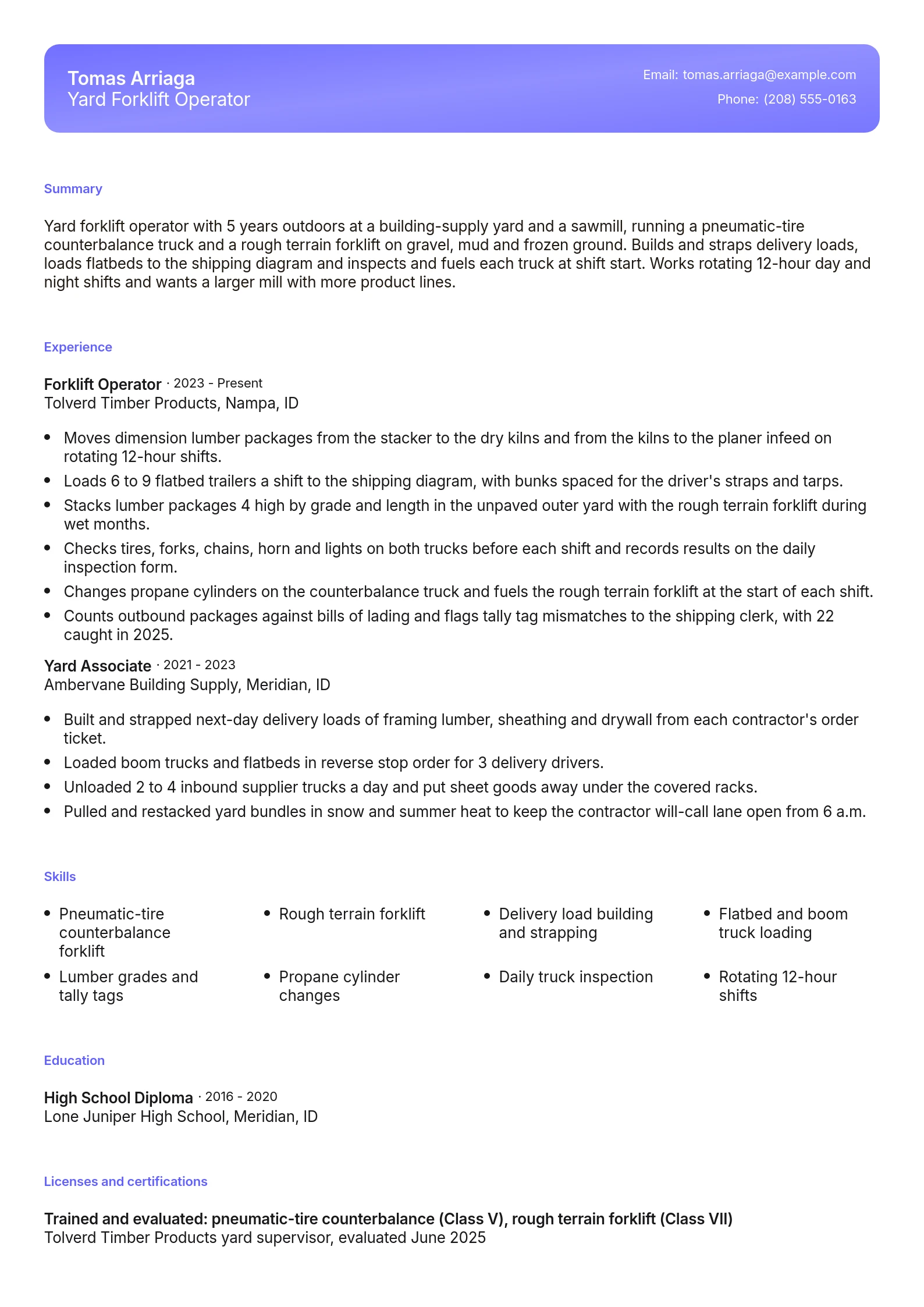
Tomas works outdoors on a pneumatic-tire counterbalance truck and a rough terrain forklift, so his credential line names both and his bullets name the ground he drives on. He shows delivery loads built in stop order, flatbeds loaded to a diagram, propane cylinder changes and tally tag checks. Use this layout if you work in a lumber yard, sawmill or building-supply yard on rotating shifts.
Class V and Class VII trucks with a June 2025 evaluation
Delivery loads built in reverse stop order for three drivers
22 tally tag mismatches caught in 2025
Cold storage high-reach operator
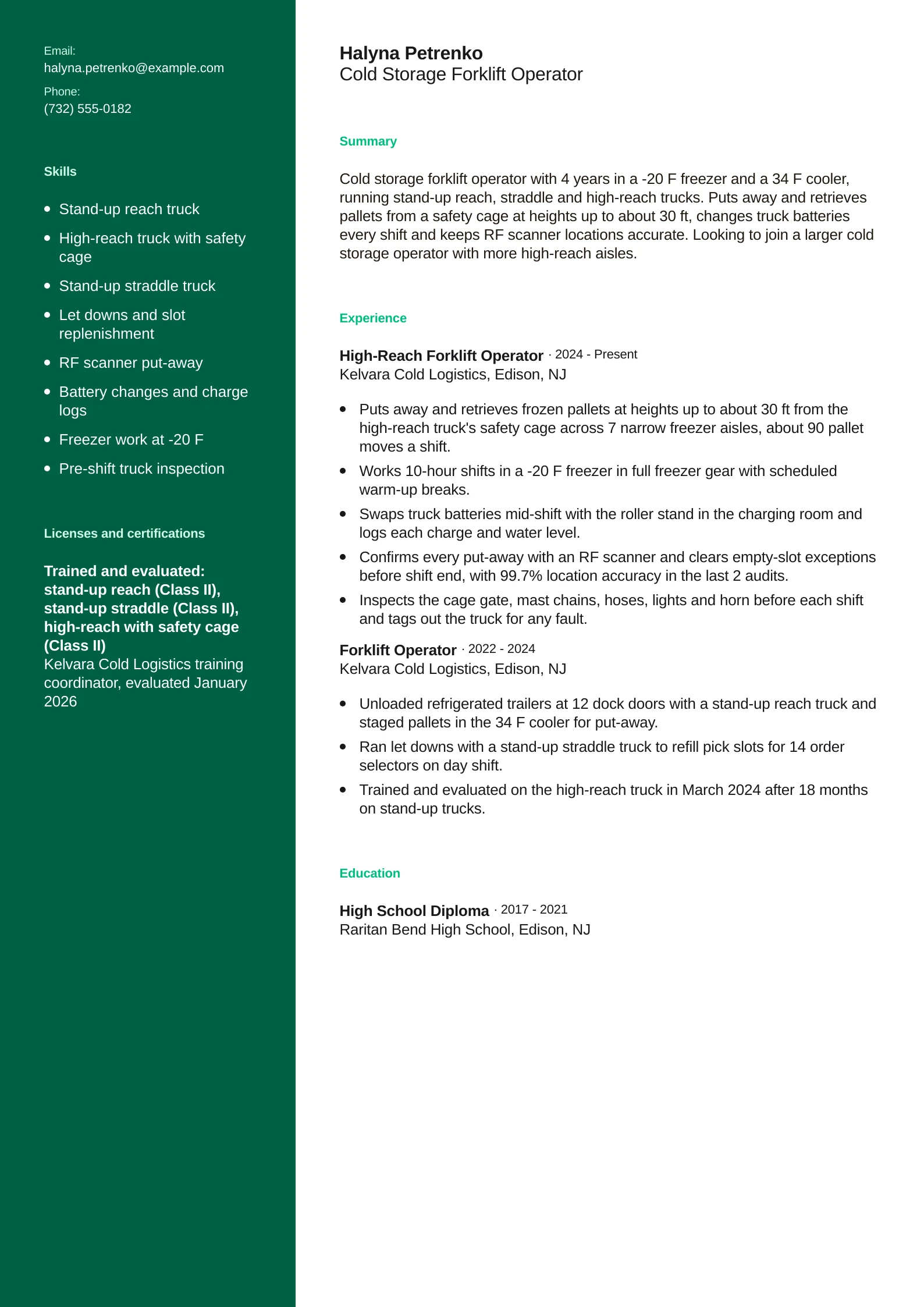
Halyna's resume shows what separates freezer work from dry warehouse driving: put-away from a safety cage at about 30 ft, mid-shift battery changes, -20 F shifts and scanner accuracy scores. Two job titles at one employer show her move from stand-up trucks to the high-reach truck and the evaluation that came with it. Use it if you run reach, straddle or high-reach trucks in a cooler or freezer.
Newer title shows the move to the high-reach truck in March 2024
Battery changes and charge logs listed as daily work
99.7% location accuracy in the last two audits
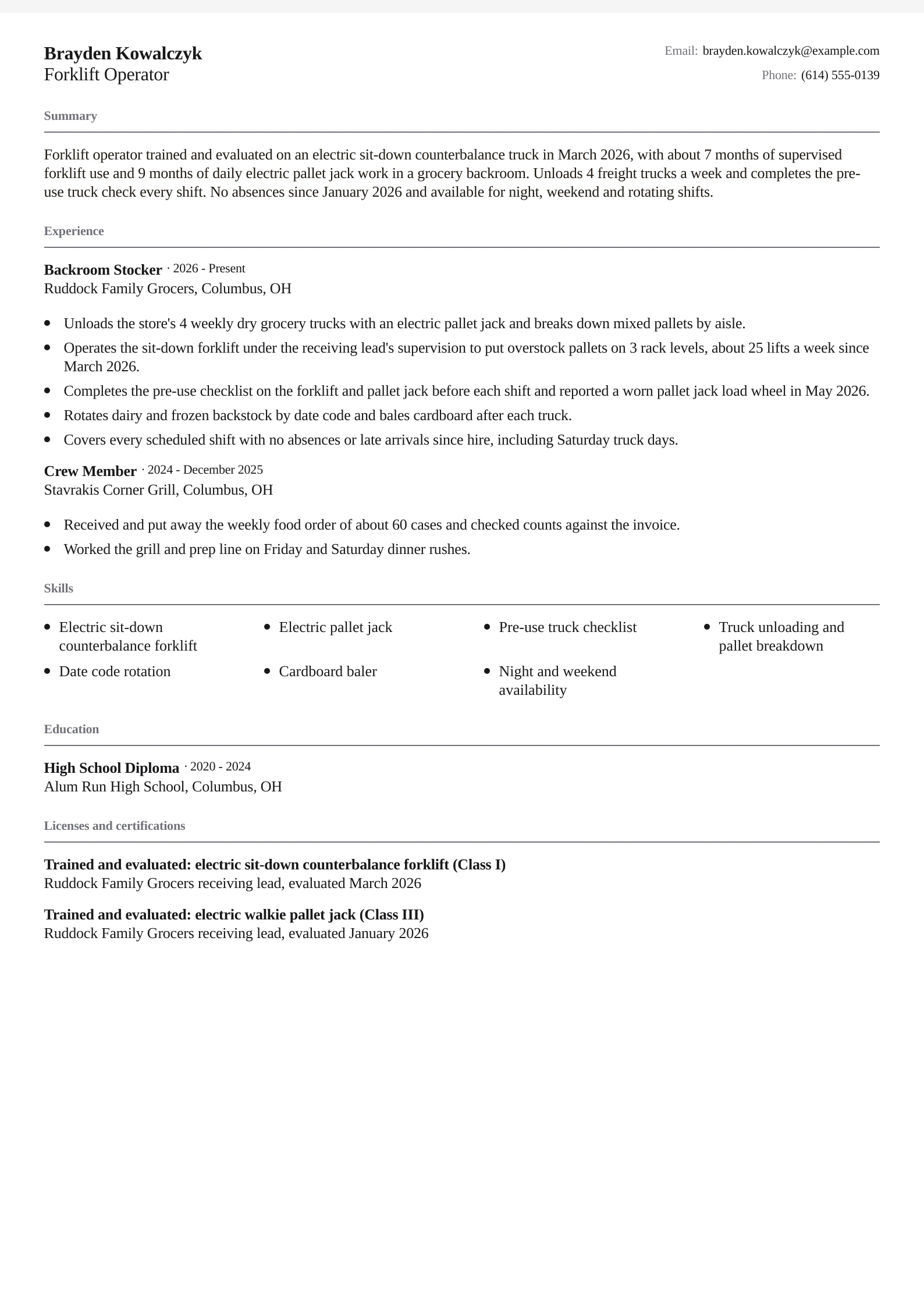
Newly trained forklift operator from a grocery backroom
Brayden has one forklift evaluation, from March 2026, and his summary opens with it and the months of supervised use since. His bullets count lifts per week and freight trucks unloaded with an electric pallet jack, and his attendance record is a dated bullet, not an adjective. Use it if an employer trained you on a forklift this year and the next ad asks for lift truck experience.
Separate evaluation lines for the forklift and the pallet jack
About 25 supervised forklift lifts a week
No absences since January 2026
Write who evaluated you and when, not 'OSHA certified'
List your forklift credential as employer training and evaluation, with the trucks, the evaluator and the date. OSHA doesn't issue forklift cards or licenses. Under 29 CFR 1910.178(l), your employer trains you, evaluates you on its trucks in its workplace and certifies that both happened.
That certification record holds your name, the training date, the evaluation date and who trained or evaluated you, so put the same facts on your resume. Write one credential line per evaluation. Name the trucks in plain words in the title, then the employer, the evaluator's role and the month and year in the second line: 'Brindlecrest Flooring safety coordinator, evaluated February 2026.'
Expect a new evaluation when you change jobs. Earlier training carries over only after the new employer evaluates you and finds you competent, which is why some plants run their own lift truck test for new hires. Your current evaluation still helps, because it tells them which trucks to test you on first.
If you took a forklift class at a community college or safety school, list it as training with its date and keep the word 'license' off it.
Names the trucks, the evaluator and the date
Trained and evaluated: sit-down counterbalance (Class I), stand-up reach (Class II), order picker (Class II). Brindlecrest Flooring safety coordinator, evaluated February 2026.
Name the truck in plain words and add the class in parentheses
List each truck by the name used on the floor, and add the class number only when you're sure of it. Ads ask for sit-down, stand-up, reach, order picker and high-reach experience. Class numbers come from OSHA's list of seven commonly used truck classes and from industry standards.
Power and tires change the class. An electric sit-down counterbalance truck is Class I, a propane sit-down on cushion tires is Class IV and a propane or diesel truck on pneumatic tires is Class V. Walk-behind tuggers, stackers and reach trucks are Class III, and sit-down tow tractors are Class VI. If you don't know which one you ran, the plain name alone is correct.
Truck as you'd write it
Class
Where you'll see it
What to add in the bullet
Electric sit-down or stand-up counterbalance
Class I
Plants, docks, grocery and retail backrooms
Trailers loaded per shift, dock locks, lines supplied
Stand-up reach, order picker, high-reach or straddle truck
Class II
Narrow-aisle racking and cold storage
Rack height, pallet moves per shift, scanner accuracy
Name the work around the truck, because 'operated forklift in a warehouse' fits every forklift job and tells an employer nothing. A plant manager reads for line supply and trailer loading, a mill for outdoor driving and load building and a freezer for height and cold.
In a manufacturing plant, name the lines you feed, what you bring them and what you do at the dock. One plant ad asks for banding and wrapping machines and glad hand locks, so name the machines you run, the trailer locks you set and the inventory system you post cycle counts in. Write each as a task with a number, such as 'Loads 8 to 12 outbound trailers a shift' or 'Counts 40 rack locations each morning.'
In a lumber yard, sawmill or building-supply yard, name the products and the ground. Write that you build and strap delivery loads, load flatbeds or boom trucks in stop order and stack packages by grade and length. Put your shift pattern and conditions in the summary as plain facts, such as 'rotating 12-hour shifts' or 'gravel and frozen ground', because one lumber mill ad lists rotating shifts as a requirement.
In cold storage, name the temperature, the truck and the height. One high-reach freezer ad lists stand-up, high-reach and straddle trucks, work from a safety cage up to 30 ft, battery changes and temperatures from 32 F down to -45 F. Put your freezer's temperature in the summary and your put-away height and moves per shift in a bullet.
If your forklift time was a few hours a week inside a job built around picking and packing, the warehouse worker resume examples are a closer match. This page fits when the truck is the job.
Put the pre-shift inspection and a dated safety record in your bullets
List the daily truck inspection as a bullet in your current job, with what you check and what you do when a truck fails. OSHA requires every truck to be examined before it's placed in service, at least daily, and one lumber mill ad lists 'inspect lift trucks daily and complete the required forms' as a duty. Write it as it happens: 'Completes the pre-shift inspection form on each truck and tags out any truck with a defect.'
Add one defect you caught if you have one, such as a leaking lift cylinder, a worn pallet jack wheel or a cage gate that didn't latch. One real example shows the check happens more clearly than an adjective about being careful.
Give a safety record a period it covers: 'no lost-time incidents since October 2023' or 'no rack strikes or product damage claims in 2025.' Take the dates from your employer's safety board or your last review, and use your own record rather than the site's.
Battery and fuel work goes in the same part of the resume. Changing propane cylinders, swapping batteries in the charging room and logging charges are daily truck care, and one cold-storage ad asks for battery changes by name.
Open with your evaluation date when you're newly trained
Put your evaluation month, the truck type and the months of use since then in the first line of your summary, because an ad asking for 6 months of lift truck experience is asking about exactly that. 'About six months of supervised forklift use' answers it. 'Experienced forklift operator' after one evaluation invites a question you can't answer in the interview.
Count pallet jack time separately. An electric pallet jack is a powered industrial truck with its own training and evaluation, so daily dock work on one is real truck experience. Give it its own credential line and its own bullet, with the trucks unloaded per week.
Some employers train new hires on their own trucks and ask instead for a diploma or GED and some warehouse experience. If you have the warehouse months but no forklift evaluation yet, open with those months and your pallet jack work and apply to the ads that train.
Show attendance and availability with dates. If an ad lists rotating, night or weekend shifts, a line such as 'no absences since January 2026, including Saturday truck days' answers that for an operator with a short work history.
Summary for a newly trained forklift operator
Forklift operator trained and evaluated on an electric sit-down counterbalance truck in [month and year], with about [number] months of supervised forklift use and [number] months of daily electric pallet jack work in a [setting]. Unloads [number] freight trucks a week and completes the pre-shift truck inspection on every shift. No absences since [month and year] and available for [shifts].