Recruiters check a pilot resume against hard minimums before they read it: total and turbine time, PIC, the right certificate and a current medical. The examples below put those numbers where they can be counted, and each one leads with the figure its setting asks for first, from dual given to time in type.
A regional first officer applying to a major airline
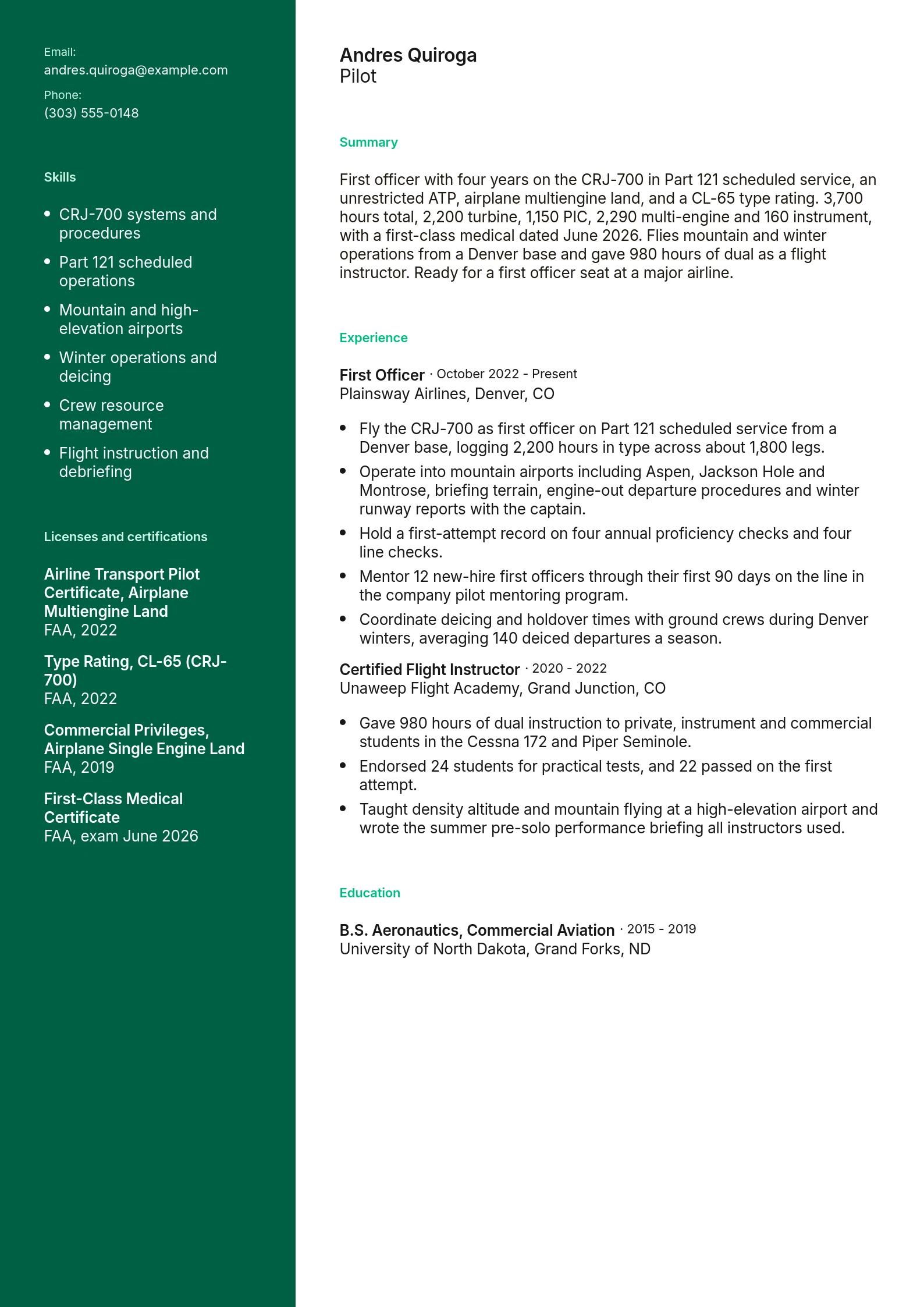
Andres flies the CRJ-700 under Part 121 and wants a first officer seat at a major airline. His summary gives 3,700 total, 2,200 turbine, 1,150 PIC, 2,290 multi-engine and 160 instrument hours in one sentence, so a recruiter can check them against an ad's minimums without opening the logbook.
The credentials list an unrestricted ATP, airplane multiengine land, the CL-65 type rating his airline needs for the CRJ-700, and a first-class medical with its exam month. The first bullet names the aircraft, the operating rule, the seat and the base. His flight instructor job stays on the page because it explains where his PIC time came from.
More pilot resumes by seat, aircraft and flight time
Pick the example whose next job matches yours. A charter captain and an air medical pilot both need PIC time first, but they count it in different aircraft and conditions.
Flight instructor building toward a restricted ATP
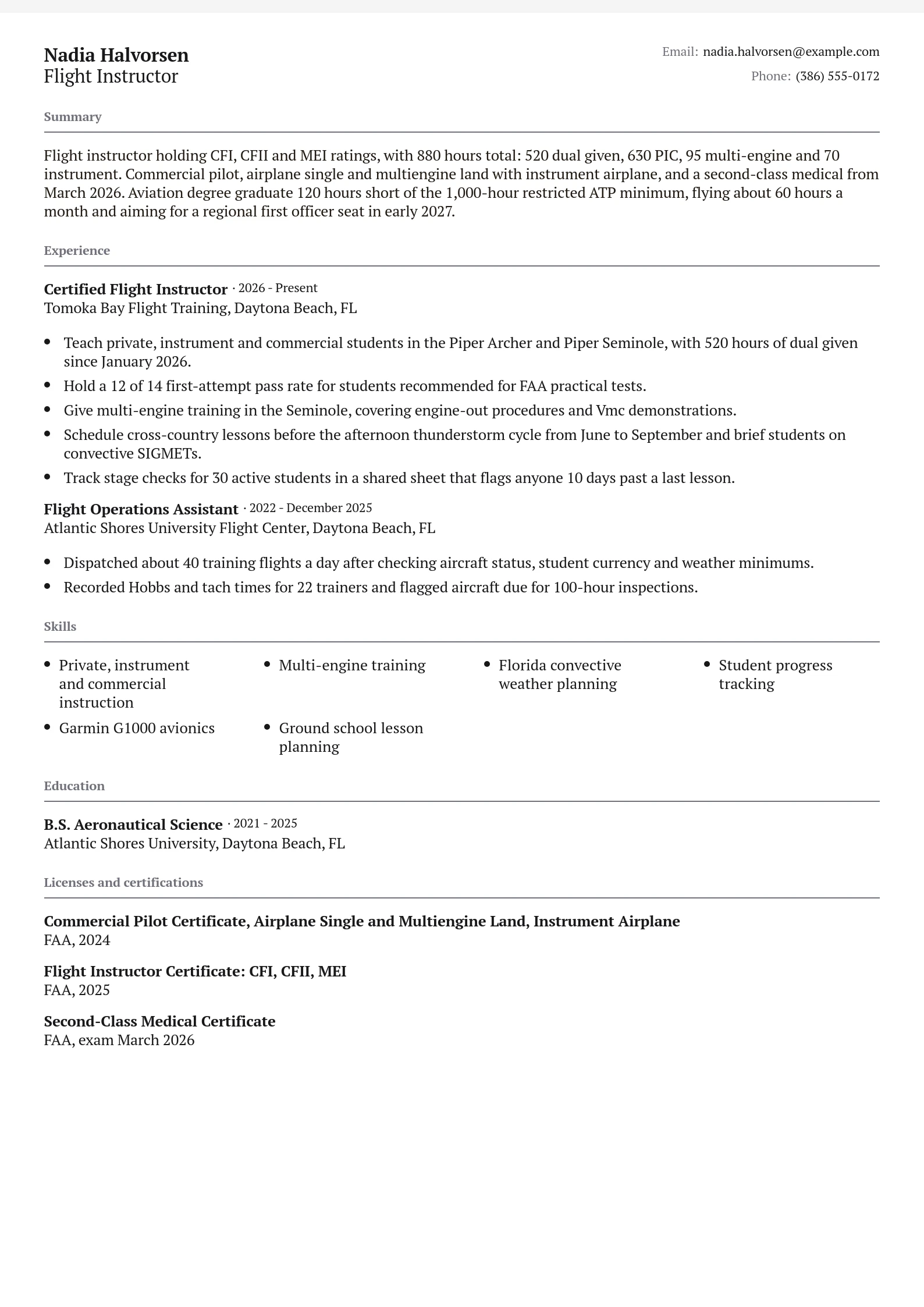
Nadia's summary gives total time, dual given, PIC, multi-engine and instrument hours in one line, then states the gap: 120 hours to the 1,000-hour restricted ATP minimum and a target hire date. Her credentials list the commercial certificate, the CFI, CFII and MEI ratings and a second-class medical with its exam month. Copy it if you teach at a flight school and your next step is a regional airline.
520 hours of dual given shown separately from total time
Hours left to the restricted ATP minimum and a target date
Student pass rate on FAA practical tests
Part 135 charter captain in a turboprop and light jet
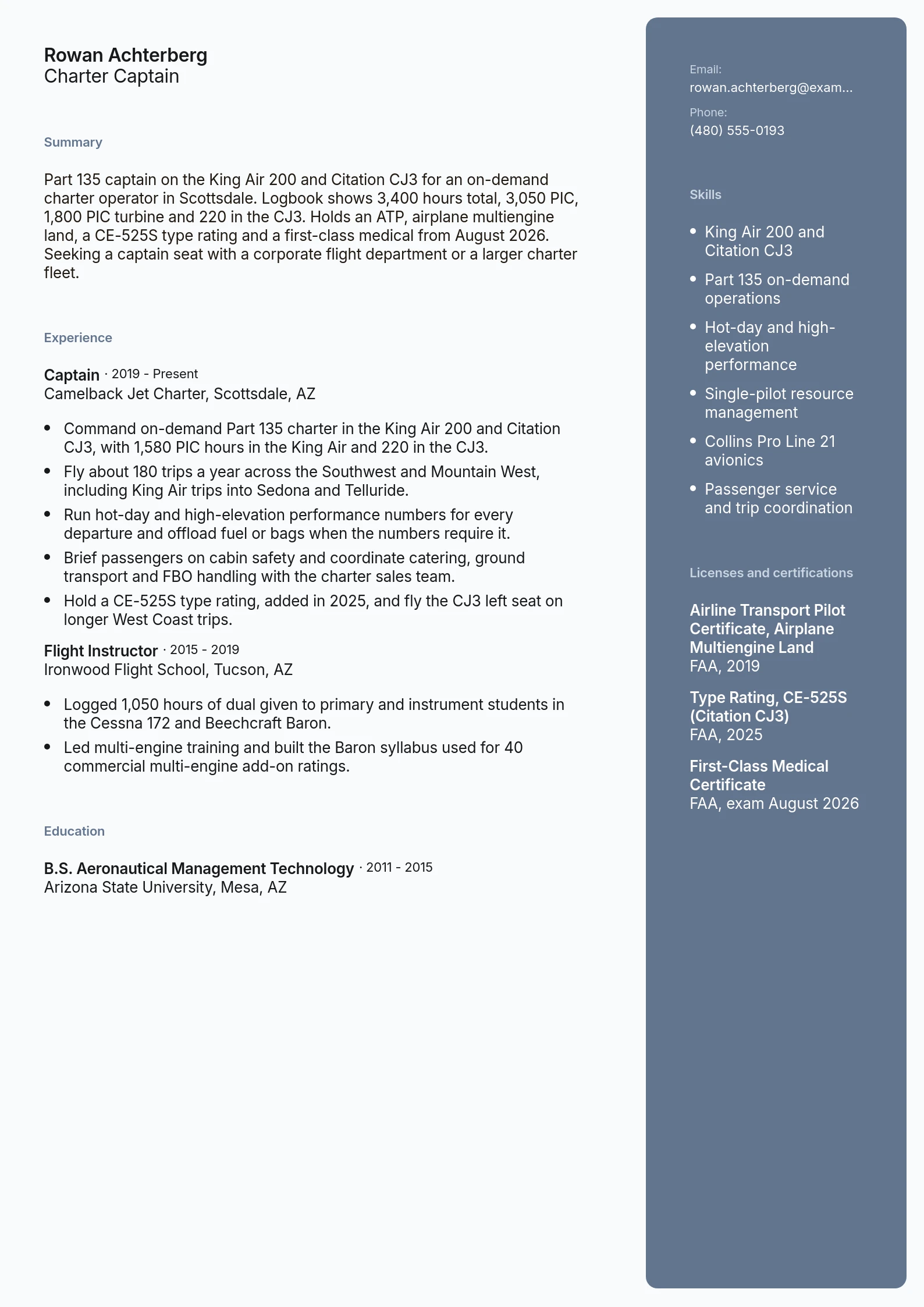
Rowan leads with PIC turbine time and hours in the CJ3, the two figures charter and corporate ads set minimums on. The CE-525S type rating has its own credential line and year, and the bullets split King Air hours from CJ3 hours. Use this layout if you fly single-pilot or two-pilot charter under Part 135 and want a corporate flight department or a bigger fleet.
1,800 PIC turbine hours and 220 in type in the summary
CE-525S type rating listed with the year it was added
Hot-day and high-elevation performance planning
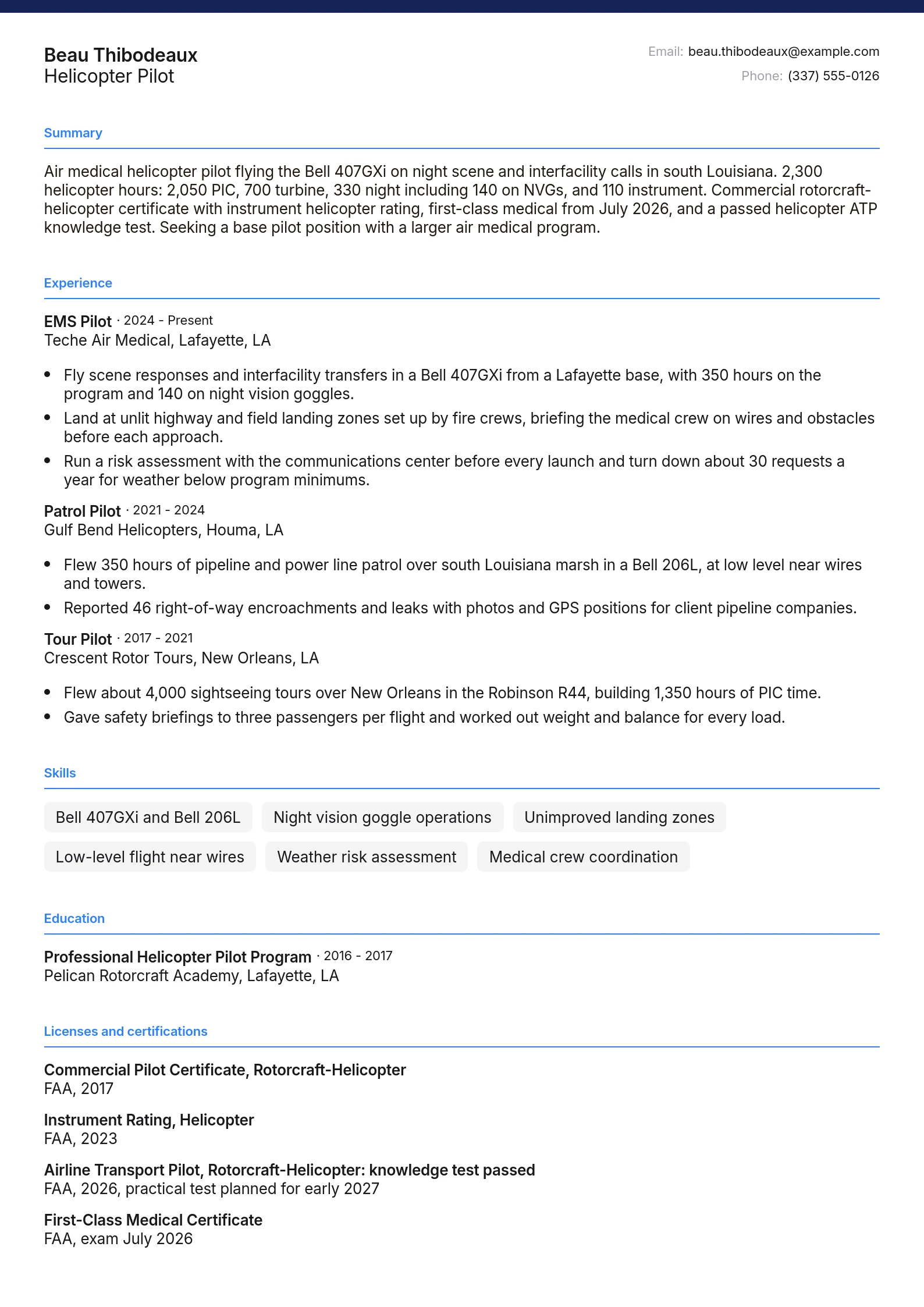
Air medical helicopter pilot with night and NVG time
Beau's summary counts helicopter time only and breaks out PIC, turbine, night, NVG and instrument hours, the categories air medical ads list. His helicopter ATP line shows the passed knowledge test and when the practical test is planned. Bullets name the Bell 407GXi, unlit landing zones and weather turn-downs. Follow it if you fly helicopters in EMS, patrol or tours and are moving into air medical work.
140 NVG hours inside 330 night hours
Helicopter ATP knowledge test passed, practical test planned
Patrol and tour jobs that built PIC time
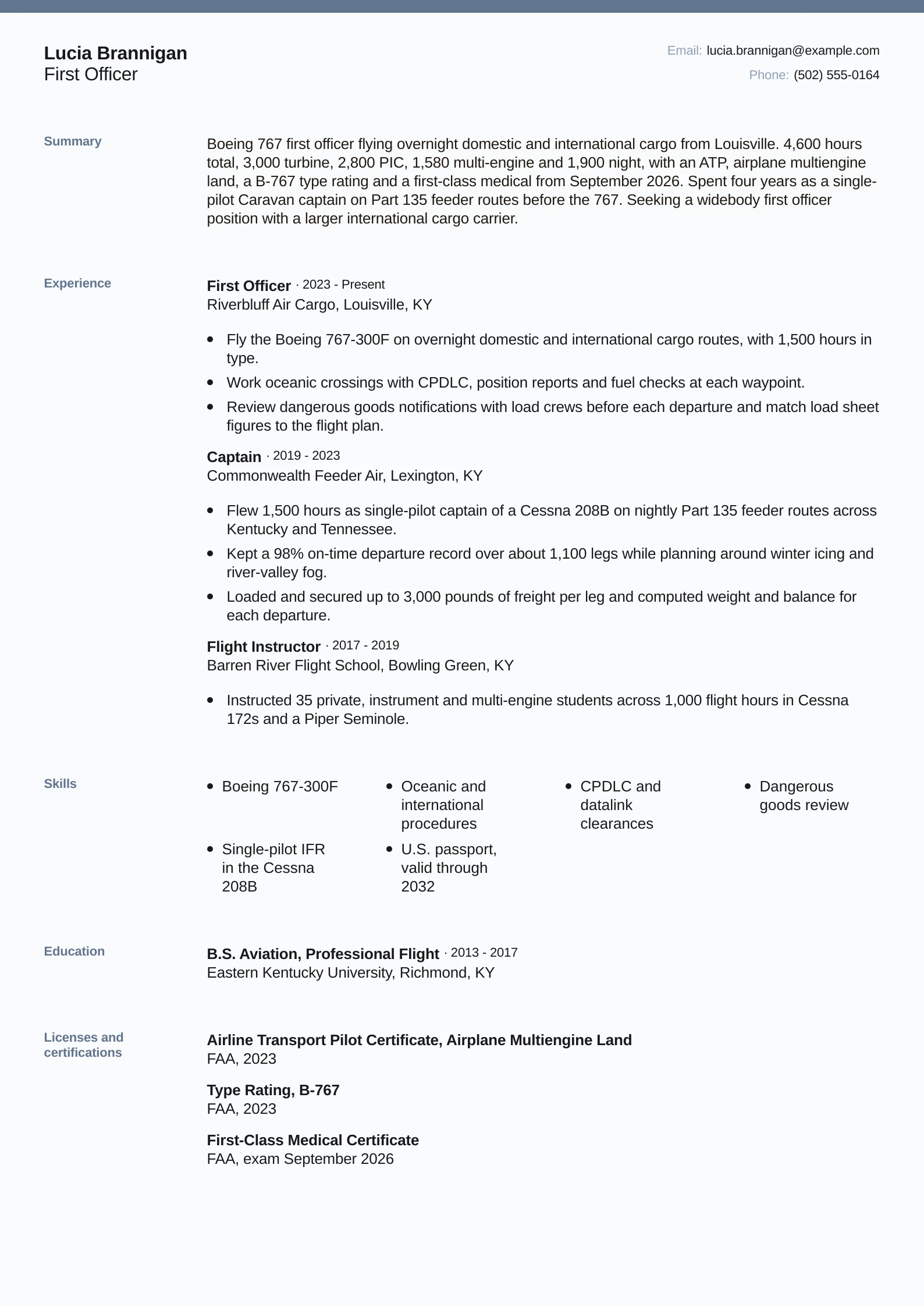
Widebody cargo first officer with international flying
Lucia shows 3,000 turbine and 1,900 night hours, most of it from overnight freight flying. Her Caravan captain job gives single-pilot Part 135 PIC time its own entry, so a recruiter sees where 2,800 PIC hours came from. Oceanic procedures, dangerous goods review and a passport date sit in the bullets and skills. Use it if you fly freight and want a larger international carrier.
Part 135 feeder captain time shown as its own job
Oceanic crossings with CPDLC and fuel checks
Passport validity listed in skills
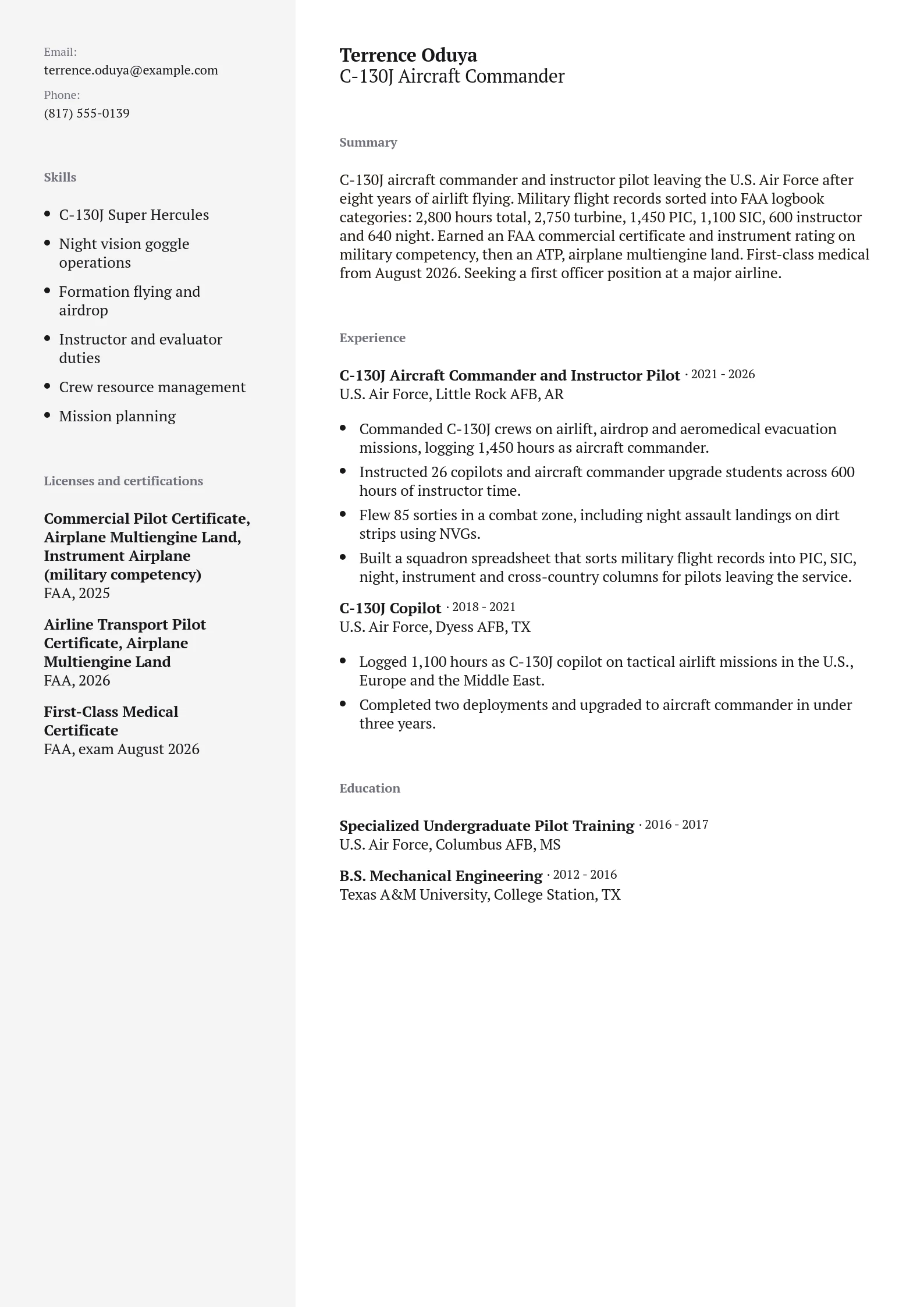
Military pilot sorting Air Force time into FAA categories
Terrence lists his C-130J hours under the FAA headings an airline application asks for: total, turbine, PIC, SIC, instructor and night. Aircraft commander and copilot jobs are separate entries, so the PIC and SIC figures match the dates. Credentials show the commercial certificate earned on military competency, then the ATP and first-class medical. Copy it if you fly military transports or tankers and are applying for an airline first officer job.
Aircraft commander and copilot time split by job
600 instructor hours and NVG combat sorties
Military competency certificate listed before the ATP
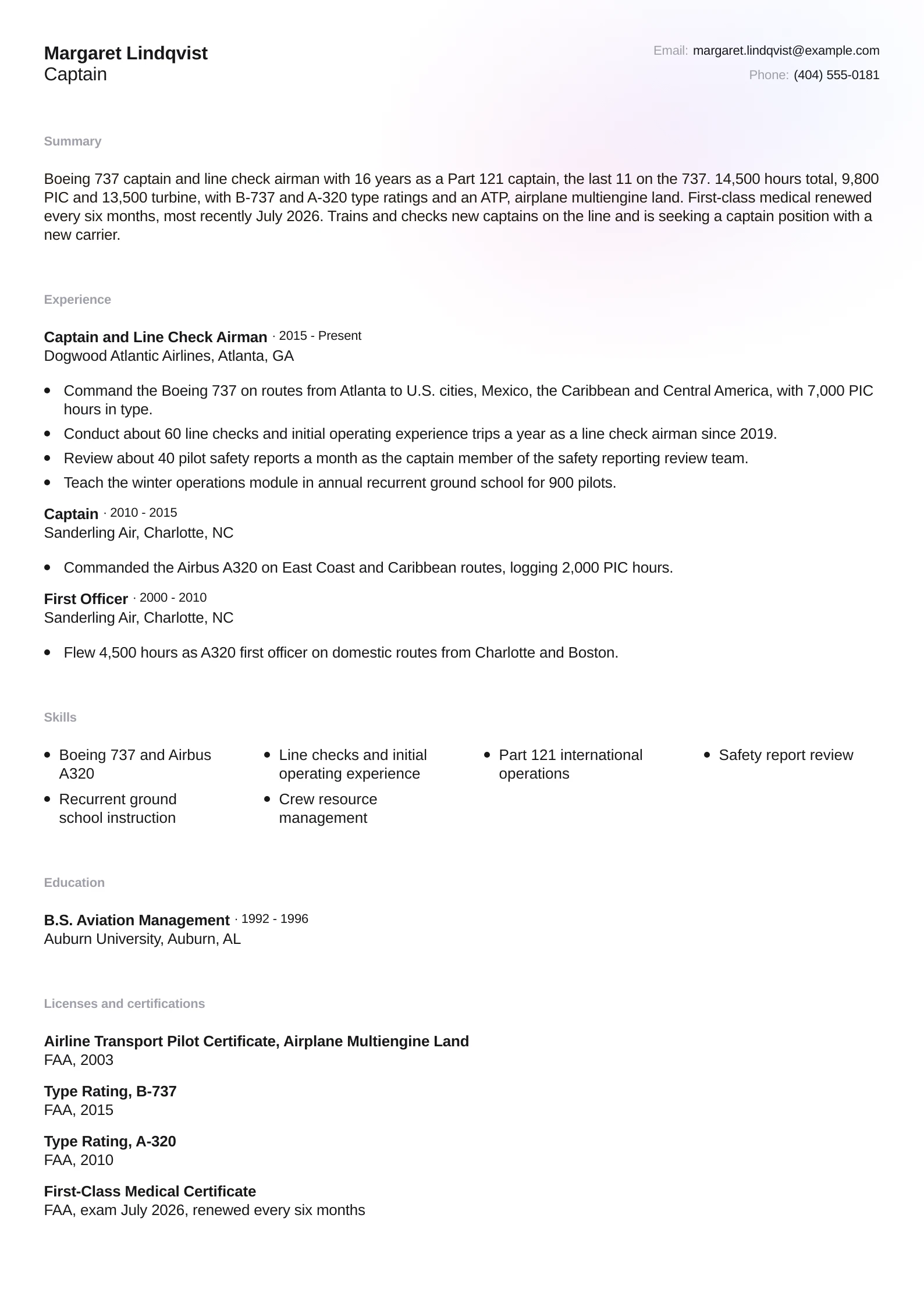
Airline captain and check airman changing carriers
Margaret's summary gives 9,800 PIC and 13,500 turbine hours, then both type ratings. Her medical line says it is renewed every six months, which matches her age. Line checks, safety report review and recurrent teaching show duties beyond flying the line. Use it if you hold a captain seat at a Part 121 carrier and are applying to another airline for a captain or check pilot role.
B-737 and A-320 type ratings with years
Six-month first-class medical renewal stated
About 60 line checks a year as a check airman
Career changer with a new commercial certificate
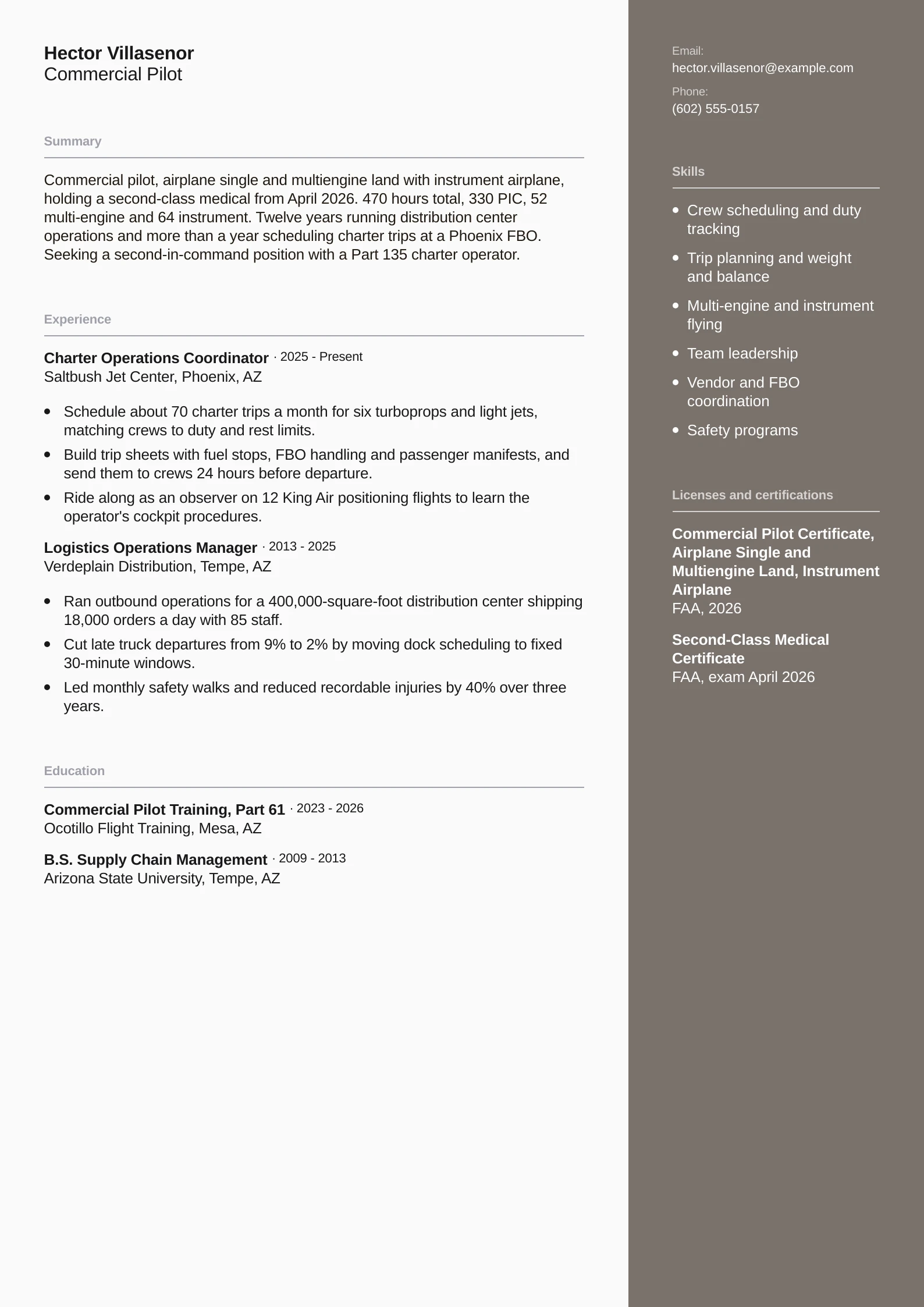
Hector puts his commercial certificate, instrument and multi-engine ratings and medical at the top, then 470 hours split into PIC, multi-engine and instrument time. His charter coordinator job shows he already knows crew duty limits and trip sheets, and the logistics job shows 12 years of running a shift operation. Copy it if you came to flying from another career and want a Part 135 second-in-command seat.
470 hours split by category in the summary
Charter scheduling job that maps to Part 135 work
Logistics results with numbers
Split flight time into the categories the ad counts
Give total time, then each category the job ad names, in one line near the top of the resume. A single total such as "3,700 hours" makes the recruiter guess whether you meet 250 PIC, 50 multi-engine or a turbine minimum.
Airline applicants should list total, PIC, SIC, turbine, multi-engine and instrument time. Charter and corporate applicants should add PIC turbine and time in the aircraft type they would fly. Helicopter pilots should count helicopter time on its own and add night and NVG hours. Instructors should show dual given as its own figure.
Use the totals your logbook shows, and round down, never up. Airlines can ask for logbook documentation at the interview, so every figure on the resume should match a logbook page.
List the certificate first, then type ratings, then the medical and its date
Put your highest pilot certificate first, written with its category and class: "Airline Transport Pilot Certificate, Airplane Multiengine Land". Under it, add any lower-certificate privileges you still use, such as commercial single engine land, and any instrument rating that is not part of the ATP.
Type ratings come next, each with the FAA designation and year: "Type Rating, CE-525S (Citation CJ3), 2025". A type rating is required to act as PIC of large aircraft and turbojet-powered airplanes, so charter and corporate recruiters look for this line before they read your jobs. A Part 121 first officer also needs an ATP and a type rating for the aircraft flown, so list the one your airline issued, such as CL-65 for the CRJ-700. Instructors add the flight instructor certificate and each rating on it, such as CFI, CFII and MEI.
Finish with the medical class and the month of the exam. A first-class medical carries ATP pilot-in-command privileges for 12 months if you are under 40 and 6 months if you are 40 or older, then drops to lower-class privileges. A second-class medical carries commercial privileges for 12 months. The captain example writes "exam July 2026, renewed every six months" so the reader can see the date is current.
A Part 121 first officer needs at least a second-class medical and a captain needs a first-class medical, but many airline ads ask first officers for first-class too. BasicMed or a third-class medical will not meet either. Some ads also list an FCC restricted radiotelephone permit or a passport, so add either one under credentials or skills when the ad names it.
Airlines, charter operators and air medical programs count different hours
Lead with the number your target employer screens first. The FAA minimums below are the floor, and most ads set higher figures, so check the one you are answering.
Employer
Hours they check first
Certificate and medical
What to put near the top
Part 121 airline
Total time, then turbine. An unrestricted ATP needs 1,500 total, 250 PIC, 100 night and 75 instrument, and many ads add a turbine minimum.
ATP or restricted ATP and a type rating for the aircraft. First-class medical for a captain, at least second-class for a first officer
Total, turbine, PIC and SIC, multi-engine, ATP line
Part 135 charter or corporate
PIC turbine time and time in the make and model you would fly
Type rating to act as PIC of a jet or large aircraft, first-class or second-class medical as the ad states
PIC turbine, hours in type, type ratings
Air medical helicopter
Helicopter PIC and turbine time. A helicopter ATP needs 1,200 total, 200 in helicopters, 100 night and 75 instrument, and air medical ads ask for much more
Commercial and instrument helicopter at least. Check whether the ad wants a helicopter ATP by a set date
Helicopter PIC, turbine, night and NVG hours
Flight school
Dual given. The CFI itself needs 15 hours PIC in the category and class
Commercial or ATP with instrument rating, CFI, third-class medical or BasicMed to act as PIC
Instructor ratings, dual given, student pass rate
Under 1,500 hours, state the gap and the date you will close it
Give your current total and how far it is from the minimum that applies to you. The flight instructor example says she is 120 hours short of the 1,000-hour restricted ATP minimum and flies about 60 hours a month, which tells a regional recruiter when she can start class.
Name the restricted ATP route only if you qualify for it. The minimums are 750 hours for military pilots, 1,000 hours with a bachelor's degree and an aviation major from an authorized institution, and 1,250 hours with an associate degree. The minimum age is 21, compared with 23 for an unrestricted ATP.
Show the hours that build toward the categories airlines count next. Write dual given, PIC and multi-engine time as separate figures, because the ATP asks for 250 PIC and 50 hours in the class of airplane on top of 1,500 total. If you teach in a twin, say so in the bullet: "Give multi-engine training in the Seminole".
Career changers with a new commercial certificate should list the certificate, ratings and medical before any earlier career. Then pick the parts of the old job a charter operator uses, such as crew scheduling, duty limits, trip sheets or running a shift, and give each a number.
Name the aircraft, the operating rule and your seat in every job
Each flying job should say what you flew, under which rules and from which seat. A recruiter reads "Part 121", "Part 135" or "Part 91" as a different kind of experience, and "first officer" or "single-pilot captain" tells them whether the hours are PIC or SIC.
Use the aircraft designation the industry uses, such as CRJ-700, Boeing 767-300F, King Air 200 or Bell 407GXi. Add hours in type when they are high enough to matter for the ad. Then add one or two duties that set the job apart: line check airman, instructor pilot, NVG operations, oceanic crossings or mountain airports.
Military pilots should name the aircraft, the crew position and the mission types, and list aircraft commander and copilot time as separate jobs so the PIC and SIC totals match the dates.
Specific
Fly the CRJ-700 as first officer on Part 121 scheduled service from a Denver base, logging 2,200 hours in type across about 1,800 legs.