A manager hiring for a first part-time job checks two things before your grades: whether you are old enough for the role and which hours you can work around school. Each example below opens with a real availability line, for a 16-year-old who has never had an employer, an 18-year-old cashier ready for more responsibility, a certified lifeguard and a 15-year-old scheduling inside the under-16 hour limits.
A first-job resume built from volunteer shifts and babysitting
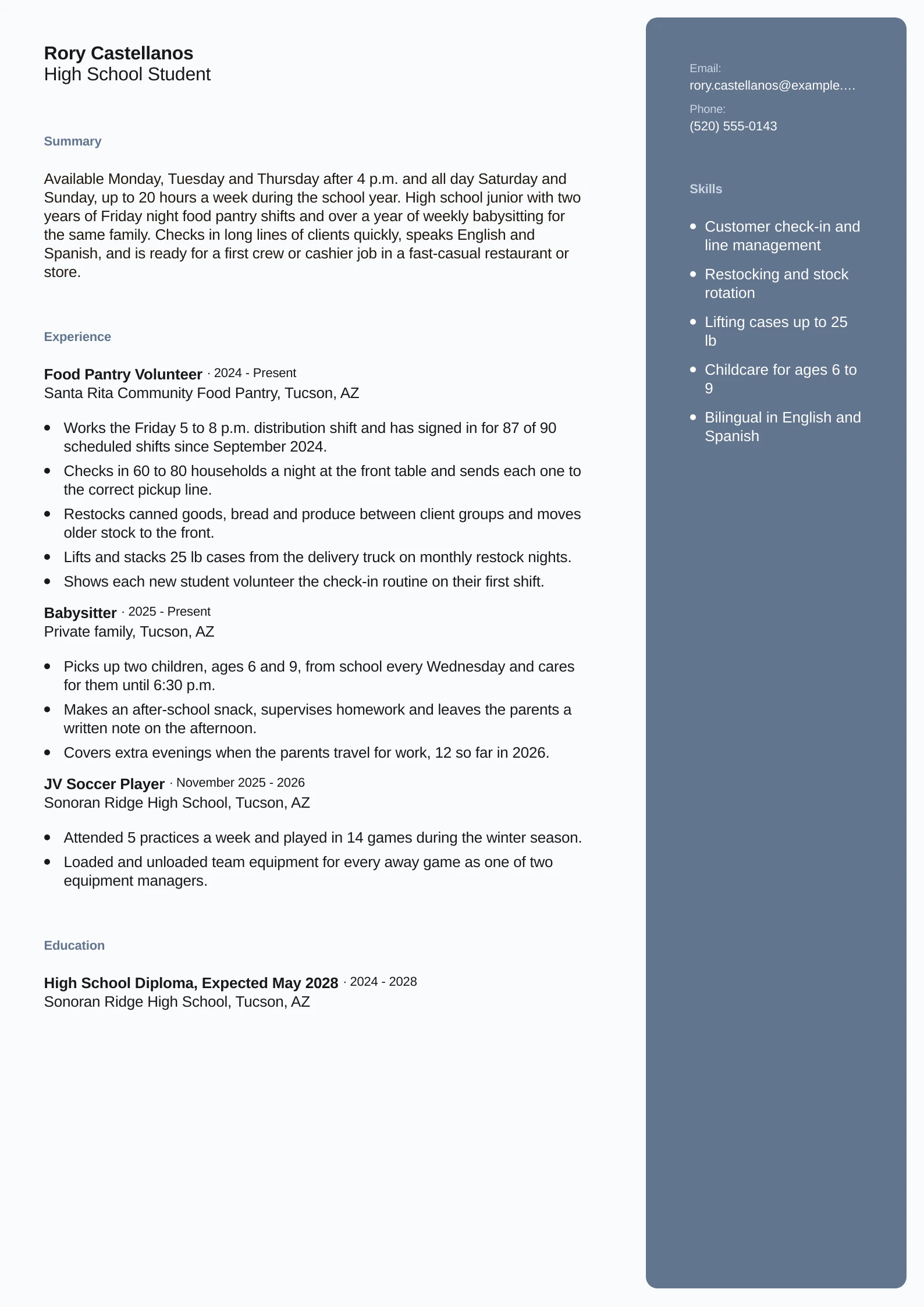
Rory is 16, has never been paid by an employer and is applying to fast-casual restaurants and stores in Tucson. The first line of the summary names the exact days Rory can work, so a manager filling a weekend schedule can decide in seconds.
Those days leave out Friday nights and Wednesday afternoons, because Rory already has a food pantry shift and a babysitting job then. Listing open days around existing commitments tells the manager the schedule will hold.
The experience section treats two years of Friday pantry shifts like a job: a title, start date, the shift hours and an attendance count. The pantry bullets use words from crew and cashier ads, such as checking in customers, restocking and lifting cases, so the manager can picture Rory on the floor.
Examples for a working senior, a lifeguard and a 15-year-old
Each of these students has a different age or job setting, and that changes what the availability line has to say. Pick the one closest to your age and the job you want, then copy its structure.
Senior with 14 months of paid cashier work
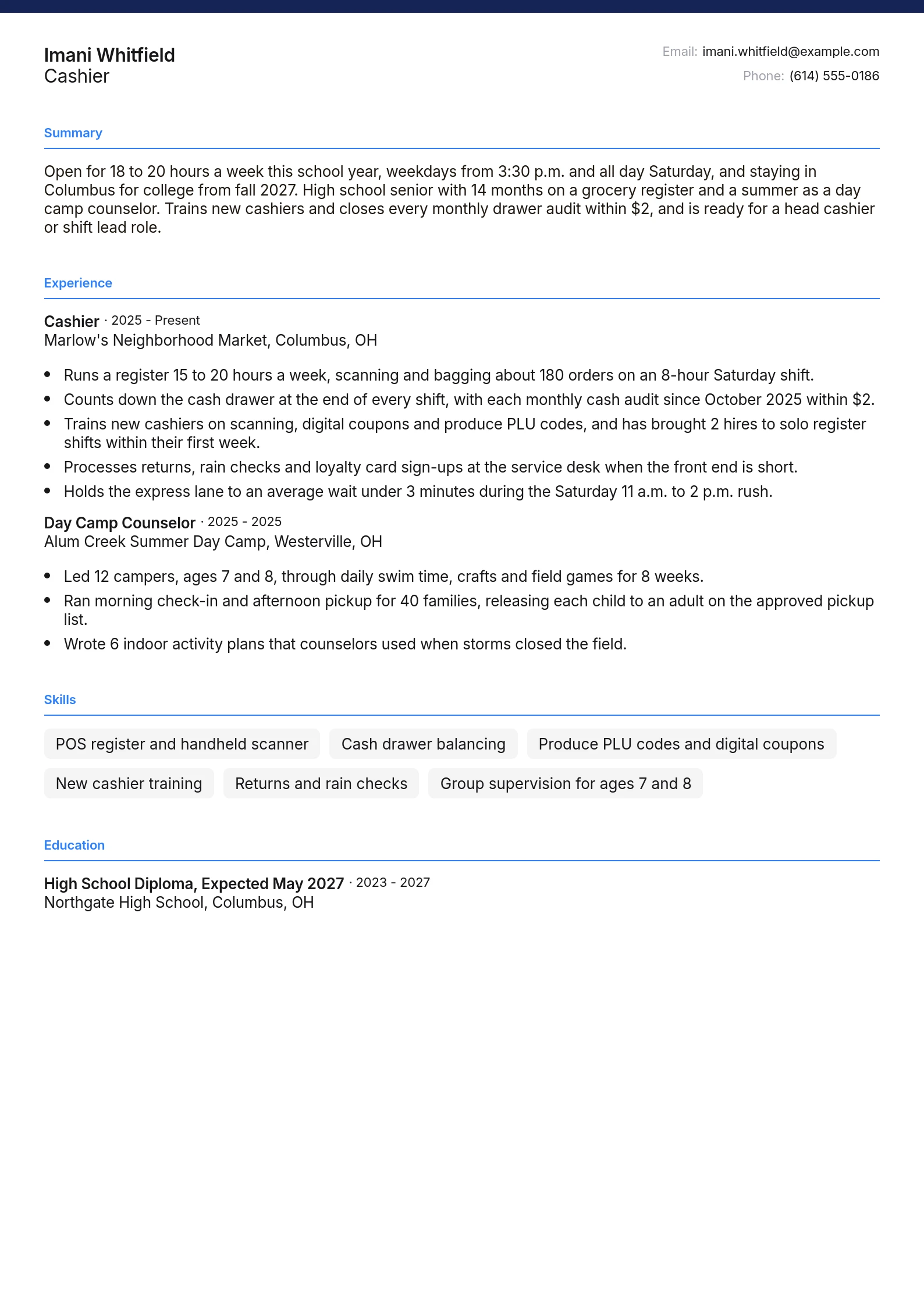
Imani already has a paid job and is applying for a head cashier or shift lead role. Her summary gives weekly hours and a plan to attend college in Columbus, which tells a manager she can stay after graduation. Her cashier bullets lead with training new hires and passing cash audits, the duties a lead role adds. Use this if you have a year or more of paid work and want a step up.
Availability as 18 to 20 hours a week plus a college plan in the same city
Training bullet with a result: 2 new hires on solo registers within a week
Monthly cash audits within $2 since October 2025
Lifeguard with Red Cross certifications and summer dates
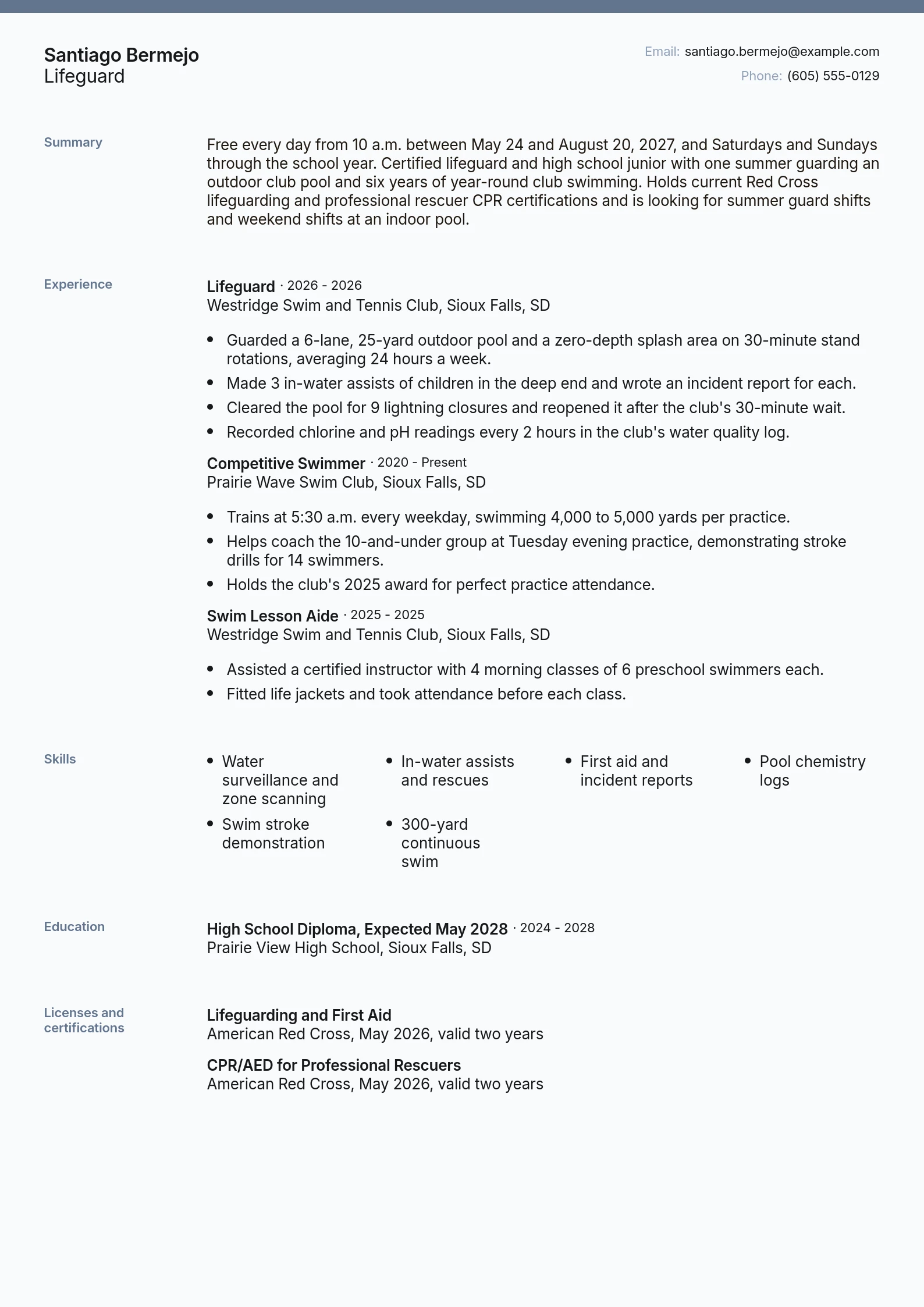
Santiago is 17 and applying for summer guard shifts and weekend shifts at an indoor pool. His availability gives exact summer start and end dates, and his two Red Cross certifications sit in their own section with the month earned. Six years of club swimming and a swim lesson aide summer show the fitness and the pool experience behind the certificate. Use this for a pool, camp waterfront or other seasonal job that needs a certification.
Summer availability with dates: May 24 to August 20, 2027
Lifeguarding and First Aid and CPR/AED for Professional Rescuers, both earned May 2026
Lifeguard bullets with counts: 3 in-water assists, 9 lightning closures
Age 15 with school-year hours inside the federal limits
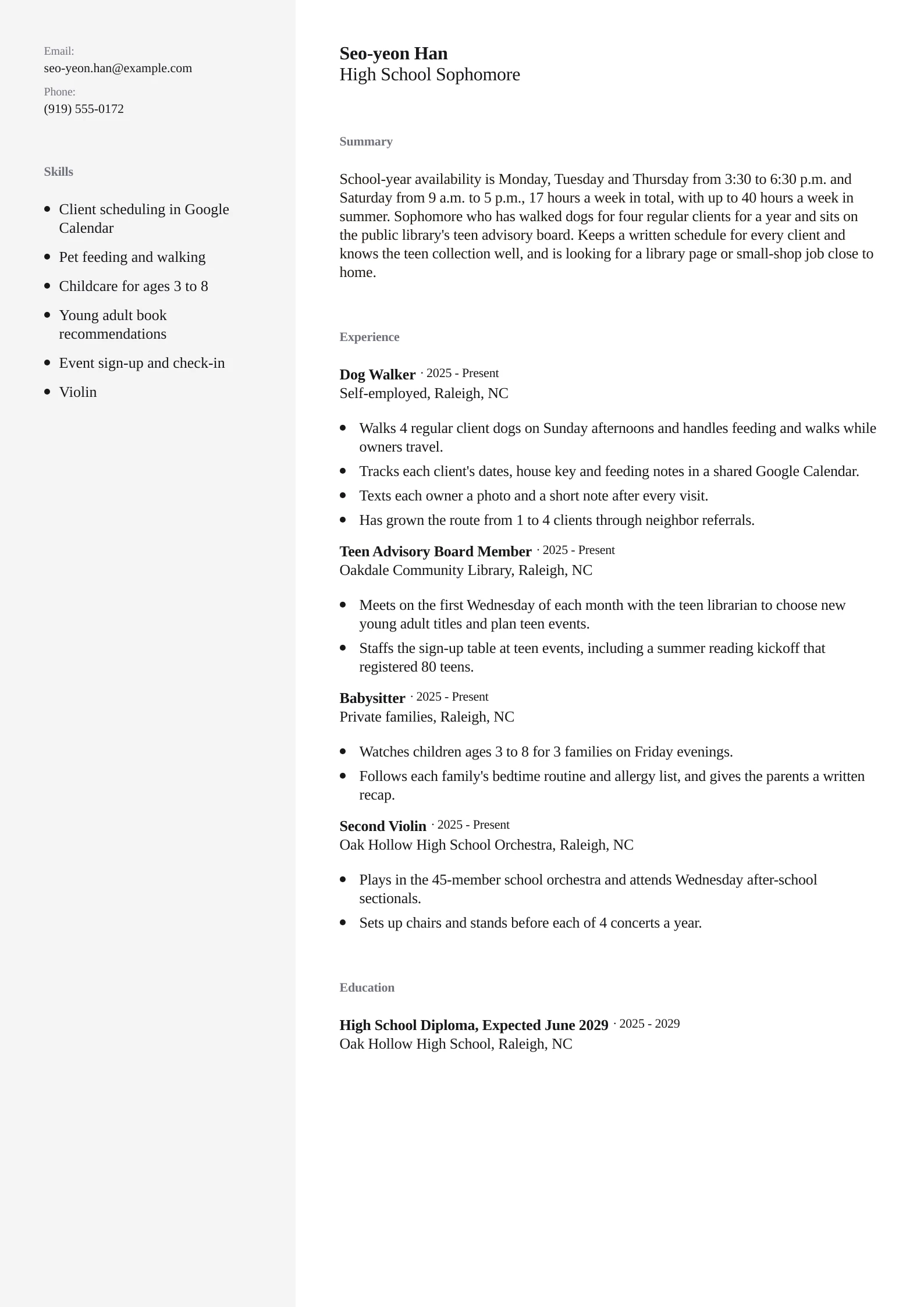
Seo-yeon is 15 and wants a library page or small-shop job in Raleigh. Her availability ends at 6:30 p.m. on school days, runs 8 hours on Saturday and adds up to 17 hours a week, which fits the federal limits for workers under 16. Dog walking for 4 regular clients and a seat on the library's teen advisory board stand in for a job with an employer. Use this if you are 14 or 15.
Availability that totals 17 school-week hours and ends before 7 p.m.
Self-employed dog walking entry with a client count and referral growth
Teen advisory board entry tied to the library job she wants
Name your days and hours in the first line of the summary
Put your availability as the first sentence of your summary, directly under your name and contact details. Teen job ads ask about it before anything else: one restaurant ad asks for weekend availability and an evening shift, and a big-box store asks for nights, weekends and holidays.
Name days and start times, not a feeling. "Monday, Tuesday and Thursday after 4 p.m." tells a manager which shifts you can take. "Flexible" tells them nothing and gets you scheduled into a practice you cannot miss.
Add a weekly total if you have one, such as "up to 20 hours a week during the school year." Leave out the times you already have a standing commitment like a team practice, a volunteer shift or a babysitting job, so the schedule you are given is one you can keep.
Write school-year and summer hours as two separate statements if they differ. For a pool, camp or other summer job, give your first and last available dates, because those employers staff for an opening day and lose students when school starts in August. If you are applying in October or November for holiday hiring, add the holiday weeks you can work, such as "all of winter break, December 19 to January 4."
Days, times and a weekly limit
Available Monday, Tuesday and Thursday after 4 p.m. and all day Saturday and Sunday, up to 20 hours a week during the school year.
Too vague to schedule
Flexible schedule. Available anytime outside of school.
List volunteer shifts, teams and babysitting under Experience
If you have never had a paid job, your experience section holds the commitments you have kept over months: a volunteer shift, a sports team, a club role, babysitting for the same family or a course you finished. A manager hiring 16-year-olds reads these for one thing, which is whether you show up when scheduled.
Give each one a title, an organization, a city and a start month, the same as a job. Write "Food Pantry Volunteer" and the pantry's name, not "Volunteering." For babysitting, pet sitting or yard work, put "Private family" or "Self-employed" where the employer goes.
In the first bullet, state how often and how long. "Works the Friday 5 to 8 p.m. distribution shift" is stronger than "helps at a food pantry." If you have an attendance record, such as 87 of 90 shifts, use the number. Ask your coordinator or coach for the sign-in record if you are unsure of it.
For babysitting or dog walking, give the number of children or clients, their ages or needs, the routine you handle and how long the same family has kept you. "Picks up two children, ages 6 and 9, from school every Wednesday" shows trust that a parent gave you week after week. A client count that grew through referrals, like 1 to 4 dog walking clients, shows the same thing.
For a sports team, give the season, the practices per week and any job you held, such as equipment manager or carpool organizer. Goals scored and personal records matter less to a store manager than five practices a week for a whole season.
Then match your bullets to the words in the job ad. Crew ads list stations like grill, cashier, prep and expo. Retail ads list checkout, handheld scanners and lifting up to 44 pounds. If your pantry shift includes checking people in at a table or carrying 25-pound cases off a truck, write it in those terms.
Keep the skills section concrete. A second language you speak, cash counting from a fundraiser table, Google Sheets or childcare for a named age range are skills a manager can use. Leave out "hard worker," "team player" and "leadership," because your bullets should already prove them.
Leave your age off and let the hours you list fit the law
You do not need to write your age or birth date on the resume. The job application asks for it, and many employers set their own minimum: quick-service crew ads often say 16, while one city pool hires lifeguards from 15. What your resume should do is list hours the employer can legally schedule for your age.
Federal rules limit work hours for 14 and 15 year olds and set no hour limits for 16 and 17 year olds, though everyone under 18 is barred from jobs the Labor Department lists as hazardous. States can set stricter rules on hours and on which jobs teens may do, and where the state rule is stricter, it applies. Before you write your availability, check your state labor department's page on youth employment.
Work permits, sometimes called working papers, are also a state matter. Some states require one, issued through your school or the state labor department, and others do not, so it belongs on the hiring paperwork, not the resume.
Age
School-week limit (federal)
Summer limit (federal)
Latest finish (federal)
What to write in your availability
14 and 15
3 hours on a school day, 8 on a non-school day, 18 a week
8 hours a day, 40 a week
7 p.m., or 9 p.m. from June 1 to Labor Day
After-school blocks that end by 7 p.m. and total 18 hours or less, such as 3:30 to 6:30 p.m. three days and 9 a.m. to 5 p.m. Saturday
16 and 17
No federal limit, and hazardous jobs are barred until 18
No federal limit
No federal limit
The evenings and weekend days you can work, plus any school-night cutoff your state sets
18
No limit
No limit
No limit
Weekly hours and how long you will stay, such as a plan to attend college in the same city
Write a separate resume for college and scholarship applications
A job resume is not the same as the one you send with college or scholarship applications. A college or scholarship resume leads with GPA, honors courses, awards and leadership titles. A job resume leads with availability and the commitments that show you are reliable, so keep two files and send the right one.
On a job resume, education is one entry: your school, its city and your expected graduation month and year, such as "High School Diploma, Expected May 2028." Add a GPA only if it is 3.5 or higher, and leave off class rank and test scores.
List a course only when it matches the job. Spanish 3 helps for a role where you will serve Spanish-speaking customers. A culinary arts class helps for a kitchen crew job. AP Biology does not help at a grocery register.
Keep a club or student government role only if you can describe work a manager would recognize. "Ran the cash box at 6 home basketball games for the band fundraiser" belongs on a cashier resume. "Class treasurer" on its own does not tell the manager what you did.
If you are a senior, say how long you can stay. A note that you plan to attend college nearby and keep working tells a manager you are worth training for a lead role. If you are leaving in August, give that date on a summer job resume so the employer can plan around it.
Use the college version for internships, summer academic programs and scholarship applications, which ask for the grades and awards a job resume leaves out.