Warehouse supervisors read your resume for the trucks you're trained on, the rate and accuracy you hold, and signs you'll show up for early, cold or weekend shifts.
The four examples cover a distribution center picker, a first warehouse job through a staffing agency, a freezer order selector and a reach truck operator.
A five-year distribution center resume built on rate and equipment
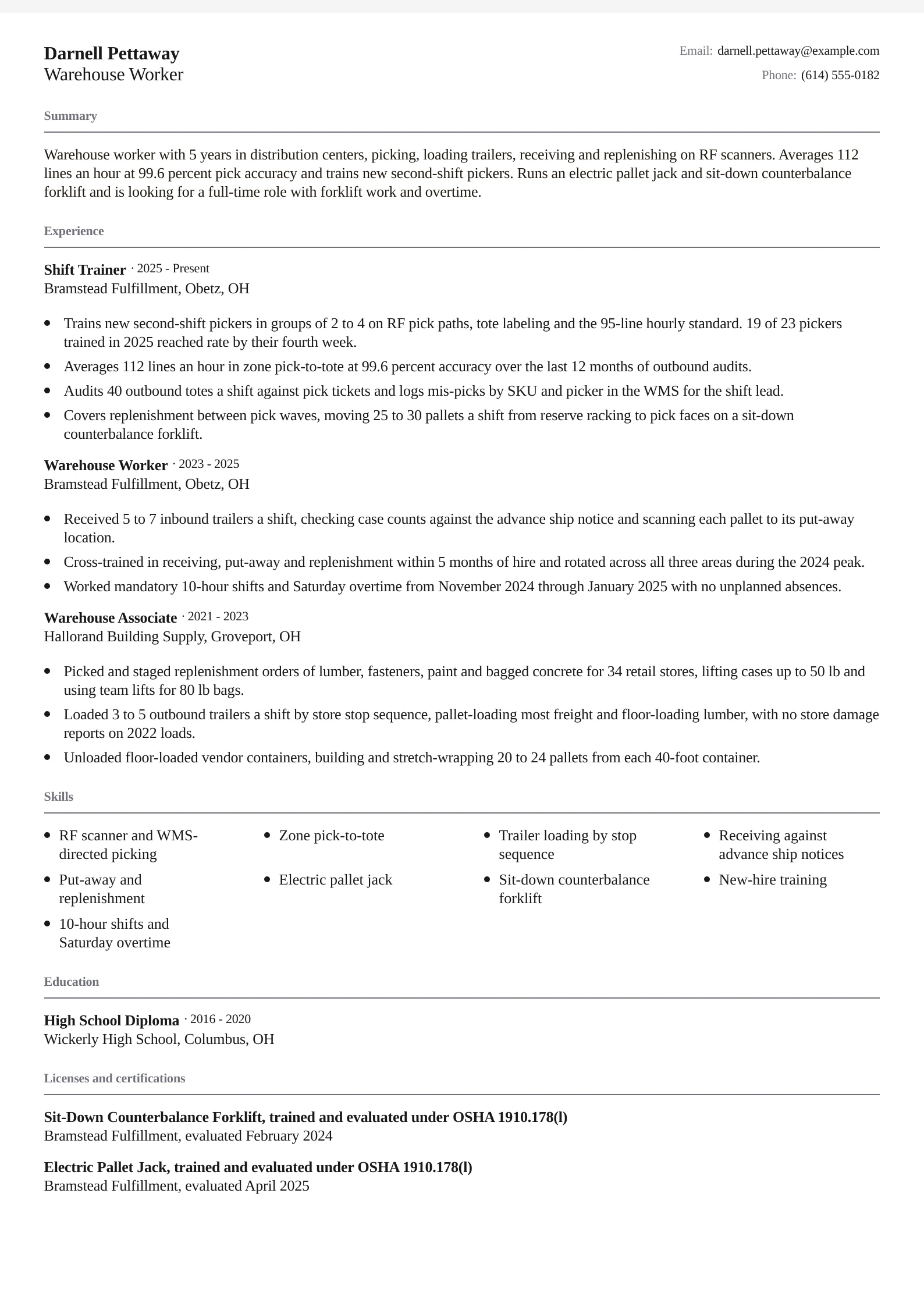
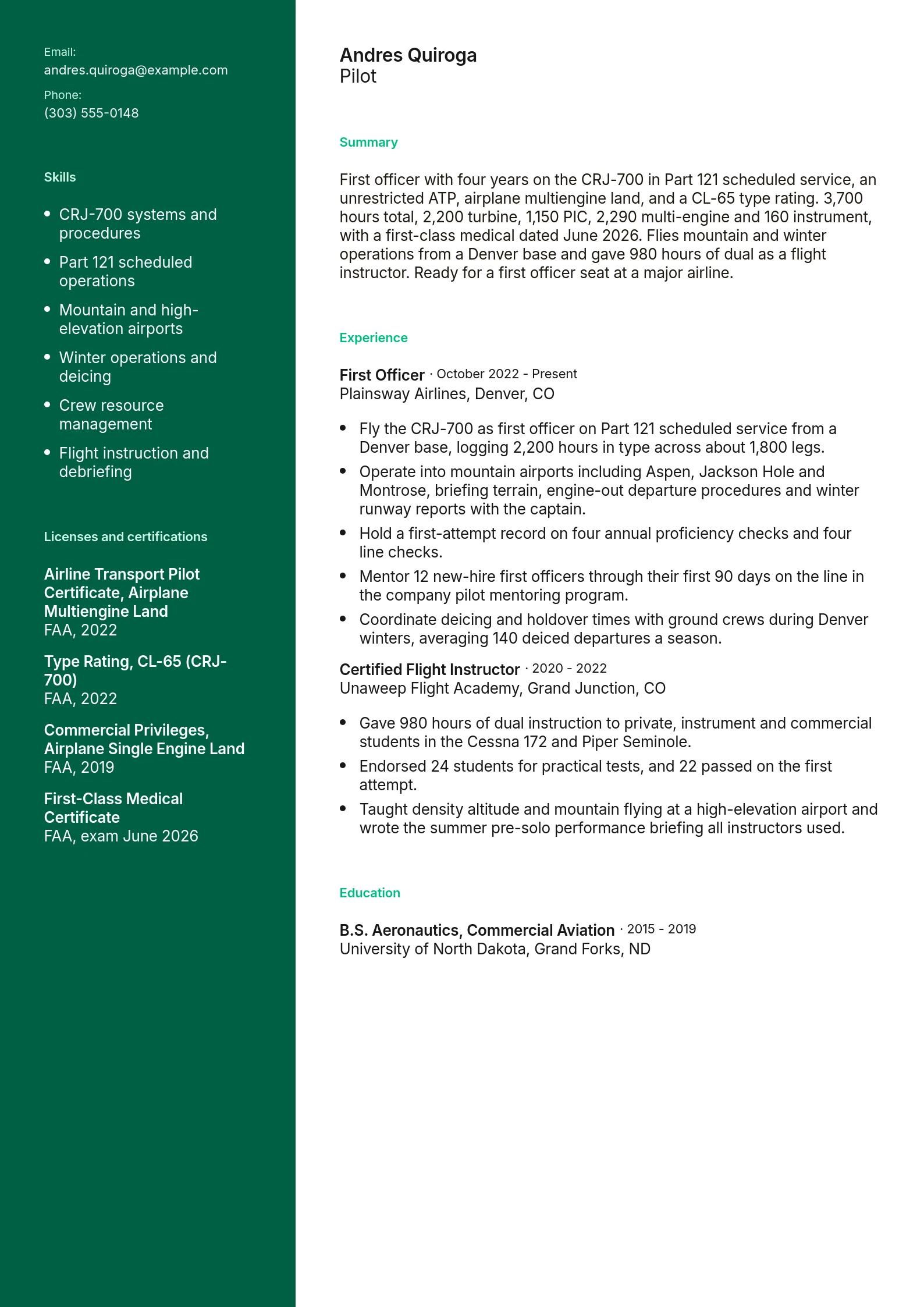
Darnell's resume fits a picker, loader or receiver with a few years in distribution centers who wants the next full-time role. His summary gives his hourly line rate and pick accuracy in the second sentence, because those are the two numbers a shift manager compares first.
Each job splits the work by area: picking, trailer loading, receiving, put-away and replenishment. Lumber, bagged concrete and store stop sequence tell a reader what kind of freight he moved at the building supply job, and the fulfillment center bullets switch to RF pick paths and tote audits.
The credentials section gives the sit-down counterbalance forklift and the electric pallet jack separate lines, each with the employer that evaluated him and the month. If you've trained new hires, copy the structure of his trainer bullet and give the number of people who reached rate and by which week.
Agency, freezer and forklift versions of the job
Pick the example that matches the posting you're answering. The agency example suits a first or second peak season, the freezer example suits food distribution and cold storage ads, and the forklift example suits operator postings that list truck types.
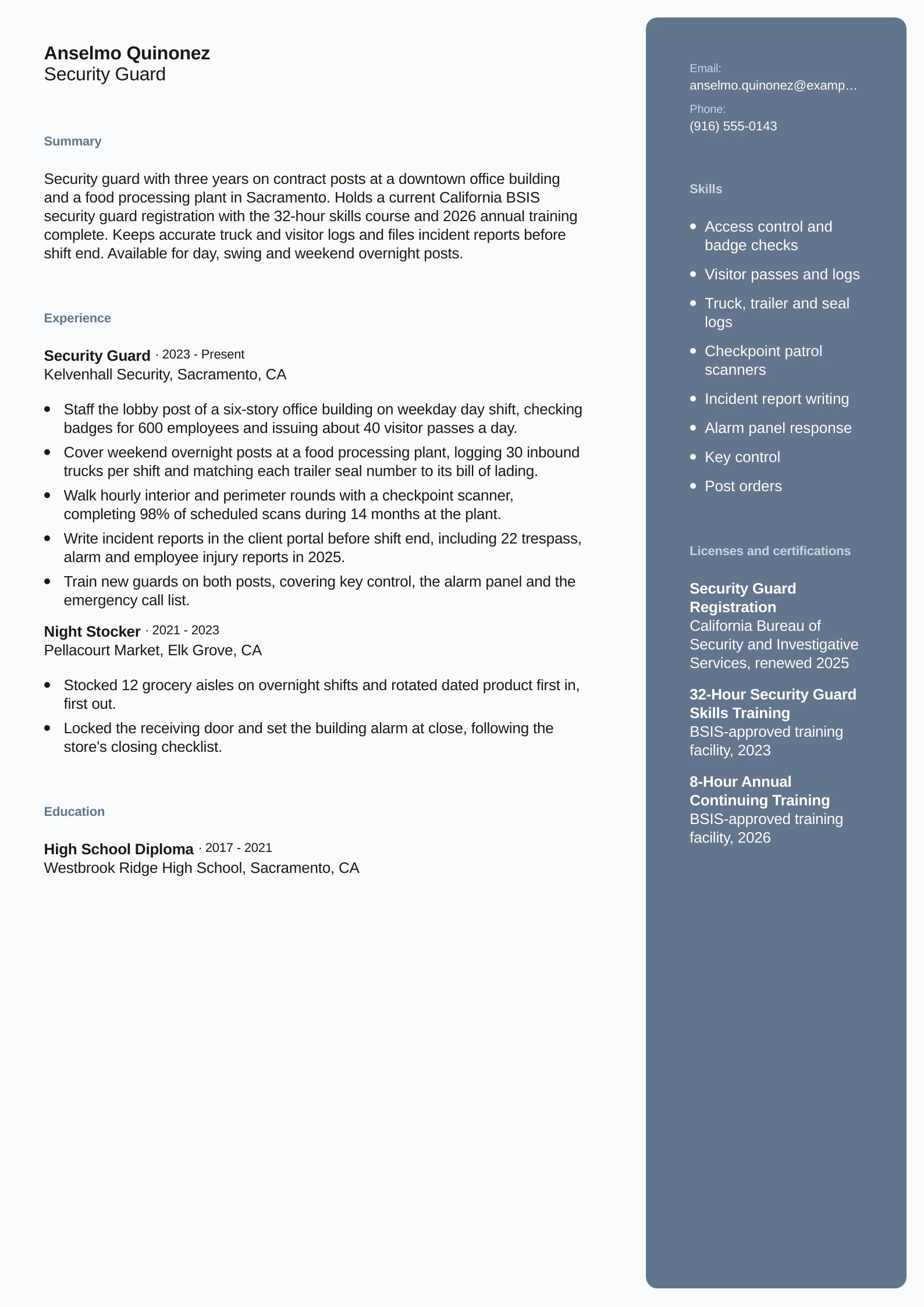
Entry-level warehouse worker with agency peak seasons
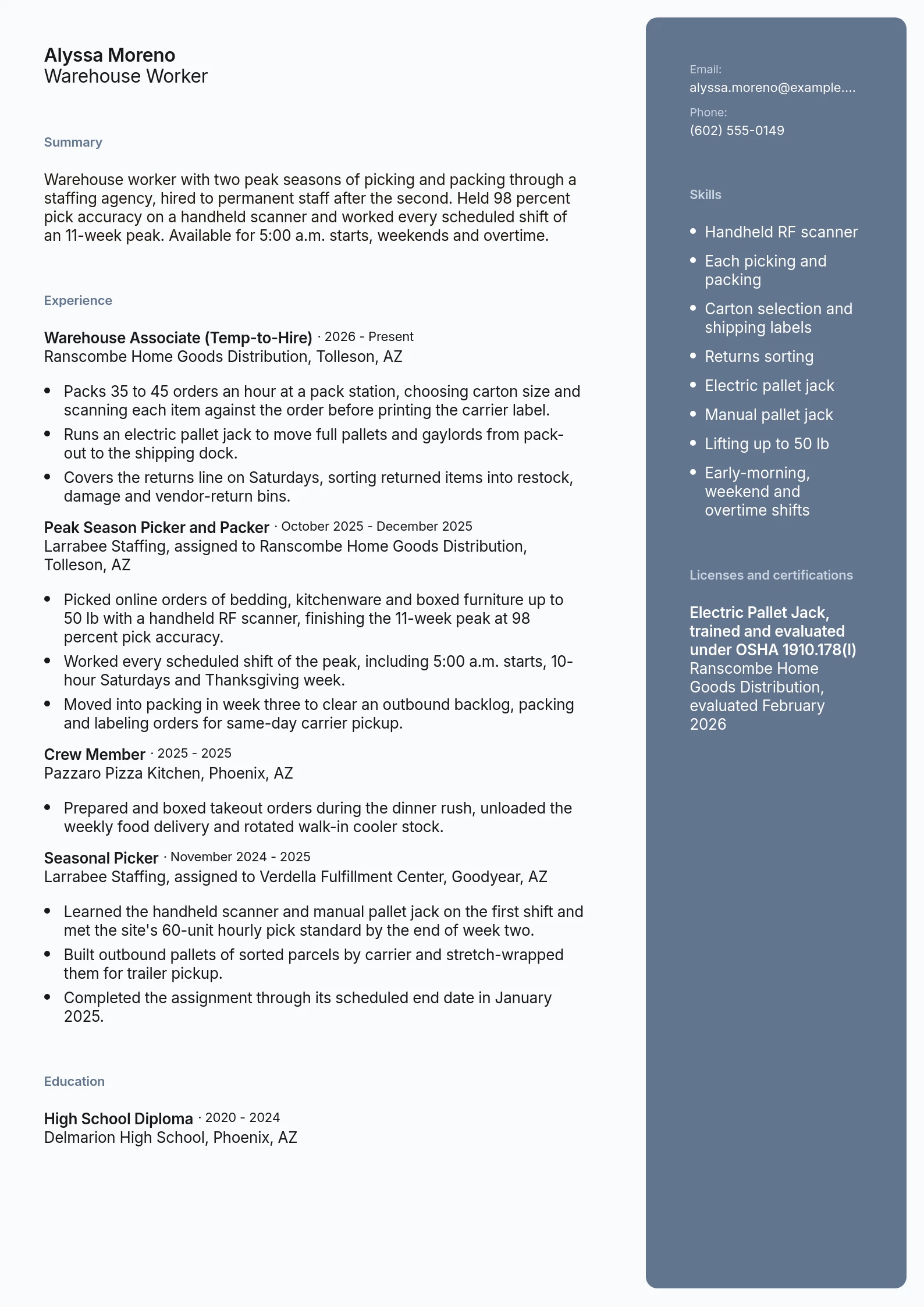
Alyssa's resume suits someone whose warehouse history is one or two peak seasons through a staffing agency. Each assignment is a dated entry naming the agency and the client site, and the permanent job sits on top with a temp-to-hire title. Her bullets give the site's pick standard, her 98 percent accuracy and a full peak with no missed shifts. A restaurant job fills the months between seasons.
Agency assignments listed with client site and dates
Temp-to-hire job shown as its own entry
98 percent pick accuracy and full peak attendance
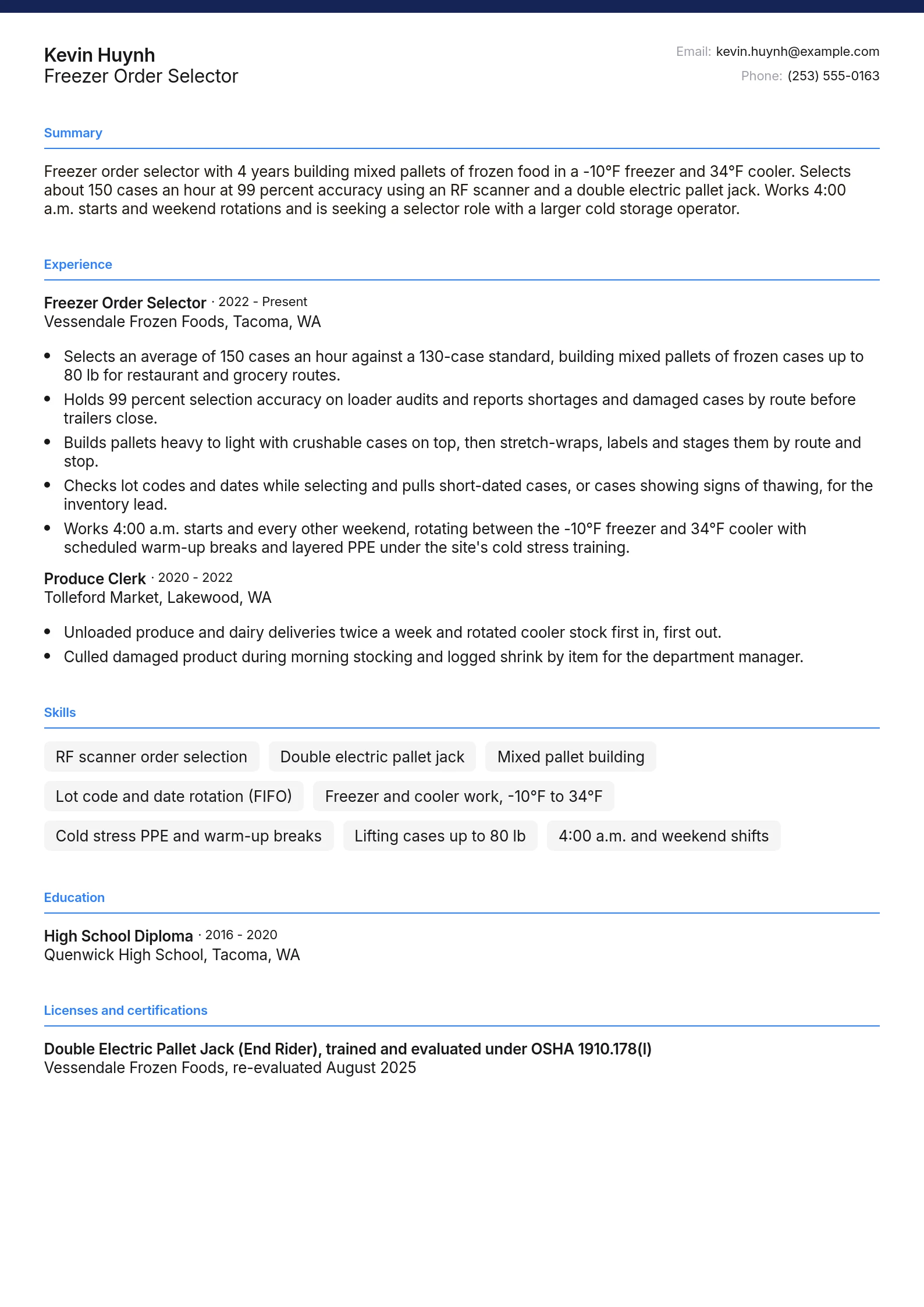
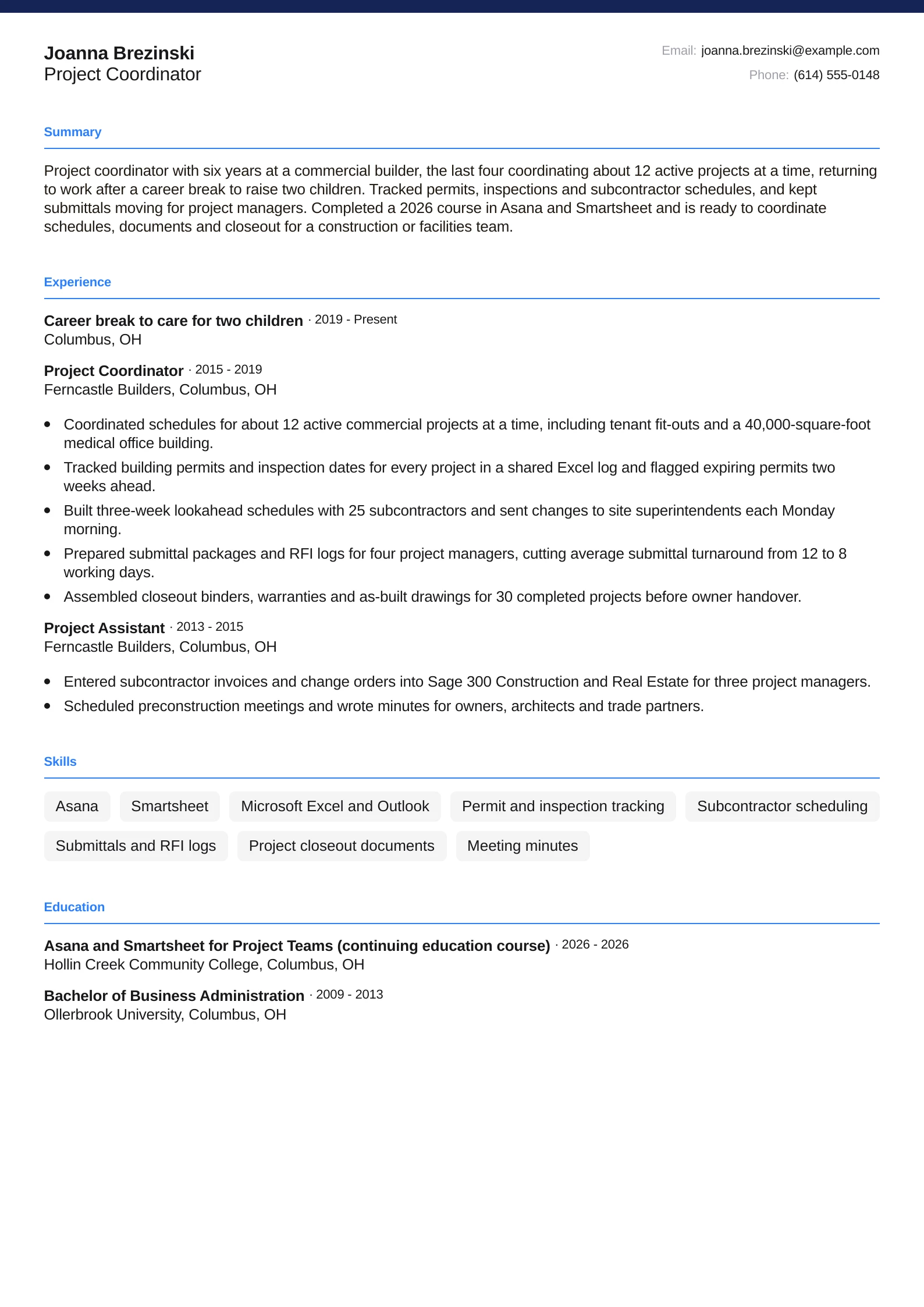
Cold storage order selector in a -10°F freezer
Kevin's resume is for order selectors in freezers and coolers at food distributors. His first bullet puts 150 cases an hour beside the 130-case site standard, and his bullets name cases up to 80 lb, the -10°F freezer, 4:00 a.m. starts and every other weekend. Lot code and date checks cover food safety. His double pallet jack credential shows the three-year re-evaluation and its date.
Cases per hour shown against the site standard
Freezer temperature, case weights and start time in bullets
Pallet jack re-evaluation dated August 2025
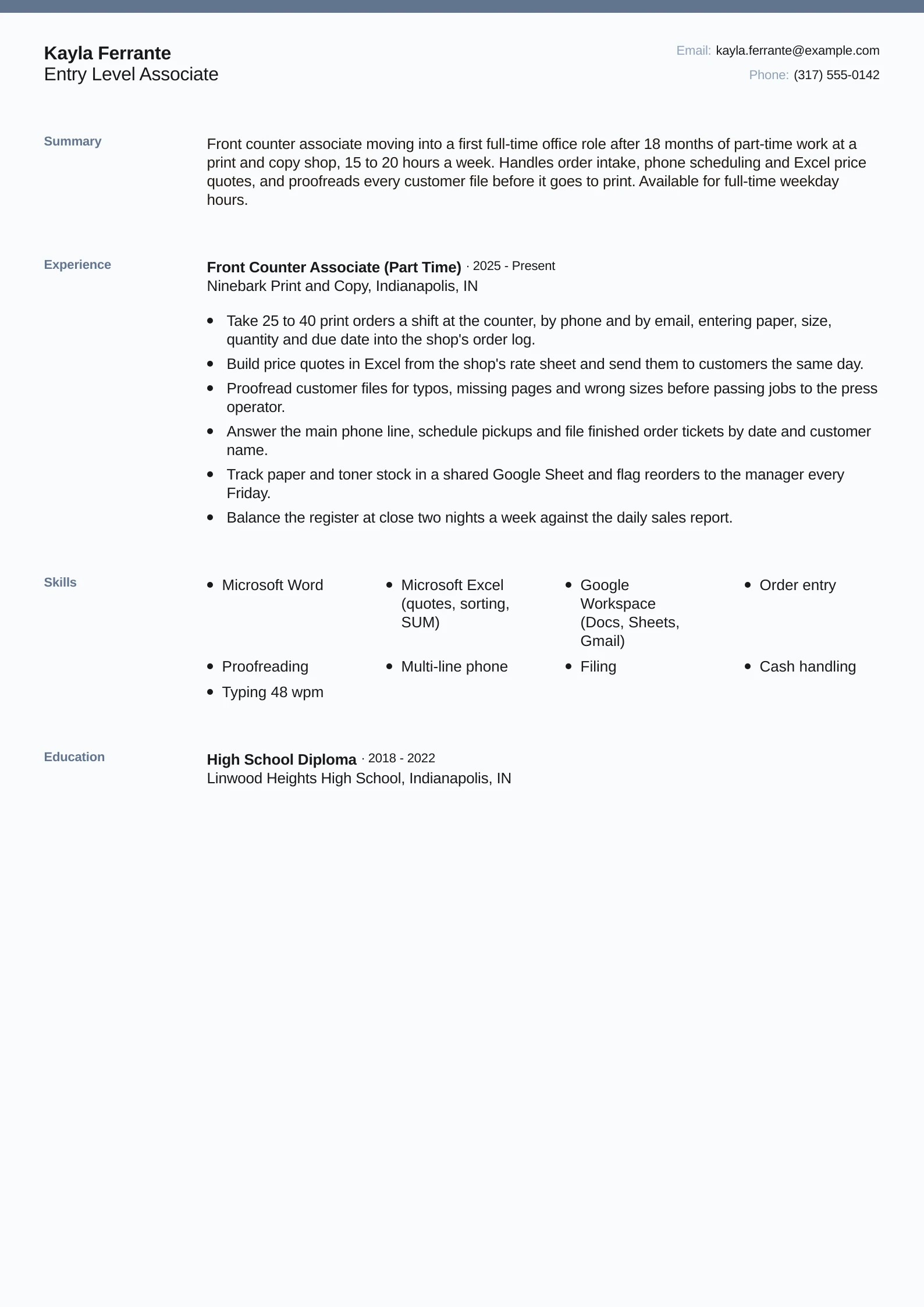
Forklift operator with reach truck and counterbalance experience
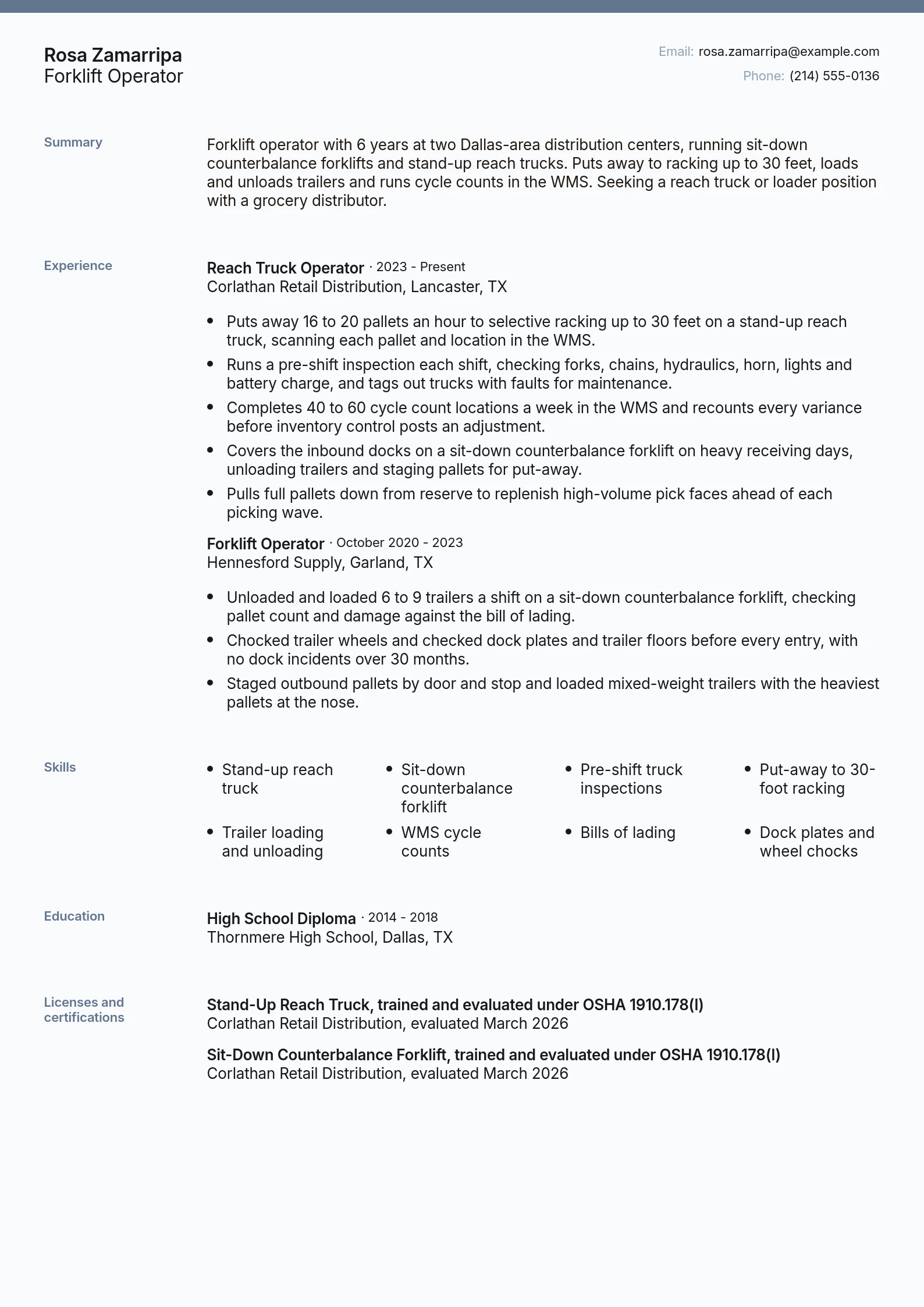
Rosa's resume fits an operator applying for reach truck, loader or put-away jobs. Her title reads Forklift Operator, and each truck type has its own credential line showing the March 2026 evaluation by her current employer. Bullets give pallets put away per hour, racking up to 30 feet, trailers loaded per shift and weekly cycle counts. Pre-shift truck inspections get a bullet of their own.
Separate credential line for each truck type
Put-away rate and rack height in the first bullet
Pre-shift inspection and cycle count bullets
Name the truck, who trained you and the evaluation month
List each powered truck by type, then the employer that trained and evaluated you and the month of your last evaluation. OSHA's forklift rule, 29 CFR 1910.178(l), requires the employer to train, evaluate and certify each operator, so there is no OSHA forklift license or card to list, and 'OSHA certified' is the wording to drop.
Write the truck the way postings do: sit-down counterbalance forklift, stand-up reach truck, order picker, electric pallet jack. A selector ad that asks for electric pallet jack experience is looking for those words, and a reach truck opening wants 'reach truck' by name, not a general 'forklift'.
Give each truck its own line in the credentials section, then show the work in a bullet: put-away height, trailers loaded per shift or pallets moved per hour. Rosa's resume lists two trucks, each evaluated by her current employer in March 2026.
Evaluations repeat at least every three years, so check the date before you copy it. If your last evaluation is older than three years or came from a job you've left, move the truck into skills with the years you ran it, such as 'Sit-down counterbalance forklift, 2019 to 2022'.
Truck type, trainer and evaluation date
Stand-Up Reach Truck, trained and evaluated under OSHA 1910.178(l). Corlathan Retail Distribution, evaluated March 2026.
No truck, no trainer, no date
OSHA Certified Forklift Operator
Put cases or lines per hour beside the site's standard
Give your hourly rate in the unit your site measured, your accuracy from audits and the standard you were held to. 'Fast-paced environment' gives a supervisor nothing to check, while '112 lines an hour against a 95-line standard' shows you clear the bar.
Use the unit from your rate report or the board on the floor: lines or units for e-commerce picking, cases for grocery and freezer selection, orders for packing, trailers for loading and pallets for forklift put-away. Quote the site standard beside your number so a reader from another building can judge it.
Put accuracy in the same bullet as speed or the one right after it. Give pick accuracy as a percent from outbound or loader audits, and add shortages, mis-picks or damage claims when you have a count. A new picker with no rate history can give the standard they met and the week they met it, as Alyssa does.
Job
Speed measure
Accuracy or quality measure
Example bullet
E-commerce picker
Lines or units per hour
Pick accuracy from tote or outbound audits
Averages 112 lines an hour against a 95-line standard at 99.6 percent accuracy
Grocery or freezer selector
Cases per hour
Selection accuracy from loader audits, shortages by route
Selects 150 cases an hour against a 130-case standard
Packer
Orders packed per hour
Pack accuracy, carton choice
Packs 35 to 45 orders an hour, scanning each item against the order
Loader
Trailers per shift
Store or carrier damage reports, load sequence errors
Loaded 3 to 5 store trailers a shift by stop sequence with no store damage reports on 2022 loads
Forklift or reach truck operator
Pallets put away or moved per hour
Location scan accuracy, cycle count variances
Puts away 16 to 20 pallets an hour to racking up to 30 feet
State the case weights, temperatures and start times you worked
Write the physical conditions into the bullets where the work happened: what you lifted, how cold it was and when your shift started. Postings list these as requirements, such as lifting 50 lb frequently and 100 lb occasionally, a freezer at zero degrees, or shifts that start at 3:00 a.m., and a supervisor reads your bullets for proof you've done it.
Give weights as the product you handled: '50 to 80 lb frozen cases', 'bagged concrete with team lifts for 80 lb bags'. Give the temperature with its unit, such as '-10°F freezer' or '34°F cooler', and name the safety training if your site gave one, such as cold stress or layered PPE.
Name the start time and the pattern: '4:00 a.m. starts and every other weekend' or '10-hour Saturdays through peak'. If you worked every scheduled shift of a peak season, or had no unplanned absences through mandatory overtime, make that a bullet with the length of the period.
If your physical work so far is outside warehouses, give the same details from that job. Alyssa's restaurant entry lists unloading the weekly food delivery and rotating walk-in cooler stock, which tells a reader she has lifted cases and handled cold stock.
List agency assignments under the agency, with the client site and dates
Show each staffing agency assignment as its own entry with the agency first, the client warehouse second, and the start and end month. 'Larrabee Staffing, assigned to Verdella Fulfillment Center' tells a reader the short stint was a seasonal agency assignment. A bullet saying you finished it through its scheduled end date answers the next question.
Title each entry with what the assignment was, such as Seasonal Picker or Peak Season Picker and Packer. Use the bullets for what you finished during it: the pick standard you met by week two, a full peak with no missed shifts, or a move into packing to clear an outbound backlog.
If an assignment turned into a permanent job, list the permanent job as a separate entry above it with its own start month and a title such as 'Warehouse Associate (Temp-to-Hire)'. A reader sees the client chose to keep you, which is the strongest attendance evidence an agency worker has.
Some ads prefer two years of consistent work history, so keep the jobs that fill the months between seasons, even outside warehouses. When three or more short assignments came through one agency, you can group them under one agency heading with a dated line for each client site.