Many entry-level ads list a diploma, shift availability, a lifting limit, a driver's license or a typing speed among their requirements, so put those facts where a reader finds them first.
The nine examples aim at office, warehouse, trades helper, phone and county clerical jobs, and each starts from a different history: part-time work, no paid job, short temp jobs, gig work or a GED.
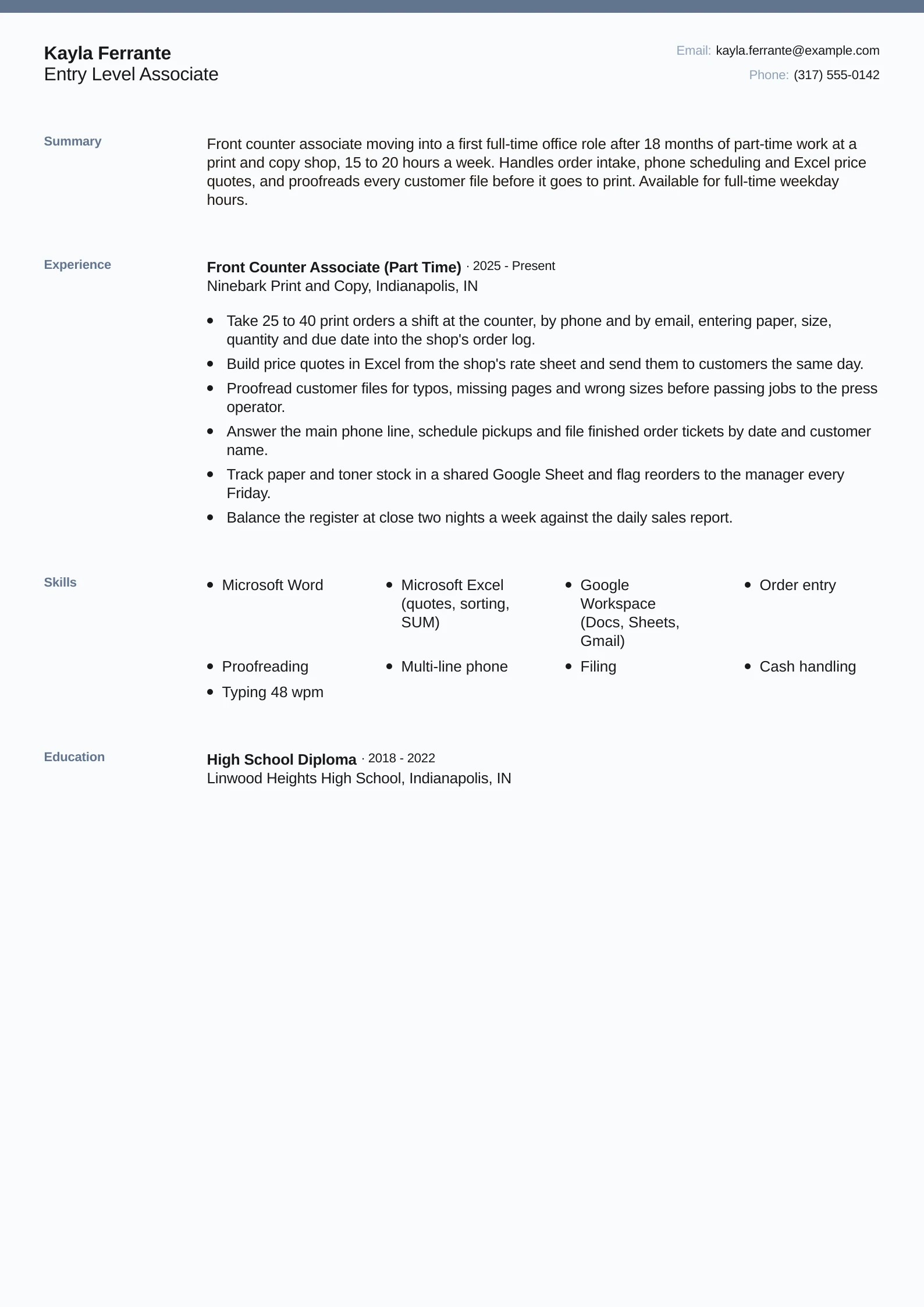
Office assistant resume from 18 months of part-time counter work
Kayla is moving from a part-time print shop counter to a full-time office job. Her summary gives the months and weekly hours, and her bullets turn counter work into office duties: order entry, Excel quotes, phone scheduling, filing and proofreading.
Copy this structure if your only job so far was part-time. Put the hours in the summary, name the software and your typing speed in skills, and end the summary with the schedule you can work.
Eight more starting points for a first full-time job
Pick the example whose history looks most like yours, then adjust its job target to the ad you're answering. If you're finishing college, the student resume examples cover that case.
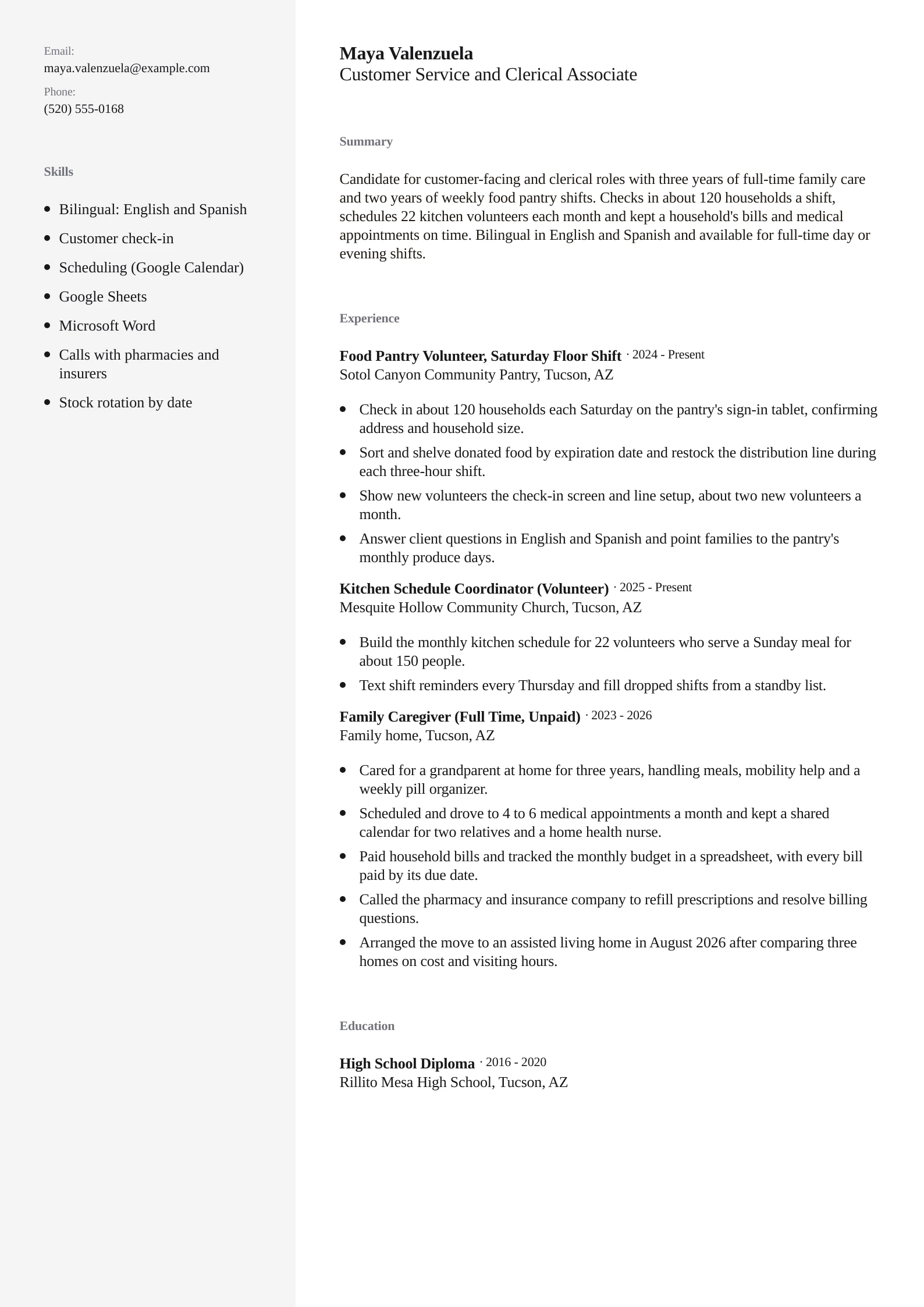
No work history: family care and volunteer shifts
Maya has never held a paid job, so her resume lists three years of full-time care for a grandparent, two years of Saturday pantry shifts and a church kitchen schedule as experience, each with dates and counts. Her summary names 120 households a shift and her English and Spanish. Use this layout if family care or volunteering is your main history and you're applying to front-desk, retail or clerical jobs.
Unpaid caregiving listed with dates and duties
Volunteer check-in counts in the summary
English and Spanish in skills
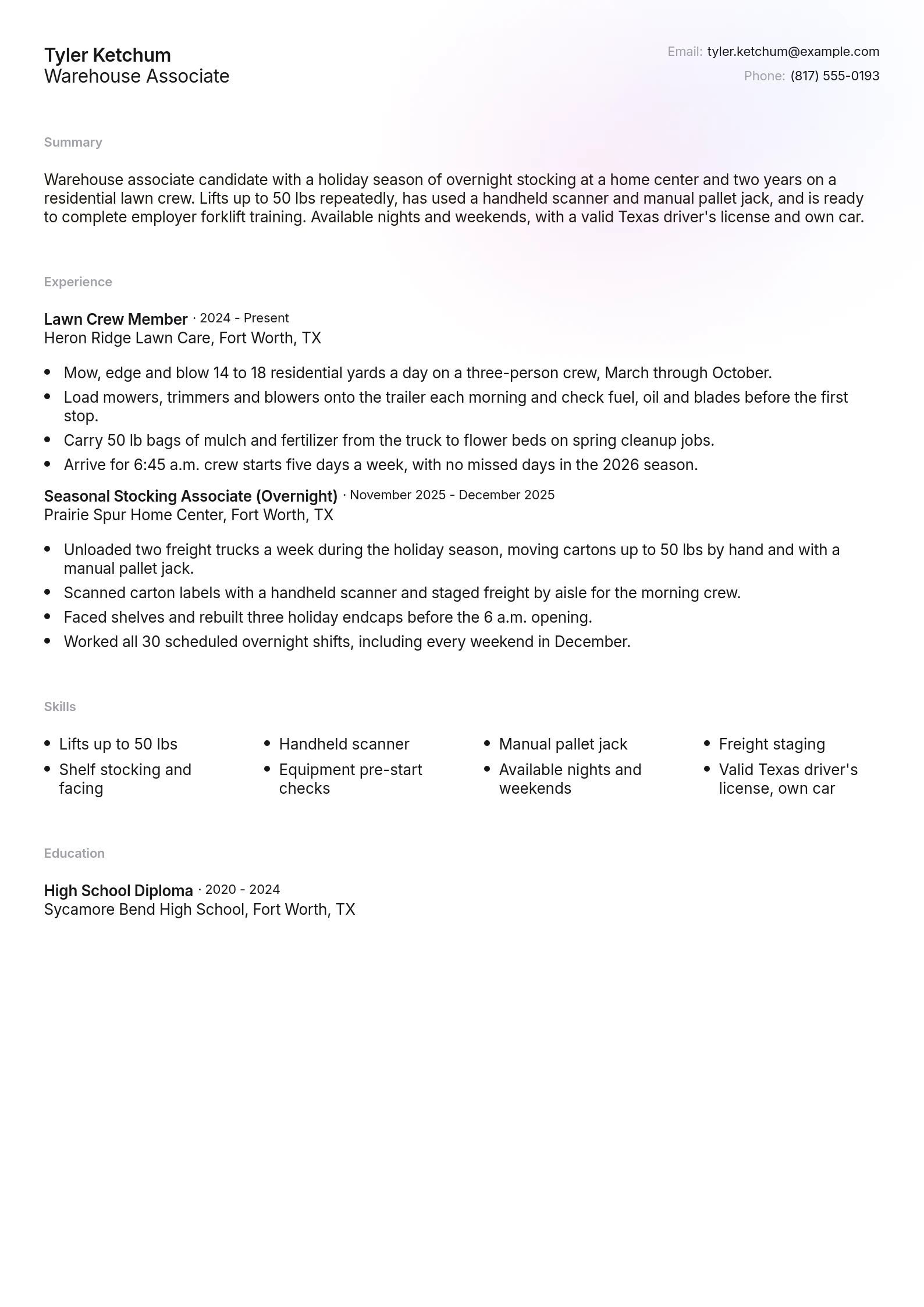
Warehouse associate with a seasonal stocking job and a lawn crew
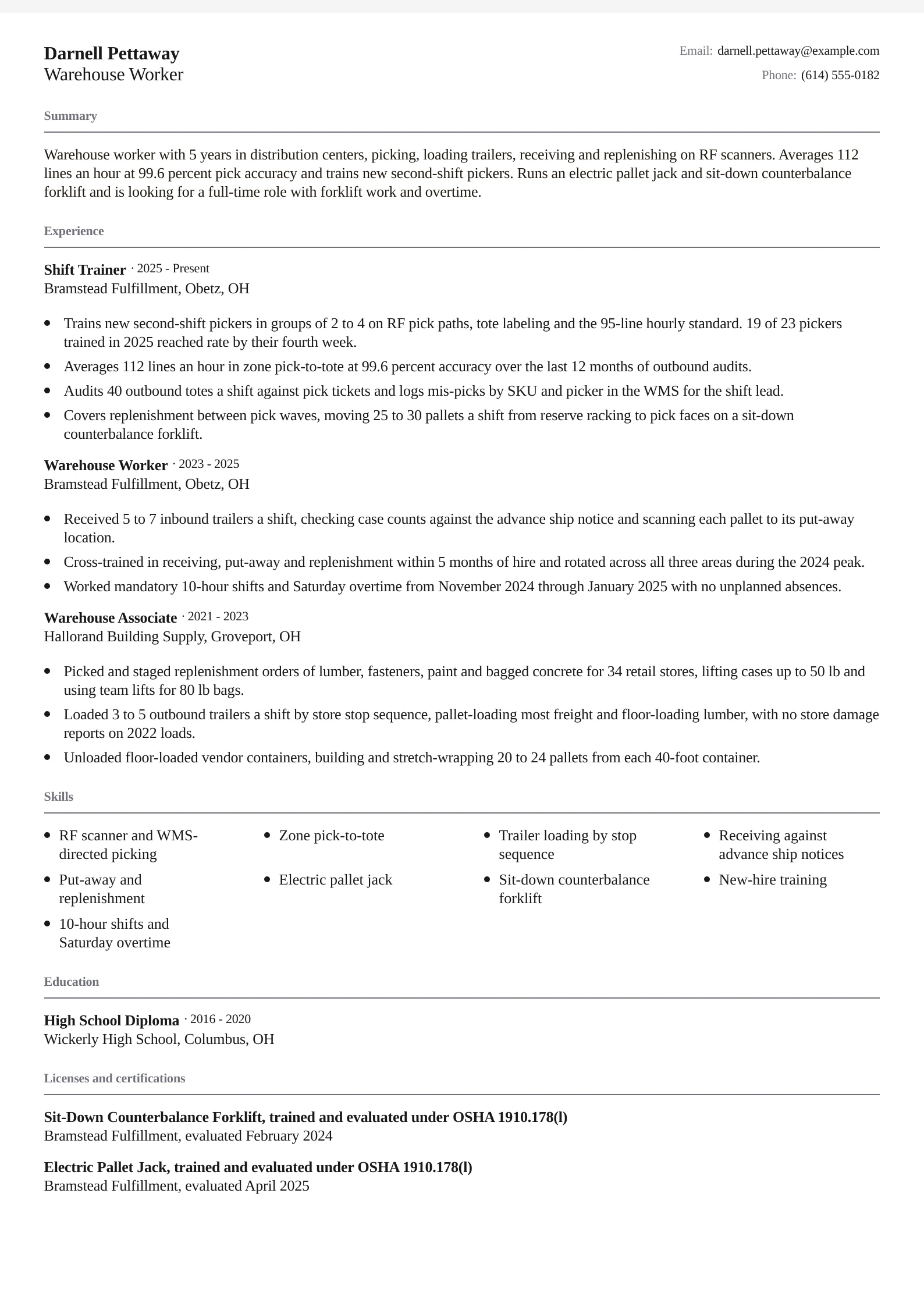
Tyler has one holiday season of overnight stocking and two years on a lawn crew. His summary leads with the facts warehouse screeners check first: lifts up to 50 lbs, available nights and weekends, own car. It names the handheld scanner and pallet jack he has used and says he is ready for employer forklift training. Use it for warehouse, stocking or distribution jobs when you have no warehouse title yet.
Lifting limit, shifts and car in the summary
All 30 scheduled overnight shifts worked
Forklift listed as training he will complete
Electrical helper heading into an apprenticeship
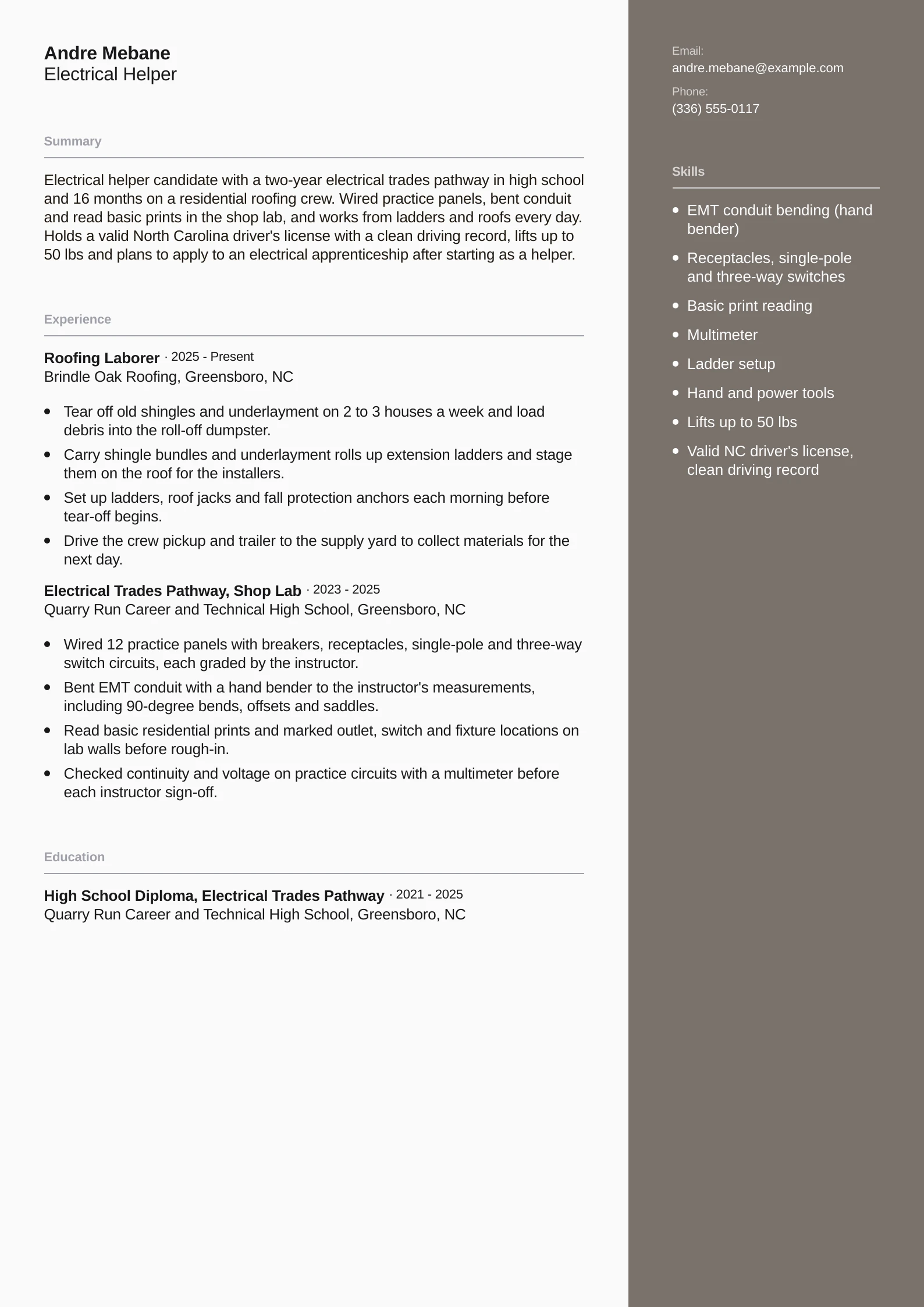
Andre lists his high school electrical shop as its own experience entry, with practice panels, conduit bends, print reading and multimeter checks. His roofing job shows daily ladder and roof work, and his skills give the driver's license, clean record and 50 lb lifting limit that helper ads ask for. Use it if you finished a career-tech program and want to start as a helper before applying to an apprenticeship.
Shop lab work as an experience entry
Driver's license and clean record in skills
Apprenticeship plan in the summary
Front desk resume with a GED and one restaurant job
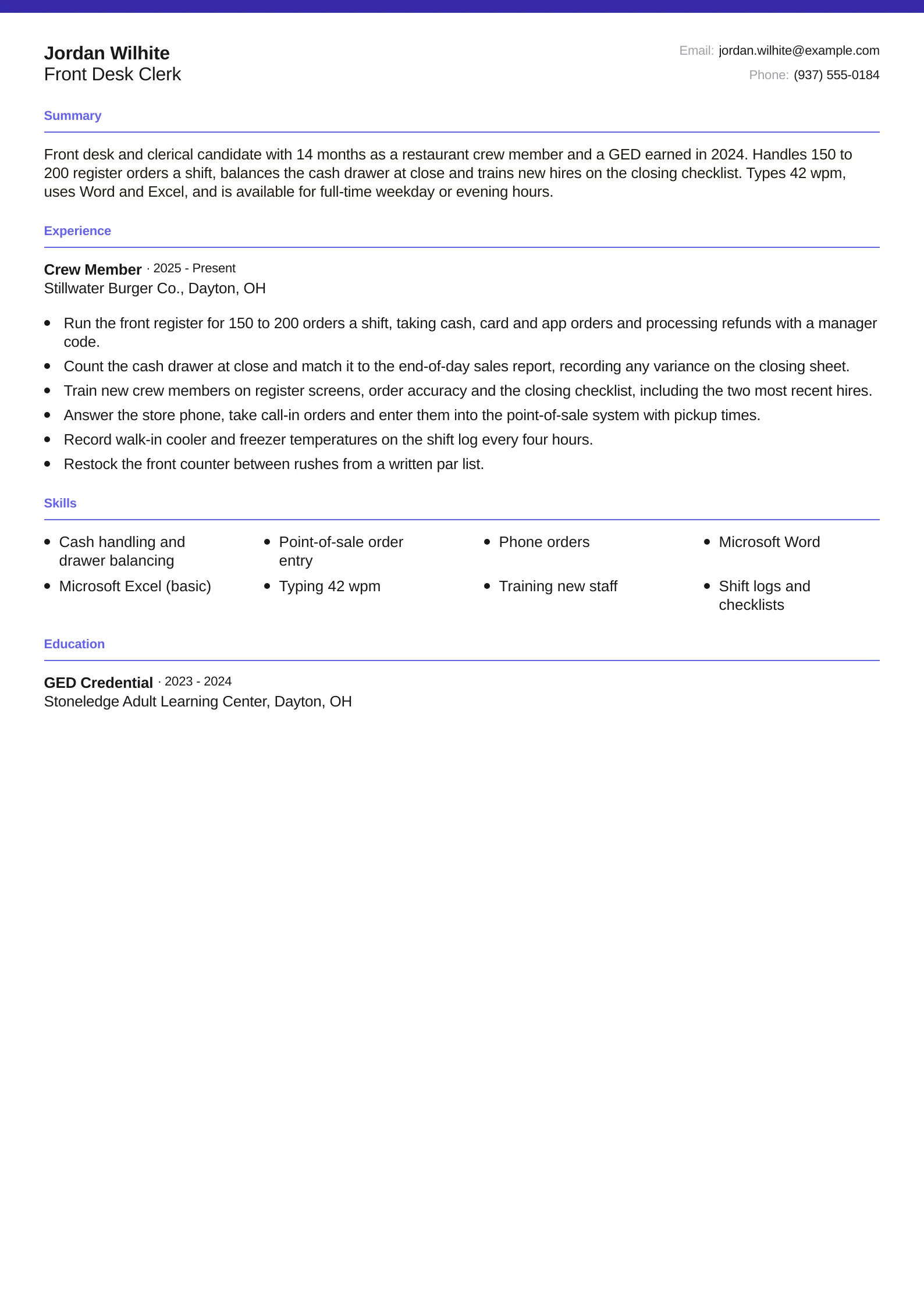
Jordan has a GED and 14 months as a burger restaurant crew member, aimed at clerical and front-desk jobs. The bullets pick the parts of the job that transfer to a desk: cash drawer balancing, phone orders, shift logs and training new hires. The GED sits in education with its year, and the summary adds typing speed, Word and Excel. Use it when the ad asks for a diploma or equivalent.
GED listed with the year earned
Cash drawer and phone orders as clerical proof
Typing speed in skills
County office assistant using the posting's duty words
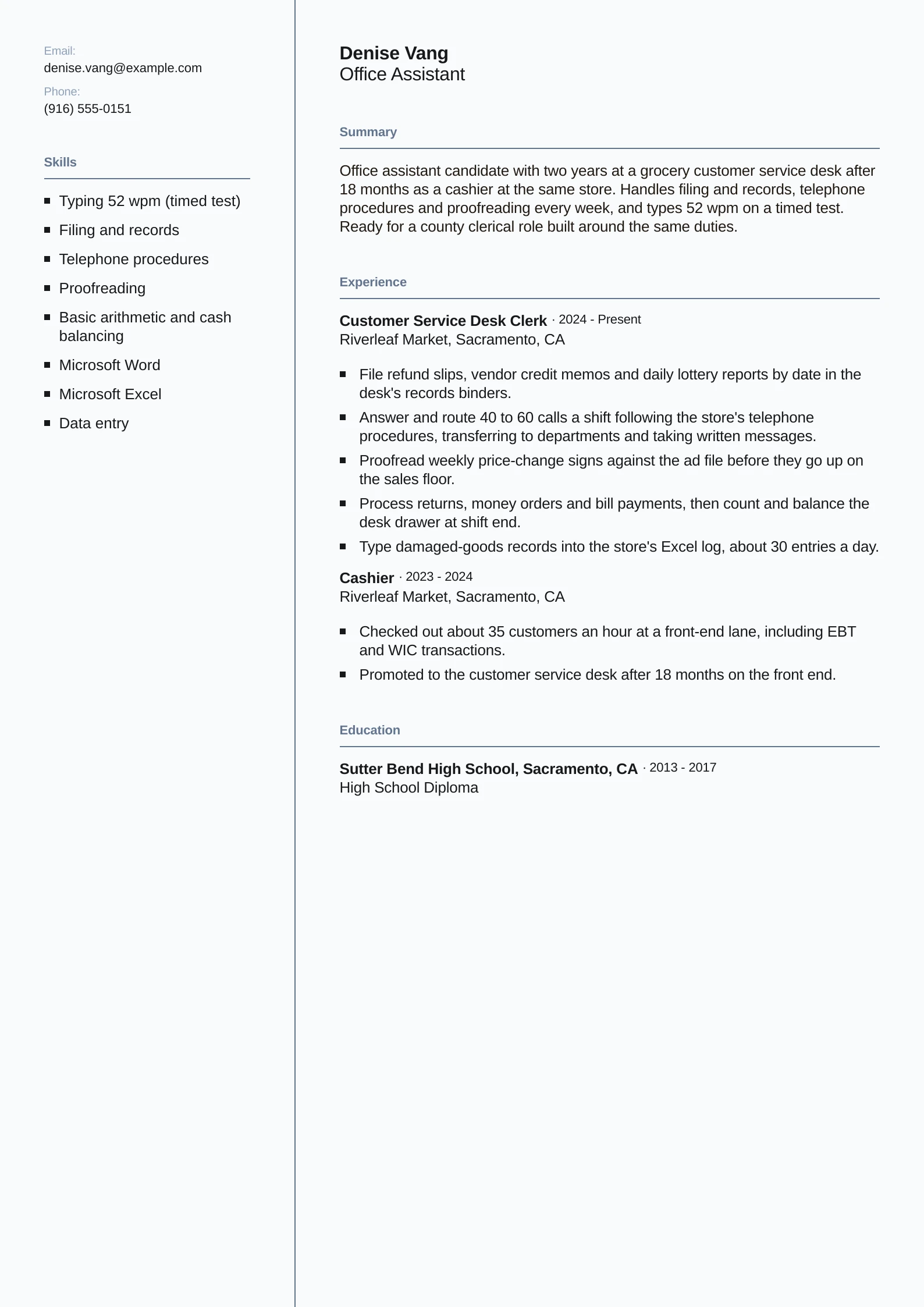
Denise moved from cashier to a grocery customer service desk, and both titles appear under the same store with their own dates. Her bullets and skills reuse duty words a county Office Assistant posting listed: filing, telephone procedures, arithmetic and proofreading. Her skills give a 52 wpm timed typing score. Use it for a public-sector clerical job where a scored questionnaire rates how relevant your experience is.
Promotion shown as two titles at one store
52 wpm timed typing score
Bullets that use the posting's duty words
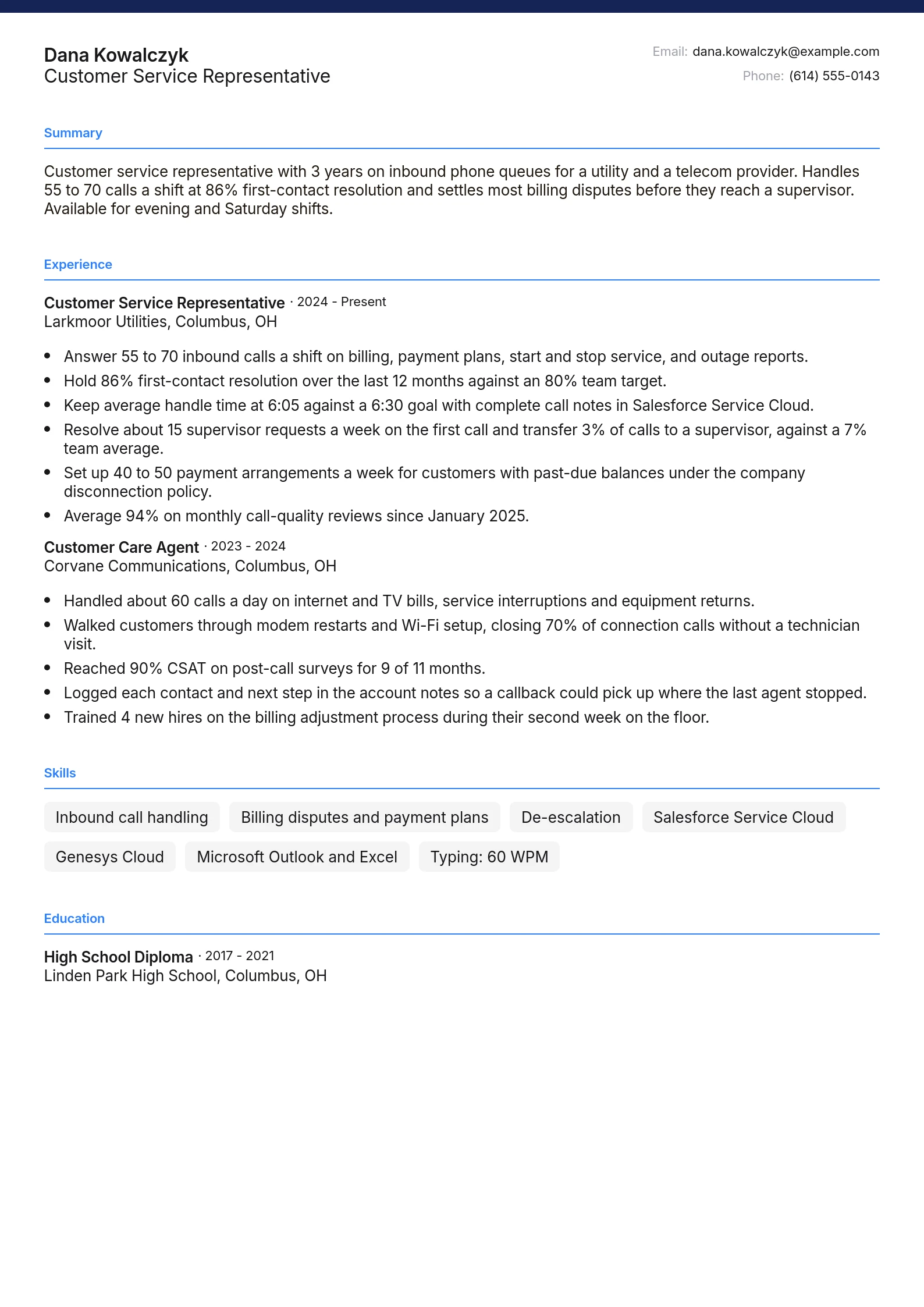
Phone customer service rep coming from a store service desk
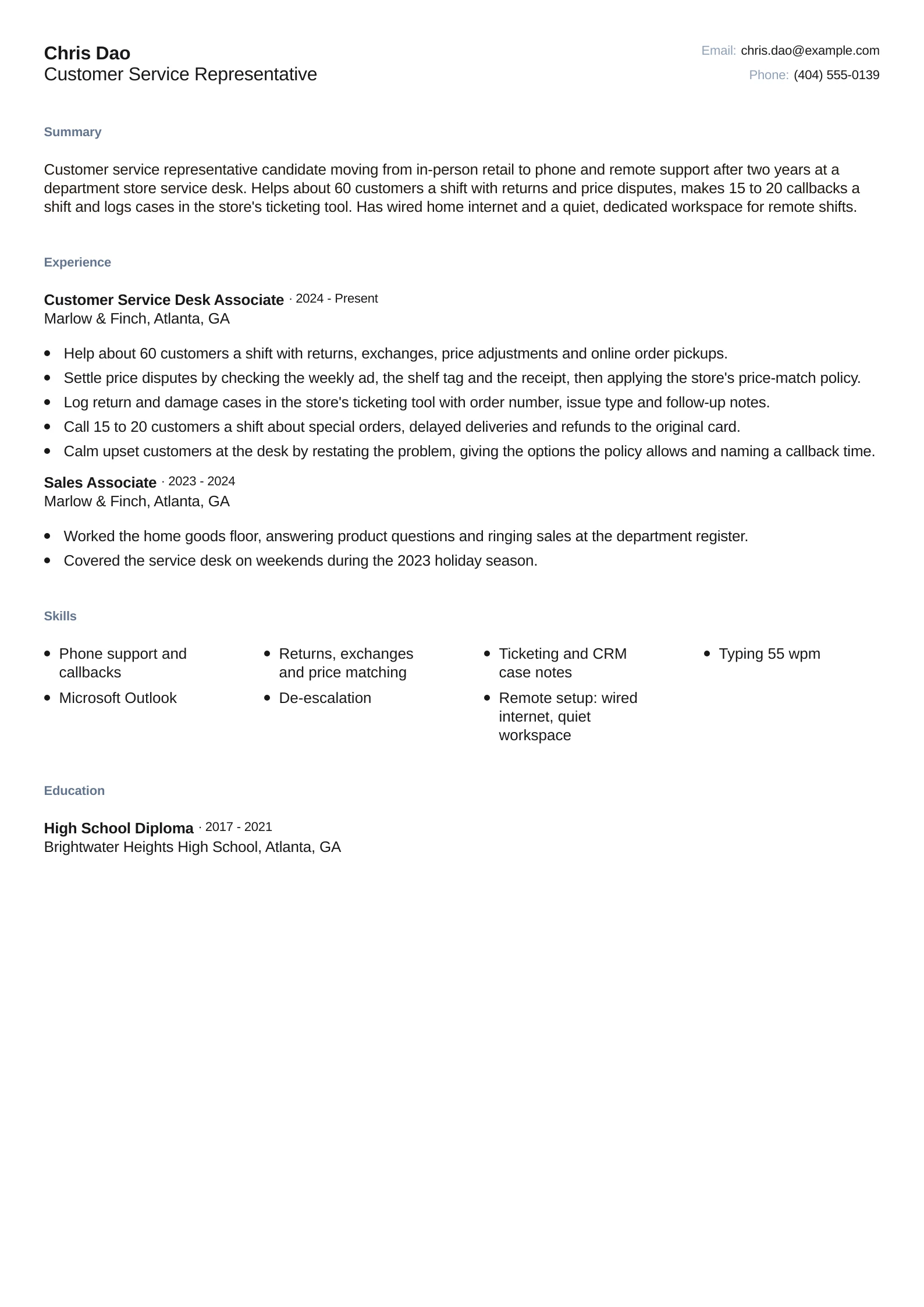
Chris is moving from an in-person department store desk to remote phone support. The bullets count customers and callbacks per shift, show how price disputes get settled, and show cases logged in a ticketing tool. The summary ends with wired internet and a quiet workspace for remote shifts. Use it if you have retail service experience and want your first phone or remote role.
Callbacks per shift counted
Ticketing and CRM case notes in skills
Remote setup named in the summary
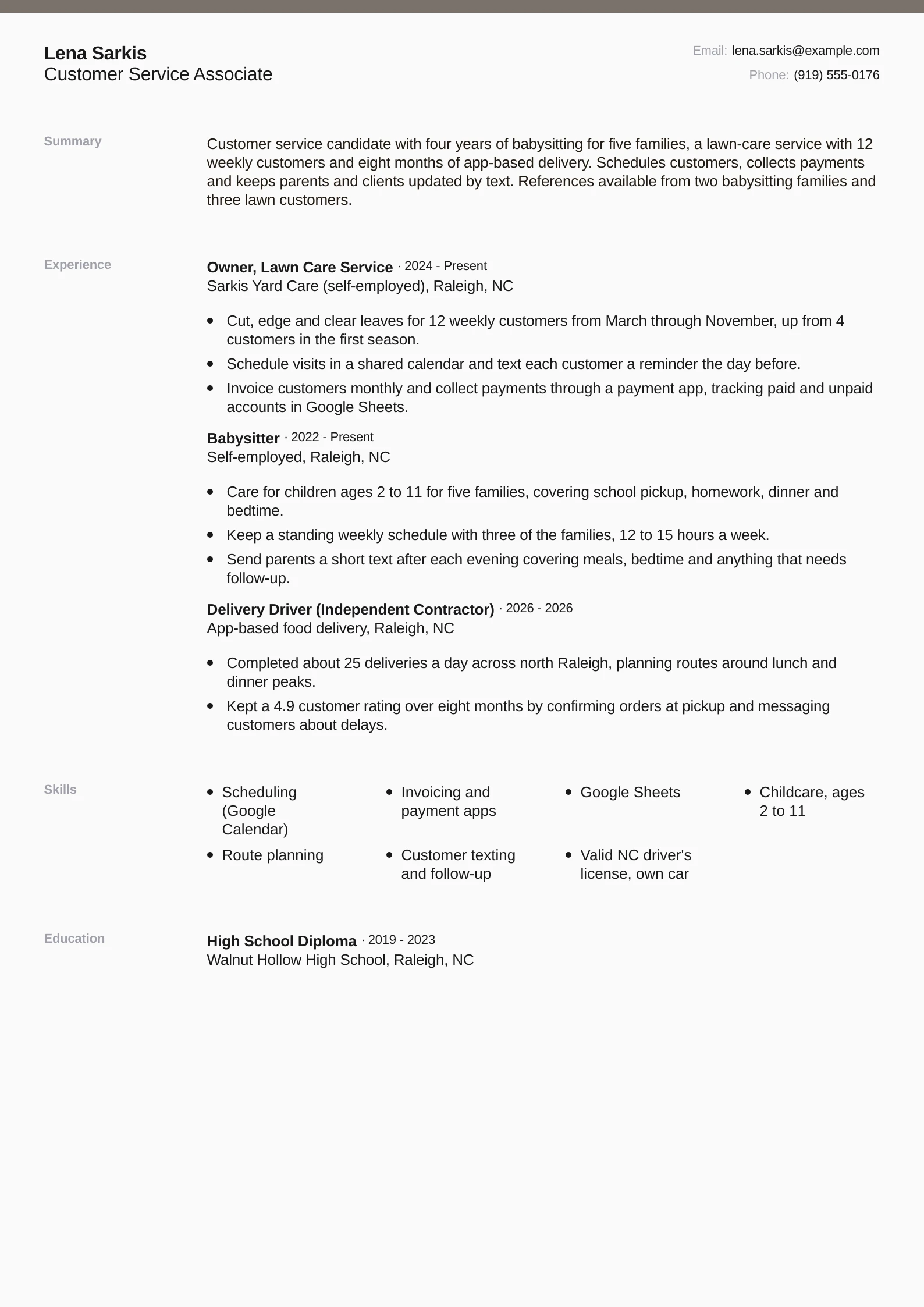
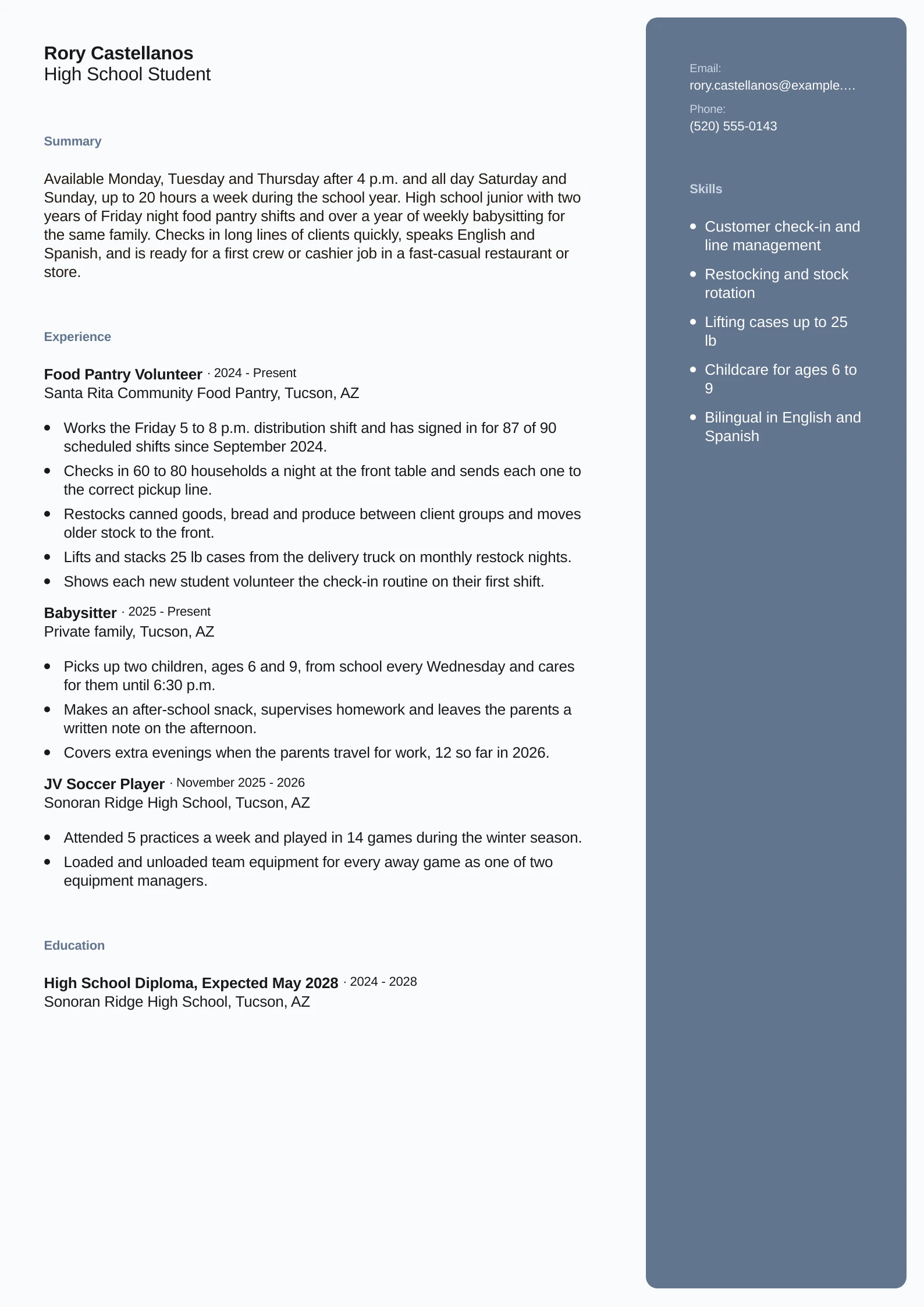
Babysitting, lawn care and gig work as the only history
Lena has never been on an employer's payroll. Her resume gives each kind of work a job title, dates and counts: babysitting for five families, her own lawn-care service with 12 weekly customers, and eight months of app-based delivery. The summary closes with references from families and lawn customers. Use it if your work history is self-employment, side jobs or gig apps and you want each one to read as a real job.
Self-employment written as named jobs
Customer counts and a delivery rating
References offered in the summary
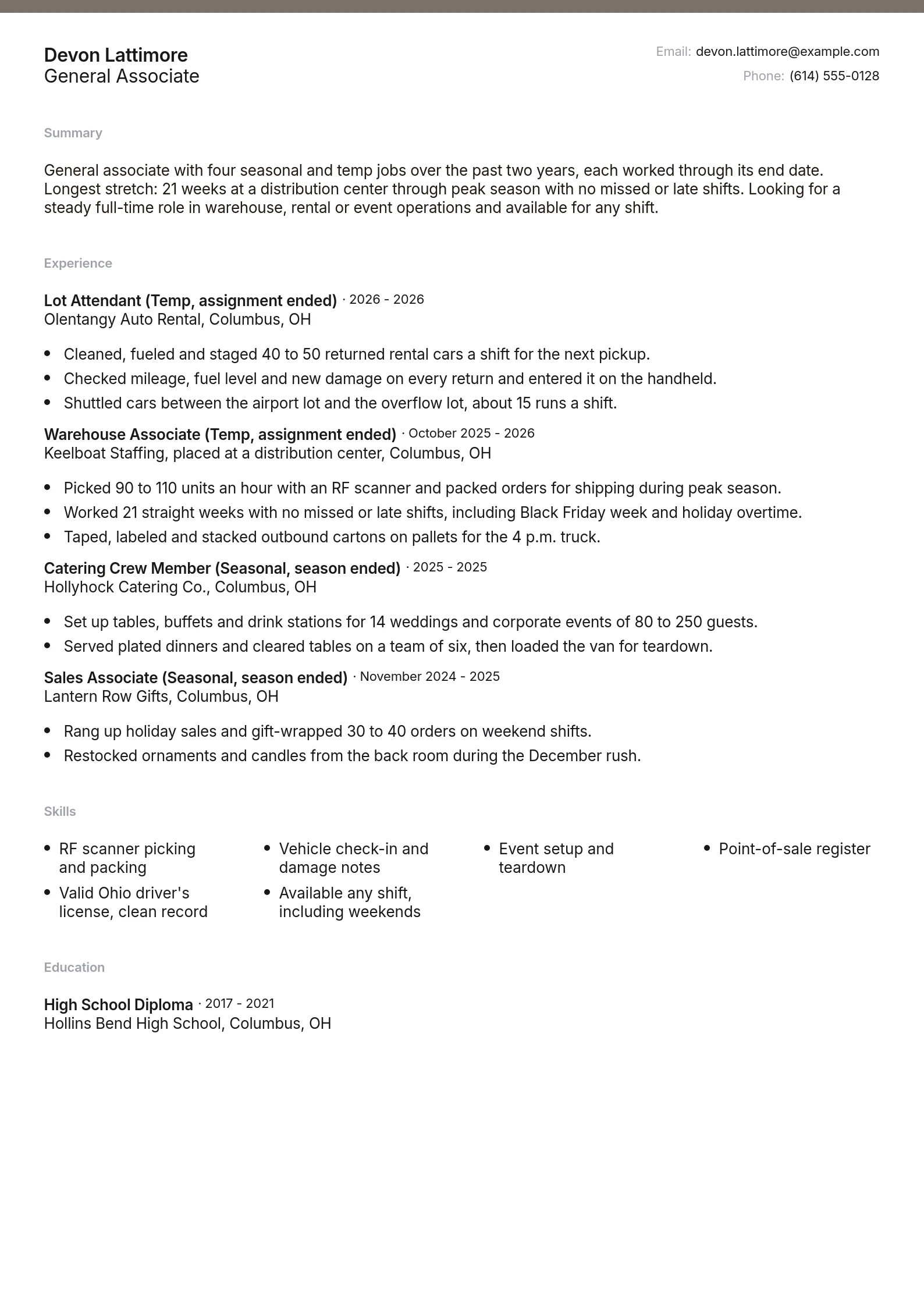
Four short seasonal and temp jobs, now looking for steady work
Devon has held four jobs in about two years, each under six months. Every title says seasonal or temp and how it ended, so a hiring manager doesn't have to guess why it was short. The summary leads with the longest stretch, 21 weeks through peak season with no missed or late shifts. Use it if short assignments make up most of your history and you now want one steady job.
Seasonal or temp and end reason in each title
Longest attendance stretch in the summary
Any-shift availability in skills
Prove you show up with months, hours and what you were trusted with
A first-job resume shows reliability through tenure, schedule and trust, so put all three on the page. Write the months and weekly hours for every role. "15 to 20 hours a week for 18 months" tells a hiring manager more than "part-time."
Name what you were trusted with. Closing the register, counting the drawer, training new hires and opening at 6 a.m. are reliability facts, and Jordan's restaurant resume uses most of them. If a manager moved you from cashier to the service desk, list both titles under the employer with their own dates, as Denise does.
Put availability in the summary in the words the ad uses: "available nights and weekends," "full-time weekday hours" or "any shift." Warehouse, retail and restaurant ads often name the shifts they need, so match their wording.
With no paid job, count regular commitments as experience. Two years of Saturday pantry shifts and three years of daily care for a grandparent show the habits a store or office wants, so list them with dates and numbers, as Maya does.
If you have several short jobs, label each one seasonal or temp in the title and say how it ended. Then give your longest unbroken stretch in the summary, such as Devon's 21 weeks with no missed or late shifts.
Match your history to the experience level the ad names
Entry-level ads differ on experience, so read the requirements line before you write. One electrical helper ad said no previous electrical experience was required, while a home-improvement retailer's front-desk ad required previous customer service experience. If an ad gives a short range of years instead, count every dated job you have held.
Find which of these three the ad uses, then build your experience section to answer it.
What the ad says
What you can count
What to lead with
Closest examples
No experience required, training provided
Steady commitments: a school shop program, family care, volunteer shifts, a lawn crew
Eligibility facts, availability and the one activity closest to the job
Andre (electrical helper), Tyler (warehouse), Maya (no work history)
A short range, such as 0 to 2 years
Part-time, seasonal and temp jobs, gig work and self-employment, each with dates
Total months of related work in the summary, such as "14 months handling a cash drawer"
Jordan (GED), Lena (informal work), Devon (short temp jobs)
Previous customer service or office experience required
Work where you served customers directly: service desks, counters, phone orders, pantry check-in
A title and bullets that use the ad's own words, such as "customer service" and "order entry"
Kayla (office), Chris (phones), Denise (county clerical)
Put diploma, shift, lifting, license and typing facts where screeners look
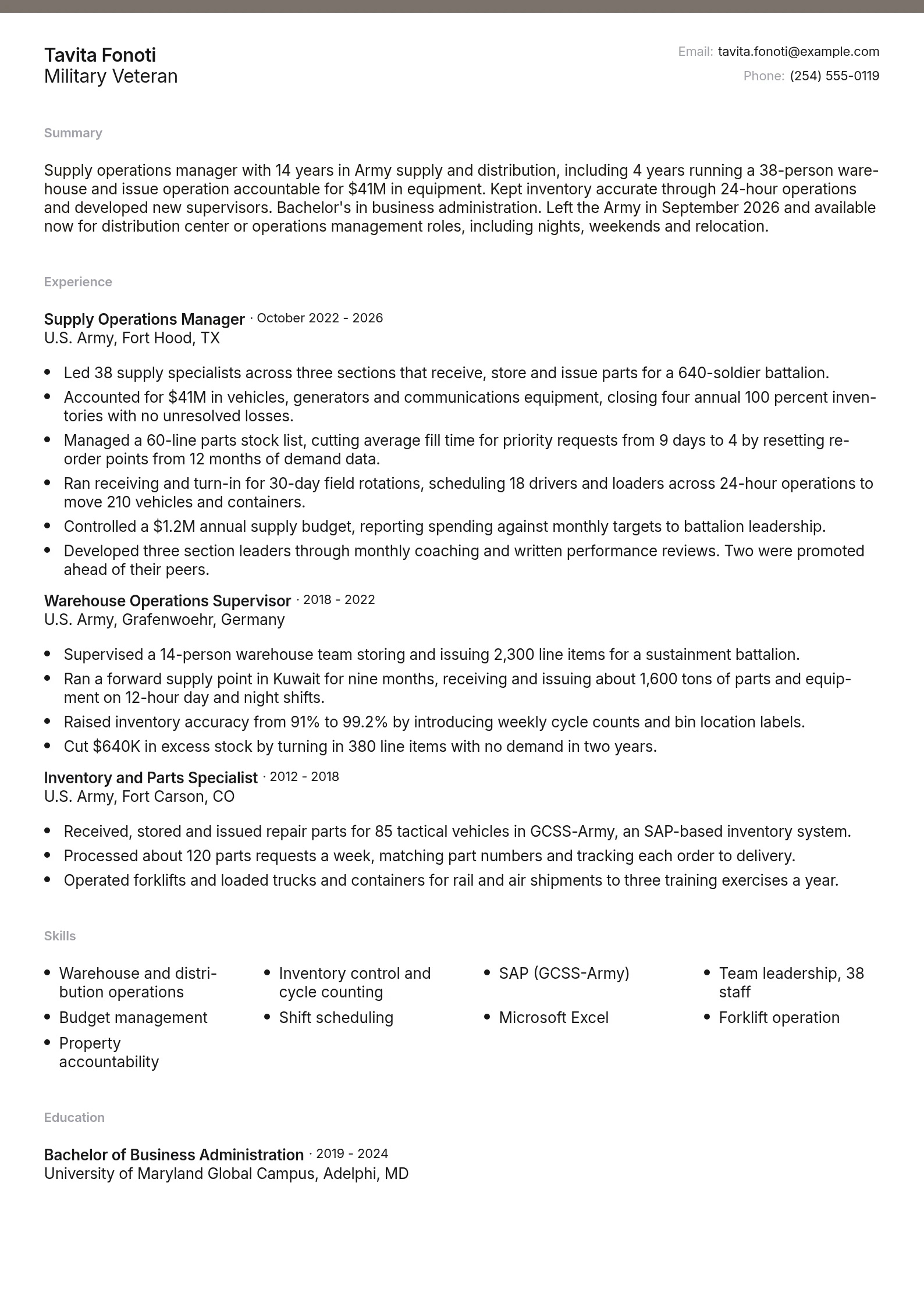
Put each fact the ad lists as a requirement in your summary or near the top of your skills, in the ad's own words, so a screener can check it off in seconds. Use real numbers: the lifting limit the ad states, your tested typing speed and the state on your license.
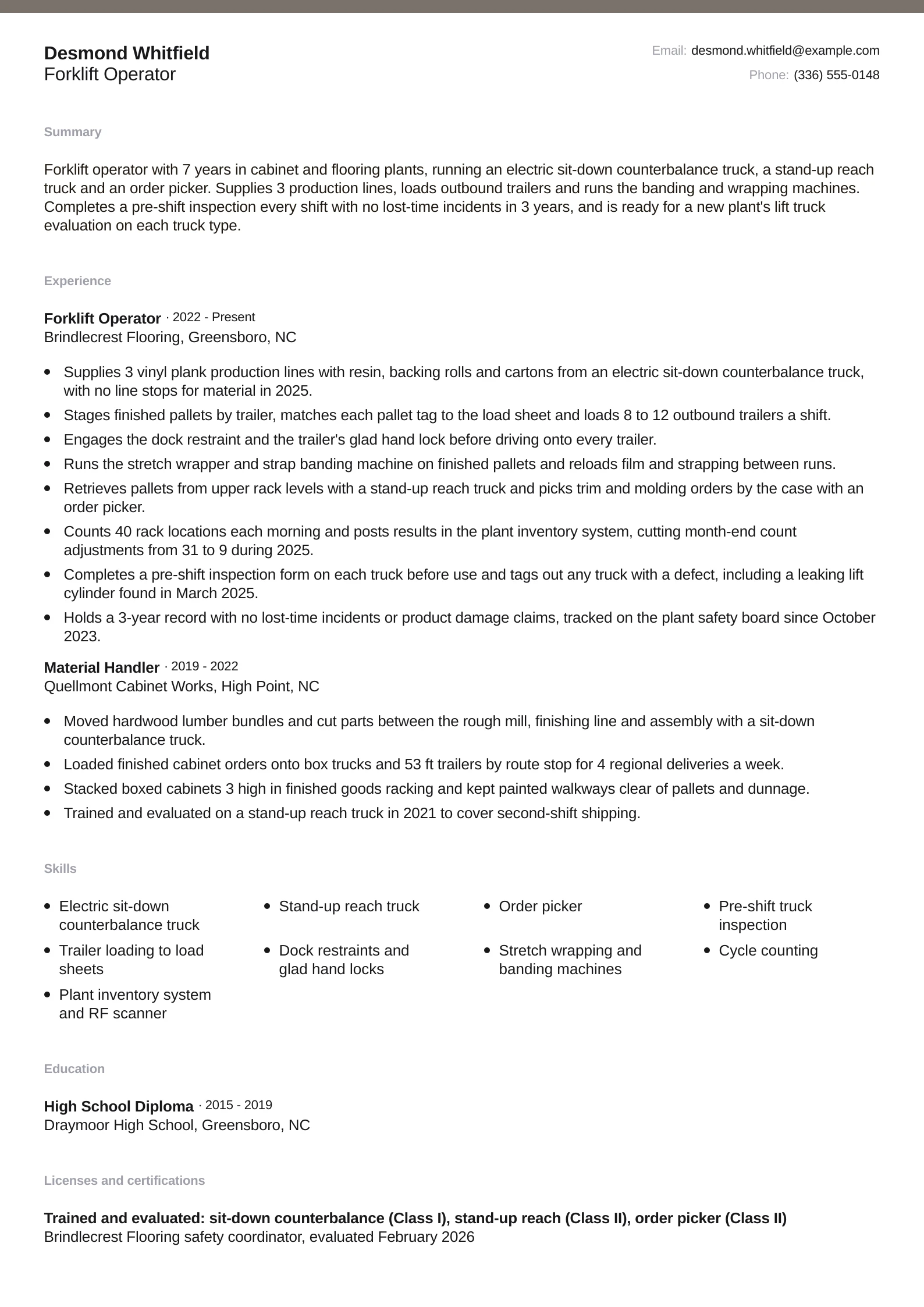
Forklift is the one fact that changes wording. Employers train, evaluate and certify their own forklift operators, so write "ready to complete employer forklift training" or "trained on the job," never "licensed."
Fact
Jobs that screen for it
How to write it
High school diploma or GED
Office, front desk, apprenticeships
List it in education with the year, such as "GED credential, 2024." Repeat it in the summary only when the ad lists it as a requirement.
Shifts and weekends
Warehouse, retail, restaurants, rental lots
"Available nights and weekends" or "Available for day or night shift" as the last line of the summary
Lifting limit
Warehouse, stocking, trades helper
"Lifts up to 50 lbs" in skills, matching the number in the ad
Driver's license and driving record
Trades helper, delivery, rental lots
"Valid NC driver's license, clean driving record" in skills. Add "own car" when the ad asks for reliable transportation.
Typing speed
Office, county clerical, phones
"Typing 52 wpm (timed test)" in skills, using the score from a test you took
Named software or equipment
Office, phones, warehouse
The tool and what you did with it, such as "Excel price quotes" or "handheld scanner"
Borrow the ad's duty words for work you have actually done
Use the ad's own duty words for tasks you have done, and attach each one to a count, a tool or a schedule. A Sacramento County Office Assistant posting, for example, listed filing, telephone procedures, keyboard skills, basic arithmetic and proofreading among its duties and skills. Denise's bullets use those words for her grocery desk work.
For a tool you have used only briefly, describe what you did with it. "Log return and damage cases in the store's ticketing tool" matches "ticketing" in a phone ad and is easy to talk about in an interview. If you have never used a named tool, list the closest one you know, such as Google Sheets for an Excel ad.
Trades and warehouse ads have their own duty verbs. Use them where they're true: "bent EMT conduit," "read basic residential prints," "staged freight by aisle," "scanned carton labels."
Duty words tied to real work
File refund slips, vendor credit memos and lottery reports by date, and route 40 to 60 calls a shift following the store's telephone procedures.
Duty words listed as claims
Proficient in Microsoft Office, filing and phones. Detail-oriented team player with strong customer service skills.
Choose a template with a skills column beside your experience
Most entry-level resumes work best in a one-page template with a skills column beside the experience section. Your lifting limit, shifts, license and typing speed then sit next to your jobs, where a screener sees them in the first pass.
For office, county and phone jobs, use a clean design like the one on Kayla's, Denise's and Chris's resumes, with a colored header and skills shown as tags. A plain left-column design like Maya's or Jordan's suits front-desk and clerical jobs where a manager may print the page.
For warehouse and trades helper jobs, pick a tighter layout like Tyler's and Andre's. Its smaller type and spacing fit a crew job, a shop program and a full skills list on one page.
If your history is self-employment or gig work, a right-column design like Lena's moves education and skills to the side and leaves the main column for your three self-run jobs. Whatever you pick, skip photos and skill-rating bars, because they take space from the facts an entry-level screener checks.