Supervisors hiring janitors want to know your building type, how much floor you cover per shift, which machines you run and when you work, and a list of chores answers none of that.
The five examples cover an office night route, a school custodian, a cheese plant, a first janitor job and a crew lead, each with the training and clearances its building asks for.
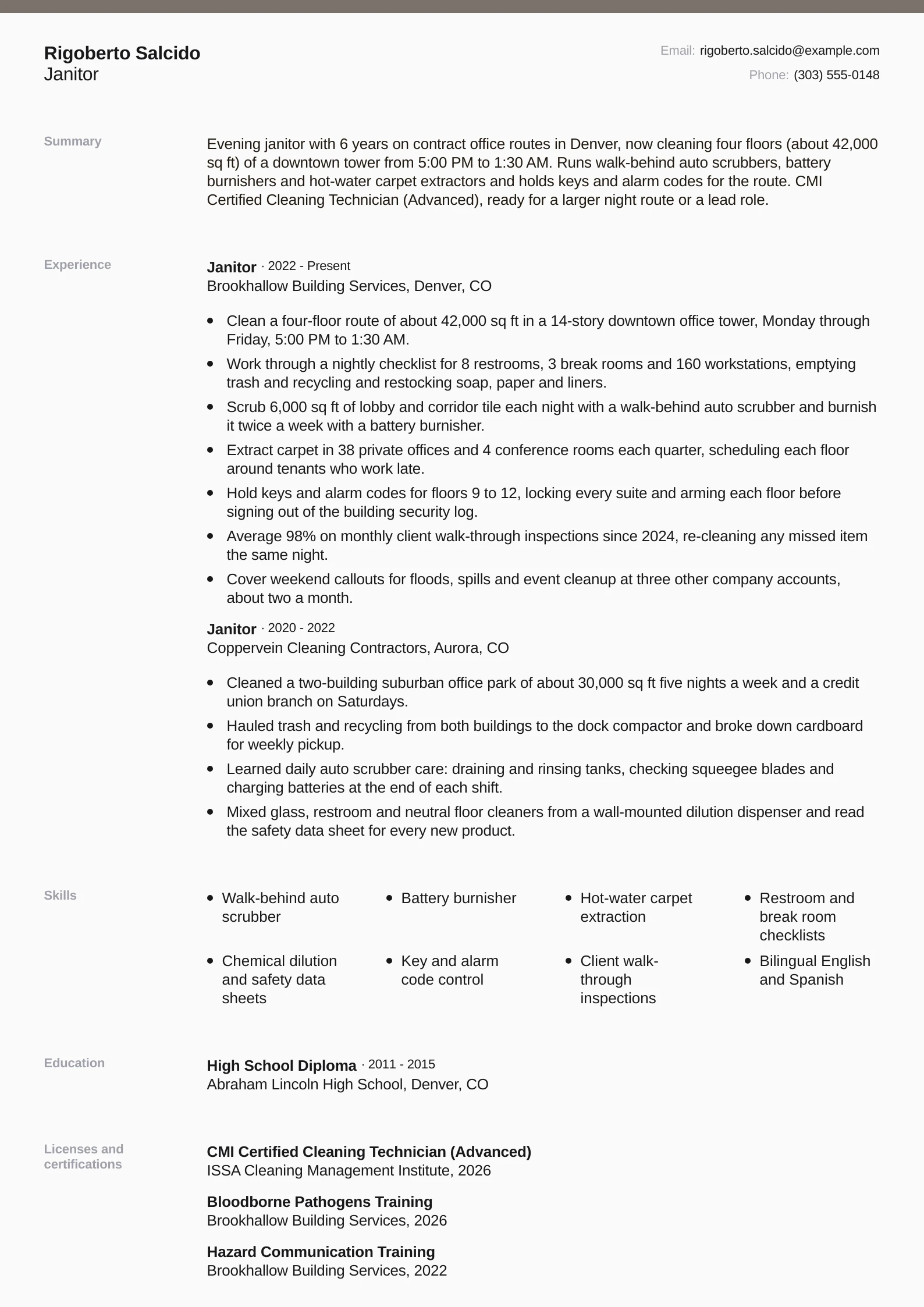
Rigoberto's resume is the closest match for most janitors: a contract cleaner, an office building and a shift that runs past midnight. His first bullet gives the building, the four floors, the square footage and the hours, so a supervisor can picture the route before reading anything else.
Notice how the machines and the keys appear as nightly work with numbers attached, and how his CMI certificate and two employer trainings sit in credentials with their years.
School, plant, first-job and crew lead versions
Pick the example whose building and experience match yours, then swap in your own route, shift and machines. Each one names different equipment and screening items, so copy from the one closest to the job you're applying for.
School custodian on second shift
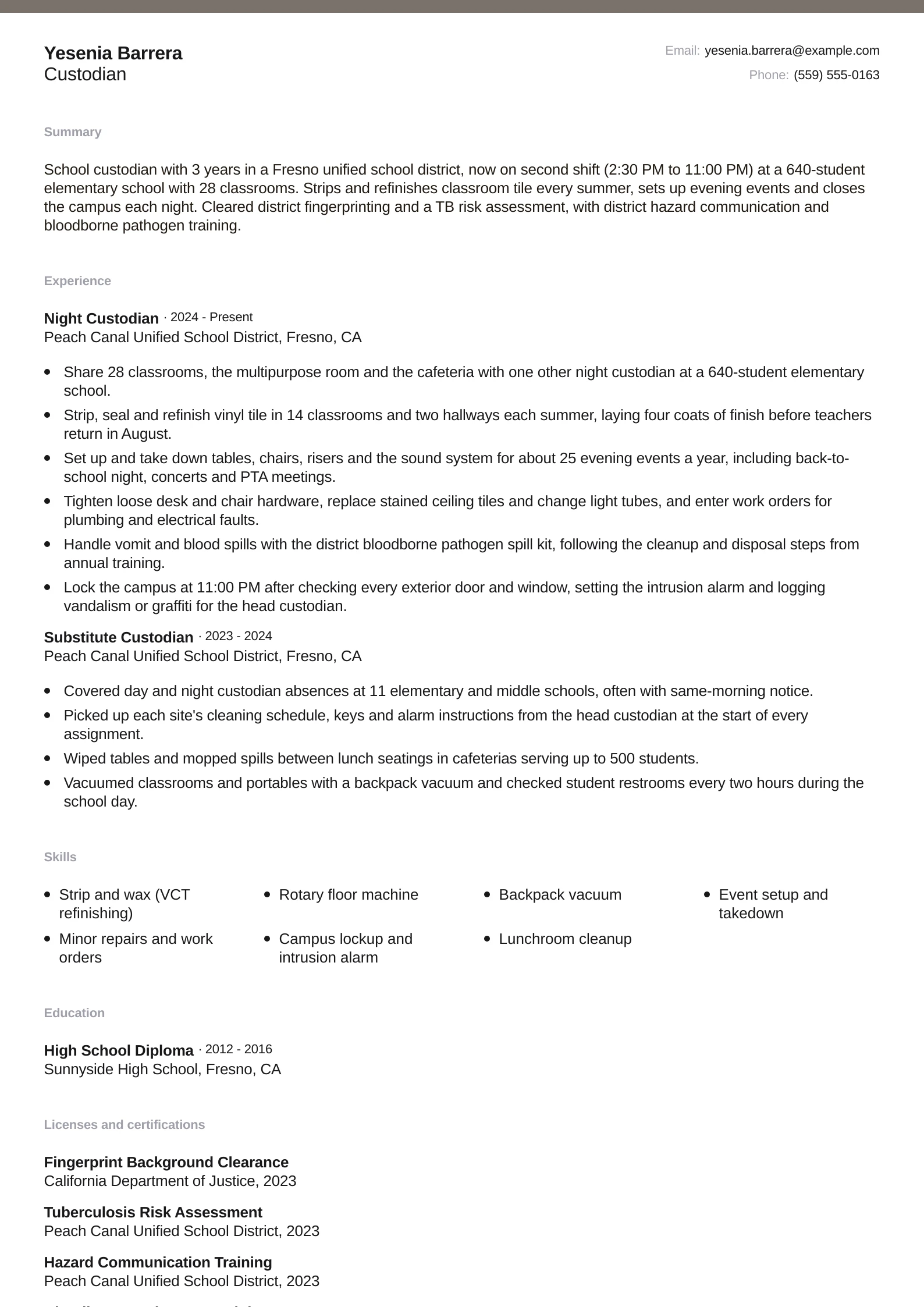
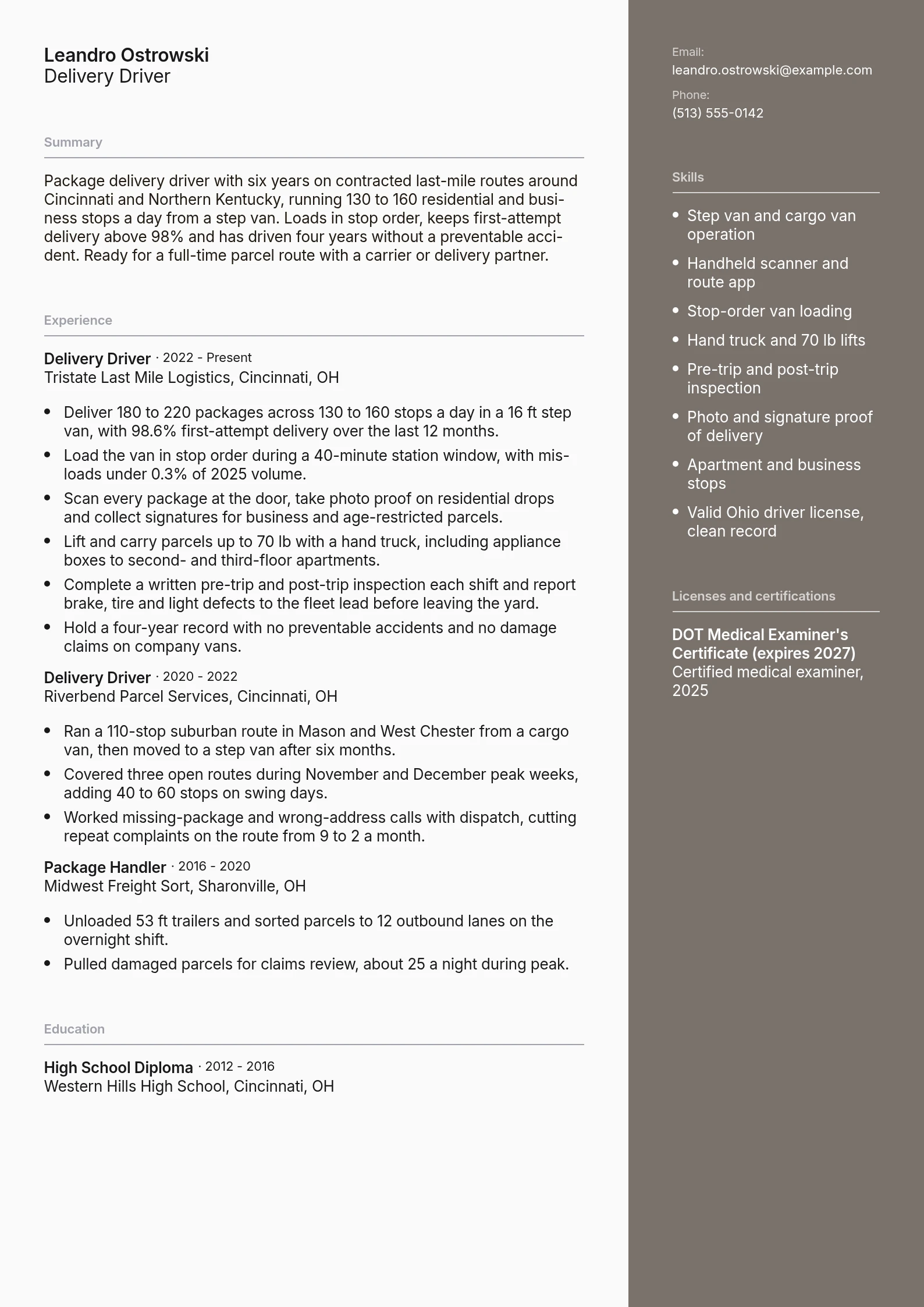
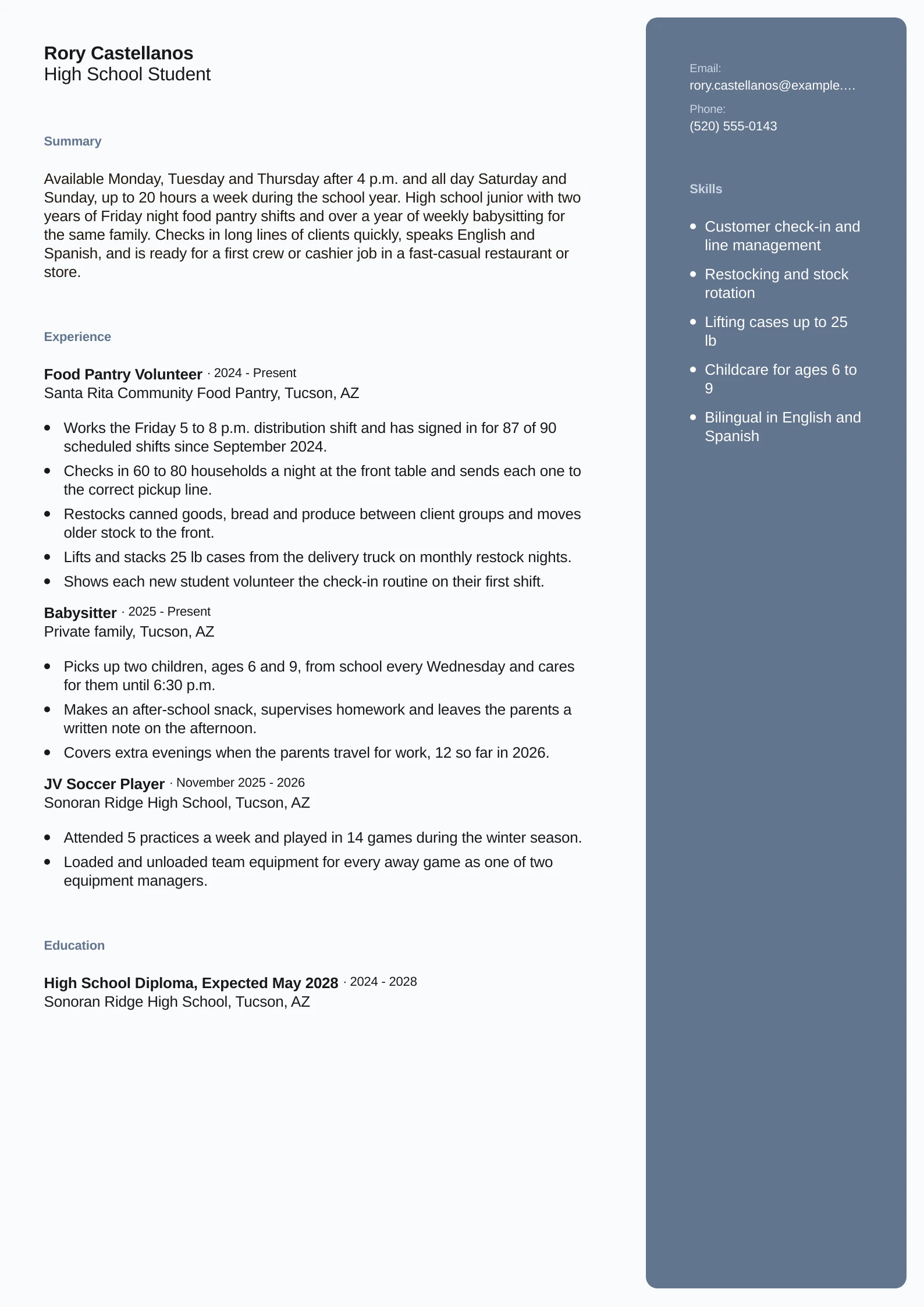
Yesenia's resume uses Custodian, the title most school districts post, and opens with a 2:30 PM to 11:00 PM shift at a 28-classroom elementary school. It lists summer strip and wax with coat counts, evening event setup and nightly campus lockup. Her fingerprint clearance and TB risk assessment sit in credentials with the year cleared. Use it if you clean a school or college, or want to move to a district from a contract cleaning job.
Summer strip and wax in 14 classrooms with four coats of finish
Fingerprint clearance and TB risk assessment listed with years
About 25 evening events set up and taken down a year
Plant janitor in food production
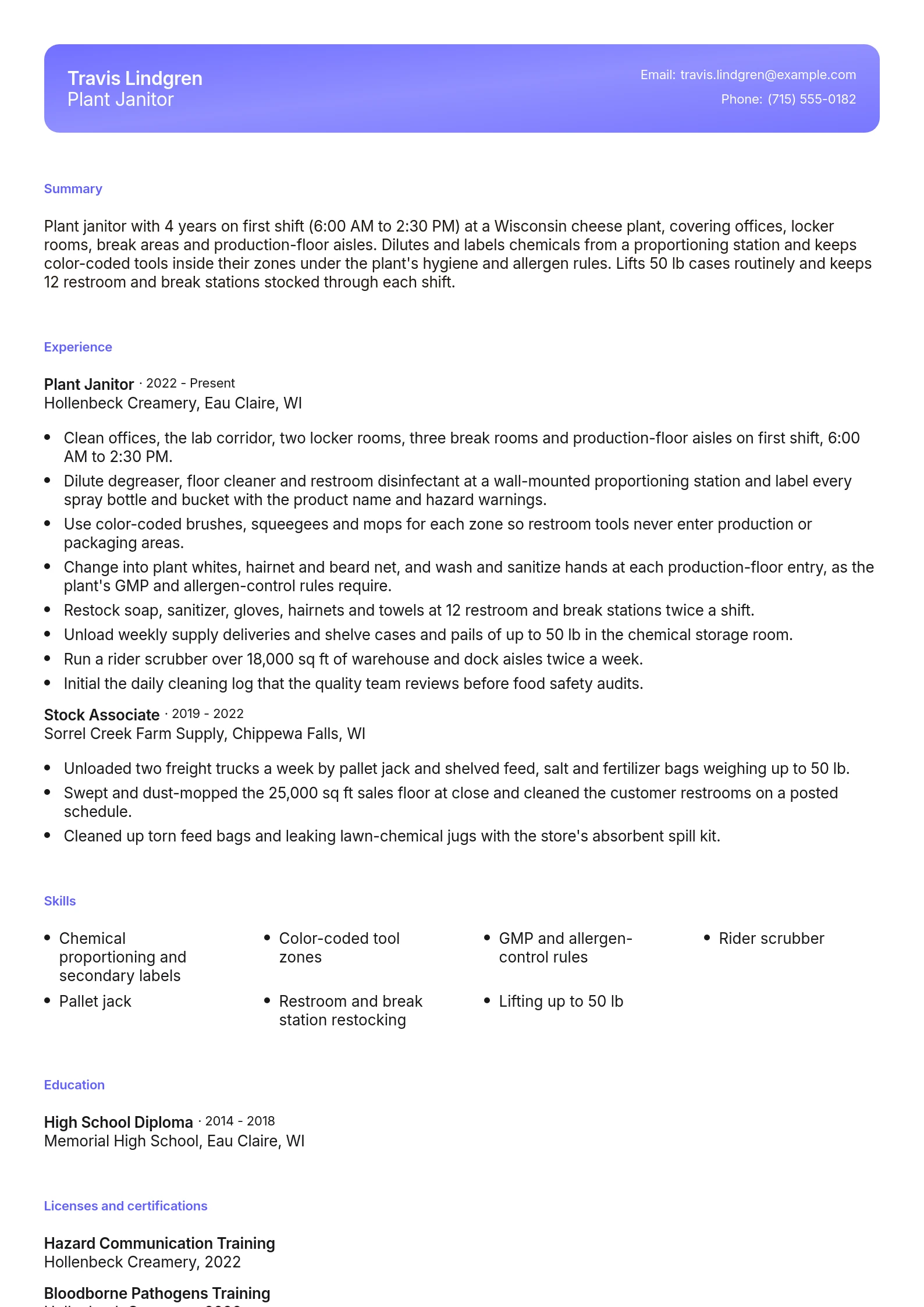
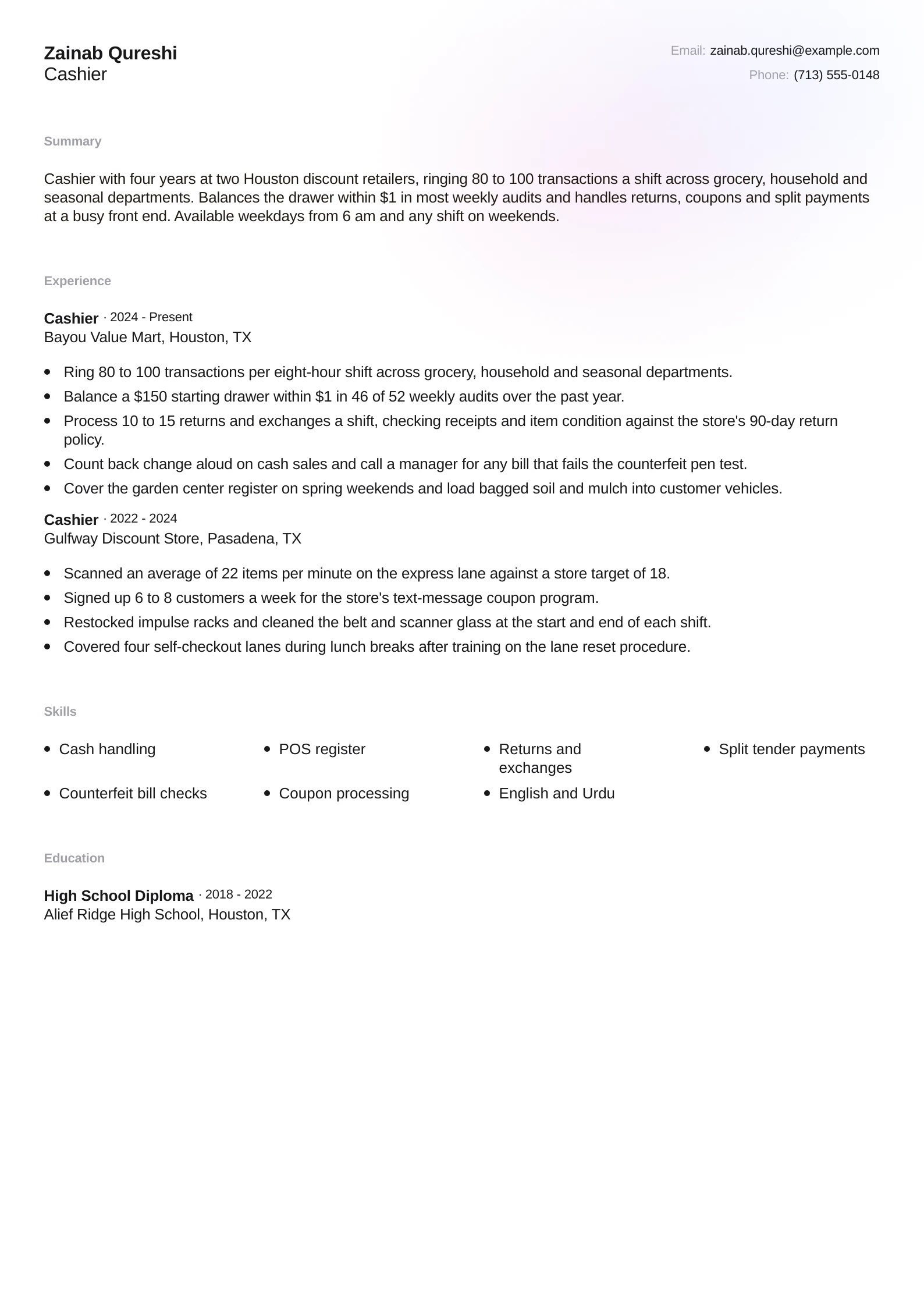
Travis cleans offices, locker rooms and production-floor aisles at a cheese plant on first shift. His bullets name the proportioning station he dilutes chemicals from, the labels he puts on every bottle and bucket, and the color-coded tools that stay in their zones. Lifting 50 lb shows up as weekly supply deliveries. Use it for a manufacturing, warehouse or food plant job where hygiene rules and audits shape the work.
Chemical dilution and labels on every bottle and bucket
Color-coded tools and GMP hygiene rules
Rider scrubber on 18,000 sq ft of warehouse aisles
Entry-level janitor with restaurant experience
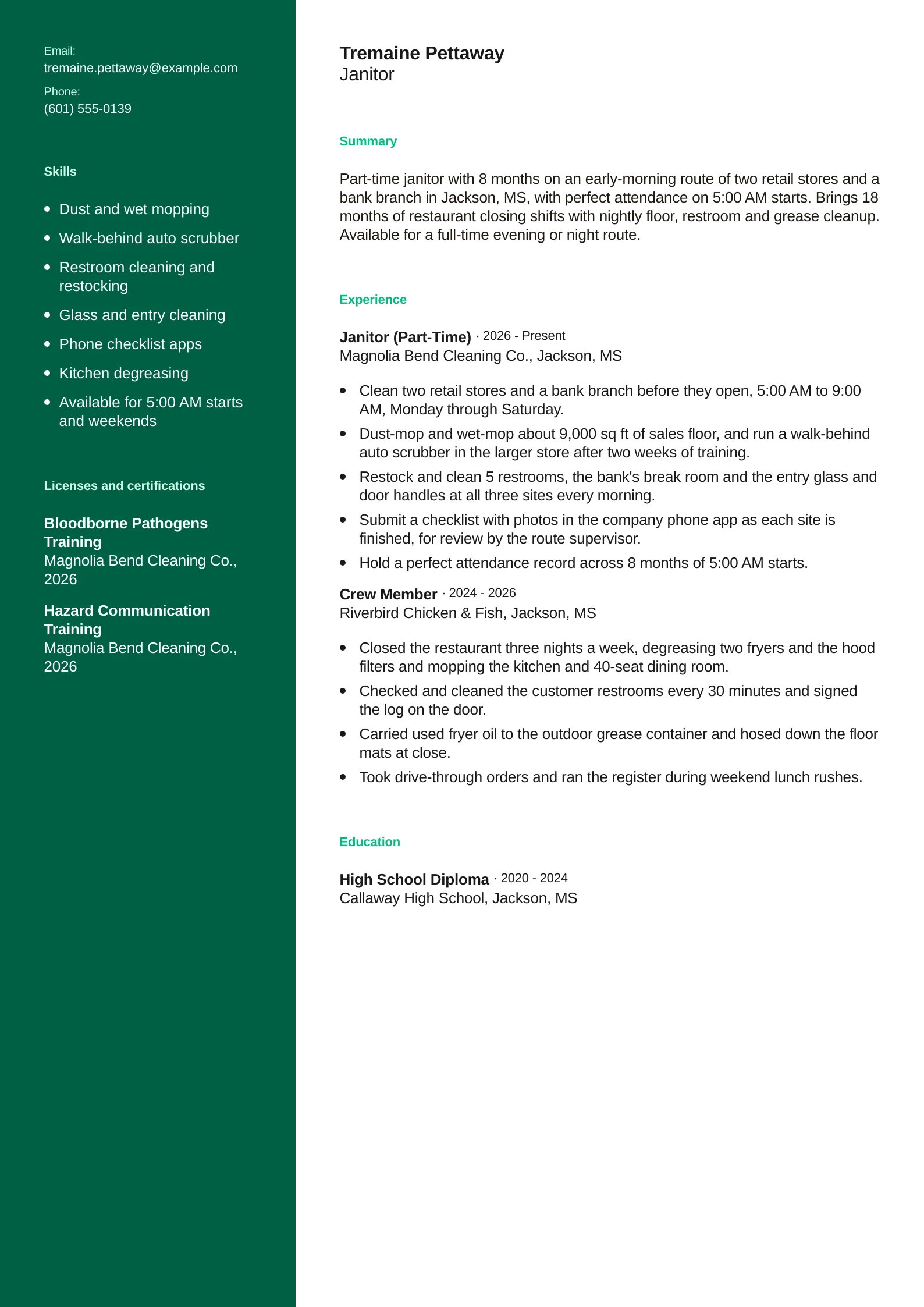
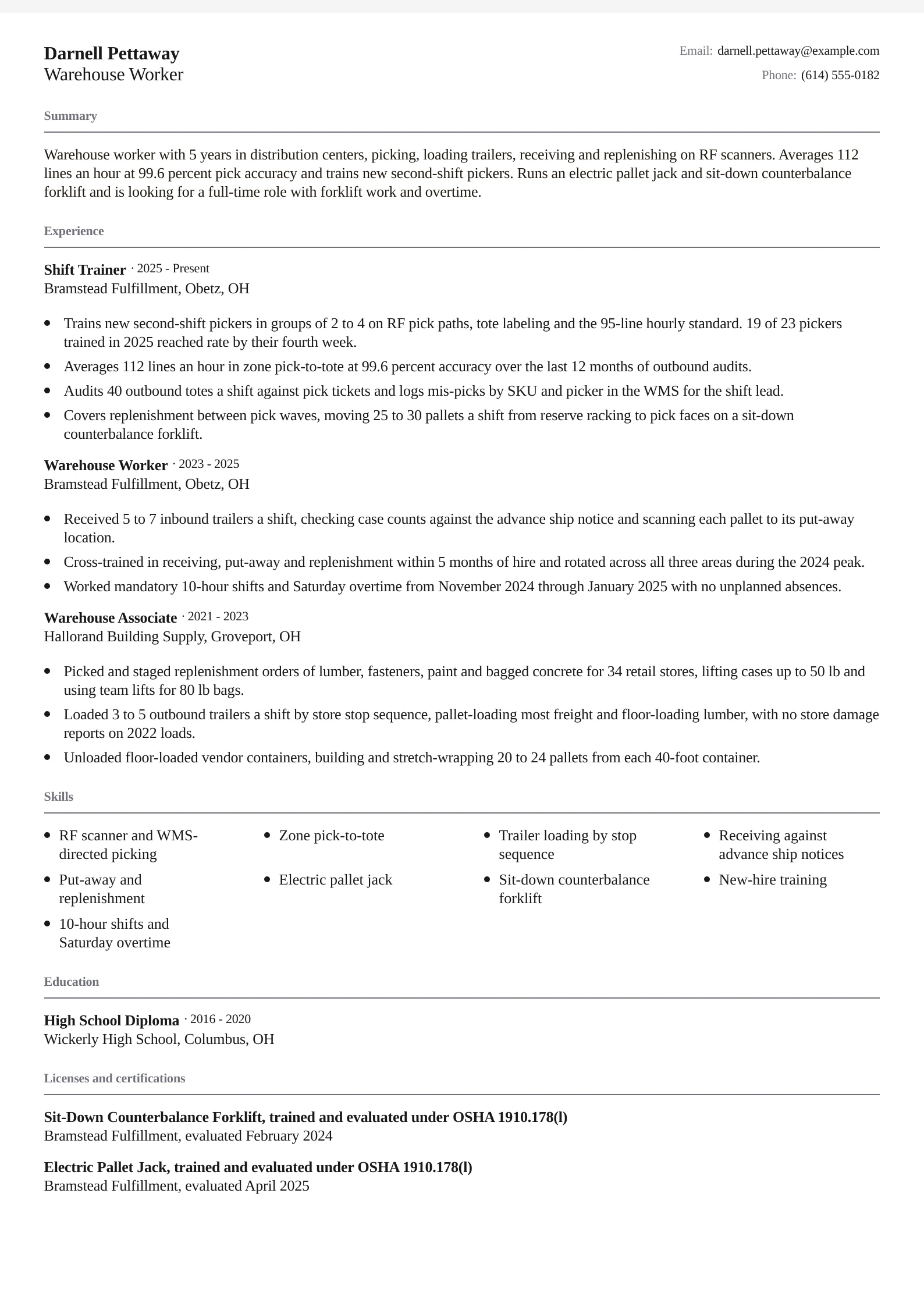
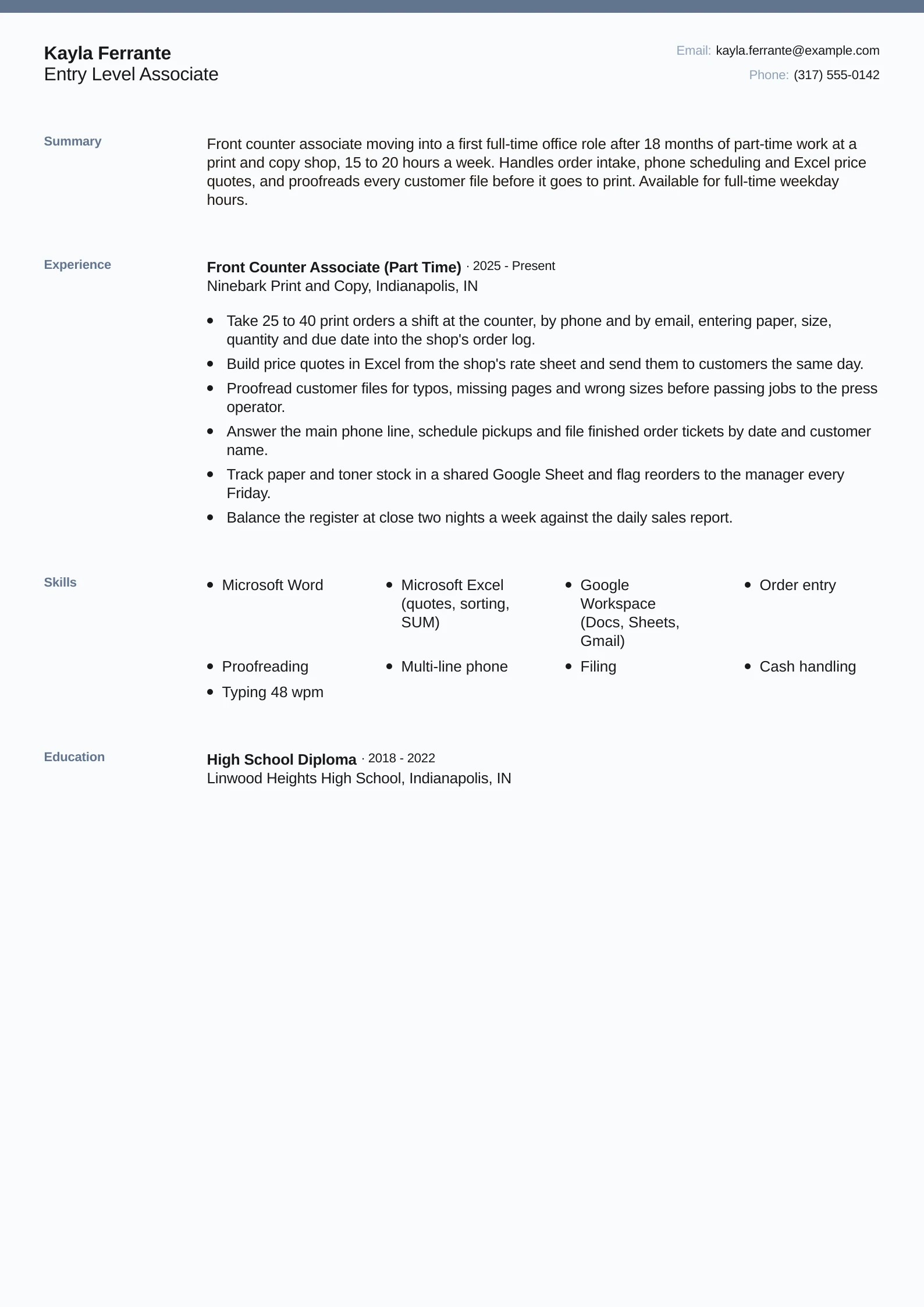
Tremaine has 8 months on a part-time 5:00 AM route of two stores and a bank branch, so his resume leans on attendance, a phone checklist with photos and the auto scrubber he learned in two weeks. His earlier restaurant job counts because closing meant degreasing fryers and mopping a 40-seat dining room. Use it if you're moving into cleaning from food service, retail or warehouse work.
Perfect attendance on 5:00 AM starts as its own bullet
Restaurant closing duties written as cleaning experience
Employer trainings listed with the current year
Lead janitor running a night crew
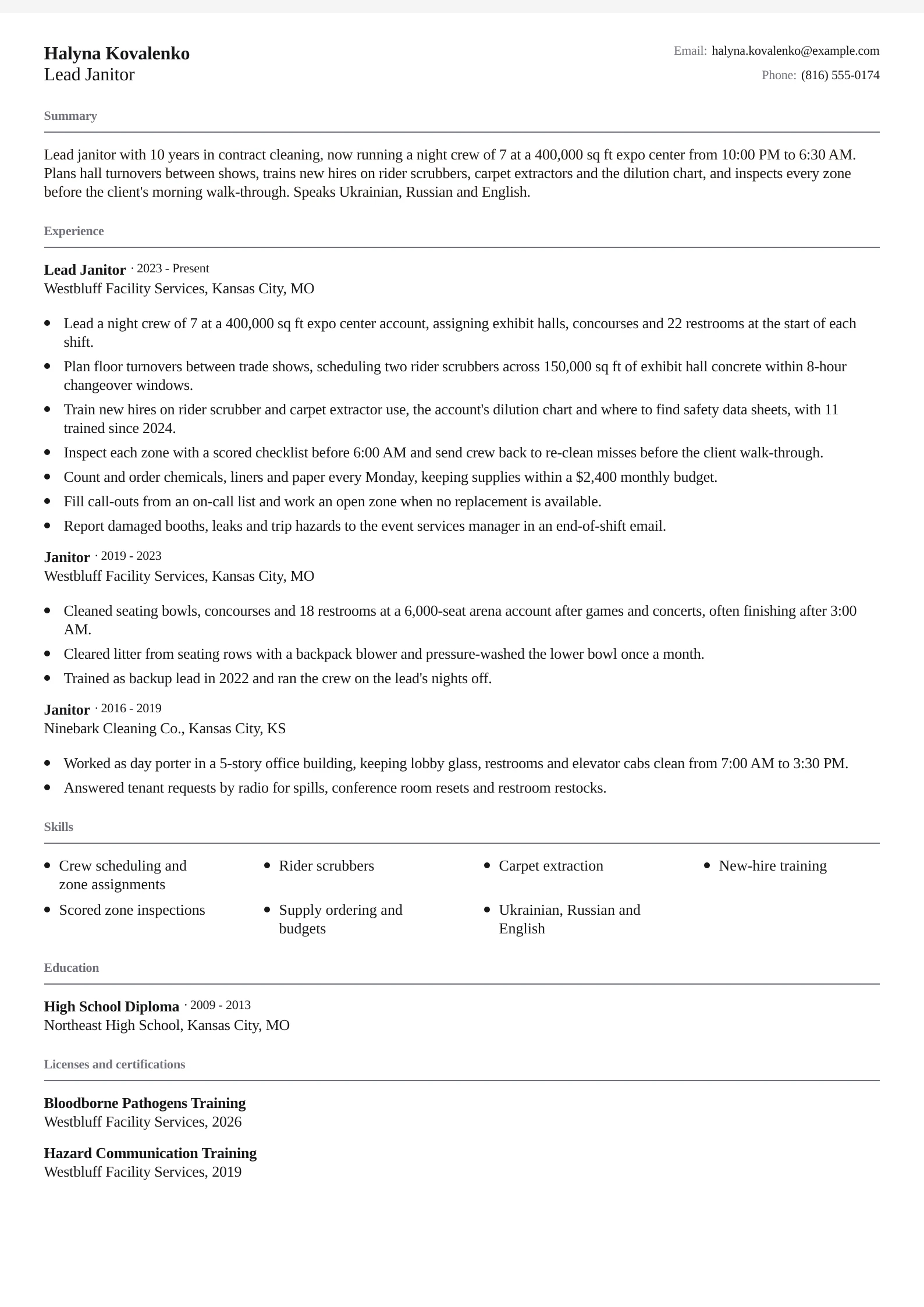
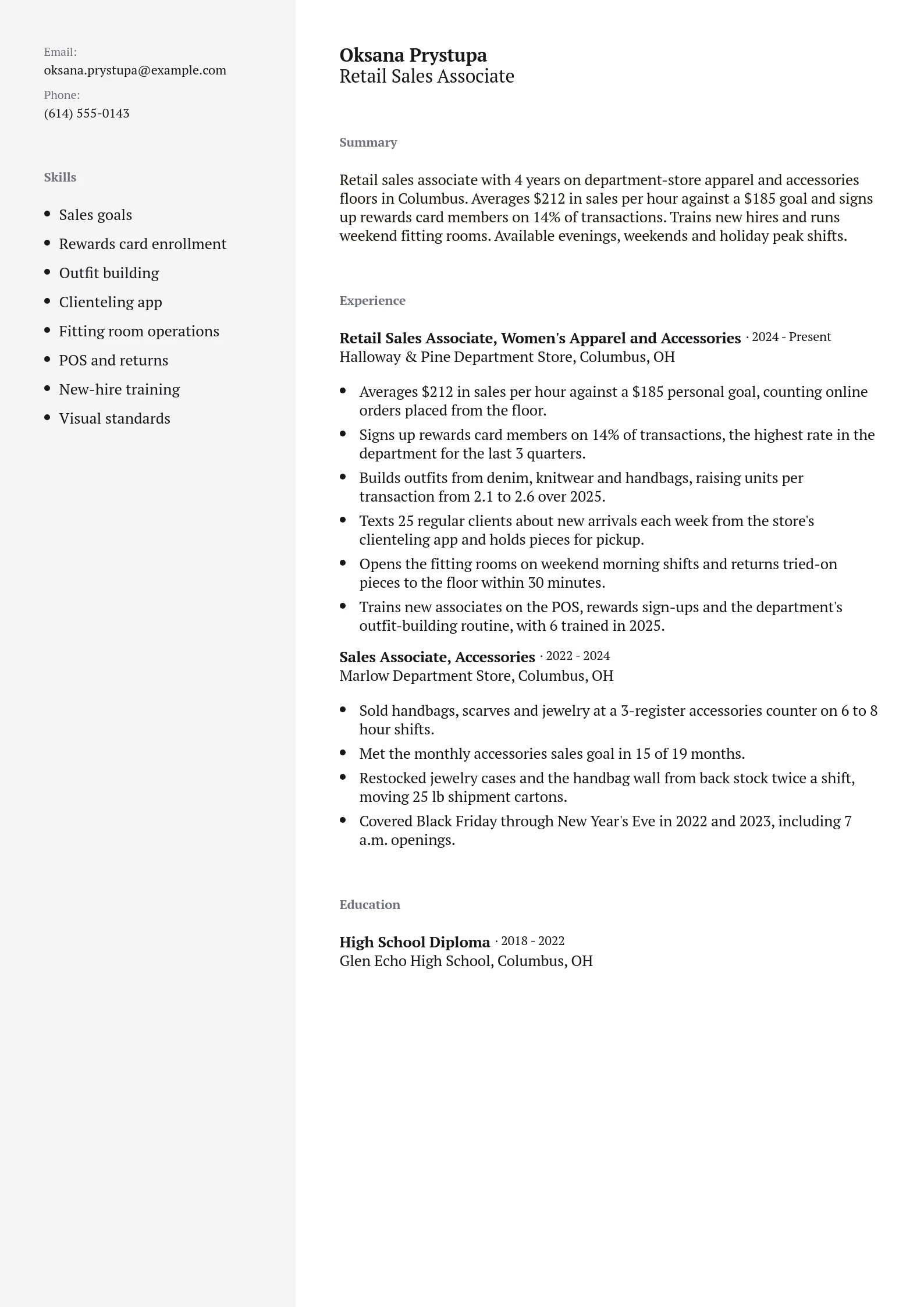
Halyna leads 7 janitors overnight at a 400,000 sq ft expo center, and her bullets cover what a lead adds: zone assignments, hall turnovers between trade shows, new-hire training and scored inspections before the client walk-through. A $2,400 monthly supply budget and 11 trained hires put numbers on the lead work. Use it if you already train others or cover for your lead and want the title.
Crew of 7 with zone assignments each shift
Hall turnovers within 8-hour changeover windows
Supply ordering within a $2,400 monthly budget
Count your route in square feet, rooms and hours
Your numbers come from the route itself: the square feet or floors you cover, how many restrooms, classrooms or workstations are on it, and the hours of the shift. The work repeats every night, so these counts are what tell a supervisor how much building you can handle alone.
If you don't know the square footage, ask your supervisor or check the work order for your account. A rounded figure such as "about 42,000 sq ft" is fine, and floors or rooms work when nobody has measured. Write shift times in full, such as 5:00 PM to 1:30 AM, so a contract cleaner can match you to an opening.
Add a quality number if you have one: a client inspection score, audits the building passed or a record of zero re-cleans in a month. Skip invented percentages such as "30% fewer slips", which a supervisor can ask you to explain.
Shows a route a supervisor can picture
Clean a four-floor route of about 42,000 sq ft in a 14-story downtown office tower, Monday through Friday, 5:00 PM to 1:30 AM.
Says what every janitor does
Cleaned restrooms, emptied trash and mopped floors in an office building.
Name the floor machines and chemicals you run
Name each machine by type, because a supervisor reads "auto scrubber" or "burnisher" as work you can start on the first night. Add the floor or area you use it on and how often. If an ad asks for a rider scrubber and you've only run a walk-behind, list the walk-behind with its square footage.
For chemicals, name the type and how you prepare it: neutral floor cleaner, degreaser, glass cleaner or restroom disinfectant, mixed at a wall-mounted dilution dispenser or from premixed jugs. A line such as "Dilute floor cleaner and disinfectant at a proportioning station and label every spray bottle" shows safe chemical handling in one bullet.
Machine
What it does
How to write it
Walk-behind auto scrubber
Scrubs and dries hard floors in one pass
Scrub 6,000 sq ft of lobby tile nightly with a walk-behind auto scrubber
Rider scrubber
Covers large open floors such as warehouses and exhibit halls
Run a rider scrubber over 18,000 sq ft of dock aisles twice a week
Burnisher (battery or propane)
Polishes finished floors to a gloss at high speed
Burnish corridor tile twice a week with a battery burnisher
Rotary floor machine (swing machine)
Strips old finish, scrubs and buffs at low speed
Strip, seal and refinish 14 classrooms each summer
Hot-water carpet extractor
Injects and recovers cleaning solution to deep clean carpet
Extract carpet in 38 offices each quarter
Backpack vacuum
Vacuums classrooms, offices and stairs quickly
Vacuum 20 classrooms a night with a backpack vacuum
List bloodborne pathogen and hazard communication training by name
Janitors don't need a license, so the training you've had is what fills your credentials section. Under OSHA's hazard communication standard, employers train workers on the hazardous chemicals in their work area when they're first assigned and again when a new chemical hazard is introduced. Under the bloodborne pathogens standard, employers train workers whose tasks could expose them to blood or other infectious material when they're first assigned to those tasks and at least once a year after that.
List each one with the employer that gave it and the year, such as "Bloodborne Pathogens Training, Brookhallow Building Services, 2026". This is training your employer provides, so don't call it an OSHA certification or an OSHA card.
An optional certificate you can add is the CMI Certified Cleaning Technician from ISSA's Cleaning Management Institute, which some CMI pages still call Certified Custodial Technician. It has Basic and Advanced levels, and Advanced requires Basic, so list the highest level you hold. Each level is valid for two years, so give the year you earned or renewed it and keep it current if you list it.
School districts add their own clearances. California, for example, requires fingerprinting for a Department of Justice record check and a TB risk assessment before a district hires classified staff such as custodians, and the TB assessment is repeated at least every four years. If you already work for a district, list both with the year cleared.
Show keys, alarm codes and attendance as duties
Write trust into your bullets as things you do with the building: which keys and alarm codes you hold, what you lock and arm at the end of the shift, and who you report problems to. Night janitors often work alone in an empty building, and ads for these jobs often ask for a background check for that reason.
Name the scope, such as "Hold keys and alarm codes for floors 9 to 12", and the closing routine, such as checking every exterior door before setting the alarm. If you sign out of a security log or send an end-of-shift report, say so.
Put attendance in its own bullet when it's strong. "Hold a perfect attendance record across 8 months of 5:00 AM starts" is easy for a reference to confirm. Weekend callouts and covering open shifts belong here too, with how often you take them.
Match the resume to an office, a school or a plant
The daily work overlaps, but each kind of building screens for different things, so lead with what matches the job you're applying for. Use the title the employer posts: districts and colleges often say custodian, while contract cleaners and plants usually say janitor.
Setting
Office (contract cleaner)
School or college
Plant or warehouse
Common shifts
Often evenings or overnight, after tenants leave
Often an afternoon-to-evening second shift
Can be any shift, including first shift around production
Lead bullet
Floors and square feet on the route
Classrooms, cafeteria or gym and student count
Offices, locker rooms and production aisles covered
Machines to name
Auto scrubber, burnisher, carpet extractor
Rotary machine for strip and wax, backpack vacuum
Rider scrubber, chemical proportioning station
Screening items
Background check, keys and alarm codes, weekend callouts
District clearances, event setup, minor repairs
Hygiene and allergen rules, lifting, chemical labels